M6.10 - Teacher-Student Distillation and Model Transfer
M6.10 - Teacher-Student Distillation and Model Transfer
0x00 Why One Trained Model Is Not One Deployment Shape
A large model has been trained, evaluated, and found useful. It is also too expensive for the intended deployment. Perhaps it misses a latency target, cannot fit on the available device, or consumes too much memory when many replicas are required. A natural question follows:
Can the behavior of the large, well-trained model be transferred into a smaller model that is cheaper to run?
That question sounds similar to quantization, pruning, or low-rank adaptation, but the operation is different. Quantization changes how an existing model is represented. Pruning changes which parameters or structures remain. LoRA changes which small update state is trained. Distillation starts another training problem: one model becomes a source of supervision for another.
The established names are teacher and student. The teacher is normally the stronger model. The student is the model being optimized. In a compression setting the student is deliberately shallower, narrower, or otherwise cheaper, but the definition does not require that. A same-size student can be distilled, and a model can even be trained from another instance of the same architecture. Knowledge distillation is therefore a transfer procedure, not a file format and not a guarantee of compression.
The deployment chain is:
choose a student architecture
        |
        v
construct teacher-derived supervision
        |
        v
optimize the student under a distillation objective
        |
        v
evaluate and export the student by itself
        |
        v
measure the student-only deployment
The first step creates the possible runtime saving. The middle steps try to recover behavior within that smaller hypothesis class. The last step proves whether the proposed saving exists in the actual runtime.
0x00A The Object Being Transferred Kept Changing
Distillation did not begin as one canonical Transformer loss. It accumulated several different transfer contracts as researchers changed what the student could observe and what kind of model they wanted to produce.
The pre-Transformer lineage already separated two ideas that are still easy to conflate. Ba and Caruana showed that a shallow model could learn the class-probability function of a deeper model more successfully than the same shallow architecture learned from hard labels alone. FitNets then treated an intermediate teacher representation as a hint, adding a learned regressor when teacher and student hidden widths differed. The student architecture, the output target, and the intermediate alignment object were already separate choices.
Hinton, Vinyals, and Dean made softened teacher distributions and temperature scaling the standard vocabulary. That work also inherited an earlier ensemble-compression motivation: the deployed model should reproduce useful behavior without carrying every model that created the target distribution. Sequence-Level Knowledge Distillation changed the artifact again. Instead of retaining a full teacher distribution at every reference-prefix row, it decoded teacher sequences and trained the student on those discrete outputs. Attention Transfer supplied another representation-level branch: transfer can constrain relations or activation-derived maps even when it does not match raw hidden vectors.
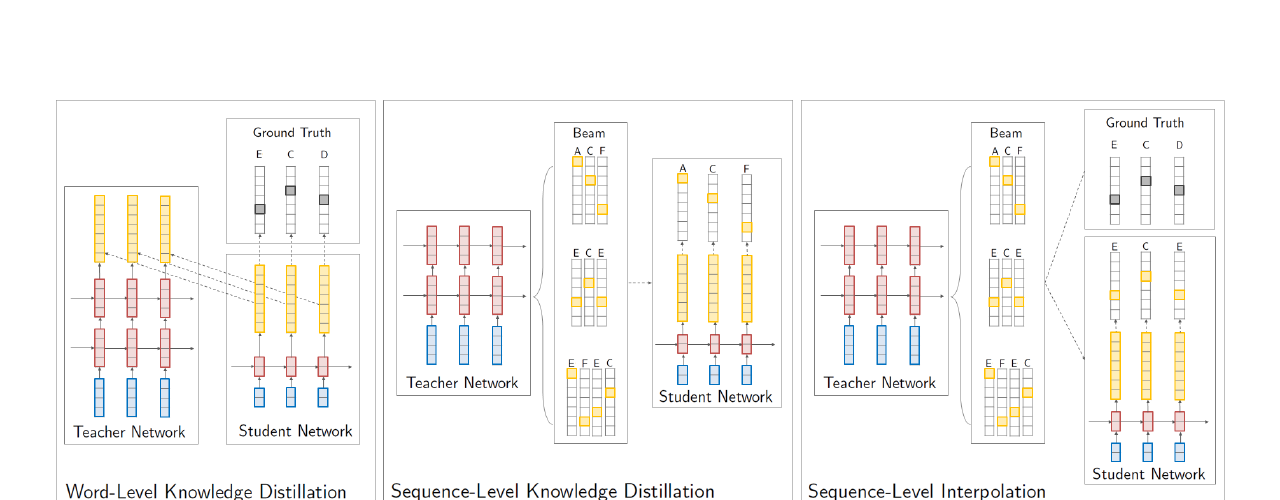
Source: Kim and Rush, Sequence-Level Knowledge Distillation, arXiv:1606.07947v4, Figure 1, cropped from the revision-pinned PDF. The figure distinguishes row-wise teacher distributions, one decoded teacher sequence, and sequence interpolation. It does not include later student-generated on-policy prefixes and does not prove that these objectives are equivalent.
Transformer distillation widened the target set further. DistilBERT combined a shallower initialized student with output-distribution, masked-language-model, and cosine objectives. PKD transferred selected teacher layers. TinyBERT used general and task-specific stages with embedding, hidden, attention, and prediction targets. MiniLM moved from raw states toward attention and value-relation matrices. These papers did not merely improve one scalar KD formula; they changed architecture, layer mapping, target tensors, training stages, and state lifetime.
Autoregressive LLM work exposed a different mismatch. A student trained only on reference or teacher prefixes is not directly supervised on the prefixes created by its own mistakes. MiniLLM and GKD therefore made prefix occupancy, divergence direction, sampling, and rescoring part of the method contract. Recent pruning-plus-distillation and sparse-logit work adds two systems questions: whether distillation is recovery for an already changed student graph, and whether a compressed teacher-target artifact still defines the same gradient estimator.
The resulting lineage is not one sequence of replacements:
output function      -> softened token distributions
raw labels           -> teacher-decoded sequence artifacts
final output         -> hidden, attention, and relation targets
fixed prefixes       -> student-generated on-policy prefixes
online teacher       -> versioned full or sparse cached targets
unchanged student    -> deliberately smaller or structurally transformed graph
Each arrow changes a different contract. Later sections derive those contracts individually instead of treating every paper as a synonym for “KD.”
0x00B The Teacher Provides More Than One Correct Token
Ordinary supervised training often presents one observed target. At a
next-token row, the loss may say only that token Paris should receive more
probability than every alternative. A trained teacher can expose a richer
local structure:
Paris          high probability
Lyon           lower, but still a plausible city token
France         grammatically possible in another continuation
London         semantically related but wrong for this context
punctuation    depends on whether the answer is already complete
The teacher distribution does not make these alternatives correct. It reveals how the teacher orders them. Hinton, Vinyals, and Dean formalized the common teacher-student recipe using softened output distributions: temperature exposes probability relationships that are almost invisible behind a confident argmax, while the student can still retain an ordinary hard-label objective.
This output-distribution view is only the beginning. Later work transfers different objects:
output logits and probabilities
selected hidden states
attention distributions
relations between token representations
teacher-generated output sequences
teacher feedback on prefixes generated by the student
These targets are not interchangeable. Logit matching requires compatible output support. Hidden-state matching may require a projection from student width to teacher width. Attention matching requires a policy for layers and heads. A generated sequence can be obtained through a black-box API, but it retains much less information than the full teacher distribution. On-policy distillation adds another cost because the student must generate the contexts on which the teacher supervises it.
Calling all of these methods “teacher-student training” is correct but not sufficient. The target tensor, the contexts on which it is evaluated, the available teacher interface, and the execution plan all change.
0x00C The Student Architecture Creates The Deployment Saving
Suppose a conventional decoder block has hidden width , FFN width , and equal-width Q, K, V, and output projections. A rough projection-parameter ledger is:
For a two-matrix FFN:
and for a three-projection gated FFN such as SwiGLU:
These are intentionally local ledgers. Embeddings, normalization parameters, biases, tied output heads, grouped-query attention, and runtime effects still need their own accounting. They are enough to expose the ownership boundary:
reduce layers
  -> fewer blocks execute

reduce d
  -> smaller attention and residual projections

reduce d_ff
  -> smaller FFN projections

change head layout
  -> different attention and KV state

reduce vocabulary
  -> smaller embedding/output interface

change only the loss
  -> no structural runtime saving is guaranteed

The toy ledger in the figure uses a 32-layer teacher with and a 16-layer student with . Under the simplified gated-block count, block projection parameters fall from about billion to billion, or roughly of the teacher’s block projection count. That is not a latency prediction and it excludes embeddings and the output head. It proves a narrower point: the architecture decision creates the smaller executable graph. Distillation is one way to train that graph.
This distinction also explains why the same word appears in different parts of Transformer System. M8.7 uses teacher supervision while a student experiences fake quantization. M8.8 discusses method-specific transfer into native binary or ternary models. The live M6.11 pruning article uses a teacher as one optional recovery path after physical pruning. Those are applications of distillation inside other structural or representation changes; they do not redefine its general training contract.
0x00D The Teacher Is Training State, Not A Deployment Dependency
During online distillation, a training step may hold:
teacher weights and forward buffers
student weights, gradients, and optimizer state
teacher and student logits
optional teacher/student hidden or attention tensors
alignment projections used only by auxiliary losses
valid-token masks and loss-reduction state
The teacher is normally frozen, so it does not need gradient or optimizer state. That does not make it free. Its weights must be resident, loaded, offloaded, or served somewhere; its forward pass consumes compute; and intermediate-target methods can keep large activation tensors alive until the student loss is formed.
Offline distillation changes the state rather than removing it. Full logits, sparse logits, hidden states, or teacher-generated sequences become versioned artifacts. The teacher revision, tokenizer, temperature, generation policy, normalization contract, and sample identity now belong to the data lineage. Caching the output of an expensive teacher can save repeated forward passes, but a cache without this provenance is not a reproducible target.
The exported deployment should be loadable without the teacher, the distillation wrapper, or training-only alignment projections. If the claimed student cannot run and pass evaluation alone, the transfer pipeline has not produced a deployment artifact yet.
0x00E What This Article Owns
This article owns:
temperature-scaled logit distillation and its gradient scale
hard-label and teacher-distribution objective composition
causal token alignment, masks, and vocabulary support
hidden-state, attention, and relation transfer
student depth/width/head alignment and initialization
sequence-level and black-box distillation
fixed-prefix versus student-generated on-policy supervision
online, cached, hybrid, and distributed training execution
teacher/student artifacts, provenance, evaluation, and export boundaries
comparisons among major paper variants
It reuses M3.9’s training execution and M3.8’s output-head interface. It does not re-derive teacher forcing or the base vocabulary projection. It consumes the accounting and execution vocabulary established by M4.1 and M4.2, without claiming that a logical distillation ledger is a measured kernel result. It hands pruning to M6.11, and hands distilled draft-model use to M7.1, QAT-specific transfer to M8.7, native low-bit transfer to M8.8. When the student is composed with low-bit W/A/KV or a native low-bit representation, its existing local artifact/evaluation evidence becomes input to M8.9/M8.10. This does not assign every nonquantized student’s production promotion to M8.
The owner question is:
How do teacher logits, temperature, hidden or relational targets, generated sequences, student architecture, and cached or online supervision determine what behavior is transferred and what training/runtime state is required?
0x00F Immutable Identity, Evidence, And Loop Contract
“Teacher” and “student” are roles, not sufficient artifact identities. A replayable transfer candidate needs at least the following state before a loss is evaluated:
teacher:
    model artifact + exact revision + architecture + tokenizer
student:
    initialization artifact + exact revision + architecture + tokenizer
supervision:
    matched object + temperature/divergence + layer/head/width map
prefix/data:
    dataset revision + sample identity + generation/filtering policy
execution:
    online/offline/hybrid/on-policy plan + dtype + parallel ownership
release:
    student-only artifact identity + forbidden teacher/training-only state
Two runs that share the words “teacher,” “student,” and “KL” but differ in one of those fields are not the same experiment. A generated sequence belongs to a decoding configuration; a cached logit row belongs to a teacher, tokenizer, temperature, vocabulary, and sample position; an intermediate-state target belongs to a layer map and an alignment transform. The manifest is therefore part of the mathematical and runtime contract, not clerical metadata.
The evidence labels used throughout this article are deliberately separate:
| Label | What it establishes | What it does not establish |
|---|---|---|
| Primary-paper claim | a revision-pinned paper states or derives the method claim | that the paper run was reproduced locally |
| Official-code contract | a pinned repository or versioned official interface implements a particular state path | that every framework or revision behaves identically |
| Source-local explanation | the earlier book/design material motivates an explanatory sequence | independent technical verification |
| Local derivation | the displayed algebra, tensor trace, or deterministic fixture is internally replayable | model quality, GPU performance, or production behavior |
| Source-reported result | a named paper reports a measurement under its declared setup | a transferable benchmark or deployment guarantee |
| Uncertain or runtime-specific | the claim depends on missing disclosure, moving software, hardware, or workload | permission to generalize it |
Loop 1 freezes lineage, identities, sources, figures, and owner boundaries. It does not claim to have trained a teacher or student, reproduced a paper metric, executed a framework model or GPU kernel, validated a production scheduler, checked every live external URL, or deployed the student. The later loops are intentionally non-interchangeable:
Loop 2   classical logits, temperature, and gradient scale
Loop 3   causal token rows, support, and distributed loss
Loop 4   hidden, attention, relation, and layer-map transfer
Loop 5   architecture, initialization, capacity gap, and state cost
Loop 6   sequence and black-box artifacts
Loop 7   on-policy prefixes, divergences, MiniLLM, and GKD
Loop 8   supervision artifact schema, storage, filtering, and revisions
Loop 9   online/offline/hybrid distributed runtime
Loop 10  paper-by-contract and equal-budget comparison
Loop 11  evaluation, failures, release, and teacher independence
Loop 12  formula, source, rendering, accessibility, and boundary closure
The article can be publication-closed only after all twelve evidence bundles agree on the same candidate. Loop 1 proves the starting identities and claim ceiling; it does not pre-approve the later mechanisms.
0x01 Four Contracts Define A Distillation Method
A distillation method cannot be identified by its loss name alone. The same KL formula can train on reference prefixes or student-generated prefixes. The same teacher can expose only text, full logits, or every hidden state. Two systems can match identical targets while one runs teacher and student together and the other reads a multi-terabyte cache.
A useful method signature is:
K = (
  matched object,
  prefix distribution,
  teacher access,
  execution plan
)

This four-part signature prevents several false equivalences. DistilBERT and TinyBERT both use Transformer teachers, but their training objectives and intermediate-state contracts differ. Sequence-level KD and on-policy GKD both involve generated text, but the former commonly trains on teacher-produced sequences while the latter deliberately asks the teacher to score contexts created by the student.
0x01A Contract One: What Teacher Object Is Matched?
| Matched object | Typical tensor/artifact | What it preserves | Alignment requirement |
|---|---|---|---|
| hard token | token id per valid row | observed target | student vocabulary contains target |
| soft token distribution | [B,S,V] logits/probabilities | teacher ordering over alternatives | compatible output support and token rows |
| hidden state | [B,S,d_T] | selected representation coordinates | layer map and often width projection |
| attention distribution | [B,H,S,S] | token-to-token read pattern | layer, head, mask, and token alignment |
| relation matrix | often [B,H,S,S] | pairwise structure rather than raw width | token and relation-head policy |
| generated sequence | token/text artifact | one or more teacher trajectories | generation and tokenizer provenance |
The rows expose an information-access tradeoff. Output text can be collected from a black-box teacher but discards most of the teacher distribution. Full logits preserve far more local information but create vocabulary-sized compute, communication, and storage. Intermediate tensors can provide dense guidance, yet they couple the student to teacher layer semantics and greatly increase activation lifetime.
Patient Knowledge Distillation transfers multiple teacher-layer representations rather than relying only on the final output. TinyBERT combines embedding, hidden, attention, and prediction targets across general and task-specific stages. MiniLM instead emphasizes self-attention and value-relation transfer, avoiding a requirement that raw teacher and student hidden widths be identical. It still needs compatible token and relation layouts; relation matching is not alignment-free.
0x01B Contract Two: Which Prefix Distribution Is Supervised?
An autoregressive teacher predicts a distribution conditioned on a prefix. The source of that prefix changes the learning problem.
reference prefix:
    both models see contexts from the labeled or fixed corpus

teacher-generated prefix:
    the teacher decodes a sequence; the student trains on that artifact

student-generated prefix:
    the student visits its own contexts; the teacher scores those contexts

mixed prefix policy:
    training combines fixed and generated contexts under an explicit ratio
Fixed-prefix token KD is efficient because every target row can be produced in parallel under teacher forcing. It also leaves an exposure gap: at inference, the student conditions on its own earlier outputs, including mistakes not present in the reference corpus.
Sequence-Level Knowledge Distillation addresses sequence generation by producing target sequences with the teacher and training the student on those sequences. The generated corpus is useful even when only black-box text is available, but beam width, sampling temperature, stopping policy, and filtering become part of the transferred behavior.
On-Policy Distillation of Language Models, which introduces GKD, moves supervision onto student-generated outputs. The teacher and student are evaluated along prefixes the student actually visits. This is not merely a different divergence. It adds student generation to the training runtime and changes the distribution of contexts on which teacher feedback is consumed.
0x01C Contract Three: What Teacher Access Exists?
| Teacher interface | Can support | Cannot provide by itself | Main systems cost |
|---|---|---|---|
| generated text only | sequence-level targets, filtering | full token uncertainty or hidden state | generation latency and corpus storage |
| top-k logits | sparse local distribution target | exact omitted tail without extra contract | indices, values, tail/normalization metadata |
| full logits | token KL/cross-entropy over shared support | internal representation targets | [B,S,V] compute, traffic, or storage |
| selected hidden/attention state | representation and relation losses | arbitrary unexposed layers | teacher activation lifetime and layer coupling |
| full white-box model | all of the above | nothing architectural in principle | maximum integration and residency burden |
Direct token-wise KL normally assumes teacher and student probabilities refer to compatible vocabulary events at aligned token positions. If the tokenizers differ, equal tensor rank does not establish semantic correspondence. A system must introduce an explicit cross-tokenizer projection/alignment contract or transfer at another level, such as generated text. Silent truncation to the smaller vocabulary is not a valid general solution.
Teacher access also determines which claims can be reproduced. A hosted model that returns only generated strings can serve as a sequence teacher, but it cannot retroactively support a TinyBERT hidden-state loss. Conversely, access to every teacher tensor does not mean every tensor is a useful target; each additional match constrains the student and extends the training graph.
0x01D Contract Four: How Is Supervision Executed?
| Execution plan | Live state | Persistent artifact | Failure boundary |
|---|---|---|---|
| online logits | teacher and student forwards | checkpoints and logs | teacher throughput/residency |
| online intermediate transfer | both models plus selected activations | checkpoints, layer map, projections | activation memory and hook correctness |
| cached full/sparse logits | student training plus cache reader | versioned logit shards | storage, stale cache, omitted-tail bias |
| offline teacher sequences | ordinary student training | generated corpus and decode provenance | narrow search/data coverage |
| on-policy scoring | student generation, teacher score, student update | prompts, generation policy, logs | high compute and scheduler complexity |
| distributed KD | sharded teacher/student and reductions | topology-aware checkpoints | vocabulary normalization and partition mismatch |
Online and offline are not quality labels. Online execution preserves the ability to change contexts or teacher settings during training, but repeatedly pays for teacher inference. Offline execution amortizes teacher work, but fixes the teacher revision, examples, temperature, and output schema into the cache. A hybrid system can cache common examples and query the teacher on new student-generated prefixes; it must then prove that the two supervision paths use compatible distributions and normalization.
The execution contract also controls recovery. A resumable training run needs more than student optimizer state when data were generated on policy. It may need generation RNG state, teacher and tokenizer revisions, cache-shard positions, the fixed/on-policy mixture schedule, and training-only alignment parameters. Losing that state can change the objective after a restart even if the student checkpoint loads successfully.
0x01E Paper Names Are Coordinates, Not Complete Specifications
| Method | Matched object | Prefix source | Teacher access | Execution sketch |
|---|---|---|---|---|
| Hinton KD | softened output distribution plus hard labels | fixed examples | teacher probabilities/logits | online or cached token targets |
| DistilBERT | output distribution, MLM labels, cosine representation target | pretraining corpus | logits and hidden state | online pretraining transfer |
| TinyBERT | embedding, hidden, attention, prediction targets | general and task-specific corpora | broad white-box access | multi-stage online transfer |
| MiniLM | attention and value relations | fixed corpus | relation-producing internal tensors | online relation transfer |
| Sequence-Level KD | teacher-decoded sequence | teacher generation | text output is sufficient | offline generated corpus |
| GKD | selectable divergence on teacher/student token distributions | fixed and student-generated | teacher scores selected prefixes | online generation and scoring |
The table is a preview, not a verdict. These choices can be staged and combined. A student may be initialized from selected teacher layers, trained with hidden and logit objectives on fixed data, then refined on student-generated prefixes. Each stage changes the matched state, required teacher interface, stored artifacts, and runtime ledger.
That is the starting discipline for the rest of M6.10: before comparing loss values or benchmark results, identify the four contracts and the student graph that will actually be deployed.
0x02 Classical Logit Distillation
The simplest white-box transfer object is the teacher’s output distribution at one supervised row. Let the teacher and student produce vocabulary logits for the same prefix . Temperature defines two distributions over the same vocabulary events:
This is an ordinary softmax with rescaled logits. At it is the model’s usual output distribution. Raising reduces every pairwise log-odds gap:
The ranking does not change, but the distribution becomes less concentrated. The teacher and student must use the same temperature inside the soft-target term. After training, the student normally returns to for ordinary inference; temperature is not baked into its weights as a deployment setting.
This loop deliberately freezes the problem at one already aligned causal row. Its contract is:
| Field | Loop 2 value | Why it cannot remain implicit |
|---|---|---|
| teacher row | frozen | the target must not receive student gradients |
| student row | trainable | every derivative below is with respect to this row |
| event support | identical ordered vocabulary events | equal vector length alone does not establish semantic alignment |
| soft temperature | one positive used for teacher and student | unequal temperatures define a different matching problem |
| hard temperature | the deployed next-token objective is not softened accidentally | |
| soft direction | reversing the arguments changes the expectation and gradient | |
| reduction | sum over vocabulary for one row | causal shifts, token masks, and vocabulary shards enter in Loop 3 |
The contract is narrow on purpose. It lets us prove what temperature and do without hiding row-alignment or distributed-reduction errors inside the same derivation.
0x02A Temperature Exposes Relative Structure
The formula should be evaluated as a stable softmax, not as literal unbounded exponentials. With
the equivalent implementation is
Subtracting changes neither numerator-to-denominator ratios nor the final probabilities, while preventing the largest exponential from overflowing. More generally, softmax discards a common logit offset:
Temperature therefore acts on differences, not absolute logit levels. For finite , it preserves ranking and divides every pairwise log-odds gap by . If the maximum is unique,
Neither limit creates knowledge. A small temperature discards almost all non-argmax structure; an arbitrarily large temperature eventually erases the differences it was meant to expose.
Consider one teacher row with four logits:
vocabulary events: [A, B, C, D]
teacher logits:    [8, 4, 1, -2]
| Event | Logit | Probability at | Probability at |
|---|---|---|---|
| A | 8 | 0.9811 | 0.6159 |
| B | 4 | 0.0180 | 0.2266 |
| C | 1 | 0.000895 | 0.1070 |
| D | -2 | 0.0000445 | 0.0506 |
At , a hard target and the teacher distribution both look almost like “choose A.” At , the student can see that B is a much stronger alternative than C, and C is stronger than D. This relative structure among non-target events is what the classical distillation literature calls dark knowledge. It is not a hidden tensor or a claim that the teacher knows ground truth about every alternative. It is the teacher’s learned ordering, including any teacher mistakes and biases.

Hinton, Vinyals, and Dean motivate high temperature for exactly this reason: ratios among very small probabilities can describe which mistakes the teacher considers similar. Their result does not say that the largest possible temperature is best. At very high temperature, weakly constrained, very negative teacher logits can receive more influence. The useful temperature depends on the teacher, student capacity, data, and loss weighting.
0x02B One Row Contains Two Different Targets
Classical KD commonly combines two objectives:
- A hard-label objective asks the student to predict the observed token using its ordinary distribution.
- A soft objective asks the student to match the teacher distribution formed with .
There are several superficially similar ways to construct the second term, but they do not preserve the same invariances or scalar meaning:
| Target/objective | Row loss | What it preserves | Important difference |
|---|---|---|---|
| hard label | observed target event | says nothing about teacher ordering among alternatives | |
| raw-logit regression | every absolute logit coordinate | changes under independent teacher/student offsets unless logits are centered | |
| centered-logit regression | relative logit geometry | is the high-temperature limit, not the exact finite- objective | |
| soft-target cross-entropy | teacher-weighted event support | includes constant teacher entropy in the reported scalar | |
| forward KL | same student gradient as soft cross-entropy | reports zero exactly when the two distributions match |
Ba and Caruana used output-function matching before the temperature recipe became standard. Hinton, Vinyals, and Dean then showed why high-temperature distribution matching approaches centered logit matching. This is a derivation-level relationship, not permission to swap finite-temperature KL for uncentered MSE without changing the method.
For the teacher row above, suppose the student produces . At :
| Event | Teacher | Student | Transfer signal |
|---|---|---|---|
| A | 0.6159 | 0.4596 | student underweights teacher’s top event |
| B | 0.2266 | 0.3580 | student overweights the closest alternative |
| C | 0.1070 | 0.1026 | distributions nearly agree |
| D | 0.0506 | 0.0799 | student overweights the weakest event |
For this row, . Multiplication by makes the scaled soft contribution about before token averaging and the mixture weight are applied. If A is also the observed hard target, the student’s ordinary probability for A is about , giving hard-label NLL .
These scalar values should not be compared as if they had the same natural scale. The factor and mixture coefficient deliberately set the gradient balance. The useful information is the direction of both signals: the hard target rewards A, while the soft target also says how probability should move among B, C, and D.
0x02C Masked Hard And Soft Objectives
For batch index , causal prediction row , valid-target mask , and , define:
and
This article uses the forward direction . Reversing the arguments creates a different objective and gradient. Soft-target cross-entropy, , gives the same student gradient because
and teacher entropy is constant with respect to student parameters. The logged scalar is not the same, however. An implementation and experiment record must say whether it reports KL or soft cross-entropy, which reduction it uses, and whether is applied before or after reduction.
For one row, write and let be the one-hot hard target. The exact student-logit gradients of the two terms are
where . Consequently,
This equation is the coefficient contract. Some codebases instead use
, or define as the hard-loss weight.
Those parameter names are not interchangeable. A run manifest must record the
expanded scalar equation, not only alpha=0.5.
0x02D Deriving The Gradient Scale
The multiplier should not be memorized as a convention. It follows from how temperature enters both the softmax derivative and the difference between the soft distributions.
Let be a fixed teacher target and be the student distribution. For one-row soft-target cross-entropy,
The derivative of temperature-scaled log-softmax is
Therefore:
That is the first factor of . A second factor appears because the two soft distributions themselves become closer as temperature rises. Softmax is invariant to adding one constant to every logit, so center each teacher and student vector separately:
When is large relative to centered logit magnitudes, . Since centered logits sum to zero:
Subtracting them and substituting into the gradient gives:
One comes from differentiating the scaled softmax. The other comes from teacher and student probabilities converging toward the uniform distribution. Multiplying by approximately cancels this shrinkage:
This also explains the centered-logit connection in the high-temperature limit. Distillation approaches matching centered teacher and student logits, not arbitrary raw logits: adding a common offset changes neither softmax distribution.
The loss itself has the same limit. Let
Expanding the centered exponentials one order further gives
and similarly for . Substituting the normalized expansions into KL and collecting the first nonzero term yields
so
This proves the loss-level relationship that the gradient argument suggests. It also shows why the factor is compensation, not normalization to a fixed finite-temperature value: the omitted terms still depend on .
Temperature also changes curvature. For fixed teacher probabilities, the exact one-row Hessian of the unscaled soft cross-entropy is
Multiplication by removes the explicit curvature factor, but the
matrix still changes because itself changes with temperature. Therefore
tau_squared does not make optimization exactly temperature-invariant.
For the teacher/student rows used above, the centered-logit limits are
and
The exact sweep makes the distinction visible:
| unscaled KL | KL | |||
|---|---|---|---|---|
| 1 | 0.241712 | 0.241712 | 0.355075 | 0.355075 |
| 2 | 0.169050 | 0.676198 | 0.178497 | 0.713990 |
| 4 | 0.058029 | 0.928465 | 0.051572 | 0.825147 |
| 8 | 0.014729 | 0.942637 | 0.011934 | 0.763754 |
| 16 | 0.003536 | 0.905247 | 0.002761 | 0.706878 |
| 32 | 0.000856 | 0.876934 | 0.000661 | 0.677239 |

The non-monotonic scaled columns matter. At and , the compensated loss is above its asymptotic value. The factor preserves order of magnitude; it does not guarantee the same loss landscape or the same best mixture weight at every temperature.
The approximation has boundaries. It is strongest when dominates the centered logit scale. At moderate temperature the exact gradient remains . The multiplier belongs to this temperature-scaled softmax argument; it is not a universal multiplier for hidden-state MSE, attention transfer, sequence-level targets, or arbitrary divergences.
0x02E Executable One-Row Oracle
The derivation is small enough to check without a framework. The article-local oracle uses stable softmax, evaluates KL and soft cross-entropy independently, compares the analytical gradient to central finite differences, and sweeps temperature toward the centered-logit limit:
def audit_logit_kd(z_teacher, z_student, tau):
    p = stable_softmax(z_teacher, tau)
    q = stable_softmax(z_student, tau)

    teacher_entropy = -sum(pi * log(pi) for pi in p)
    soft_cross_entropy = -sum(pi * log(qi) for pi, qi in zip(p, q))
    forward_kl = sum(pi * (log(pi) - log(qi)) for pi, qi in zip(p, q))

    exact_gradient = [(qi - pi) / tau for pi, qi in zip(p, q)]
    scaled_gradient = [tau**2 * gi for gi in exact_gradient]

    assert_close(soft_cross_entropy - teacher_entropy, forward_kl)
    assert_close(exact_gradient, central_difference_gradient(...))
    assert_close(sum(exact_gradient), 0.0)
    return forward_kl, scaled_gradient
The checked fixture uses teacher logits [8, 4, 1, -2], student logits
[6, 5, 0, -1], temperatures from through , and independent common
offsets for the two rows. Its report proves:
probabilities sum to one                         exact
finite positive temperature preserves ranking  exact
teacher/student common-offset invariance        exact
soft CE - teacher entropy = forward KL          exact
analytical gradient = finite difference         within numeric tolerance
gradient coordinates sum to zero                within numeric tolerance
Hessian rows sum to zero                         within numeric tolerance
tau^2 KL -> centered-logit MSE / (2V)            observed at tau = 1024
tau^2 gradient -> centered-logit gradient        observed at tau = 1024
This is numerical evidence for the stated algebra only. It does not train a student, establish a best temperature, reproduce Hinton et al.’s experiments, or predict optimization behavior for a full Transformer.
0x02F Classical Logit-KD Failure Lab
| Mistake | Shape check | What changes | Required correction |
|---|---|---|---|
| teacher uses , student uses | passes | different distributions are compared | use the same inside the soft term |
| hard loss also uses | passes | deployed target is weakened | compute hard NLL from unscaled student logits |
| omit while tuning temperature | passes | soft gradient shrinks roughly as | scale the intended soft term or retune with explicit rationale |
| use accidentally | passes | mode-seeking reverse-KL gradient replaces teacher cross-entropy | state and test divergence direction |
| apply softmax before a log-softmax API | often passes | avoidable underflow and changed API semantics | start from logits and use stable log-softmax |
| average batch means with different valid-token counts | passes | short sequences receive disproportionate weight | reduce valid-token sums and counts |
| treat high temperature as always better | passes | noisy low teacher logits gain influence | validate , , and student capacity together |
| call exact normalization | passes | finite-temperature loss and curvature still vary | log the exact sweep and tune the mixture under the chosen |
| regress uncentered logits as if it were KL | passes | arbitrary teacher/student offsets become supervision | center both rows or retain the finite-temperature distribution objective |
compare alpha values across different coefficient conventions | passes | hard/soft gradient ratios differ despite the same metadata | persist the expanded objective equation and reductions |
Loop 2 closes the scalar and one-row mathematics. It does not yet prove which Transformer row is supervised, how padding is removed, how a vocabulary shard contributes to the global denominator, or how teacher state is scheduled. Those are the tensor and execution contracts of Loop 3.
0x03 Token-Level KD In A Transformer
Loop 2 proved the loss for one already aligned row. A language-model batch adds four independent address spaces around that row: batch ownership, causal position, ordered vocabulary event, and distributed rank. A finite KL scalar does not prove that any of those addresses agree.
This section owns the fixed-prefix token objective. It consumes the generic teacher-forcing, shifting, mask, and global-token-mean derivations from M3.9 and the ordered output-event interface from M3.8. It adds what those articles intentionally do not own: the identity between a teacher row and a student row, vocabulary support shared by two checkpoints, and the two different reduction axes introduced by data and vocabulary parallelism.
| Loop 3 owns | Consumes | Defers |
|---|---|---|
| teacher/student causal row identity | M3.9 autoregressive shift and mask semantics | hidden, attention, value-relation, and layer maps to Loop 4 |
| exact valid-row hard and soft numerators | Loop 2 one-row objective and gradients | cached sparse/full targets and omitted tails to Loop 8 |
| ordered vocabulary-event compatibility | M3.8 output event interface | teacher placement, collectives, overlap, and fused kernels to Loop 9 |
| mathematical data/vocabulary-parallel reductions | a declared averaged-gradient DDP convention | framework and GPU execution evidence to Loop 9 |
The owner question is therefore narrower than “how do I run distillation?”:
Which teacher and student tensor entries denote the same next-token event, and how can their exact token objective survive masks and two orthogonal partition axes?
0x03A One Row Identity, Three Alignment Conditions
For token sequence , a decoder-only model factorizes
The output head materializes one logit row for each already-observed prefix:
Under one external shift, output row predicts input token :
If token position owns target supervision through indicator , the prediction-row mask is shifted by the same address rule:
This gives one row identity, three alignment conditions:
- Prefix identity: teacher and student row receive the same token IDs, position IDs, segment/packing metadata, and allowed visible prefix.
- Event identity: teacher and student vocabulary coordinate names the same output event, or an explicit transport maps both to a declared common event space.
- Ownership identity: teacher KL, hard-label NLL, row mask, and reduction denominator all refer to the same address.
The teacher probability at and the hard token are two targets for the same student row. Shifting teacher logits, student logits, labels, or masks independently creates a different objective. A model API that shifts labels internally is valid; an external loss adapter is also valid. Two owners shifting once each is a two-position bug with perfectly plausible shapes.
0x03B A Complete Causal Address Trace
Use a padded batch with , , and the ordered vocabulary
[BOS, A, B, C, EOS, PAD]:
input_ids[0] = [BOS, A, B, EOS, PAD]
input_ids[1] = [BOS, C, EOS, PAD, PAD]

attention_mask = target_mask =
    [[1, 1, 1, 1, 0],
     [1, 1, 1, 0, 0]]

prediction rows: logits[:, :-1, :]   [2,4,6]
hard targets:    input_ids[:, 1:]    [2,4]
row ownership:   target_mask[:, 1:]  [2,4]
| Batch | Prediction row | Prefix ends with | Hard target | Row valid? | Teacher/student object |
|---|---|---|---|---|---|
| 0 | 0 | BOS | A | 1 | both [0,0,:] rows over six ordered events |
| 0 | 1 | A | B | 1 | both [0,1,:] rows |
| 0 | 2 | B | EOS | 1 | both [0,2,:] rows |
| 0 | 3 | EOS | PAD | 0 | excluded before probability normalization |
| 1 | 0 | BOS | C | 1 | both [1,0,:] rows |
| 1 | 1 | C | EOS | 1 | both [1,1,:] rows |
| 1 | 2 | EOS | PAD | 0 | excluded |
| 1 | 3 | PAD | PAD | 0 | excluded |
The rectangular schedule contains prediction rows. The objective contains only
valid rows. The denominator is five, not eight, two sequences, or the number of nonempty ranks.

The figure adds a teacher/student identity layer to M3.9’s generic causal training trace. It does not claim that KD changes the autoregressive factorization. It requires both models to evaluate that same factorization on the same fixed prefixes.
0x03C Attention Visibility Is Not Loss Ownership
Four state objects are often called “the mask,” but they act at different locations:
| Object | Typical shape | Acts on | KD-specific invariant |
|---|---|---|---|
| key-padding mask | broadcast from [B,S] | attention scores | teacher and student cannot see padded keys |
| causal/segment visibility | logical [B,S,S] or packed metadata | attention scores | both models use the same permitted prefix topology |
| target ownership | [B,S], shifted to [B,S-1] | loss rows | hard and soft targets select the same rows |
| teacher mode/gradient state | model state, not a tensor mask | teacher forward and graph | deterministic frozen target, no teacher backward graph |
In response-only SFT, prompt tokens remain visible to later answer rows while their own target ownership is zero. Reusing the target mask as attention visibility deletes context. Conversely, a correct attention mask does not remove prompt or padding rows from the loss automatically.
There is also an order-of-operations issue. A common dense implementation
computes log-softmax for all rows and multiplies the final row losses by
zero. That works only if excluded rows are finite. IEEE arithmetic does not
make 0 * NaN equal zero. Gather valid rows before probability
normalization:
row_valid = target_mask[:, 1:].to(bool)          # [B,S-1]
row_index = nonzero(row_valid)                   # [C,2]

t_rows = teacher_logits[:, :-1, :][row_valid]    # [C,V]
s_rows = student_logits[:, :-1, :][row_valid]    # [C,V]
labels = input_ids[:, 1:][row_valid]              # [C]

assert t_rows.shape == s_rows.shape == (labels.numel(), V)
This selection also removes vocabulary-sized work on excluded rows in an unfused loss. A fused implementation may keep rectangular tensors internally, but its semantic oracle must produce the same selected-row objective.
Packed independent documents add one more condition. A physical next token at a segment boundary is not automatically a target for the preceding segment. The collator’s segment-aware target ownership must be shifted into before teacher and student rows are gathered. Loop 3 consumes that boundary policy from M3.9; it does not infer it from token adjacency.
0x03D Exact Masked Hard And Soft Numerators
For each valid row and shared event , define
The temperature-scaled soft row and ordinary hard row are
Keep their numerators and count separate:
For the coefficient convention used in this article,
This ratio is the objective contract. Averaging each component over a different mask, dividing soft KL by , or averaging per sequence before mixing changes it. Logging only the final scalar loses the information needed to reconcile those differences.
The Loop 3 fixture uses and . Its five rows produce:
S_soft = 1.1543226735934238
S_hard = 2.9774370771735104
S_mix  = 0.7*S_soft + 0.3*S_hard = 1.7012569946674498
C      = 5
L      = S_mix / C = 0.34025139893349
| State | Shape before selection | Shape after selection | Owner and lifetime |
|---|---|---|---|
| token IDs, positions | [B,S] | row metadata [C] | immutable batch/compiler state |
| attention/segment state | broadcast or packed descriptor | consumed by both forwards | must describe the same prefix topology |
| target ownership | [B,S] | Boolean [C] through index selection | shifted exactly once |
| teacher logits | [B,S,V_T] | [C,V] | frozen, detached, discardable after target formation |
| student logits | [B,S,V_S] | [C,V] | graph-retaining student state |
| teacher/student log-probabilities | optional [B,S-1,V] | preferably [C,V] or vocabulary chunks | stable accumulation dtype required |
| row KL and NLL | [C] | [C] | summed before global normalization |
| soft numerator, hard numerator, count | three scalars | three globally reducible scalars | telemetry and backward normalization |
Teacher freezing does not remove teacher inference memory, its logits, or the loss temporaries. It only changes gradient ownership. Runtime liveness and placement remain Loop 9 work.
0x03E Dense Online Tensor And Gradient Trace
The following semantic path deliberately selects valid rows before softmax and keeps the local numerator distinct from the globally normalized backward scalar:
teacher.eval()
student.train()
teacher.requires_grad_(False)

with no_grad():
    t_full = teacher(
        input_ids=input_ids,
        attention_mask=attention_mask,
        position_ids=position_ids,
    ).logits                                      # [B,S,V]

s_full = student(
    input_ids=input_ids,
    attention_mask=attention_mask,
    position_ids=position_ids,
).logits                                          # [B,S,V]

valid = target_mask[:, 1:].to(bool)               # [B,S-1]
t_rows = t_full[:, :-1, :][valid]                 # [C_local,V]
s_rows = s_full[:, :-1, :][valid]                 # [C_local,V]
labels = input_ids[:, 1:][valid]                  # [C_local]

assert teacher_tokenizer_fingerprint == student_tokenizer_fingerprint
assert teacher_special_token_map == student_special_token_map
assert t_rows.shape == s_rows.shape

# Probability normalization is performed in a declared stable dtype.
t_logp = log_softmax(t_rows.float() / tau, dim=-1)
s_logp = log_softmax(s_rows.float() / tau, dim=-1)
t_prob = exp(t_logp)

soft_rows = tau**2 * sum(t_prob * (t_logp - s_logp), dim=-1)
hard_rows = cross_entropy_per_row(s_rows.float(), labels)

soft_sum = soft_rows.sum()
hard_sum = hard_rows.sum()
count = tensor(labels.numel(), dtype=int64)
mixed_sum = alpha * soft_sum + (1.0 - alpha) * hard_sum

global_count = all_reduce_sum_detached(count, data_group)
if global_count == 0:
    reject_global_empty_supervision()

# For a DDP implementation that averages parameter gradients by W:
backward_loss = data_world_size * mixed_sum / global_count
backward_loss.backward()
teacher.eval(), frozen parameters, and no_grad() remain three different
controls. Evaluation mode fixes training-only behavior such as dropout;
parameter flags define optimizer ownership; no-grad avoids a teacher activation
graph. The student remains in training mode and owns every gradient.
A locally empty rank is not automatically a globally empty update. It may contribute zero numerator and zero count while still participating in collectives. Only makes the global objective undefined. Exactly how a runtime keeps an empty rank in the graph and schedule is a Loop 9 integration question.
0x03F Ordered Vocabulary Support And Transport Alternatives
Direct token KL is an elementwise comparison over events, not array slots. Let teacher support be , student support be , and common comparison support be . A transport map sends model events to common events:
The induced teacher distribution is the pushforward
with the analogous definition for the student. KL is defined only after both pushforwards are normalized on the same .
The ordered-event contract has four cases:
| Case | Operation | Exact object preserved | What must be declared |
|---|---|---|---|
| identical tokenizer and order | compare same indices directly | original token-event distribution | tokenizer/revision hash and special-token map |
| same events, different order | apply known bijective permutation | exact original event distribution | immutable event-ID permutation |
| many-to-one map into common events | sum probability mass before KL | distribution on a coarser event space | common event definition and loss of within-group distinctions |
| no defensible event map | direct token KL is undefined | none | use sequence, byte/span, sampled-action, or intermediate targets |
Equal widths do not establish the first case. Two vocabularies of size 32,000 can assign unrelated byte strings to index 17. Matching only embedding/output matrix shapes is likewise insufficient. BOS, EOS, PAD, unknown, and added special tokens are semantic events and must be included in the fingerprint.
The executable fixture permutes the teacher order for one row:
teacher order expressed as student IDs = [2, 0, 5, 1, 4, 3]
baseline aligned KL                 = 0.016081816165513345
naive same-index KL                 = 0.18528895854109495
KL after explicit bijective remap   = 0.016081816165513345
The remap recovers the baseline exactly; equal vector length alone differs by
. Truncating to min(V_T,V_S) is therefore not a compatibility
strategy.
Cross-tokenizer alternatives change the supervised object:
| Alternative | Strength | New contract or limitation |
|---|---|---|
| byte/span-aligned event projection | can retain local distribution guidance | token events must be composed into common spans and timing may differ |
| common auxiliary vocabulary head | gives both models one declared support | adds trainable/frozen projection state and may not match deployed head |
| sampled sequence/action supervision | avoids dense same-index support | transfers only sampled events and generation policy becomes provenance |
| hidden or relational transfer | bypasses output vocabulary | width/layer/head/token alignment moves to Loop 4 |
| sequence-level black-box transfer | works with token-only teacher access | generation, filtering, and artifact identity move to Loop 6/8 |
Cached top- targets do not solve support alignment and are not automatically equal to dense KL. Their omitted tail and normalizer belong to Loop 8.
0x03G Data Parallelism: Numerators, Counts, And Backward Scale
Suppose data-parallel rank owns valid-row set . Its mixed token-sum numerator and count are
The declared global token mean is
The mean of rank means is a different objective:
It gives each nonempty rank weight regardless of how many valid rows it owns. In the fixture:
| Rank | Valid rows | Mixed numerator | Local mean |
|---|---|---|---|
| 0 | 3 | 1.0568925556 | 0.3522975185 |
| 1 | 2 | 0.6443644391 | 0.3221822195 |
| global | 5 | 1.7012569947 | 0.3402513989 |
The unweighted mean of local means is , already wrong on a two-sequence toy batch.
The backward scaling needs one additional step. Let . Under the declared convention that DDP averages parameter gradients across replicas, backpropagating
produces, after DDP reduction,
DDP’s average cancels the explicit world-size factor. Backpropagating instead leaves each rank equally weighted. The Loop 3 oracle compares every student-logit gradient entry:
two-rank W/C-scaled DDP max error       = 1.39e-17
two-rank local-mean DDP max error       = 1.67e-02
three-rank probe with one empty rank    = 6.94e-18
This specializes M3.9’s global-token derivation to a mixed hard/soft KD numerator. PyTorch DDP 2.13 is versioned implementation evidence for averaged replicated gradients, not a universal law for every distributed runtime. The reduction convention belongs in the run manifest.
0x03H Vocabulary Parallelism: Global Distribution, Local Events
Data parallelism partitions rows. Vocabulary parallelism partitions the event axis of each row. A vocabulary shard owns events, not complete distributions. Let rank own event set and temperature-scaled teacher values . Stable global normalization begins with
then
Each rank can now evaluate its exact local log probabilities:
Repeat the maximum and shifted-sum reductions for the student. The local KL contribution is
and one SUM reduction gives
After Loop 2’s scaling, each aligned student shard owns gradient slice
Five row-shaped reductions replace one vocabulary all-gather in this explicit construction:
teacher: MAX row maximum, SUM shifted exponential denominator
student: MAX row maximum, SUM shifted exponential denominator
loss:    SUM local KL contribution
For selected rows [C,V] split over ranks, local logits are
[C,V/P_V]; each logical collective above carries a [C] row array rather
than a full [C,V] tensor. Collective implementations can fuse or reorganize
this schedule, but they must preserve the same global normalization and
gradient.
def sharded_log_probs(local_logits, tau, vocab_group):
    local_scaled = local_logits.float() / tau       # [C,V_r]
    local_max = local_scaled.max(dim=-1).values     # [C]
    global_max = all_reduce_max(local_max, vocab_group)
    local_exp_sum = exp(local_scaled - global_max[:, None]).sum(dim=-1)
    global_exp_sum = all_reduce_sum(local_exp_sum, vocab_group)
    return local_scaled - global_max[:, None] - log(global_exp_sum[:, None])

t_logp_r = sharded_log_probs(t_logits_r, tau, teacher_vocab_group)
s_logp_r = sharded_log_probs(s_logits_r, tau, student_vocab_group)

assert local_teacher_event_ids == local_student_event_ids
local_kl = sum(exp(t_logp_r) * (t_logp_r - s_logp_r), dim=-1)  # [C]
row_kl = all_reduce_sum(local_kl, aligned_vocab_group)           # [C]
This is communication algebra, not a drop-in autograd kernel. The student normalizer needs an autograd-aware collective or fused loss; the teacher can be detached. The pinned Megatron vocabulary-parallel cross-entropy source upcasts logits, reduces global row maxima and exponential sums, and retains local softmax slices for backward. That hard-label primitive grounds the reduction pattern. It does not prove that Megatron implements the exact KD kernel derived here.
If teacher and student shard boundaries differ, same-rank arrays may represent different event IDs even when widths match. One side must be repartitioned by event ID, or the KL must run where aligned teacher and student shards coexist. Teacher placement, process groups, overlap, and measured traffic remain Loop 9.

0x03I Executable Token And Partition Oracle
The article-local pure-Python oracle evaluates the complete , , fixture without a model framework or process group. It independently computes dense rows, a nontrivial vocabulary permutation, uneven data ranks, an empty-rank gradient probe, and two vocabulary shards:
| Contract | Oracle result |
|---|---|
| valid rows / rectangular rows | 5 / 8 |
| correct shifted hard-target IDs | [1, 2, 4, 3, 4] |
| dense mixed token mean | 0.34025139893349 |
| invalid-row logit perturbation error | 0 |
| naive permuted-vocabulary KL error | 0.1692071423755816 |
| explicitly remapped-vocabulary KL error | 0 |
| mean-of-rank-means loss error | 0.0030115299004488394 |
| exact DDP student-logit gradient max error | 1.39e-17 |
| vocabulary-parallel normalization error | 2.22e-16 |
| vocabulary-parallel KL max error | 1.77e-16 |
| vocabulary-parallel soft-gradient max error | 3.33e-16 |
The checks are stronger than a single expected scalar. Mutating excluded rows cannot change the selected loss; a double shift changes the target trace; an explicit vocabulary bijection must recover the baseline while naive indexing must not; uneven and locally empty data ranks must reproduce the dense gradient; every sharded row must normalize and match its dense KL and gradient slices.
The oracle establishes tensor algebra and ownership only. It did not instantiate a teacher or student, execute PyTorch DDP, create a process group, run a GPU kernel, train a checkpoint, reproduce a paper result, or measure communication.
0x03J Token-KD Failure Lab And Loop Boundary
| Failure | Why shape checks can pass | Observable consequence | Repair owner |
|---|---|---|---|
| teacher and student receive different position/segment metadata | both emit [B,S,V] | KL compares different prefixes | input manifest and row-identity assertion |
| model and loss adapter both shift | both become compatible [B,S-2,*] tensors | target trace is two positions ahead | one named shift owner |
| attention mask reused as target mask | both are Boolean and broadcastable | prompt rows gain loss or context disappears | separate visibility and ownership state |
| excluded rows normalized before selection | final row mask still has zeros | padding NaN survives as 0*NaN | gather finite valid rows first |
| local empty rank aborts before global count | local count is zero | valid rows on other ranks are discarded | reject only globally empty supervision |
| rank-local means are averaged | each rank emits one scalar | shorter ranks receive excess weight | reduce numerators/counts or apply exact scaling |
| DDP world-size factor is omitted | training remains finite | gradient is smaller by under token-sum formulation | record reduction convention and derive backward scale |
| equal vocabulary widths assumed sufficient | KL returns a scalar | unrelated token events are matched | tokenizer/special-token fingerprint or event transport |
| known vocabulary permutation ignored | support sets are equal | loss differs solely because coordinates moved | reorder by immutable event map |
| many-to-one map treated as a permutation | output width may be coerced | probability mass is duplicated or dropped | sum mass on declared common events |
| local vocabulary softmax used | each shard sums to one | global probabilities and KL depend on TP degree | global max and shifted-sum reductions |
| teacher/student shards aligned by rank number only | local widths match | same positions denote different events | align/repartition by event ID |
| hard-label CE source cited as fused KD proof | reduction pattern looks similar | unsupported implementation claim | mark KD construction as local derivation |
| synthetic oracle called distributed execution | arithmetic is exact | performance and backend failures remain unknown | defer runtime evidence to Loop 9 |
Renderer-safe contract summary:
prediction row:       (b,s) -> prefix x[b,0:s] -> target x[b,s+1]
valid row:            m[b,s] = target_owner[b,s+1]
soft numerator:       sum_valid tau^2 * KL(p_T || p_S)
hard numerator:       sum_valid NLL_student(target)
global objective:     [alpha*S_soft + (1-alpha)*S_hard] / C_global
DDP local backward:   world_size * S_rank / C_global   # if gradients average
vocab-sharded KL:     SUM_r local_KL_r after global MAX/SUM normalizers
Loop 3 therefore closes classical full-logit KD from one row through causal tensor addresses and mathematical distributed ownership:
same token IDs + positions + visible prefix
  -> teacher and student [B,S,V] logits
  -> exactly one causal shift
  -> gather the same valid [C,V] rows
  -> align ordered vocabulary events
  -> exact hard and soft token numerators
  -> reduce row counts across data partitions
  -> normalize events across vocabulary partitions
  -> student-only gradient of one declared global objective
Loop 4 may now add internal-state targets. It must consume this exact token and mask identity while introducing explicit width projections, layer maps, head maps, and token-pair support. It may not use a hidden-state tensor to repair an already-misaligned causal row or vocabulary objective.
0x04 Intermediate Representation Transfer
The token objective from 0x03 asks the student to reproduce a conditional distribution. It does not require the student to reach that distribution by the same internal route. Intermediate transfer adds a second kind of supervision: it identifies a teacher-side object, identifies a student-side object, maps their incompatible axes, and declares a reduction. That sentence contains four separate design decisions. Calling all of them “feature distillation” hides the part that usually breaks.
There is no single Transformer tensor called the representation:
residual/hidden state:       [B,S,d]
query, key, value vectors:   [B,H,S,d_h]
pre-softmax attention score: [B,H,S,S]
attention distribution:     [B,H,S,S]
value-value relation:        [B,H,S,S]
relation-head vectors:       [B,A_r,S,d_r]
output distribution:        [B,S,V]
The batch and token axes consume Loop 3’s immutable example, tokenizer, position, prefix, and mask identities. Loop 4 owns the new axes:
depth axis:       which teacher layer supervises which student layer?
width axis:       direct coordinates, learned projection, normalization, or relation?
head axis:        same attention heads, explicit head map, or independent relation heads?
pair axis:        which query/key pairs exist, and over which key set is a row normalized?
state axis:       which alignment tensors train, checkpoint, resume, and disappear at export?
schedule axis:    joint objective, stage-wise hinting, general KD, or task-specific KD?

The paper lineage makes those distinctions concrete. FitNets
uses a trainable regressor and a separate hint-training stage.
Patient Knowledge Distillation, or PKD,
matches normalized [CLS] states at selected layers. TinyBERT
defines embedding, hidden, unnormalized attention-score, and prediction targets
inside general and task-specific stages. MiniLM
matches last-layer attention and value relations. MiniLMv2
repartitions concatenated Q/K/V coordinates into relation heads so teacher and
student attention-head counts no longer have to match. They are not aliases for
one projected MSE.
0x04A One Phrase, Five Different Target Objects
Before deriving a loss, write its target contract as a tuple:
where:
| Field | Meaning | Example |
|---|---|---|
| teacher/student hook points | post-block hidden state, pre-softmax QK score, post-softmax relation | |
| student-to-teacher layer map | student 2 -> teacher 5 | |
| coordinate transforms | identity, L2 normalization, learned width projection, relation construction | |
| token or query-key support | valid tokens, [CLS] only, bidirectional padding mask, causal pair mask | |
| discrepancy | squared error, cosine distance, forward KL | |
| reduction | per coordinate, per row, per head, per layer, then global count | |
| trainable alignment state | hidden projection, head mixer, or empty set |
Two runs that differ in any field optimize different objectives even when both
log them as intermediate_kd_loss. A reproducible run must serialize this tuple
or an equivalent manifest, not only the scalar weights.
Five common target families preserve different information:
| Target | Preserves | Discards or constrains |
|---|---|---|
| raw/projected hidden MSE | teacher coordinates, direction, and magnitude after projection | requires a width map and selected layers |
| normalized hidden loss | direction in teacher/student feature space | discards radius; needs a zero-norm policy |
| unnormalized attention-score MSE | token-pair score offsets and scale | needs compatible heads and finite-pair handling |
| attention-distribution KL | each query’s distribution over visible keys | discards row-wise additive score offsets; still constrains heads |
| Q/K/V relation KL | token-pair geometry after a dot product | discards raw coordinate basis; preserves mask and relation-head obligations |
This is also why an intermediate target cannot repair a broken token contract. If teacher row predicts a different event or sees a different prefix from student row , matching their hidden states merely forces two semantically different computations into the same coordinate system.
0x04B Hidden Projection Algebra, Reduction, And Exact Gradients
Let student layer produce
and let the immutable map select
The depth map does not solve width mismatch. For , introduce a student-side projection
The batch matrix multiplication is conceptually a row-wise map:
H_S:       [B,S,d_S]
flatten:   [B*S,d_S]
W_m:       [d_S,d_T]
project:   [B*S,d_T]
restore:   [B,S,d_T]
Let select valid token rows and . Define
A per-coordinate masked objective is
Why the denominator is follows directly from the claimed unit: a mean over valid scalar coordinates. A per-token mean would divide by and would be times larger for the same error tensor. Neither convention is universally correct, but the coefficient multiplying it cannot be interpreted without the convention.
Gather the valid rows into matrices and . Then
Using and gives
Reordering each Frobenius inner product yields the exact gradients
and
There is no teacher gradient because is a detached target. The projection is therefore not a passive shape cast: it receives gradients, needs optimizer state, participates in clipping and mixed-precision scaling, and must be restored on resume. If it is training-only, it must not leak into the exported student graph.

A concrete trace makes the counts auditable:
B=2, S=4, d_S=3, d_T=4
valid rows per example: [3,2] -> N=5
student layers: [0,1]
teacher map:    [1,3]

each H_S:       [2,4,3]
each W:         [3,4] = 12 trainable scalars
each H_S @ W:   [2,4,4]
valid elements: 5*4 = 20 per matched layer
two projections: 24 trainable scalars before optimizer state
For matched layers, two reduction policies often get conflated:
versus
They coincide only when every mapped layer has the same valid-element count. Across data-parallel ranks, the second requires global numerator and count reductions, exactly like the token objective in 0x03. A mean of rank means changes example weights under uneven valid-row counts.
0x04C Normalized Hidden Geometry And PKD’s Exact Contract
Projected MSE is not the only way to compare hidden states. For a nonzero vector , define
The differential is
The matrix projects onto the tangent space orthogonal to . Consequently, a loss on normalized vectors sends no first-order gradient in the radial direction. Positive rescaling leaves unchanged; raw hidden MSE does not. This is the derivation behind the phrase “matches direction rather than magnitude.”
It also exposes a missing contract: has no direction. An implementation must reject zero-norm rows, define an epsilon-clamped normalization, or exclude those rows. Silent division by zero turns one hidden target into NaNs that can contaminate the full student update.
PKD uses this normalized geometry in a much narrower form than generic hidden
distillation. In the paper’s BERT setup, and
are the student and teacher [CLS] vectors for example , not all token
rows. Its patient objective is
The paper combines it with supervised and output-distribution losses:
For its 12-layer teacher and 6-layer student, two published layer hypotheses are:
PKD-Skip teacher patient layers: [2,4,6,8,10]
PKD-Last teacher patient layers: [7,8,9,10,11]
student patient layers:          five intermediate student positions
teacher layer 12:                omitted from patient loss; output KD owns it
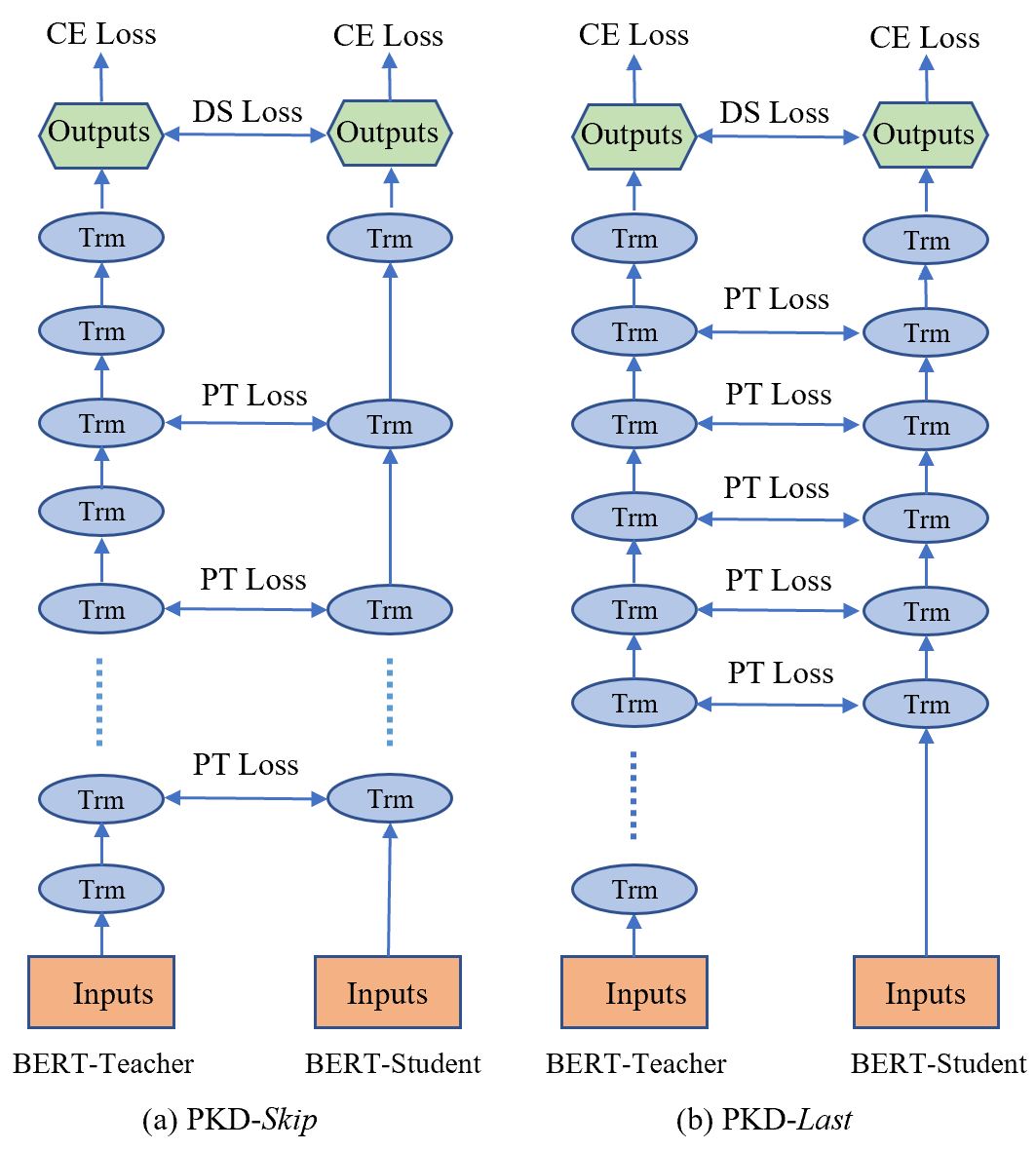
Source figure: PKD Figure 1, revision 1908.09355v1. It illustrates the
paper’s two layer-map contracts; it is not a reproduced accuracy result.
The map is objective state. A framework may return hidden states as
[embedding_output, block_1, ..., block_L] while a paper numbers only
Transformer blocks. An unrecorded +1 offset can select the wrong teacher
layer while every tensor shape remains valid.
def resolve_layer_map(hidden_states, map_spec):
    # The manifest declares whether hidden_states[0] is the embedding output.
    offset = 1 if map_spec.includes_embedding_slot else 0
    resolved = []
    for student_block, teacher_block in map_spec.block_pairs:
        s_idx = student_block + offset
        t_idx = teacher_block + offset
        assert map_spec.student_revision == loaded_student_revision
        assert map_spec.teacher_revision == loaded_teacher_revision
        resolved.append((s_idx, t_idx))
    return tuple(resolved)
Layer indices, indexing convention, selected token rows, normalization, and loss coefficient all belong in the checkpoint manifest. Loading tensors while changing one of those fields is not a faithful resume.
0x04D FitNets: A Regressor Plus A Two-Stage Training Program
FitNets introduced intermediate hints before Transformer-specific distillation. Its teacher hint layer emits ; the student guided layer emits . A regressor maps the guided output to the hint shape. The paper writes
The key mechanism is not only the equation. It is the schedule:
stage 1: freeze teacher
         train student only through the guided layer + regressor
         objective = hint reconstruction

transition:
         retain learned student prefix
         discard the training-only regressor unless explicitly reused
         initialize/activate the rest of the student

stage 2: train the whole student
         objective = output-level knowledge distillation
The paper does not define FitNets as a joint sum of hint and output losses from step zero. It reports stage-wise optimization and discusses deeper guided layers as a possible over-regularization risk: the later the student is forced to reproduce a teacher hint, the fewer downstream layers remain to reorganize that constraint.
The original Figure 1 separates teacher/student architecture, hint training, and output distillation. The following retained panels are source context, not a claim that the CNN regressor can be copied unchanged into a Transformer:
| Teacher/student networks | Hint-training stage | Output-KD stage |
|---|---|---|
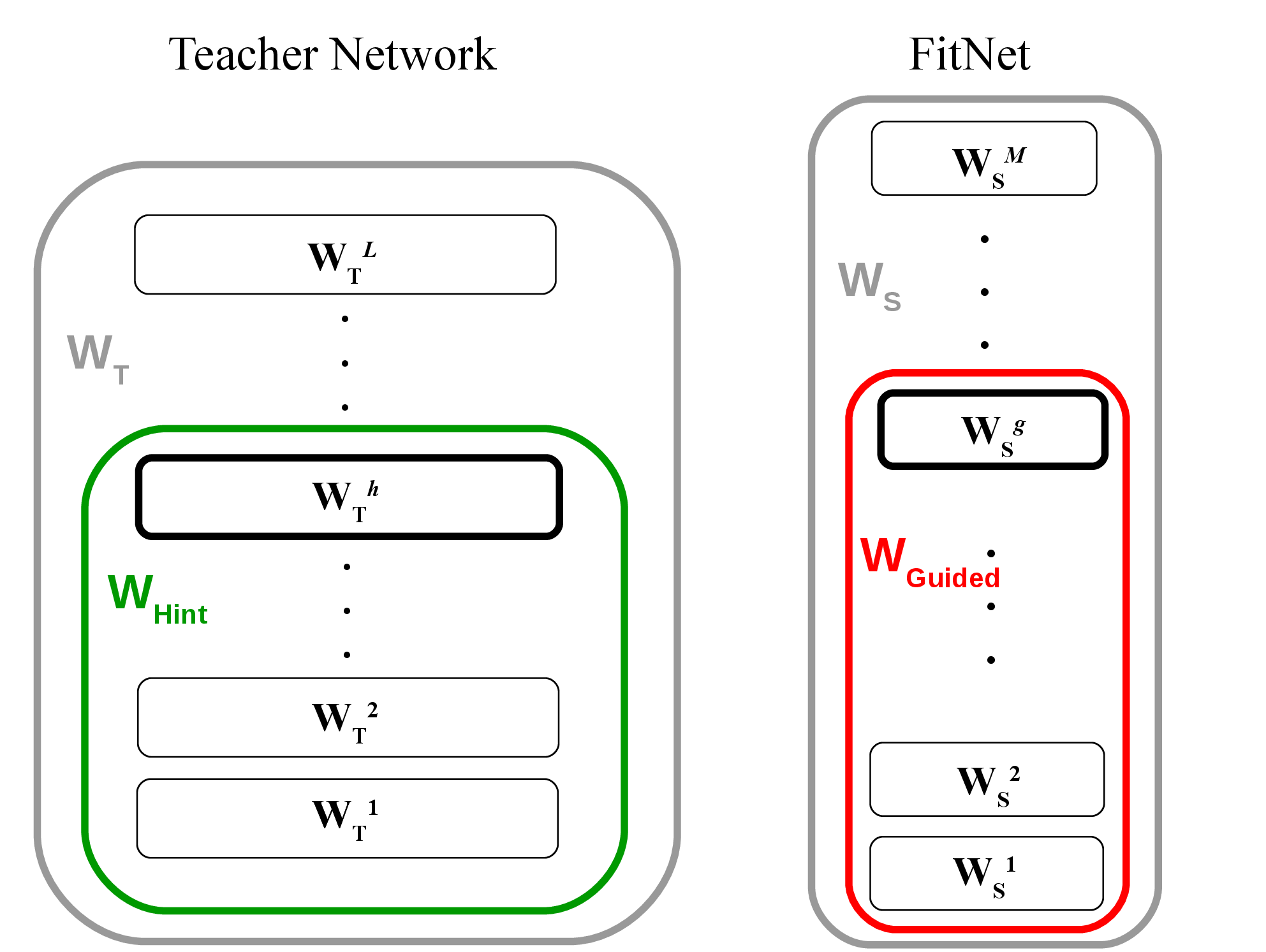 | 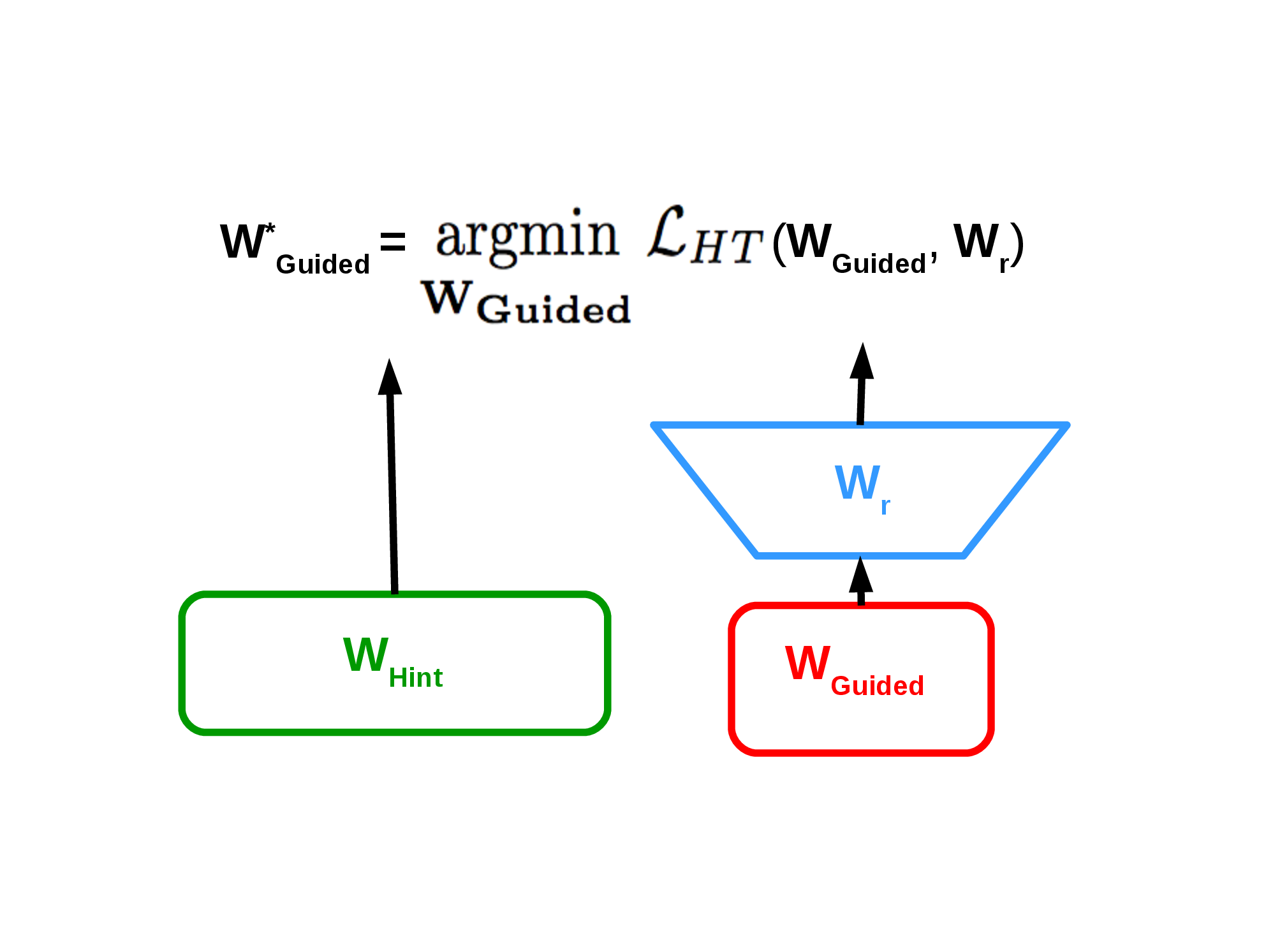 | 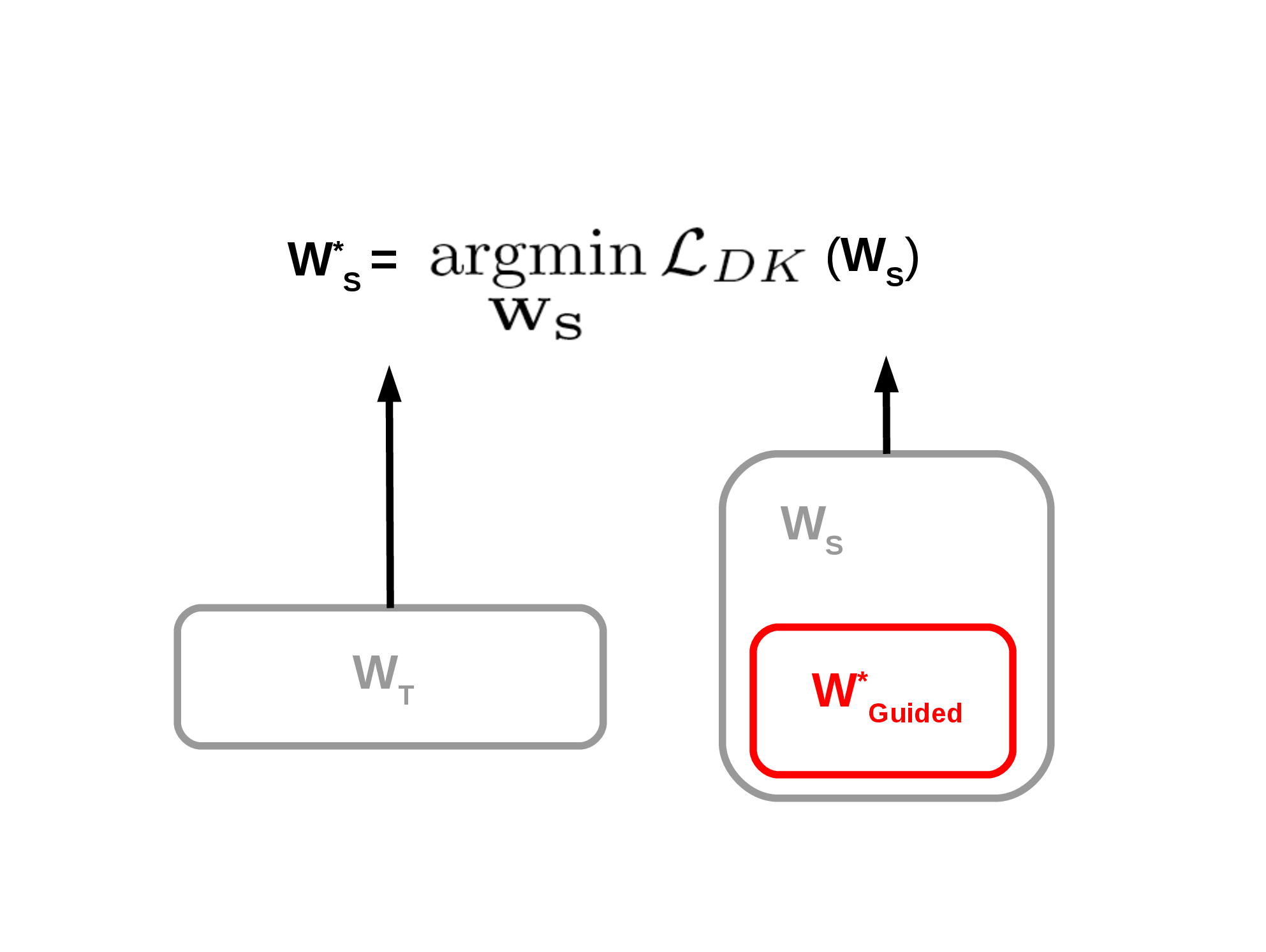 |
Source panels: FitNets Figure 1, revision 1412.6550v4. The mechanism is a
historical training-program contract; published outcomes remain source-reported.
For a Transformer hidden projection, the analogous stage-one state is:
trainable:
    student blocks 0..guided_block
    W_projection or alignment regressor

frozen:
    teacher
    student blocks after guided_block, if already instantiated

checkpoint:
    student prefix
    alignment parameters
    optimizer/scaler/scheduler state
    exact hint/guided hook names and layer indices

stage transition:
    copy retained prefix into full student
    record whether alignment state is discarded or remains an auxiliary loss
This schedule belongs to Loop 4 because it changes who receives intermediate gradients. Choosing the final student architecture and initialization policy remains Loop 5.
0x04E TinyBERT: A Piecewise Layer Objective, Not One Loss
TinyBERT makes the target surface explicit. Let a teacher have Transformer layers and a student have layers. The paper defines a map that includes boundary objects:
Index 0 denotes the embedding layer, indices 1..M denote student
Transformer layers mapped into teacher layers, and M+1 denotes the prediction
layer. The model-level objective is a sum of target-specific layer losses:
Its piecewise contract is
Embedding And Hidden Targets
When widths differ, TinyBERT uses learned transforms:
and
The equations look like 0x04B, but the implementation must still pin the MSE reduction and valid-token support. The published BERT setting and a padded causal decoder do not imply the same mask semantics.
Unnormalized Attention Scores
For each aligned head , TinyBERT writes
where the paper uses the unnormalized attention matrices and reports that choice as converging faster and performing better in its experiments. This is not MiniLM’s KL between row-softmax distributions.
For a masked Transformer, the safe numerator is over finite valid pairs:
Selecting valid pairs before subtraction matters. If both masked scores are
-inf, then (-inf)-(-inf) is nan; multiplying the resulting scalar by zero
does not repair it.
General And Task-Specific Stages
TinyBERT’s result also depends on a two-stage learning framework:
general distillation:
    teacher = original pretrained BERT
    data = large general-domain text corpus
    targets = embedding + intermediate Transformer targets
    paper footnote excludes prediction-layer loss in this stage

task-specific distillation:
    teacher = task-fine-tuned BERT
    data = task data plus the paper's augmentation procedure
    targets = task-specific intermediate + prediction transfer
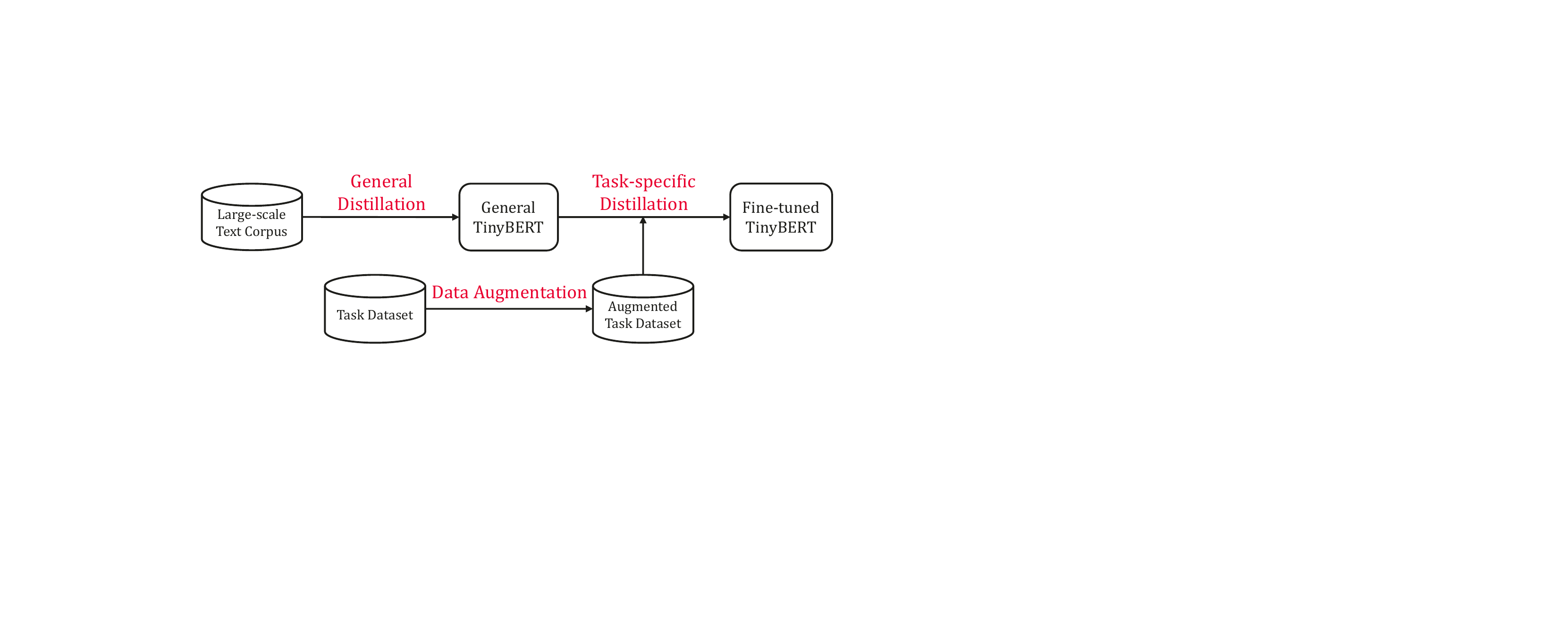
Source figure: TinyBERT Figure 1, revision 1909.10351v5. It identifies the
two published stages; it does not make the source-reported benchmark portable
to another corpus, architecture, or augmentation pipeline.
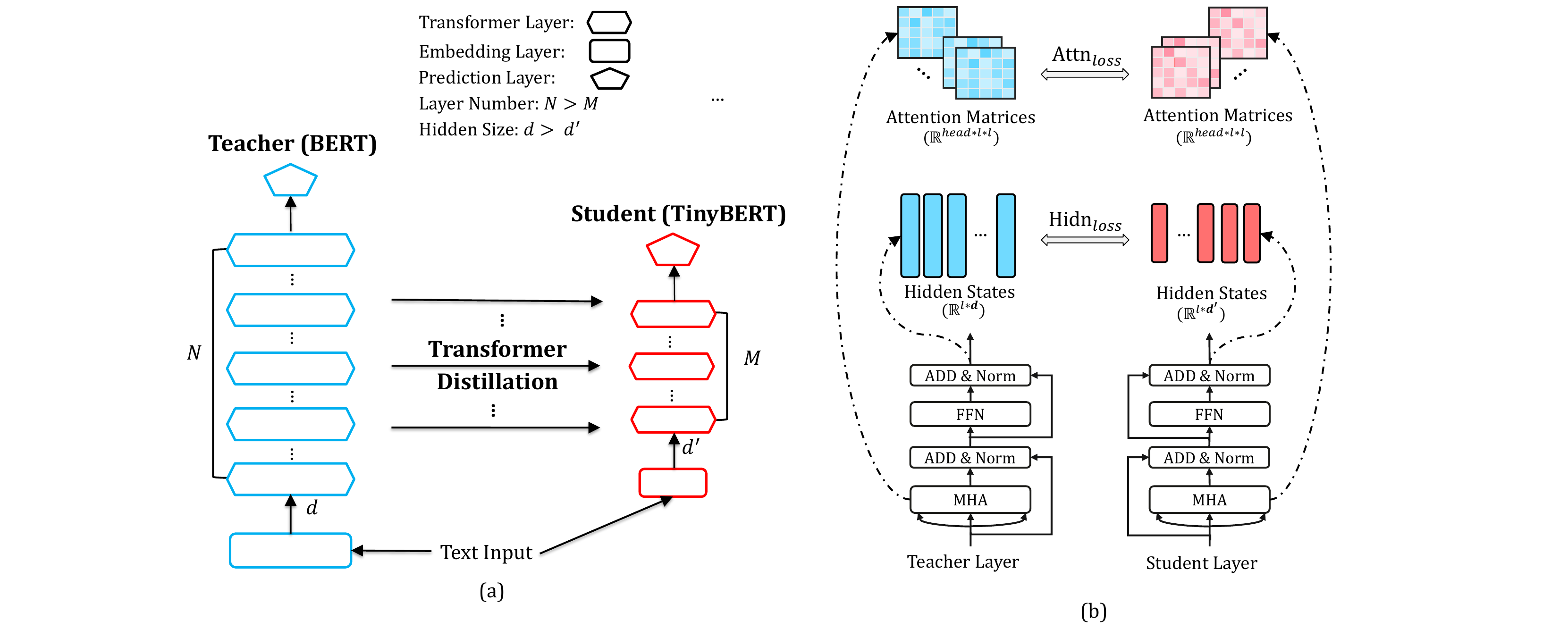
Source figure: TinyBERT Figure 2, revision 1909.10351v5. It shows the
paper’s hidden and attention target paths; the exact mask and reduction still
belong to the implementation contract.
Collapsing both stages into one joint fine-tuning run is an alternative method, not a faithful implementation of TinyBERT. Likewise, retaining only hidden MSE while citing the full TinyBERT result removes the attention, prediction, general-corpus, and augmentation contracts that contributed to that result.
0x04F Attention Scores, Attention Distributions, And Mask Algebra
Let one layer expose
For query and key , define a Boolean support . In a bidirectional encoder, it usually excludes padding. In a causal decoder, it also requires . The score and normalized attention row are
The denominator derives the softmax axis: a fixed query selects a distribution over visible keys. Normalizing over queries instead produces a valid-shaped tensor that answers a different question.
For teacher distribution and student distribution , a masked forward KL is
where excludes query rows with no semantic target and . The key mask is used inside normalization; the query mask is used outside it for reduction. One mask cannot substitute for the other.
def masked_row_distribution(scores, pair_mask):
    # scores: [B,H,Q,K], pair_mask: [B,1,Q,K]
    assert pair_mask.dtype == bool
    assert pair_mask.any(dim=-1).all()  # no empty normalized row
    neg_inf = full_like(scores, -inf)
    visible_scores = where(pair_mask, scores, neg_inf)
    row_max = visible_scores.max(dim=-1, keepdim=True).values
    exp_shifted = where(pair_mask, exp(visible_scores - row_max), 0.0)
    return exp_shifted / exp_shifted.sum(dim=-1, keepdim=True)

def masked_row_forward_kl(teacher_p, student_p, query_mask):
    rows = query_mask[:, None, :, None]
    numerator = where(
        rows & (teacher_p > 0),
        teacher_p * (log(teacher_p) - log(student_p)),
        0.0,
    ).sum()
    denominator = query_mask.sum() * teacher_p.shape[1]
    return numerator, denominator
The hook point is part of the target. For rotary-position models, Q/K can be captured before or after the positional rotation. For grouped-query attention, K/V can be stored with heads or expanded to . Teacher and student must expose the same semantic stage; equal shapes are insufficient.
Head count is another objective decision:
| Choice | What it preserves | What it costs |
|---|---|---|
| require | direct head identity | constrains student architecture |
| group teacher heads | coarse head groups | destroys within-group identity |
| learned head mixer | adaptable alignment | trainable/checkpointed alignment state |
| average over heads | head-agnostic token relation | removes head specialization |
| independent relation heads | width/head flexibility | changes the target to a MiniLMv2-style relation |
The Attention Transfer lineage uses the word attention differently: it reduces CNN feature channels into normalized spatial activation maps and aligns selected teacher/student groups. That work motivates relation-like, width-independent supervision, but its activation map is not a Transformer QK attention matrix.
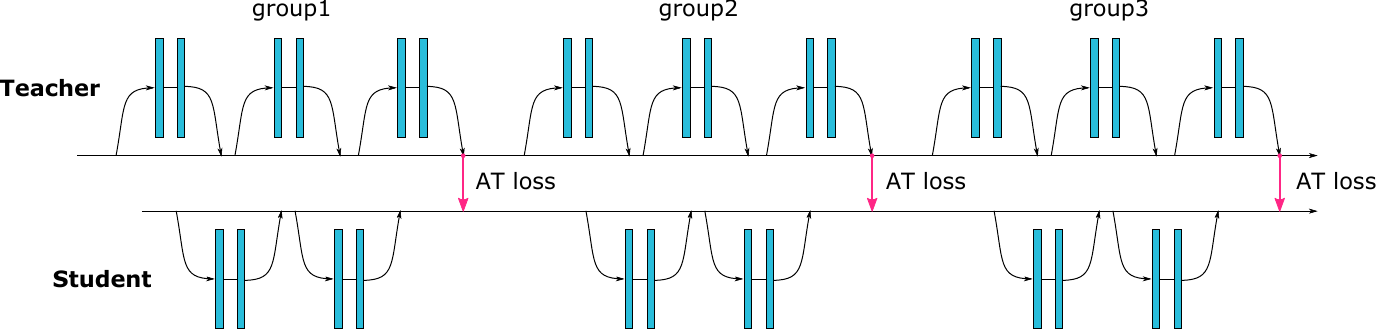
Source figure: Attention Transfer Figure 5, revision 1612.03928v3. It is
historical representation-transfer context, not a Transformer attention-score
implementation diagram.
0x04G MiniLM: Last-Layer Attention And Value Relations
MiniLM avoids raw hidden-coordinate matching. It selects the last teacher Transformer layer and the last student layer, then transfers two row distributions.
For head , query-key attention is
with the analogous student matrix . The paper’s attention objective is
For values, form
and
The value-relation objective is
and the published transfer objective is
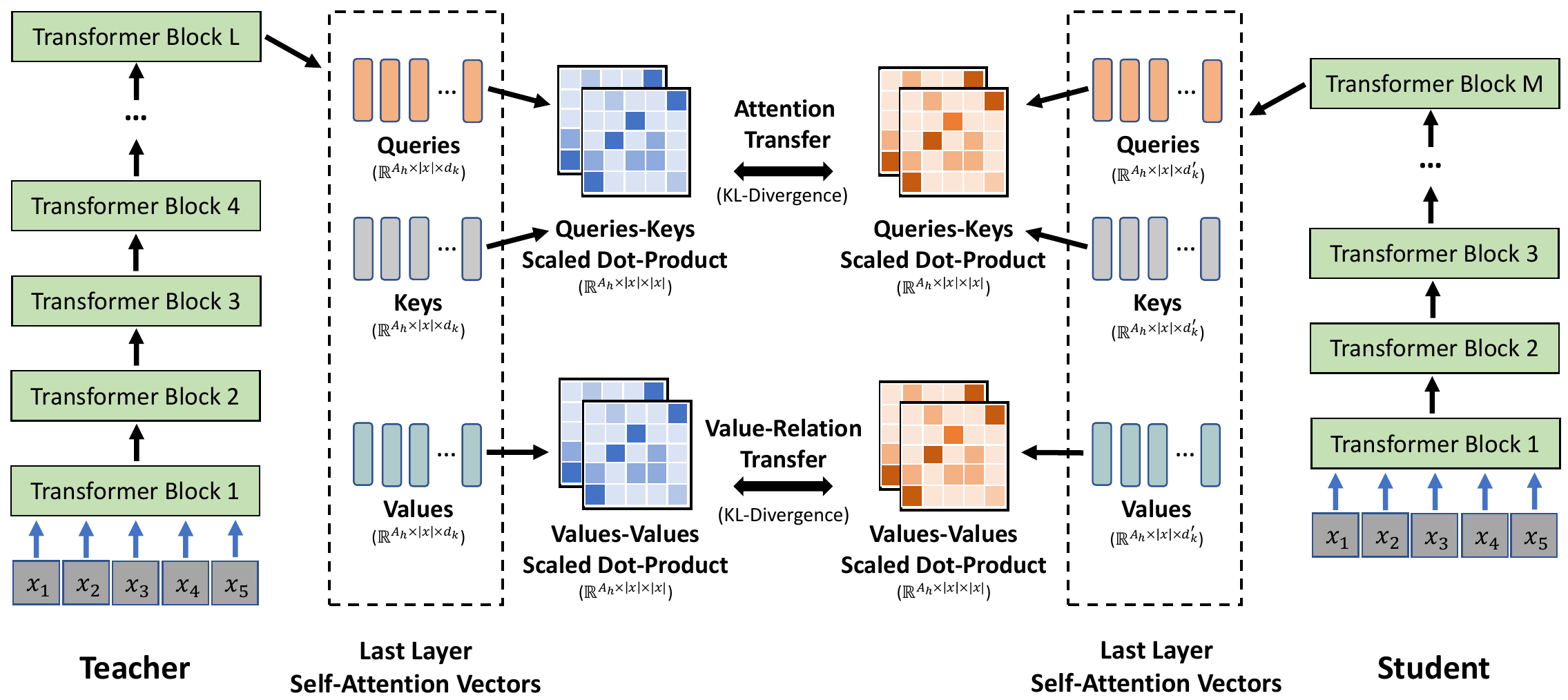
Source figure: MiniLM Figure 1, revision 2002.10957v2. It shows the original
last-layer relation contract; the paper’s results remain source-reported.
Why The Relation Removes Width Coordinates
For one head, but . The inner width contracts, so teacher and student can have different while their token-pair matrices still match. This is a precise form of architectural freedom, not complete invariance.
If is orthogonal, then
The relation cannot distinguish an orthogonal change of feature basis. A raw hidden MSE can. But scaling multiplies pair logits by and changes row-softmax sharpness, so the target is not scale-invariant. A general non-orthogonal transform also changes the relation.
The original MiniLM contract still assumes the same number of attention heads on teacher and student sides. Width independence should not be misquoted as arbitrary head-count compatibility. MiniLMv2 is the separate method that relaxes that restriction.
0x04H MiniLMv2: Concatenate, Repartition, Then Compare Relations
MiniLMv2 decouples relation heads from model attention heads. For one of , start with
teacher tensor: [B,H_T,S,d_hT]
student tensor: [B,H_S,S,d_hS]
At each token, concatenate all model-head coordinates:
teacher: [B,H_T,S,d_hT]
      -> [B,S,H_T*d_hT] = [B,S,d_T]

student: [B,H_S,S,d_hS]
      -> [B,S,H_S*d_hS] = [B,S,d_S]
Choose one common relation-head count such that and . Repartition each flat width:
teacher relation vectors: [B,A_r,S,d_rT]
student relation vectors: [B,A_r,S,d_rS]
The chunks need not respect original attention-head boundaries. Therefore need not equal, or be a multiple of, or . It must divide the total concatenated widths. This distinction is what makes an 8-head teacher and a 6-head student comparable when both widths admit the selected .
For , relation head defines
and
The pair-specific loss is
and the general objective is
The paper selects Q-Q, K-K, and V-V relations as a performance/compute trade-off rather than instantiating all nine ordered pairs. When relation heads coincide with attention heads, the Q-K relation recovers ordinary attention weights; Q-Q, K-K, and V-V encode different token-pair geometries.
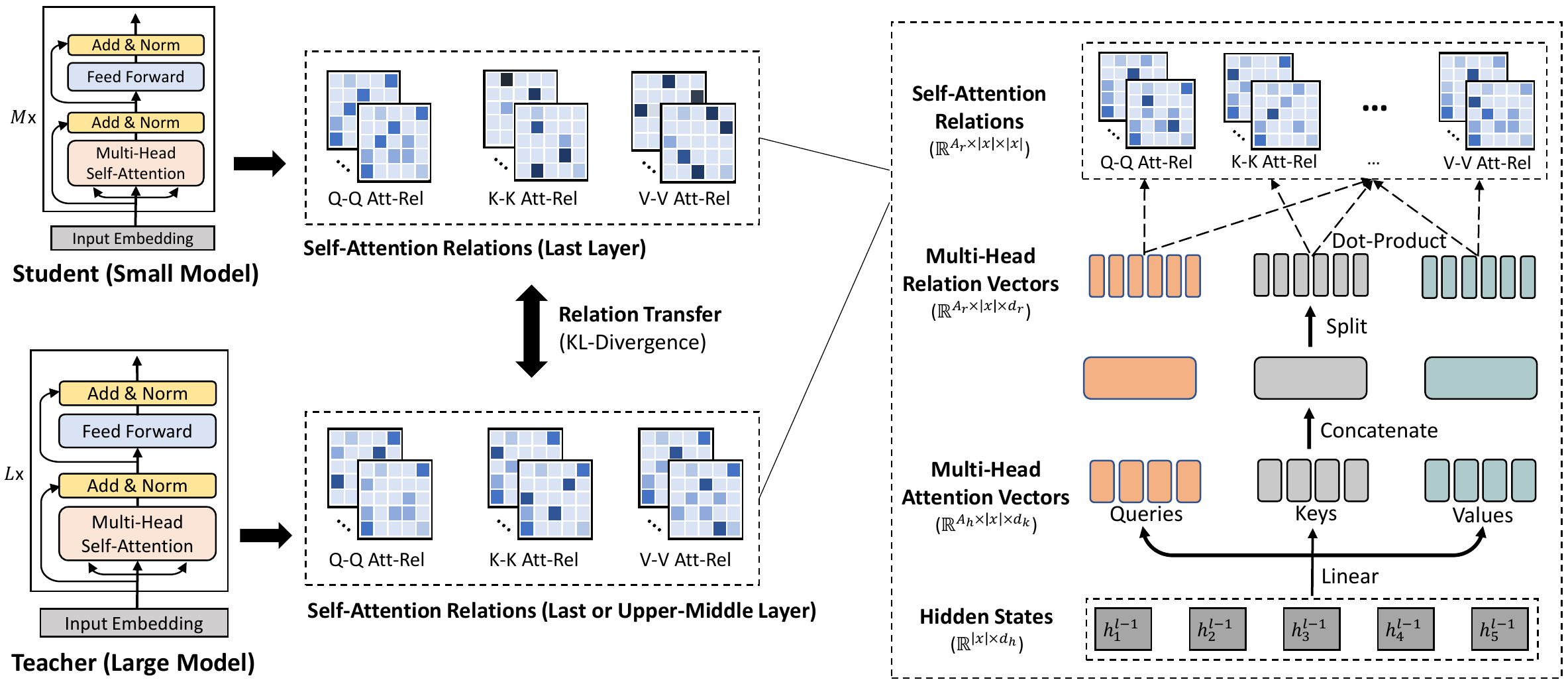
Source figure: MiniLMv2 Figure 1, revision 2012.15828v2. It establishes the
paper’s relation-head mechanism; its layer-selection and benchmark outcomes are
source-reported.
def relation_heads(x, relation_head_count):
    # x: [B,H,S,d_h]
    B, H, S, d_h = x.shape
    total_width = H * d_h
    assert total_width % relation_head_count == 0
    d_r = total_width // relation_head_count

    # Preserve token-major coordinate order while joining model heads.
    flat = x.transpose(1, 2).reshape(B, S, total_width)
    rel = flat.reshape(B, S, relation_head_count, d_r)
    return rel.transpose(1, 2)  # [B,A_r,S,d_r]

def relation_distribution(left, right, pair_mask):
    # left/right: [B,A_r,S,d_r]
    assert left.shape == right.shape
    logits = left @ right.transpose(-1, -2) / sqrt(left.shape[-1])
    return masked_row_distribution(logits, pair_mask)
Changing transpose/reshape order permutes coordinates among relation heads and changes the objective without changing the final shape. The flatten order, relation-head count, Q/K/V pair set, teacher layer, and student layer therefore belong in the immutable training manifest.

MiniLMv2’s layer policy is also source-dependent. The paper reports the last teacher layer as effective for its base-teacher settings and upper-middle layers for some large teachers. Those are paper experiments, not a universal rule. A production study must treat teacher-layer choice as a measured hyperparameter while freezing it for each resumable run.
0x04I End-To-End Tensor And Gradient Ownership Trace
The following trace combines projected hidden loss with MiniLMv2-style relations. It is an implementation contract, not a claim that the cited papers jointly train this exact objective.
teacher.eval()
student.train()
alignment.train()

layer_map = ((0, 1), (1, 3))
relation_spec = {
    "teacher_layer": 3,
    "student_layer": 1,
    "relation_heads": 2,
    "pairs": (("q", "q"), ("k", "k"), ("v", "v")),
}

with no_grad():
    teacher_out = teacher(
        input_ids,
        attention_mask=attention_mask,
        output_hidden_states=True,
        capture_qkv_layers={3},
    )

student_out = student(
    input_ids,
    attention_mask=attention_mask,
    output_hidden_states=True,
    capture_qkv_layers={1},
)

valid_token = target_row_mask.to(bool)            # Loop 3 identity
pair_mask = build_query_key_mask(
    padding_mask=attention_mask,
    causal=student.is_causal,
)                                                  # [B,1,S,S]

hidden_num = scalar_zero()
hidden_den = integer_zero()
for student_layer, teacher_layer in layer_map:
    hs = student_out.hidden_states[student_layer]  # [B,S,d_S], has graph
    ht = teacher_out.hidden_states[teacher_layer]  # [B,S,d_T], detached
    aligned = alignment[student_layer](hs)         # [B,S,d_T], has graph

    valid_error = (aligned - ht)[valid_token]      # [N,d_T]
    hidden_num += valid_error.float().square().sum()
    hidden_den += valid_error.numel()

tq, tk, tv = teacher_out.qkv[3]
sq, sk, sv = student_out.qkv[1]

t_rel = {
    "q": relation_heads(tq, relation_spec["relation_heads"]),
    "k": relation_heads(tk, relation_spec["relation_heads"]),
    "v": relation_heads(tv, relation_spec["relation_heads"]),
}
s_rel = {
    "q": relation_heads(sq, relation_spec["relation_heads"]),
    "k": relation_heads(sk, relation_spec["relation_heads"]),
    "v": relation_heads(sv, relation_spec["relation_heads"]),
}

relation_num = scalar_zero()
relation_den = integer_zero()
for left_name, right_name in relation_spec["pairs"]:
    teacher_p = relation_distribution(
        t_rel[left_name], t_rel[right_name], pair_mask
    )
    student_p = relation_distribution(
        s_rel[left_name], s_rel[right_name], pair_mask
    )
    num, den = masked_row_forward_kl(
        teacher_p, student_p, query_mask=valid_token
    )
    relation_num += num
    relation_den += den

# Exact global means require numerator/count reductions, not rank-mean averaging.
hidden_num, hidden_den = all_reduce_sum(hidden_num, hidden_den)
relation_num, relation_den = all_reduce_sum(relation_num, relation_den)

hidden_loss = hidden_num / hidden_den
relation_loss = relation_num / relation_den
loss = token_kd_loss + beta_h * hidden_loss + beta_r * relation_loss
loss.backward()

assert all(p.grad is None for p in teacher.parameters())
assert any(p.grad is not None for p in student.parameters())
assert all(p.grad is not None for p in alignment.parameters())
capture_qkv_layers is a model-specific hook, not a standard API. Its schema
must state:
hook location:       pre- or post-positional transform
head representation: native H_q/H_kv or expanded heads
layout:              [B,H,S,d_h] and exact coordinate order
mask topology:       bidirectional, causal, prefix, sliding-window, or custom
dtype:               storage, score accumulation, softmax, and loss reduction
gradient owner:      detached teacher, differentiable student
A hook taken from fused attention may not expose Q/K/V at all. Recomputing them from block inputs is valid only if it repeats the same projection, bias, normalization, positional transform, and head expansion as the actual attention path.
0x04J Liveness, Temporary Traffic, And Checkpoint State
Intermediate targets can dominate training memory even when they add no serving parameters. For hidden targets, a simple payload ledger is
before student activations, projected states, gradients, or alignment optimizer state. A dense token-pair relation has
For , , , and bytes, one dense relation tensor is
Teacher and student Q-Q, K-K, and V-V relations would be six such payloads if all were materialized simultaneously. That is not required by the algebra. A row-chunked implementation can compute teacher and student relation rows, accumulate KL numerator/count, and release each chunk. The chunked schedule is equivalent only if every row is normalized over its full visible key set. Chunking the key dimension and applying a local softmax changes the objective unless an online global-softmax merge is used.
Alignment state also has a persistent ledger. For projections ,
With parameter bytes , gradient bytes , and optimizer bytes ,
This is training state, not student serving size. Loop 5 owns the full teacher/student/alignment memory and capacity ledger; Loop 4 only closes the fact that trainable alignment tensors exist and must survive resume.
Minimum checkpoint fields are:
teacher revision and hook schema
student revision and hook schema
tokenizer/position/mask identity consumed from Loop 3
layer map plus embedding-offset convention
hidden projection tensors and optimizer state
target family and exact reductions
attention or relation head policy
relation flatten/repartition order and Q/K/V pair set
loss weights and schedule stage
global step, scheduler, scaler, RNG, and data cursor
Cached teacher intermediates add artifact fields: source example identity, teacher revision, layer/hook, dtype, token mask, pair mask, positional stage, normalization, and checksum. Loop 8 owns their full storage and invalidation schema.
0x04K Paper-By-Contract Comparison
| Method | Target object | Depth policy | Width/head policy | Optimization schedule | What must not be generalized |
|---|---|---|---|---|---|
| FitNets | teacher hint reconstructed by student guided layer + regressor | selected hint/guided pair | learned regressor; CNN source design | hint stage, then whole-student KD stage | not a joint Transformer hidden-loss recipe |
| Attention Transfer | normalized activation-derived spatial maps | selected residual groups | channel-reduced spatial map | auxiliary attention loss in CNN training | not Transformer QK attention |
| PKD | normalized [CLS] hidden states + output KD | PKD-Skip or PKD-Last | published direct vector match | task-specific joint objective | not all-token hidden MSE |
| DistilBERT | soft outputs, MLM, cosine hidden direction | reduced-depth BERT; one hidden direction target | same hidden width in published student | pretraining triple loss | initialization and architecture move to Loop 5 |
| TinyBERT | embedding, hidden, unnormalized attention scores, prediction | explicit including boundaries | learned width transforms; aligned attention heads | general stage, then augmented task-specific stage | full result cannot be attributed to hidden MSE alone |
| MiniLM | QK attention distributions + VV relations | last teacher and student layers | width may differ; original heads align | task-agnostic pretraining transfer | width flexibility is not arbitrary head compatibility |
| MiniLMv2 | selected Q/K/V relation distributions | one teacher layer to student last layer | concatenate then split into common relation heads | relation distillation | layer choices and outcomes are source-reported settings |
These rows are design contracts, not a leaderboard. Paper outcomes are source-reported for their data, architecture, objective, schedule, and runtime. An ablation that removes one contract must be named as an ablation rather than presented under the full paper label.
The alternatives answer different engineering constraints:
| Constraint | Plausible target | Trade-off |
|---|---|---|
| exact teacher coordinate recovery matters | projected hidden MSE | projection state and coordinate sensitivity |
| magnitude should not dominate | normalized hidden/cosine | zero-norm policy and radial information loss |
| student must preserve score calibration | unnormalized score MSE | finite-pair handling and head compatibility |
| only query-to-key behavior matters | attention KL | score offsets/scales become invisible after softmax |
| teacher/student widths differ | MiniLM value relations | original head-count restriction remains |
| widths and attention-head counts differ | MiniLMv2 relation heads | reshape order and relation-head count become contracts |
| training a very thin/deep student is unstable | FitNets-style staged hinting | extra stage and disposable regressor state |
| runtime cannot expose internal Q/K/V | hidden or output target | relational attention objective may be unavailable |
0x04L Failure Closure And Loop Boundary
| Failure | Why ordinary checks miss it | Observable consequence | Required repair |
|---|---|---|---|
| layer map shifts by one because embeddings occupy slot 0 | all hidden tensors share [B,S,d] | plausible but wrong supervision depth | pin block numbering and resolved tensor indices |
| per-token MSE is labeled per-coordinate MSE | scalar remains finite | objective weight changes by | serialize denominator convention |
| projection omitted from optimizer | forward shapes pass | alignment never learns | assert gradient and optimizer ownership |
| projection omitted from checkpoint | fresh run works | resume changes the objective trajectory | checkpoint alignment and optimizer state |
| training wrapper exported with projection | model loads | serving graph contains training-only state | export student artifact independently |
| normalized target receives a zero vector | tensor shape passes | NaN loss/gradient | reject, clamp, or explicitly exclude zero norm |
PKD expanded from [CLS] to all tokens without renaming | formula still runs | different target and row weighting | label as a new all-token variant |
TinyBERT score loss runs on masked -inf pairs | masks look correct | inf-inf -> nan | gather finite valid pairs before subtraction |
| attention softmax uses query axis | probabilities still sum to one on an axis | wrong conditional relation | assert key-axis row sums on valid support |
| BERT mask copied into a causal decoder | matrix dimensions match | future information leaks into target | derive pair support from actual student topology |
| MiniLM used with unequal heads by broadcasting | framework may broadcast or reshape | silent head mixing | preserve/map heads or use MiniLMv2 contract |
| relation reshape swaps head/token coordinate order | output is still [B,A_r,S,d_r] | different relation partitions | pin flatten order and reconstruct in oracle |
| teacher pre-RoPE Q compared with student post-RoPE Q | shapes match | semantically different geometry | capture identical hook stage |
| row relations normalized inside key chunks | each chunk forms a distribution | objective differs from full-key softmax | use full-key rows or exact online merge |
| rank-local means averaged under uneven rows | distributed scalar looks stable | rank-dependent sample weights | reduce global numerator and count |
| paper label retained after stage/target removal | citation remains valid | unsupported benchmark implication | name the ablation and re-evaluate |
Loop 4 has now closed the intermediate-transfer object, map, mask, reduction, gradient, schedule, and checkpoint contracts. It deliberately does not own:
Loop 5:
    student depth/width/head/FFN architecture choice
    alternating-layer or other student initialization
    teacher-assistant capacity-gap programs
    full teacher/student/alignment persistent-state and compute ledger

Loop 8:
    cached hidden/relation artifact serialization and invalidation

Loop 9:
    teacher placement, distributed hook implementation, collectives,
    pipeline/context parallel integration, and production scheduling
The immediate handoff is therefore not “add more losses.” It is: choose a student graph whose serving cost is worth the transfer program, then prove that the selected intermediate contracts are available and affordable for that graph.
0x05 Student Architecture, Initialization, And Capacity Gap
Intermediate transfer can recover behavior only inside the student graph that was chosen. That graph determines deployment cost and also determines which teacher targets are mathematically available. Reducing “model size” along one axis does not have the same alignment effect as reducing it along another.
This loop therefore owns a different object from the preceding loss loops:
owns:
    the exact student graph and checkpoint tensor set
    the initialization transition into that graph
    architecture-induced target compatibility
    teacher / student / alignment persistent state
    activation liveness and peak-memory accounting
    direct versus teacher-assistant training paths
    resumable training state versus student-only export

consumes:
    0x02 scalar output-distillation convention
    0x03 causal token rows and vocabulary support
    0x04 intermediate target, map, mask, and gradient contracts
    M4.1 parameter, FLOP, byte, and liveness conventions

defers:
    0x06 generated sequence artifacts and black-box supervision
    0x07 student-generated prefix distributions
    0x08 serialized supervision artifact schemas
    0x09 distributed teacher placement and production scheduling
The causal direction is important:
Distillation does not create structural savings by itself. It is a training program that tries to recover behavior after a deployment graph has already been selected. A same-shape student with deleted training-only losses remains a same-shape serving model.
0x05A Five Architecture Axes, Five Alignment Consequences
| Student change | Deployment effect | Distillation consequence |
|---|---|---|
| fewer layers | fewer sequential blocks and block parameters | requires layer map, last-layer target, or no layer-wise match |
| smaller hidden width | smaller residual/attention projections | raw hidden coordinates need projection or relational target |
| smaller FFN width | smaller MLP parameters and compute | neuron-wise MLP matching is undefined without another map |
| fewer/different Q or KV heads | different attention compute and KV layout | head-wise targets require grouping, mapping, or relation heads |
| different vocabulary/tokenizer | smaller/different embedding and output support | direct token KL may become semantically undefined |
Keeping the architecture unchanged avoids most alignment work, but also creates no guaranteed structural saving. Conversely, a radically different student can be an excellent deployment target while making white-box coordinate losses inappropriate. Sequence-level or output-only transfer may be the cleaner contract in that case.
Five axes are enough to introduce the problem, but they are not enough to reconstruct a model. A checkpoint-compatible architecture manifest needs at least
where:
| Symbol | Meaning | Why KD cares |
|---|---|---|
| block count | determines sequential depth and teacher-layer map | |
| vocabulary size and token identity | determines embedding/output support | |
| position and token-type tables | determine input-state keys and compatibility | |
| embedding width | may require an embedding-to-residual projection | |
| residual and FFN widths | determine block parameters, work, and hidden projection shape | |
| query and KV head layouts | determine attention tensor interpretation and cache shape | |
| normalization placement/type and activation | determine graph semantics even when shapes match | |
| weight-tying and alias contract | determines unique parameter storage and checkpoint identity |
The manifest must also name positional encoding, bias policy, attention type, FFN family, classifier/pooler heads, and tensor dtypes when those differ from the BERT-like example below. The vector is a teaching shorthand, not a universal Transformer schema.

The four outputs of the diagram are deliberately separate. A reduction in parameter count need not yield proportional latency. A head-layout change can leave dense projection parameter count nearly unchanged while invalidating a head-wise target. A tied embedding saves stored parameters but does not remove the output projection’s matrix multiplication.

The diagram has three separate kinds of arrows. Layer-map arrows select teacher stages. Width-projection arrows transform coordinates only for the loss. Teacher-assistant arrows represent separate training runs and model artifacts. Treating all three as “alignment” hides very different runtime and checkpoint costs.
0x05B Exact BERT-Like Parameter Derivation
To make “student size” auditable, start with one declared graph rather than a parameter total copied from a model card. Consider a BERT-like encoder with:
token, learned position, and token-type embeddings
optional embedding projection d_e -> d
L post-norm blocks
four attention affine maps Q, K, V, O
two affine FFN maps d -> d_ff -> d
two LayerNorms per block
tied token embedding and MLM decoder weight
MLM transform d -> d_e, transform LayerNorm, and decoder bias
optional untied pooler and task head
This contract is intentionally narrower than “Transformer.” Decoder-only models, RMSNorm, gated FFNs, rotary positions, GQA, bias-free linears, and untied language heads require different terms.
The input embedding state is
The first three terms are token, position, and token-type tables. The term is embedding LayerNorm gain and bias. If embedding and residual widths differ, the final term adds a dense projection and its bias.
One encoder block contains:
Therefore
The tail is not decorative. It contains four attention biases, the FFN output bias, four LayerNorm vectors, and the FFN intermediate bias. Dropping it can be acceptable for an asymptotic estimate, but not for exact checkpoint reconciliation.
With a tied decoder weight, the MLM head adds
The terms are the transform weight, transform bias, transform LayerNorm gain and bias, and decoder bias. The decoder matrix is not counted again because it aliases the input token embedding. The complete declared model is
For a standard dense pooler, . A task head depends on label support and must be named rather than hidden in “about 110M.”
Worked checkpoint-scale reconciliation
The following rows use , , and the explicit assumptions above. They are article-local reconstructions; paper totals remain source-reported because implementations can differ in heads, aliases, and included task state.
| Graph | Declared dimensions | Reconstructed unique parameters | Source-reported scale |
|---|---|---|---|
| BERT-base-like teacher | , tied MLM, pooler | about –M depending on counting surface | |
| DistilBERT-like student | , no token-type table, no pooler, tied MLM | about –M | |
| TinyBERT-like student | , tied MLM, pooler | M in the paper |
For the BERT-base-like row:
For the TinyBERT-like row, shrinking both and changes the quadratic and bilinear block terms, while the vocabulary table remains substantial:
This is why “four layers instead of twelve” does not imply exactly one-third of the total model: embeddings, heads, and other non-block state do not scale with .
An executable counter should enumerate unique storage rather than blindly sum named references:
def count_unique_parameters(named_parameters):
    seen_storage = set()
    total = 0
    rows = []

    for name, tensor in named_parameters:
        storage_id = tensor.storage_identity()
        aliased = storage_id in seen_storage
        if not aliased:
            seen_storage.add(storage_id)
            total += tensor.numel()
        rows.append({
            "name": name,
            "shape": tuple(tensor.shape),
            "numel": tensor.numel(),
            "storage_id": storage_id,
            "counted": not aliased,
        })

    return total, rows
A tied embedding and decoder should appear as two semantic names sharing one storage identity. A serialized checkpoint may store aliases differently, so logical unique parameters, serialized bytes, and loaded resident bytes remain three ledgers.
0x05C Architecture-Level Forward Work And Deployment Shape
Use two scalar FLOPs per multiply-add and ignore softmax, normalization, activation, bias, and data movement for the first logical matmul ledger. For a batch and sequence length :
- Q, K, V, and output projections each perform FLOPs, giving .
- performs FLOPs across all heads.
- attention-probability times performs another .
- FFN up and down projections each perform .
Thus one dense BERT-like block performs approximately
The derivation explains why architecture axes behave differently:
For training, backward and recomputation add convention-dependent multiples; M4.1 owns the full training-compute convention. For serving, the formula is still not a latency prediction. Fewer layers shorten the sequential critical path. Narrow widths can produce less favorable kernel tiles. Different head counts affect launch geometry and KV organization. MobileBERT’s paper, for example, separately changes architecture and operations because equal FLOP counts do not imply equal device latency.
The student release must therefore carry both logical and observed evidence:
logical graph:
    exact unique parameters
    exact tensor shapes and aliases
    prefill/decode FLOP convention
    expected persistent bytes

observed deployment:
    target runtime and hardware
    sequence and batch distribution
    latency quantiles and throughput
    peak resident memory
    numerical and quality gates
Neither ledger can substitute for the other.
0x05D Initialization Is A State Transition, Not A Distillation Target
When student and teacher blocks have compatible tensor shapes, selected teacher parameters can initialize the student. DistilBERT keeps BERT’s hidden width, removes the token-type embeddings and pooler, halves the number of layers, and initializes the student by taking one teacher layer out of two. Its training then uses a triple objective: masked-language modeling, output distillation, and cosine hidden-state alignment.
Initialization answers where optimization starts. A distillation loss answers which behavior remains constrained during training. Copying teacher layers and then training only on hard labels is not the same procedure as continuing to compare teacher outputs. Conversely, a randomly initialized student can still be distilled.

Write initialization as an explicit state transition:
is not necessarily a tensor copy. It may train a compact model, run a general-distillation stage, or sample a random initializer. The initialization manifest must identify every source revision, mapping, transform, dtype conversion, random seed, and excluded tensor. The subsequent update still follows a declared objective:
Common choices are:
| Initialization | When it is available | Benefit | Risk |
|---|---|---|---|
| alternating or mapped teacher layers | matching student/teacher block shapes | starts from learned features | constrains width/head architecture; layer semantics may not compress cleanly |
| copy embeddings/output head | shared tokenizer and equal widths/support | preserves lexical interface | impossible or partial under vocabulary/width changes |
| initialize from an independently pretrained small model | suitable checkpoint exists | student already fits its capacity | teacher/student representations may use different coordinate systems |
| random initialization | always | maximum architecture freedom | more optimization and data burden |
| staged general then task-specific student | broad corpus and task teacher available | separates general/domain transfer | extra stages and artifact lineage |
Shape-compatible layer copying: DistilBERT
The DistilBERT paper couples three choices that should not be credited to one another. The student removes the token-type embeddings and pooler and halves depth while retaining the teacher’s hidden dimensions. Shape compatibility permits initialization by taking one teacher layer out of two. Training then uses masked-language-model, soft-output, and cosine hidden-direction losses. The paper’s random- initialization ablation is evidence for this specific training contract; it does not prove that every KD student should copy teacher layers.
For a copy map , the complete compatibility predicate is stronger than equal element count:
The semantic term covers Q/K/V ordering, norm placement, activation family, position mechanism, and alias behavior. A transposed or sliced tensor can have the desired shape and still implement a different function.
0x05E Compact Pretraining, General Distillation, And Task Transfer
Pretraining a compact graph and distilling a compact graph are different operations even when they use the same unlabeled text.
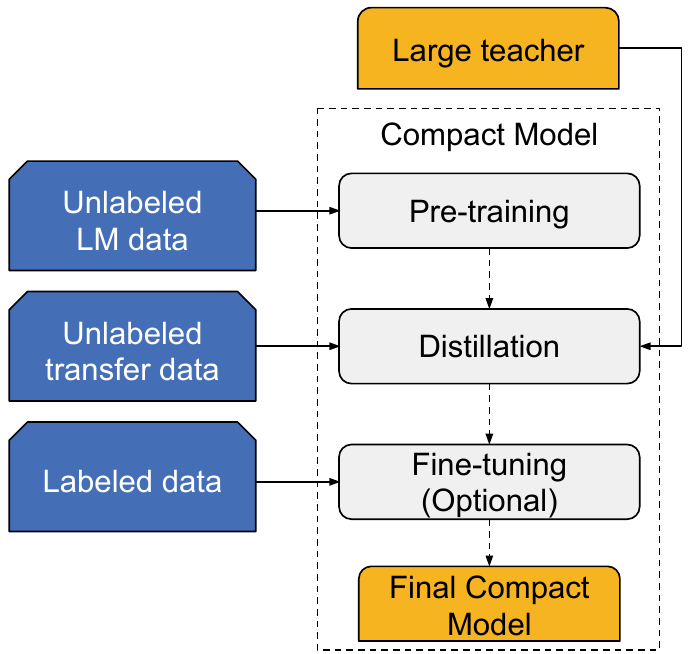
Source figure: Turc et al., Well-Read Students Learn Better: On the Importance of Pre-training Compact Models, recipe figure from the revision-pinned source archive. It establishes the paper’s stage order—compact-model pretraining, distillation on an unlabeled transfer set, and optional fine-tuning. It does not prove the paper’s source-reported gains for another architecture or dataset.
The paper studies a grid of compact Transformer students and argues that pretraining the student in its own architecture can materially improve later distillation. The state transition is
The first stage has no teacher in its loss. It establishes a compact-model prior. The second stage uses teacher behavior. Calling both stages “pretraining” erases the teacher boundary; calling both “distillation” erases the independently learned compact checkpoint.
TinyBERT exemplifies the last choice. It first performs general distillation from an unfine-tuned BERT on general-domain data, then task-specific distillation from a fine-tuned teacher on augmented task data. Its results cannot be attributed to hidden MSE alone; target types, data augmentation, and the two-stage schedule are part of the method.
TinyBERT’s paper contract is:
followed by
The general stage in the paper omits prediction-layer distillation. The task-specific stage uses a fine-tuned teacher and augmented task data. For TinyBERT, the source reports and mapping from a 12-layer, 768-wide BERT-base teacher. The paper also instantiates a six-layer, 768-wide student for controlled comparison. These are two different architecture contracts under one method name.
| Initialization path | Teacher used to create initial state? | Architecture must match teacher? | Extra artifact |
|---|---|---|---|
| DistilBERT mapped copy | yes, by tensor copy | copied tensors must match exactly | copy/provenance manifest |
| compact LM pretraining | no | no | compact pretrained checkpoint |
| TinyBERT general distillation | yes, by a full training stage | target-specific compatibility only | general-distilled checkpoint |
| random initialization | no | no | RNG/initializer record |
Initialization loader and provenance trace
A safe initialization path checks keys and shapes instead of relying on layer names alone:
for s_layer, t_layer in initialization_map.items():
    s_block = student.blocks[s_layer]
    t_block = teacher.blocks[t_layer]

    for name, s_parameter in s_block.named_parameters():
        t_parameter = t_block.get_parameter(name)
        assert s_parameter.shape == t_parameter.shape
        copy_(s_parameter, t_parameter)

record_provenance({
    "teacher_revision": teacher_revision,
    "initialization_map": initialization_map,
    "copied_parameter_names": copied_names,
})
If hidden width, FFN width, attention-head layout, positional encoding, or normalization placement differs, a partial copy needs an explicit transform. Slicing a larger matrix to fit is an initialization algorithm with its own quality assumptions, not a neutral loading convenience.
0x05F MobileBERT Co-Designs Teacher And Student Interfaces
DistilBERT exploits shape compatibility that already exists. MobileBERT takes the opposite route: it modifies both teacher and student so that layer-wise interfaces agree while their internal capacities differ.
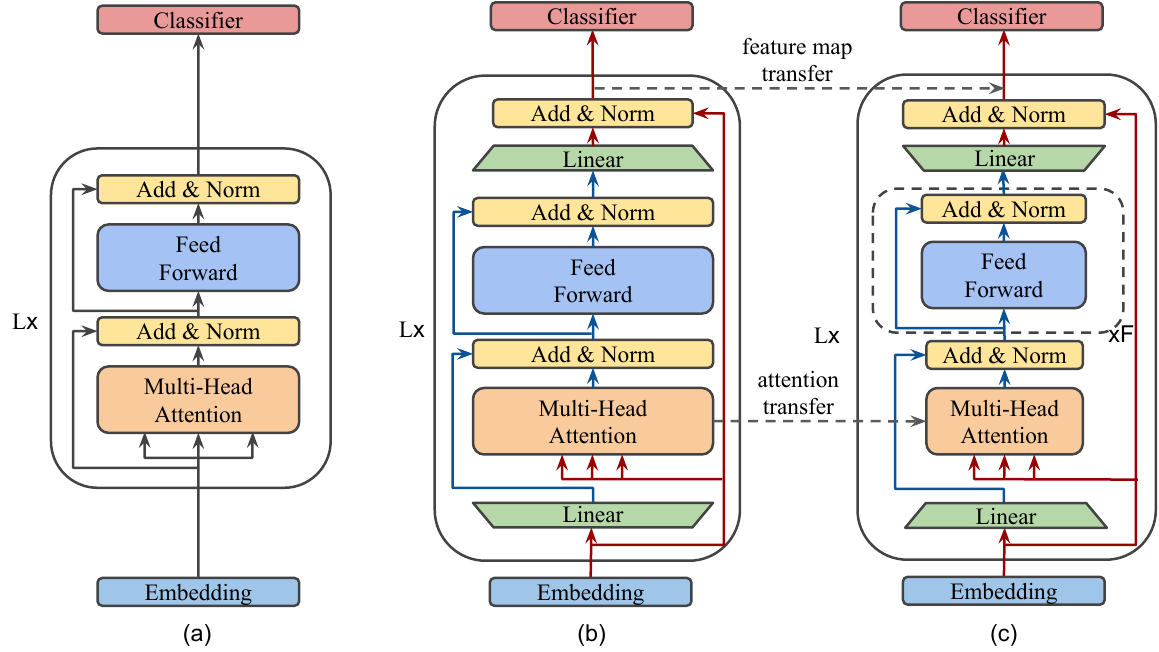
Source figure: Sun et al., MobileBERT, Figure 1 from the revision-pinned source archive. The figure shows BERT, IB-BERT, and MobileBERT block topology, including feature-map and attention transfer. It is paper-local architecture evidence, not a claim that these blocks are optimal for modern decoder-only runtimes.
The paper’s teacher, IB-BERT, preserves a large intra-block representation while exposing a 512-wide inter-block feature map. The MobileBERT student also exposes a 512-wide inter-block feature map but compresses its intra-block path to 128. That common interface allows direct layer-wise feature comparison:
even though the internal block coordinates and parameter counts differ. This is architecture co-design for transfer, not a learned hidden projection added after the student has been chosen.
The revision-pinned paper and official configuration describe the principal MobileBERT student as:
blocks L                         24
inter-block residual width u    512
intra-block bottleneck width b  128
attention heads                 4
FFN intermediate width f        512
stacked FFNs per block m        4
token embedding width d_e       128
trigram embedding input         enabled
normalization                   NoNorm in the released optimized config
activation                      ReLU
source-reported total           25.3M parameters
This graph cannot be reconstructed from the tuple used for ordinary BERT. It has two residual coordinate widths and multiple FFNs per block.
Source-to-code weight trace
In the pinned official
modeling.py,
the released student configuration follows this path:
prev_output [B,S,u]
    -> input bottleneck [B,S,b]                    weight u*b
    -> shared Q/K bottleneck from prev_output      weight u*b
    -> Q and K projections b -> b                  weight 2*b^2
    -> V projection u -> b                         weight u*b
    -> attention output projection b -> b          weight b^2
    -> m stacked FFNs b -> f -> b                  weight 2*m*b*f
    -> output bottleneck b -> u                    weight b*u
    -> residual with prev_output [B,S,u]
Under that exact path, and excluding biases, normalization parameters, embeddings, heads, and task state, one block has
The terms are input bottleneck, shared Q/K bottleneck, value projection, and output bottleneck. The terms are Q, K, and attention output projections. The final term contains all FFN up/down pairs.
For :
weight elements per block, or
before the excluded state. This is a code-contract cross-check, not a reconstruction of the paper’s full source-reported M total. Exact reconciliation must add trigram embedding projection, embeddings, biases, NoNorm parameters, pooler/head state, and aliases from the same pinned implementation.
The official code also rejects before attention construction. That assertion belongs in the architecture manifest:
Using would describe a different head geometry.
0x05G MobileBERT AKT, JKT, And PKT Are Different Schedules
The MobileBERT paper holds the broad teacher/student architecture fixed and compares three ways to schedule its layer-wise feature and attention targets.
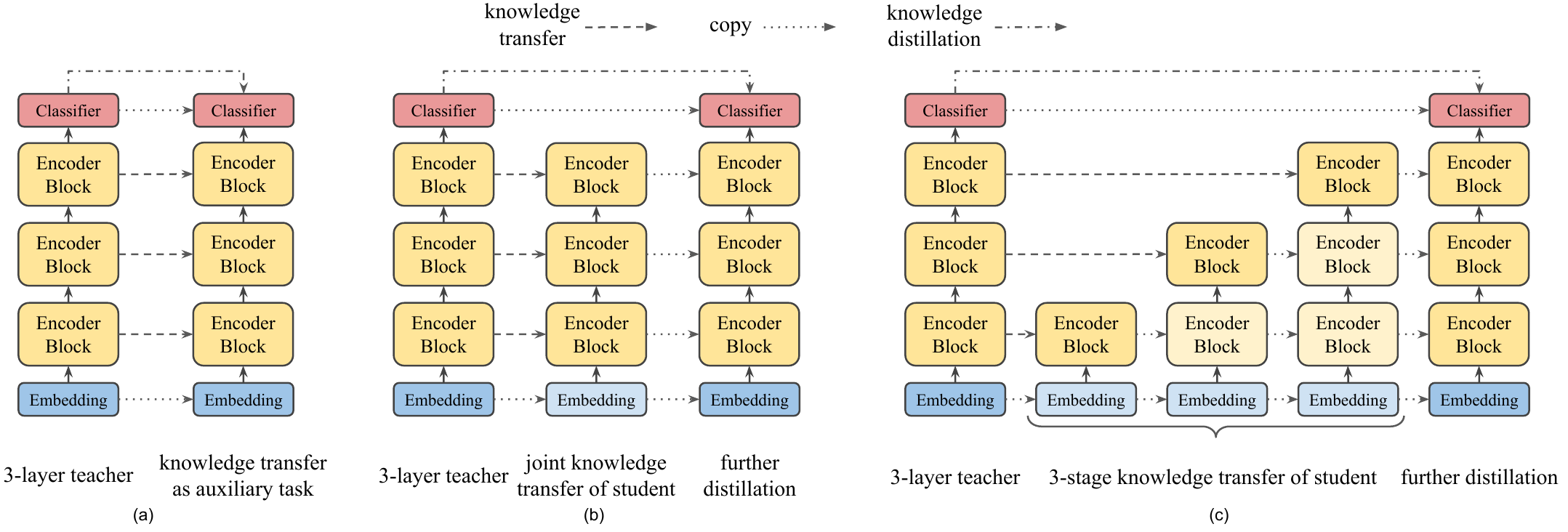
Source figure: Sun et al., MobileBERT, Figure 2 from the revision-pinned source archive. Dashed arrows denote knowledge transfer, dotted arrows denote copied state, and lighter blocks denote frozen state in that stage. Reported accuracy and speed results remain source-reported.
The paper defines feature-map and attention targets at layer :
and pretraining distillation
Loop 4 owns the target-object and reduction caveats. Here the new object is the schedule:
| Strategy | Layer-wise transfer | Pretraining distillation | Frozen/copied state |
|---|---|---|---|
| AKT | all layer losses act as auxiliary terms | optimized in the same combined objective | no separate layer-transfer stage |
| JKT | all layer losses optimized jointly first | a later PD stage | embedding and classifier copied for the staged paper path |
| PKT | one layer-transfer stage per depth | a later PD stage | lower layers frozen, or softened to a smaller learning rate, while the current layer is trained |
These are not algebraic rearrangements of one sum. They produce different optimizer trajectories and checkpoint boundaries. In particular:
for a non-convex network and finite optimizer schedule.
The pinned official code computes . Its helper constructs piecewise values around each layer’s phase. The loss call uses the helper in binary mode, thresholding those values at , so the layer-wise loss gate is effectively active only in its selected phase:
Do not infer the complete parameter-learning-rate schedule from that loss gate. The training script separately invokes an optimizer with layer-wise warmup enabled, while the paper states that lower layers may be frozen or updated with a smaller learning rate. A faithful implementation must pin both the loss gate and optimizer multiplier for every parameter group.
The paper source-reports a 500k-step teacher/pretraining schedule and an additional 240k progressive-transfer steps over 24 layers. Those numbers are paper evidence, not a recommended modern default.
0x05H Alignment State Can Be Larger Than It Looks
Return to the running decoder example with teacher width , student width , and four mapped hidden layers. One independent dense projection per mapped layer contains
parameters. At FP16, projection weights alone occupy MiB. A common mixed-precision Adam layout with FP16 weights/gradients and FP32 master, first-moment, and second-moment state can approach 16 bytes per trainable parameter, or MiB for these adapters. Exact optimizer layouts differ, so this is a planning ledger rather than a universal framework constant.
The state must be classified correctly:
| State | Trainable? | Checkpointed for resume? | Exported with student? |
|---|---|---|---|
| student weights | yes | yes | yes |
| student optimizer state | optimizer | yes during training | no |
| frozen teacher weights | no | by reference/revision | no |
| hidden projections | yes | yes | normally no |
| learned head/layer map | if used | yes | normally no |
| fixed layer/token masks | no | configuration/provenance | no |
Sharing one projection across mapped layers lowers parameter state but assumes all student layers use a common coordinate transform into all matched teacher layers. Low-rank projections lower training state but constrain the alignment map. Relation transfer removes raw width projections but can create quadratic-in-sequence temporary tensors. The correct choice follows the memory and geometry budget, not the desire to avoid one extra module.
Let
For one declared mixed-precision optimizer layout, define:
Then the persistent trainable state is
This formula is preferable to saying “Adam costs 16 bytes per parameter” because it exposes the actual assumptions. FP16 forward weights and gradients, an FP32 master copy, and two FP32 moments give
bytes per trainable parameter. BF16 without a master copy, fused state, 8-bit moments, sharding, offload, and gradient accumulation change this ledger. A frozen teacher adds
but no teacher gradient or optimizer terms when its graph is correctly detached.

The visual separates three questions:
ownership:
    who creates, updates, and checkpoints the state?

liveness:
    between which execution events must the state remain resident?

export:
    which state is needed to execute the student after training?
Conflating them produces common errors: counting frozen teacher optimizer state, omitting teacher target activations, or exporting training-only alignment modules.
0x05I Activation Liveness, Streaming, And Peak
With , , four selected teacher layers, , and two-byte elements, the selected hidden-state payload is
The four student source tensors at add MiB. Materializing all four projected student tensors at adds another MiB. The matched hidden path can therefore expose about GiB of payload before the rest of either model, backward activations, allocator overhead, or loss temporaries are counted.
This does not mean every implementation pays the full sum simultaneously. The ledger shows what must be scheduled:
retain all teacher layers
    simple code, high activation lifetime

stream one teacher target and loss at a time
    lower lifetime, more model/hook coordination

recompute selected teacher layers
    lower storage, higher teacher compute

cache hidden targets offline
    lower repeated teacher compute, large versioned artifacts

replace raw states with final-layer relations
    fewer layers, but [S,S] temporary state
Teacher no_grad() removes its autograd graph, not the need to hold target
activations. Student hidden states remain connected to backward. Projection
outputs also remain live unless the loss is formed and released immediately.
Peak memory must be measured around the actual objective schedule rather than
estimated from teacher parameters alone.
For each live object , record byte size , production event , and final-consumer event . Peak memory is
The GiB calculation is therefore an exposed-payload upper ledger for one eager materialization schedule, not an automatic peak. A streamed schedule can shorten teacher and projected-student lifetimes:
teacher_handles = install_selected_layer_hooks(teacher, layer_map.values())
student_handles = install_selected_layer_hooks(student, layer_map.keys())

with no_grad():
    teacher.forward(batch)

student_loss = student.forward_hard_objective(batch)
for s_layer in ordered_student_layers:
    t_layer = layer_map[s_layer]

    teacher_target = teacher_handles.pop(t_layer)       # detached [B,S,dT]
    student_state = student_handles.pop(s_layer)        # autograd [B,S,dS]
    projected = align[s_layer](student_state)           # autograd [B,S,dT]

    student_loss = student_loss + hidden_loss(projected, teacher_target)
    release(teacher_target)
    release(projected_when_graph_allows())

student_loss.backward()
This pseudocode is still a contract sketch. Some frameworks retain the projected tensor for backward; releasing the Python reference does not free storage that autograd saved. Hooks may also keep teacher outputs alive until the whole forward returns. A real implementation must inspect allocator snapshots and saved-tensor state around each event.
Checkpointing and caching trade different resources:
| Policy | Teacher forward compute | Device target lifetime | External artifact | Invalidation surface |
|---|---|---|---|---|
| retain all selected layers | once per batch | long | none | runtime code |
| stream loss by selected layer | once per batch | shorter if hooks permit | none | schedule/hook code |
| recompute selected teacher regions | more than once | short | none | teacher graph and RNG |
| cache teacher targets offline | once per artifact build | loaded slice only | potentially very large | teacher, tokenizer, data, target schema |
| use last-layer relations | once per batch | fewer layers, possible state | none or relation cache | relation contract |
Loop 8 owns cached-artifact schemas. Loop 9 owns distributed placement and whether streaming actually overlaps teacher and student execution.
The deployment ledger remains separate. From 0x00, the toy teacher’s 32 blocks at contain about billion simplified gated projection parameters, while 16 student blocks at contain about billion. Alignment projections can add hundreds of MiB to training yet still add zero bytes to a student-only export. Conversely, if the student architecture remains 32 layers at the teacher widths, deleting the alignment state after KD does not make the deployed graph smaller.
0x05J Capacity Gap Is Not One Scalar
It is tempting to assume that the largest, most accurate teacher is always the best source for a fixed student. Teacher Assistant Knowledge Distillation provides evidence against that universal rule: in the paper’s CNN/ResNet experiments, student performance can degrade as the capacity gap grows even while teacher accuracy improves. The proposed repair is a staged path:
large teacher T
    -> distill intermediate-capacity assistant A
        -> distill deployment student S
The assistant is a complete trained model, not a hidden-width projection. This adds at least one training stage, checkpoint, evaluation gate, and set of teacher targets. A chain of assistants adds more. The paper’s evidence is source-reported for its evaluated image-classification architectures; it supports capacity gap as a design risk, not a theorem that every language model needs an assistant.
Represent the gap as a vector rather than a parameter ratio:
Two teacher/student pairs with the same parameter ratio can differ in every component. A width gap threatens coordinate targets. A tokenizer gap threatens token KL. An objective/data gap can make a same-shape teacher provide poor supervision. “Capacity gap” is therefore a diagnosis category, not a sufficient intervention rule.
Several mechanisms can contribute to a gap:
student cannot represent the teacher function closely
teacher outputs are too sharp to expose useful alternatives
raw hidden coordinates are poorly aligned
target set does not cover the student's failure contexts
objective weights demand mutually incompatible matches
A teacher assistant directly changes the function being imitated at the final stage. Temperature changes output smoothness. Projections change coordinate compatibility. On-policy data changes visited prefixes. These are alternative interventions on different contracts; they should be diagnosed separately.
MiniLM reports that a teacher assistant helped its smaller Transformer students. That does not collapse MiniLM and teacher-assistant KD into one method: the relation objective defines what is transferred, while the assistant defines which model supplies that target at a stage.
0x05K Teacher-Assistant Paths Add Models, Runs, And Artifacts
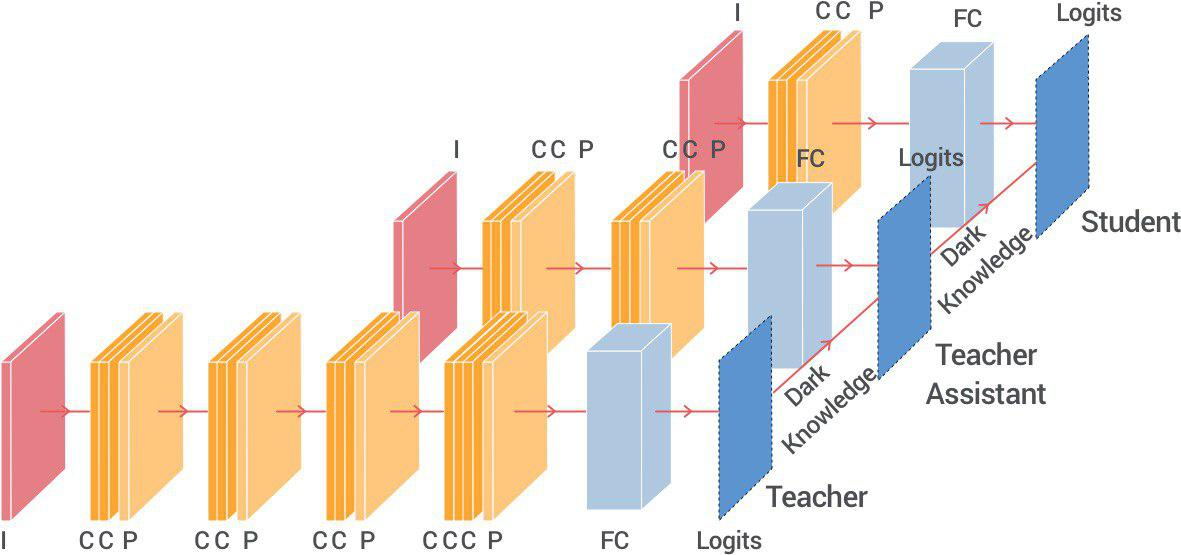
Source figure: Mirzadeh et al., Improved Knowledge Distillation via Teacher Assistant, Figure 1 from the revision-pinned source archive. The experiments are primarily CNN/ResNet classification experiments. The figure motivates a staged teacher-assistant path; it does not establish a universal language-model ordering theorem.
Write a -stage path as
Its training cost is not the cost of the final stage:
It also creates a lineage:
With candidate assistants ordered between teacher and student, choosing any ordered subset yields possible paths, including the direct path. That is a search-space count, not evidence that every subset should be trained. The paper’s appendix proposes principles and a dynamic-programming view under empirical assumptions; the authors explicitly distinguish those principles from theorems. This article therefore does not promote its path heuristic to a general law.
An equal-budget comparison must charge the chain for everything it adds:
| Ledger | Direct | |
|---|---|---|
| training runs | 1 | 2 |
| trained deployment candidates before final choice | 1 | assistant + student |
| teacher forward programs | during one stage | during stage 1, during stage 2 |
| resumable checkpoints | one stage lineage | two stage lineages |
| evaluation/promotion gates | one | at least two |
| final serving graph | still |
The assistant earns its place only if final-student quality or optimization reliability improves enough to justify those added resources. A smaller teacher, a smoother temperature, relation targets, better data, or on-policy prefixes may address a different diagnosed component at lower cost.
0x05L Architecture-To-Training Implementation Contract
Before model construction, freeze a machine-readable manifest:
student_spec = {
    "architecture_revision": "...",
    "layers": L,
    "vocab_revision": "...",
    "vocab_size": V,
    "position_contract": {"type": "learned", "size": P},
    "token_type_size": T,
    "embedding_width": d_e,
    "residual_width": d,
    "ffn_width": d_ff,
    "query_heads": H_q,
    "kv_heads": H_kv,
    "norm": {"type": "layer_norm", "placement": "post"},
    "activation": "gelu",
    "bias_policy": "bert_dense_bias",
    "weight_aliases": [["emb.token.weight", "mlm.decoder.weight"]],
    "pooler": True,
}
Then resolve the initialization plan against actual tensors:
def resolve_initialization(student, sources, plan):
    resolved = []
    for rule in plan:
        dst = student.tensor(rule.dst_name)
        src = sources[rule.source_id].tensor(rule.src_name)

        assert tuple(src.shape) == tuple(rule.expected_source_shape)
        assert tuple(dst.shape) == tuple(rule.expected_destination_shape)
        assert semantic_role(src) == rule.source_role
        assert semantic_role(dst) == rule.destination_role

        value = apply_declared_transform(src, rule.transform)
        assert tuple(value.shape) == tuple(dst.shape)
        copy_(dst, cast(value, rule.destination_dtype))

        resolved.append({
            "dst": rule.dst_name,
            "src": [rule.source_id, rule.src_name],
            "transform": rule.transform,
            "source_sha256": tensor_sha256(src),
            "destination_sha256": tensor_sha256(dst),
        })
    return resolved
A rule with transform="slice_first_d" is not equivalent to
transform="identity". It must be evaluated and versioned as an
initialization algorithm. Unmatched student tensors require an explicit
initializer; unmatched teacher tensors are expected when depth is reduced.
At runtime, build four disjoint parameter sets:
Only student and declared alignment tensors enter the optimizer. An assertion should reject both missing trainable state and accidental teacher gradients:
optimizer_ids = ids(optimizer.parameters)
assert optimizer_ids == ids(student.trainable) | ids(alignment.trainable)
assert not (optimizer_ids & ids(teacher.parameters))
assert all(not p.requires_grad for p in teacher.parameters())
0x05M Export And Resume Invariants
Training should fail early when architecture and target contracts disagree:
assert set(student_to_teacher) == set(requested_student_layers)
assert max(student_to_teacher) < student.num_layers
assert max(student_to_teacher.values()) < teacher.num_layers

for s_layer, t_layer in student_to_teacher.items():
    assert alignment[s_layer].in_features == student.hidden_size
    assert alignment[s_layer].out_features == teacher.hidden_size

assert relation_head_contract(teacher, student, head_map)
assert tokenizer_contract(teacher_tokenizer, student_tokenizer, token_loss)
A resumable checkpoint needs:
student parameters
student optimizer and scheduler
alignment projection/head-map parameters
alignment optimizer state
teacher revision and tokenizer revision
layer map and loss weights
normalization, mask, and reduction contracts
data/cache position and RNG state
A deployment export should prove the opposite boundary:
artifact = export_student_only(student)
loaded = load_student_without_teacher_or_alignment_modules(artifact)

assert loaded.parameter_count == expected_student_parameters
assert not contains_prefix(artifact.state_dict, "teacher.")
assert not contains_prefix(artifact.state_dict, "alignment.")
assert student_only_quality_gate(loaded)
assert student_only_runtime_gate(loaded)
The first list preserves the training objective after interruption. The second proves that training-only state has not become an undeclared serving dependency.
Resume equivalence requires more than loading tensors. Let the training state at update be
where is optimizer state, is scheduler state, is RNG state, is data/artifact cursor, and contains the teacher, tokenizer, architecture, initialization, target, mask, and reduction manifests. A resume test should compare the next update from uninterrupted and restored state:
within the declared deterministic or numerical tolerance. Merely loading the student without error does not test resume.
The deployment artifact has the inverse inclusion rule:
and excludes , hooks, and training data cursors. If an alignment projection is needed during serving, it was not training-only and must be incorporated into , recounted, and benchmarked.
0x05N Paper-By-Contract Comparison
The papers below do not answer one interchangeable question:
| Method | Student architecture | Starting state | Main transfer interface | Stage structure | Serving consequence |
|---|---|---|---|---|---|
| DistilBERT | half-depth, same principal hidden dimensions; token-type embeddings and pooler removed | every-other teacher-layer copy | MLM + output KD + cosine hidden alignment | pretraining distillation | student only |
| Well-Read Students | grid of compact Transformer depths/widths | independently pretrained compact model | black-box teacher output transfer in the paper setup | compact pretrain, distill, optional fine-tune | student only |
| TinyBERT | four-layer narrow and six-layer same-width variants | general-distilled compact checkpoint | embedding, hidden, attention-score, and prediction targets | general KD then task KD with augmentation | student only |
| MobileBERT | deep/thin bottleneck student with co-designed IB-BERT teacher | copied interfaces plus staged transfer under the paper recipe | common inter-block features, attention maps, MLM KD | AKT, JKT, or PKT plus PD | student only; altered operations affect runtime |
| MiniLM | smaller student, paper variants include teacher-assistant use | task-specific paper recipe | last-layer QK and VV relations | relation KD, optionally from an assistant | student only |
| Teacher Assistant KD | ordered capacity chain in CNN/ResNet evidence | each stage starts a complete student model | stage-local output KD | final student only; extra training artifacts |
This table prevents several invalid comparisons:
DistilBERT versus TinyBERT:
    not only one hidden loss versus another;
    architecture, initialization, data, targets, and stages differ.

TinyBERT versus MobileBERT:
    not only shallow versus deep;
    MobileBERT co-designs teacher interfaces and block topology.

direct KD versus teacher-assistant KD:
    not one loss versus another;
    the latter adds complete models and training runs.

same parameter count:
    not an equal deployment contract;
    depth, width, operations, and target runtime still differ.
Any source-reported benchmark belongs beside its exact architecture, data, teacher, schedule, hardware, and measurement surface. Loop 5 does not reproduce those training runs.
0x05O Failure Closure
| Failure | Observable symptom | Broken contract | Required repair |
|---|---|---|---|
| approximate total copied from paper but graph differs | checkpoint count mismatch | architecture/accounting | enumerate named unique tensors and aliases |
| tied embedding counted twice | logical parameters exceed unique storage | alias contract | group semantic names by storage identity |
| layer copy checks shape only | model loads but behavior degrades immediately | initialization semantics | validate role, ordering, norm, position, and transform |
| silent slice or transpose during load | non-reproducible starting state | initialization provenance | name and hash the transform |
| student graph unchanged | no structural serving saving | deployment graph | choose and benchmark an actual smaller/different graph |
| frozen teacher enters optimizer | unexpected gradients/state growth | ownership | assert optimizer parameter-set equality |
| teacher uses no-grad but targets are all retained | out-of-memory despite frozen teacher | liveness | stream, recompute, or cache under a measured schedule |
| all created activations are summed as peak | pessimistic and unauditable capacity estimate | liveness interval | compute maximum overlap by event |
| projected targets exported accidentally | teacher-free artifact fails to load or grows | export boundary | strip training-only modules and reload in a clean process |
| correction made by temperature only | hidden/token/data mismatch persists | capacity diagnosis | identify which gap component failed |
| assistant credited without charging first stage | apparent quality gain under unequal budget | path accounting | include all runs, artifacts, and gates |
| MobileBERT loss gate treated as optimizer schedule | wrong parameters update in each phase | schedule contract | pin loss gate and parameter LR separately |
| paper parameter/latency number generalized | runtime prediction fails | source-report scope | reproduce on declared graph, runtime, and hardware |
The deterministic Loop 5 oracle checks architecture arithmetic, initialization maps, aliasing, state ownership, liveness intervals, teacher-assistant path cost, and student-only export. It does not train any cited model, execute a framework autograd graph, reproduce a benchmark, or validate a production runtime.
0x05P Loop Boundary
Intermediate transfer and student shape now have explicit contracts:
depth        -> layer selection g(m)
width        -> projection, compatible coordinates, or relation target
heads        -> equal layout, aggregation, map, or relation-head design
tokens       -> shared positions, masks, and output support
initialization -> starting state, separate from continuing supervision
capacity gap -> direct teacher or staged teacher-assistant path
runtime      -> teacher activations + student graph + training-only alignment
export       -> student alone
Loop 5 has established the complete graph-and-state contract:
where the architecture, initialization, resumable training state, liveness schedule, and optional multi-stage path are all versioned separately. This is the precondition for comparing supervision artifacts fairly.
The next loop will change a different axis: the supervision artifact and the prefix distribution. Sequence-level KD replaces a full local teacher distribution with teacher-generated trajectories, while on-policy methods ask the teacher to score contexts generated by the student. Neither can be derived by simply adding another hidden-state loss.
0x06 Sequence-Level And Black-Box Distillation
Owner question. What exactly can be transferred when the teacher returns generated text rather than weights, hidden states, or a complete vocabulary distribution, and what state must exist before that text becomes a valid student-training row?
Loop 6 changes the supervision object. It consumes the student graph and state contracts closed in 0x05, but it does not change the student architecture. It owns complete-sequence objectives, black-box access levels, generated labels, rationales, explanations, prompts, proxy distributions, and the semantic identity of one generated artifact. It deliberately defers four adjacent problems:
0x07  student-generated token prefixes, MiniLLM, GKD, and divergence direction
0x08  physical corpus layout, sharding, compression, filtering jobs, and revisions
0x09  distributed teacher placement, online hooks, collectives, and scheduling
0x11  final quality gates, deployment promotion, release, and rollback
The sources in this loop establish different contracts rather than one linear history:
| Source | Contract used here | Status and ceiling |
|---|---|---|
| Sequence-Level KD | exact sequence objective, mode, K-best, Monte Carlo, and reference-near interpolation | Externally verified paper contract; NMT results remain source-reported |
| Distilling Step-by-Step | label and rationale as distinct task-conditioned targets | Externally verified paper and commit-pinned code contract |
| Orca | system-conditioned explanation traces and progressive teachers | Externally verified paper contract; data sizes and outcomes are source-reported |
| Self-Instruct | instruction, input, and output generation plus similarity filtering | Externally verified paper and commit-pinned code; adjacent synthetic-data method, not automatically KD |
| Lion | imitation, student-aware discrimination, and hard-instruction generation | Externally verified paper and commit-pinned code; paper-specific referee policy |
| Proxy-KD | black-box hard sequences plus an aligned white-box proxy distribution | Externally verified paper contract; proxy logits are never promoted to teacher logits |
0x06A Black-Box Is An Access Contract, Not A Model Size
A model is black-box with respect to a particular caller. A hosted API may return only text, text plus a sequence score, chosen-token log probabilities, a top- list, or a full logit tensor. Those interfaces expose different random variables and support different losses.
| Returned object | Smallest faithful artifact | Objectives it can directly support | It cannot establish |
|---|---|---|---|
| one text response | raw response bytes plus generation identity | hard sequence NLL, label/rationale/explanation generation | alternatives, teacher entropy, full KL, hidden transfer |
| responses plus calibrated sequence log probabilities | candidate rows and their exact score semantics | finite-support sequence expectation | probability mass outside the retained set |
| chosen-token or top- log probabilities | sparse row events plus residual-mass policy | path scoring or sparse-logit approximation | unseen token identities and their individual probabilities |
| full ordered-vocabulary logits | [valid_rows, V_T] tensor plus support map | word-level cross-entropy, KL, entropy, temperature | hidden-state or relation targets |
| hidden/attention tensors | layer-named tensors plus projections and maps | 0x04 intermediate transfer | black-box portability |

The access levels are ordered by information, but the arrow is not an inverse. Given one returned string , there are infinitely many teacher distributions for which is the selected output. Neither the tail mass nor its allocation over alternative sequences is identifiable from that string. Calling hard-label instruction tuning “black-box KD” describes the lineage of the target; it does not make the hard target algebraically equivalent to Hinton-style full-distribution KD.
This distinction also prevents a common Proxy-KD overclaim. Proxy-KD obtains text from a black-box teacher and logits from a separately trained white-box proxy. The proxy logits may be useful supervisory state. They are still samples from , not recovered calls to an unavailable logit interface.
0x06B The Exact Sequence Objective Is An Expectation Over Stopping Paths
For prompt or source sequence and output , include EOS in . The autoregressive sequence probability is
Variable-length generation means that contains both token choices and stopping paths. Omitting EOS changes the sample space and removes the teacher’s length decision from the objective.
If and denote teacher and student sequence distributions, their sequence cross-entropy is
Substitute the student factorization:
so
Regroup the expectation by visited prefix . Let be the teacher-induced occupancy measure, including the probability that the trajectory survives to that row. Then
This identity separates two independent choices:
prefix occupancy:     which contexts receive weight?       d_T(c)
local target:         what distribution is matched there?  p_T(.|c)
Word-level KD on human references uses reference-prefix occupancy. Sequence distillation uses teacher-generated occupancy. Loop 7 will use current-student occupancy. Forward versus reverse KL changes the local divergence; it does not, by itself, choose the prefix distribution.
The exact sum is exponential. Kim and Rush therefore do not compute it. They define it, then study estimators and support-reducing approximations.
0x06C Sampling, Mode Decoding, And K-Best Lists Approximate Different Objects
Monte Carlo Preserves The Expectation, Not Every Batch
If are independent samples from the declared teacher distribution, then
is unbiased:
The condition matters. Samples from a top-, top-, constrained, filtered, or temperature-modified decoder come from , not necessarily . Without importance weights and support coverage, they estimate . In practical black-box distillation that policy-defined distribution is often the intended teacher, but it must be named.
One Decoded Sequence Is A Delta Approximation
Let
where contains the complete search, sampling, stopping, and reranking contract. Replace the sequence distribution by a point mass:
Then
The last line is ordinary teacher-forced maximum likelihood on a synthetic target. The unchosen token probabilities have disappeared. Beam search does not repair that information loss; it selects the point at which the delta mass is placed.
Kim and Rush use beam search as an approximate mode finder. Their paper itself reports that a greedy candidate accounted on average for only and of sequence mass in its two translation directions, and a beam-five list for and . Those paper-local numbers are evidence that the retained path can work empirically in that setup, not evidence that one mode contains the full teacher distribution.
A Renormalized K-Best Loss Has A Missing-Mass Term
For retained set , define
and, only when the stored scores are calibrated log probabilities under one common sequence policy,
Split the exact objective into retained and tail support:
This derivation shows what renormalization does: it conditions the teacher on the retained list, drops the tail expectation, and usually drops the factor . If the API returns only a beam ranking score, a length-normalized score, or a reranker score, is not even identifiable. Keep these fields separate:
raw token log-probability sum
length-normalized model score
search score after constraints or penalties
reranker score
candidate rank
0x06D Sequence-KD And Sequence Interpolation Select Different Training Rows
The original paper defines multiple programs, not one generic SeqKD switch:
| Method | Occupied prefix during student training | Local target | Required teacher return | Artifact meaning |
|---|---|---|---|---|
| Word-KD | observed | full teacher token distribution | logits | local alternatives on reference prefixes |
| Seq-KD | decoded | hard decoded token | one selected sequence | approximate teacher-mode trajectory |
| Seq-Inter | selected beam candidate | hard selected token | beam list plus reference similarity | teacher-supported, reference-near trajectory |
| Seq-KD + Word-KD | decoded teacher prefix | hard token plus local distribution | sequence plus logits | global selected path and local alternatives |
For sequence interpolation, let be the teacher beam and the observed target. The paper’s implementable selection is
using smoothed sentence-level BLEU in its experiment. It does not interpolate token IDs. It chooses one complete teacher-supported candidate whose text is closest to the reference. The broader idealized criterion in the paper also includes teacher probability:
Changing similarity, beam width, tie-breaking, or reference normalization can change the selected target while leaving the student code untouched. Those are artifact-generation parameters.

The article’s primary-source Figure 1 near the historical introduction shows the paper’s Word-KD, Seq-KD, and Seq-Inter paths. The native diagram above adds the later occupancy boundary: a cached teacher path belongs here; a student-generated token prefix rescored during training belongs to 0x07.
0x06E Generation Configuration And Semantic Identity Are Target State
The same source prompt can produce different supervision after any of these changes:
source row or source schema revision
teacher provider, endpoint, returned model revision, or tokenizer if visible
rendered prompt, system instruction, demonstrations, and chat template
decode mode, temperature, top-k, top-p, beam width, and candidate count
length normalization, repetition/frequency penalties, constraints, and reranker
maximum tokens, stop strings, EOS policy, timeout, and seed when meaningful
normalizer, parser, safety policy, quality filter, and deduplication revision
student tokenizer, vocabulary, special-token, packing, and truncation revision
Define canonical semantic identity for artifact as a typed map of those fields. Serialize it with sorted keys, stable number encoding, UTF-8, and no volatile timestamps. The artifact key is
A cache row is reusable only when the expected and stored semantic identities are equal:
This is narrower than the physical corpus lifecycle owned by 0x08. Loop 6 defines what makes one supervision object the same object. Loop 8 will own how millions of such objects are serialized, partitioned, compacted, migrated, filtered, and versioned as a dataset.
Store provider-returned model identity separately from the requested alias. A
moving alias such as latest cannot by itself prove that two calls used the
same teacher state. If the provider exposes no immutable revision, record that
limitation and treat regeneration as a new empirical corpus rather than exact
reproduction.
0x06F Raw Teacher Text And Student Causal Tensors Are Different Artifacts
A text-only teacher and a student do not need the same tokenizer. The interchange object is raw text. Student token IDs are a derived cache tied to a particular student tokenizer and packing policy.
Let
After applying one explicit truncation policy, append EOS exactly once:
The causal tensors are
For response-only training, label row is valid when its shifted token belongs to the response or is its terminal EOS:
The first valid row is therefore the final prompt input row, because that row predicts the first response token. Masking according to the input segment instead of the shifted label segment silently drops that first target.

One deterministic toy row makes the shift auditable:
prompt IDs P:      [101, 102]
response IDs R:    [201, 202]
EOS:               [2]

packed z:          [101, 102, 201, 202, 2]
input_ids:         [101, 102, 201, 202]
labels:            [102, 201, 202, 2]
response mask:     [  0,   1,   1, 1]
Truncation is part of the target definition. A safe policy reserves terminal space before cutting content:
def pack_sequence_row(prompt_ids, response_ids, *, max_length, eos_id):
    prompt_ids = remove_terminal_eos(prompt_ids, eos_id)
    response_ids = remove_terminal_eos(response_ids, eos_id)

    # Policy choice: retain the full prompt if possible, then response prefix,
    # and always reserve one terminal EOS position.
    room_for_response = max_length - len(prompt_ids) - 1
    if room_for_response < 1:
        raise ArtifactError("prompt_leaves_no_supervised_response_row")
    response_ids = response_ids[:room_for_response]

    z = prompt_ids + response_ids + [eos_id]
    input_ids = z[:-1]
    labels = z[1:]
    first_response_label = len(prompt_ids) - 1
    loss_mask = [int(j >= first_response_label) for j in range(len(labels))]

    assert labels[-1] == eos_id
    assert sum(token == eos_id for token in labels) == 1
    assert labels[first_response_label] == response_ids[0]
    return input_ids, labels, loss_mask
Alternative policies may left-truncate a conversation, retain the answer tail, or reject overlong rows. They are not interchangeable. The artifact must record which semantic content was removed, not just the final tensor length.
0x06G Rationales Can Be Targets Without Becoming Inference Inputs
Text-only access can return more than an answer. Distilling Step-by-Step elicits a teacher label and rationale , then trains a smaller task-specific model with two task-conditioned outputs.
The label objective is
and the rationale objective is
The paper writes the combined objective as
The pinned official implementation at commit
ef944263c9ddfd40a9888557f3e7d17513fd1a7e constructs separate prediction and
explanation batches in model_utils.py:26-39, executes two forwards in
model_utils.py:49-53, and uses
For ,
so the relative coefficient corresponds to , but the whole loss is also scaled by . That outer scale preserves an unconstrained minimizer but changes gradient magnitude under a fixed learning-rate, clipping, weight-decay, or scheduler contract. Paper notation and executable weighting must both be recorded.
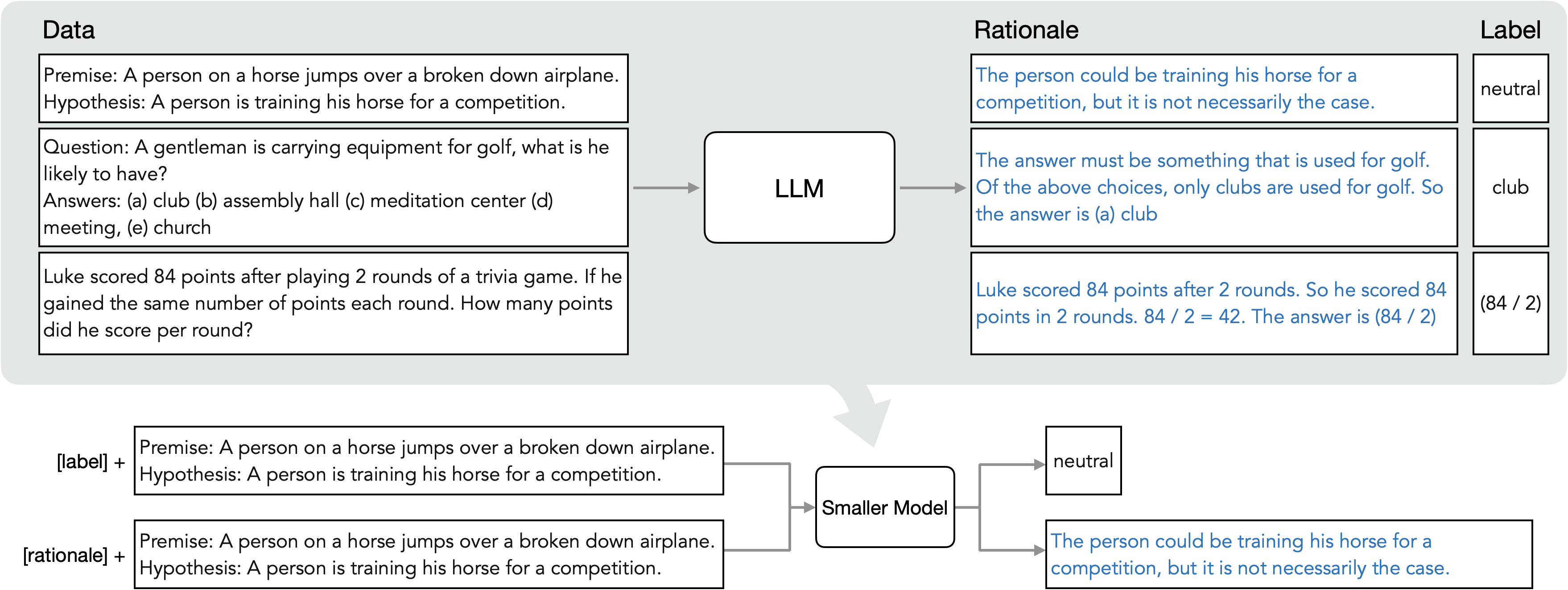
Source figure: Hsieh et al., Distilling Step-by-Step, arXiv:2305.02301v2, framework figure from the revision-pinned source archive. It establishes label-plus-rationale multi-task supervision. The source-reported data efficiency and model results are not reproduced here.
This design differs from supplying a rationale as an inference-time input:
input-rationale design:
    teacher generates rationale at deployment
    student predicts label from [x, rationale]
    teacher dependency remains

multi-task target design:
    rationale is auxiliary training output
    deployment can call [predict: x] without teacher or rationale
    student release remains teacher-independent
A generated rationale is evidence about teacher behavior, not automatically a faithful causal explanation. Parsing success, label-rationale consistency, factuality, and downstream usefulness require separate evaluation. Do not let a fluent rationale overwrite a correct label without an explicit conflict policy.
0x06H Explanation Tuning Changes Prompt State And Teacher Schedule
Orca uses richer explanation traces for general instruction following rather than the task-specific two-output interface above. One training row includes a system instruction , user instruction , optional task input , and teacher response :
The system instruction is not decorative metadata. It changes the desired response style and often the amount or form of explanation. Removing it while keeping the response creates a different conditional task.
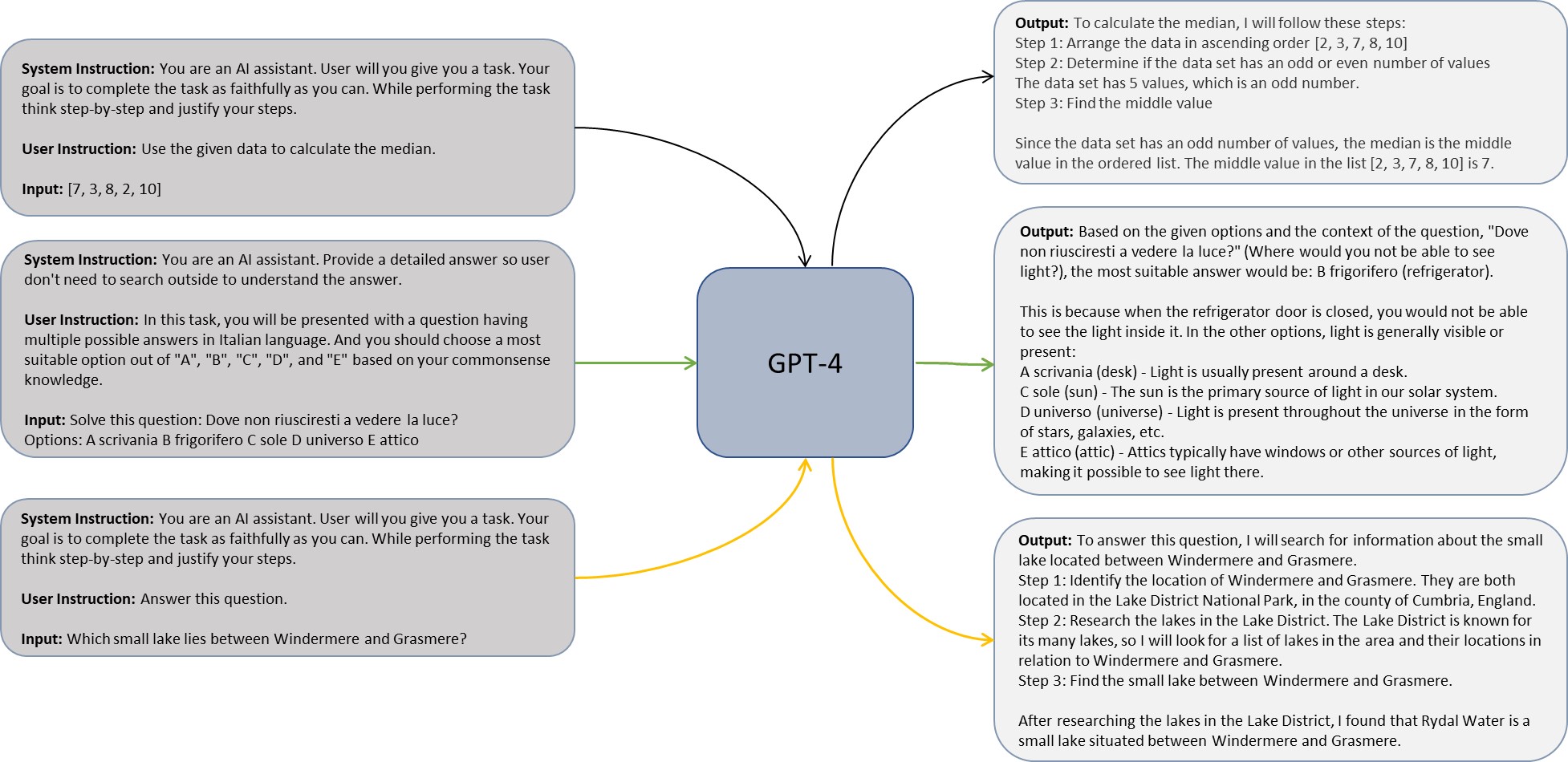
Source figure: Mukherjee et al., Orca, arXiv:2306.02707v1, explanation-tuning example from the revision-pinned source archive. It demonstrates that system instructions are part of the input contract and that explanation form varies with that contract. It is not evidence that generated reasoning is faithful or portable to another teacher.
Orca also uses a progressive teacher schedule. Abstractly, with a cheaper assistant corpus and a stronger-teacher corpus :
This order is training state. The paper reports five million ChatGPT-augmented rows followed by one million GPT-4-augmented rows. Those counts and its benchmark outcomes are source-reported; they are not a universal ratio. A fair cost ledger charges both generation phases and both student phases. Swapping the stages, mixing them from step zero, or using one teacher are alternative methods.
Orca’s assistant is also distinct from 0x05K’s classical teacher assistant. Here the intermediate teacher chiefly changes generated data, cost, and curriculum. It does not necessarily provide a differentiable bridge between a white-box teacher distribution and student distribution.
0x06I Generating Prompts Changes The Training Distribution, Not Only Labels
Response-only distillation fixes prompts and asks a teacher for . Synthetic instruction pipelines can also generate . Their artifact is therefore a joint object:
and their training distribution is a generated , not merely teacher labels on the original .
Self-Instruct Bootstraps A Task Pool
Self-Instruct starts from a seed task pool . At round , the generator samples demonstrations from the current pool, proposes instructions, classifies task type, creates instances, filters them, and adds accepted tasks:
owns the prompt and decode policy. owns parser, length, modality, consistency, and similarity rules. The paper’s diversity gate accepts a new instruction only if
The pinned implementation at commit
0b26ccaa415992100fa32df62d41b994cf928e23 loads prior generated rows and
resumes request_idx in bootstrap_instructions.py:140-149, samples two
machine and remaining human demonstrations at lines 163-171, declares the
generation policy at lines 173-187, and enforces the threshold at
lines 195-213. These are implementation-local choices, not mathematical
constants of synthetic data generation.
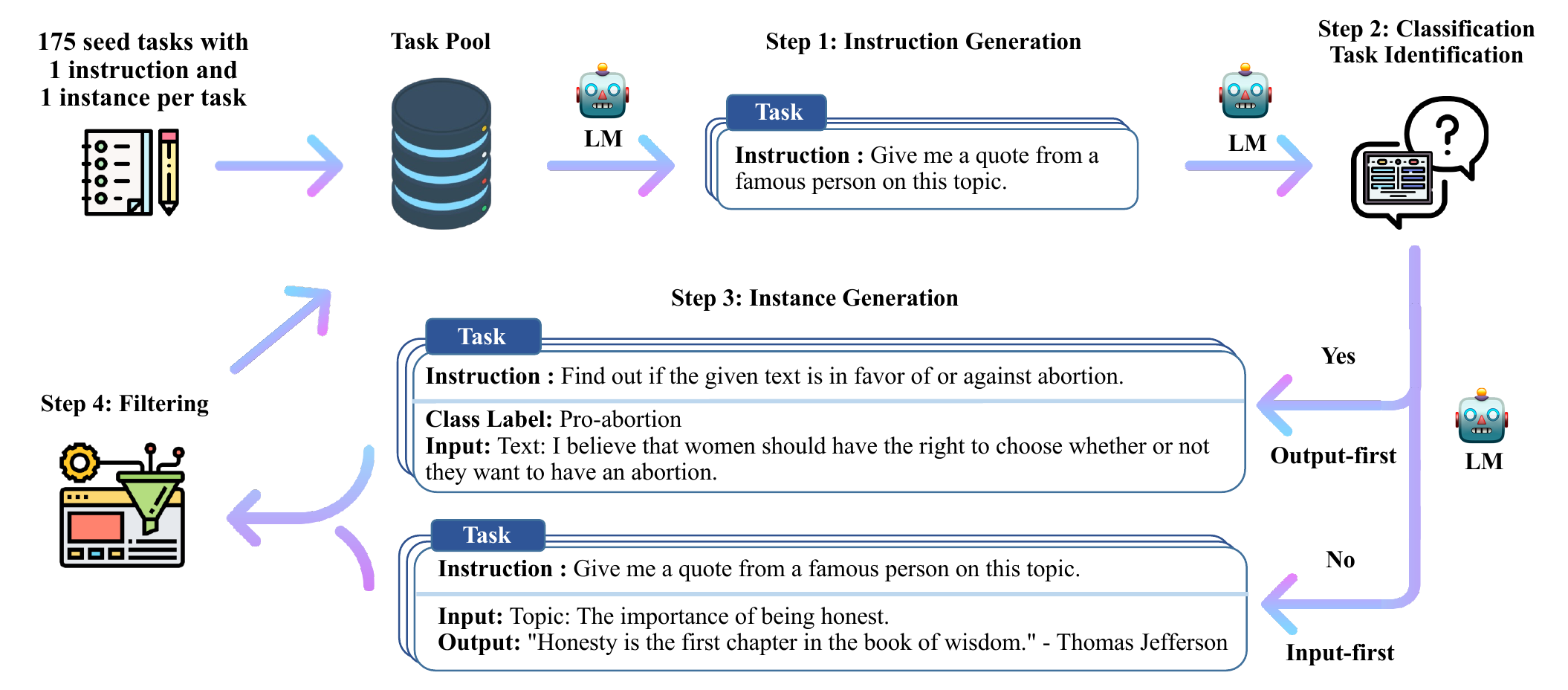
Source figure: Wang et al., Self-Instruct, arXiv:2212.10560v2, Figure 2 rendered from the revision-pinned source archive. Self-Instruct is included as a generated instruction-data contract. It is self-training in its original form and becomes black-box distillation only when a distinct stronger teacher supplies the supervision being transferred.
The generated task pool needs two non-collapsible identities:
lineage identity:
    which seed and previously accepted tasks influenced this generation?

training identity:
    which final instruction/input/output row trained the student?
Deduplicating only final responses misses duplicated instructions. Deduplicating only instructions misses conflicting outputs for the same input. Loop 8 will generalize those filters across the full corpus.
Lion Uses Student Failure To Generate New Instructions
Lion gives a proprietary model three paper-specific roles: teacher , referee , and generator . For cache prompt , let and be teacher and student responses. The official implementation evaluates both presentation orders and averages the aligned scores. Define
then
The pinned code at commit
0d94c4c7e2e5e545dc68253f6e242712b9e4edc0 computes the two-order averages in
src/discrimination.py:19-30 and uses the paper implementation’s
split at lines 47-51. The repository’s documented iteration is:
1. imitation
   query teacher on Train Pool
   train student on teacher responses

2. discrimination
   query teacher and student on Cache Pool
   referee both response orders
   split hard/easy prompts by score gap

3. generation
   generate new prompts from hard and easy seeds
   replace/add them to the next pool
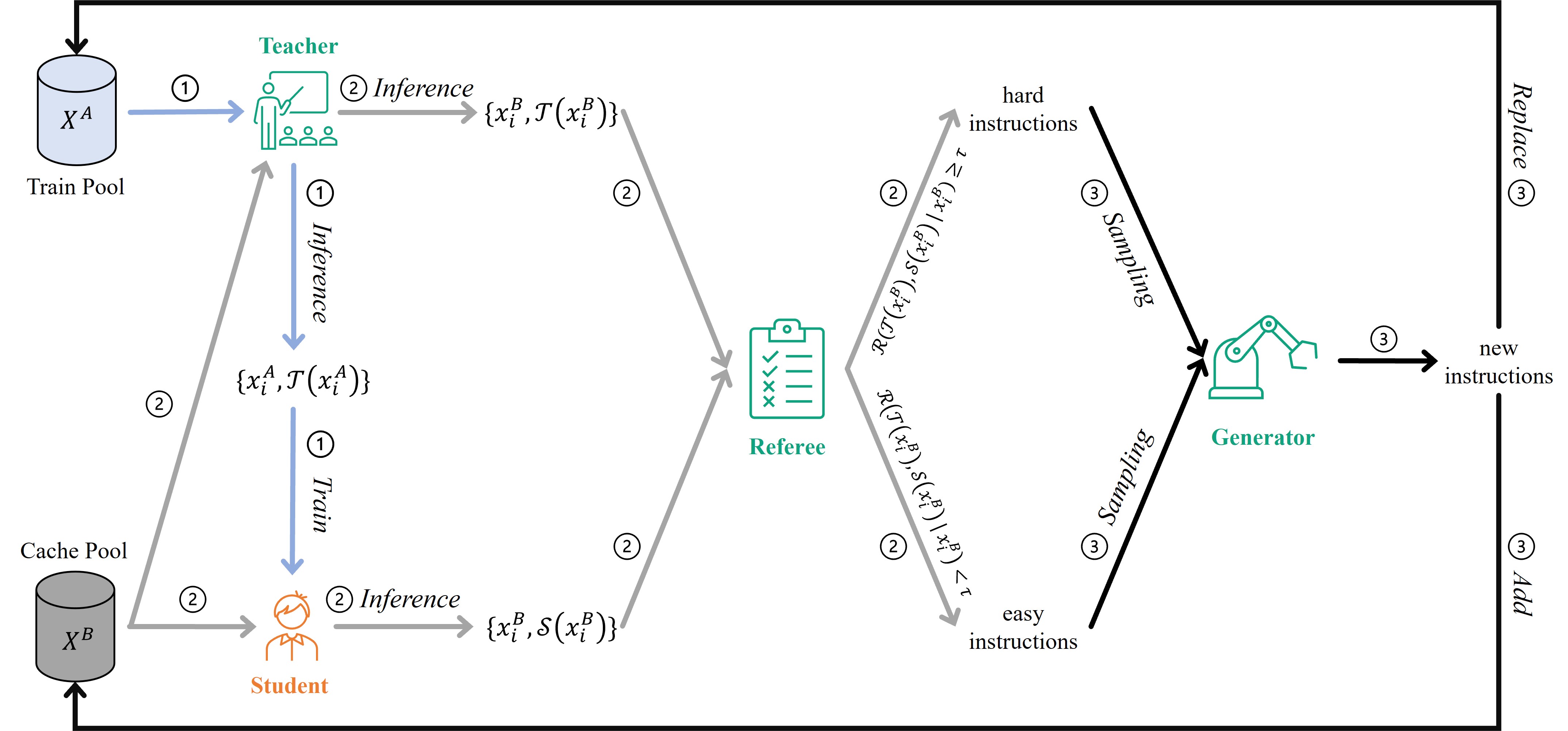
Source figure: Jiang et al., Lion, arXiv:2305.12870v2, method overview from the revision-pinned source archive. The teacher, referee, and generator are logical API roles even when one provider model serves all three. The threshold, judge reliability, data mix, and reported outcomes remain paper-specific.
Lion is student-aware, but its placement here is precise: student responses alter the future prompt pool. It does not, in the paper contract used here, ask the teacher for a full token distribution on every student-generated token prefix. The latter is the on-policy occupancy problem owned by 0x07.
0x06J Proxy-KD Adds A Surrogate Distribution And Another Training Program
When a black-box teacher returns only text, one alternative is to train a white-box proxy that imitates the teacher and then expose the proxy’s logits to the student. Proxy-KD makes that two-stage path explicit.
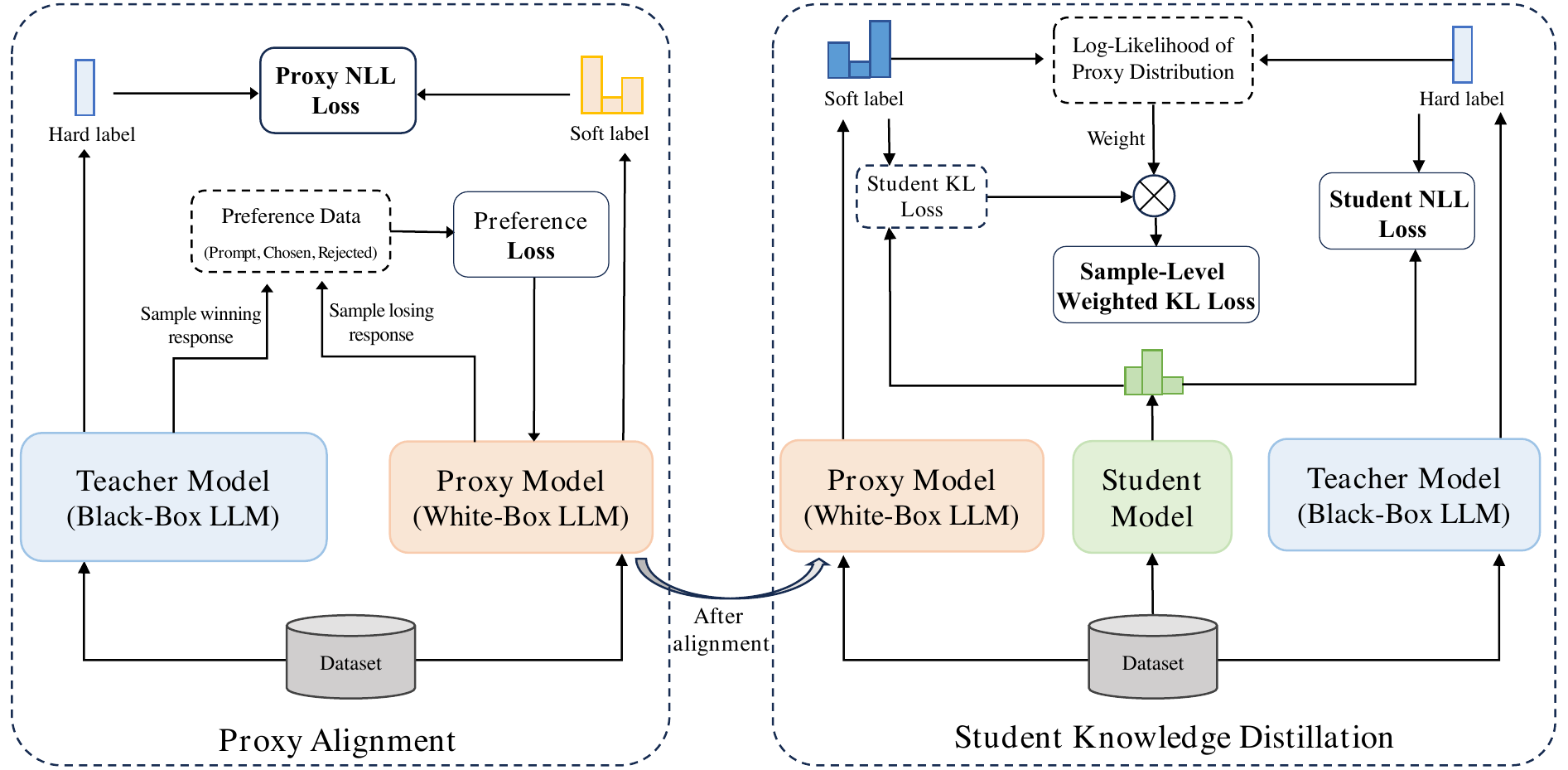
Source figure: Chen et al., Knowledge Distillation of Black-Box Large Language Models, arXiv:2401.07013v2, Figure 2 rendered from the revision-pinned source archive. It establishes the paper’s proxy-alignment and student-distillation stages. It does not establish that the proxy recovers the unavailable black-box teacher distribution.
Stage 1: Align The Proxy
For teacher-generated sequence , the proxy hard-label objective is
The paper also forms a preference pair from teacher response and proxy response . Under a standard DPO minimization convention with reference :
Thus
Teacher-over-proxy preference is a paper assumption and data-construction rule, not a human preference label. If the teacher fails on a prompt, the pair can align the proxy toward that failure.
Stage 2: Train The Student From Two Different Sources
The hard sequence still comes from the black-box teacher:
The soft row distribution comes from the proxy:
The paper downweights examples on which the proxy assigns low sequence likelihood to the teacher response. Let
Then
and
An executable implementation must define four details that the compact formula can hide:
- whether is a sum or length-normalized mean over response tokens;
- the valid-row mask and tokenizer/support alignment for proxy and student;
- the numerical fallback when or the calibration shard is tiny;
- whether and are frozen corpus statistics or moving estimates.
The paper’s 10/45/45 warm-up/proxy/student split is source-reported design state, not a universal prescription. Proxy-KD also incurs proxy generation, proxy alignment, proxy forward, and proxy storage costs. It is not “free soft labels” for a text-only API.
0x06K Every API Call Belongs To An Idempotent Transaction And Cost Ledger
A generation worker can time out after the provider completed a request but before the client committed the row. Blind retry can create two outputs with the same semantic identity. Exactly-once effects therefore require an idempotency key and atomic commit, even when the provider offers only at-least-once request execution.

One semantic record can retain the states needed by later loops without fixing their physical file format:
{
  "artifact_key": "sha256:...",
  "sample_id": "prompt-004219",
  "source_revision": "prompts@sha256:...",
  "teacher": {
    "provider": "provider-a",
    "requested_model": "teacher-alias",
    "returned_model": "teacher-revision-if-exposed"
  },
  "prompt": {
    "template_revision": "chat-v3",
    "system_instruction_revision": "helpful-v2",
    "rendered_sha256": "..."
  },
  "decode": {
    "kind": "sample",
    "temperature": 0.7,
    "top_p": 0.95,
    "max_new_tokens": 256,
    "stop_revision": "stop-v2"
  },
  "attempts": [
    {"attempt_id": 1, "status": "retryable_timeout", "input_tokens": 91},
    {"attempt_id": 2, "status": "complete", "input_tokens": 91, "output_tokens": 37}
  ],
  "raw_teacher_text": "Paris.",
  "normalizer_revision": "unicode-nfc-v1",
  "student_tokenizer_revision": "student-tokenizer@sha256:...",
  "student_target_ids": [8712, 13, 2],
  "response_mask_revision": "response-eos-v1",
  "filter": {"revision": "quality-v4", "decision": "accept"}
}
The monetary generation cost is a sum over attempts, not accepted rows:
The complete artifact-creation ledger is
With accepted rows and attempted calls,
Retries, rejected safety outputs, parse failures, duplicate proposals, and referee calls all cost resources even though they produce no student row.
def generate_once(source_row, semantic_identity, provider):
    key = sha256(canonical_json(semantic_identity))
    prior = artifact_store.get(key)
    if prior and prior.status == "complete":
        return prior

    attempt_id = artifact_store.begin_attempt(key)
    try:
        response = provider.generate(
            rendered_prompt=semantic_identity["rendered_prompt"],
            decode=semantic_identity["decode"],
            idempotency_key=key,
        )
        row = parse_normalize_tokenize(response, semantic_identity)
        validate_semantic_row(row, semantic_identity)
        return artifact_store.commit_once(key, attempt_id, row)
    except RetryableProviderError as error:
        artifact_store.record_retryable(key, attempt_id, error)
        raise
    except ArtifactPolicyError as error:
        artifact_store.reject(key, attempt_id, typed_reason=error.code)
        raise
commit_once must reject a second accepted row for the same key. If sampling
intentionally requests multiple outputs, candidate index or deterministic
sample identity belongs in ; otherwise deduplication will incorrectly
collapse intended candidates.
0x06L Artifact Creation And Student Training Are Separate Executables
An offline path should permit student training with no teacher credentials, teacher weights, proxy weights, or provider client installed:
@no_grad()
def artifact_producer(source_rows, teacher_client, contract):
    for source in source_rows:
        identity = build_semantic_identity(source, contract)
        generate_once(source, identity, teacher_client)


def artifact_validator(row, expected_contract):
    assert row.artifact_key == hash_identity(expected_contract, row.sample_id)
    assert row.raw_teacher_text_sha256 == sha256(row.raw_teacher_text)
    assert row.student_tokenizer_revision == expected_contract.tokenizer_revision
    assert row.labels[-1] == expected_contract.eos_id
    assert count_supervised_eos(row) == 1
    assert first_supervised_label_is_first_response_token(row)
    assert row.filter.decision == "accept"


def student_train_step(student, rows):
    batch = collate_prevalidated_rows(rows)
    logits = student(input_ids=batch.input_ids).logits
    token_loss = causal_cross_entropy(
        logits,
        batch.labels,
        mask=batch.response_mask,
        reduction="global_valid_token_mean",
    )
    token_loss.backward()
There is exactly one causal shift in this pseudocode: it occurred when the artifact row was packed. A framework that expects unshifted labels may move the shift into its loss helper, but the contract must choose one owner. Applying both shifts trains token against target while shapes still match.
The offline split has concrete benefits and limitations:
| Property | Offline generated artifacts | Online teacher call |
|---|---|---|
| teacher loaded during student training | no | yes |
| target reuse across student runs | high when identity matches | low unless responses are cached |
| student sees fresh teacher feedback after drift | no | possible |
| provider failure interrupts optimizer step | no | yes |
| artifact storage and privacy burden | explicit | lower storage, higher runtime coupling |
| reproducibility | strong only with immutable identity and retained raw outputs | bounded by provider and request replayability |
0x06M Paper-By-Contract Comparison
| Method | Prompt source | Teacher return | Student target | Extra model or role | Iteration state | Deployment dependency |
|---|---|---|---|---|---|---|
| Seq-KD | fixed observed source inputs | approximate-mode sequence | response-only sequence NLL | beam search | one offline generation pass | student only |
| Seq-Inter | fixed source plus observed reference | K-best sequence list | one reference-near candidate | similarity metric | one offline beam/rerank pass | student only |
| Distilling Step-by-Step | fixed labeled or unlabeled task inputs | label and rationale | two task-prefixed outputs | rationale parser | generate, then multi-task train | student only when rationale is target |
| Orca | sampled instruction mixtures plus system messages | explanation trace | full response text | progressive teacher assistant | assistant corpus then stronger-teacher corpus | student only |
| Self-Instruct | evolving generated task pool | instruction, input, output | instruction-tuning row | classifier and filters | iterative pool bootstrap | tuned model only |
| Lion | train/cache pools plus generated prompts | teacher response and referee scores | response NLL on evolving prompt pool | teacher/referee/generator roles | imitation, discrimination, generation | student only |
| Proxy-KD | fixed teacher-response corpus | black-box sequence | teacher NLL plus proxy KL | aligned white-box proxy | proxy warm-up/alignment then student KD | student only after training |
These methods choose along at least six axes:
access:          text / candidates / sparse logprobs / full logits / internals
prompt source:   observed / generated / student-failure-generated
target object:   answer / rationale / explanation / preference / proxy distribution
prefix source:   observed / teacher-decoded / current-student (deferred to 0x07)
execution:       offline / iterative corpus creation / online
release:         student only / student plus required external teacher
Equal model size does not make two methods equal-budget. Compare teacher calls, returned tokens, referee/generator calls, proxy training, student updates, artifact bytes, filter yield, and wall time under the same quality gates.
0x06N Primary-Source And Code Trace
| Source | Exact revision or commit | Observed mechanism span | Claim limit |
|---|---|---|---|
| Sequence-Level KD | 1606.07947v4 | source main.tex:346-478: exact sequence objective, mode approximation, K-best/Monte Carlo alternatives, Seq-Inter | paper definition and source-reported NMT evidence only |
| Distilling Step-by-Step | 2305.02301v2; code ef944263... | paper sections/03_method.tex:1-71; code model_utils.py:26-55, run.py:138-150 | paper/code weighting and two-task data path; no training reproduction |
| Orca | 2306.02707v1 | explanation-tuning.tex:1-280: system messages, sampling, progressive ChatGPT/GPT-4 data | paper data-generation contract; provider behavior is historical and source-reported |
| Self-Instruct | 2212.10560v2; code 0b26ccaa... | paper main.tex:172-255; code bootstrap_instructions.py:140-213 | task-pool and filter mechanics; not universal synthetic-data quality |
| Lion | 2305.12870v2; code 0d94c4c7... | paper 3_method.tex:1-164; code README.md:109-252, discrimination.py:19-51 | paper-specific iterative roles and threshold |
| Proxy-KD | 2401.07013v2 | acl_latex.tex:248-461: proxy alignment, preference path, weighted proxy KL | proxy is a surrogate; no official implementation was identified in the pinned source |
The code repositories were inspected statically at the commits above. No provider API, framework training run, distributed backend, paper checkpoint, or benchmark was executed by this loop.
0x06O Sequence Artifact Failure Closure
| Failure | Why shape or type checks pass | Observable consequence | Repair |
|---|---|---|---|
| returned text called a teacher distribution | string is valid | alternatives and entropy are overclaimed | declare delta/finite-support artifact |
| decode policy unversioned | response parses | regenerated corpus drifts without attributable cause | hash complete generation identity |
| moving model alias treated as immutable revision | provider accepts alias | exact replay cannot be claimed | retain returned model identity or mark non-reproducible |
| beam ranking score used as probability | each candidate has a scalar | K-best weights are length/reranker biased | preserve probability and search/reranker scores separately |
| top- logprobs treated as full support | sparse rows normalize locally | unseen tail is silently deleted | store residual-mass contract or keep claim sparse |
| prompt tokens included in response loss | tensors align | objective partly reconstructs the prompt | build mask on shifted label ownership |
| first response token masked | lengths align | answer starts are never supervised | test the final-prompt-row boundary |
| EOS omitted or duplicated | visible answer tokens train | stopping behavior is absent or overweighted | reserve and assert one supervised EOS |
| tokenizer revision changes while IDs are reused | IDs remain integers | cached targets mean different events | preserve raw text and invalidate derived IDs |
| truncation cuts after EOS insertion | maximum length is valid | EOS or response semantics disappear | reserve EOS before content truncation |
| rationale concatenated into inference input | model trains normally | teacher/rationale dependency remains at serving | use separate task-conditioned target when teacher-independent release is required |
| rationale and label disagree | both strings parse | auxiliary loss can train contradictory behavior | retain both, detect conflict, apply versioned policy |
| Self-Instruct filter changes silently | accepted rows remain valid | prompt distribution changes | version generator, pool lineage, and filter |
| referee position bias ignored | two scalar scores exist | hard/easy split follows answer order | evaluate both orders or use an audited judge contract |
| proxy logits called teacher logits | [R,V] shapes match | surrogate error disappears from claims | name and measure agreement/calibration |
| proxy likelihood uses unnormalized sequence sum | one score per row exists | long responses receive systematically different weights | declare sum/mean/length policy |
| retry commits two accepted rows | both calls succeeded | duplicate supervision and cost undercount | key by semantic identity and commit once |
| rejected rows disappear from ledger | train corpus is clean | effective cost and policy cannot be audited | retain typed rejection and attempt metadata |
| credentials or raw teacher cache enter release | student checkpoint loads | license, privacy, and dependency boundary is violated | student-only export allowlist plus lineage references |
0x06P Loop Boundary
Loop 6 closes the generated-supervision object:
Here can be an answer, label-rationale pair, explanation trace, generated instruction row, or teacher sequence augmented by a proxy distribution. Its access level, semantic identity, causal tensors, cost, rejection state, and claim ceiling are explicit.
The next loop changes a different axis. It replaces the fixed reference- or teacher-generated prefix distribution with prefixes visited by the changing student, and it must then separate occupancy, divergence direction, sampling, and gradient ownership. None of the offline artifact contracts above implies that on-policy problem is solved.
0x07 Autoregressive Mismatch And On-Policy Distillation
Sequence-KD changes the training corpus from observed targets to teacher targets, but the resulting corpus is still fixed while the student changes. At deployment, the student conditions on its own earlier decisions. A mistake at position creates a prefix that may never have appeared in either the reference or teacher-generated corpus, yet every later prediction is conditioned on it.
On-policy distillation changes the source of prefixes. It lets the current student generate a trajectory, then asks the teacher how the next-token distribution should look on those student-visited states.
0x07A Three Coordinates Define An On-Policy Distillation Method
“On-policy distillation” is incomplete unless three independent coordinates are named:
occupancy:
    which prefixes receive training weight?

local discrepancy:
    which probability distributions are compared on each selected prefix?

sampling estimator:
    does changing the probability of visiting a prefix contribute a gradient,
    or are sampled token IDs stopped and treated as training data?
The first coordinate is about states. The second is about distributions on one already selected state. The third is about credit assignment through the probability of selecting that state. Conflating them turns materially different algorithms into the same slogan.

Prefix Occupancy Is Independent Of Divergence Direction
Let , , and denote prefix distributions induced by reference sequences, teacher generation, and the current student. For any token-level divergence , three objectives are possible:
and
Changing does not change which prefixes were selected. Changing the prefix source does not force a particular divergence. GKD is useful partly because it makes these axes independently configurable.
Consider one small trace:
prompt:       The capital of France is
reference:    Paris . <eos>
student draw: Lyon is located ...

fixed-prefix KD rows:
    [prompt]
    [prompt, Paris]
    [prompt, Paris, .]

on-policy KD rows:
    [prompt]
    [prompt, Lyon]
    [prompt, Lyon, is]
Both methods can use forward KL at every row. Only the student-prefix path asks the
teacher how to recover after Lyon. The selected student token remains part of
the next prefix even when the teacher assigned it low probability. Replacing it
with the teacher argmax would move training back toward a teacher trajectory
and would no longer expose later student states.
This vocabulary descends from imitation learning. In DAgger, the learner executes a policy, the expert labels learner-visited states, and the next learner is trained on the aggregate. ImitKD adapts that idea to autoregressive models but replaces examples inside each mini-batch instead of growing an unbounded aggregate. GKD later exposes the same output-source choice as a student-data fraction. These methods share a state-distribution concern; they do not share one objective or estimator.
0x07B Sequence KL Factorization Determines Its Own Occupancy Measure
The occupancy distinction is not only an intuition about exposure bias. It falls out of the chain rule for sequence distributions.
For a prompt , let a complete stopping path include its EOS decision:
where . Define the unnormalized prefix occupancy of policy as
Its total mass is expected generated length, not necessarily one. That choice is useful because one occupied prefix corresponds to one next-token loss row. If a paper averages by response length, it is using a normalized variant and must state where that normalization occurs.
Start with sequence-level forward KL:
Group complete paths by the prefix and next token they visit:
Forward sequence KL therefore carries teacher occupancy. Reversing the arguments reverses both the local support weighting and the trajectory measure:
This equality is exact when paths and EOS are included consistently. It does not justify evaluating reverse token KL on arbitrary fixed prefixes and calling the result sequence reverse KL: fixed prefixes replace with a different measure.
The Loop 7 oracle makes the chain rule finite. A two-step tree uses
teacher root:    [A=.70, B=.30]
student root:    [A=.40, B=.60]

teacher after A: [A=.80, B=.20]
student after A: [A=.60, B=.40]

teacher after B: [A=.25, B=.75]
student after B: [A=.30, B=.70]
The four complete paths are AA, AB, BA, and BB. Direct path-space
sums and occupancy-weighted local sums reconcile to
The forward decomposition weights the after A row by ; the reverse
decomposition weights it by . The local probability tables did not
change. Only the trajectory distribution supplying the expectation changed.
0x07C Forward KL And Reverse KL Weight Different Support
At one already selected prefix , define and . Forward KL is
The teacher weights the sum. If while approaches zero, the penalty grows without bound. This pressure asks the student to represent every teacher-supported alternative that carries meaningful mass.
Reverse KL changes the weighting distribution:
Now student-supported tokens dominate the expectation. Probability placed where the teacher has almost none is expensive, while a teacher mode that the student does not visit contributes little directly. For a capacity-limited family, this can favor concentrating on a subset of teacher modes.
For example, let a teacher assign to three alternatives and a concentrated student assign . The second teacher mode has a large forward-KL contribution
but its reverse-KL contribution is weighted by the student’s :
Individual KL summands can be negative even though the complete divergence is non-negative. The example explains support weighting; it does not prove that a reverse-KL-trained language model is always more truthful or that forward KL always produces bad text. Model capacity, parameterization, prefix source, sampling temperature, optimization estimator, and task all matter. The GKD paper reports that its preferred divergence was task-dependent.

The difference is also visible before any optimizer is chosen. Let the student probabilities be . The softmax Jacobian is
For forward KL, only the cross-entropy term depends on :
Reverse KL differentiates both the student weight and its logarithm:
The constant cancels because the softmax rows sum to one. These are local logit gradients on a fixed prefix. They explain different support pressure; they do not yet include how changing the student changes which future prefixes are visited.
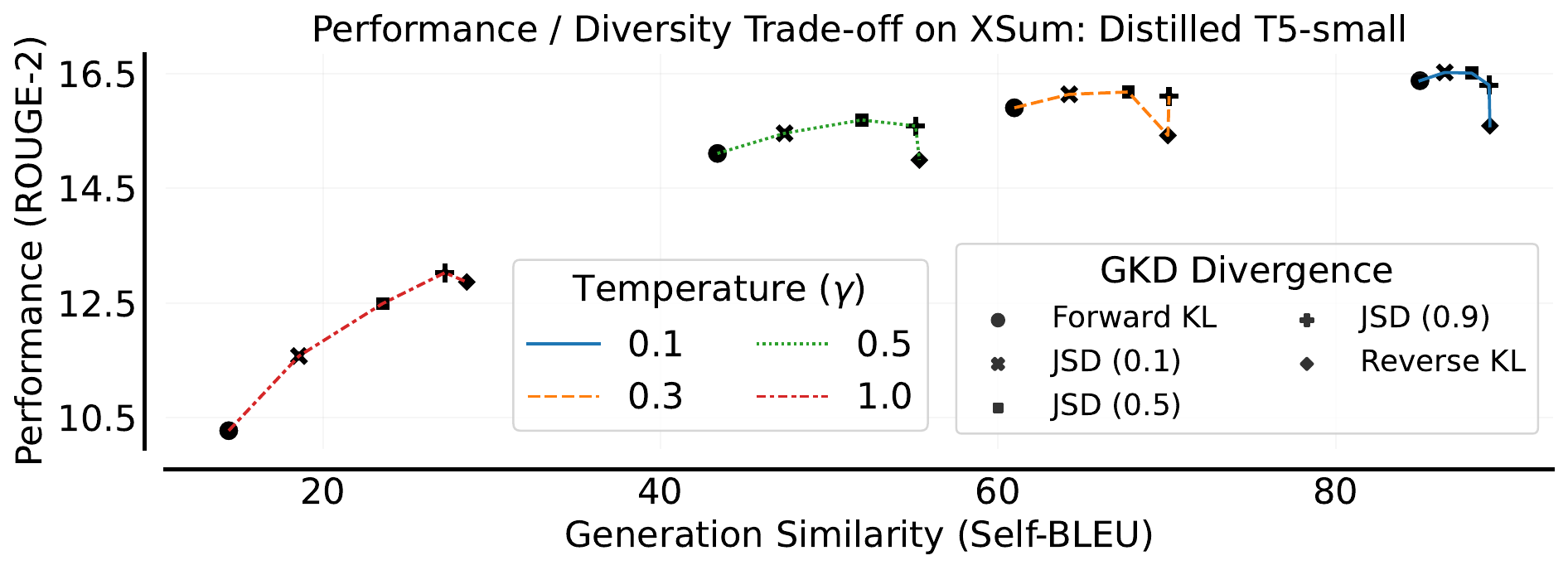
Source-reported GKD comparison. The figure motivates exposing divergence as a method coordinate; it does not establish one universally optimal direction.
0x07D The Reverse-KL Gradient Contains An Occupancy Derivative
Sequence reverse KL depends on the student twice. The student appears inside the log ratio, and it defines the probability of visiting the complete path:
Write . Applying the score-function identity before simplifying gives
The first term is the occupancy derivative: changing the student changes which paths are sampled. The second is the ordinary derivative of the log student probability on the selected path. A stopped-token local KL update retains the second kind of gradient on each rescored prefix but omits the score-function contribution from selecting that prefix.
Factor the path log probability and define teacher-relative reward
Terms before action are a conditional baseline for , so the exact gradient can be written
The is not an arbitrary reward bonus. It comes from differentiating inside the expectation. The Loop 7 two-step oracle evaluates this expression exactly: its analytic reverse-KL gradient and reward-to-go gradient differ by only , while central finite differences differ by . No derivative is taken through a discrete token ID; trajectory probability is handled through the score function.
0x07E MiniLLM Optimizes A Sequence Reverse-KL Objective
MiniLLM owns this full sequence reverse-KL contract. Its target is not merely token reverse KL evaluated on a convenient batch:

Source-reported MiniLLM method figure. It establishes the paper’s intended trajectory source and teacher interaction, not the correctness of every later runtime implementation.
The method begins from a student already fine-tuned for conditional generation. It samples student trajectories, obtains teacher probabilities on those exact trajectories, and optimizes the estimator above. That base estimator exposes three practical problems identified by the paper: high-variance long-horizon credit, exploitation of poorly shaped likelihood-ratio rewards, and a bias toward short outputs. The published recipe therefore includes estimator and sampling machinery, not only a divergence name.
0x07F MiniLLM Splits Single-Step And Long-Term Credit
The MiniLLM decomposition follows by writing :
Condition on in the first line and sum exactly over the current token:
This is the gradient of local reverse KL on student-occupied prefixes. It can be evaluated with a vocabulary sum and does not require sampling the current action. The second line is the long-term term: action receives credit for how it changes all later teacher/student likelihood ratios. It is the part a stopped-prefix local divergence does not recover.
exact reverse-sequence-KL gradient
    = single-step local reverse-KL gradient
    + future-return occupancy gradient
The equality requires on-policy expectation under the same . Turning either term into a clipped, replayed, or behavior-policy estimate changes the estimator and must be recorded. The finite oracle checks the decomposition before any Monte Carlo variance or neural parameterization is introduced.
0x07G Teacher-Mixed Sampling Is A Behavior-Policy Change
MiniLLM also samples from a token-level teacher/student mixture
Once trajectories come from rather than , an exact change-of-measure correction through time is a prefix product:
For the finite Loop 7 tree, weighting the behavior-policy expectation with this product reconstructs the exact reverse-KL target . A practical token-local approximation uses
That approximation can reduce variance and cost, but it is not the exact prefix importance ratio. The paper and official code must therefore be read at two levels: the source derivation defines the exact correction; the training implementation uses a lower-variance practical estimator.

0x07H Stabilizers Are Part Of The MiniLLM Method
The pinned MiniLLM paper and the official LMOps implementation add the following training state:
| Mechanism | Problem it addresses | Contract that must be pinned |
|---|---|---|
| remaining-length normalization | long returns and short-output bias | EOS inclusion and denominator at every token |
| PPO-style ratio clipping | large policy updates from stale rollout probabilities | rollout revision, old log probability, clipping interval |
| teacher-mixed sampling | low-quality or exploitative student trajectories | , exact or approximate importance ratio |
| local reverse-KL term | lower-variance immediate correction | vocabulary reduction and coefficient |
| auxiliary pretraining LM loss | retention of general language behavior | corpus, mixing coefficient, masking |
The official code samples with gradients disabled, stores rollout-time student and teacher selected-token log probabilities, and later performs a fresh student forward. Its reward implementation computes remaining-length normalization from the valid response mask. This resolves a notation edge in the paper more concretely than copying an index expression without checking the code.
def minillm_update(rollout, student, teacher_mix_alpha, clip_eps):
    # rollout owns ids, masks, old student log-probs, teacher log-probs,
    # and the student revision that generated them.
    ids = rollout.input_ids
    mask = rollout.response_mask

    new_logits = student(ids, use_cache=False).logits[:, :-1]
    new_log_q = selected_log_probs(new_logits, ids[:, 1:])

    token_reward = rollout.teacher_log_p - rollout.old_log_q
    return_to_go = reverse_cumsum(token_reward, mask)
    normalized_return = divide_by_remaining_valid_length(return_to_go, mask)

    ratio = exp(new_log_q - rollout.old_log_q)
    clipped = clamp(ratio, 1 - clip_eps, 1 + clip_eps)
    policy_loss = -masked_mean(
        minimum(ratio * normalized_return, clipped * normalized_return),
        mask[:, 1:],
    )
    return policy_loss
This is PPO-style clipping, not full PPO. MiniLLM does not introduce a learned value network or inherit PPO’s usual reference-policy KL penalty merely because it uses a clipped ratio. Naming those absent states prevents a familiar algorithm label from silently expanding the implementation.
0x07I GKD Stops Sampling Gradients And Rescores Exact Student Prefixes
Generalized Knowledge Distillation (GKD) chooses a different estimator. It lets a fraction of outputs come from the current student, stops the sampling path, and minimizes a configurable local divergence on the selected prefixes:
where
At , all output rows are fixed. At , all are generated by the current student. The divergence is independent of that source choice. GKD can therefore use forward KL on student prefixes or reverse KL on fixed prefixes; neither phrase alone identifies the complete method.
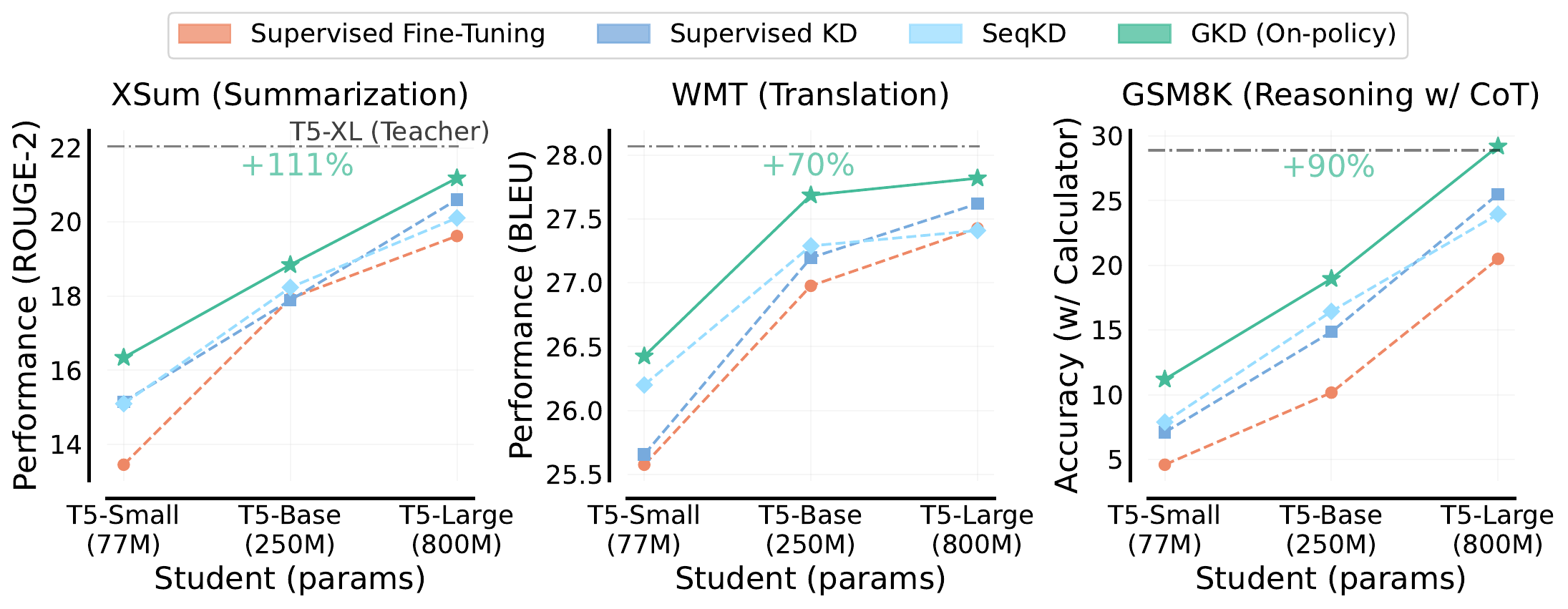
Source-reported GKD method comparison. The student-generated IDs are the prefix-selection artifact; gradients are owned by the later student scoring pass, not by the discrete generation operation.
The GKD paper assumes a student already capable of supervised fine-tuning and adequate generation. That is an initialization contract. With an untrained student, fully on-policy rows can concentrate teacher queries on degenerate states; a fixed/on-policy mixture or prior SFT is not merely an optimization convenience.
0x07J Generalized JSD Needs A Pinned Beta Convention
For , define
The mixture should be computed in log space:
There is an endpoint trap. The unscaled interior expression above tends to zero
as or . The pinned TRL GKD implementation instead
defines beta == 0 as forward KL and beta == 1 as reverse KL. Those endpoint
values are an explicit implementation extension, consistent with the
paper’s intended interpolation after scaling, not the literal endpoint of the
unscaled interior formula. A reproduction must pin which convention it uses.
PyTorch adds another source of silent reversal: torch.nn.functional.kl_div
expects log-probabilities as input and the comparison distribution as
target. A wrapper must name teacher, student, and direction explicitly; a
shape-correct call can otherwise optimize the opposite divergence.
0x07K The Runtime Is Generate, Teacher-Score, Student-Rescore
Stopped-sampling GKD has three distinct compute phases:
1. student generate
       sequential decode, no gradient

2. teacher score the exact packed student IDs
       frozen forward, no gradient

3. student rescore the same packed IDs
       differentiable forward and backward
For one fixture:
prompt ids:          [101, 102]
student response:    [12, 13, 2]       # 2 is EOS
packed ids:          [101, 102, 12, 13, 2]
labels:              [-100, -100, 12, 13, 2]
shifted labels:      [-100, 12, 13, 2]
valid shifted mask:  [0, 1, 1, 1]

teacher logits:      [B, S-1, V], requires_grad=False
student logits:      [B, S-1, V], requires_grad=True
The first response token is scored from the final prompt position. Prompt rows are masked after the causal shift. The first EOS remains valid, while padding after EOS does not. Teacher and student must see identical IDs, positions, attention masks, tokenizer mapping, and vocabulary axis.
def gkd_on_policy_step(prompts, student, teacher, divergence, gen_cfg):
    with no_grad():
        response_ids = student.generate(prompts, **gen_cfg)

    packed, labels, attention_mask = pack_causal(prompts, response_ids)
    shifted_labels = labels[:, 1:]
    valid = shifted_labels.ne(-100)

    with no_grad():
        teacher_logits = teacher(packed, attention_mask).logits[:, :-1, :]
    student_logits = student(packed, attention_mask).logits[:, :-1, :]

    assert teacher_logits.requires_grad is False
    assert student_logits.requires_grad is True
    assert teacher_logits.shape == student_logits.shape

    t_rows = teacher_logits[valid]                    # [C,V]
    s_rows = student_logits[valid]                    # [C,V]
    token_loss = divergence(t_rows, s_rows, vocab_axis=-1)  # [C]
    return token_loss.sum() / valid.sum()

A first-order phase ledger is
Generation may be latency-bound while both scoring passes are prefill-shaped. Reusing detached generation logits eliminates the training gradient; retaining the entire generation graph implements a different, much larger liveness contract. Peak memory and wall time therefore cannot be inferred from the student-only release artifact.
0x07L ImitKD And f-Distill Change Different Contracts
The on-policy family did not begin with MiniLLM or GKD, and related papers do not make the same approximation:
- DAgger establishes the imitation-learning pattern of executing the learner, asking an expert to label learner-visited states, and aggregating those states, often while mixing expert and learner policies during collection.
- ImitKD transfers that idea to autoregressive sequence models. It schedules a fixed/student-generated sequence mixture and replaces rows inside the current mini-batch rather than growing DAgger’s unbounded aggregate.
- f-Distill derives sequence -divergence decompositions. Its exact chain results for forward KL, reverse KL, and sequence Jensen-Shannon divergence are valuable, but its practical token objectives stop the sampling gradient. The paper’s own notes clarify that a local mixture is not generally the conditional of the global sequence mixture, and direct backpropagation omits the trajectory-distribution derivative.
That last distinction matters. A mathematically exact sequence decomposition, a local divergence evaluated on sampled prefixes, and an unbiased gradient estimator of the sequence objective are three separate claims. The article does not upgrade one into another without a proof.
0x07M On-Policy State Is Revisioned And Ephemeral
An on-policy row is not identified only by prompt and response IDs. At minimum its runtime record needs:
prompt/example id
generated response ids and first-EOS position
generating student checkpoint or revision
generation temperature, top-p/top-k, maximum length, and RNG seed lineage
teacher revision and tokenizer/vocabulary identity
old student selected-token log probabilities, if an importance ratio is used
teacher selected-token log probabilities or full distributions required by loss
response mask, truncation state, and rejection reason
collection timestamp/step and replay age
The student distribution changes after every update. A rollout from revision used at revision is replay or off-policy data, even if the prompt is unchanged. Replay can be deliberate, but policy lag and any correction must be observable. Loop 8 owns the complete artifact schema, retention, filtering, and revision transaction; this loop establishes why those fields are necessary.
0x07N Paper-By-Contract Comparison
| Method | State/prefix source | Local or sequence target | Sampling-gradient contract | Behavior correction | Training/runtime state |
|---|---|---|---|---|---|
| DAgger | learner/expert policy mixture | expert action labels | supervised after collection | collection-policy schedule | aggregated state dataset |
| ImitKD | scheduled fixed/student mini-batch rows | teacher token distribution | stopped sampled IDs | no sequence importance product | batch replacement schedule |
| MiniLLM | student or teacher-mixed trajectories | sequence reverse KL | score-function reward-to-go | exact prefix ratio in theory; token-local approximation in practice | old log-probs, returns, clipping, length normalization, LM mix |
| GKD | fixed/student rows controlled by | configurable local FKL/RKL/JSD | stopped sampled IDs, fresh rescore | none for full sequence objective because it optimizes a stopped-prefix surrogate | generation config, row source, divergence, masks |
| f-Distill | divergence-specific sampled prefixes | sequence -divergence decomposition plus practical local objectives | practical direct backprop stops sampling gradient | method-dependent | prefix sampler and divergence family |
The table is about contracts, not a leaderboard. Source-reported results remain tied to each paper’s teacher, student, data, decoding, and evaluation setup.
0x07O Primary-Source And Code Trace
| Evidence | Pinned revision | What was checked | Claim ceiling |
|---|---|---|---|
| MiniLLM paper | 2306.08543v6 | sequence reverse KL, exact policy gradient, single/long-term split, teacher mixture, importance ratios, clipping, length normalization | paper method and source-reported experiments |
| MiniLLM official LMOps code | commit 4f2a9deb5f08e459fd44c2e4792344d78ca89fc3 | sampler, reward, storage, trainer, practical per-token correction, remaining-length normalization | pinned implementation behavior, not all forks |
| GKD paper | 2306.13649v3 | student-data fraction, stopped sampling, divergence alternatives, student initialization | paper method and source-reported experiments |
| TRL GKD | commit 24db2a825029f7e0e60f6d3c160485565a784503 | same-vocabulary guard, beta endpoints, log-space mixture, causal shift, EOS mask, generate/teacher-score/student-rescore | pinned trainer behavior, not a timeless API promise |
| DAgger | 1011.0686v3 | learner occupancy, expert labels, aggregation, policy mixing | imitation-learning contract |
| ImitKD | 2009.07253v2 | sequence source schedule and mini-batch replacement | paper algorithm |
| f-Distill | 2307.15190v1 | sequence decompositions and documented practical-gradient caveat | paper derivation and stated approximation |
The executable Loop 7 oracle is an independent finite check. It proves the identities on a fully enumerable tree; it does not reproduce any paper’s neural training run or benchmark.
0x07P On-Policy Failure Closure
| Failure | Observable symptom | Violated contract | Repair |
|---|---|---|---|
| local reverse KL is called sequence reverse KL | loss decreases but future-state credit is absent | occupancy derivative | name the stopped-prefix surrogate or use a valid sequence estimator |
| token-local teacher-mixture ratio is called exact | apparent variance reduction with biased expectation | behavior-policy correction | record approximation; use prefix products for exact finite target |
| detached generation logits are reused | no student gradient | fresh student rescore | run a differentiable scoring forward |
| full generation graph is retained unintentionally | memory grows with decode length | stopped sampling contract | generate under no_grad() and rescore |
| teacher scores its own continuation | tensors may be shape-compatible but rows differ | shared-prefix identity | score exact student-generated IDs |
| student mistake is overwritten by reference token | recovery rows disappear | learner occupancy | preserve sampled IDs in every scorer |
| prompt/padding rows enter reduction | deceptively low loss | causal shift and response mask | shift first, mask prompt and post-EOS padding |
kl_div arguments are reversed | stable optimization of wrong direction | divergence identity | test against a tiny explicit vocabulary sum |
| unscaled JSD endpoint is equated with KL | beta endpoint disagrees with implementation | pinned endpoint convention | handle beta==0/1 explicitly |
| stale rollout is called on-policy | current student differs from collecting policy | revision identity | regenerate or report lag/correction |
| weak student uses only generated rows | teacher labels mostly degenerate states | initialization/source mixture | SFT first or lower |
| source figure is treated as benchmark proof | visual similarity becomes outcome claim | evidence ceiling | label figures and results source-reported |
0x07Q Loop Boundary
Loop 7 now owns and closes:
prefix occupancy versus local divergence versus sampling estimator
sequence FKL/RKL chain rules and local logit gradients
the reverse-KL occupancy derivative and reward-to-go gradient
MiniLLM's exact objective, decomposition, behavior policy, and stabilizers
GKD's stopped-sampling generate/score/rescore runtime
generalized-JSD endpoint and implementation conventions
DAgger, ImitKD, and f-Distill boundaries
on-policy revision state and failure closure
Loop 8 owns a different problem: the persistent schema, storage format, filtering, revisioning, retention, and invalidation rules for full logits, sparse logits, hidden targets, hard sequences, and rollout records. This loop requires those fields but does not pre-empt their data-system design.
0x08 Supervision Artifact Schema, Storage, Filtering, And Revisioning
The phrase distillation dataset hides at least four different objects. An example distribution says which prompts, documents, labels, conversations, or student states may be queried. A logical target says what the teacher returned. A physical representation says how those targets are indexed and stored. A publication manifest says which immutable bytes a training run is allowed to read. Changing any one of them can change the experiment even when the other three remain byte-identical.
This distinction matters because the previous loops deliberately produced different supervision objects. Loop 3 produced valid causal logit rows. Loop 4 produced hidden and relation tensors. Loop 6 produced generated sequences. Loop 7 produced policy-revision-bound rollouts. Loop 8 does not invent another distillation objective. It defines how those objects survive outside the teacher forward pass without losing their semantics.
Owner question. What must be recorded, stored, validated, versioned, and filtered so that a later reader can prove it trained on the intended teacher target rather than on merely shape-compatible bytes?
0x08A Four Layers Define One Supervision Artifact
A usable artifact has four layers with different failure modes:
| Layer | Question it answers | Example fields | Failure if omitted |
|---|---|---|---|
| semantic identity | which mathematical target is this? | source bytes, render, teacher, tokenizer, target estimator, filter graph | stale or incompatible targets appear reusable |
| logical payload | what values and coordinates were materialized? | logits, IDs, counts, hidden states, masks, offsets, dtype | a reader reconstructs the wrong loss |
| physical layout | how are logical rows encoded and located? | record batch, row group, tensor sidecar, tar member, index | random access or scans become pathological |
| publication state | which complete immutable objects are visible? | shard checksums, row ranges, validation state, manifest root | partial output is mistaken for a cache hit |
The layers are related but not interchangeable. Apache Arrow specifies typed arrays, buffers, record batches, and IPC framing. Apache Parquet specifies row groups, column chunks, pages, and indexes. Neither format can tell whether a stored sparse row means normalized top-, an unnormalized partial target, or an importance-sampling draw. That meaning belongs to semantic identity and the logical payload schema.

The strict dependency is
Reading those arrows backwards is unsafe. Finding a tensor file does not prove that a manifest admitted it, and finding a manifest does not prove that its rows implement the intended objective unless the semantic contract also validates.
0x08B Semantic Identity Is Canonical And Content-Derived
A folder named teacher-v2/topk64 is a human hint, not an identity. The
artifact key must be derived from every field that can change row meaning:
The exact serialization used by is itself part of the schema. A canonical JSON implementation, for example, must fix key order, string encoding, number representation, and excluded self-hash field. A cache implementation that hashes an unordered language map or the display name of a mutable model alias does not have a reproducible key.
semantic identity
  source:
    corpus + immutable revision + sample ID + exact content hash
  lineage and split:
    parent family ID + immutable split-manifest hash + split name
  rendered input:
    prompt-template hash + packing hash + exact rendered-input hash
  teacher:
    checkpoint-content hash + architecture revision + precision
    eval/train mode + stochastic-layer policy
  tokenizer:
    tokenizer revision + ordered vocabulary hash
  target:
    schema version + value semantics + temperature/layer map/decode rule
    reduction + sparse-selection or sampling estimator
  producer:
    code revision + deterministic/nondeterministic execution contract
  filter:
    filter-graph revision, not only final threshold values
This is stricter than a generic dataset-cache fingerprint. Hugging Face Datasets, for example, provides transform fingerprints and cache behavior in a specific implementation. That is useful lineage evidence, but a generic transform fingerprint does not automatically include teacher mode, ordered vocabulary support, target estimator, hidden-state hook location, or rollout policy age. Loop 8 therefore treats it as an implementation example rather than a complete distillation identity.
Identity invalidation is field-sensitive:
| Change | Raw full logits | Top-/sampled target | Hidden target | Teacher sequence | Student rollout |
|---|---|---|---|---|---|
| teacher weights | invalidate | invalidate | invalidate | invalidate | rescore or regenerate |
| vocabulary order | invalidate | invalidate | normally invalidate | retokenization may alter prefixes | regenerate |
| prompt or packing bytes | invalidate affected rows | invalidate affected rows | invalidate affected rows | regenerate | regenerate |
| temperature | reusable only if raw logits were stored | invalidate derived values, selection, or proposal | usually unchanged | invalidate if used during decoding | invalidate generation/scoring contract |
| mapped layer or hook | unchanged | unchanged | invalidate | unchanged | loss-dependent |
| filter graph | raw rows may remain reusable under a new view | raw rows may remain reusable under a new view | raw rows may remain reusable under a new view | selected subset changes | selected subset changes |
| student revision | unchanged | unchanged | unchanged | unchanged for teacher sequences | age and policy relation change |
“Raw rows may remain reusable” means that a new manifest may refer to the same immutable shards. It never means mutating the old manifest or silently mixing two target identities.
0x08C One Envelope Carries A Typed Payload Union
The common envelope owns provenance and coordinates; the payload is a tagged
union. A single untagged field called teacher_values is not sufficient:
| Payload tag | Required method-specific fields | Shape sketch | What remains reconstructible |
|---|---|---|---|
full_logits | raw/log-prob/probability semantics, dtype, ordered vocabulary hash | [N_valid,V] | full local teacher distribution under declared temperature |
topk_logits | IDs, values, , tie rule, normalized/unnormalized objective, global normalizer, tail rule | [N_valid,k] | only the declared truncation estimator |
sampled_sparse_target | proposal , sample count, replacement, temperature, RNG algorithm/seed/counter, counts or weights | ragged or [N_valid,K] | the declared finite-sample estimator |
hidden_state | teacher layers, module path, pre/post-norm hook, width, dtype, loss mask | [N_valid,m,d_T] | mapped feature values at exact hooks |
sequence_target | token IDs, offsets, prompt length, decode rule, EOS/truncation, scores | ragged [N,S_i] | selected trajectories under one decode contract |
rollout_record | generated IDs, masks, student revision, generation config, RNG state, age policy | ragged [B,S_i] | states visited by one collecting policy |
The union prevents a reader from applying temperature twice to cached probabilities, treating raw logits as normalized values, or interpreting sample counts as top- probabilities. It also makes migrations explicit: a new payload tag or changed field semantics requires a new schema version rather than a permissive reader guess.
The common envelope is still not enough by itself. Two hidden-state payloads
with the same [N,m,d] shape are different targets if one records residual
stream values before LayerNorm and the other records normalized values after
it. Two sparse rows with the same token IDs and values are different if one
stores logits and the other stores teacher probabilities. Shape agreement is
necessary, not semantic proof.
0x08D Ragged Rows Need Explicit Coordinate Maps
One source example can expand into multiple packed tokens, only some causal rows own targets, and each valid row can own a fixed or ragged payload. These are four coordinate spaces:
For source offsets , payload offsets , and target rows, the reader must verify
All offsets must be monotone. The explicit valid-row map must equal the indices selected by the loss mask:
The Loop 8 fixture packs two source samples into nine token positions, selects five target rows, and maps those rows to twenty dense-logit scalars:
source sample offsets:       [0, 5, 9]
packed token positions:      [0, 1, 2, 3, 4, 5, 6, 7, 8]
loss mask:                   [0, 1, 1, 0, 0, 0, 1, 1, 1]
valid -> packed row:          [1, 2, 6, 7, 8]
payload offsets, width V=4:  [0, 4, 8, 12, 16, 20]

The map is more reliable than reconstructing row ownership from sequence lengths at read time. Packing algorithms, prompt masks, EOS ownership, dropped rows, and later schema migrations can all change that reconstruction.
0x08E Dense Logits Define The Reference Storage And Gradient
Let be student logits, , and let a nonnegative target vector have total mass
The generalized target cross-entropy is
Substitute :
Differentiating with respect to one student logit gives the identity that all sparse variants must reconcile:
For full KD, and , so
This is the reference objective, not necessarily the preferred storage plan. For valid rows, vocabulary width , and bytes per value, dense raw storage is
With , , and :
M_full = 100,000,000 * 128,000 * 2
       = 25,600,000,000,000 bytes
       = 25.6 TB decimal
       ~= 23.28 TiB binary
At 1,024 balanced shards, the raw logit payload is about 25 GB per shard before offsets, masks, metadata, framing, checksums, replicas, and temporary producer files. Offline caching moves teacher compute out of the student step; it does not make teacher output small.
Hidden-state caches can also dominate storage. Four two-byte layers of width 4,096 over the same rows require
Sequence IDs are much smaller: four-byte IDs are roughly 400 MB before offsets, prompts, scores, and provenance. The smaller object is not equivalent supervision; it is a harder information bottleneck.
0x08F Deterministic Top-k Is Compact But Changes The Target
For a deterministic selected set of size , define retained teacher mass
There are at least two common top- objectives, and they are not the same. The unnormalized partial target keeps the original selected probabilities:
The generalized gradient derived above becomes
The omitted student logits still receive a positive term, but every student-probability term is scaled by . The renormalized target instead defines
and therefore
This forces every omitted teacher target to zero and increases each retained target by . Unless , neither gradient equals full KD.
A ghost or residual bucket stores as one extra event. It preserves aggregate tail mass, but it cannot identify how that mass was distributed over omitted tokens. For a two-token tail with mass , both and produce the same bucket. The student gradient over those individual tokens is therefore underdetermined unless an additional tail model is declared.
The raw payload byte ledger is
For , , two-byte values, and four-byte IDs:
M_topk_payload = 100,000,000 * 64 * (2 + 4)
               = 38,400,000,000 bytes
               = 38.4 GB decimal
               ~= 35.76 GiB binary

dense / sparse raw-payload ratio ~= 667x
That ratio is a byte result, not a quality result. The cache must also record the value domain, global log-normalizer, tie rule, selection stage, , temperature, retained mass, tail treatment, and exact objective.

0x08G Sampled Sparse Targets Trade Bias For Variance
Sparse Logit Sampling starts from the same incomplete-target gradient and replaces deterministic truncation with a random estimator. Let wherever , draw token IDs with replacement from , and let be token ‘s count. An importance-weighted target estimator is
Since ,
When , the weights cancel and
The sampled gradient is
so its expectation recovers full KD:
Unbiased does not mean noiseless. Under teacher-proposal multinomial sampling,
and count covariances between different tokens are negative. Larger reduces variance while increasing bytes and reader work. A proposal changes variance and requires the importance weight ; omitting it changes the objective.
The Loop 8 oracle enumerates every multinomial count vector for and . It recovers and the full gradient exactly in expectation, while retaining variances
The persistent row must therefore record proposal family, proposal temperature, sample count, replacement policy, RNG algorithm, seed and counter, count/weight semantics, and any quantization. Re-running “the same” sampler without that state does not reproduce the same finite artifact.
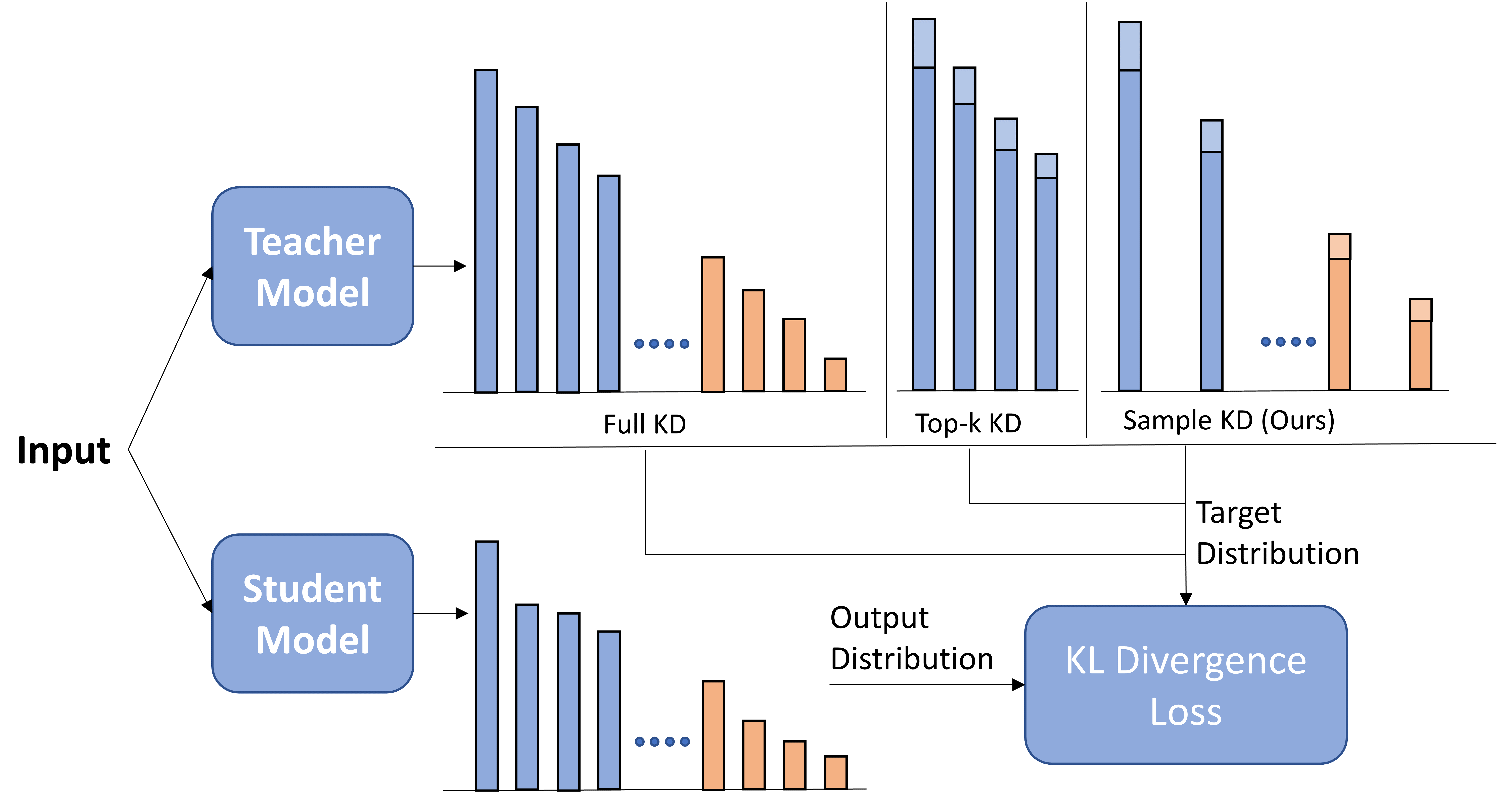
The paper links an official repository. Static inspection at commit
9d0f3816de14fe96175d0b33931ab46d8f14feb5 finds a README and poster but no
executable implementation. The paper derivation is therefore pinned as primary
evidence, but Loop 8 does not claim a source-to-running-code reproduction for
SLS.
0x08H Physical Layout Follows Access Pattern, Not Method Name
Once target semantics are frozen, physical layout should follow the reader’s access pattern:
| Layout family | Natural strength | Relevant physical unit | Main tradeoff |
|---|---|---|---|
| Arrow IPC | typed columns, variable-length arrays, record-batch interchange, memory mapping | array buffers and record batches | very large dense tensors often benefit from separate tensor payloads |
| Parquet | column pruning, compression, predicate filtering, analytical scans | row group, column chunk, page | token-row random access requires another index/translation layer |
| fixed/ragged tensor sidecar | direct dense or indexed tensor reads | contiguous tensor extent plus offset table | metadata and tensor files must be checksum-bound together |
| tar/WebDataset-style stream | sequential streaming and colocated row members | archive member and stream shard | predicate pushdown and arbitrary random access are weaker |
No row format is universally best. An offline top- trainer may scan Parquet metadata while fetching token IDs and values from aligned tensor sidecars. A large sequential sequence-KD job may prefer stream shards. A diagnostic tool may need Arrow record batches for zero-copy metadata inspection. The manifest must bind all files, schemas, indexes, offsets, and checksums that together implement one logical shard.
A useful cost model separates bytes selected from bytes read:
Predicate pruning can reduce the first or second term depending on format and layout, but it does not alter target semantics. Conversely, changing a sparse estimator can alter target semantics even if physical bytes read remain the same.
0x08I Shards Become Visible Through Manifest-Gated Atomic Publication
Artifact production is a state machine:
planned -> staged -> validated -> immutable shard committed
                                      |
                                      v
                     manifest committed after every required shard
For each staged shard, validation must close at least shape, mask, finiteness, row range, schema, byte count, and content digest. Only then may it receive an immutable object name. The manifest root is a digest over ordered shard records:
The producer protocol is:
for shard_spec in immutable_plan.shards:
    staged = write_staging_object(
        materialize_targets(shard_spec, frozen_semantic_contract)
    )
    stats = validate_shape_mask_finiteness_and_ranges(staged)
    payload_hash = sha256_exact_bytes(staged)
    committed = publish_immutable_object(staged, payload_hash, stats)
    append_candidate_manifest_record(committed)

assert every_planned_shard_is_committed()
manifest_root = hash_ordered_shard_records()
publish_manifest_atomically(manifest_root)
A readable staging file is not a cache hit. A valid shard absent from the manifest is not part of the training input. A manifest referring to a staged or failed shard is invalid. This ordering makes interrupted production resumable without allowing a consumer to train on whichever files happened to finish first.

Atomicity here is a logical protocol. The Loop 8 oracle proves its state and hash rules on tiny synthetic records; it does not validate the transaction semantics of any cloud object store or distributed metadata service.
0x08J Revisions Form A DAG, Not An Overwritten Folder
Artifact evolution has dependencies:
raw source r1
    -> rendered/packed input r2
        -> teacher target r3
            -> filter view r5
                -> training manifest r6
Those nodes should be immutable and edges should form a directed acyclic graph.
A changed filter can create filter-r6 that reuses target-r3; it should not
rewrite filter-r5. A changed prompt template creates a new rendered node and
invalidates every descendant target, filter view, and manifest while leaving
the raw source node intact.
For revision graph , validity requires
The DAG answers two questions a flat cache directory cannot:
- Why is this row stale? Trace which ancestor identity changed.
- What can be reused? Reuse immutable ancestors whose semantics did not change, then materialize only new descendants.
Garbage collection is also graph-aware. A shard may be deleted only when no pinned manifest or retained descendant references it. This lifecycle belongs to artifact production; deployment package retention remains outside this article, and M8.9/M8.10 own it when the student is composed with a low-bit representation.
0x08K Filtering Is A Selection Operator
Quality, safety, rights, length, language, duplication, and contamination filters may be necessary. They are not distribution-neutral cleanup. Let the source distribution be and let be acceptance probability. The retained distribution is
The derivation is conditional probability:
The fixture starts with slice masses and acceptance probabilities . Therefore and the kept distribution is
An overall 60% acceptance rate hides that the final slice lost all support. No inverse-propensity weighting can recover a slice for which because no accepted example contains information about it. Preserving rejected-row IDs, reason codes, and before/after slice counts is therefore part of auditability, not optional logging.
Dolma supplies a concrete source context: filtering, tagging, deduplication, mixing, and decontamination are interacting data-pipeline stages, and threshold choices change the selected corpus. Loop 8 uses that evidence to justify explicit filter-graph identity and slice reports; it does not transfer Dolma’s source-reported ablation numbers to distillation artifacts.
0x08L Deduplication And Decontamination Need Lineage Groups
Exact-string deduplication is not enough when one source record produces paraphrases, prompt templates, rationale variants, teacher responses, or student rollouts. Let be the parent/near-duplicate family ID. A split function must operate on the family:
not independently on each derived row. The invariant is
where denotes shared parent or declared near-duplicate lineage.
Deduplication should keep both a representative ID and alias lineage. Dropping all aliases without a map destroys the ability to explain source weights, filter outcomes, and derived-example ancestry. Decontamination should compare evaluation families against raw prompts and parents before teacher generation where possible; checking only final generated text can miss transformed siblings.
The exact paper and its official code also distinguish a conceptual policy from an executable deduplication pipeline. The code pin is evidence for one implementation lineage, not proof that its thresholds or cluster definition are universally correct for prompts, responses, or multilingual examples.

0x08M Rollout Records Have Policy Age And Expiry
A sequence generated by the teacher is stable with respect to future student updates. A student rollout is not. Let be the collecting student revision and the current revision. Define policy age
Under a bounded-age policy with maximum , admission is
The fixture records , , , and , so the rollout remains admissible. At revision 9 it would expire. A stricter policy may require ; an importance-corrected replay policy requires behavior probabilities or another valid correction contract. Merely storing the token IDs is not sufficient.
The rollout row must bind:
collecting student checkpoint/content hash
generation configuration hash
RNG algorithm, seed, and counter
prompt and packed token identity
collection time or monotone revision
current age and maximum admitted age
replay policy and any behavior probabilities
teacher scoring revision, if scores were cached separately
Calling a bounded-age or corrected replay buffer on-policy without qualification erases an important approximation. Loop 7 owns the exact occupancy mathematics; Loop 8 makes the collecting policy and staleness persistent.
0x08N Reader Validation Reconstructs Semantics Before Loading Payload
A reader should fail closed before allocating large target tensors:
def open_supervision_artifact(run_contract, manifest):
    assert manifest.root_hash == run_contract.manifest_root_hash
    assert manifest.semantic_identity == run_contract.semantic_identity
    assert acyclic(manifest.revision_dag)

    for shard in manifest.ordered_shards:
        assert shard.state == "committed"
        assert shard.schema_hash == manifest.schema_hash
        assert checksum(shard.object) == shard.payload_sha256
        assert shard.row_range.continues_previous_range()

        metadata = read_metadata_before_payload(shard)
        assert typed_payload_union_is_supported(metadata)
        assert offsets_are_monotone_and_close(metadata)
        assert loss_mask_rows_equal_target_rows(metadata)
        assert sparse_estimator_is_fully_specified(metadata)
        assert lineage_and_split_are_compatible(metadata)
        assert rollout_age_is_admissible(metadata)

        yield load_validated_payload(shard, metadata)
Validation order matters. Reading terabytes and only then discovering a tokenizer mismatch wastes resources; worse, permissively coercing an unknown schema can train a valid-shaped but mathematically different objective. The reader should reject unknown payload tags, unknown estimator revisions, nonmonotone offsets, split-family leakage, expired rollouts, and manifest/shard digest disagreement.
0x08O Paper, Format, And Code Trace
| Evidence | Exact pin | What Loop 8 takes from it | What remains outside the claim |
|---|---|---|---|
| Sparse Logit Sampling | 2503.16870v2 | incomplete-target gradient, deterministic top- bias, sampled estimator, variance/tail alternatives | no paper training or benchmark reproduction; pinned repo has no executable implementation |
| Datasheets for Datasets | 1803.09010v8 | composition, collection, preprocessing, distribution, maintenance, archival versions | not a distillation-specific row schema |
| Deduplicating Training Data | 2107.06499v2 | near-duplicate families, train/validation overlap, contamination risk | source-reported C4 results are not universal |
| Dolma | 2402.00159v2 | filter/tag/dedupe/mix pipeline, overlap, decontamination, release maintenance | source thresholds and ablations are not copied as prescriptions |
| Apache Arrow | commit a7d0bfa5... | arrays, record batches, buffers, IPC/file framing | does not choose a KD target estimator |
| Apache Parquet format | commit 2076361b... | row groups, column chunks, pages, page indexes | not automatically best for token-row access |
| Hugging Face Datasets | commit 48b7ee7b... | one concrete transform-fingerprint/cache lineage | not a complete teacher-target identity |
| Google deduplication code | commit 4e9888ac... | one executable near-duplicate pipeline lineage | no universal threshold or multilingual guarantee |
| Dolma code | commit 669f5348... | concrete mixer and deduper implementation surfaces | not executed by this article |
Every paper PDF, source archive, relevant TeX file, official repository commit, and inspected code/document file is digest-pinned in the Loop 8 evidence bundle. The executable oracle is independent: it proves finite arithmetic, hashes, offsets, graph, filtering, split, and expiry contracts, not the papers’ training outcomes or a production data platform.
0x08P Artifact Failure Closure
| Failure | Observable symptom | Violated contract | Repair |
|---|---|---|---|
| cache directory named only by model alias | results drift after quiet model update | semantic identity | pin checkpoint content and every target-changing field |
| top- values have no objective tag | stable tensors train different gradients | sparse estimator identity | declare normalized/unnormalized/tail/sampling contract |
| global log-normalizer omitted | retained logits cannot recover teacher probabilities | value semantics | store normalizer or explicitly store probabilities |
| ghost bucket treated as full tail | omitted-token gradients are invented | tail allocation | name aggregate-only semantics or add a tail model |
| sampled target omits proposal/RNG | finite rows cannot be replayed or reweighted | sampling identity | persist , temperature, count, replacement, seed, counter |
| hidden rows omit hook location | matching is shape-correct but wrong | payload union | persist module path and pre/post-norm capture point |
| offsets are inferred from current packer | valid rows shift after code update | coordinate identity | persist source, packed, valid-row, and payload maps |
| Arrow/Parquet file name defines method | correct bytes receive wrong objective | layer separation | bind storage files to semantic schema in manifest |
| readable staging shard is consumed | training row count depends on interruption | atomic publication | expose only committed shards through final manifest |
| filter revision overwrites old subset | previous run cannot be reconstructed | revision DAG | publish immutable filter views and manifest roots |
| accepted rows only are retained | support loss cannot be audited | filter observability | retain rejection IDs/reasons and before/after slices |
| derived siblings cross splits | evaluation information reaches training | family lineage | split by parent/near-duplicate family |
| old rollout called current on-policy | prefix distribution lags student | policy age | persist collector revision and enforce replay policy |
| source figure treated as local result | external evidence becomes reproduction claim | evidence ceiling | label source-reported and keep independent oracle scope |
0x08Q Loop Boundary
Loop 8 now owns and closes:
four-layer artifact architecture
canonical semantic identity and typed payload union
source -> packed -> valid-row -> payload coordinates
full-KD reference gradient and dense storage ledger
unnormalized top-k, normalized top-k, and ghost-tail distinctions
importance-sampled sparse targets, expectation, and finite variance
Arrow, Parquet, tensor-sidecar, and stream-layout alternatives
immutable shard validation and manifest-gated publication
append-only revision DAG and reuse/invalidation rules
filter selection distribution and zero-support failure
family-safe deduplication/decontamination lineage
rollout policy age, expiry, and reader fail-closed behavior
Loop 9 consumes those immutable row and shard contracts and owns the runtime problem: online versus offline versus hybrid execution, teacher/student placement, transfer and prefetch, vocabulary-parallel loss, checkpoint/resume, and failure recovery. Loop 8 deliberately does not claim that its logical state machine validates a production object store or distributed trainer.
0x09 Training Runtime And Distributed Execution
The same mathematical loss can create very different training systems. An online run pays for the teacher every batch. An offline run pays once and then turns storage bandwidth into the target source. A hybrid run carries both failure modes unless it identifies which path produced every row.
Owner question. Given the objective, row schema, and student architecture
from 0x01-0x08, which processes execute each step, where do their tensors
live, which collective preserves the objective, and what state makes an
interrupted run resume as the same method?
Loop 9 owns the execution graph rather than another loss. It owns online, offline, hybrid, and on-policy process topology; teacher/student placement; logical target transfer; bounded queues and prefetch; exact vocabulary- and data-parallel reduction; checkpoint publication; and topology-changing resume. It consumes Loop 8’s immutable target manifest without redefining top- or sampling semantics. Loop 10 owns paper comparison, Loop 11 owns release, and M8.9/M8.10 own deployment packaging when the student is composed with a low-bit representation.
This section uses three evidence levels deliberately:
- primary papers establish algorithms and source-reported systems results;
- pinned framework repositories expose concrete, version-scoped code paths;
- the local Python oracle proves only small accounting and state-transition examples. It does not execute a GPU collective, framework trainer, object store, or production checkpoint backend.
0x09A Online, Offline, Hybrid, And On-Policy Are Cost Plans
The mode name is shorthand for a process graph. A complete graph names the target producer, prefix owner, transport, lifetime, reuse count, and failure boundary:
| Mode | Target producer | Prefix owner | Transport and lifetime | Reuse/freshness state |
|---|---|---|---|---|
| online | live teacher each update | current training batch | device-local or cross-mesh; step/chunk lifetime | no amortization unless explicitly reused |
| offline | producer job | immutable artifact producer | committed shard -> reader -> device | manifest revision and counted reuse |
| hybrid | cache or live fallback | artifact or current batch | both paths converge on one schema | hit/miss source plus identical teacher/target identity |
| on-policy | current or age-bounded student rollout, then live teacher score | declared collector revision | rollout artifact plus teacher/student score passes | policy revision, RNG, age, and replay rule |

An online token-KD step has approximate work
C_online ~= C_teacher_forward
          + C_student_forward
          + C_student_backward
          + C_alignment_losses
          + optional C_student_generation
The teacher has no optimizer state and normally no backward graph, but its weights, forward workspace, logits, communication, and any intermediate targets remain real. A useful peak-memory ledger is
M_peak ~= M_student_training_state
        + M_teacher_resident_weights
        + M_teacher_targets_still_live
        + M_alignment_state
        + M_runtime_and_collective_buffers
This is a scheduling ledger, not a promise that all terms peak at exactly the same instruction. Their overlap depends on forward order, pipeline schedule, chunked losses, activation checkpointing, and where the teacher is placed.
| Execution mode | When teacher work occurs | Persistent artifact | Freshness | Dominant systems risk |
|---|---|---|---|---|
| online logits/states | every student batch | little or none | current teacher and input | teacher residency and throughput |
| cached full targets | producer job once per manifest | extreme logit/state shards | fixed | capacity, I/O, invalidation |
| cached sparse targets | producer job once per manifest | compact estimator payload | fixed | biased or under-specified tail |
| teacher sequences | generation job before training | token IDs plus provenance | fixed | decode policy collapses distribution |
| student on-policy | student generation, teacher scoring, student rescoring | usually ephemeral or short replay | high | three-phase scheduling and policy lag |
| hybrid | cache hits plus selected live queries | both | mixed | silent target-version drift |

Offline execution amortizes teacher work only when artifacts are reused enough to repay production and storage. If student epochs replay the same target rows, the teacher forward may be amortized over uses. If augmentation, packing, or on-policy prefixes create new rows each epoch, the assumed reuse may not exist.
The amortization follows from comparing like-for-like student updates. Let be one teacher production pass, one offline read-plus-transfer, the student forward/loss/backward work, and the number of valid uses of the produced target:
Offline target delivery is cheaper on this narrow ledger only if
which requires . The fixture uses s, s, and s. Online is s per update. At , offline is s per use, while the strict break-even is . This does not include producer queueing, target invalidation, storage replication, or a changed example distribution; those can remove the apparent saving.
The recent offline top- and fused chunked-KL paper makes the same systems separation concrete: target production, persistent sparse payload, output projection, and loss materialization are independent memory decisions. Its speed, throughput, and H200 memory values remain source-reported for that implementation.
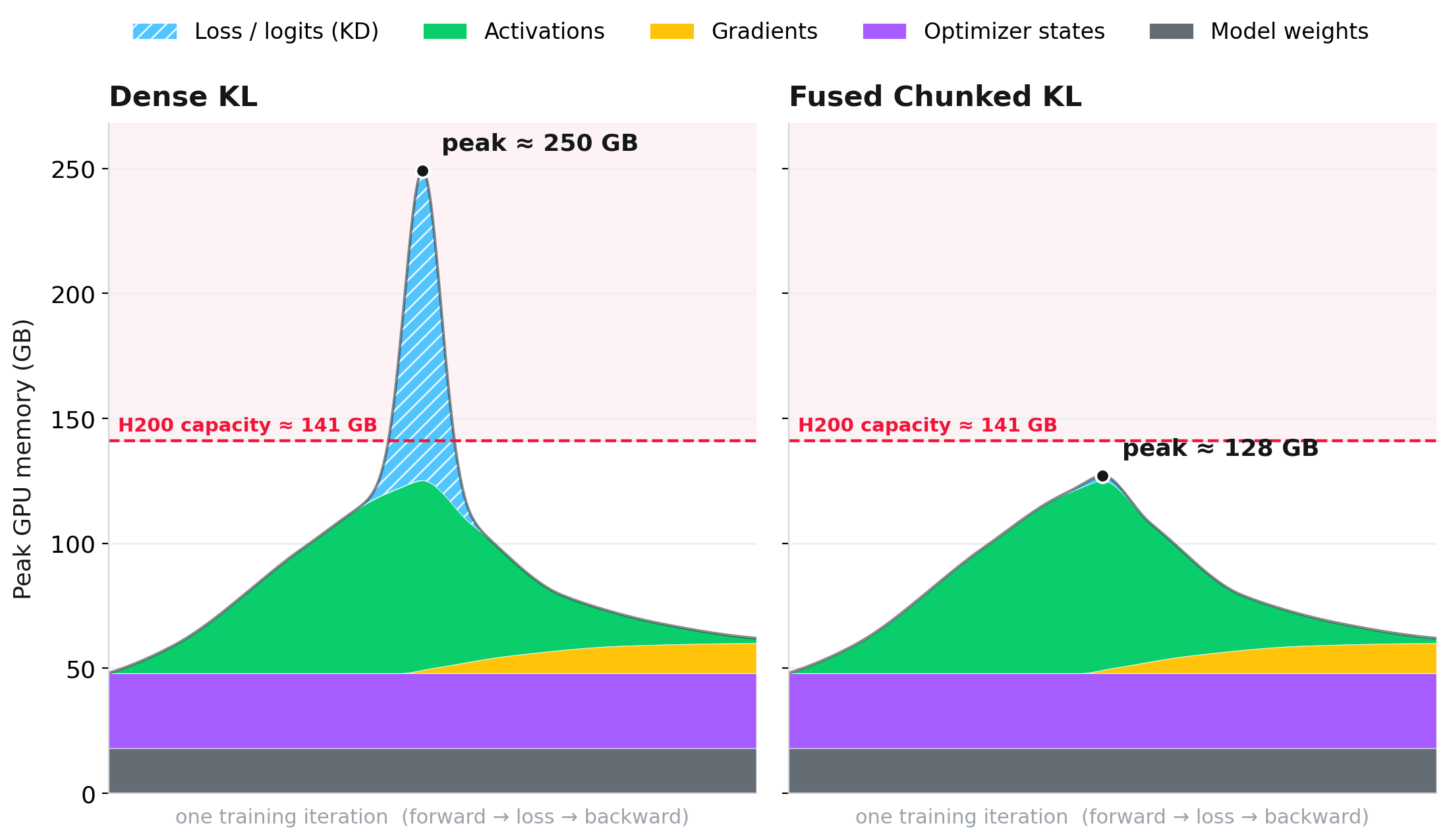
Source figure: Efficient Knowledge Distillation for LLMs, Figure 1, revision
2608.03796v1. The displayed memory values belong to the paper’s model,
sequence, precision, and hardware setup; the local oracle does not reproduce
them.
Throughput Is A Queue-Stability Contract
An offline or separate-teacher design has at least a producer, transport, and consumer. If teacher production serves rows/s and transport serves rows/s, the sustainable upstream service rate is
For a student consuming rows/s, a steady bounded queue requires after accounting for bursts and finite buffers. A discrete backlog evolves as
where is demanded work and is completed upstream service during interval . In the fixture, teacher, transport, and student rates are , , and rows/s: the steady service rate is rows/s. When transport falls to rows/s, the backlog grows by rows/s even though the teacher itself is fast enough. More prefetch delays the stall; it does not make an unstable queue stable.

0x09B Forward Order Determines Tensor Lifetime
A minimal co-resident online step looks simple:
teacher.eval()
student.train()

with no_grad():
    teacher_targets = teacher.forward(batch, return_targets=target_spec)

student_outputs = student.forward(batch, return_targets=target_spec)
loss = hard_loss(student_outputs, batch)
loss += distillation_loss(student_outputs, teacher_targets, masks)

del teacher_targets
loss.backward()                 # gradients belong to student/alignment only
optimizer.step()
The apparent no_grad() saving is limited. It avoids teacher gradient and
optimizer state, but output logits still have shape [B,S,V], and mapped
teacher activations must survive until their corresponding student loss is
formed. Reversing the forward order retains the student’s backward activations
while the teacher runs. Either order can produce a large overlap.
There are several implementation choices:
| Choice | Target lifetime | Memory consequence | Compute/communication consequence |
|---|---|---|---|
| materialize all teacher logits | until student logits exist | full [B,S,V] target tensor | simplest loss implementation |
| chunk/fuse vocabulary loss | one vocabulary chunk at a time | avoids one full target copy | more kernel and collective coordination |
| compute mapped layers together | all mapped teacher states may remain live | can dominate logits | simple multi-loss backward |
| stream one mapped target | target released after local comparison | lower peak | recomputation or synchronized execution |
| cache targets on host/NVMe | device target is staged per batch | lower accelerator residency | PCIe/storage bandwidth and prefetching |
| separate teacher ranks/service | teacher weights leave student ranks | student memory improves | target transport and backpressure appear |
The correct peak is an interval calculation, not the sum of every allocation named in the program. For tensor or state with live interval and size ,
One deliberately small schedule demonstrates the distinction:
| Interval | Live state beyond 28 GiB base weights/training state | Total |
|---|---|---|
| s | 4 GiB teacher activations | 32.0 GiB |
| s | 1 GiB streamed target chunk + 6 GiB student activations | 35.0 GiB |
| s | previous state + 0.5 GiB loss scratch | 35.5 GiB |
| s | 6 GiB student activations through backward | 34.0 GiB |
Materializing all teacher logits would replace the 1 GiB chunk with the full target allocation. Running the student first would retain its 6 GiB backward state while the teacher executes. Streaming hidden targets can shorten their lifetime, but it may force teacher/student pipeline synchronization or recomputation. The schedule is therefore part of the memory proof.

A tensor-level implementation should make release points reviewable:
with torch.no_grad():
    teacher_hidden = teacher(batch).last_hidden_state       # [B,S,d_T]
    target_chunk = project_or_slice(teacher_hidden, spec)   # [B,S_c,d_A]
del teacher_hidden                                         # no longer live

student_hidden = student(batch).last_hidden_state          # saved for backward
numerator = tensor(0.0, device=student_hidden.device)
denominator = tensor(0, device=student_hidden.device)
for rows in causal_target_chunks(batch.loss_mask):
    local_target = stage(target_chunk, rows, non_blocking=True)
    local_student = map_student(student_hidden, rows)
    numerator += loss_sum(local_student, local_target)
    denominator += rows.valid_count
    del local_target

loss = globally_normalized(numerator, denominator)
loss.backward()
This code is a lifetime trace, not a recommendation to retain one giant
student_hidden tensor. Pipeline schedules, selective activation
checkpointing, and fused output losses can change its implementation while
preserving the same ownership contract.
On-policy execution adds another phase boundary:
with no_grad():
    rollout = student.generate(prompts, generation_config, rng_state)

packed = pack_exact_student_prefixes(prompts, rollout.ids)

with no_grad():
    teacher_scores = teacher.score(packed)

student_scores = student.score(packed)  # fresh differentiable forward
loss = masked_divergence(student_scores, teacher_scores, rollout.mask)
loss.backward()
Generation K/V, rollout IDs, teacher scoring buffers, and the fresh student
backward graph do not all need to coexist, but an implementation that keeps
them accidentally can exceed the memory of ordinary online KD. The rollout
and scoring schedules also need the exact same packed token IDs, positions,
EOS policy, and response mask established in 0x07.
0x09C Exact Vocabulary-Parallel KL Does Not Require A Logit All-Gather
Suppose teacher and student share one vocabulary and rank owns vocabulary
shard . For one [B,S] grid of valid rows, each rank first finds
its local teacher maximum. A MAX all-reduce gives the stable global maximum:
Each rank then computes a shifted local exponential sum. A SUM all-reduce gives the full shifted denominator:
Repeat the same two reductions for the student. Each rank can then accumulate its local forward-KL contribution
and a final SUM all-reduce produces the exact per-row KL. In pseudocode:
def sharded_log_probs(local_logits, vocab_group):
    local_max = local_logits.max(dim=-1).values        # [B,S]
    global_max = all_reduce_max(local_max, vocab_group)
    local_sum = exp(local_logits - global_max[..., None]).sum(dim=-1)
    global_sum = all_reduce_sum(local_sum, vocab_group)
    return local_logits - global_max[..., None] - log(global_sum[..., None])

logp_t = sharded_log_probs(local_teacher_logits, teacher_vocab_group)
logp_s = sharded_log_probs(local_student_logits, student_vocab_group)
p_t = exp(logp_t)
local_kl = (p_t * (logp_t - logp_s)).sum(dim=-1)       # [B,S]
row_kl = all_reduce_sum(local_kl, aligned_vocab_group)
loss = masked_mean(row_kl, response_mask)
This is communication pseudocode, not a drop-in autograd implementation. The
student path needs an autograd-aware collective or fused vocabulary-parallel
loss whose backward propagates through the global sum. The teacher path can be
evaluated under no_grad().
The Forward And Backward Must Close On The Same Global Distribution
For student logits split over vocabulary shards, define
The maximum can be detached because adding or subtracting a common constant does not change softmax. The global exponential sum cannot be replaced by a non-differentiable local value on the student path: every shard’s logits affect and therefore every .
For normalized teacher probabilities , forward KL is
Differentiating one logit gives
That last equality uses . Loop 8’s unnormalized sparse target has retained mass , so its corresponding gradient is on retained coordinates and elsewhere. A distributed runtime must not quietly turn one estimator into the other while optimizing communication.
The fixture uses and , split as and . It obtains
global max m                 = 1.000000
local shifted sums           = [1.449329, 0.579468]
global shifted sum           = 2.028797
log Z                        = 1.707443
q                            = [0.492903, 0.221476, 0.164073, 0.121548]
shard KL terms               = [0.007502, 0.020087]
dense KL = sharded KL        = 0.0275887865
concatenated shard gradient  = q - p
                             = [0.092903,-0.078524,-0.035927,0.021548]
The equality checks both the scalar objective and every logit gradient. A forward-only scalar test would miss a broken autograd collective.

The pinned Megatron cached-logit path at commit
c3d44dcf...
provides one current implementation trace: cached_logits_loss.py performs a
TP MAX reduction, an autograd-aware SUM reduction, local lookup of the
teacher’s global top- indices, and optional residual-mass handling. The
pinned Full-Chunked-KL-Loss
implementation
recomputes output-projection chunks in backward and forms local sparse-target
gradients. These code paths verify implementation surfaces; they do not prove
that every Megatron-derived trainer or fused kernel has identical semantics.
Data Parallelism Reduces Numerators And Denominators, Not Rank Means
After vocabulary shards produce one loss per selected row, data-parallel ranks still have unequal valid-token counts because of padding, truncation, packed examples, or response masks. Let be the summed loss and the valid-token count for rank , microbatch . The gradient-accumulation correct objective is
It is not the mean of rank-local means. With rank sums and counts , the global mean is ; averaging rank means gives . The error changes with padding and world size. The loss implementation therefore needs a globally reduced denominator or an equivalent scaling contract coordinated with DDP/FSDP gradient averaging.
The current pinned TRL GKD implementation explicitly accepts a global
num_items_in_batch for gradient-accumulation-correct normalization. That is a
useful code trace, not evidence that every trainer supplies that value
correctly under every distributed sampler.
The derivation assumes teacher and student shards represent the same token IDs
on ranks that can pair their local contributions. If shard boundaries differ,
one side must be repartitioned. If teacher and student occupy separate rank
pools, teacher target shards must be transported or recomputed where the loss
runs. If tokenizers differ, matching same-index logits is not repaired by an
all-reduce; 0x03D’s semantic alignment problem remains.
For scale, with B=4, S=2048, V=128000, and two-byte logits, gathering a
full local batch vocabulary would expose about 2.10 GB of logit payload:
4 * 2,048 * 128,000 * 2 bytes ~= 2.10 GB
Each max or sum reduction above operates on an [B,S] array instead. At FP32,
that logical array is 32 KiB. Collective algorithms still move more physical
traffic than this logical payload, and separate teacher/student rank pools add
target transfer, but the vocabulary dimension need not be globally gathered.
Megatron Core’s vocabulary-parallel cross-entropy API documents the same systems principle for hard-label CE: logits remain split across tensor-parallel ranks and the tensor-parallel group participates in the reduction. The KL construction above is a derivation for distillation, not a claim that every framework exposes this exact fused primitive.
0x09D Teacher Placement Changes The Bottleneck
Teacher placement is part of the method specification:
| Placement | Teacher weights | Target path | Useful when | New constraint |
|---|---|---|---|---|
| co-resident on student ranks | overlap student model state | device-local or same-rank shards | both models fit and topology aligns | memory peak and kernel scheduling |
| separate accelerator ranks | isolated teacher pool | streamed logits/features | student needs its full ranks | network volume, queueing, shard alignment |
| sequential device residency/offload | staged from host/NVMe | local after transfer | compute is available but device memory is not | transfer latency can dominate |
| remote teacher service | service owns teacher | RPC responses or generated text | teacher shared across jobs or API-only | retries, nondeterminism, rate limits, version pinning |
| offline producer | absent during student training | immutable cache shards | examples are stable and reuse is high | storage and invalidation |
Placement changes the critical path only through a declared schedule. For target rows, vocabulary size , target width , and bytes per value, two logical payloads are
At , , , and , full logits are MB while one hidden layer is bytes (2 MiB), a logical ratio. Multiple mapped hidden layers, attention relations, projection placement, sparse indices, padding, protocol headers, and collective algorithms change the comparison. These are logical payload bytes; physical wire traffic depends on route multiplicity and topology.
A separate teacher mesh does not merely send “the tensor.” It converts a source layout into the layout expected by the loss or student mesh. The cross-mesh resharding paper formalizes this as many-to-many multicast and studies schedules that can overlap communication. Its diagram is useful here because teacher/student meshes can differ in replica and shard axes even when their global tensor shapes match.
Source figure: On Optimizing the Communication of Model
Parallelism, cross-mesh resharding
examples, revision 2211.05322v2, cropped to the diagram. It establishes the
layout-conversion problem; it is not a reproduced distillation topology or
performance result.
An implementation contract therefore needs both global token semantics and layout metadata:
TargetShard = {
    "global_token_range": [v_start, v_end],
    "row_coordinate_hash": packed_row_hash,
    "source_mesh": {"dp": 4, "tp": 8, "pp": 1},
    "source_layout": "vocab_sharded",
    "destination_mesh": {"dp": 8, "tp": 4, "pp": 2},
    "destination_layout": "loss_owner_vocab_shard",
    "dtype": "float16",
    "target_spec_hash": target_spec_hash,
}

assert reshard_plan.covers_each_global_coordinate_once()
assert receive_row_hash == student_row_hash
Replica fan-out, all-to-all, point-to-point pipeline transfer, and host staging can all realize the logical conversion. The article does not prescribe one collective without a topology and measured link map.
Current framework behavior must be source- and version-scoped. For example, the NeMo Framework distillation guide currently describes loading both checkpoints, running forward passes for both models and backward only for the student. Its documented path requires the two models to support the same parallelism strategy; with pipeline parallelism, intermediate-state losses are documented only on the final pipeline stage. Those are constraints of that implementation path, not mathematical requirements of knowledge distillation.
Intermediate transfer can make placement harder than logit KD. A separate
teacher pool must send selected [B,S,d_T] features or relations in addition
to output supervision. Pipeline stages need to agree where mapped layers meet.
A width projection may belong on teacher ranks, student ranks, or the transport
boundary; that choice changes bytes, checkpoint ownership, and gradient flow.
Only trainable student-side alignment modules should receive gradients.
There are three common pipeline alternatives:
| Alternative | Where teacher target is produced | Where loss runs | Consequence |
|---|---|---|---|
| terminal-stage only | teacher final stage | student final stage | simplest transport; cannot match earlier states directly |
| mapped-stage rendezvous | corresponding teacher/student stages | each mapped student stage | lower target lifetime, more synchronization and loss reduction |
| target collector stage | teacher stages send selected states to one owner | dedicated or student stage | centralized alignment/projection, but extra activation traffic |
If teacher and student have different depths, “same pipeline stage” is not a
layer map. The semantic map from 0x04 and the physical route are separate
objects. A trainable width projection placed on the teacher mesh also changes
gradient ownership: either it must be part of the student optimization domain,
or it must remain frozen and be identified in the target contract.
0x09E Offline Readers And Hybrid Fallback Are Stateful Systems
The Reader Owns A Coordinate Cursor, Not Just A File Name
An offline artifact is immutable, but its reader is stateful. It owns the manifest revision, current shard and entry, source-to-current data-parallel mapping, prefetch queue, decode workers, pinned-memory buffers, and the point at which a checksum-validated row becomes visible to training.
The pinned Megatron cached-logit implementation provides a concrete current trace: tar shards are grouped by source DP rank, remote objects can be prefetched, decode work can use a thread pool, and a DataLoader stages tensors through pinned host memory for non-blocking device copies. Its exact saved-DP to current-DP behavior is implementation-specific. A simpler teaching map for downscaling from saved DP 4 to current DP 2 is
which yields current rank 0 reading source ranks and current rank 1 reading . This map is not universal. What is universal is the invariant: every committed logical row must have one declared owner under the new topology, and resume must preserve or explicitly document ordering semantics.
reader_state = {
    "manifest_id": "manifest-r6",
    "saved_dp": 4,
    "current_dp": 2,
    "cursor": {"shard": 7, "entry": 11},
    "source_rank_assignment": {0: [0, 2], 1: [1, 3]},
    "prefetch": [
        {"manifest_id": "manifest-r6", "shard": 8},
        {"manifest_id": "manifest-r6", "shard": 9},
        {"manifest_id": "manifest-r6", "shard": 10},
    ],
}

for item in reader_state["prefetch"]:
    assert item["manifest_id"] == reader_state["manifest_id"]
    validate_committed_checksum(item)
Changing DP degree without remapping can duplicate or skip rows. Restoring only the shard number without its entry offset can replay a shard prefix. Restoring prefetch buffers from another manifest can produce a few correctly shaped but semantically stale batches after restart.
A Hybrid Path Must Not Silently Mix Targets
A cache miss can fall back to online teacher inference, but the result needs the same contract checks as a cache hit:
key = build_cache_key(batch, frozen_target_contract)
cached = cache.lookup(key)

if cached is not None:
    assert cached.schema == expected_schema
    assert cached.teacher_revision == pinned_teacher_revision
    targets = cached.payload
    target_source = "cache"
else:
    targets = online_teacher(batch, frozen_target_contract)
    target_source = "online"
    cache.stage_for_atomic_publish(key, targets)

loss = distill(student(batch), targets)
telemetry.record(target_source, targets.revision, loss)
The fallback is valid only if all target-defining state is equal:
cached teacher revision       == live teacher revision
cached tokenizer/vocabulary   == live tokenizer/vocabulary
cached temperature/objective  == live temperature/objective
cached row/packing identity    == current row/packing identity
cached sparse-tail estimator  == live target estimator
If any field differs, the online result is a new artifact revision, not a cache fill. A retry policy must also distinguish a transient transport failure from a semantic miss. Retrying a pinned teacher request is operational; silently routing to a newer teacher is a method change.
Online raw logits and cached temperature-scaled probabilities are not
interchangeable just because both have shape [B,S,V]. Nor are targets from
two teacher checkpoints. Hybrid telemetry should report cache hit rate, source
mix by data slice, target age, teacher revision, and loss by source. Otherwise
a quality change caused by the online/cache mixture can be mistaken for an
optimizer effect.
0x09F Checkpointing Must Capture More Than Student Weights
The deployable artifact is still the student, but a resumable training job needs the state of the entire supervision process:
student:
    weights, optimizer, scheduler, scaler, trainable alignment modules

data position:
    sampler state, source-mixture counters, packing cursor, accumulation step

teacher contract:
    teacher revision, tokenizer/vocabulary hash, target specification

cache contract:
    pinned manifest ID, completed producer shards, reader cursor/prefetch state

on-policy state:
    generation configuration, RNG, lambda schedule, rollout buffer
    generating student revision and accepted replay-age policy

distributed state:
    data/tensor/pipeline topology, shard metadata, loss normalizers

observability:
    valid-token denominator, source counts, dropped rows, cache hits/misses
Not every item belongs in one model checkpoint file. It must, however, be captured in the run checkpoint or immutable run manifest. Resume should fail loudly when the pinned cache manifest is unavailable or the teacher revision changes. Replaying a partially consumed data shard from its beginning may be acceptable if documented; silently skipping or duplicating unknown rows is not.
For on-policy methods, a resume boundary is also a policy boundary. Rollouts created before the checkpoint can be replayed only under an explicit off-policy age rule. Calling them current on-policy data after restoring a newer student changes the method.
The local fixture requires sixteen state classes. Teacher weights need not be copied into the run checkpoint when the teacher is an immutable external artifact, but teacher identity and target semantics do:
| State class | Why it changes the resumed method if missing |
|---|---|
| student model, optimizer, scheduler, scaler | update rule and numerical trajectory |
| RNG, global step, accumulation cursor | sampling, dropout, schedule, and update boundary |
| sampler/packer cursor and source-mixture counters | occupied example and causal-row distribution |
| teacher contract and target-manifest ID | target distribution and payload semantics |
| target-reader cursor | exact persistent-row position |
| rollout policy state | prefix distribution and replay age |
| DP/TP/PP topology and shard metadata | ownership and reconstruction of state |
| loss-normalizer state | correct accumulated numerator/denominator |
| async checkpoint generation | which snapshot is complete and visible |
Asynchronous Save Has Snapshot, Write, And Publication Boundaries
“Save started” is not “checkpoint resumable.” A correct asynchronous path has at least these states:
generation 12, training step 100
    -> freeze immutable logical snapshot
    -> stage device state to owned host/storage buffers
    -> write rank shards while training may advance to step 101
    -> verify all rank writes and metadata
    -> run cross-rank finalize callbacks
    -> atomically publish generation 12 manifest
The visibility predicate is
Training may mutate live step-101 state only after generation 12 owns immutable staging buffers or a copy-on-write equivalent. A directory containing some rank files is not a checkpoint. Rotation must not delete the last finalized generation because a newer generation has merely started.
The current pinned implementations expose compatible but distinct surfaces:
- PyTorch Distributed Checkpoint
async_savedistinguishes staging completion from upload completion and marks the API experimental; - Megatron’s async request can be frozen and attaches finalize callbacks that run after distributed completion;
- NeMo’s distributed-checkpoint wrapper tracks pending async saves and warns when finalization has not completed.
These are version-scoped code observations, not one shared transaction API.

Resume Across A New Topology Is A Reshard Plus Data-Position Problem
Suppose the saved run uses DP 4, TP 2, PP 1 and the restarted run uses DP 2, TP 4, PP 1. Matching global world size is insufficient. Model and optimizer tensors need a representation that can be mapped from the saved ownership to the current ownership. The vocabulary hash, parameter names/shapes, and optimizer slot semantics must remain compatible. Separately, the data reader must remap DP ownership and restore its logical cursor.
The Universal Checkpointing paper represents model parameters independently of one training parallelism strategy, then reconstructs the requested target strategy. Its source figure makes the distinction between one logical parameter checkpoint and many runtime shard layouts explicit.
Source figure: Universal
Checkpointing, overview figure, revision
2406.18820v3. It explains the paper’s parallelism-decoupled representation;
its scale and performance results remain source-reported.
A fail-closed resume gate is broader than load_state_dict:
def admit_resume(saved, current):
    require(saved.checkpoint_state == "finalized")
    require(saved.student_schema.compatible_with(current.student_schema))
    require(resharder.supports(saved.topology, current.topology))
    require(reader.can_map(saved.data_cursor, current.dp))
    require(saved.teacher_contract == current.teacher_contract)
    require(saved.target_manifest_id == current.target_manifest_id)
    require(saved.tokenizer_hash == current.tokenizer_hash)
    require(saved.rollout_policy.admissible_at(current.student_revision))
Failure injection should interrupt after staging, after one rank write, before finalization, after publication, and during reader prefetch. Only the finalized generation may be selected; each accepted resume must reproduce the next logical row IDs and the same global loss numerator/denominator as an uninterrupted control run.
0x09G Pinned Runtime Code Trace And Evidence Ceiling
The source set is intentionally heterogeneous because no one repository owns the entire runtime:
| Surface | Exact pin | What the code trace establishes | What it does not establish |
|---|---|---|---|
| Megatron-LM | commit c3d44dcf... | cached tar-shard reader, prefetch, DP resize path, TP-normalized sparse KL, async finalization primitives | universal cached-KD schema or production throughput |
| NVIDIA Model Optimizer | commit a21173a4... | co-resident student/teacher trainer path and ModelOpt checkpoint integration | every placement or framework backend |
| TRL GKD | commit 24db2a82... | generation, response masking, live teacher/student rescoring, global-item normalization hook | sequence-level estimator equivalence for arbitrary configs |
| Full-Chunked-KL-Loss | commit 38d09ce3... | chunked output projection, TP max/sum, backward recomputation | paper benchmark reproduction in this repo |
| PyTorch | commit 3b7cd3f2... | Stateful protocol and async checkpoint staging/upload futures | a distillation-specific run manifest |
| NeMo | commit b24cbb5e... | resumable dataloader inspection and pending distributed-checkpoint finalization | implementation-independent resume behavior |
The evidence bundle pins every inspected file digest. Current documentation is also version-sensitive: older NeMo distillation documentation described same-parallelism co-residency and narrower PP/FSDP support, while newer recipe surfaces differ. Framework behavior must therefore be cited with a version or commit, not phrased as a permanent property of knowledge distillation.
0x09H Runtime Failure Lab
| Failure | Observable symptom | Violated runtime contract | Repair |
|---|---|---|---|
| teacher is frozen but its graph is retained | memory resembles two-model training | teacher gradient ownership | no_grad, detach targets, audit saved tensors |
| teacher and student forwards overlap all targets | unexplained peak-memory spike | target lifetime | chunk/fuse losses or stream mapped targets |
| sharded softmax uses only local normalization | rank-dependent probabilities and loss | global vocabulary partition function | all-reduce max and shifted exponential sum |
| student partition sum uses a non-autograd collective | scalar forward is right but logit gradients are local | distributed backward ownership | autograd-aware SUM or fused backward with dense-gradient oracle |
| local KL terms are averaged before shard sum | loss changes with tensor-parallel degree | vocabulary reduction | sum vocabulary contributions, then reduce rows |
| rank-local means are averaged | padding pattern changes the objective | global token normalization | reduce loss numerator and valid-token denominator |
| separate rank pools assume matching shard IDs | correct shapes but mismatched tokens | vocabulary partition alignment | explicit repartition/token-ID routing |
| transport service is slower than student demand | prefetch queue grows until a periodic stall/OOM | queue stability | measure service rates, bound backlog, change placement or consumption |
| cache fallback uses a newer teacher | loss jumps only on cache misses | pinned teacher contract | reject or create a new manifest/run |
| host-offloaded targets miss prefetch deadlines | accelerator utilization collapses | input pipeline bandwidth | shard locally, overlap prefetch, measure stalls |
| partial cache shard is accepted | nondeterministic row count or decode error | atomic artifact publication | checksum and manifest-gated visibility |
| DP degree changes without reader remap | valid rows repeat or disappear after resume | logical data-position ownership | map every source rank/row once and persist cursor semantics |
| checkpoint restores student only | source mix and LR resume but data differs | full run state | restore sampler, cache, RNG, and supervision schedule |
| pending async generation is selected | some ranks or optimizer slots are absent | cross-rank checkpoint finalization | publish only a finalized manifest; retain prior finalized generation |
| staged snapshot aliases live tensors | saved step-100 state contains step-101 mutations | immutable snapshot generation | owned staging buffers or copy-on-write fence |
| old rollout buffer is called on-policy | prefix distribution lags current student | policy revision/age | expire, reweight, or label replay explicitly |
0x09I Loop Boundary
The execution plan can now be audited independently of the loss name:
example distribution
    -> defines which inputs and prefixes are occupied

artifact schema and manifest
    -> define what teacher information survives and when it is valid

placement and tensor lifetime
    -> define peak memory, transport, and throughput

distributed normalization
    -> preserves the mathematical vocabulary objective across shards

checkpoint and recovery state
    -> preserve the actual training method across interruption
The executable Loop 9 fixture closes the following equalities and state transitions without claiming a production run:
online critical path                   = 10.5 s
offline amortized path at reuse 4      = 8.0 s
chunked liveness peak                  = 35.5 GiB
stable producer/transport service      = 2,500 rows/s
unstable backlog growth                = 200 rows/s
dense KL                               = sharded KL
dense q-p gradient                     = concatenated shard gradients
global token mean                      = 1.125 (not rank-mean 1.25)
saved DP 4 -> current DP 2              = {0:[0,2], 1:[1,3]}
checkpoint visibility                  = all-rank finalized only
saved DP4/TP2 -> current DP2/TP4        = admitted only with reshard + cursor map
The oracle also rejects 163 one-field mutations spanning pinned evidence, mode identity, service rates, shard boundaries, loss normalization, reader state, hybrid identity, snapshot publication, topology resume, and claim ceilings. This is evidence for the stated contract, not a substitute for fault injection on the intended trainer and storage stack.
Loop 10 can now compare paper variants without hiding these differences behind a single “KD” column. Loop 11 will own evaluation, instrumentation, promotion, rollback, and the student-only release contract; Loop 12 will own final source, formula, render, accessibility, and cross-article closure.
0x0A Paper-By-Contract And Equal-Budget Comparison
The phrase knowledge distillation hides several different interventions. One paper changes the target distribution. Another changes which prefixes are visited. Another adds a projection and matches hidden states. Another chooses a smaller architecture and an initialization. Another creates an offline corpus. Another inserts an assistant model or a pruning phase. Comparing those methods as if each were a loss-function toggle erases the mechanism that produced the result.
Owner question. Given two named distillation methods, which coordinates of the learning and execution contract differ, and under which explicitly frozen resource denominator would an empirical comparison be interpretable?
Loop 10 owns the comparison schema, the paper-by-contract matrix, the cost
event ledger, equal-budget admission, composition accounting, and the evidence
transfer firewall. It consumes the exact objectives, tensor traces,
architectures, artifact schemas, and runtimes from 0x01-0x09. It does not
choose a production method: 0x0B owns strategy selection, Loop 11 owns
evaluation and promotion, and M8.9/M8.10 own deployment packaging when the
student is composed with a low-bit representation.
Three evidence levels remain separate:
- the revision-pinned papers establish their own method and source-reported experiments;
- the fixed-computation study and its pinned code show one concrete comparison protocol, not a universal fairness theorem;
- the local oracle validates a small contract and accounting fixture. It does not train any paper model or reproduce any benchmark.
0x0AA A Method Name Is Not An Executable Contract
Represent a method by the tuple
where:
| Coordinate | Meaning | Examples |
|---|---|---|
| matched object | softened logits, hidden rows, attention scores, value relations, decoded sequences | |
| prefix and data distribution | fixed teacher-forced rows, teacher-decoded corpus, student-generated prefixes | |
| teacher interface | text only, logits, selected hidden states, Q/K/V-derived relations, live trajectory scoring | |
| alignment contract | token support, target shift, layer map, width projection, head repartition, mask | |
| student construction | random initialization, inherited layers, compact pretraining, pruning, assistant path | |
| runtime topology | online, offline, hybrid, generation plus scoring, multi-stage chain | |
| persistent training state | target shards, projections, assistant checkpoints, rollout revision, reader cursor | |
| evidence regime | architecture family, task, data, compute denominator, hardware, evaluation protocol |
The tuple is deliberately larger than a loss equation. For example, replacing
forward KL by generalized JSD changes only part of ; switching from fixed
rows to student prefixes changes , , and usually . Calling both
changes gkd=True is not a complete implementation description.
The executable Loop 10 manifest requires every paper row to name all eight coordinates. Two rows may share a loss and still be different methods. Two papers may share a family label and still be incomparable because their student construction or evidence regime differs.

0x0AB Output And Sparse-Distribution Papers Change Different Objects
The first family starts at the output interface, but even these papers do not define one interchangeable objective.
| Paper contract | and | Interface and alignment | Construction, runtime, and evidence boundary |
|---|---|---|---|
| Ba and Caruana, 1312.6184v7 | student approximates a teacher function on transfer examples | teacher output targets; shared output semantics | pre-Hinton function matching in the paper’s classification regime; it does not define temperature-scaled softmax KD |
| Hinton et al., 1503.02531v1 | hard target plus softened class distribution on fixed examples | common class support and the same temperature convention | ordinary student update with online or materialized targets; architecture compression is external to the loss |
| Sparse Logit Sampling, 2503.16870v2 | sparse stochastic estimator of the full teacher-distribution gradient | sampled indices, proposal probabilities, exact row identity | offline sparse artifact plus estimator metadata; deterministic normalized top- is not the same estimator |
The output family therefore already contains three distinct claims:
- a student can approximate a teacher’s function;
- softened probabilities expose relative class evidence;
- sparse storage can preserve a dense gradient only under a stated estimator.
The first claim does not imply the second, and neither implies the third. Loop 2 owns the dense probability algebra; Loop 8 owns the sparse payload and estimator proof. Loop 10 records their distinct contracts instead of deriving them again.
0x0AC Intermediate And Architecture Papers Change The Alignment Graph
Intermediate transfer is not one family of shape-compatible MSE losses. Each paper chooses a different teacher object, map, schedule, and student graph.
| Paper contract | Matched object | Alignment hypothesis | Training and architecture contract |
|---|---|---|---|
| FitNets, 1412.6550v4 | one teacher hint through a learned regressor | selected teacher/student layers plus spatial and channel compatibility | hint-regression stage precedes output training; the regressor is training state |
| Attention Transfer, 1612.03928v3 | normalized activation-derived attention maps | selected residual groups and a paper-specific map operator | relation-like spatial transfer; not Transformer attention-probability matching |
| DistilBERT, 1910.01108v4 | MLM target, softened output, and cosine hidden direction | BERT-family token rows and selected hidden states | six-layer inherited-width student initialized from alternating teacher layers; encoder pretraining recipe |
| Patient KD, 1908.09355v1 | task, prediction, and normalized intermediate states | PKD-Skip or PKD-Last layer map | task distillation; a layer map is a method hypothesis rather than semantic ground truth |
| TinyBERT, 1909.10351v5 | embeddings, hidden states, unnormalized attention scores, and prediction logits | layer map, learned width projections, token/head/mask identity | general distillation followed by task-specific distillation and augmentation |
| MiniLM, 2002.10957v2 | last-layer QK attention and VV relation distributions | aligned token pairs and compatible relation heads | task-agnostic relation distillation; raw hidden width need not match |
| MiniLMv2, 2012.15828v2 | query, key, and value relations after concatenation and repartition | relation-head count divides the concatenated width | relation-head choice changes the target geometry; it is not merely a kernel parameter |
These seven rows span at least four different alignment graphs: direct hidden
projection, activation-map normalization, attention-score matching, and
relation-distribution matching. The paper-specific figures retained in Loop 4
show why a single intermediate_loss box would be misleading.

The visual is a readable nine-method subset, not the full executable manifest. The manifest also includes Ba and Caruana, FitNets, Attention Transfer, MiniLMv2, Minitron, and Sparse Logit Sampling so that every one of the 15 core papers is represented.
0x0AD Sequence, Occupancy, Capacity, And Structure Change The Process Graph
The remaining core papers alter where targets come from, how often the teacher runs, or which student graph is trained.
| Paper contract | Changed process | Persistent artifact or state | Scope that must not be erased |
|---|---|---|---|
| Sequence-Level KD, 1606.07947v4 | decode one or more teacher sequences, then train on those sequences | generated corpus, decode configuration, source-to-target identity | one decoded sequence is an approximation to a sequence distribution |
| Teacher Assistant KD, 1902.03393v2 | train , then | assistant checkpoint and two run manifests | changes the capacity path and total training work, not the base KD target |
| MiniLLM, 2306.08543v6 | sample student trajectories and optimize a reverse-sequence-KL estimator | rollout policy, behavior correction, reward-to-go state | token-local reverse KL without sequence credit is not the paper method |
| GKD, 2306.13649v3 | mix fixed and student-generated prefixes, then teacher-score and differentiably student-rescore | generation schedule, mixture coefficient, divergence, response mask | sampled IDs are stopped; the live path has generation, teacher score, and student rescore passes |
| Minitron, 2407.14679v2 | prune a pretrained teacher-derived graph, then recover it with KD | pruning/search decision, pruned checkpoint, recovery run | structural compression is owned by M6.11; KD is one recovery stage in a larger pipeline |
This table prevents a common causal mistake. If Minitron and ordinary token KD produce different deployment models, the observed difference cannot be attributed to a divergence alone. If GKD and offline sequence KD see different prefix distributions, the result mixes objective and occupancy changes. If a teacher assistant helps, the experiment has also purchased an extra model and an extra optimization trajectory.
0x0AE Equal Budget Begins With Event Counts, Not A Single Word
For a candidate , count the work-producing events before assigning costs:
The subscripts denote student forward, student backward, teacher scoring forward, teacher decode, and student decode. The byte terms are artifact traffic, is peak residency, and records separate training stages. This is an event vector, not yet a scalar cost.
Given a declared unit-cost vector , an additive compute estimate is
That equation follows by partitioning one method into mutually exclusive forward, backward, and decode events, then summing the work of each event. It does not convert bytes, peak memory, serial decode depth, or number of artifacts into FLOPs. Those remain separate coordinates.
Wall time is different again. If is the measured execution DAG and is the observed duration of node , then
not the sum of all device FLOPs. Overlap, utilization, communication, input stalls, and synchronization can change without changing logical work. Consequently, same wall time and same compute are different controls.

0x0AF Five Common Denominators Answer Five Different Questions
| Frozen denominator | What may vary | Question answered | Invalid conclusion |
|---|---|---|---|
| student updates or processed tokens | teacher work, wall time, storage | does added supervision help after the same number of student updates? | that the methods used equal total resources |
| unique examples | repetitions, updates, compute | which method extracts more from the same distinct data? | that each method had equal optimization opportunity |
| logical compute | processed tokens, updates, wall time | which method uses a fixed modeled FLOP allowance better? | that measured hardware time was equal |
| measured wall time on frozen hardware/software | tokens, updates, logical work | what fits into an operational time window on that stack? | that algorithmic compute was equal or portable |
| teacher calls or paid API tokens | student-only work, cached reuse, wall time | how much value is obtained from scarce teacher access? | that a no-teacher baseline is bounded by the same resource |
Storage, peak memory, serial decode depth, hyperparameter search, and number of training stages can also be hard constraints. A candidate is feasible only if every declared resource fits:
There is no requirement that one scalar rank all resources. In fact, a method can be compute-feasible and storage-infeasible, or fit total FLOPs while missing a wall-time deadline because generation is serial.
For a scalar additive budget , if one update costs , the maximum whole-update count is
For a vector budget with additive per-update resource ,
provided every one-time requirement fits. The minimum appears because the first exhausted resource stops the run.
0x0AG Fixed-Compute Evidence Is A Protocol, Not A Universal Ranking
Bui et al.’s revision-pinned study explicitly compares no-KD and several KD strategies with the same target architecture and a fixed wall-clock pretraining window. It also separates an unlimited-data regime from a limited-data regime where examples repeat. The paper reports that no-KD processes more tokens because it omits the teacher pass, and it scopes its conclusions to the studied encoder models, data, hardware, and protocol (arXiv:2404.19319v1).
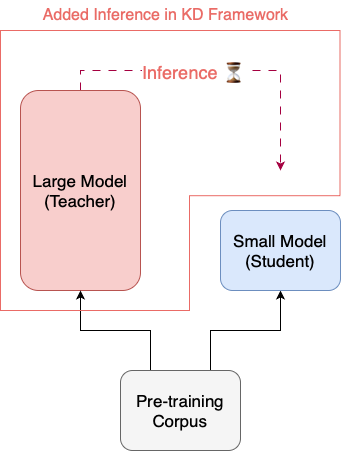
The accompanying
official repository
is pinned here at commit
dcc7b1d4abd071cde0ac7265dbb0ec03d95ddc8c. The code trace exposes the
protocol rather than merely repeating the abstract:
| Pinned code path | Observed contract |
|---|---|
pretraining/schedules.py:90-104 | TimeScheduler maps elapsed hours, not update count, onto the learning-rate schedule |
pretraining/args/pretraining_args.py:124-135 | total and early-exit training time are explicit run state |
slurm/.../distillbert_6layer_1epoch.sh:46-55 | teacher path, four-hour budget, architecture, method, and checkpoint time markers are configured together |
This is strong evidence that time budget can be made executable. It does not prove that wall-clock matching is sufficient in every system: even the paper notes that wall time can vary, and its result does not cover decoder-only on-policy generation, offline target production, paid APIs, or heterogeneous clusters.
0x0AH Processed Tokens, Unique Data, And Repetition Must Be Separate
Let be student updates, valid rows per update, and the number of distinct eligible rows in the frozen corpus. Then
and the exposure ratio is
If no-KD processes more rows under a time budget, it may see more unique data when . Once the corpus is exhausted, additional throughput increases repetition instead. A comparison that reports only processed tokens cannot distinguish those regimes.
The data identity also includes filtering, ordering, corruption, packing, and lineage-safe split rules from Loop 8. Two methods that read the same nominal corpus but apply different teacher-dependent filtering do not have the same training data.
0x0AI A Reproducible Toy Ledger Exposes The Trade-Offs
The local oracle uses intentionally artificial work units. It sets one student forward to 1 unit, one student backward to 2 units, one teacher score forward to 4 units, and declares separate teacher-decode, storage, peak-memory, and run-count coordinates. The values teach accounting; they are not measurements of any paper implementation.
With compute budget , teacher-work budget , serial-decode budget , storage budget 32 GiB, and peak-memory budget 80 GiB, the fixture produces:
| Candidate | Work/update | Updates under compute only | Updates under full vector budget | Binding resource or interpretation |
|---|---|---|---|---|
| no-KD | 3.00 | 2,800 | 2,800 | compute; no teacher coordinate is consumed |
| online dense token KD | 7.00 | 1,200 | 1,200 | compute and teacher work meet together |
| offline dense KD, reuse 4 | 4.00 amortized | 2,100 | 0 | 64 GiB one-time target artifact exceeds storage budget |
| offline sampled sparse KD, reuse 4 | 4.00 amortized | 2,100 | 2,100 | compute; sparse artifact fits at 8 GiB |
| online hidden/relation KD | 7.50 | 1,120 | 1,120 | compute; added alignment work remains explicit |
| offline sequence KD | 4.25 amortized | 1,976 | 1,440 | serial teacher decode is the binding coordinate |
| on-policy GKD | 8.50 | 988 | 988 | compute; student generation, teacher score, and rescore are all charged |
| teacher-assistant chain | 12.00 | 700 | 700 | two training runs and an assistant artifact are part of the method |
The same-update comparison is different. At 1,000 updates, no-KD costs 3,000 units, online token KD costs 7,000, on-policy GKD costs 8,500, and the teacher-assistant chain costs 12,000. Equal update count is therefore not equal compute in this fixture.

The oracle also computes unique-row exposure with a 1.5-million-row corpus. A candidate can process more rows yet gain no new unique rows after the cap; its increases instead. This is why compute, data, and repetition must be reported together.
0x0AJ The Controlled Pair Must Freeze More Than The Student Shape
A controlled method comparison requires one immutable manifest shared by every candidate:
release target:
    student graph, parameter/storage identities, tokenizer, precision, context

initial state:
    initialization class, checkpoint digest, random-seed policy

training rows:
    source revision, split lineage, filtering, corruption, packing, masks

optimization:
    valid-row reduction, optimizer, schedule coordinate, clipping, updates

resource denominator:
    one primary budget plus every hard secondary limit

search allowance:
    candidate count, pilot tokens, failed runs, seed count, selection rule

evaluation:
    frozen tasks, prompts, metrics, decoding, hardware, software, repetitions
The no-KD control must use the same deployable student, not merely a model with a similar parameter count. Otherwise architecture and supervision change at the same time. If a paper method requires a distinct architecture, report that as a separate pipeline comparison and do not call the difference a pure KD effect.
For quality functional under protocol , the distillation effect for a fixed student is
The notation keeps the protocol argument because changing the compute budget, data regime, initialization, or evaluation creates a different estimand. Loop 11 will own uncertainty, seed aggregation, metric direction, and promotion rules. Loop 10 only makes the pair admissible.
0x0AK Method Composition Adds Costs And Provenance
Methods can be composed, but their contracts do not disappear. A plausible pipeline is:
phase 0: choose or prune the student graph       -> S0
phase 1: transfer general representations       -> S1 + alignment state
phase 2: train on versioned teacher sequences   -> S2
phase 3: refine on student prefixes              -> S3 + rollout lineage
release: remove teacher-only state               -> deployable student bundle
For additive resources such as logical compute,
For sequential phases whose live tensors do not overlap,
whereas overlapping producer and consumer phases require an interval-liveness calculation from Loop 9. Persistent storage is the content-addressed union of artifacts rather than a blind sum:
Wall time is the critical path of the phase DAG. It is a sum only when every phase is serial and no production overlaps consumption.

A projection learned against one teacher revision cannot silently survive a teacher change. Teacher-generated sequences from phase 2 are not on-policy for or . An assistant checkpoint is not free because it is absent from the final bundle. Composition adds identities, costs, and rollback points.
0x0AL Comparison Admission And Pareto Reporting
The comparison harness rejects undefined pairs before looking at quality:
def admit_comparison(shared, candidates, budgets):
    assert shared.same_release_student
    assert shared.same_tokenizer_and_context
    assert shared.same_split_lineage
    assert shared.same_evaluation_contract
    assert shared.primary_budget_coordinate in budgets
    assert shared.search_budget_is_counted

    reports = []
    for candidate in candidates:
        contract = validate_eight_coordinate_contract(candidate)
        events = count_runtime_events(contract)
        resources = price_declared_coordinates(events, shared.unit_costs)
        feasible = all(resources[name] <= budgets[name] for name in budgets)
        reports.append((contract, resources, feasible))

    return pareto_front(
        reports,
        minimize=["compute", "wall_time", "teacher_calls", "storage", "peak_memory"],
        maximize=["quality"],
    )
pareto_front is deliberate. A single score requires exchange rates between
quality, teacher access, storage, latency, and engineering risk. Unless those
weights are declared by the deployment owner, the honest result is a frontier,
not a universal winner.
0x0AM Evidence Does Not Transfer Between Paper Contracts
The 15 core papers establish results in different regimes. DistilBERT, Patient KD, TinyBERT, and MiniLM study BERT-family encoders or encoder-style pretraining. Sequence-Level KD was developed for sequence generation. MiniLLM and GKD study autoregressive language-model distillation. Teacher Assistant KD’s original capacity-gap evidence is from image classification. Minitron combines pruning and recovery. Sparse Logit Sampling studies an estimator and storage path.
Therefore:
- an encoder result does not prove the same layer map is optimal in a causal decoder;
- a source-reported speedup includes one graph, runtime, hardware, workload, and denominator;
- an assistant that helps one capacity path does not establish that every extra stage helps;
- a divergence result under one prefix occupancy does not make prefix choice irrelevant;
- sparse-target accuracy does not transfer to a different support estimator;
- implementation parallelism is not a mathematical property of the objective;
- a pruned-and-recovered student is not a controlled test of KD alone.

0x0AN Paper-By-Contract Source Trace
The executable comparison manifest binds the complete core paper corpus:
1312.6184v7  Ba and Caruana function matching
1412.6550v4  FitNets
1503.02531v1 Hinton et al. classical KD
1606.07947v4 Sequence-Level KD
1612.03928v3 Attention Transfer
1908.09355v1 Patient KD
1909.10351v5 TinyBERT
1910.01108v4 DistilBERT
1902.03393v2 Teacher Assistant KD
2002.10957v2 MiniLM
2012.15828v2 MiniLMv2
2306.08543v6 MiniLLM
2306.13649v3 GKD
2407.14679v2 Minitron
2503.16870v2 Sparse Logit Sampling
Loop 10 adds 2404.19319v1 for the fixed-computation comparison protocol and
pins its author repository at
dcc7b1d4abd071cde0ac7265dbb0ec03d95ddc8c. All benchmark values remain
source-reported. The local comparison fixture contains no copied leaderboard
scores and cannot validate paper quality claims.
0x0AO Comparison Failure Lab
| Failure | Broken invariant | Consequence | Recovery owner |
|---|---|---|---|
| same updates labeled equal compute | event vectors differ | teacher-heavy methods receive extra work | Loop 10 budget manifest |
| same wall time inferred from FLOPs | critical path was not measured | overlap and utilization disappear | Loop 9 runtime plus Loop 10 protocol |
| same nominal corpus after different filtering | row lineage differs | data effect is attributed to KD | Loop 8 artifact manifest |
| no-KD control uses another architecture | release student differs | architecture and transfer are confounded | Loop 5 construction manifest |
| top- renormalization labeled Sparse Logit Sampling | estimator identity differs | gradient claim is false | Loop 8 sparse-target contract |
| MiniLM row labeled hidden-state MSE | matched object differs | relation geometry disappears | Loop 4 target contract |
| sequence KD labeled on-policy | prefix producer differs | exposure-bias claim is unsupported | Loops 6 and 7 |
| GKD omits student rescore | sampled IDs are treated as differentiable | wrong gradient path | Loop 7 three-pass trace |
| assistant checkpoint omitted from cost | extra run/artifact hidden | capacity-path method appears free | Loops 5 and 10 |
| offline target production omitted | teacher work moved outside window | online/offline comparison is biased | Loops 8 and 9 |
| hyperparameter trials omitted | search resources differ | selected result receives hidden budget | Loop 10 manifest; Loop 11 statistics |
| one source-reported result generalized across regimes | evidence coordinates differ | paper claim becomes universalized | Loop 10 evidence firewall |
| composed phases sum peak memory | liveness, not addition, defines peak | capacity estimate is wrong | Loop 9 interval ledger |
| one weighted score has undeclared exchange rates | preferences are hidden | apparent winner is policy-dependent | Loop 10 Pareto report |
0x0AP Executable Closure And Boundary
The Loop 10 oracle validates 15 unique paper contracts, eight method coordinates, eight toy candidates, scalar and vector budget arithmetic, unique-data exposure, composition accounting, comparison admission, and claim ceilings. It rejects one-field mutations in source revisions, method coordinates, resource events, budgets, shared controls, and evidence scope.
What it proves is intentionally bounded:
proved locally:
    immutable paper-coordinate rows
    no duplicate full method contracts
    event-to-resource arithmetic
    scalar and vector budget admission
    processed-versus-unique row accounting
    additive/peak/union/critical-path composition rules

not proved:
    any paper benchmark
    any trained student quality
    any real GPU throughput or wall time
    any universal ranking of distillation methods
    any deployment promotion decision
Loop 11 can now evaluate candidates whose identities and budgets are actually
comparable. 0x0B can choose a strategy without pretending that a paper name
determines the target, data, runtime, cost, and release artifact by itself.
0x0B Strategy Admission Begins With A Release Identity
Strategy selection begins with the deployable student, not with a favorite paper. A method name such as MiniLM, sequence KD, or GKD does not identify the student graph, teacher interface, data occupancy, runtime, cost, or release artifact. Before selecting a target, freeze the student release tuple:
student release identity:
    architecture/config digest
    parameter and storage identities
    tokenizer and canonical token support digest
    context limit and generation interface
    serving precision and runtime revision
    target hardware and workload matrix
    latency, throughput, memory and quality gates
The candidate set then needs at least three distinct identities:
- : the same student graph trained without transferred supervision;
- : that graph under the proposed transfer contract;
- : the teacher, reported as a quality and cost reference rather than as the control that isolates transfer value.
Comparing only with answers how much capability remains below the teacher. It does not answer whether KD helped the chosen student. Comparing with a different small architecture confounds architecture selection with transfer. Loop 10 admitted only candidates whose identities and budgets are comparable; Loop 11 decides whether one of those candidates has earned a student-only release artifact.
0x0BA Teacher Access Defines The Feasible Target Set
The teacher interface is a hard boundary, not an implementation convenience.
| Available interface | Feasible supervision | What remains unavailable |
|---|---|---|
| generated text only | hard sequence artifacts, teacher-side filtering or reranking over returned text | exact token distributions and internal representations |
| sampled tokens plus sampled-token log-probabilities | sampled-action objectives and explicit sequence estimators | dense forward KL without another estimator |
| sparse top- logits plus tail metadata | the declared sparse or sampled estimator | exact dense KL by merely renormalizing retained entries |
| full logits on fixed rows | token KD, forward/reverse token divergences, offline dense caches | hidden, attention, and value relations |
| selected hidden, attention, or QKV states | intermediate and relational transfer in addition to output KD | any unstored layer, head, row, or tensor |
| live teacher on student trajectories | on-policy token or sequence training | deployment independence unless export proves it separately |
If the API returns text only, there is no hidden-state matching problem to
solve. If teacher and student token supports differ, same-index KL is undefined
even when both responses are arrays called logits. A sequence objective or an
explicit transport between token supports may be valid; a shape cast is not.
0x0BB Compatibility Chooses Between Raw States, Relations, And Outputs
Raw hidden matching is easiest to define when token rows correspond, mapped layers have a defensible role, and width can be aligned by a controlled projection. Relation matching can retain token-pair geometry when widths or head counts differ. Output or sequence transfer is usually the cleaner contract when architectures differ radically or internal access is absent.
More targets are not monotonically better. An intermediate objective can add teacher compute, activation retention, collectives, projections, fragile layer maps, and optimization conflict. It earns inclusion only if the same-student ablation later shows value under the same primary budget.
| Constraint | Initial design | Escalate only when |
|---|---|---|
| shared tokenizer, full logits, modest teacher cost | masked token KD on fixed examples | self-generated trajectory failures remain |
| compatible stacks and internal access | output KD plus one justified state or relation target | a paired ablation supports the extra target |
| black-box text teacher | versioned sequence corpus | generation coverage, filtering and decoding-policy bias are measured |
| errors compound after student mistakes | fixed/student-prefix mixture | online generation and teacher scoring fit the vector budget |
| large capacity gap | repair temperature, data and optimization first | equal-budget direct KD remains optimization-limited |
| dense targets exceed storage | chunking, lower precision, or a verified sparse estimator | approximation error is checked against dense targets on an auditable subset |
| pruned or quantized student needs recovery | keep structural or numerical recipe fixed, then add scoped KD | same-artifact hard-label recovery is an insufficient baseline |
0x0BC The Design Procedure Returns Contracts, Not A Paper Name
def design_distillation(requirements, teacher, student, budget):
    assert student.release_identity == requirements.student_release_identity
    assert requirements.has_same_architecture_no_kd_control

    plan = {
        "matched_objects": [],
        "prefix_distribution": None,
        "teacher_interface": teacher.interface,
        "execution_mode": None,
        "persistent_artifacts": [],
        "evaluation_manifest": requirements.frozen_evaluation_manifest,
    }

    if teacher.interface == "text_only":
        plan["matched_objects"] = ["teacher_decoded_sequence"]
        plan["prefix_distribution"] = "source_plus_teacher_target"
        plan["execution_mode"] = "versioned_offline_sequence_corpus"
        plan["persistent_artifacts"] = ["sequence_manifest", "filter_lineage"]
        return validate_plan(plan, budget)

    if teacher.token_support_hash != student.token_support_hash:
        assert requirements.has_explicit_cross_tokenizer_objective

    if teacher.has_full_logits:
        plan["matched_objects"].append("token_distribution")
        plan["prefix_distribution"] = "fixed_examples"
        plan["execution_mode"] = choose_online_offline_or_hybrid(budget)

    if requirements.needs_intermediate_transfer:
        target = choose_hidden_attention_or_relation_target(teacher, student)
        assert target.has_layer_width_head_row_and_mask_contract
        plan["matched_objects"].append(target)

    if requirements.needs_student_prefix_coverage:
        assert teacher.can_score_student_trajectories
        plan["prefix_distribution"] = requirements.frozen_prefix_mixture
        plan["execution_mode"] = "generate_teacher_score_student_rescore"

    return validate_plan(plan, budget)
The result is a testable design, not evidence that the design is useful. Selection still requires the same student, immutable evaluation rows, a fixed budget, paired uncertainty, runtime gates, and export closure.
0x0BD Transfer Cost And Student-Only Deployment Cost Are Different Ledgers
An expensive transfer can be rational when the student is served many times, but hidden production work remains part of the method:
The deployed path has another denominator:
Counting the teacher in every future request understates the benefit of a teacher-independent student. Omitting target generation, assistants, failed search runs, and rollout production understates the cost of creating it. A term is zero only when the selected execution graph genuinely omits that event.
0x0BE The Evaluation Manifest Is Executable State
An evaluation result is meaningful only under an immutable protocol. Define
where is generation configuration, metric definitions and directions, case/seed blocking, hardware, and runtime. Every digest belongs in the result record. A task name alone does not identify the dataset revision, prompt, few-shot examples, filters, metric code, or generation policy.
The official lm-evaluation-harness task guide explicitly treats task YAML
plus the code commit as shareable evaluation state. This article pins
task_guide.md
and
evaluator.py
at commit e90e5b656bcc91559f1f2928c431ef4801f15804. This is evidence for
versioned configuration and result metadata, not a claim that one harness
covers every safety, human, code, or long-generation evaluation.
def freeze_evaluation(spec):
    manifest = canonicalize({
        "task_revision": spec.task_revision,
        "dataset_revision": spec.dataset_revision,
        "split_hash": hash_rows(spec.case_ids),
        "prompt_hash": sha256(spec.prompt_template),
        "fewshot_ids": spec.fewshot_ids,
        "tokenizer_hash": spec.tokenizer_hash,
        "generation": spec.generation,
        "metric_versions": spec.metric_versions,
        "metric_directions": spec.metric_directions,
        "block_ids": spec.case_seed_block_ids,
        "hardware_runtime": spec.hardware_runtime,
    })
    assert lineage(manifest.test_rows).isdisjoint(training_and_target_rows)
    return sha256(manifest), manifest

0x0BF Leakage Is A Lineage Failure, Not Just An Exact String Match
Evaluation rows must be disjoint from student training data, teacher-target production rows, assistant training data, prompt-selection data, and hyperparameter-selection data. Exact row IDs are the first check; near duplicates, benchmark-derived synthetic rows, translated copies, and teacher artifacts generated from held-out prompts require lineage-aware exclusion.
The order matters:
training/search data -> candidate selection -> frozen validation decision
                    -> untouched final test -> release report
If the final test chooses temperature, layer map, prefix mixture, checkpoint, or decoding policy, it has become selection data. A content digest cannot undo that conceptual leak. The manifest must record which decisions each split was allowed to influence.
0x0C Paired Evaluation, Uncertainty, And Conjunctive Admission
Distillation creates two different estimands:
The first isolates transfer for a fixed student. The second reports the remaining teacher gap. Neither substitutes for the other. For a lower-is- better metric such as NLL or latency, reversing the sign informally is error prone, so normalize every metric to an improvement coordinate.
0x0CA Metric Direction Is Part Of The Formula
Let when metric is maximized and when it is minimized. For paired block ,
Now positive always means that KD improved the same student. The teacher gap uses the same orientation:
The block can be one test case, prompt, user, document, conversation, random seed, or a declared composite. It must be the same block for both candidates. Shuffling one candidate’s rows preserves both marginal means while destroying the paired estimand.
Peyrard et al. show why independent averages can hide the joint structure of scores observed on the same examples. Their paper is used here to motivate preserving pairs; it does not prescribe this article’s release gate (ACL Anthology paper and source Figure 2).
0x0CB Deriving The Paired Bootstrap Gate
The point estimate is
Resampling candidates independently would erase their shared case difficulty. Instead sample block indices with replacement and carry the already-computed paired differences together:
For a percentile interval with two-sided error rate ,
The local oracle uses only six synthetic blocks, so it enumerates all bootstrap index vectors exactly rather than adding Monte Carlo noise. This is a teaching choice, not a recommendation to evaluate a real model on six prompts.
For a non-inferiority margin , admit metric only when
A primary transfer metric can require ; a safety or long-generation guardrail may allow a predeclared small regression. The margin is product policy fixed before observing the candidate, not a value chosen to make the candidate pass.

The synthetic fixture produces:
| Metric | Direction | Mean oriented transfer delta | 95% percentile interval | Gate |
|---|---|---|---|---|
| task score | maximize | primary passes | ||
| NLL | minimize | guardrail passes | ||
| safety score | maximize | guardrail passes | ||
| long-generation score | maximize | approximately | guardrail passes |
These numbers are generated data. They validate code paths and signs, not KD quality.
0x0CC Bootstrap, Paired Tests, And Hierarchical Blocks Are Alternatives
No statistical procedure is universal:
| Procedure | Useful when | Main contract or failure |
|---|---|---|
| paired mean and paired interval | block differences are an appropriate mean estimand and sample size supports the approximation | sensitive to heavy tails and dependence |
| paired percentile or BCa bootstrap | the statistic can be recomputed under block resampling | resampling unit must match dependence; small remains small |
| sign or signed-rank family | direction or rank shift matters more than magnitude | answers a different estimand and carries its own assumptions |
| pairwise win probability or Bradley-Terry family | per-instance relative outcomes are primary | does not preserve the meaning of every task-native score automatically |
| hierarchical bootstrap | prompts nest in documents, users, tasks, or seeds | hierarchy must reflect the data-generating and deployment unit |
| multi-seed paired analysis | training randomness is material | three favorable seeds are not a population proof |
Case resampling estimates evaluation-set uncertainty conditional on trained weights. Seed resampling estimates training-run uncertainty. Treating hundreds of prompts from one seed as hundreds of independent training replications is pseudoreplication. If both sources matter, report both levels or use a declared hierarchical design.
0x0CD Quality Is A Vector And Admission Is A Conjunction
Teacher agreement measures imitation, not correctness. Teacher and student can share the same error, so release evaluation needs labels, references, constraints, human judgments, or independent evaluators whose provenance is not the distilled teacher itself.
| Surface | Required evidence | Hidden failure in one aggregate |
|---|---|---|
| token prediction | held-out NLL/perplexity under one tokenizer and reduction contract | rare-language or long-context regressions disappear in the mean |
| task quality | task-native exact match, F1, pass rate, rubric or preference with metric version | teacher agreement can increase while correctness decreases |
| calibration | NLL, Brier score, reliability curve or precisely defined ECE | better top-line quality need not mean calibrated confidence |
| long generation | quality by output length, repetition, EOS, constraints and recovery after early mistakes | fixed-prefix loss does not exercise student trajectories |
| capability slices | language, domain, prompt form, context length, code/tool mode | capacity can be reallocated between slices |
| safety/refusal | harmful-completion, jailbreak, over-refusal and policy slices | KD can transfer both desired and undesired behavior |
Let , , , and be quality, runtime, artifact, and export gates. Admission is
An excellent average task score cannot compensate for a failed safety floor, teacher dependency, tokenizer mismatch, or latency ceiling. Pareto reporting can rank candidates that pass hard gates; a weighted score must not turn a failed invariant into a tradeable preference.
0x0CE Runtime Evaluation Is A Student-Only Experiment
The release benchmark starts in a fresh process that cannot resolve teacher weights, teacher APIs, target caches, rollout workers, assistants, or training-only alignment modules. The measured identity is
Record checkpoint/config bytes, cold load, resident and peak memory, prompt and output length distributions, concurrency, batching, warmup, repetitions, prefill/decode timing, throughput, kernel selection, and fallbacks. The same candidate under another runtime or workload is another experiment.
def benchmark_release(bundle, workload):
    process = fresh_process(network_policy="deny_teacher_services")
    model = process.load_student_only(bundle)
    assert model.weights_hash == bundle.candidate_weights_hash
    assert process.loaded_components == {
        "student_model", "student_tokenizer", "runtime_kernel"
    }

    warmup(model, workload.warmup_cases)
    raw = [run(model, workload) for _ in range(workload.repetitions)]
    return aggregate_without_discarding_raw_samples(raw)
The teacher and student should share a controlled protocol when reporting a deployment gap, but each may also receive an operationally tuned batch size. Report the controlled and tuned comparisons separately. A paper’s speedup does not transfer across precision, hardware, runtime, prompt/output lengths, or concurrency without remeasurement.
0x0D Attribution, Teacher-Independent Export, And Failure Closure
Evaluation says whether the candidate passed. Instrumentation and ablation say which contract plausibly produced the change. Export then proves that the measured candidate became a self-contained student artifact.
0x0DA Distributed Telemetry Preserves Numerators And Denominators
A scalar loss cannot diagnose a multi-target run. Every component keeps its
population:
hard CE: numerator / valid causal rows
token KD: numerator / valid shared-support rows
hidden target: numerator / valid mapped token-feature elements
attention or relation target: numerator / valid mapped pairs
sequence estimator: weighted return terms / valid response actions
runtime: teacher, generation, transport, cache wait, student fwd/bwd
correctness: teacher gradient tensors, padding contribution, dropped rows
For rank with numerator and denominator , the global objective is
not
The two are equal only under special denominator symmetry. The fixture uses 40 and 60 valid rows across two ranks and recovers hard CE and token KD . It also requires zero teacher-gradient tensors and zero padding-loss numerator.
0x0DB A Factorial Ablation Exposes Interaction
One-at-a-time ablations can miss interactions between targets. For token KD and hidden transfer , freeze architecture, initialization policy, data, optimizer, budget, seeds, and evaluation. The interaction is
In the synthetic fixture,
so the token effect at is , the hidden effect at is , and . The arithmetic shows that combined gain is not the sum of isolated gains. It does not prove a causal mechanism: hidden hyperparameter search, seed selection, compute drift, or data differences would invalidate that interpretation.

Other questions require their own controlled pair: direct versus assistant path including both runs; fixed versus student prefixes at matched resource budget; forward versus reverse KL on identical rows and estimator budget; dense versus sparse targets on a dense-audited subset; and pre-export versus exported student under the same runtime input fixture.
0x0DC A Release Bundle Is A Dependency Closure
The final training checkpoint is not the release artifact. Define the required student set
and the forbidden training set
A teacher-independent bundle requires
Names alone are insufficient. Starting from the serving entrypoint, compute the reachable dependency graph . No reachable node, import, credential, endpoint, tensor key, or lazy loader may require teacher-side state. An unused teacher file is still a packaging defect; an unbundled but reachable teacher API is a runtime defect.
The pinned Safetensors repository documents a tensor-only header/data format
and forbids arbitrary executable payload in the tensor file itself
(format at commit 6eb4dc9...).
That narrows one serialization surface; it does not validate tensor meaning,
model configuration, tokenizer compatibility, dependencies, or release
provenance. Those remain manifest checks.

0x0DD Content Addressing And Export Parity Bind The Candidate
For canonical identity and sorted file records , define
The release identity binds student weights, config, tokenizer, evaluation
manifest, generation policy, runtime compatibility, limitations, and rollback
predecessor. A mutable directory name or latest tag is an alias, not the
identity.
Export equivalence is another gate. For fixed parity inputs and chosen comparison function ,
and the exporter passes only if under a declared dtype and comparison surface. Token equality under greedy decoding is useful but can hide logit drift until a near-tie changes. Logit or hidden parity is stronger when the runtime exposes it; end-to-end generated parity is still needed at the actual interface.
def audit_student_bundle(bundle, expected):
    verify_every_file_digest(bundle)
    assert bundle.identity.weights_hash == expected.candidate_weights_hash
    assert bundle.identity.eval_manifest_hash == expected.eval_manifest_hash
    assert bundle.identity.tokenizer_hash == expected.tokenizer_hash
    assert required_paths(bundle) == expected.student_release_paths
    assert not forbidden_paths_tensor_keys_or_dependencies(bundle)

    graph = resolve_runtime_dependency_graph(bundle.entrypoint)
    assert not graph.reachable_nodes.intersection(expected.teacher_side_nodes)

    model = load_in_fresh_student_only_process(bundle)
    error = compare_pre_export_and_export(model, expected.parity_inputs)
    assert error <= expected.parity_tolerance
    return content_addressed_manifest(bundle)
0x0DE Local Promotion Is Not Production Rollout
Loop 11 owns a local, content-addressed state machine:
candidate -> evaluated -> bundled -> admitted to release registry
Every transition is monotonic and writes evidence before moving the registry pointer. The previous admitted student remains a valid predecessor. A failed evaluation or partial bundle never mutates the admitted pointer. Rolling back this local decision means restoring the pointer to the predecessor bundle and quarantining the failed identity.

This is not a canary, traffic ramp, SLO monitor, or production rollback. Those require stateful routing, live workload measurement, observability and recovery policy. M8.10 owns their whole-tuple release gate when this student is composed with a quantized/native low-bit deployment; M8.9 admits that representation. M6.10 retains the exact teacher-independent bundle and its local proof. Generic nonquantized production integration remains a separate, unassigned program boundary, not an implicit expansion of M8 ownership. M8.10’s release and rollback procedure is the closest material in this series; its low-bit parts do not apply.
The documentation boundary follows the same principle. Model Cards proposes reporting intended uses, evaluation procedures, performance conditions and limitations with released models (Mitchell et al.). A model card is necessary release context, not a cryptographic identity or substitute for raw evidence.
0x0DF Executable Evaluation And Release Oracle
The local Loop 11 oracle performs the following synthetic transaction:
1. validate pinned source and evaluation manifests
2. prove no-KD and KD candidates share the controlled student identity
3. preserve six paired blocks across four directed metrics
4. enumerate 46,656 exact paired bootstrap resamples per metric
5. apply primary and guardrail lower-confidence-bound gates
6. apply student-only latency, throughput, memory and load gates
7. globally reduce objective numerators and denominators
8. compute a two-factor ablation interaction
9. validate exactly nine release files and their digests
10. prove no teacher/training state is bundled or runtime-reachable
11. verify export parity and rollback predecessor identity
12. reject 26 semantic fault injections
The accepted toy candidate has task-score transfer , NLL improvement , a nine-file bundle digest, and maximum synthetic export error near . None of those values came from a trained model or real device.
0x0DG Cross-Contract Failure Lab
| Failure | Why a shallow check passes | Observable consequence | Fail-closed repair |
|---|---|---|---|
| KD compared only with teacher | teacher gap is a real number | architecture and transfer effects remain confounded | require the same-architecture no-KD control |
| final test tunes the KD recipe | split names still look correct | optimistic release estimate | freeze decision rights and use untouched final test |
| metric direction omitted | score is finite | lower NLL appears as a regression or latency as an improvement | store direction and orient every paired delta |
| candidate rows shuffled independently | marginal means remain unchanged | pairing and uncertainty are wrong | bind stable block IDs before aggregation |
| prompts from one seed treated as independent runs | sample count looks large | training uncertainty is understated | separate case and seed levels |
| one aggregate passes | average improves | safety, long-generation or language slice regresses | conjunctive bucketed gates |
| teacher agreement used as correctness | imitation improves | shared teacher errors are rewarded | use independent task/reference evidence |
| per-rank means averaged | all ranks report a scalar | objective changes with padding and world size | reduce numerators and denominators globally |
| one-at-a-time ablation only | isolated effects look additive | target interaction is hidden | include factorial cells or state interaction is unmeasured |
| teacher weights omitted but endpoint remains | bundle bytes look small | serving still depends on teacher availability | traverse runtime dependency graph under denied teacher access |
| alignment projection ships accidentally | state dict loads | claimed student bytes and graph are wrong | allowlist student keys and deny training-only state |
| required projection is deleted | package is smaller | released function is incomplete | classify inference-required modules as student graph before costing |
| tokenizer changes after evaluation | model weights are unchanged | prompt rows and generation semantics drift | bind tokenizer digest into candidate, evaluation and release identities |
| bundle digest excludes metadata | weight hash matches | config or generation policy mutates silently | digest canonical identity plus every file record |
| export parity checks only one token | smoke test passes | later logits or generation diverge | use fixed multi-surface parity fixtures |
| failed candidate overwrites release pointer | publication job partially succeeds | no known-good local predecessor remains | write immutable bundle first, then atomic pointer update |
| source-reported speedup becomes release expectation | citation is valid | target runtime misses its workload gate | remeasure exact student/runtime/workload identity |
| local admission called production deployment | registry state is real | live traffic, state and rollback risks are unevaluated | preserve local proof; low-bit composition enters M8.9/M8.10, other production integration remains separate |
A diagnostic should proceed from semantic identity to rows, objective, statistics, runtime, and release. Optimizer tuning cannot repair a mismatched token support, leaked split, destroyed pair, reversed metric, or teacher- dependent artifact.
0x0DH Loop 11 Claim Ceiling And Boundary
The loop proves locally:
proved by synthetic executable evidence:
    manifest hashing and split-lineage rejection
    controlled same-student identity
    metric-direction normalization
    exact paired-bootstrap arithmetic on six toy blocks
    conjunctive quality/runtime/artifact/export admission
    global numerator/denominator aggregation
    factorial interaction arithmetic
    release allowlist, denylist and runtime dependency closure
    content digest, parity threshold and rollback predecessor
    26 fail-closed semantic mutations

not proved:
    any student was trained
    any paper benchmark was reproduced
    any real GPU was benchmarked
    any real model was exported or published
    any method is universally best
    any production rollout or rollback was exercised
    article-wide publication closure
Loop 12 can now audit the complete article’s formulas, source pins, visual semantics, rendering, accessibility, internal links, boundaries, and final claim ceiling without changing the Loop 11 evaluation or release result.
0x0E Boundaries And Handoffs
Distillation can participate in several later workflows, but it does not own their mechanisms.
| Boundary | This article contributes | Owning article |
|---|---|---|
| structural pruning | teacher targets may support post-pruning recovery; this article does not choose heads, channels, layers, or sparsity structure | M6.11 - Pruning, Structural Compression, and Executable Sparsity |
| quantization-aware recovery | teacher supervision may be combined with fake-quantized student training; fake-quant placement and low-bit optimization are separate | M8.7 - Quantization-Aware Training |
| native low-bit architectures | a low-bit student can be distilled, but its binary/ternary parameterization and training dynamics are not KD | M8.8 - Native Binary and Ternary Transformers |
| quantized artifact integration | when low-bit W/A/KV or a native low-bit representation is added, retain the student bundle/provenance and validate the composed format, loader and kernel | M8.9 - Quantized Artifacts and Runtime Integration |
| quantized deployment rollout | student-only local proof feeds, but does not replace, whole-tuple quality/resource/canary/rollback gates for that low-bit composition | M8.10 - Deployment Evaluation, Release, and Rollback |
The same boundary applies to rationale, chain-of-thought, tool-trajectory, and cross-tokenizer distillation. They can be important transfer interfaces, but they add data-governance, observability, semantic-alignment, and sometimes safety contracts that this article has not derived. They should not be hidden inside a generic “sequence KD” label.
0x0F Claim Status And Evidence Discipline
This article uses five evidence labels:
| Label | Meaning |
|---|---|
| Source-local | a claim or explanatory pattern present in the related Transformer Series articles or repository material |
| Externally verified | checked against a primary paper or current official documentation |
| Rewrite interpretation | a synthesis, engineering derivation, or implementation recommendation produced for this article |
| Source-reported | a result reported by its source under that source’s model, data, hardware, and evaluation setup |
| Uncertain | plausible or implementation-dependent, but not established strongly enough to generalize |
The main claims resolve as follows:
| Claim | Status | Scope |
|---|---|---|
| softened output distributions can transfer information beyond one hard label | Externally verified | classical KD under a shared output support |
| sequence-level KD can train on teacher-decoded sequences | Externally verified | the decoded sequence is an approximation/artifact, not the full teacher distribution |
| DistilBERT combines language modeling, distillation, and cosine objectives in a reduced-depth BERT student | Externally verified | encoder-specific recipe; published outcomes remain source-reported |
| Patient KD, TinyBERT, and MiniLM match different intermediate objects | Externally verified | their layer, width, head, token, and phase contracts differ |
| an intermediate teacher assistant can mitigate some capacity gaps | Externally verified, source-scoped | original evidence does not prove universal benefit for LLM distillation |
| MiniLLM uses a sequence reverse-KL approach and GKD trains on student-generated outputs with teacher feedback | Externally verified | exact estimators, mixtures, and implementations remain method-specific |
| the four-contract signature is sufficient to expose most hidden method differences | Rewrite interpretation | an audit framework, not a theorem from one paper |
| exact sharded vocabulary KL can avoid full-logit all-gather through global normalizers and local contributions | Rewrite interpretation grounded in distributed softmax identities | requires aligned token support, shard mapping, and autograd-aware collectives |
| sparse logit sampling can estimate a dense objective without treating naive top- renormalization as exact | Externally verified, recent and source-scoped | estimator assumptions and variance must be audited for the actual method |
| KD always makes a model smaller or faster | False if generalized | architecture and runtime create the saving; KD is a transfer process |
| on-policy or reverse-KL distillation is always superior | Uncertain if generalized | depends on model, prefix distribution, estimator, data, and budget |
All performance numbers from papers are therefore source-reported unless a local reproduction states the student artifact, data, hardware, precision, runtime, batch/concurrency, and measurement protocol. No result in the references should be read as a universal deployment forecast.
The diagrams in this article are original explanatory redraws. Where a visual follows a paper-specific organization, its caption names that source. The Sequence KD, TinyBERT, MiniLM, MiniLLM, and GKD papers remain the authoritative descriptions of their own algorithms and figures.
0x10 Publish Gate And Final Contract
Before this article is considered complete, a reader should be able to audit the following without guessing.
0x10A Concept Gate
- Distillation is defined as transfer, not as a weight representation or compression format.
- The student architecture, precision, and runtime are identified as the source of deployment savings.
- Matched object, prefix distribution, teacher access, and execution plan remain separate contracts.
- Token KD, sequence artifacts, sequence objectives, and on-policy token objectives are not conflated.
- Paper variants are compared by what they change, not ranked under one unspecified benchmark.
0x10B Mathematical Gate
- Temperature softening, centered logits, and the gradient-scale convention are derived.
- Forward and reverse KL state which distribution supplies the expectation.
- Token rows, shifted labels, sequence trajectories, and sampled-prefix estimators are distinguished.
- Hidden, attention, and relation objectives state layer, width, head, token, position, and mask assumptions.
- Distributed vocabulary normalization and valid-token reduction preserve the intended global objective.
0x10C Implementation Gate
- The teacher is pinned, in evaluation mode, evaluated without gradients, and excluded from the released student.
- Tiny tensor traces expose shifts, masks, route/mapping metadata, and gradient ownership.
- Sampling stops gradients through discrete token IDs while rescoring the exact sampled prefixes.
- Online, offline, hybrid, and on-policy paths include their distinct runtime, cache, transport, and checkpoint state.
- Cached targets have versioned schemas, manifests, checksums, and explicit invalidation rules.
- Student-only export excludes teacher, assistant, cache, rollout, and training-only alignment state.
0x10D Evidence And Scope Gate
- Primary papers support paper-specific mechanism claims.
- Current framework behavior is cited as implementation-specific, not as a mathematical requirement.
- Benchmark and speed claims are labeled source-reported or locally reproduced with full context.
- Sparse-target claims are recent, source-scoped, and do not call naive top- renormalization exact.
- Pruning, QAT, native low-bit training, artifact integration, and rollout are handed to their owning articles.
- Semantic visuals state what they prove, include mobile variants, and do not substitute diagram similarity for algorithmic equivalence.
- Loop 12 independently closes formula and source identity, normalized
browser rendering, accessibility, owner boundaries, local-route acceptance,
and exact article-source rollback as
publishable_with_declared_scope.
0x10E Answer To The Owner Question
The teacher transfers behavior by exposing a richer training signal than the student’s original hard labels or data provide. That signal may be a softened token distribution, generated sequence, hidden state, attention relation, value relation, or likelihood on a student-generated trajectory. The student becomes cheaper only because a separately chosen architecture and numerical representation make it cheaper.
The complete method is therefore not
KD = KL(teacher, student)
but
distillation method =
    deployable student specification
  + matched teacher object
  + supervised prefix/data distribution
  + teacher access and alignment contracts
  + estimator and optimization contract
  + artifact/runtime/checkpoint plan
  + student-only evaluation and release gate
If any term is omitted, the method may still run, but it is no longer clear what information was transferred, what objective was optimized, what resources were consumed, or whether the released artifact realizes the claimed saving.
0x11 Final Formula, Source, Rendering, Accessibility, Boundary, And Rollback Closure
Loop 12 is not another distillation strategy. It is a transaction over the article produced by Loops 1 through 11. A token-KD oracle can pass while a source revision drifts; a release allowlist can pass while its explanatory figure is missing on mobile; a mathematically correct section can still point to the wrong downstream owner. Publication therefore requires several independent surfaces to identify the same article candidate.
The parent is the exact Loop 11 Markdown digest. The final candidate changes only this closure section and the single final-gate row above. The rollback oracle removes those two additions in memory and requires the reconstructed bytes to hash to that parent. It never rewrites the working article.
0x11A One Candidate, Several Independent Evidence Surfaces
There is no aggregate documentation score. Every row below must pass, and all rows are joined by the final article digest.
| Surface | Frozen publication identity | Acceptance condition |
|---|---|---|
| formulas | 309 source-ordered display blocks plus their rendered inline peers | exact LaTeX text, order, section, line span, and digest; browser source/render parity |
| sources and claims | 61 published external URLs, revision-pinned source artifacts, source traces, and claim matrices from all eleven loops | local source-artifact digests exact; article URL set exact; source-reported results remain scoped |
| figures and visuals | 115 local asset routes yielding 72 rendered image elements, including 43 responsive pictures and 29 source-figure elements | every file exists and is digest-bound; every alternative is nonempty; responsive source selection matches viewport |
| executable evidence | eleven historical loop contracts and 1,331 mechanism, artifact, runtime, comparison, and release mutations | each mutation remains owned by its original oracle; the final audit does not flatten failure semantics |
| browser surface | desktop/mobile crossed with light/dark | MathJax parity, headings, anchors, language, themes, local routes, images, content types, and article-owned overflow pass |
| release and rollback | one final article digest and one exact Loop 11 parent digest | publication follows browser acceptance; rollback reconstructs the parent bytes without mutating the source file |
The final registries are candidate registries. They do not rewrite historical Loop 1 through Loop 11 manifests whose article digests describe earlier states. This distinction preserves provenance: historical evidence remains replayable against the state it originally validated, while Loop 12 records the complete final state separately.
0x11B Normalized Browser And Accessibility Contract
Four profiles load the built local route: desktop light, desktop dark, mobile light, and mobile dark. Each profile waits for all MathJax sources to gain a rendered peer, resolves every article image, and audits the complete article DOM. Screenshots are viewport evidence; the checks are not limited to the screenshot rectangle.
math sources == rendered MathJax nodes
display-math sources == 309
rendered image elements == 72
responsive picture elements == 43
source-figure elements == 29
broken images == 0
empty image alternatives == 0
duplicate heading IDs == 0
broken internal anchors == 0
article-owned horizontal overflow == 0
article-owned console/page errors == 0
all local image and owner routes return the expected content type
mobile profiles select mobile sources; desktop profiles select desktop sources
The browser contract proves this repository snapshot under the four declared profiles. It does not prove every browser, assistive technology, zoom policy, site-shell arrangement, live external URL, or production deployment.
0x11C Concrete Owner Boundaries And Program Handoff
The final boundary audit resolves conceptual handoffs to actual local files, checks their routes, records current digests under an explicit policy, and rejects long exact prose duplication. These contracts remain non-transferable:
| Relation | Owner | Contract preserved here |
|---|---|---|
| consumes | M3.9 | teacher forcing, causal shifts, masks, and valid-token reduction |
| consumes | M3.8 | output logits, shared vocabulary support, and token-row interface |
| consumes | M4.1 | parameter, compute, memory, activation, and traffic accounting |
| consumes | M4.2 | logical-versus-observed execution and measurement boundary |
| next program owner | M6.11 | pruning scores, masks, graph surgery, sparse artifacts, recovery, and pruning-specific release proof |
| defers | M7.1 | draft proposal, exact target verification, and speculative K/V state |
| defers | M8.7 | fake quantization, STEs, observers, and low-bit optimization |
| defers | M8.8 | binary and ternary student parameterization |
| conditionally consumes | M8.9 | format, loader, executable ABI and kernel compatibility when composed with low-bit representation |
| conditionally consumes | M8.10 | whole-tuple canary, monitoring and rollback for that low-bit composition; not universal student rollout ownership |
M6.10 closes teacher-student transfer and a teacher-independent candidate artifact. It does not own which parameters M6.11 removes, how an M8 numerical representation is packed, or how M8.10 moves production traffic. In particular, the local registry admission in Loop 11 is a predecessor to deployment, not a claim that deployment occurred.
0x11D Release Verdict, Evidence Ceiling, And Narrow Rollback
The final article state is publication_closed with verdict
publishable_with_declared_scope. Static formula, source, figure, visual,
failure, boundary, and browser surfaces pass. All local article and asset
routes are accepted. Live external availability remains unclaimed.
The rollback artifact is executable only at article-source scope: it proves that removing the Loop 12 span and gate row returns the exact Loop 11 Markdown bytes. It does not roll back a student checkpoint, tokenizer, teacher service, optimizer, target cache, rollout cache, registry generation, production service, or infrastructure deployment.
No teacher or student was trained. No framework model, GPU kernel, production scheduler, paper benchmark, live external-link monitor, or deployment was executed by Loop 12. The closure proves publication consistency for this repository snapshot; it does not establish empirical superiority of a distillation method or a real model release.
0xFF References
Primary Papers
- Jimmy Ba and Rich Caruana. Do Deep Nets Really Need to be Deep?, NeurIPS 2014.
- Adriana Romero et al. FitNets: Hints for Thin Deep Nets, ICLR 2015.
- Geoffrey Hinton, Oriol Vinyals, and Jeff Dean. Distilling the Knowledge in a Neural Network, 2015.
- Yoon Kim and Alexander M. Rush. Sequence-Level Knowledge Distillation, EMNLP 2016.
- Sergey Zagoruyko and Nikos Komodakis. Paying More Attention to Attention: Improving the Performance of Convolutional Neural Networks via Attention Transfer, ICLR 2017.
- Victor Sanh, Lysandre Debut, Julien Chaumond, and Thomas Wolf. DistilBERT, a distilled version of BERT: smaller, faster, cheaper and lighter, 2019.
- Siqi Sun, Yu Cheng, Zhe Gan, and Jingjing Liu. Patient Knowledge Distillation for BERT Model Compression, EMNLP-IJCNLP 2019.
- Xiaoqi Jiao et al. TinyBERT: Distilling BERT for Natural Language Understanding, 2019.
- Wenhui Wang et al. MiniLM: Deep Self-Attention Distillation for Task-Agnostic Compression of Pre-Trained Transformers, NeurIPS 2020.
- Wenhui Wang et al. MiniLMv2: Multi-Head Self-Attention Relation Distillation for Compressing Pretrained Transformers, ACL-IJCNLP 2021.
- Seyed-Iman Mirzadeh et al. Improved Knowledge Distillation via Teacher Assistant, AAAI 2020.
- Yuxian Gu et al. MiniLLM: On-Policy Distillation of Large Language Models, ICLR 2024; this article pins the 2026-01-31 arXiv revision rather than relying on the floating abstract.
- Rishabh Agarwal et al. On-Policy Distillation of Language Models: Learning from Self-Generated Mistakes, ICLR 2024.
- Saurav Muralidharan et al. Compact Language Models via Pruning and Knowledge Distillation, 2024.
- Anshumann et al. Sparse Logit Sampling: Accelerating Knowledge Distillation in LLMs, 2025.
- Stephane Ross, Geoffrey Gordon, and Drew Bagnell. A Reduction of Imitation Learning and Structured Prediction to No-Regret Online Learning, AISTATS 2011.
- Alexander Lin, Jeremy Wohlwend, Howard Chen, and Tao Lei. Autoregressive Knowledge Distillation through Imitation Learning, EMNLP 2020; referred to as ImitKD in this article.
- Yuqiao Wen, Zichao Li, Wenyu Du, and Lili Mou. -Divergence Minimization for Sequence-Level Knowledge Distillation, ACL 2023.
Current Implementation Documentation
- Hugging Face TRL. GKD Trainer, accessed 2026-07-21.
- Microsoft LMOps. MiniLLM reference
implementation,
pinned to commit
4f2a9deb5f08e459fd44c2e4792344d78ca89fc3. - Hugging Face TRL. Pinned GKD trainer
source,
pinned to commit
24db2a825029f7e0e60f6d3c160485565a784503. - NVIDIA NeMo Framework. Knowledge Distillation, accessed 2026-07-21.
- NVIDIA Megatron Core. Fused vocabulary-parallel cross entropy, accessed 2026-07-21.
Official documentation above describes current framework interfaces. It is version-scoped implementation evidence, not the primary proof of the paper algorithms.