After M8 - How Transformer System Is Made: Research Loops, Evidence, and Publication
After M8 - How Transformer System Is Made: Research Loops, Evidence, and Publication
0x00 The Published Article Is A Compiled Artifact
Transformer System began as a rewrite of the Transformer Series. The early assumption was that a better structure would make the same material easier to understand. That was only partly true. Reorganization removed repetition, but it also exposed a more dangerous failure: a concise synthesis can preserve conclusions while deleting the derivations, tensor transitions, implementation choices, training state, runtime consequences, and paper lineage that made the conclusions useful.
The production method changed in response. An article stopped being treated as a document written from top to bottom. It became the publication artifact compiled from four different layers:
| Layer | Main question | Typical artifacts | Reader-facing? |
|---|---|---|---|
| research corpus | what evidence exists, and what does each source actually support? | local source articles, papers, official code/docs, source figures | references and selected figures |
| design and ownership | which article owns each concept, and which neighboring article must not duplicate it? | roadmap, owner contract, boundary graph, depth-gap audit | owner question and handoffs |
| engineering evidence | do formulas, shapes, algorithms, examples, links, and renders agree? | manifests, fixtures, oracles, tests, hashes, browser reports | examples, pseudocode, failure labs |
| publication prose | what sequence lets a reader reconstruct the mechanism? | Markdown, figures, captions, references, publish gate | yes |
The first three layers contain planning machinery that would normally remain in an author’s notebook, code repository, spreadsheet, or review history. Transformer System makes much of that machinery explicit because it is still under construction. This is normal. Human authors also work through outlines, rejected explanations, derivation scratchpads, source tables, editorial comments, and successive drafts. Those intermediate structures are not defects in the process, but they are not automatically the final literary form either.
The distinction matters:
research and evidence machinery
    proves that the candidate article is coherent

publication prose
    teaches the coherent mechanism to a reader

final editorial form
    may later hide loop labels and internal gates
    without deleting the depth they produced
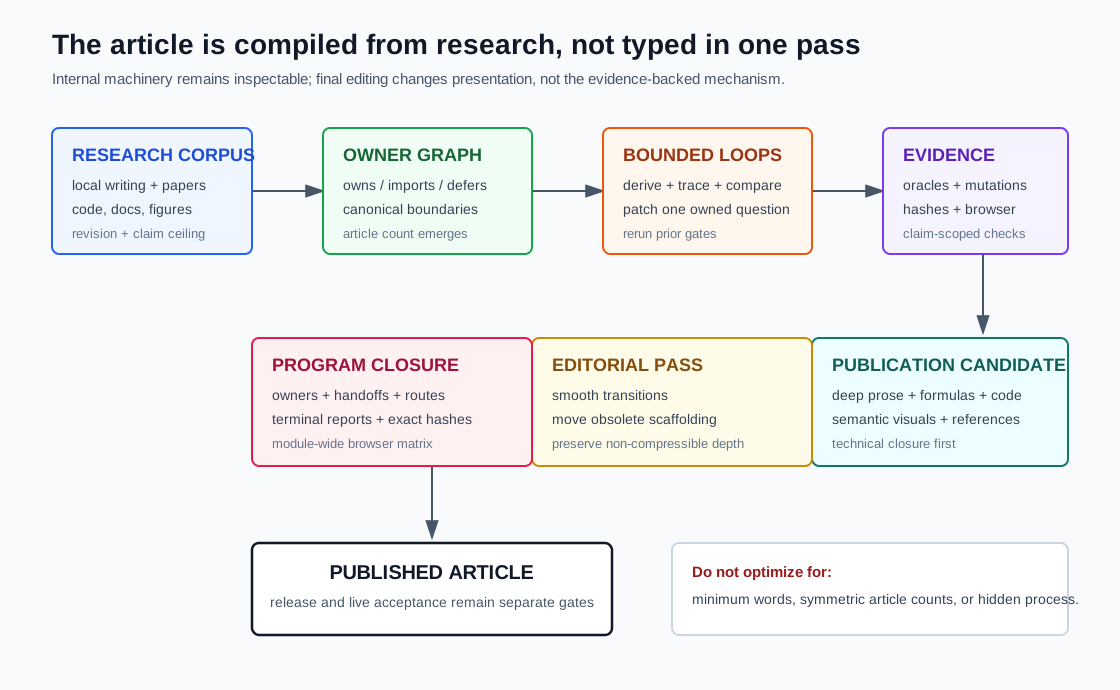
This afterword records that production method. It is not a claim that every Transformer System article has reached the same editorial maturity. It is a reusable protocol for building the next series with the same depth while improving the separation between internal scaffolding and final exposition.
0x01 Begin With A Corpus, Not A Table Of Contents
A new series should not begin by inventing article titles. It should begin by constructing the evidence surface.
For Transformer System, the corpus included the original Transformer Series, the roadmap, later local writing, primary papers, official runtime documentation, source code, figures, and selected engineering references. The original articles were not treated as obsolete drafts. They established a minimum depth baseline: the rewrite could remove duplicated prose or repair an error, but it could not silently discard useful explanations simply to become shorter.
0x01A Every Source Has A Role And A Claim Ceiling
A source manifest should record more than a URL:
source_id: paper_or_local_name
kind: local_article | primary_paper | official_code | official_docs | secondary
revision: exact version, commit, or retrieval date
supports:
  - mechanism or claim supported by this source
claim_ceiling: source_local | source_reported | externally_verified
figures:
  - identifier, license, disposition, and intended semantic use
The claim ceiling prevents several common substitutions:
paper reports a benchmark
    != benchmark reproduced locally

official API exposes an option
    != optimized backend executed

source code contains a path
    != deployed runtime selected that path

article explains a mechanism
    != every implementation uses that mechanism
Sources should therefore be classified by what they can prove. Primary papers own their algorithm and source-reported experiments. Official code and docs own version-specific interfaces and implementation boundaries. Local articles own their explanations, but technically consequential claims still need external verification. Secondary sources are useful for discovery and interpretation, not as silent replacements for the primary record.
0x01B Read Sources For Missing Machinery, Not Only Missing Facts
The source audit asks what the current draft has compressed away:
- the historical pressure that created the method;
- prerequisite concepts the source author introduced before the mechanism;
- derivation steps between the objective and final formula;
- tensor shapes, indexing, masks, and persistent state;
- alternative methods and why one design was chosen;
- training schedules, initialization, checkpoint, and export behavior;
- runtime dispatch, memory, synchronization, and serving integration;
- source figures that explain a mechanism better than prose alone;
- negative results, assumptions, and failure cases.
This is why source length is not the decision rule. A long historical survey may compress into one lineage table, while a single two-line equation may require a full derivation, numerical example, and implementation trace.
0x02 Design An Ownership Graph Before Writing Prose
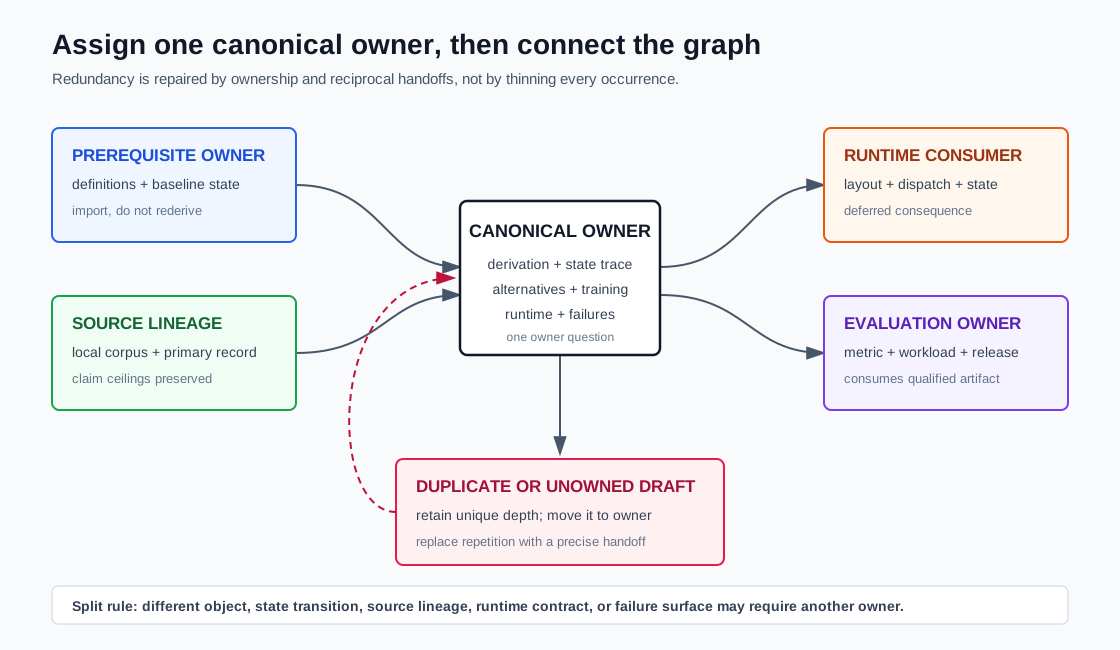
Redundancy is not solved by deleting repeated concepts everywhere. It is solved by assigning one canonical owner and giving other articles explicit imports and handoffs.
Each article begins with one owner question. The question must be specific enough that a reader can tell when the article is complete. An owner contract then separates four sets:
owns:
    mechanisms derived completely here

imports:
    prerequisites used from earlier owners

defers:
    consequences developed by later owners

forbidden collapses:
    distinctions the article must never merge
For example, a method name must not collapse a training objective, an exported artifact, and a runtime kernel into one object. A nominal bit width must not collapse logical codes, serialized bytes, loaded memory, executed arithmetic, and measured service capacity. A speculative output token must not collapse with the K/V row that is valid to commit. These distinctions became owner and failure contracts because plausible prose had hidden them before.
0x02A Article Count Is An Output
The number of articles should emerge from ownership. It should not be fixed for symmetry with an older series.
Split an article when two sections have different:
- owner questions;
- mathematical objects or state transitions;
- source lineages;
- training or runtime contracts;
- evaluation denominators;
- failure modes;
- downstream consumers.
Merge articles only when they explain one continuous state transition and a split would force both halves to repeat the same derivation or manifest. The M6, M7, and M8 expansions were consequences of this rule. Depth was preserved by adding owners rather than forcing unrelated mechanisms into a word budget.
0x02B A Program Audit Precedes Article Audits
Before deepening one article, inspect the module as a graph:
- list every owner question;
- map prerequisites and downstream consumers;
- locate exact duplicated explanations;
- locate concepts referenced everywhere but owned nowhere;
- identify incompatible notation or state models;
- freeze stable routes unless a migration is necessary;
- order work so foundational contracts close before consumers.
This prevents an excellent local rewrite from making the series globally less coherent.
0x03 The Read-Only Pre-Loop Audit
The first operation on an article is a read-only audit. It is deliberately not a rewrite. Its output is a bounded inventory:
| Audit surface | Questions |
|---|---|
| introduction | does the reader know why the problem exists and what came before it? |
| owner boundary | what is fully owned, imported, deferred, or forbidden? |
| formulas | are assumptions, variables, units, shapes, and derivations present? |
| mechanisms | can one input be traced through the state transition? |
| alternatives | which viable designs exist, and what does each exchange? |
| training | what is initialized, optimized, frozen, scheduled, saved, or converted? |
| runtime | what is allocated, packed, dispatched, synchronized, cached, measured, or rolled back? |
| papers | are methods compared by full contracts rather than names and benchmark maxima? |
| visuals | which source figures can be reused, which need reconstruction, and what is still invisible? |
| evidence | which claims can be checked symbolically, numerically, structurally, or in a browser? |
| scope | which claims remain source-reported, uncertain, environment-dependent, or untested? |
The audit ends with priorities, not prose. A useful classification is:
P0: correctness or publication blocker
P1: missing mechanism depth
P2: visual, source, accessibility, or editorial closure
P3: optional extension with a separate owner or verification need
This inventory becomes the loop plan. It also provides a stopping rule: when a later audit finds no unowned P0/P1 mechanism gap, work can move from technical construction to editorial refinement.
0x04 Freeze Identity Before Deriving Behavior
Many technically wrong explanations are shape-correct. They fail because the identity of a token, row, cache entry, expert route, candidate branch, adapter, quantization group, or experimental sample changed silently.
The early loops therefore freeze the article’s immutable objects. The exact manifest is domain-specific, but often includes:
- source and target tensor names, shapes, axes, dtypes, devices, and layouts;
- sample, request, token, route, branch, or artifact identity;
- masks, positions, validity, and supervision state;
- trainable, frozen, optimizer, checkpoint, and random-number state;
- persistent, temporary, recomputed, transferred, and released memory;
- runtime version, source commit, backend, kernel, topology, and fallback;
- dataset split, workload, metric, tolerance, and decision policy;
- source, figure, license, and article hash.
0x04A Hashes Are Evidence Bindings, Not Proof By Themselves
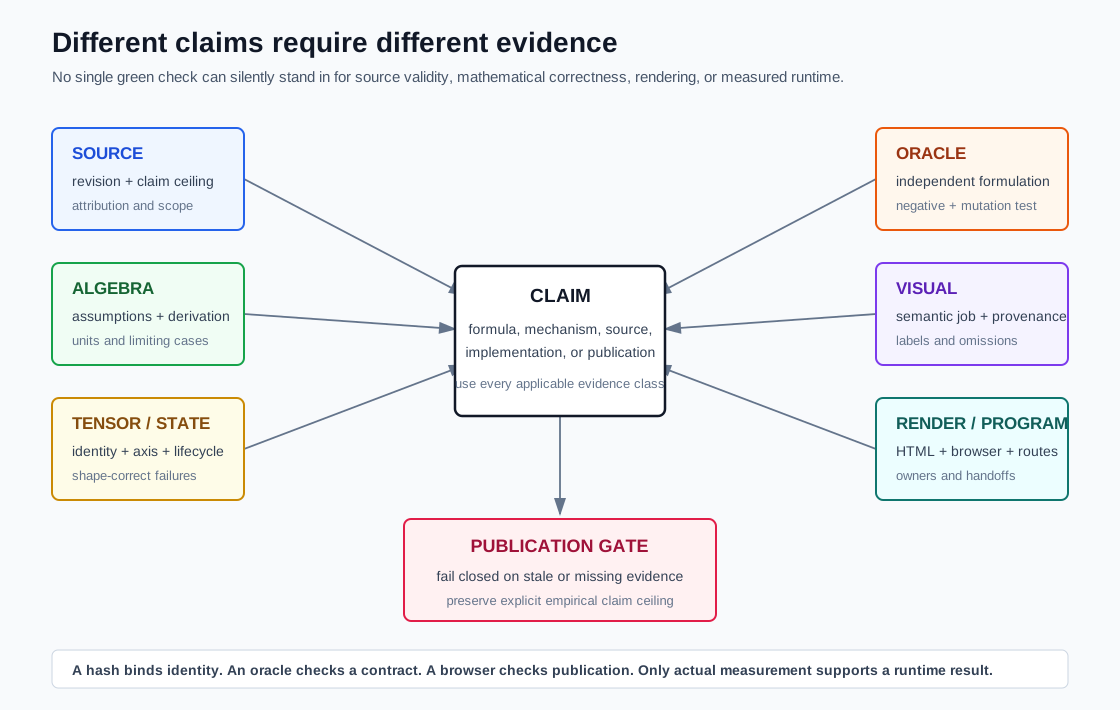
A hash answers one narrow question: is this the same byte sequence that the report evaluated? It does not prove that the evaluated claim is true. Transformer System uses hashes to prevent a green report from drifting away from the article, source revision, generated HTML, or fixture that produced it.
The proof still comes from the appropriate check:
symbolic identity     -> derivation or algebraic oracle
tensor implementation -> shape/index/state oracle
numerical behavior    -> reference calculation and tolerance
source claim          -> pinned primary source and scoped wording
rendered publication  -> generated HTML and browser evidence
runtime performance   -> measured exact environment, if actually executed
0x05 Plan Bounded Loops, Not One Giant Rewrite
A loop is the smallest coherent research-and-publication transaction that can close one question without making the rest of the article unauditable.
Each loop has:
question: one bounded uncertainty or missing mechanism
inputs: exact sources and prior owner contracts
deliverables: prose, formulas, traces, visuals, and evidence
gate: observable conditions required to call the loop complete
scope_ceiling: claims the loop is not allowed to make
rollback: article and evidence state that can be restored
There is no universal twelve-section article template. Twelve loops became a useful engineering rhythm for many deep Transformer System owners, but their contents were adapted to the mechanism. A common sequence was:
| Loop family | Typical purpose |
|---|---|
| 0 | immediate correctness repair or read-only pre-loop audit |
| 1 | historical introduction, owner contract, source and figure manifest |
| 2 | immutable identities, tensor/state schemas, and source-to-object trace |
| 3-6 | mathematical derivation and mechanism implementation, one dependency at a time |
| 7-9 | training/runtime integration, alternatives, paper variants, cost and sensitivity |
| 10 | executable oracle, framework/source trace, or pipeline comparison |
| 11 | evaluation, failure injection, release, rollback, and source-reported reconciliation |
| 12 | formula, source, visual, render, accessibility, and cross-article closure |
The numbering is bookkeeping, not pedagogy. Some articles need fewer loops. Others need a new article owner rather than a thirteenth unrelated mechanism.
0x05A The Atomic Loop
Inside one loop, the work proceeds in a fixed causal order:
- restate the owner question and exact gate;
- inspect the current article and primary sources without editing;
- write the derivation and name every assumption;
- trace one concrete input through tensors, state, and code;
- compare viable alternatives under the same contract;
- patch only the owned section and its handoffs;
- build an independent oracle or reconciliation fixture;
- turn plausible failure modes into negative or mutation tests;
- add or revise semantic visuals and provenance;
- build and inspect desktop/mobile, light/dark publication output;
- review the diff, rerun prior gates, and update the next loop.
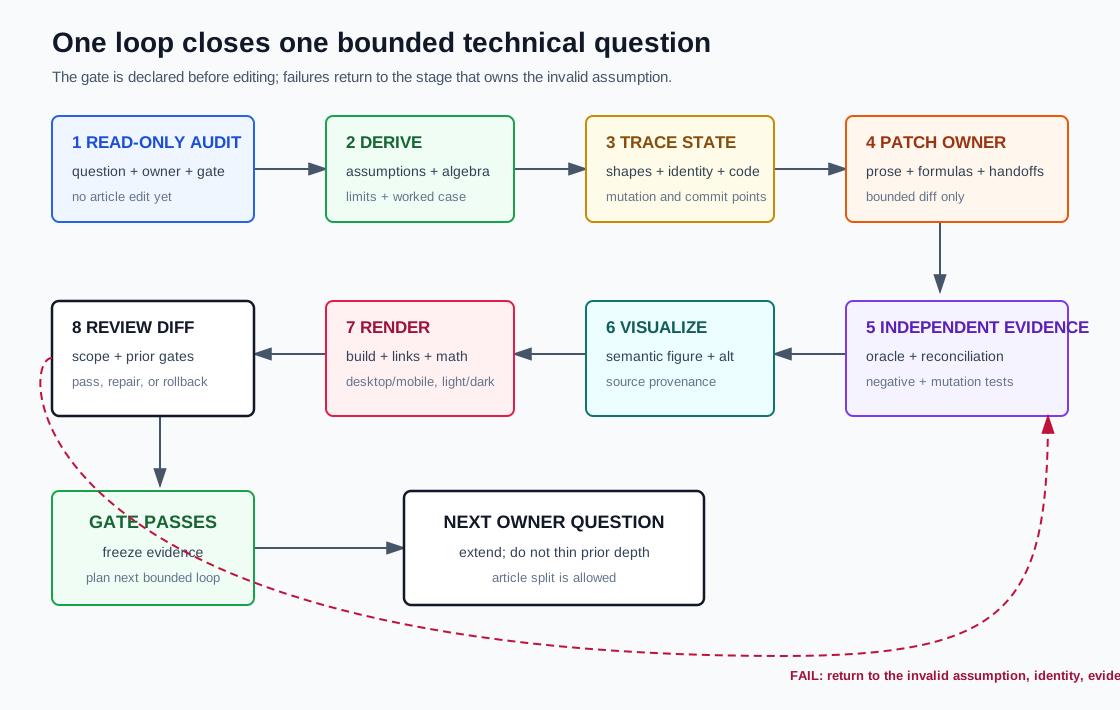
Later loops extend earlier work. They do not earn room by compressing derivations, implementation traces, alternatives, training/runtime integration, or paper comparisons that already passed a gate.
0x06 Five Dimensions Of Depth Are Non-Compressible
The roadmap depth contract names five dimensions that must survive every rewrite. The loop process makes each one operational.
0x06A Derive The Formula, Do Not Merely Display It
A formula section should answer this chain:
object and objective
 -> assumptions
 -> decomposition or state transition
 -> algebraic steps
 -> final expression
 -> variables, shapes, units, and convention
 -> limiting cases
 -> worked numerical example
 -> implementation translation
 -> failure if an assumption changes
For a generic constrained objective,
showing the final Lagrangian is not enough. A deep treatment must define the trajectory distribution behind each expectation, the reward and cost return conventions, finite- or infinite-horizon assumptions, discounting, feasibility, and why nonnegative multipliers correspond to upper-bound constraints. Only then does the saddle objective have a stable meaning:
The sign, multiplier projection, update timescale, and empirical estimator are not typographic details. They determine whether the code encourages or punishes constraint violation.
0x06B Carry Tensor And State Identity Through Code
Pseudocode must preserve the identities established by the manifest. It should include shapes, indexing, ownership, mutation, and commit points.
For reinforcement learning, a trace might follow:
environment transition
 -> trajectory row (s_t, a_t, r_t, c_t, done_t, timeout_t)
 -> reward and cost returns
 -> reward and cost advantages
 -> policy/value/cost-value minibatches
 -> primal gradient and dual update
 -> projected multiplier state
 -> checkpoint and evaluation policy
The trace must distinguish termination from truncation, on-policy collection from replay data, behavior policy from target policy, per-step cost from trajectory constraint, and training-time estimates from evaluation-time gates. Those are the constrained-RL equivalents of token/KV, logical/physical, or artifact/runtime identity failures in Transformer System.
0x06C Compare Alternative Designs Under One Contract
Alternatives should not appear as a list of acronyms. Normalize them across the same axes:
| Contract axis | Example questions for constrained RL |
|---|---|
| objective | expected cost, chance constraint, CVaR, worst case, or temporal logic? |
| feasibility | assumed feasible start, learned recovery, shield, or no guarantee? |
| update | penalty, primal-dual, trust region, projection, or model-predictive correction? |
| estimator | on-policy, off-policy, model-based, importance weighted, or conservative? |
| guarantee | asymptotic, local, high probability, empirical only, or none? |
| state | policy, reward critic, cost critic, multipliers, model, safety set, replay buffer |
| runtime | training-only constraint, action filter, shield, planner, or deployment monitor |
| evidence | theorem assumptions, simulator result, real-system result, reproduced result |
This exposes real design exchanges instead of declaring one paper universally better.
0x06D Connect Training To Runtime
Training details are part of the method:
- initialization and pretraining;
- data collection policy and environment versions;
- reward and cost normalization;
- critic targets and bootstrapping;
- optimizer and update frequencies;
- multiplier parameterization and projection;
- trust-region or clipping behavior;
- replay, importance weights, and distribution shift;
- checkpoint contents and resumption;
- export, inference policy, safety layer, monitoring, and rollback.
A method whose safety mechanism exists only during training is different from a method whose runtime action is filtered by a shield. The article must carry that difference into deployment rather than ending at the loss function.
0x06E Compare Papers By Pipeline Contract
Paper comparison should separate:
problem definition
assumptions and guarantee
objective and estimator
data/interaction budget
optimization schedule
architecture and persistent state
evaluation protocol
reported result
artifact/runtime consequence
Benchmark numbers remain source-reported unless reproduced. A theorem remains conditional on its assumptions. A method evaluated with privileged simulator state is not silently equivalent to one deployed from observations alone.
0x07 Evidence Should Fail Closed
Tests in a writing repository are not substitutes for peer review or empirical reproduction. They are executable checks that specific contracts remain true as the article evolves.
0x07A Useful Evidence Classes
| Evidence | What it can catch | What it cannot prove alone |
|---|---|---|
| source manifest | citation drift, wrong revision, unsupported attribution | technical correctness of the source |
| formula registry | missing variables, duplicate symbols, convention drift | truth of the derivation |
| executable oracle | algebra, index, state, or numerical mismatch on defined fixtures | general performance or unrestricted correctness |
| mutation test | audit that stays green after a known-bad change | completeness of all possible failures |
| article hash | report/article drift | semantic quality |
| route/link audit | missing local posts, assets, or external targets | source relevance |
| browser matrix | math parity, overflow, broken images, theme and viewport regressions | pedagogical clarity |
| program audit | duplicate owners, missing handoffs, stale final evidence | correctness of every article claim |
0x07B The Oracle Must Be Independent Enough To Disagree
Reimplementing the article pseudocode line for line and calling it a reference creates correlated errors. Prefer a second formulation:
- enumerate a tiny state space instead of sampling;
- compare a merged online state with direct full computation;
- calculate a ledger from dimensions rather than parsing the displayed total;
- build a mask from a graph relation rather than copying a table;
- replay a state machine from events rather than trusting the final state;
- compare a source-pinned implementation trace with the teaching pseudocode.
Every oracle should state its domain. Passing a tiny deterministic fixture does not become a hardware benchmark or a proof for every model.
0x07C Mutation Tests Protect The Audit
An audit can be more dangerous than no audit when it reports green without checking the terminal artifact. Mutation tests deliberately change a hash, formula token, route, state transition, mask entry, or source revision and require the audit to fail. They test the detector, not the mechanism.
The central rule is:
no final report without source identity
no program green without running article terminal gates
no browser green without exact route/profile cardinality
no performance claim without an executed measurement contract
0x08 Visuals Are Part Of The Explanation
The visual process begins during source research, not after prose is complete. Every figure found in a local source or primary paper receives one disposition:
reuse:
    license and resolution permit direct use; caption states provenance

reconstruct:
    redraw the mechanism with Transformer System notation and cite the conceptual source

context-only:
    useful during research but redundant or too paper-specific for publication

omit:
    decorative, illegible, unsupported, duplicated, or outside the owner scope
A custom visual needs a semantic job. Good jobs include proving an axis, showing ownership, exposing temporary versus persistent state, comparing two algorithms under one input, or making a failure visible. “Make the page less text-heavy” is not a sufficient specification.
Each visual should declare:
- the claim or transition it explains;
- labels and notation shared with the prose;
- source and reconstruction provenance;
- what is intentionally omitted;
- alt text that communicates the semantic result;
- stable dimensions and mobile legibility;
- light/dark compatibility and text containment.
Source figures remain valuable, especially for paper lineage and source-reported results. Custom diagrams are better for cross-paper normalization, tensor/state traces, and program-specific owner boundaries. The two roles should not be confused.
0x09 Article Closure And Program Closure Are Different
An article can pass locally while breaking the series. Closure therefore occurs at two levels.
0x09A Article Closure
The terminal article audit checks:
- owner question and owns/imports/defers boundary;
- derivations, variables, units, shapes, and renderer-safe formulas;
- source manifest and source-scoped wording;
- visual routes, provenance, captions, and alt text;
- code fences, tables, heading IDs, links, and references;
- executable oracles, negative fixtures, and mutation tests;
- desktop/mobile and light/dark rendering;
- explicit empirical and runtime claim ceilings;
- article-source hash binding.
0x09B Program Closure
The module audit then checks:
- ordered owner set and publication state;
- reciprocal handoffs and no missing owner;
- duplicate deep prose and conflicting notation;
- final report selection for every article;
- all terminal validators, not selected status fields;
- exact article hashes and generated routes;
- normalized browser evidence across the complete module;
- bounded repair scope for any remaining delta.
This distinction was learned through false greens: a central report can say “pass” while an article’s current terminal suite fails, its source hash is absent, or the central selector points to a structural report instead of the final publication report.
0x09C Build, Deployment, And Live Acceptance Are Separate Gates
A successful static build proves that the publication can be generated. A local browser matrix proves properties of that generated candidate. Deployment proves that a particular release was transferred. Live acceptance proves that public routes and assets behave in the deployed environment. No earlier gate should claim a later one.
0x0A The Final Editorial Pass Comes After Technical Closure
The current Transformer System articles often expose loop boundaries, manifests, owner language, and publish gates. That is useful while mechanisms are still being deepened because it keeps scope and evidence visible. It is not necessarily the final reading experience.
A later editorial pass may:
- replace “Loop 4” with a descriptive transition;
- move detailed manifests from the article into repository evidence;
- merge repetitive publish gates into a concise end note;
- convert internal source-status tables into precise citations and prose;
- smooth transitions between sections written in different loops;
- remove planning narration that no longer helps reconstruct the mechanism;
- preserve a short methodology link back to this afterword.
It must not remove:
- derivations and assumptions;
- tensor, state, and code traces;
- alternative design comparisons;
- training/runtime bridges;
- paper-by-contract distinctions;
- useful source and reconstructed figures;
- failure cases and claim limitations.
The editorial objective is therefore not “make it shorter.” It is:
reduce visible scaffolding
while preserving or improving reconstructible technical depth
0x0B Failure Lab For Research-Loop Writing
| Failure | Why it looks reasonable | Detection | Required response |
|---|---|---|---|
| start from article titles | a clean curriculum appears quickly | important concepts have no owner or appear repeatedly | audit corpus and build owner graph first |
| treat old articles as word budget | rewrite looks concise | derivations and implementation details disappear | use old corpus as minimum depth baseline |
| one giant rewrite | prose becomes stylistically consistent | review cannot identify which claim changed | split into bounded loops with gates |
| fixed twelve-section template | process appears standardized | article structure follows tooling rather than mechanism | keep loop protocol, customize loop content |
| formula without derivation | mathematical notation signals rigor | sign, axis, assumption, or unit cannot be reconstructed | add derivation ladder and limiting cases |
| pseudocode without identities | code looks executable | state, positions, ownership, or commit semantics are ambiguous | freeze manifest and trace one concrete example |
| methods compared by names | survey covers many papers | training budget, assumptions, and runtime differ | compare full pipeline contracts |
| source figure copied without audit | paper authority transfers visually | license, caption, axes, or scope are wrong | record provenance and disposition |
| every visual redrawn | style is uniform | source evidence and historical context disappear | mix licensed source figures with semantic reconstructions |
| tests mirror prose exactly | all checks pass | the same error exists in article and oracle | use an independent formulation and mutations |
| central audit trusts old report | module remains green | article hash or terminal suite is stale | execute terminal gates and require exact binding |
| benchmark quoted as local result | article sounds decisive | no environment or raw evidence exists | label source-reported and scope exact setup |
| internal machinery kept forever | process remains transparent | reader path becomes repetitive and bureaucratic | perform separate editorial pass after closure |
| scaffolding removed too early | article reads smoothly | later patches silently reintroduce drift | retain evidence layer until program closure |
0x0C Adapting The Method To Constrained Reinforcement Learning
The process transfers across domains; the manifests and invariants do not. A constrained reinforcement learning series should not merely replace Transformer terms in existing loop plans. It needs a domain audit centered on decision processes, feasibility, estimators, guarantees, and deployment-time safety.
0x0CA Domain Invariants To Freeze Early
At minimum, distinguish:
reward objective vs safety/cost constraint
per-step cost vs discounted/undiscounted trajectory cost
expected constraint vs chance, CVaR, worst-case, or temporal constraint
environment termination vs time-limit truncation
behavior policy vs target policy vs deployed policy
true environment cost vs learned cost critic estimate
training feasibility vs evaluation compliance
penalty coefficient vs Lagrange multiplier vs runtime safety threshold
asymptotic/theoretical guarantee vs finite-sample empirical result
simulator safety vs real-system safety
training-time correction vs runtime shield or action projection
mean performance vs violation frequency, severity, and tail risk
0x0CB A Seed Ownership Map, Not A Final Curriculum
The corpus audit should be allowed to change this map:
| Candidate owner | Owner question |
|---|---|
| orientation and MDP execution | what state, action, transition, return, value, policy, and data-generation objects exist? |
| policy/value optimization | how do dynamic programming, policy gradients, actor-critic estimators, and trust regions transform trajectory evidence? |
| constrained MDP foundations | what is feasible, how do occupancy measures express reward/cost objectives, and when does duality apply? |
| penalty and primal-dual methods | how are multipliers estimated, projected, scheduled, and stabilized with learned critics? |
| trust-region constrained updates | how do CPO-style approximations, projections, and first-order variants differ by guarantee and implementation? |
| risk and distributional constraints | how do chance constraints, CVaR, tail costs, robust objectives, and ambiguity sets change the state? |
| safe exploration and runtime intervention | what belongs to shields, control barrier functions, model predictive safety, recovery policies, or human override? |
| offline constrained RL | how do support mismatch, conservative estimation, behavior data, and counterfactual safety limit learning? |
| systems and reproducibility | how are environments, vectorization, seeds, replay, normalization, checkpoints, evaluators, and distributed state made exact? |
| evaluation and release | how are reward, feasibility, violation tails, uncertainty, stress tests, monitoring, fallback, and rollback turned into gates? |
The first research deliverable should be a gap and ownership audit that either confirms, splits, merges, or rejects these candidate owners.
0x0D Reusable Bootstrap Prompt For The Next Series
The following prompt is intentionally detailed. It asks the next research agent to build the program architecture and loop plan before writing final article prose.
You are helping build a deep technical article series on reinforcement learning,
with constrained reinforcement learning as its central specialization.

The objective is not to summarize papers or compress existing material. The
series must let a technically serious reader reconstruct the mathematics,
estimators, training state, implementation, runtime safety boundary, empirical
contract, and paper lineage of each mechanism.

Treat every published article as a compiled artifact produced from a research
corpus, an ownership graph, bounded implementation loops, executable evidence,
semantic visuals, and a final editorial pass.

NON-COMPRESSIBLE DEPTH

Do not compress or remove:
1. derivations explaining why formulas take their final form;
2. tensor-level, trajectory-level, state-level, and code-level traces;
3. alternative methods and design choices;
4. training details and runtime/deployment integration;
5. comparisons between paper variants by complete pipeline contract.

If these dimensions do not fit coherently, create another article owner. Article
count is an output of the ownership audit, not a fixed target.

CLAIM STATUS

Label consequential claims as one of:
- source-local;
- externally verified;
- rewrite interpretation;
- source-reported empirical result;
- locally reproduced;
- uncertain or not externally verified.

Never convert a paper benchmark into a local result. Never convert an
asymptotic theorem into an unconditional finite-sample safety guarantee. Never
convert simulator compliance into real-system safety.

STAGE 1: READ-ONLY CORPUS AUDIT

Before proposing articles, inspect all supplied local writing and build a source
manifest. Then research primary papers, official code, official documentation,
benchmark/environment definitions, and relevant surveys for discovery only.
Pin paper revisions, code commits, environment versions, and retrieval dates.

For every source record:
- what mechanism or claim it supports;
- its assumptions and empirical denominator;
- whether it contains useful figures;
- figure license/provenance and reuse/reconstruct/context/omit disposition;
- its claim ceiling.

Identify depth present in local writing that must survive reconstruction, even
if the prose quality is lower than the target series.

STAGE 2: DOMAIN AND OWNERSHIP AUDIT

Build a concept/dependency graph before a table of contents. At minimum audit:
- MDP/POMDP state, action, transition, reward, cost, horizon, discount, and
  occupancy conventions;
- value functions, policy gradients, actor-critic estimators, bootstrapping,
  termination, and truncation;
- constrained MDP feasibility, primal and dual forms, strong-duality conditions,
  and occupancy-measure geometry;
- penalties, primal-dual methods, multiplier state, update timescales, and
  critic-estimation error;
- constrained trust-region and projection methods;
- chance, CVaR, distributional, robust, and temporal-logic constraints;
- safe exploration, recovery, shields, barrier functions, model-based safety,
  and human intervention;
- offline constrained RL, support mismatch, conservative estimation, and
  counterfactual limitations;
- multi-agent or hierarchical constraints only if the corpus justifies owners;
- environment/runtime integration, reproducibility, evaluation, monitoring,
  fallback, and rollback.

For each proposed article produce:
- one owner question;
- owns, imports, defers, and forbidden collapses;
- prerequisite and downstream links;
- primary source set;
- required derivations, traces, alternatives, training/runtime sections,
  visuals, failure cases, and publish gate.

Detect duplicated content and assign one canonical owner. Do not delete a deep
explanation until its new owner exists and reciprocal links are explicit.

STAGE 3: ARTICLE PRE-LOOP AUDIT

For the next article only, perform a read-only gap audit. Classify findings:
- P0 correctness/publication blockers;
- P1 missing mechanism depth;
- P2 source, visual, render, accessibility, or editorial closure;
- P3 optional expansion requiring separate verification or ownership.

Do not begin with a giant rewrite. Convert the findings into small loops. Each
loop must have one question, exact inputs, deliverables, a pass/fail gate, a
claim ceiling, and rollback scope.

STAGE 4: IMMUTABLE MANIFESTS

Freeze the identities needed by the article. For constrained RL include as
applicable:
- environment and wrapper versions;
- observation/action spaces and normalization;
- horizon, discount, termination, truncation, and reset semantics;
- reward and every cost signal with units and aggregation;
- policy, reward critic, cost critic, target network, multiplier, model, shield,
  replay, optimizer, RNG, and checkpoint state;
- behavior, target, collection, evaluation, and deployed policy identity;
- trajectory schema and tensor shapes;
- dataset split, seed, scenario, stressor, and independent sampling unit;
- evaluation metric, confidence interval, feasibility margin, and release rule;
- source, code, visual, article, and generated-page hashes.

STAGE 5: BOUNDED RESEARCH LOOPS

Use the following as a customizable loop family, not a rigid article template:
0. immediate correctness repair or pre-loop audit;
1. historical introduction, motivation, owner contract, source/figure manifest;
2. immutable trajectory, estimator, state, and environment contract;
3-6. derivations and mechanism traces, one dependency at a time;
7-9. alternatives, training schedules, implementation/runtime integration,
     sensitivity, and paper variants;
10. independent executable oracle and source/code trace;
11. evaluation, stress/failure injection, monitoring, fallback, and rollback;
12. formula, source, visual, render, accessibility, and boundary closure.

Within every loop:
1. inspect current content and primary sources before editing;
2. derive formulas from the declared objective and assumptions;
3. carry one concrete trajectory through tensors, estimators, updates, and state;
4. show code-level pseudocode with shapes, mutation, ownership, and commit points;
5. compare viable alternatives under one contract;
6. patch only the owned section;
7. create an independent oracle or reconciliation fixture;
8. create negative and mutation tests for plausible wrong implementations;
9. add or update semantic visuals and provenance;
10. build and check desktop/mobile plus light/dark rendering;
11. rerun prior gates and review the bounded diff before planning the next loop.

STAGE 6: DERIVATION CONTRACT

For each important formula provide:
- object and objective;
- assumptions;
- derivation steps;
- variables, shapes, units, signs, and reduction axes;
- limiting/special cases;
- worked numerical or tiny-state example;
- implementation translation;
- failure when assumptions change.

For constrained objectives, explicitly distinguish expected cumulative cost,
per-step cost, violation probability, CVaR/tail risk, worst-case cost, and
temporal constraints. State feasibility and duality assumptions. Show why the
Lagrangian sign and multiplier projection are correct. Separate true constraint
values from learned estimates.

STAGE 7: PAPER-BY-CONTRACT COMPARISON

Normalize every paper across:
- problem definition and constraint class;
- assumptions and guarantee type;
- objective and estimator;
- data source and interaction budget;
- policy/critic/model/shield architecture;
- optimization and multiplier schedule;
- persistent training and runtime state;
- environment, scenarios, seeds, baselines, metrics, and uncertainty;
- source-reported result;
- artifact and deployment consequence.

Do not compare method names or maxima from incompatible environments as if they
shared a denominator.

STAGE 8: VISUAL SYSTEM

Audit every useful figure from local sources and primary papers. Record license
and provenance. Reuse licensed source figures when they carry historical or
empirical evidence. Reconstruct figures when common notation or a cross-paper
comparison is needed. Omit decorative or redundant figures.

Every custom visual must have a semantic job, such as:
- MDP/occupancy geometry;
- primal-dual update and timescale state;
- trajectory-to-estimator tensor trace;
- trust-region/projection geometry;
- constraint type comparison;
- training-only versus runtime safety boundary;
- offline support and uncertainty;
- evaluation, stress, monitoring, fallback, and rollback state machine.

Require descriptive alt text, stable dimensions, mobile legibility, light/dark
compatibility, and labels consistent with article notation.

STAGE 9: EVIDENCE AND CLOSURE

Create checks appropriate to the claim:
- symbolic or enumerated tiny-MDP checks for derivations;
- shape/index/state checks for trajectory and update code;
- deterministic fixtures for return, advantage, multiplier, projection, and
  termination/truncation semantics;
- independent reference implementations where feasible;
- mutation tests proving audits fail on sign, mask, state, source, hash, or
  boundary errors;
- link, source, figure, formula, route, alt-text, and browser checks;
- article-source and generated-page hash binding.

State what was not executed: paper training, large environments, hardware,
real-system interaction, deployment, or live acceptance. Tests in the writing
repository do not become empirical reproduction.

Close the article first, then run a program-level audit for owner coverage,
reciprocal handoffs, duplicates, notation conflicts, terminal evidence, exact
hashes, routes, and normalized browser profiles.

STAGE 10: FINAL EDITORIAL FORM

Only after technical and program closure, perform a separate editorial pass.
Remove visible loop bookkeeping and repetitive internal planning language when
it no longer helps the reader. Preserve every derivation, state/code trace,
alternative, training/runtime bridge, paper distinction, useful visual, failure
case, and claim limitation. The objective is less visible scaffolding, not a
thinner technical series.

FIRST RESPONSE REQUIRED

Do not write final article prose yet. Return:
1. corpus and source-acquisition plan;
2. constrained-RL concept/dependency graph;
3. proposed owner map with merge/split reasoning;
4. redundancy and missing-owner audit;
5. per-article non-compressible depth requirements;
6. visual research backlog;
7. evidence/test strategy;
8. recommended implementation order;
9. the complete bounded loop plan for the first article only.
0x0E Publish Gate For A New Series
Before the first constrained-RL article is considered technically closed:
- The corpus includes local explanations, primary papers, official code, environment definitions, and source figures with claim ceilings.
- The series owner graph was designed before final article prose.
- MDP, constraint, estimator, training state, runtime intervention, and evaluation objects have canonical owners.
- Reward and every cost constraint have explicit horizon, discount, unit, aggregation, and feasibility semantics.
- Termination and time-limit truncation are distinct in formulas and code.
- Every central formula has assumptions, derivation, variables, limiting cases, worked example, and implementation translation.
- At least one trajectory is traced through collection, returns, reward and cost advantages, primal update, dual update, checkpoint, and evaluation.
- Penalty, primal-dual, trust-region, projection, risk-sensitive, shielded, model-based, and offline alternatives are compared only where one owner and source corpus justify the comparison.
- Paper results and guarantees are scoped to exact assumptions and empirical denominators.
- Training-time safety signals and runtime safety interventions are not conflated.
- Source figures have provenance and dispositions; custom visuals have semantic jobs and accessible labels.
- Oracles are independent enough to disagree with the teaching pseudocode.
- Mutation tests prove the audit fails on plausible sign, state, identity, or evidence errors.
- Article and program closure execute terminal gates and bind current source and generated-page identities.
- The final editorial pass removes obsolete scaffolding without deleting non-compressible depth.
0x0F What To Carry Forward
The most reusable Transformer System lesson is not “use twelve loops.” It is that depth needs an architecture of its own.
corpus before outline
ownership before expansion
identity before algebra
derivation before summary
state trace before pseudocode confidence
contract before paper comparison
oracle before green report
visual semantics before decoration
article closure before program closure
technical closure before editorial compression
The next series should improve the method, not imitate its accidental surface. Constrained reinforcement learning has different mathematical objects, safety claims, failure consequences, and empirical limitations. The process transfers because it forces those differences to become explicit.
0xFF References And Local Method Sources
- M0.0 - Roadmap - series architecture, owner
boundaries, and the non-compressible depth contract.
[TRANSFORMER SYSTEM] - M4.1 - Transformer Cost Model -
immutable manifests, derivation, reconciliation, and executable accounting.
[TRANSFORMER SYSTEM] - M4.3 - IO-Aware Attention And FlashAttention-1 -
derivation-to-algorithm-to-oracle workflow and source-figure reconstruction.
[TRANSFORMER SYSTEM] - M5.8 - Multi-Head Latent Attention -
twelve-loop architecture, source-to-tensor manifests, runtime integration,
final publication evidence, and program-level repair.
[TRANSFORMER SYSTEM] - M6.11 - Pruning, Structural Compression, And Executable Sparsity -
mechanism-specific loop design, paper-by-contract comparison, recovery,
runtime proof, and preservation rule.
[TRANSFORMER SYSTEM] - M7.1 - Speculative Decoding -
exactness derivation, output/KV/RNG identity, correction state, and fail-closed
publication contracts.
[TRANSFORMER SYSTEM] - M8.10 - Deployment Evaluation, Release, And Rollback -
immutable candidate tuples, statistical gates, measurement contracts,
staged release, observability, and rollback.
[TRANSFORMER SYSTEM] - X1.3 - Masks, Training, Runtime, And State -
cross-cutting ownership, mixed-origin state, training/runtime bridges, and
reuse/release boundaries.
[TRANSFORMER SYSTEM]