M5.4 - Long-Context KV Policies: Retention, Compression, and Budget Allocation
M5.4 - Long-Context KV Policies: Retention, Compression, and Budget Allocation
0x00 Historical Introduction And Owner Contract
M5.1 established why autoregressive serving materializes K/V state in the first place. Without a cache, every decode step would project keys and values again for the entire accepted prefix. With a cache, each committed token contributes one persistent K/V row per layer and later queries reuse those rows.
That exchange removes repeated projection work; it does not make a long history free. Under full-cache attention, the persistent state grows with the accepted sequence, and every new query remains logically able to read every old row. M5.3 can allocate those rows in pages, map them through virtual memory, or reuse an exactly compatible prefix. Those mechanisms change where exact state lives and who owns it. They do not decide that an old token has ceased to be part of the model-visible history.
The owner question is:
Given a compatible model and a finite historical-state budget, which past representations remain visible to each layer and head, how is that decision updated, and what quality and runtime contract replaces full-cache attention?
M5.4 owns that decision as one conceptual KVVisibilityPolicy. Its thesis is:
Long-context K/V optimization is not one technique and not one byte count.

The exact baseline keeps every committed row visible.
A visibility policy may retain original rows, choose different rows per
layer or head, or replace several rows with another representation.

Each policy must name:
    the state it changes,
    the evidence used to change it,
    the work and metadata it adds,
    whether omitted history is recoverable,
    and the quality contract that is no longer exact full-cache attention.
0x00A The Cache Solved Recomputation And Created A Historical-State Problem
The historical progression matters because the word “cache” hides several different problems:
no K/V cache:
    repeatedly project old accepted tokens

exact full K/V cache:
    project each accepted row once
    retain every row
    expose every row to later attention

exact dynamic layout:
    retain the same logical rows and visibility
    allocate, share, and reclaim physical storage more precisely

long-context visibility policy:
    change which historical rows or representations attention may consume
The full cache is therefore the semantic baseline for this article:
for query position t and layer l:
    legal visible history = every committed position 0..t
    stored object = the checkpoint-compatible K/V representation
    omitted committed history = empty
This baseline does not promise that a model reasons perfectly over every visible token. It says only that the cache policy has not removed evidence that the checkpoint’s attention rule could otherwise read. That distinction is important: model capability, positional generalization, physical storage, and legal visibility are separate contracts.
A second distinction is equally important:
sparse attention execution:
    all historical K/V may remain stored
    a backend computes only a declared subset for one query
    generic kernel and mask execution remain M4.5 concerns

persistent K/V retention:
    omitted rows no longer belong to the resident visible set
    future queries cannot use them unless another contract recovers them
    this is M5.4
Both can reduce attention work. Only the second necessarily reduces persistent K/V rows, and only the second changes the future visibility state owned here.
0x00B From Attention Concentration To A Visibility Decision
The handwritten source A25 introduces sequence-length reduction through two empirical observations: attention can be concentrated on a subset of positions, and different tokens can receive very different attention mass. That is the right motivation, but it is not yet an eviction proof.
Attention is conditional on at least:
current query token
layer and attention head
prompt and generated history
task and data distribution
checkpoint and position regime
decoding step
The figure below is the A25 crop of Keyformer’s source-reported CNN/DailyMail summarization measurements. It shows that attention sparsity varies across models and layers and that substantial cumulative attention mass can be concentrated in a fraction of the context under that experiment. It does not establish one universal cache ratio, and it does not prove that a position with low attention now will remain irrelevant to an unknown future query.
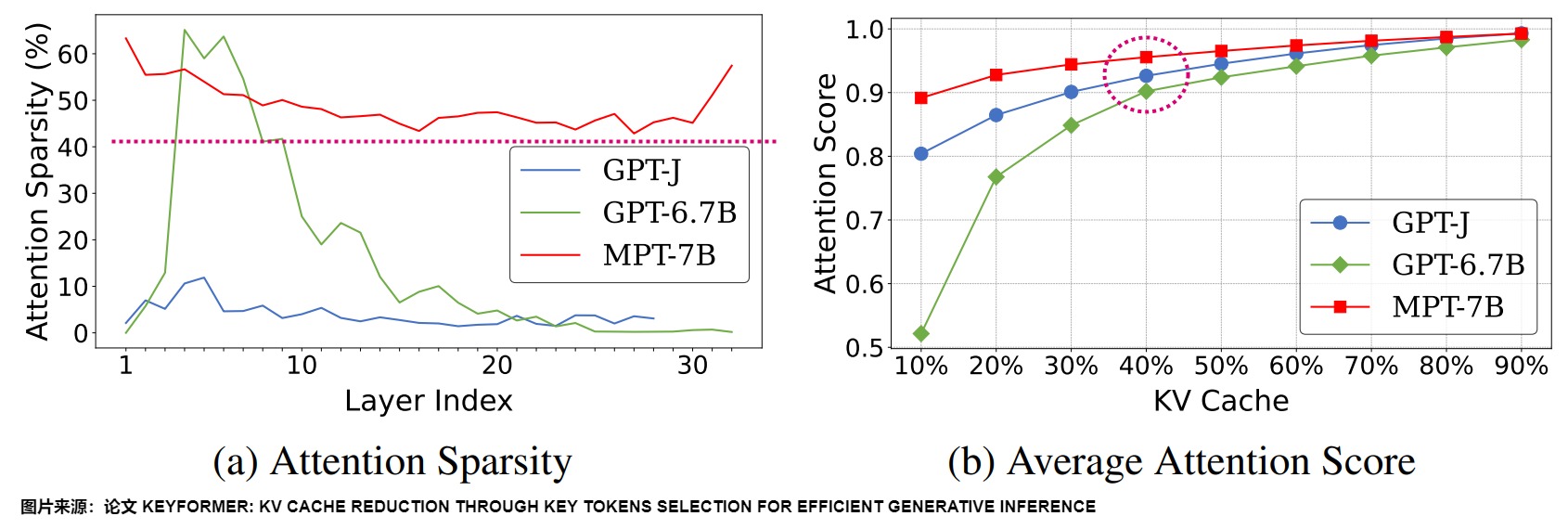
Source: Keyformer, Figure 3(a,b), cropped as preserved in A25. The measurements are evidence for the named models, dataset, and evaluation setup, not a universal future-relevance law.
Turning concentration into a persistent cache policy adds a prediction problem:
observed fact:
    a row received little or much attention for queries already evaluated

policy inference:
    a row is unlikely or likely to matter to future queries

irreversible action:
    evict or merge the row so future full-cache attention is unavailable
That last implication is method-specific. Sliding windows use recency. StreamingLLM protects initial sink positions plus recent rows. H2O, Scissorhands, and Keyformer use different importance histories or score rules. SnapKV observes a prompt suffix and clusters selected prompt positions. PyramidKV, PyramidInfer, FastGen, ZigZagKV, and HeadKV make layer, head, phase, or budget heterogeneity explicit. DMC, MiniCache, and Layer-Condensed KV Cache change the stored representation rather than merely selecting an unchanged row set.
The governing warning is:
current attention is evidence about the current query;
it is not proof of future irrelevance
0x00C The Owner Object: KVVisibilityPolicy
The article uses one conceptual object to stop those methods from collapsing into a list of paper names:
KVVisibilityPolicy
    baseline:
        compatible full-cache attention contract

    selection unit:
        token | token group | head-token | layer-token | layer-head-token

    decision phase:
        prefill | decode | both

    visible-state rule:
        protected positions
        selected original rows
        replacement or merged representations
        per-layer and per-head budgets

    update rule:
        static | periodic | every decode step | learned transition

    evidence:
        recency | attention history | query similarity
        observation window | learned gate | architecture state

    recoverability:
        resident and visible
        permanently omitted from this cache generation
        nonresident but recallable through M5.5

    failure contract:
        invalid policy state
        insufficient physical capacity
        selector or representation failure
        quality threshold or fallback action
This is a teaching object, not a claim that the cited papers or serving engines expose one class with these fields. Loop 2 below turns the concept into an immutable manifest and rejects ambiguous or impossible combinations.
The policy output must also remain distinct from its consumers:
M5.4 decides the legal logical visible state
M5.3 decides how accepted state is physically mapped
M5.2 decides when admitted work is served
M4.5 decides whether a backend can execute the resulting layout and mask
M5.5 decides how recallable nonresident state is found and transferred
0x00D Four Reading Lanes
The methods in A25 and its primary sources become easier to compare when organized by the object they change:
| Lane | Mechanism family | Representative methods | What changes | Main contract risk |
|---|---|---|---|---|
| A. Retain original rows | static or decode-time selection of checkpoint-compatible K/V rows | full cache, sliding window, StreamingLLM, H2O, Scissorhands, Keyformer | the visible position set | omitted evidence may become relevant later |
| B. Allocate selection by phase, layer, or head | prompt compression and heterogeneous budgets | SnapKV, PyramidKV, PyramidInfer, FastGen, ZigZagKV, HeadKV | visible sets and budgets become K_l or K_{l,h} instead of one global K | a global observation or budget rule can fail locally |
| C. Change the persistent representation | merge, accumulate, or share information across rows/layers | DMC, MiniCache, Layer-Condensed KV Cache | one cache slot no longer means one original token row at every layer | representation error and checkpoint/training compatibility |
| D. Hand off to a different owner | exact reuse, retrieval/offload, trained recurrent memory, head sharing, latent or quantized cache | PagedAttention/prefix reuse, InfiniGen-style retrieval, Transformer-XL, MQA/GQA, MLA, K/V quantization | physical residence, architecture state, or scalar representation rather than M5.4’s visibility decision alone | false comparison caused by calling every bounded state “compression” |
The lanes are not a ranking. A system can compose them, but composition is a new contract. For example, per-head prompt selection over quantized K/V in an offload hierarchy has at least four independent sources of approximation, metadata, failure, and latency. A paper name does not remove the need to state those coordinates.
0x00E Owner Contract: Consumes, Owns, And Defers

M5.4 may consume a neighboring fact without re-owning the mechanism that produced it:
| Relationship | Owner | Contract at the M5.4 boundary |
|---|---|---|
| consumes | M3.5 | checkpoint context, positional, recurrent-memory, and trained-compression compatibility |
| consumes | M4.5 | generic backend support for the declared mask, ragged shape, and representation |
| consumes | M5.1 | request/cache identity, generation, committed frontier, and logical cache ABI |
| consumes | M5.2 | selected work, service phase, and budget or fallback intent |
| consumes and publishes to | M5.3 | physical mapping receipts enter as facts; accepted visibility changes become allocation, compaction, or release intent |
| owns | M5.4 | logical visible sets, protected state, policy evidence and update state, per-layer/head budgets, representation-mode declaration, recoverability class, quality contract, and policy failure |
| defers | M5.5 | candidate index, tier residence, promotion, fetch, consistency, timeout, and recall fallback |
| defers | M5.6 | prefill/decode placement, topology, transfer channel, and worker readiness |
| consumes | M5.7 | MHA/MQA/GQA K/V-head ownership and tensor shape |
| consumes | M5.8 | MLA latent-cache identity and absorbed execution boundary |
| consumes | M8.6 | K/V scalar representation, scale metadata, byte profile, and quantization quality contract |
Three boundaries are especially easy to confuse:
exact layout:
    the same legal history exists
    storage and reuse change
    owner: M5.3

lossy visibility:
    some original history is no longer legal input to attention,
    or is replaced by another declared representation
    owner: M5.4

recallable nonresidency:
    state remains in a larger logical pool but is not currently local;
    lookup, transfer, timeout, and fallback decide whether it arrives
    owner: M5.5
0x00F A25 Source Continuity And Corrections
A25 is not discarded. Its mechanism depth remains the main source-local spine, but Transformer System assigns each part to one owner and tightens several statements:
| A25 source area | Transformer System owner | Preserved depth | Contract correction |
|---|---|---|---|
| attention sparsity and token importance | M5.4 motivation | score concentration, attention sinks, persistence, and task dependence | observed attention is conditional evidence, not a theorem of future irrelevance |
| static and dynamic sparsification | M5.4 lanes A and B | windows, sinks, heavy hitters, decode-time updates, prefill selection, layer/head allocation | dropping a row removes it from the softmax domain; it is not merely “setting one already-normalized score to zero” |
| K/V merging | M5.4 lane C | representation-changing compression and its information-loss risk | merged state is not an original-row subset and needs its own consumer/training contract |
| prefix reuse, Prompt Cache, RadixAttention, Hydragen, and ChunkAttention | M5.3 | exact compatibility, indexing, sharing, and execution reuse | exact reuse does not reduce one request’s legal historical visibility |
| InfiniGen and retrieval-oriented schemes | M5.5 | larger backing pool, prediction/retrieval, and reduced local reads | nonresident does not mean omitted; misses, transfer, and fallback are part of the method |
| recurrent, compressed, or learned summary memory | M3.5, consumed here as a boundary | trained state transition and stored-object identity | architecture memory is not an arbitrary serving-time K/V eviction plugin |
All benchmark numbers remain source-reported. Later loops must preserve each paper’s checkpoint, task, context length, cache budget, baseline, hardware, runtime, and quality coordinate before comparing results.
0x00G Memory Management Can Preserve Or Change Model Context
An allocator can move exact K/V bytes without changing which tokens attention can read. A retention policy makes a stronger decision: some history may be discarded, summarized, compressed, predicted, or fetched only when needed. That changes the effective attention context even if the prompt was originally accepted in full.
exact layout optimization:
    same K/V values and visibility, different storage

lossy retention:
    fewer or compressed values remain visible

retrieval or offload:
    values exist elsewhere but may not arrive for every step

recomputation:
    trade additional model work for lower persistent storage
Long-context K/V methods therefore need more than one result column: persistent and temporary bytes, attention and policy work, metadata, latency, and task-quality change. A policy that works for local dialogue may fail when an answer depends on an early document span or a specific tool event.
0x00H Fixed Size Does Not Identify The Stored Object
The phrase fixed-size memory gives only a capacity bound. It does not say what one slot represents, whether old evidence remains individually addressable, or whether an unchanged checkpoint can consume the state.
| Design | Persistent object | Relation to full-cache attention | Training/architecture contract | Characteristic failure |
|---|---|---|---|---|
| raw K/V window | selected original key and value rows | exact over the retained window, lossy relative to omitted history | can be imposed as a serving policy, although quality may fail without window-aware training | an omitted token is no longer visible |
| merged K/V state | weighted or learned combinations of several K/V rows | approximate; several original rows become one representation | may be post-hoc or trained, method-dependent | facts from different rows become entangled |
| recurrent hidden memory | cached hidden activations reused by a recurrence-aware model | changes the attention architecture; hidden rows are projected into later K/V | requires compatible recurrence and positional semantics | stale or positionally inconsistent recurrent state |
| local plus compressed memory | fine-grained recent activations plus coarser old activations | preserves two resolution levels, not the original old rows | requires a model trained to produce and attend to compressed state | the compressor removes old information needed later |
| accumulated segment summaries | final-layer hidden vectors emitted at special summary-token positions | replaces token-addressable old segments with learned d_model vectors consumed as a soft prompt | requires a checkpoint trained to emit, accumulate, and use summaries | compression loses evidence, while accumulated summary length still grows with segment count |
The tensor paths expose why the labels cannot be exchanged:
raw K/V window:
    K_keep, V_keep                 [L, H_kv, W, d_h] each
    -> consumed directly by the checkpoint's attention kernel

merged K/V:
    merge(K_group, V_group)
    -> K_bar, V_bar                [L, H_kv, K, d_h] each, K < W
    -> original grouped rows are not recoverable from the cache contract

recurrent hidden memory:
    H_mem                          [L, M, d_model]
    concat(stop_gradient(H_mem), H_current)
    -> architecture-specific K/V projections for the next segment

local plus compressed memory:
    H_local                        [L, M_local, d_model]
    H_compressed                   [L, M_comp, d_model]
    -> attention over fine and coarse activation memories

accumulated segment summaries:
    sigma_<i                       [B, (i - 1) * kappa, d_model]
    -> prepended to segment i as soft-prompt embeddings
    -> current segment emits kappa new final-layer summary vectors
For a scalar width of b bytes, the first-order resident-state ledgers are therefore different:
and a two-tier activation memory has the payload
before compressor parameters, temporary workspaces, positional state, allocator slack, or attention outputs. Equal slot counts do not imply equal bytes: 2 H_kv d_h can differ substantially from d_model, especially under MQA or GQA.
Transformer-XL is the recurrent-hidden-state example. It caches a sequence of previous-segment hidden states, stops gradients through that reused segment state during the next segment, and conditions the next segment’s keys and values on the extended hidden context. Its recurrence and relative-position contract are model semantics, not a K/V eviction plugin.
Compressive Transformer adds a second resolution level. When fine-grained memories age out, a learned or defined compression function maps them into a smaller compressed memory; attention can read both the recent granular memory and the older coarse memory. This is architecture-level lossy state trained for long-range modeling, not proof that averaging arbitrary serving-cache rows is safe.
The classification rule is:
name the stored object before naming the budget
A statement such as “memory size = 512” is incomplete until it says whether those 512 slots are K/V rows, hidden activations, compressed activations, learned summaries, or retrieval references.
0x01 Claim Status And Scope
| Claim | Status | Evidence | Rewrite-safe wording |
|---|---|---|---|
| Full KV cache grows linearly with retained tokens, layers, KV heads, head dim, and dtype. | Source-local and externally verified | A24, A25, H2O | ”Full-cache attention keeps exact history but pays a linear storage and read-pressure term.” |
| Sliding window is lossy when retrofitted onto a full-attention model. | Source-local and externally verified | A25 and StreamingLLM | ”A window makes old K/V invisible unless the model’s attention rule was designed around that window.” |
| Attention sinks stabilize streaming but do not summarize arbitrary old content. | Source-local and externally verified | A25 and StreamingLLM | ”Sink tokens are positional stability anchors, not semantic memory.” |
| H2O keeps recent tokens plus heavy hitters. | Source-local and externally verified | A25 and H2O | ”Heavy-hitter retention assumes attention-derived importance persists enough to guide eviction.” |
| SnapKV is prompt compression, not exact prefix reuse. | Source-local and externally verified | A25 and SnapKV | ”It selects clustered important prompt K/V positions per head from an observation window.” |
| PyramidKV and PyramidInfer make layer-wise budgets first-class. | Source-local and externally verified | A25, PyramidKV, PyramidInfer | ”The retained token count can be K_l, not one global K.” |
| InfiniGen is retrieval/offload, not free memory. | Source-local and externally verified | A25 and InfiniGen | ”It trades GPU residency for prediction, fetch bytes, and miss/fallback risk.” |
| Low attention now may not mean irrelevant forever. | Source-local and rewrite interpretation | A25’s warning on dynamic attention | ”A current attention score is evidence, not proof of future irrelevance.” |
| A fixed number of memory slots defines one common cache contract. | False | tensor identity and primary architecture papers | ”Slot count is meaningful only with the stored object, shape, update rule, and consumer.” |
| Transformer-XL memory is an ordinary serving K/V cache. | False; externally verified boundary | Transformer-XL | ”It reuses previous-segment hidden states and projects the extended context into later keys and values.” |
| Compressive Transformer can be retrofitted as arbitrary K/V eviction. | False; externally verified boundary | Compressive Transformer | ”It is trained to compress past activations and attend to granular plus compressed memory.” |
| AutoCompressor keeps one fixed-size recurrent summary. | False; externally verified boundary | AutoCompressor paper and official implementation | ”It emits kappa summary vectors per compressed segment and, with summary accumulation enabled, concatenates all prior segment summaries.” |
| AutoCompressor summary vectors are cached K/V rows. | False; externally verified boundary | AutoCompressor paper and official implementation | ”They are final-layer hidden vectors extracted at special summary-token positions and reused as soft-prompt embeddings.” |
M5.4 should be read as a contract map, not as an endorsement of one policy. The important questions are:
Which K/V entries remain visible?
Which byte term went down?
What scoring, clustering, or retrieval state was added?
What prompt can now fail?
0x01A Immutable Visibility Manifest, Policy State, And Tensor Identity
The owner object from 0x00 is still too informal for implementation. A
runtime cannot safely execute “keep important tokens” until it can answer:
Which immutable policy meaning was admitted?
Which cache generation and committed frontier did the decision observe?
Which original token position does each packed K/V row still represent?
Which K/V head owns that row under MHA, MQA, or GQA?
Did selection preserve an original row or create a replacement representation?
Can omitted state be recovered, and which module owns that recovery?
Loop 2 freezes those answers before deriving any paper-specific score. The mechanical owner question is:
Given one logical cache ABI and one admitted visibility policy, how can a runtime update a compact per-layer/per-head view without losing row identity, position semantics, generation fencing, or the distinction between exact and approximate state?
Five Records, Not One Mutable Policy Dictionary
One dictionary containing configuration, selected rows, physical pointers, and temporary scores would give every subsystem authority to reinterpret every other subsystem’s state. M5.4 instead separates five records:
| Record | Mutability | Question answered | Owner |
|---|---|---|---|
M5.1 LogicalCacheABI | immutable for one cache generation | What mathematical K/V row does the cache contain? | M5.1 |
KVVisibilityPolicyManifest | immutable for one admitted policy generation | What may be selected or replaced, at which granularity, under which quality and fallback contract? | M5.4 |
KVPolicyState | immutable generation-stamped snapshots | Which original positions are currently visible, protected, omitted, or represented? | M5.4 |
PackedKVViewReceipt | immutable result of one accepted packing transaction | Which packed rows and offsets implement that state for one consumer call? | M5.4 to M4.5/M5.3 boundary |
| M5.3 physical mapping receipt | versioned physical fact | Where do the accepted rows or replacement objects reside? | M5.3 |
The first two records define meaning. The next two describe one state and one
materialized view under that meaning. The fifth describes storage. Updating a
selection produces a successor KVPolicyState; it does not edit the manifest
or relabel existing physical bytes.
policy manifest p7:
    immutable selection and representation semantics

state s11:
    selected positions derived from committed cache generation c23

next decode decision:
    scores new evidence against s11 and c24
    publishes s12 only if its source generations still match

late worker derived from c23:
    cannot overwrite s12 or reinterpret c24
This generation split is normative. It does not require JSON or SHA-256 on the hot path; packed structs and integer handles are valid implementations if they reconstruct the same immutable contract.
KVVisibilityPolicyManifest: Freeze Meaning Before State
The article-local manifest contains:
KVVisibilityPolicyManifest
    schema_version
    policy_manifest_id
    policy_generation
    logical_cache_abi_sha256
    checkpoint_generation

    tensor_contract:
        cache-producing layers L
        query heads H_q
        K/V heads H_kv
        head dimension d_h
        K and V scalar representations
        logical source axes
        query-head -> K/V-head map
        key positional stage and value stage

    selection_contract:
        selection unit
        decision phase
        budget scope and maximum rows
        protected-position rule
        evidence family and update cadence
        ordering and duplicate rules

    representation_contract:
        original rows | replacement rows
        full-cache exact | lossy subset | lossy replacement
        replacement consumer schema, when required

    recoverability_contract:
        resident visible | omitted irrecoverable | recallable nonresident
        M5.5 handoff identity, when recallable

    quality_and_fallback:
        evaluation profile
        minimum quality gate
        invalid-state action
        physical-capacity action
        quality-regression action
Several combinations are impossible rather than merely undesirable:
full_cache_exact + omitted positions:
    reject; the state contradicts its semantic class

lossy_subset + replacement_rows:
    reject; original-row selection and representation replacement differ

lossy_replacement + no consumer schema:
    reject; the packed object has no declared interpretation

recallable_nonresident + no M5.5 handoff:
    reject; "recoverable" has no lookup, movement, or fallback contract

per_layer_kv_head selection + no q_to_kv_head_map:
    reject; query-head consumers cannot identify their K/V slice
The manifest identifies a policy family and contract, not the rows selected
at one decode step. A state update caused by new attention evidence therefore
does not advance policy_generation. Changing the selection unit, protected
set, representation kind, K/V-head mapping, or quality/fallback contract does.
Canonical Identity And Deliberate Exclusions
The teaching fixture derives one immutable identity:
policy_manifest_sha256 = SHA256(canonical_json({
    schema_version,
    policy_manifest_id,
    policy_generation,
    logical_cache_abi_sha256,
    checkpoint_generation,
    tensor_contract,
    selection_contract,
    representation_contract,
    recoverability_contract,
    quality_and_fallback
}))
Canonicalization recursively sorts object keys and preserves array order. Array order is semantic for axes, head maps, and protected-position lists; a serializer must not sort those arrays as if they were sets.
The following mutable facts are deliberately excluded from the manifest hash:
| Excluded fact | Why it is not policy meaning | Where it belongs |
|---|---|---|
| current attention scores | evidence changes each step | selector workspace or KVPolicyState evidence receipt |
| selected positions | output of the admitted policy | KVPolicyState |
| packed row offsets | materialization of one state | PackedKVViewReceipt |
| physical block/page IDs | allocation can move exact rows | M5.3 mapping receipt |
| request ID | names the live owner, not the policy semantics | M5.1 request identity and policy state |
| scheduler priority or deadline | selects service order, not visible history | M5.2 |
Exclusion does not make those fields unimportant. It prevents a state update or physical move from pretending to be a new policy definition.
KVPolicyState: A Successor Snapshot, Not An In-Place Edit
The mutable process publishes immutable snapshots:
KVPolicyState
    request_id
    request_generation
    cache_generation
    policy_manifest_sha256
    policy_generation
    state_generation
    parent_state_generation

    source_committed_frontier
    source_position_origin
    decision_phase and decision_epoch
    evidence_receipt_id

    selected_original_positions[L][H_kv][]
    protected_original_positions[]
    omitted_interval_summary
    replacement_object_ids, if representation-changing
Every selected position must satisfy:
must occur at most once in one layer/head selection, must obey the manifest’s ordering rule, and must fit that layer/head’s budget. Every protected position inside the committed frontier must remain selected wherever the protected rule applies.
Renderer-safe fallback:
position_origin <= selected_position
selected_position < position_origin + committed_frontier
An asynchronous selector may read state s11 and cache generation c23 while
decode publishes c24. Its result is not “almost current”: it is stale input
to a state transition and must be retried or discarded. Likewise, a request
generation mismatch is not repaired by matching token counts; it may identify
a canceled, forked, or recycled request lineage.
Source Tensor To Ragged Packed View
Use the logical source tensors consumed from M5.1 and M5.7:
For each layer l and K/V head h, the policy state publishes an ordered
position set:
Original-row subset packing is a gather, not a re-encoding:
The compact row r is only a storage coordinate. Its semantic position is:
Renderer-safe fallback:
packed_K[l,h,r,:] = source_K[l,h,position_map[l,h,r],:]
packed_V[l,h,r,:] = source_V[l,h,position_map[l,h,r],:]

packed row r is not token position r
A practical ragged representation can flatten all selected head rows:
packed_K_rows          [R_total, d_h]
packed_V_rows          [R_total, d_h]
original_position_map  [R_total]
row_offsets            [L, H_kv + 1]
For one (l,h) slice:
begin = row_offsets[l, h]
end   = row_offsets[l, h + 1]

packed_K_rows[begin:end]
packed_V_rows[begin:end]
original_position_map[begin:end]
The fixture uses independent global offsets per layer row, so every offset is
monotonic and the final offset equals R_total. Other legal ABIs can store a
base offset per layer plus head-local offsets. The convention must be frozen;
mixing the two can yield shape-correct reads from another head.

Position Identity Survives Packing
Suppose one head keeps original positions [0, 2, 5, 7]. Replacing them with
dense positions [0, 1, 2, 3] changes more than metadata:
wrong interpretation:
    packed row 2 -> token position 2

correct interpretation:
    packed row 2 -> original token position 5
The original position can affect causal legality, positional bias, relative
distance, rotary-key interpretation, diagnostics, later scoring, and any
attempt to join policy state with the authoritative token stream. If keys were
stored after RoPE, gathering preserves their already-applied rotary values; it
does not authorize recomputing them at packed indices. If a backend needs
positions for another mask or bias rule, it consumes
original_position_map.
For a decode query at original position t, the legal selected keys satisfy:
not r <= t. A policy can impose a stricter visible subset, but it cannot use
the packed coordinate as evidence that a future original position is causal.
GQA Maps Query Heads To K/V Identity; It Does Not Duplicate Ownership
Under GQA, H_q can exceed H_kv. The manifest carries an explicit mapping:
q_to_kv_head_map[q_head] -> kv_head
The fixture uses:
H_q  = 4
H_kv = 2

q_to_kv_head_map = [0, 0, 1, 1]
Query heads 0 and 1 consume the packed slice owned by K/V head 0; query heads
2 and 3 consume head 1. The visibility budget is charged once per stored K/V
head, not once per query head. Expanding K/V rows to [H_q, ...] for a kernel
may be a transient execution view, but counting it as persistent selected
state would erase the M5.7 architecture contract.
The manifest uses an explicit map rather than assuming q_head // group_size
because that arithmetic is only valid for the declared contiguous grouping.
The validator still checks the fixture’s named contiguous_gqa mode against
that rule.
Complete Two-Layer, Two-K/V-Head Trace
The executable fixture freezes:
L = 2, H_q = 4, H_kv = 2, T = 8, d_h = 4
b_K = b_V = 2 bytes
maximum rows per layer/K/V head = 4
protected original positions = [0, 7]
The selected positions are:
| Layer | K/V head | Original positions | Flat packed rows |
|---|---|---|---|
| 0 | 0 | [0, 2, 5, 7] | [0, 4) |
| 0 | 1 | [0, 1, 6, 7] | [4, 8) |
| 1 | 0 | [0, 3, 4, 7] | [8, 12) |
| 1 | 1 | [0, 2, 6, 7] | [12, 16) |
Therefore:
R_total = 16 layer-head rows

original_position_map =
    [0,2,5,7, 0,1,6,7, 0,3,4,7, 0,2,6,7]

row_offsets =
    [[0,4,8],
     [8,12,16]]
The oracle constructs symbolic source values:
K[l,h,t,c] = 1000*l + 100*h + 10*t + c
V[l,h,t,c] = 5000 + 1000*l + 100*h + 10*t + c
For layer 1, K/V head 0, packed row 1 maps to original position 3:
packed K row = [1030, 1031, 1032, 1033]
packed V row = [6030, 6031, 6032, 6033]
position map = 3
That one check jointly catches wrong layer, wrong head, wrong token, K/V misalignment, and packed-index substitution.
The useful full-cache payload is:
M_full = L * H_kv * T * d_h * (b_K + b_V)
       = 2 * 2 * 8 * 4 * (2 + 2)
       = 512 bytes
The selected payload is:
M_selected = R_total * d_h * (b_K + b_V)
           = 16 * 4 * (2 + 2)
           = 256 bytes
The teaching metadata adds:
position map = 16 * 4 bytes = 64 bytes
row offsets  = 2 * 3 * 4 bytes = 24 bytes
The resulting 344 B is not an allocator or kernel measurement. It proves
that selected payload, position metadata, and offsets are separate terms. A
padded backend may spend more, and a fused implementation may encode offsets
differently.
Packing Transaction And Publication Checks
The normative subset path is:
def materialize_subset_view(manifest, state, source_cache):
    require(state.policy_manifest_sha256 == digest(manifest))
    require(state.policy_generation == manifest.policy_generation)
    require(state.cache_generation == source_cache.generation)
    require(state.source_committed_frontier == source_cache.committed_frontier)
    validate_selection(manifest, state)

    packed_k, packed_v = [], []
    position_map, row_offsets = [], []

    for layer in range(manifest.L):
        offsets = [len(position_map)]
        for kv_head in range(manifest.H_kv):
            for position in state.selected_original_positions[layer][kv_head]:
                packed_k.append(source_cache.K[layer, kv_head, position, :])
                packed_v.append(source_cache.V[layer, kv_head, position, :])
                position_map.append(position)
            offsets.append(len(position_map))
        row_offsets.append(offsets)

    receipt = PackedKVViewReceipt(
        policy_manifest_sha256=digest(manifest),
        state_generation=state.state_generation,
        cache_generation=source_cache.generation,
        packed_k=packed_k,
        packed_v=packed_v,
        original_position_map=position_map,
        row_offsets=row_offsets,
    )
    validate_gather_identity(receipt, source_cache, state)
    return receipt
Publication occurs only after every K/V row, position entry, and terminal offset has validated. A partially filled packed buffer is workspace, not a visible successor state. Physical placement can then consume the immutable receipt without gaining authority to change its selected positions.
Alternative Materializations Are Different ABI Choices
The flat ragged gather is not the only implementation:
| Materialization | Advantage | Cost or risk | Required identity evidence |
|---|---|---|---|
| ragged packed rows plus offsets | avoids padding and exposes true K_lh | indirection and backend support | offsets, original positions, state generation |
padded [L,H_kv,K_max,d_h] plus validity mask | regular shapes | padding can erase memory/traffic savings | validity mask and original-position tensor |
| stable full-size slots plus tombstones | cheap updates and stable addresses | persistent capacity may not shrink | live bitmap, generation, original positions |
| gather-on-read from exact backing cache | no persistent duplicate packed payload | repeated gather/address work | selected-position state and source generation |
| replacement rows | can represent more history per row | no longer an original-row gather | replacement schema, provenance, consumer contract |
These are design choices, not aliases. A paper can prove a better selection
rule while a runtime loses the expected latency benefit because its backend
pads every head to K_max or repeatedly gathers noncontiguous rows. M4.5 owns
the measured backend result; M5.4 must publish enough identity for that backend
to be correct.
Executable Manifest, Oracle, And One-Field Failures
The article-local oracle canonicalizes the manifest, validates the state, constructs symbolic K/V tensors, materializes the ragged view, and verifies every packed scalar against its source coordinate. Negative fixtures mutate one contract at a time:
manifest digest or policy generation mismatch
stale request/cache/state generation
committed frontier mismatch
query-head map length or ownership error
axis, dtype, position-stage, or representation mismatch
duplicate, unsorted, protected-missing, over-budget, or out-of-range position
row-offset or position-map drift
K/V gather misalignment
full-cache exact label with omitted rows
replacement rows without a consumer schema
recallable state without an M5.5 handoff
All reject before the result becomes a PackedKVViewReceipt. The executable
evidence lives in:
docs/numinens-evidence/m5-4-long-context-kv-policies/
    visibility_policy_fixture.json
    invalid_visibility_policy_fixtures.json
    visibility_policy_oracle.py
    visibility_policy_report.json
    test_loop2_visibility_manifest.py
This is source-bound synthetic evidence. It proves deterministic identity, shape, gather, generation, and rejection behavior for the declared fixture. It does not reproduce a paper’s selector, measure GPU performance, or prove quality under cache reduction.
Loop 3 can now derive the rectangular, per-layer, per-head, metadata, workspace, and temporary-state byte ledgers without guessing what one retained row means.
0x02 Full Baseline, Policy Cost, Traffic, And Accuracy
Loop 2 fixed the identity of one visible K/V row. This loop asks what that row costs to retain, select, publish, and read, and what approximation error follows when rows are omitted. Those are four different ledgers:
persistent state    bytes that survive between decode steps
transaction peak    old state + unpublished successor + selection workspace
traffic             bytes read or written while selecting and attending
accuracy            change in the local attention output, then full-model quality
No single “cache size” number answers all four.
0x02A One Visible-Set Notation
Let
be the ordered set of original token positions visible to batch row , layer , and stored K/V head when query step executes. Its cardinality is
The Loop 2 receipt preserves every position in this set. Packing may move a row; it may not erase which original position, layer, or K/V head produced it.
One selected position stores a key row and a value row. If their scalar widths are and bytes, one row instance costs
This form is derived, not memorized: each of K and V has scalars, so its byte count is dimension times scalar width; adding the two arrays gives the row-instance payload. The formula intentionally does not multiply by query heads. Under GQA, several query heads consume one stored K/V head.
0x02B Full Persistent Payload From One Row
For a rectangular full cache with committed positions per sequence, there are row instances. Therefore:
With equal K/V widths , this is the familiar expression. The factor two is not an unexplained attention constant; it is the sum of one key array and one value array.
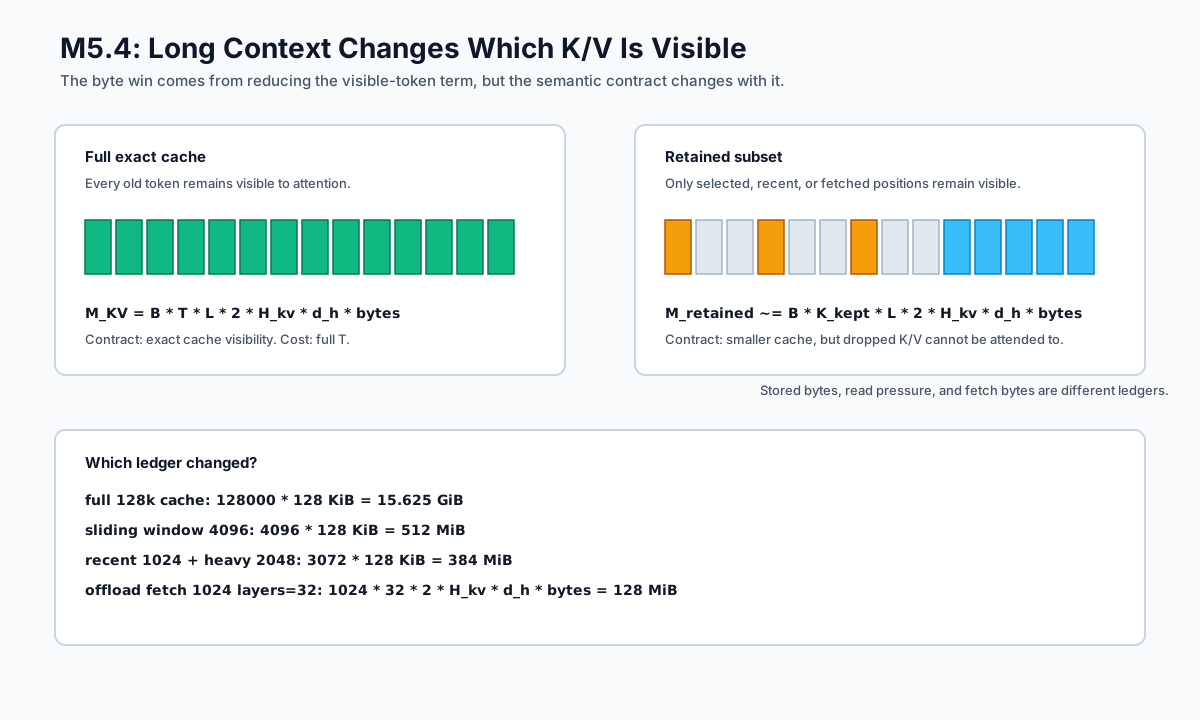
Using the running M5 shape:
B = 1, L = 32, H_kv = 8, d_h = 128
b_K = b_V = 2 bytes

B_row                         = 128 * (2 + 2) = 512 bytes
bytes per token, all layers   = 32 * 8 * 512  = 131072 bytes = 128 KiB
Then:
| Visible tokens | Persistent K/V payload | Logical full-cache read per generated query |
|---|---|---|
| 32768 | 4.000 GiB | 4.000 GiB |
| 128000 | 15.625 GiB | 15.625 GiB |
The read column is a logical payload ledger, not a profiler result. M4.5 owns kernel tiling, page traversal, cache behavior, and measured HBM traffic. M5.4 owns which rows the kernel is permitted to read.
0x02C Persistent Policy State Is More Than Payload
A selected-subset policy stores the payload implied by its visible sets:
But a runnable policy can also need original-position maps, ragged offsets, validity bits, selection scores, protected-position state, and a versioned receipt:
The terms answer different questions:
| Term | Persistent object | Why it exists |
|---|---|---|
| packed K and V rows | attention payload | |
| original position per row | positional and causal identity | |
| segment boundaries | ragged layer/head lookup | |
| padding or live-row marks | exclude nonrows or tombstones | |
| policy evidence | update the future visible set | |
| mandatory-row state | preserve sinks, recency, or other invariants | |
| identity and generation fields | fence stale or incompatible views |
Allocator capacity, physical fragmentation, shared-page refcounts, and measured residency remain M5.3 concerns. A host or remote fallback copy remains an M5.5 object. They must not be silently folded into .
0x02D Ragged, Padded, And Tombstone Layouts Have Different Costs
Consider a small fixture with two layers, two K/V heads, eight committed positions, and retained row counts:
K[l,h] = [[4, 2],
          [3, 1]]

sum K[l,h] = 10 selected row instances
B_row = d_h * (b_K + b_V) = 4 * (2 + 2) = 16 bytes
A compact ragged representation stores ten rows. A padded representation with stores row slots. A tombstone representation keeps the full 32-row payload and adds live-state metadata.
| Representation | Payload | Metadata and fixed state | Persistent total |
|---|---|---|---|
| ragged packed | 160 B | 385 B | 545 B |
| padded to | 256 B | 401 B | 657 B |
| full payload plus tombstones | 512 B | 325 B | 837 B |
The ragged padding efficiency is
The toy ragged total is even larger than the bare full payload, 545 B > 512 B,
because the fixture deliberately includes a fixed 192-byte receipt and score
state for every historical candidate. That is not a paradox and does not show
that long-context selection is useless. It shows why small examples and short
requests can be metadata-dominated, while the payload term dominates
at long context.
0x02E Score State Can Still Scale With History
Let be the candidate universe a selector can reconsider. It is not necessarily the current visible set. If one score of width is kept per candidate, then
This yields a design fork:
score only retained rows:
    bounded state, but permanently evicted rows cannot be reconsidered

score all historical rows:
    broader future choice, but score metadata may still grow with history

score recallable external rows:
    state can be reconsidered, but M5.5 must provide lookup and fetch semantics
A claim of “constant K/V” is therefore incomplete unless it also names how the candidate universe and selection evidence are bounded.
0x02F Workspace And Transaction Peak
An update does not teleport from old state to new state. A generation-safe publication can keep the old view live while constructing a successor. If is selector workspace and is additional kernel or runtime workspace, a conservative transaction ledger is
In the executable toy:
top-k output workspace             = 80 B
initial full -> ragged peak         = 512 + 545 + 80 = 1137 B
ragged -> ragged update peak        = 545 + 545 + 80 = 1170 B
declared backend workspace          = 0 B
Here zero means “not included in this analytic fixture,” not “the real backend allocates nothing.” A production measurement must report temporary allocation, stream overlap, allocator reuse, and synchronization separately.
0x02G Update Traffic And Write Amplification
A simple publication pass can scan candidate scores, read selected payload, and write a new persistent view:
For the same fixture:
score scan read             = 128 B
selected K/V payload read   = 160 B
new persistent-state write = 545 B
publication traffic         = 833 B
One newly admitted token contributes 64 B of K/V across the fixture’s layers
and K/V heads. Two useful ratios expose different costs:
K/V compaction amplification = (selected payload read + selected payload write)
                               / new-token K/V
                             = (160 + 160) / 64 = 5.0x

publication amplification    = publication traffic / new-token K/V
                             = 833 / 64 = 13.015625x
These are logical byte ratios for a declared algorithm. They are not measured HBM amplification. An in-place ring, stable pages, incremental heap, or fused selector can change the traffic terms without changing the visible-set policy.
0x02H Unique K/V Reads And GQA Query-Expanded Demand
Persistent ownership follows K/V heads. Compute demand follows query heads.
For a GQA map [0,0,1,1], two query heads consume each stored K/V head. The toy
therefore has:
unique selected K/V payload per query step     = 160 B
query-expanded logical demand                  = 320 B
The second number must not be reported as persistent storage. Whether hardware actually reloads rows for each query head depends on the kernel and cache hierarchy. M4.5 owns that measured execution question.
0x02I Cumulative Decode Traffic Is A Trajectory
A per-step full-cache read grows as the committed prefix grows. If generation starts with visible positions and emits tokens, with one new visible position per step, the number of row-time instances is
Multiplying by all-layer bytes per token gives the logical cumulative read:
For , , and the running 128-KiB-per-token shape:
full-cache logical cumulative read   = 2.015594482421875 TiB
bounded 4096-row logical read         = 256 GiB
analytic reduction ratio              = 8.0623779296875x
The ratio is not a latency prediction. Policy updates, irregular addressing, metadata reads, fallback, and backend efficiency can consume some or all of the logical saving.
0x02J Fallback Is Work And Capacity
An omitted row can be:
irrecoverable:
    quality contract accepts its absence

recomputable:
    source tokens and a valid model path can rebuild it at extra compute cost

recallable:
    exact or approximate state remains in another tier and M5.5 can fetch it

full-cache fallback:
    enough capacity remains to abandon the lossy path for selected requests
Each mode needs reserved capacity and a service policy. M5.4 declares the quality trigger and legal fallback. M5.1 owns cache lifecycle, M5.2 owns admission and service consequences, M5.3 owns local capacity, and M5.5 owns nonlocal state movement.
0x02K Dense And Selected Attention Share One Denominator
For one query, layer, and head, let logits be and values be . Dense attention uses
For selected positions , define retained dense mass
Renormalizing only selected logits gives
and local selected output
This derivation explains the final formula: the selected softmax denominator is the dense denominator multiplied by retained mass. The local error oracle reports
alongside retained mass , omitted mass , and oracle top-k recall. None of those is full-model task quality.
0x02L A Cancellation Counterexample
Retained softmax mass and output error can rank two selectors differently. Take
dense probabilities p = [0.4, 0.3, 0.2, 0.1]
scalar values         v = [0,   1,   0,  -3]
The dense output cancels:
Now compare two retained sets:
| Selector | Positions | Retained mass | Renormalized output | Local L2 error |
|---|---|---|---|---|
| higher mass | [0,1] | 0.7 | ||
| lower mass | [0,2] | 0.6 |
The lower-mass set exactly matches this local output because its retained values are both zero. This does not make it a universally better selector: another query, value direction, layer, token, or downstream nonlinear path can reverse the result. It proves only the required negative claim:
retained attention mass is not an ordering theorem for local output error;
local output error is not an ordering theorem for end-task quality.
Relative error is undefined here because the dense output norm is zero. The
oracle records null rather than manufacturing a denominator.

0x02M Executable Oracle And Evidence Boundary
The Loop 3 evidence package recomputes every number above from one fixture:
docs/numinens-evidence/m5-4-long-context-kv-policies/
    cost_accuracy_fixture.json
    invalid_cost_accuracy_fixtures.json
    cost_accuracy_oracle.py
    cost_accuracy_report.json
    test_loop3_cost_accuracy.py
It rejects 23 one-contract mutations covering identity, dimensions, row counts, padding, scalar widths, score state, GQA ownership, workspace, decode trajectory, attention selections, and declared-result drift. The valid report is explicitly not allocator measurement, GPU traffic measurement, latency measurement, paper benchmark reproduction, or full-model task quality:
task_quality = null
Loop 4 can now change the evolution of for full cache, sliding windows, and sink-plus-recent policies while saying exactly which persistent, peak, traffic, and local-error terms changed.
0x03 Exact Full-Cache State Evolution
The static policies need one off-by-one convention before they need an algorithm. Let be the exclusive committed frontier:
F = 0  -> no committed positions
F = 4  -> committed original positions [0,1,2,3]
F = 8  -> committed original positions [0,1,2,3,4,5,6,7]
The full-cache visible set is therefore
This is a state after publication. While a new token is being evaluated, its K/V row may exist in temporary kernel state. M5.1 commits that row first; only then may M5.4 publish a successor visibility state with frontier . A rejected or canceled row must never advance the published frontier.
Full-Cache Transition
Suppose immutable state generation binds cache generation , frontier , and set . Accepting one row at original position creates:
The union is exact because position is new and all old rows remain legal. The successor must bind the new cache generation and parent state generation:
parent:
    cache_generation = c
    state_generation = g
    frontier = F

successor after M5.1 commit:
    cache_generation = c + 1 or another monotonic generation
    parent_state_generation = g
    frontier = F + 1
    visible = V_full(F) union {F}
For a prompt of accepted tokens, one prefill publication can advance from
to with appended positions [0,...,P-1]. Chunked prefill may
publish intermediate frontiers, but the final full-cache set must be identical.
At the Loop 3 running shape, persistent payload at frontier is
for one sequence. Full cache changes no visibility semantics, so its update does not need a selector or compaction pass. M5.3 may still page or scatter its rows; those physical changes cannot omit a committed position.
Exact Cache Policy Is Not Exact Model Capability
full_cache_exact means:
the cache policy preserves every checkpoint-compatible committed K/V row
and does not alter the attention domain
It does not mean:
the checkpoint was trained at this position range
the positional scheme extrapolates correctly
the model retrieves every visible fact
the model reasons correctly over arbitrary history
Those remain M3.5 and evaluation concerns. Full cache is the semantic reference because the two policies below can be compared against the same committed source positions.
0x04 Sliding-Window State, Rollover, And Position Identity
For a recent width , the published sliding-window set is
Its cardinality follows directly from the interval endpoints:
That last equality explains the two phases:
warmup, F < W:
    every committed row still fits
    visible count grows with F

saturated, F >= W:
    visible count stays W
    every accepted append removes one oldest visible row
Worked Prompt And Decode Trace
The executable fixture uses W=3, a four-token prompt, and accepted decode
positions 4..7:
| Publication | Frontier | Source positions | Newly removed from prior published window | |
|---|---|---|---|---|
| initialize | 0 | [] | [] | [] |
| prompt handoff | 4 | [0,1,2,3] | [1,2,3] | [] from the empty parent; position 0 is omitted at handoff |
| accept position 4 | 5 | [0,1,2,3,4] | [2,3,4] | [1] |
| accept position 5 | 6 | [0,1,2,3,4,5] | [3,4,5] | [2] |
| accept position 6 | 7 | [0,1,2,3,4,5,6] | [4,5,6] | [3] |
| accept position 7 | 8 | [0,1,2,3,4,5,6,7] | [5,6,7] | [4] |
The prompt row at position 0 is not described as “evicted from the prior
window” because it never belonged to the published F=4 window. It is an
omitted source row at the prompt/decode handoff. That distinction matters for
release logs and reclamation: omitted_from_source and
removed_from_parent_view answer different questions.
Prompt-To-Decode Handoff Has Two Valid Designs
A retrofitted serving policy can materialize the full prompt first, then publish only the last rows:
prefill source K/V: [0,1,2,3]
published W=3 view: [1,2,3]
release intent to M5.3: [0]
An architecture trained with local attention can instead avoid materializing a globally visible prompt cache. Both can end with the same visible positions, but they do not have the same prefill graph, temporary peak, training contract, or quality interpretation. A runtime must state which design it implements.
The same closure applies to chunked prefill. If chunks partition one prompt, the final state must equal the set derived from the total committed frontier, not a window restarted independently in each chunk.
Logical Position Is Not Ring Slot
A fixed-capacity implementation may place original position in a physical ring slot such as
That equation is an address rule, not a positional-encoding rule:
original position p = 6
physical slot       = 6 mod 3 = 0

slot 0 is not semantic position 0
The Loop 2 receipt must retain original position 6 even after slot 0 is reused.
M5.3 owns slot lifetime and overwrite safety. M4.5 owns whether the backend can
consume the resulting layout. If keys already contain RoPE at their original
absolute positions, relabeling packed slots 0..W-1 is invalid.
Architecture-Local Attention And Retrofitted Eviction Are Different
In a model trained with causal local attention, newer hidden states can carry information that flowed through stacked local layers. The architecture’s receptive field may therefore exceed one layer’s window. That does not make an evicted original K/V row directly visible, and it does not justify applying the same window post hoc to a full-attention checkpoint.
For a retrofit:
fact at position 2
published frontier F = 8
W = 3
visible positions = [5,6,7]

direct attention to position 2 is impossible
The Loop 4 delayed-reference fixture records visibility only. It does not claim
that a model must fail or succeed, because newer value rows may encode some
earlier information. task_quality remains null until the full checkpoint is
evaluated.
Payload And Cached-History Read Trajectory
At saturation:
For the running shape:
| Policy | Visible positions | Persistent payload |
|---|---|---|
| full 128k | 128000 | 15.625 GiB |
| window 4096 | 4096 | 512 MiB |
| window 8192 | 8192 | 1 GiB |
Across cached-history frontiers [4,5,6,7], the fixture reads 12 window-position
instances, or 1,572,864 logical bytes. Full cache reads 22 instances, or
2,883,584 bytes. These exclude the current row equally from both policies; a
fused kernel that attends to the current row adds the same current-row term.
They are logical payload ledgers, not measured HBM traffic or latency.
0x05 Attention Sinks And StreamingLLM State Evolution
Recent-only retention removes the first rows once . The StreamingLLM paper reports that initial tokens often receive strong attention even when they are not semantically important and that preserving their K/V rows largely recovers the streaming stability lost by recent-only window attention. It then combines those initial sink rows with a rolling recent suffix.
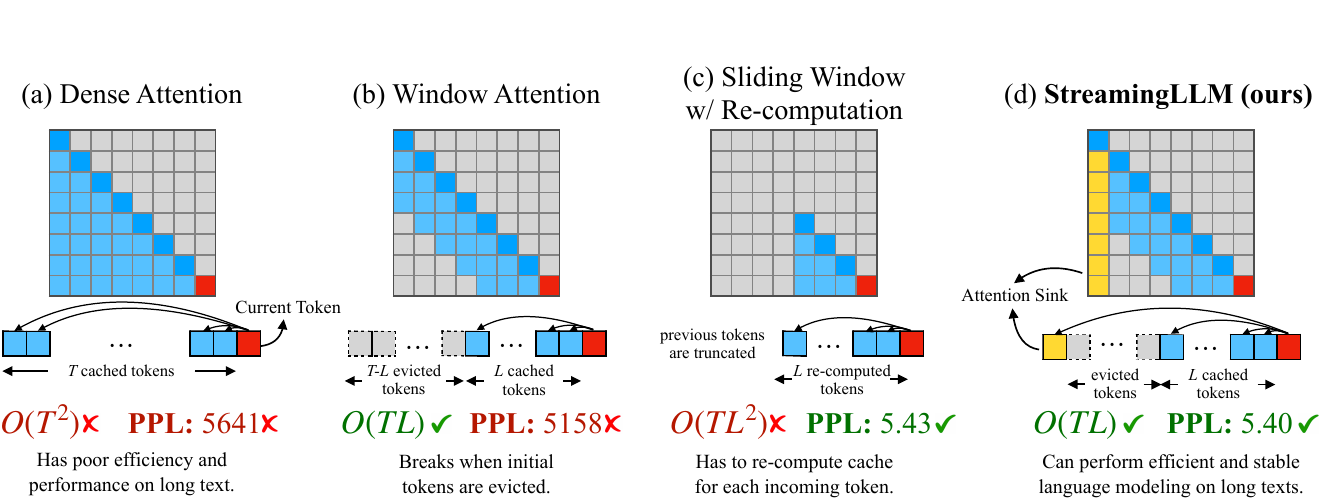
Source: Xiao et al., Efficient Streaming Language Models with Attention Sinks, Figure 1. Complexity and perplexity annotations are source-reported for the paper’s model and setup. The mechanism-level import is the distinction among full cache, recent-only cache, recomputed recent context, and retained sink-plus-recent K/V.
Sink Plus Recent Is A Union, Not An Unconditional Sum
For initial sink positions and recent width , define
The visible set is
Therefore:
For contiguous initial sinks and a contiguous recent suffix, the overlap size is
so
The shortcut is only the saturated, disjoint upper bound. It is wrong during early overlap.
Early Overlap And First Rollover
With K_s=2 and W=3:
| Frontier | Sink set | Recent set | Overlap | Published union | Omitted middle |
|---|---|---|---|---|---|
| 0 | [] | [] | [] | [] | [] |
| 1 | [0] | [0] | [0] | [0] | [] |
| 2 | [0,1] | [0,1] | [0,1] | [0,1] | [] |
| 3 | [0,1] | [0,1,2] | [0,1] | [0,1,2] | [] |
| 4 | [0,1] | [1,2,3] | [1] | [0,1,2,3] | [] |
| 5 | [0,1] | [2,3,4] | [] | [0,1,2,3,4] | [] |
| 6 | [0,1] | [3,4,5] | [] | [0,1,3,4,5] | [2] |
| 8 | [0,1] | [5,6,7] | [] | [0,1,5,6,7] | [2,3,4] |
The cache first reaches its five-row upper bound at . The first irrecoverable middle omission occurs only at . A test that begins after saturation misses both behaviors.

Pinned StartRecentKVCache Tensor Trace
The official
StreamingLLM implementation
is pinned here at commit
2e5042606d69933d88fbf909bd77907456b9b4dd. Its
StartRecentKVCache receives model-specific K and V sequence axes. For a cache
longer than start_size + recent_size, it constructs each layer’s successor as:
K_next = cat(
    K_old[..., 0:start_size, :],
    K_old[..., seq_len-recent_size:seq_len, :],
    dim=k_seq_dim,
)

V_next = cat(
    V_old[..., 0:start_size, :],
    V_old[..., seq_len-recent_size:seq_len, :],
    dim=v_seq_dim,
)
This is a shape-level summary of the pinned source, not a universal cache API.
Llama, MPT, Falcon, and Pythia do not all place sequence on the same tensor axis.
The implementation chooses k_seq_dim and v_seq_dim per model family.
Before a multi-token append, evict_for_space(past_key_values, num_coming)
keeps the initial rows and only recent_size - num_coming old recent rows. The
incoming rows then refill the recent partition:
before reservation:
    start rows K_s
    recent rows W

reserve n incoming rows:
    start rows K_s
    old recent rows W - n
    free capacity n

after accepted append:
    start rows K_s
    recent rows W
This requires n to fit the declared recent partition or a separately defined
chunk/reject path. Reserving prompt_length + max_generation_length, as the
official chat example does, is a capacity policy; it should not be hidden inside
the attention formula.
Original Identity, RoPE State, And Cache-Local Positions
Three position coordinates must remain separate:
p_original   immutable source-token identity used by policy and rollback
r_packed     current row or physical slot in the retained cache
p_attention  position consumed by the checkpoint-compatible attention path
For ordinary post-RoPE absolute keys:
p_attention = p_original
r_packed must not replace it
The pinned StreamingLLM Llama patch uses another explicit contract. It keeps
persistent keys in a repositionable pre-RoPE form, concatenates past and new
keys, then applies rotary embedding to keys using cache-local positions
arange(kv_seq_len). The query receives the bounded position supplied by the
patched streaming path. Values remain unpositioned projections.
That mechanism cannot be reproduced by gathering already absolute post-RoPE
keys and pretending their packed rows are positions 0..K-1. A runtime must
declare which key stage it stores and install a compatible position-shift
attention implementation. M5.4 keeps p_original for visibility identity;
M4.5 owns execution admission for the changed key-position path.
Retained Cache Versus Sliding-Window Recomputation
Figure 1 distinguishes two bounded-history baselines:
sliding-window recomputation:
    keep recent token IDs
    re-run the W-token local causal window for each incoming token
    refresh positions and all K/V states in that window

retained sink-plus-recent cache:
    project one accepted new row
    reuse retained sink and recent K/V
    apply the declared position-shift path
For four decode steps and W=3, the synthetic work ledger is:
| Contract | K/V projection-row instances | Local causal score-cell instances |
|---|---|---|
| retained cache append | 4 new rows | attention reads the declared retained set |
| recompute three-token window | rows | cells |
This is not a FLOP or latency benchmark. It explains why the paper labels the recomputation baseline while retained StreamingLLM attention is for bounded cache size . Source-reported speedups remain tied to the paper’s checkpoint, implementation, hardware, and workload.
Cancellation And Resume Need Versioned State
The Loop 4 fixture stages a candidate at original position 6:
published parent:
    cache_generation 103, state_generation 3, frontier 6
    sink+recent [0,1,3,4,5]

unpublished candidate:
    cache_generation 104, state_generation 4, frontier 7
    sink+recent [0,1,4,5,6]

cancel:
    restore generation 103 / state 3
    position 3 remains visible; candidate row 6 is discarded

resume with replacement content at original position 6:
    cache_generation 105, state_generation 5, frontier 7
    logical positions again [0,1,4,5,6]
The staged and resumed sets contain the same logical positions, but their token content and cache generations are not interchangeable. Publishing the staged receipt after cancellation would bind the right positions to stale K/V.
Stability Anchors Are Not Semantic Summaries
At frontier 8, the delayed-reference fixture asks only whether three positions are visible:
| Position role | Original position | Full cache | Window W=3 | Sink 2 + recent 3 |
|---|---|---|---|---|
| sink anchor | 0 | visible | omitted | visible |
| middle fact | 2 | visible | omitted | omitted |
| recent fact | 6 | visible | visible | visible |
Keeping position 0 repairs an attention-sink failure mode. It does not encode the fact at position 2. The paper and official project explicitly state that StreamingLLM does not expand the context window or add long-term memory; it is suited to streaming workloads that rely primarily on recent interactions.
The paper also studies adding a dedicated sink placeholder during pretraining. That is a model-training variant, not an inference-only cache flag. Likewise, softmax-off-by-one is an alternative attention normalization, not a property obtained by retaining first-token K/V. These design choices must not be folded into the retrofit state machine.
Executable Static-Policy Oracle
The source-pinned synthetic evidence is:
docs/numinens-evidence/m5-4-long-context-kv-policies/
    static_retention_fixture.json
    invalid_static_retention_fixtures.json
    static_retention_oracle.py
    static_retention_report.json
    test_loop4_static_retention.py
It validates full, window, and sink-plus-recent sets; prompt handoff; overlap; rollover; cached-history payload; recomputation work; delayed-reference visibility; candidate cancellation; and generation-safe resume. Twenty-seven one-contract mutations reject. It does not reproduce paper perplexity, measure GPU traffic or latency, implement a production cache, or claim model quality.
Loop 5 can now replace position-only selection with Scissorhands, H2O, and Keyformer score state while preserving the same frontier, transaction, position, recoverability, and accuracy contracts.
0x06 Dynamic Retention: Scissorhands, H2O, And Keyformer
Position-only policies know where a token is. Dynamic policies also maintain evidence about how previous queries used it. That sounds like one incremental improvement over a window. It is actually a new state machine: attention must run before the selector can update, the score row must remain attached to the same original K/V row after compaction, and deletion changes what can ever be scored again.
Owner question. Given a fixed per-owner K/V budget, which statistic is allowed to stand in for unknown future relevance, when is that statistic updated, and how does a successful decision publish K/V rows and score state without losing original token identity?
Scissorhands, H2O, and Keyformer answer differently. Scissorhands periodically
drops a batch of rows using a low-attention record over a history window.
H2O forms an online one-entry successor from accumulated attention. Keyformer
accumulates a Gumbel-softmax selection score with a temperature schedule. A
generic cumulative_attention.topk() is therefore a useful baseline, but it is
not an implementation of all three papers.
0x06A One Dynamic Phase Order, Three Different Selectors
For one layer and one K/V owner, let the published set before step be . Its tensors and score state are:
After projecting the accepted current token, the candidate set is
The common phase order is:
1. append current K/V as an unpublished candidate row
2. compute current attention over every row in C_t
3. update the method-specific score state
4. protect the method's recent partition
5. select the historical partition
6. gather K, V, score, and original-position metadata with the same indices
7. atomically publish successor cache and policy-state generations
Steps 2 and 3 cannot be reversed: the current query supplies the newest score evidence. Steps 5 and 6 cannot use different permutations: a valid K shape with a shifted V or score row is silent corruption. A candidate that is cancelled before step 7 contributes neither a committed K/V row nor committed importance state.
The papers mostly explain single-head or conventional multi-head attention. For GQA, a deployment must additionally declare whether selection belongs to a K/V head, to every mapped query head, or to a reduction across mapped query heads. That is a runtime integration choice, not an omitted constant in the paper formulas.
0x06B Persistence Of Importance Is A Hypothesis
Scissorhands calls a token pivotal for query position when its attention exceeds a threshold :
Its persistence-of-importance hypothesis says that tokens which become pivotal at a later step are likely to have appeared in an earlier pivotal set. A useful diagnostic is the later-set coverage:
The paper reports high persistence ratios for its tested checkpoints and sequences and gives a theoretical argument under assumptions on the simplified transformer, residual behavior, and trained attention weights. Those results motivate a cache oracle. They do not prove that every future query preserves the same ranking, that every layer behaves alike, or that a low-attention fact will remain irrelevant after a topic shift.
This distinction matters because Scissorhands’ compression statistic is not the pivotal-set threshold above. Algorithm 2 counts low-score events relative to the uniform baseline over a history window:
Large means that row was repeatedly below the baseline and is a stronger eviction candidate. Pivotal-set analysis explains the hypothesis; the low-score counter drives the published algorithm.
0x06C Scissorhands Compresses In Batches
Scissorhands reserves memory for at most rows. Ordinary token generation appends rows until the candidate length exceeds . A compression event then examines a history width , protects the latest rows, and drops rows with the largest low-score counts:
def scissorhands_compress(candidate, attention_history, B, w, r, m, t):
    assert len(candidate.positions) > B
    assert 0 < r <= B and 0 < m <= len(candidate.positions) - B + m

    low_count = {position: 0 for position in candidate.positions}
    for row in attention_history[-w:]:
        for position, weight in row.items():
            low_count[position] += int(weight < 1.0 / t)

    recent = candidate.positions[-r:]
    for position in recent:
        low_count[position] = 0       # intended recent protection

    historical = [p for p in candidate.positions if p not in recent]
    drop = sorted(historical, key=lambda p: (-low_count[p], p))[:m]
    keep = [p for p in candidate.positions if p not in drop]

    return gather_k_v_score_position(candidate, keep)
The batch size is also a frequency/overhead choice. The paper reports using , , and in its experiments. A large amortizes the extra history-score work but creates a larger discontinuity at each compression event. A small approaches one-at-a-time eviction and performs the selector more often. The paper describes two implementation choices: recompute the importance measurements at compression time, or maintain extra importance state during generation to avoid that burst.
Budget allocation is another paper-level choice. Scissorhands distributes a layer budget evenly across heads, then gives later layers more total budget in response to the source-reported persistence profile. That is not equivalent to the uniform per-layer/per-head contract, and it does not make one head’s score state interchangeable with another’s.
0x06D Scissorhands Algorithm 2 Has A Printed Slice Conflict
Algorithm 2 prints:
I[:-r] <- 0 # Keep cache within the recent window
The slice as printed zeroes the historical prefix, while the adjacent comment
and Section 4.1 prose say recent tokens are always kept because their importance
is not yet known. Under the same algorithm, large low-score counters are the
rows removed by Argsort(I)[:-m]; zeroing the historical prefix would therefore
protect old rows rather than the recent window.
The executable teaching fixture follows the stated intent:
I[-r:] <- 0 # protect the last r counters
This is an explicit rewrite interpretation, not a claim that the paper source contains the corrected slice. No official Scissorhands repository is pinned in this evidence set, so the article preserves both the printed line and the consistency correction instead of manufacturing implementation authority.
0x06E H2O Is A One-Entry Dynamic Successor
H2O starts from a stricter successor contract. With fixed budget , the next set has the same cardinality and differs from the previous set by at most one row:
The paper’s generic removal rule chooses the whose removal maximizes a set score:
For the intuitive additive instantiation, each retained row accumulates current attention:
Keeping a recent partition plus the largest historical values is the practical heavy/recent policy. The current query attends to the five-row candidate first; only then may one row disappear:
def h2o_append_score_select_publish(parent, current_kv, attention,
                                    K_heavy, K_recent):
    candidate = append_unpublished(parent, current_kv)
    score = align_score_to_candidate(parent.score, candidate.positions)
    score += attention                 # current query evidence

    recent = latest_original_positions(candidate, K_recent)
    history = positions_not_in(candidate, recent)
    heavy = topk(score, history, K_heavy)
    keep = sorted(heavy) + recent

    successor = gather_k_v_score_position(candidate, keep)
    return atomic_publish(parent, successor)
The official real-drop path is pinned to commit
ac75c2a8a9e76832b2a4139b9363373b56336bfb,
h2o_hf/utils_real_drop/modify_llama.py. Its
H2OKVCache_LayerWise accumulates attn_score_cache into hh_score, selects
top heavy scores before the recent suffix, gathers K and V with one boolean
mask, and gathers hh_score with the same mask. The pin is valuable source
evidence; it is not a universal cache ABI, GQA policy, concurrency protocol, or
guarantee that every backend executes a physical gather at the same point.
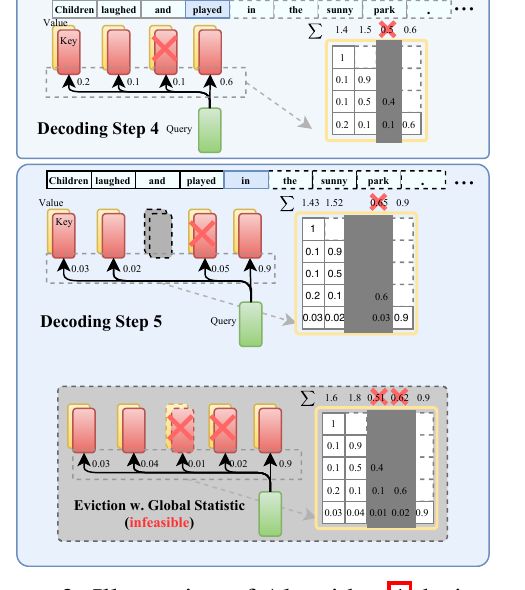
Source: H2O, Figure 3. The upper steps use retained local statistics; the globally recomputed lower alternative is marked infeasible because deleted rows are no longer available.
0x06F What The Dynamic-Submodular Result Does And Does Not Say
H2O frames online eviction as a dynamic submodular problem. Informally, a set function is submodular when adding an item has diminishing marginal value as the existing set grows:
The paper extends the set function with evolving source state and analyzes a greedy policy under its stated submodularity and approximation assumptions. The result explains why a local greedy construction can be reasonable; it does not prove that arbitrary transformer attention is always submodular, that the simple cumulative-score implementation globally recovers the unknown future, or that a fixed heavy/recent split preserves every task.
Keep three contracts separate:
| Contract | What it contributes | What it cannot establish alone |
|---|---|---|
| heavy-hitter observation | attention mass is often concentrated in the paper’s measurements | future relevance of every low-score token |
| dynamic-submodular analysis | conditional greedy guarantee for the formulated objective | universal model-quality guarantee |
| pinned real-drop code | one concrete score, top-k, recent, and gather order | production scheduling, cancellation, or another model’s owner semantics |
H2O’s throughput, latency, and quality numbers remain source-reported for the paper’s models, budgets, hardware, and implementation.
0x06G Keyformer Changes The Score Distribution
Deleting keys changes the softmax denominator. If the original logits are and the retained set is , then:
The surviving probabilities are renormalized upward. Their raw-logit order is unchanged for one query, but a cumulative selector now observes a distribution conditioned on its own earlier deletions. That feedback can reinforce an early mistake.
Keyformer introduces a separate key-token score. For a query/key logit , it adds Gumbel noise and accumulates a temperature-scaled probability:
One way to sample standard Gumbel noise is
for . The fixture supplies
fixed values so the equation is reproducible; it does not claim to
reproduce PyTorch’s random stream. The official MPT path is pinned at commit
f327831056a9909b133aaa14a48f2bd0722acede,
models/mpt-keyformer-lib/attention_keyformer_new_bias.py. It computes
gumbel_softmax for the cache score while retaining ordinary softmax attention
for the model output. The selection distribution is not the model’s token
sampling distribution and does not replace the actual attention output.
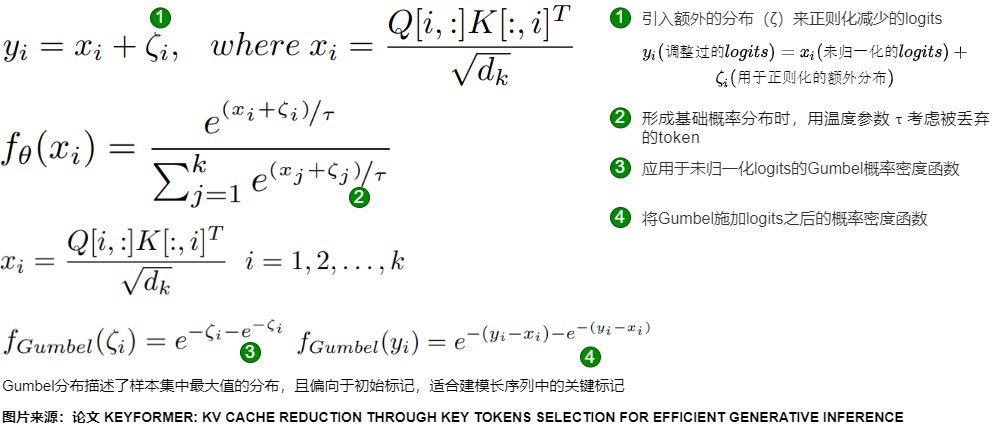
A25 annotated reconstruction of the Keyformer scoring equations. The Chinese callouts were part of the original Transformer Series asset; the equations correspond to the paper’s Gumbel regularization and temperature-scaled score.
0x06H Temperature Is A Selection-State Schedule
Keyformer schedules temperature over an expected generation length :
The effect is clearest in what one step adds to the score. Subtracting
f_{t-1} from both sides of the update in 0x06G leaves step t’s
Gumbel-softmax probability. All candidates share its denominator, so it
cancels from the odds of any two rows:
As grows, these per-step odds move toward one and the step’s
selection distribution flattens: every candidate’s share approaches 1/|C_t|.
The paper motivates this as increasing regularization as more context
has been discarded. (The paper defines the per-step score and accumulates it
in its Algorithm 1; the odds relation is derived here from that score, not
quoted from the paper.)
The relation holds for the increments, not for the cumulative scores. The
decode step of the fixture in 0x06I shows the difference. At tau_1 = 1.5,
positions 3 and 2 have regularized logits y = 1.5 and y = 0.1. Their step
contributions are 0.3104 and 0.1221, and their ratio, 2.543, is exactly
exp(1.4 / 1.5). Their cumulative scores are 0.4281 and 0.3590, a ratio of
only 1.192, because position 2 entered the step with the larger prompt score
(0.2370 against 0.1177, a ratio of 0.497).
In general the cumulative odds are a ratio of two sums:
f_t(i)     f_{t-1}(i) + delta_t(i)
------  =  -----------------------
f_t(j)     f_{t-1}(j) + delta_t(j)
With positive terms, such a ratio lies between the odds carried in,
f_{t-1}(i) / f_{t-1}(j), and the current-step odds
delta_t(i) / delta_t(j): here between 0.497 and 2.543. No constant of
proportionality links the cumulative odds to the exponential either. For
positions 3 and 2 they are 0.469 times the exponential; for positions 0 and
2, which entered with equal prompt scores, they are 0.846 times it. The
cumulative odds equal the exponential when neither row carries an earlier
score, as in the fixture’s single-row prompt step, where the cumulative scores
are the step probabilities. Once earlier scores exist, cross-multiplying the
ratio of sums shows that a pair matches only if its carried-in odds already
equal its step odds. Two rows tied both in their earlier score and in this
step’s regularized logit match trivially, with odds of 1 on both sides;
positions 0 and 2 share their earlier score but not their logit, so they do
not match.
The pinned MPT code departs from the single-row picture in a further way. On
every pass, prompt and decode alike, it sums the Gumbel-softmax rows over the
batch and over the query positions (gumbel_score.sum(0).sum(1)), keeping one
score row per head. The relation then holds for each sequence’s query row, not
for that summed increment. Only at decode with batch size 1, where each head’s
sum has a single row, does it hold for the code’s own increment.
The temperature therefore shapes each step’s contribution, not the accumulated
ranking directly. The gap between two cumulative scores changes by
delta_t(i) - delta_t(j), which tends to zero as tau_t grows because every
contribution approaches 1/|C_t|. With the fixture’s regularized decode
logits y, that change for positions 3 and 2 would be 0.2799 at tau = 1,
is 0.1884 at the scheduled tau_1 = 1.5, and would be 0.1414 at
tau_end = 2. In the limit a
step adds almost the same amount to every row and leaves the accumulated
ranking nearly as it was, while the history it inherits keeps its full weight.
The schedule introduces a deployment coordinate: actual generation can stop before or run beyond it. A runtime must declare whether temperature clamps at , continues increasing, or is recomputed when the generation budget changes.
At prompt processing, Keyformer scores every prompt row, protects the latest rows, and chooses historical key rows. At decode, one new row enters, the recent window shifts, cumulative score is updated only for surviving rows, and key rows are selected from a candidate key window of size :
def keyformer_score_select_publish(parent, current_kv, logits, gumbel,
                                   k, w, tau):
    candidate = append_unpublished(parent, current_kv)
    probability = softmax((logits + gumbel) / tau)
    score = align_score_to_candidate(parent.score, candidate.positions)
    score += probability

    recent = latest_original_positions(candidate, w)
    history = positions_not_in(candidate, recent)
    key = topk(score, history, k - w)
    keep = sorted(key) + recent

    return atomic_publish(
        parent,
        gather_k_v_score_position(candidate, keep),
    )
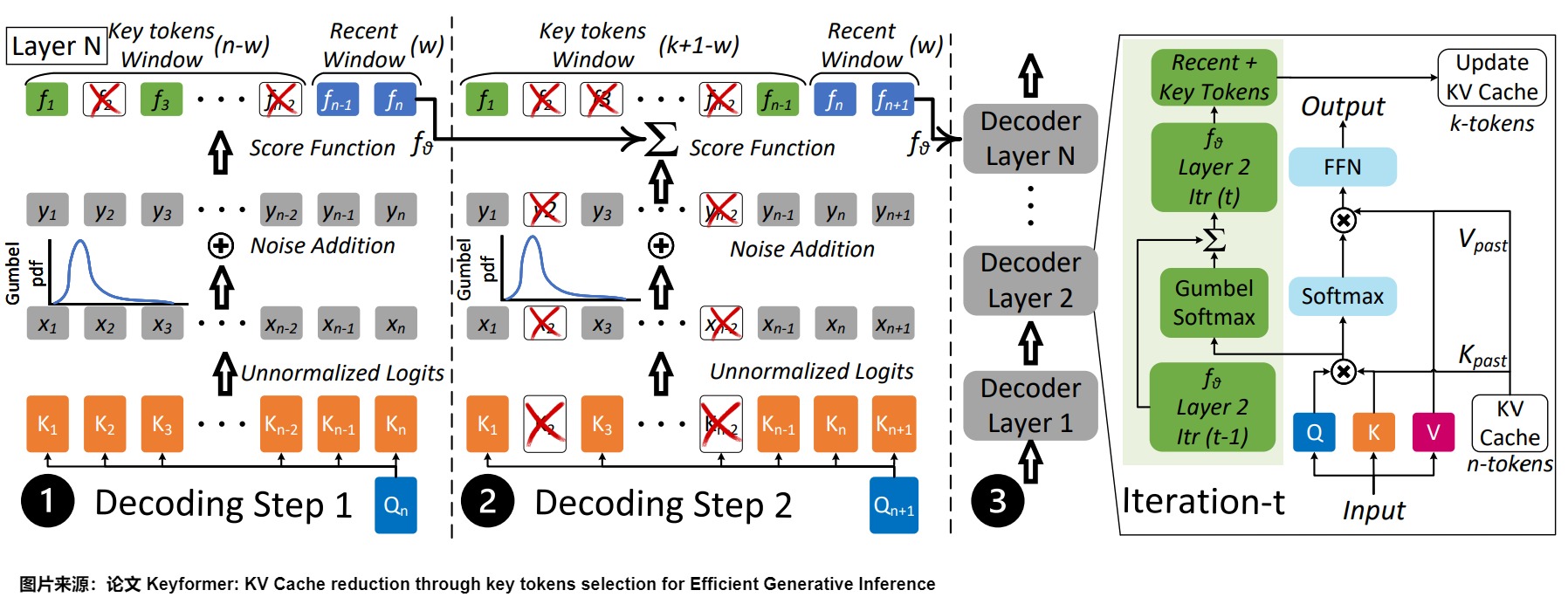
A25 annotated composite based on Keyformer Figure 6. It preserves the original article’s prompt-to-decode explanation and makes the separate ordinary-attention and cache-score paths visible.
0x06I One Fixture, Three Divergent Retained Sets
The Loop 5 fixture has one layer, one K/V head, , BF16 K/V, budget , and recent width two. It is a mechanism oracle, not a quality or runtime benchmark.
Scissorhands sees six candidate rows and three attention-history rows. With , the low-score counters are:
position:       0  1  2  3  4  5
low count I:    3  0  1  2  1  1
protected:                  4  5
drop m=2:       0        3
publish:           1  2     4  5
H2O starts from [0,1,2,3] with score [0.4,0.3,0.2,0.1]:
| H2O step | Candidate after append | Score after current attention | Recent | Heavy | Evict | Publish |
|---|---|---|---|---|---|---|
| append 4 | [0,1,2,3,4] | [.45,.40,.35,.30,.50] | [3,4] | [0,1] | [2] | [0,1,3,4] |
| append 5 | [0,1,3,4,5] | [.50,.50,.35,.70,.60] | [4,5] | [0,1] | [3] | [0,1,4,5] |
Keyformer first selects prompt rows at , then appends position 5 at :
| Keyformer step | Candidate | Key rows | Recent | Publish |
|---|---|---|---|---|
| prompt score with fixed noise | [0,1,2,3,4] | [0,2] | [3,4] | [0,2,3,4] |
| decode score with fixed noise | [0,2,3,4,5] | [0,3] | [4,5] | [0,3,4,5] |
At decode, position 3’s current regularized probability is approximately
0.3104; its cumulative score becomes 0.4281, overtaking position 2’s
0.3590. This transition is caused by Keyformer’s declared score, not by a
generic raw-attention top-k.

0x06J Score State Must Follow Row Identity
The selector adds persistent state; it does not eliminate the Loop 2 receipt:
per retained row:
    original token position
    packed row or physical slot
    K/V owner (layer, kv_head)
    method score
    score-generation provenance

per published successor:
    request generation
    parent and successor cache generations
    parent and successor policy-state generations
    exclusive committed frontier
    selected original-position list
When rows [0,2,3,4,5] are compacted to [0,3,4,5], Keyformer score state
must gather indices [0,2,3,4] in the candidate’s packed coordinate system.
Gathering score by original position after K/V has already been compacted, or
gathering K and V with one mask but score with another, can retain correct
shapes and wrong ownership.
For the fixture, each K/V row costs:
The six-row source is 96 bytes, the four-row published state is 64 bytes, and a five-row append-before-evict candidate peaks at 80 bytes. Four FP32 score values add 16 bytes per owner. These are logical payloads; allocator metadata, workspace, kernels, and physical traffic remain separate ledgers.
0x06K Permanent Deletion Is The Shared Failure
Different selectors do not remove the same rows, but all three make omitted raw K/V unavailable:
| Probe after position 5 | Scissorhands | H2O | Keyformer |
|---|---|---|---|
delayed identifier at original position 2, hypothetical future weight .8 | visible | omitted | omitted |
topic shift to original position 3, hypothetical future weight .7 | omitted | omitted | visible |
The hypothetical weights do not claim that a model would actually assign those values. They expose the causal failure: an evicted row receives no future score because it is absent from the future softmax. Recovery requires recomputing the row, retaining it in a backing tier, or using a different representation. Those mechanisms belong to M5.5 or later representation sections, not to irreversible eviction.
Additional failure surfaces are method-specific:
Scissorhands:
    batch compression can discard several rows at once;
    history width and compression frequency can miss a transition;
    paper/code intent must resolve the recent-slice discrepancy.

H2O:
    older rows have more opportunities to accumulate score;
    one-entry greedy updates cannot recover deleted evidence;
    the theoretical guarantee is conditional on the formulated objective.

Keyformer:
    the score depends on random noise and temperature schedule;
    a generation-length mismatch changes the schedule;
    survivor-only accumulation remains conditioned on earlier deletion.
0x06L Paper And Code Contracts Side By Side
| Method | Decision phase | Statistic | Update cadence | Protected state | Implementation evidence | Training |
|---|---|---|---|---|---|---|
| Scissorhands | when append exceeds budget | count of attention below 1/t over history width w | drop m rows per compression | latest r rows | paper Algorithm 2; no official code pin in this audit | no fine-tuning required |
| H2O | each over-budget append | accumulated retained-row attention | add one, evict at most one | recent partition plus heavy partition | official real-drop path pinned | no fine-tuning required |
| Keyformer | prompt reduction and every decode append | cumulative Gumbel-softmax score | prompt top-k, then one-for-one key-window update | latest w plus k-w key rows | official MPT path pinned | no model fine-tuning required |
The design alternatives are substantive. Recomputing score at compression time trades burst compute for less persistent metadata. Maintaining score each step trades metadata and update work for a cheaper eviction event. Deterministic attention accumulation is easier to replay than Keyformer’s stochastic score, but fixed noise during testing is not a production randomness policy. Batch drop reduces selection frequency; one-entry replacement reduces state jumps.
None of the papers removes runtime integration work. Continuous batching needs request-local score state. Beam search needs score/cache reordering. Prefix sharing must not share mutable query-dependent scores across requests. Speculative branches need generation-fenced score updates and rollback. Physical row release and compaction remain M5.3 operations, while scheduling admission and fairness remain M5.2.
0x06M Executable Dynamic-Retention Oracle
The source-pinned synthetic evidence is:
docs/numinens-evidence/m5-4-long-context-kv-policies/
    dynamic_retention_fixture.json
    invalid_dynamic_retention_fixtures.json
    dynamic_retention_oracle.py
    dynamic_retention_report.json
    test_loop5_dynamic_retention.py
It validates paper-specific score rules, update order, budget partitions, original-position retention, H2O and Keyformer code pins, temperature, fixed noise, generation progression, payload accounting, and two future-relevance probes. Forty one-contract mutations reject. The oracle does not reproduce paper benchmarks, PyTorch random-number streams, production cache code, GPU traffic, latency, or model quality.
0x07 Prompt Compression: SnapKV
Prompt compression is not decode-time eviction. It makes one lossy decision after the complete prompt has been processed and before the first generated token is decoded.
Owner question. Given a fully materialized prompt cache, how does SnapKV derive one bounded prompt view from the final prompt queries, preserve the source positions of every gathered row, and hand that view to decode without pretending that the omitted prompt can be recovered exactly?
This section follows the SnapKV paper and the official implementation pinned to
commit e216ddc84c5bd210378cbdbbba12ba02102aa640. The executable fixture uses a
different, explicitly labeled GQA ownership choice so that persistent K/V is not
silently duplicated across query heads.
0x07A The Phase Contract Comes Before The Selector
Let the prompt contain T_prompt tokens and let the final W_obs prompt tokens
form the observation window. The earlier prefix has length:
L_prefix = T_prompt - W_obs
SnapKV first performs the ordinary full prompt forward pass:
source K/V shape: [B, L, H_kv, T_prompt, d_h]
prompt frontier:   F_prompt = T_prompt       # exclusive
Only then can it read attention from the observation queries and derive a compressed successor. This ordering matters:
full prompt prefill
    -> observation attention exists
    -> score and select prefix rows
    -> gather selected prefix plus complete observation suffix
    -> publish compressed prompt cache
    -> first decode step
The method can lower persistent decode state, but it does not remove the full prompt prefill or its peak working state. The SnapKV paper also states this limitation: the method targets the generation stage and does not make a model capable of understanding a context length that the original prompt pass cannot handle.
If the compressed prompt capacity is C_prompt, then the selected-prefix
budget is:
K_select = C_prompt - W_obs

required:
    W_obs > 0
    C_prompt > W_obs
    0 <= K_select <= L_prefix
The last condition is not an extra restriction on which prompts are accepted.
Because K_select - L_prefix = C_prompt - T_prompt, it holds exactly when
T_prompt >= C_prompt, which is the only case in which selection runs; a
shorter prompt keeps its full cache (0x07F).
The observation suffix is protected. It is not part of the top-k competition.
The paper’s definitions also express a compression rate p through
floor((1-p) * L_prefix); the pinned implementation instead exposes a maximum
prompt capacity and selects C_prompt - W_obs prefix rows. These are two ways
to parameterize the same selected-prefix count, not two different selectors.
0x07B From Observation Attention To Prefix Votes
For one layer and one query attention head, the observation queries attend to the full prompt:
Q_obs: [W_obs, d_h]
K:     [T_prompt, d_h]

S_obs = Q_obs @ K^T / sqrt(d_h)
A_obs = softmax(mask_causal(S_obs), axis=key_position)
The causal mask is still required inside the observation window. Its first row must not see later observation tokens. After softmax over every key visible to each observation query, SnapKV discards the observation-key columns from the selection score and sums only the earlier prefix columns:
A_prefix = A_obs[:, 0:L_prefix]       # [W_obs, L_prefix]
vote[j] = sum_i A_prefix[i, j]        # [L_prefix]
That order is important. Normalizing only over prefix columns would erase the
amount of attention consumed by recent observation tokens and produce a
different score. Summation answers a concrete question: across the protected
prompt-end queries, how much normalized attention did prefix position j
receive?
0x07C Pooling Means Neighborhood Credit, Not K/V Merging
Selecting the largest raw vote picks isolated peaks. SnapKV applies a stride-one pooling operator before top-k so nearby prefix positions can share credit:
pooled[j] = Pool1D(vote)[j]
selected = TopK(pooled, K_select)
The pinned implementation supports average or maximum pooling. With odd kernel
width r, padding (r-1)/2, and stride one, the pooled vector keeps the same
length as the prefix. The article-local fixture uses average pooling with
r=3 and zero padding:
pooled[j] = (vote[j-1] + vote[j] + vote[j+1]) / 3
Out-of-range terms are zero because the pinned PyTorch AvgPool1d call counts
padding in the denominator. The implementation detail changes boundary scores;
it cannot be omitted from a reproducible selector.
Pooling scores is not semantic clustering and it does not merge K/V vectors.
Once positions are selected, their original K and V rows are gathered
unchanged. kernel_size=1 removes neighborhood smoothing. Average and maximum
pooling are alternative paper variants; neither should be declared universally
better without a pinned checkpoint, task, and budget.
0x07D GQA Forces A Selection-Owner Decision
The paper describes head-wise selection. In MHA, each query head owns one K/V head, so the phrase is unambiguous. In GQA, several query heads consume the same persistent K/V head:
q0, q1 -> kv0
q2, q3 -> kv1
There are at least three implementable contracts:
| Contract | Score owner | Persistent result | Tradeoff |
|---|---|---|---|
| pinned SnapKV path | query head after repeat_kv | one compressed K/V view per expanded query head | follows the pinned Llama patch, but duplicates the shared K/V representation |
| owner-preserving reduction | K/V head after reducing mapped query-head votes | one compressed view per physical K/V owner | preserves M5.7 ownership, but the reduction rule becomes part of the policy |
| union of query-head selections | K/V head receives the union | one owner with a potentially larger set | preserves all selected rows but can violate the nominal budget |
The official Llama integration applies RoPE, calls repeat_kv, and then invokes
SnapKV update logic. Its selector therefore works on query-head-expanded K/V.
That is a valid pinned implementation choice, not a universal GQA cache ABI.
The local Loop 6 fixture instead uses this owner-preserving teaching rule:
grouped_vote[l, h_kv, :] =
    mean(vote[l, h_q, :] for h_q mapped to h_kv)
This reduction is rewrite interpretation, not a claim about canonical SnapKV. A production implementation must pin one of these contracts before it can state cache bytes, top-k cardinality, or kernel layout.
0x07E A Worked Tensor Trace
Use a deliberately small prompt:
B=1, L=2, H_q=4, H_kv=2, d_h=3
T_prompt=6, W_obs=2, C_prompt=4
prefix positions:      [0, 1, 2, 3]
observation positions: [4, 5]
K_select=2
For layer 0, K/V head 0, query heads 0 and 1 produce the grouped prefix vote:
vote = [0.175, 0.125, 1.000, 0.150]
Average pooling with kernel 3 gives:
pooled[0] = (0     + 0.175 + 0.125) / 3 = 0.100000
pooled[1] = (0.175 + 0.125 + 1.000) / 3 = 0.433333
pooled[2] = (0.125 + 1.000 + 0.150) / 3 = 0.425000
pooled[3] = (1.000 + 0.150 + 0    ) / 3 = 0.383333
Top-2 therefore selects prefix positions [1,2] in descending score order.
Appending the complete observation suffix produces packed original positions
[1,2,4,5].
The four owner results are:
| Layer | K/V head | Mapped query heads | Selected prefix | Packed original positions |
|---|---|---|---|---|
| 0 | 0 | [0,1] | [1,2] | [1,2,4,5] |
| 0 | 1 | [2,3] | [1,0] | [1,0,4,5] |
| 1 | 0 | [0,1] | [2,3] | [2,3,4,5] |
| 1 | 1 | [2,3] | [1,2] | [1,2,4,5] |
The packed rows are score-ordered, not sorted by source position. Every row
therefore needs an explicit original-position map. Packed row 0 is not token
position 0, and M5.3 still owns the physical page, slot, or contiguous-address
mapping.

The original paper figure provides the higher-level view: selection is per head, clustered prefix positions are retained, and the observation window is kept in full.
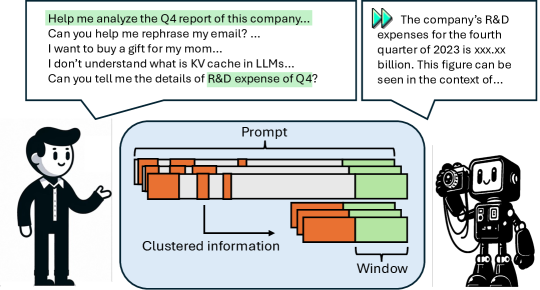
Source: SnapKV: LLM Knows What You are Looking for Before Generation, Figure 1. Orange marks selected prefix neighborhoods; observation-window rows remain in the generation cache. The figure describes the paper’s method and does not guarantee sufficiency for every later query.
0x07F The Pinned Code Path And Its Alternatives
The official implementation’s core sequence is:
1. require prompt K and Q sequence lengths to match
2. if prompt is below the configured capacity, return the full prompt cache
3. form attention from the last W_obs queries to all prompt keys
4. apply the causal observation-window mask
5. softmax over visible prompt keys
6. sum attention to prefix columns across observation queries
7. apply avg-pool or max-pool with stride one
8. take top C_prompt-W_obs prefix positions
9. gather prefix K/V and concatenate the full observation suffix
The short-prompt branch is an algorithmic boundary, not just an optimization:
if T_prompt < C_prompt:
    compressed cache = full prompt cache
The pinned Llama patch tracks the logical sequence length separately from the shortened physical cache length. That separation is required because RoPE and the causal frontier still refer to original sequence progress, not packed row count.
0x07G Materialization Is A Source-Position Gather
For each selected owner (l,h_kv), materialization gathers K and V with the
same source indices and then appends the observation suffix:
selected_prefix = topk(pooled_score, K_select)
packed_positions = selected_prefix ++ range(L_prefix, T_prompt)

K_packed = gather(K_source, packed_positions)
V_packed = gather(V_source, packed_positions)
The executable fixture makes wrong-row gathers visible with symbolic source values:
K[l,h,p,c] = 1000*l + 100*h + 10*p + c
V[l,h,p,c] = 5000 + 1000*l + 100*h + 10*p + c
For (layer=0, kv_head=0) and packed positions [1,2,4,5], the gathered K
rows must be:
[[10,11,12], [20,21,22], [40,41,42], [50,51,52]]
and V must be:
[[5010,5011,5012], [5020,5021,5022],
 [5040,5041,5042], [5050,5051,5052]]
Using the selected indices for K but a sorted or shifted index list for V would still produce shape-compatible tensors while corrupting attention. The oracle checks every scalar and rejects duplicate selected prefix positions, selected indices inside the observation suffix, a missing observation row, duplicate packed positions, and K/V receipt drift.
0x07H Compression Publishes A New Generation
The source prompt cache and compressed prompt cache are different immutable states. A successful compression receipt records at least:
request_id, request_generation
source_cache_generation
compressed_cache_generation
policy_generation
parent_state_generation
compressed_state_generation
prompt_frontier
selected owner count
rows per owner
original-position map presence
publication status
The Loop 6 fixture publishes:
request:             request-snapkv-a / generation 3
source cache:        generation 200
compressed cache:    generation 201
policy:              generation 60
policy state:        generation 10 -> 11
prompt frontier:     6 exclusive
owners:              2 layers * 2 K/V heads = 4
rows per owner:      4
The receipt also states that the full source prompt was materialized before compression and that exact prefix reuse is false. M5.1 owns request/cache identity and transaction publication. M5.3 owns the physical packed mapping. M5.4 owns which source positions the compressed visibility state contains.
Cancellation before atomic publication must leave generations 200 and 10
visible. Publishing some layers under generation 201 while other layers
still read generation 200 is not a partially useful cache; it is an invalid
cross-layer state.
0x07I Decode Appends A Tail; It Does Not Re-run Prompt Selection
The pinned integration compresses during prompt processing and then appends generated K/V rows. It does not recompute the observation-window selector at every decode step:
compressed prompt positions for owner (0,0): [1,2,4,5]
first generated original position:            6
after append:                                  [1,2,4,5,6]
All four fixture owners append original position 6; the compressed prompt
state generation remains 11 because the prompt selection did not change.
The cache frontier advances from 6 to 7 through the ordinary M5.1 append
transaction.
After g accepted generated tokens, an append-only SnapKV integration stores:
rows per owner = C_prompt + g
So SnapKV bounds the retained prompt contribution; it does not make the total cache permanently fixed-size. A separate generated-token eviction policy could bound the tail, but that would be a composition of policies and needs its own state, quality, and rollback contract.
0x07J Unique-Owner And Expanded-Head Byte Ledgers
For owner-preserving K/V storage, the logical prompt payload is:
M_unique = B * L * H_kv * T_kept * 2 * d_h * bytes
The factor 2 is K plus V. For the fixture:
full prompt:
    1 * 2 * 2 * 6 * 2 * 3 * 2 = 288 bytes

compressed prompt:
    1 * 2 * 2 * 4 * 2 * 3 * 2 = 192 bytes

logical payload reduction:
    288 / 192 = 1.5x
If the runtime persists query-head-expanded K/V after repeat_kv, replace
H_kv=2 by H_q=4: full and compressed prompt payload become 576 and 384
bytes. This is why the GQA selection owner cannot remain implicit.
The fixture also accounts for a 64-byte owner-position map, 20 bytes of owner offsets, and a 48-byte unique-owner K/V append for one generated token. These are logical payload and minimal metadata counts, not allocator residency, HBM traffic, kernel workspace, or latency measurements.
0x07K This Is Not Exact Prefix Reuse
Exact prefix reuse says:
same source tokens + same forward contract
    -> reuse every matching prefix K/V row
SnapKV says:
prompt-end attention observation
    -> predict a subset of prefix rows likely to matter during generation
A compressed cache therefore must not enter M5.3’s exact-prefix index under the source prompt’s ordinary cache identity. It needs policy identity, selection state, source generation, and original-position metadata. Reusing that lossy cache for another request is valid only under an explicitly compatible approximate-reuse contract; ordinary exact prefix matching is insufficient.
0x07L The Accuracy Boundary Is Delayed, Head-Local, And Task-Dependent
In the fixture, original prompt position 3 survives only for layer 1, K/V
head 0. It is absent from the other three owners. This proves a visibility
fact, not a quality result:
visible in one owner != globally preserved fact
omitted in one owner != measured task failure
task_quality = null
The difficult failures are delayed:
- a later user turn asks about a detail that the original observation window did not emphasize;
- exact-copy generation needs an identifier or delimiter that received little pooled score;
- averaging mapped query heads suppresses a query-head-specific peak;
- max pooling preserves that peak but over-selects a noisy neighborhood;
- top-k ties resolve differently across runtimes unless the tie contract is pinned;
- score-ordered packing loses original position if the map is omitted;
- compressed prompt rows are incorrectly advertised as exact reusable K/V;
- a short prompt is compressed even though the pinned implementation would preserve it in full.
No local selector test can establish downstream model quality. Release evidence must measure the real checkpoint and generation policy across retrieval, long-document QA, exact-copy, summarization, conversation follow-up, and adversarial delayed-reference slices.
0x07M Source-Reported Runtime Results And Local Evidence
The SnapKV paper reports lower generation memory and latency under its models, hardware, prompt lengths, budgets, and Hugging Face integration. Those are source-reported results, not local measurements.
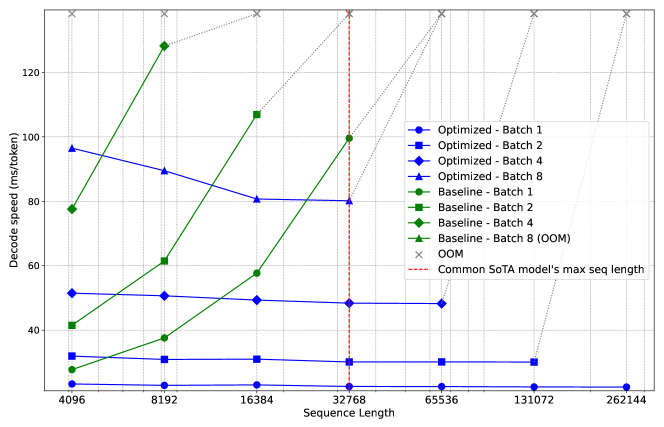
Source: SnapKV, decoding-latency experiment. The measurements use the paper’s A100 80GB setup and named implementations. OOM points are capacity outcomes for that setup; they do not establish the same limit or speedup for another checkpoint, backend, budget, or request mix.
The plot combines two effects: fewer retained prompt rows can reduce per-token decode reads, and lower residency can make a batch/length combination fit. It does not test the delayed-reference failures above.
The article-local evidence is deliberately narrower:
docs/numinens-evidence/m5-4-long-context-kv-policies/
    snapkv_fixture.json
    invalid_snapkv_fixtures.json
    snapkv_oracle.py
    snapkv_report.json
    test_loop6_snapkv.py
The deterministic oracle reproduces observation vote aggregation, GQA owner reduction, average pooling, top-k, source-position gathers, a versioned compression receipt, byte ledgers, and the first decode append. Thirty-one one-contract mutations reject. It does not run the model, reproduce the paper’s benchmark, measure GPU traffic or latency, implement a production cache, or claim task quality.
Loop 5 above owns decode-time Scissorhands, H2O, and Keyformer state evolution; SnapKV’s prompt receipt does not substitute for any of their mutable decode score states. Loop 7 can build on this prompt-compression receipt to make layer and head budgets heterogeneous without reopening SnapKV’s phase, position, or GQA ownership contracts.
0x08 Layer/Head Allocation: From One Budget To A Ragged Runtime
SnapKV answers a selection question after prompt prefill:
given one owner and one budget K, which prompt rows survive?
This section changes the question without changing that selection contract:
allocation:
    how many rows may each layer and persistent K/V head retain?

selection:
    which rows fill each assigned budget?
The distinction is operational. A selector can be identical while the budget schedule changes from uniform to pyramidal, sensitivity-aware, or calibrated per head. Conversely, two methods can assign the same number of rows and still retain different positions. Equal totals do not imply equal visible sets, local error, latency, or task quality.
0x08A One Allocation Manifest, Then One Selection Receipt
Loop 7 starts from Loop 6’s full-prompt observation receipt. It does not score a partially compressed cache and pretend that the result came from the original prompt. The phase order is immutable:
1. materialize the full prompt K/V
2. derive observation scores from that full prompt
3. allocate a prefix budget to each layer
4. allocate each layer budget to persistent K/V-head owners
5. select original prefix rows within every owner
6. append the protected observation suffix outside the prefix budget
7. publish one cross-layer generation-stamped allocation receipt
An allocation manifest therefore needs more than K_total:
request_id, request_generation
source_cache_generation, allocated_cache_generation
policy_generation, parent_state_generation, allocated_state_generation
prompt_frontier and original-position convention
layer count, query-head count, persistent K/V-head count, head dimension
query-head -> K/V-head map
prefix length and protected observation positions
real-valued targets, integer budgets, floors, caps, and tie rule
per-owner selected original positions
ragged lengths and cumulative offsets
The persistent owner is the K/V head, not every expanded query head. For GQA, several query heads can vote for one K/V owner, but charging storage to all of those query heads would count duplicated views rather than unique cache state.
With owner-specific prefix budgets K_lh and protected-window counts W_lh,
the logical unique K/V payload is
Renderer-safe form:
M_alloc =
    B * 2 * d_h * scalar_bytes
    * sum_over_layers_and_kv_heads(K_lh + W_lh)
K_lh is the selected prefix budget. W_lh is charged separately because a
SnapKV-style observation suffix is protected rather than competing in prefix
top-k. Position maps, ragged offsets, allocator metadata, transaction peak,
and kernel workspace are separate ledgers.
0x08B PyramidKV: Derive The Layer Schedule
PyramidKV begins with an empirical observation: in the paper’s evaluated models and retrieval-augmented prompts, lower layers often show broader attention while upper layers concentrate more strongly. The observation is a calibration result, not an architectural theorem.
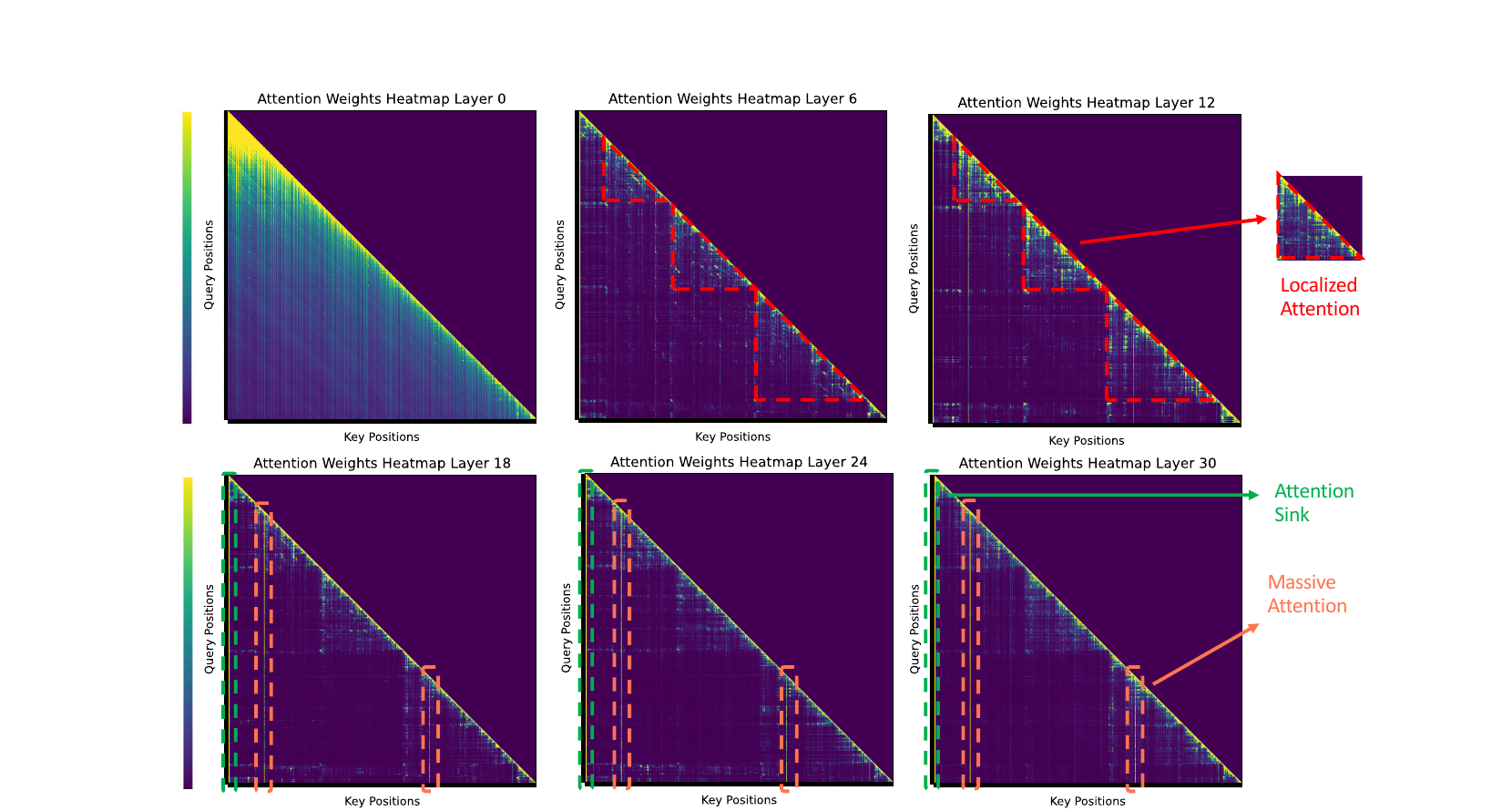
Source: Cai et al., PyramidKV, Figure 2. The figure motivates a layer schedule for the evaluated model and workload. It does not prove that every checkpoint, head, prompt, or later query follows a monotone funnel.
Let m be the number of layers, K_total the budget summed across those layers,
and beta > 0 the top-to-bottom shaping parameter. The paper sets the upper
layer endpoint to
For a linear schedule to sum to K_total, its endpoint average must be
K_total / m. Therefore
which gives
Linearly interpolating from bottom layer 0 to top layer m-1 yields
The arithmetic-series identity then verifies conservation:
For m=3, K_total=12, and beta=2:
k_top    = 12 / (2 * 3) = 2
k_bottom = 2 * 12 / 3 - 2 = 6
real layer targets = [6, 4, 2]
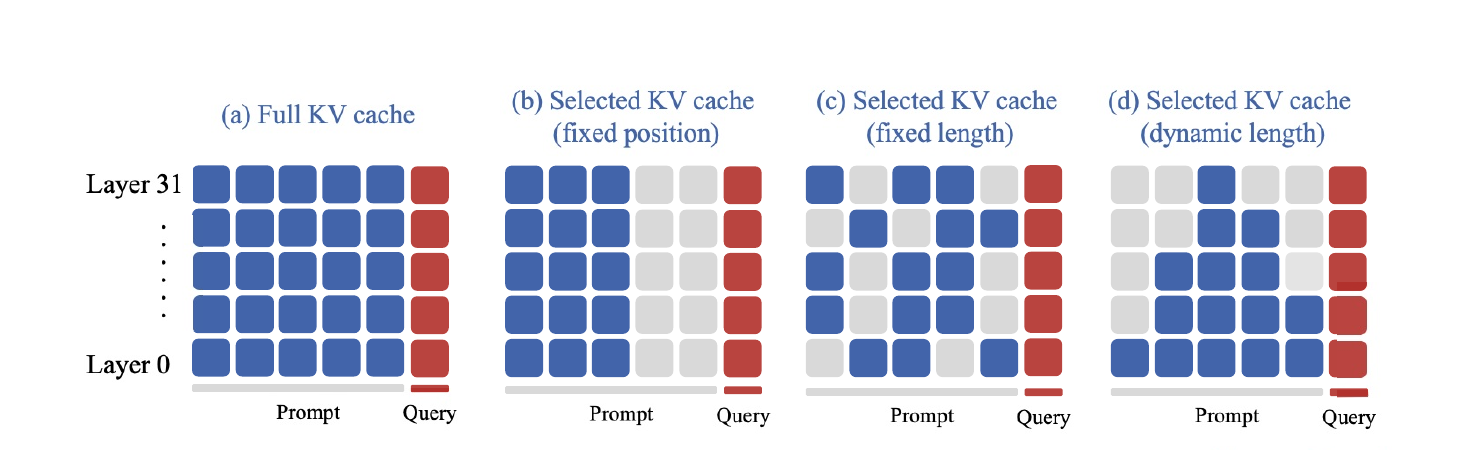
Source: Cai et al., PyramidKV, Figure 1. Blue cells represent retained positions. The final panel changes retained length by layer; it does not by itself establish accuracy or runtime speed at an arbitrary budget.
The paper formula is real-valued, while a cache stores integer rows. The pinned
official implementation at commit
94255b6
uses integer division to form layer capacities in PyramidKVCluster. That is a
concrete implementation choice, not proof that every (K_total, m, beta)
combination conserves the requested total after flooring.
A deployment needs a declared apportionment rule:
def pyramid_layer_budgets(total, layers, beta, floors, caps):
    top = total / (beta * layers)
    bottom = 2 * total / layers - top
    targets = [
        bottom - l * (bottom - top) / (layers - 1)
        for l in range(layers)
    ]
    return apportion_exact_integer_budget(targets, total, floors, caps)
This article’s oracle floors bounded targets, then assigns residual rows by largest remainder with stable owner-index ties. It checks exact conservation, floors, and caps. The rule is a rewrite implementation contract, not a claim that PyramidKV prescribes this exact integer tie-break.
One more unit distinction matters. The paper and code can apply a layer
capacity to each head. The Loop 7 teaching fixture instead treats [6,4,2] as
aggregate prefix rows per layer and then distributes each layer total across
its two persistent K/V heads. That composition is intentionally explicit; it
must not be cited as PyramidKV’s paper algorithm.
0x08C PyramidInfer Is Not Merely Another Fixed Pyramid
PyramidInfer uses a different contract. It identifies Pivotal Context (PvC) from inter-layer consistency, keeps a top proportion of crucial context, and updates the retained context as generation proceeds. Its layer-dependent proportion can decay because later layers are expected to need fewer positions. The method can also remove work during prefill, rather than only publishing a smaller prompt cache after a full prefill.
PyramidKV teaching boundary:
    assign layer capacity -> rank positions -> retain rows

PyramidInfer paper boundary:
    estimate layerwise pivotal context
    -> prune context participating in later computation
    -> update pivotal context during generation
The official PyramidInfer source is pinned here at commit
61ac641.
Its model patch is evidence for one research implementation, not a portable
cache ABI. Treating PyramidInfer as K_l = decreasing_sequence[l] would erase
its score, phase, and compute contracts.
0x08D ZigZagKV: Infer Layer Budgets Instead Of Assuming A Funnel
ZigZagKV asks how much budget each layer appears to need. For each layer it defines a Minimum Budget of Attention (MBA): the smallest retained count needed to preserve a target share of attention mass, 90% in the paper’s analysis. It then averages this signal into a layer quantity, LMBA, and also studies a Minimum Budget of Output (LMBO) based on hidden-output similarity.
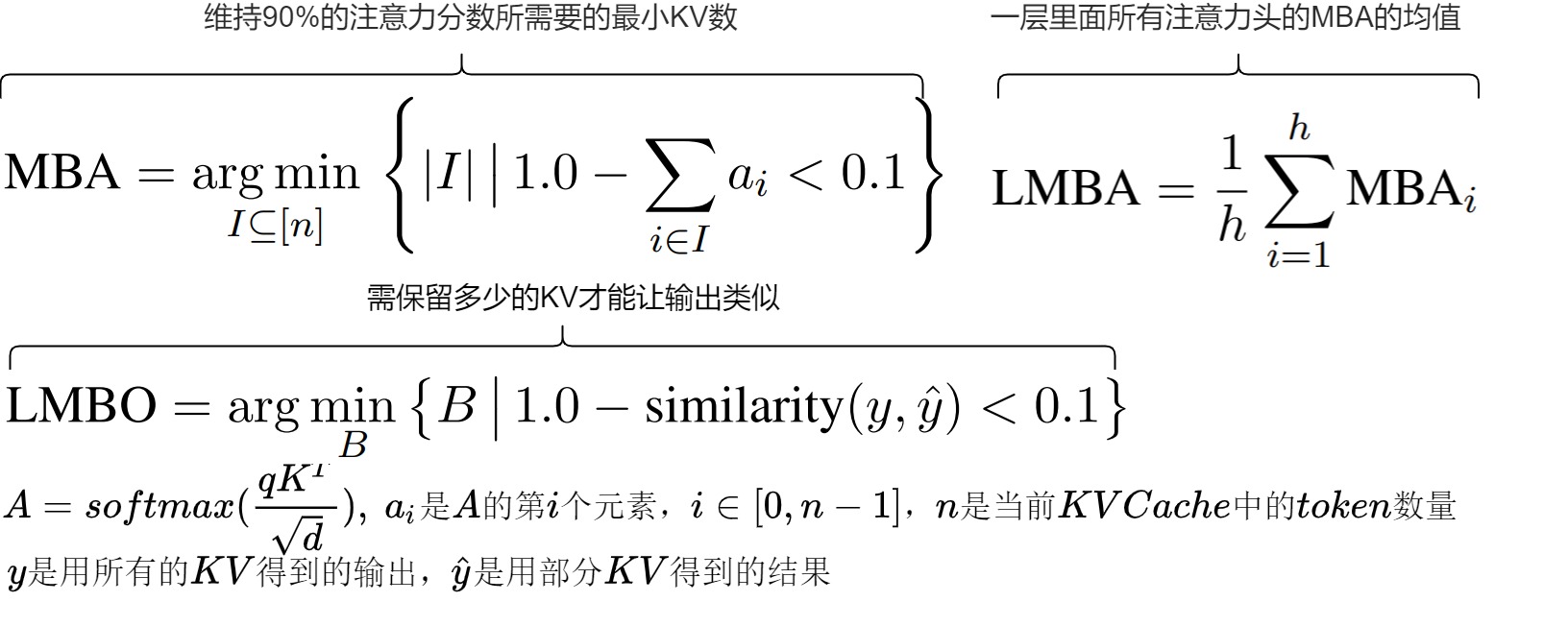
Source-local annotated figure from A25, based on ZigZagKV. MBA is attention-mass based; LMBO is output-similarity based. Neither is a full-model task-quality guarantee.
Normalize positive layer sensitivity values:
If B_mean is the desired mean layer budget across L layers, naive
proportional allocation is
This conserves B_mean L, but it can starve a low-scoring layer. Introduce a
minimum B_min and allocate only the residual above that floor:
The derivation is conservation by construction:
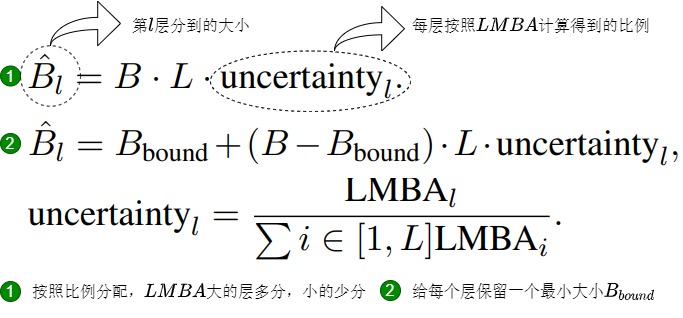
Source-local annotated figure from A25, based on ZigZagKV. The minimum avoids zero-budget layers, while the sensitivity profile redistributes the remaining pool.
For LMBA=[6,4,2], B_mean=4, and B_min=1:
u = [1/2, 1/3, 1/6]
real targets = [5.5, 4.0, 2.5]
integer targets under the declared tie rule = [6, 4, 2]
Unlike a fixed pyramid, calibrated targets need not decrease monotonically. They are profile-, model-, prompt-, and metric-dependent. A retrieval-derived profile may also understate heads or layers needed for reasoning.
0x08E Ada-KV: Why Global Top-B Produces Head Budgets
Ada-KV moves allocation inside a layer. Write the multi-head output as
where A_i^j is attention from head i to position j, and W_i^O is that
head’s output-projection slice. Let I_i^j be one when the row is retained.
The compressed output uses only rows selected by I.
Under the paper’s bounded-row-norm assumption, the local L1 output difference has the upper bound
For fixed H and C, minimizing this upper bound is equivalent to maximizing
the retained attention mass. With a layer budget B, concatenate all
head-position scores and select the global top B. The number of winners from
each head becomes that head’s raw budget.
def adaptive_head_budgets(score_by_kv_head, layer_budget):
    candidates = []
    for kv_head, scores in enumerate(score_by_kv_head):
        for original_position, score in enumerate(scores):
            candidates.append((score, kv_head, original_position))

    winners = sorted(
        candidates,
        key=lambda x: (-x[0], x[1], x[2]),
    )[:layer_budget]

    counts = [0] * len(score_by_kv_head)
    for _, kv_head, _ in winners:
        counts[kv_head] += 1
    return counts
This proves an ordering result for the stated local bound. It does not prove that attention mass orders downstream task quality, that the bounded-norm assumption is tight, or that one observation transfers to later queries.
The paper adds a uniform-allocation safeguard. If B_i* is the global-top-B
count, its adjusted real target is
The paper reports alpha=0.2 as its default. The deterministic fixture uses
alpha=0.75 only to make redistribution visible. It then imposes a one-row
deployment floor and exact integer conservation. Those floor and apportionment
steps are article-local runtime policy, not a silent change to the paper.
def apportion_exact_integer_budget(targets, total, floors, caps):
    budget = [
        min(cap, max(floor, int(target // 1)))
        for target, floor, cap in zip(targets, floors, caps)
    ]
    while sum(budget) < total:
        eligible = [i for i in range(len(budget)) if budget[i] < caps[i]]
        i = max(eligible, key=lambda j: (targets[j] - budget[j], -j))
        budget[i] += 1
    while sum(budget) > total:
        eligible = [i for i in range(len(budget)) if budget[i] > floors[i]]
        i = max(eligible, key=lambda j: (budget[j] - targets[j], j))
        budget[i] -= 1
    return budget
The official Ada-KV implementation is pinned at commit
04497ab.
Its AdaptiveSnapKVCluster uses rounding and records ragged head lengths and
cumulative offsets. Paper equations, research-code rounding, and a production
integer reconciliation policy are therefore three distinct contracts.
0x08F Worked Tensor Trace: Three Layers, Two K/V Heads
The executable fixture uses this immutable source:
K, V source shape per layer: [B=1, H_kv=2, T=8, d_h=3]
query heads: 4, mapped [0,0,1,1] -> two persistent K/V heads
prefix original positions: [0,1,2,3,4,5]
protected observation positions: [6,7]
layer prefix totals: [6,4,2]
Ada-style global ranking within each layer yields raw head counts
[[2,4],[3,1],[2,0]]. The declared safeguard, one-row floor, and integer
reconciliation publish:
integer K_lh = [[2,4], [3,1], [1,1]]
sum K_lh by layer = [6,4,2]
sum all prefix budgets = 12
Each owner selects prefix rows using its own scores, then appends protected
positions [6,7]:
| owner | prefix budget | packed original positions | packed length |
|---|---|---|---|
| layer 0, K/V head 0 | 2 | [0,1,6,7] | 4 |
| layer 0, K/V head 1 | 4 | [0,1,2,3,6,7] | 6 |
| layer 1, K/V head 0 | 3 | [0,1,2,6,7] | 5 |
| layer 1, K/V head 1 | 1 | [0,6,7] | 3 |
| layer 2, K/V head 0 | 1 | [0,6,7] | 3 |
| layer 2, K/V head 1 | 1 | [0,6,7] | 3 |
The packed lengths are [4,6,5,3,3,3]; cumulative owner offsets are
[0,4,10,15,18,21,24]. A row is gathered by (layer, kv_head, original_position) and K/V use the same index. Original positions are not
renumbered to packed rows.
def publish_allocated_prompt(source_k, source_v, budgets, scores, protected):
    packed = []
    offsets = [0]
    for layer in range(len(budgets)):
        for kv_head in range(len(budgets[layer])):
            prefix = stable_topk_positions(scores[layer][kv_head],
                                           budgets[layer][kv_head])
            positions = sorted(prefix) + protected
            packed.append({
                "layer": layer,
                "kv_head": kv_head,
                "original_positions": positions,
                "K": gather(source_k[layer][kv_head], positions),
                "V": gather(source_v[layer][kv_head], positions),
            })
            offsets.append(offsets[-1] + len(positions))
    return publish_one_generation(packed, offsets)
At BF16, one unique K/V row is 2 * d_h * 2 = 12 bytes in the toy tensor.
The full prompt payload is 3 * 2 * 8 * 12 = 576 bytes. The allocated receipt
contains 12 selected prefix rows plus 12 protected rows, or 288 bytes.
Its position map is another 24 * 4 = 96 bytes and seven 32-bit cumulative
offsets add 28 bytes. These are logical payloads, not allocator, GPU-traffic,
latency, or production-kernel measurements.

Article reconstruction. The same 12-row prefix total is first distributed to layers, then K/V heads. Protected observation rows are charged separately. A HeadKV-style calibrated alternative can produce different layer totals under the same global total.
0x08G HeadKV: Allocate Across All Layer/Head Owners
Ada-KV redistributes a fixed layer budget among heads in that layer. HeadKV
calibrates head importance across the complete (layer, head) owner set and
can therefore move rows between layers as well as between heads. Its importance
profiles can use retrieval-only or retrieval-plus-reasoning signals.
For mean per-head budget b, reserve a common base and distribute a pool using
normalized importance S_h:
The sum is bLH because sum_h S_h=1. In the fixture, normalized importances
[.05,.35,.25,.10,.20,.05], b=2, and beta=2 produce real targets
[1.3,3.1,2.5,1.6,2.2,1.3]. Exact integer apportionment gives
[1,3,3,2,2,1], whose layer totals are [4,5,3], not PyramidKV’s [6,4,2].
The official HeadKV source is pinned at commit
0862a09.
Its JSON importance profiles and rounding are checkpoint/workload artifacts.
They are not universal head importance, and rounding still requires a runtime
conservation check.
0x08H FastGen: Choose A Policy Family Per Head
Allocation need not mean only a scalar K_lh. FastGen profiles each head after
the prompt and chooses the lowest-memory policy whose retained attention mass
meets a recovery threshold. The policy family includes special-token,
punctuation, local, frequency/heavy-hitter, and full-cache behavior; hybrid
policies can union patterns.
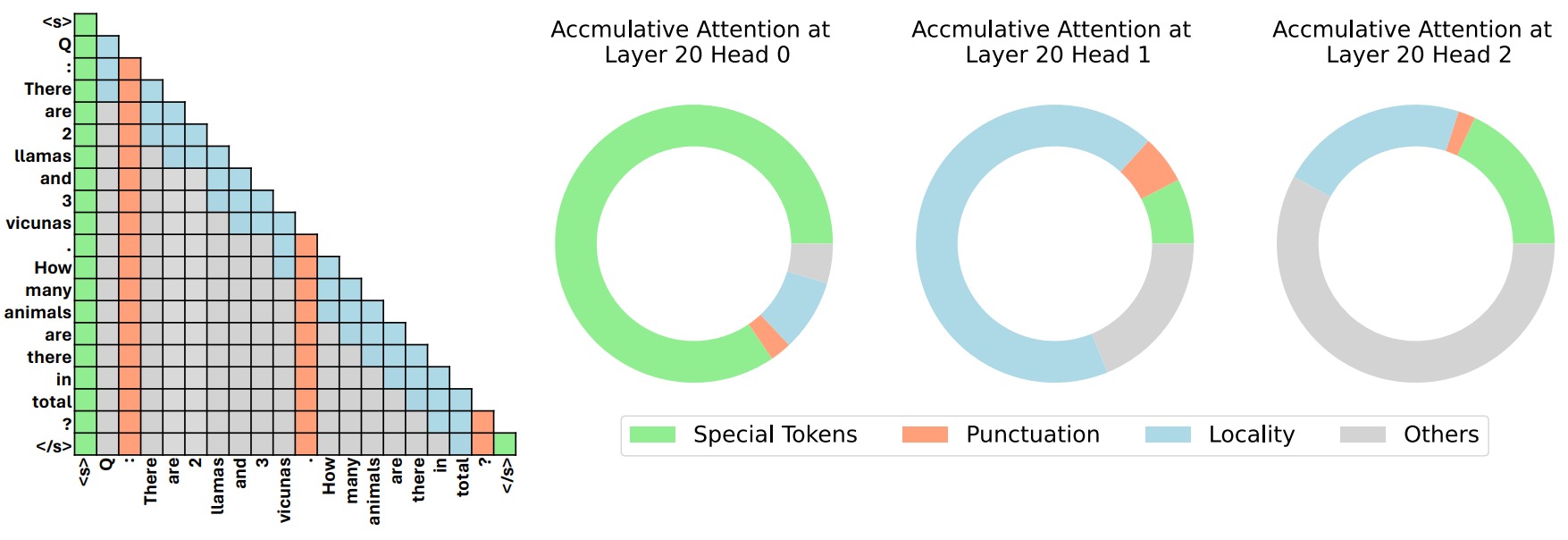
Source-local figure from A25, based on FastGen. The patterns motivate per-head policy selection; they are not permanent semantic labels guaranteed for every request.
def fastgen_profile_head(attention_mass, policy_masks, recovery_threshold):
    candidates = []
    for policy_name, positions in policy_masks.items():
        recovery = sum(attention_mass[p] for p in positions)
        candidates.append((len(positions), policy_name, recovery, positions))
    feasible = [row for row in candidates if row[2] >= recovery_threshold]
    if not feasible:
        full = policy_masks["full"]
        return (len(full), "full", 1.0, full)
    return min(feasible, key=lambda row: row[:2])
The fixture’s four synthetic profiles choose special, punctuation,
locality, and full. FastGen assumes that a head’s prompt profile remains
useful during generation; topic shifts can break that assumption. A production
contract needs a full-cache fallback or an explicit reprofile transition.
The official repository is pinned at commit
fb707b6,
but that snapshot exposes the paper link and README rather than runnable method
source. This article does not invent a source-code trace that is not there.
0x08I Ragged Storage Is Part Of The Method Contract
Heterogeneous K_lh produces ragged owners. There are three broad execution
choices:
| representation | persistent payload | execution consequence |
|---|---|---|
| packed ragged rows plus offsets | near sum_lh K_lh | kernel traverses owner offsets and position maps |
pad every owner to max_lh K_lh | can erase memory savings | regular shape, wasted rows and reads |
| bucket owners by length/policy | between packed and padded | more launches, packing, or scheduler fragmentation |
M5.4 owns the logical selected sets, owner lengths, original-position maps, and allocation receipt. M5.3 owns physical pages, slots, refcounts, sharing, and reclamation. M4.5 owns whether the decode backend can consume ragged K/V efficiently. A beautiful budget curve with a padded kernel can save logical rows while failing to save proportional HBM traffic or latency.
Generated rows form an append-only tail after the compressed prompt receipt. The prompt allocation remains stable unless the policy explicitly declares a recalibration transaction. One layer cannot publish its new allocation while another still exposes the parent generation; the receipt becomes visible only after every owner, position map, length, and offset validates.
0x08J Alternative Contracts And Failure Closure
| method | allocation signal | allocation domain | phase | important failure |
|---|---|---|---|---|
| PyramidKV | paper-observed pyramidal funnel | layer, commonly repeated per head | prompt | monotone layer assumption does not transfer |
| PyramidInfer | pivotal-context consistency | layer and evolving context | prefill plus decode | collapsing it to a fixed schedule erases compute/state updates |
| ZigZagKV | MBA/LMBA or LMBO sensitivity | layer | calibration plus prompt compression | profile metric or workload does not transfer |
| Ada-KV | global attention-score winners | heads within one layer | prompt observation | local error bound is loose or future query shifts |
| HeadKV | offline retrieval/reasoning importance | all layer/head owners | calibration plus serving | checkpoint/workload profile is stale |
| FastGen | per-head prompt recovery under policy families | head/module policy | prompt profiling plus decode | head pattern changes after profiling |
Failure probes must distinguish arithmetic, state, runtime, and quality:
budget does not sum exactly:
    allocation/rounding failure

selected K and V use different positions:
    tensor identity failure

query-head expansion duplicates persistent rows:
    GQA ownership/accounting failure

one layer publishes before the rest:
    cross-layer generation failure

ragged rows are padded or gathered inefficiently:
    runtime admission/performance failure

later query needs an omitted original position:
    lossy visibility failure

retained attention mass is high but task quality falls:
    proxy-to-quality failure
The deterministic failure probe requests original position 5; none of the
six fixture owners retained it. That proves only non-visibility. It does not
invent a task score.
0x08K Executable Allocation Oracle
The article-local evidence is:
docs/numinens-evidence/m5-4-long-context-kv-policies/
    adaptive_allocation_fixture.json
    invalid_adaptive_allocation_fixtures.json
    adaptive_allocation_oracle.py
    adaptive_allocation_report.json
    test_loop7_adaptive_allocation.py
The valid fixture derives PyramidKV and ZigZagKV layer targets, Ada-KV raw and safeguarded head budgets, exact integer apportionment, aligned symbolic K/V gathers, HeadKV global owner budgets, FastGen policy choices, one generation- stamped ragged receipt, and payload ledgers. Fifty-eight one-contract mutations reject. The oracle does not run a model, reproduce a paper benchmark, calibrate a checkpoint, implement a production allocator/kernel, or measure GPU traffic, latency, or task quality.
0x09 Boundary: Retention Is Not Retrieval Or Offload
Pure retention asks which K/V rows remain part of the logical history. Retrieval and offload preserve a larger pool elsewhere and decide which rows become resident or visible for one attention step.
retention miss:
    the historical row was permanently omitted from the logical cache

exact-offload miss:
    the exact row exists, but promotion is late or unavailable

retrieval miss:
    the row exists in the larger pool, but the query-dependent selector omitted it
Those cases need different correctness and fallback rules. Exact movement can preserve the full attention set. Query-dependent retrieval changes that set unless it recovers every required row or reruns an exact fallback.
M5.5 - KV Retrieval, Offload, and Hierarchical Memory develops the complete mechanism:
- exact GPU/CPU and multi-tier residency transactions;
- transfer, overlap, and staging-memory derivations;
- omitted-softmax-mass error rather than recall alone;
- InfiniGen’s orthogonal skewing, partial rehearsal, host pool, and prefetch pipeline;
- RetrievalAttention’s attention-aware index and partial-softmax combination;
- scheduler integration, index/pool consistency, exact fallback, and failure injection.
M5.4 retains this boundary because a hybrid can first delete or merge history and then retrieve from what remains. The evaluation must attribute quality loss to the correct stage.
0x0A Alternative Selection Signals And Budget Allocation
The methods above should not be read as a single progression from simple to advanced. They make different choices about three questions:
selection signal:
    recency, cumulative attention, regularized logits, observation-window attention,
    layer/head sensitivity, or query-dependent retrieval

budget location:
    global, per layer, per head, per request, or per decode step

irreversibility:
    permanently evict, merge, offload and fetch, or change the architecture
Scissorhands Versus H2O
Section 0x06 derives the difference from the papers and executable fixture. Scissorhands counts below-baseline attention over a bounded history and drops a batch at a compression event. H2O accumulates retained-row attention and forms a one-entry successor. Their common persistence intuition does not make their score, cadence, recent protection, or rollback state interchangeable.
Keyformer: Correct For Distribution Distortion In The Selection Score
Section 0x06 also derives Keyformer’s denominator distortion, Gumbel-softmax score, linear temperature schedule, prompt selection, and decode update. The important allocation point here is that Keyformer still assigns one key/recent budget per score owner. The next alternatives change that budget unit to a layer, head, cluster, or recall group; they do not redefine Keyformer’s score.
Head Roles Can Change The Budget Unit
Section 0x08 derives this case rather than repeating it here. Ada-KV reallocates within one layer, HeadKV can reallocate across all layer/head owners, and FastGen can assign different policy families rather than only different row counts. Their shared output is a heterogeneous logical visibility contract; 0x08I owns the resulting ragged-layout and backend boundary.
Semantic Clusters Replace Position Pages With Recall Groups
Eviction and merging are not the only ways to organize old K/V. ClusterKV groups cache entries in key/semantic space and recalls relevant clusters for a query. Its index unit is therefore not merely a contiguous token page.
Conceptual state:
cluster centroid / routing key
member token IDs or physical block references
resident members
offloaded or compressed members
recall metadata
At decode:
candidate_clusters = cluster_index.search(q, top_c)
candidate_rows = gather_members(candidate_clusters)
visible_kv = fetch_or_activate(candidate_rows, gpu_budget)
output = attend(q, visible_kv)
This can recover rows that a permanent eviction policy would have lost, but it adds index construction, search, gather, and possible tier-fetch latency. It is also approximate unless the selected clusters provably contain every row needed by the original dense attention.
Cluster granularity creates a different tradeoff from fixed pages:
large clusters:
    cheaper metadata/search, more irrelevant rows fetched

small clusters:
    finer recall, larger index and scattered gathers
The correct telemetry is not only cache hit rate. It includes cluster recall, rows fetched per useful row, search latency, transfer latency, and quality under misses.
Sparse Attention Execution Is Not Automatically Cache Compression
The original source also groups speculative or predicted sparsity with cache optimization. Keep the boundary precise:
store all K/V, score only a predicted subset:
    reduces attention work/read traffic if the kernel supports it
    does not reduce persistent cache capacity

discard non-selected K/V:
    reduces capacity
    changes the future information set and becomes lossy

store off-device and predict what to fetch:
    preserves recoverability
    adds miss and transfer latency
Those designs can share a selection model, but their failure contracts differ. An article must say whether an unselected row remains recoverable.
0x0B Allocation Handoff: Do Not Re-Derive The Budget Here
Section 0x08 owns layer/head allocation, integer conservation, calibration, ragged owner metadata, and paper-by-contract comparison. The remaining policy families change the stored representation rather than only distributing unchanged original rows:
0x08 allocation:
    assign K_lh, then retain unchanged original K/V rows

0x0C merging:
    replace multiple original rows with an approximate representation

M5.5 retrieval/offload:
    preserve a larger recoverable pool and move/select rows at query time

M5.7/M5.8 architecture:
    change which per-token head or latent representation exists at all
That boundary prevents the generic resource-allocation objective from being repeated with different names while hiding a more consequential change to the cache object.
0x0C Representation Change: Merge, Reconstruct, Or Change The Graph
Permanent eviction keeps a subset of original rows. The mechanisms in this section do something stronger: they replace original rows, share a state across layers, or stop producing most layer-local K/V altogether. Calling all three operations “compression” hides the compatibility decision that matters most.
0x0CA Three Compression Axes, Three Different Checkpoints
| Method | Changed axis | Persistent object | Training contract | Can an ordinary checkpoint use it unchanged? |
|---|---|---|---|---|
| DMC | token/time within each layer and head | importance-weighted segment K/V plus running mass | continued pretraining with relaxed decisions and an inference-like mask | no; the checkpoint must learn the controls |
| MiniCache | depth across adjacent layers | shared direction, per-layer magnitudes, angles, and exception rows | training-free post-hoc transform in the paper | yes under the paper’s supported model/runtime path, but the cache ABI changes |
| Layer-Condensed KV | producer/consumer graph across layers | K/V from only declared producer layers | architecture-specific pretraining and iterative prompt/training graph | no; projections and dependencies differ |
The immutable representation record therefore needs more than a method name:
KVRepresentationManifest:
    checkpoint_revision
    graph_revision
    representation_kind
    producer_layer_map
    consumer_layer_map
    owner = (layer, kv_head) or shared_layer_pair
    original_position_contract
    merge_or_reconstruction_parameters
    side_metadata_dtype_and_shape
    quantization_contract_id or null
    policy_generation
An eviction receipt can list retained original positions. A replacement receipt must instead list the source span or layer pair represented by every compressed row, the reconstruction rule, and the compatible consumer. It must never advertise the replacement as an exact prefix-cache row.

0x0CB DMC Inference: Derive The Segment State
Dynamic Memory Compression assigns a binary segmentation decision and an importance weight to every token, layer, and head. In the paper notation,
The convention is easy to reverse accidentally:
alpha_t = 0  -> append a new segment
alpha_t = 1  -> accumulate into the trailing segment
The two control neurons are then zeroed before ordinary attention. Let z be
the accumulated importance mass of the trailing segment. On accumulation,
The denominator is not optional bookkeeping. Expanding the recurrence for one
segment S gives
Thus the update is an importance-weighted mean, not the unnormalized sum, a
fixed convex interpolation, or a normalized key with a separately averaged
value. If alpha_t=0, the cache appends (k_t,v_t) and resets z_t=omega_t.
For n input rows, the compressed length is
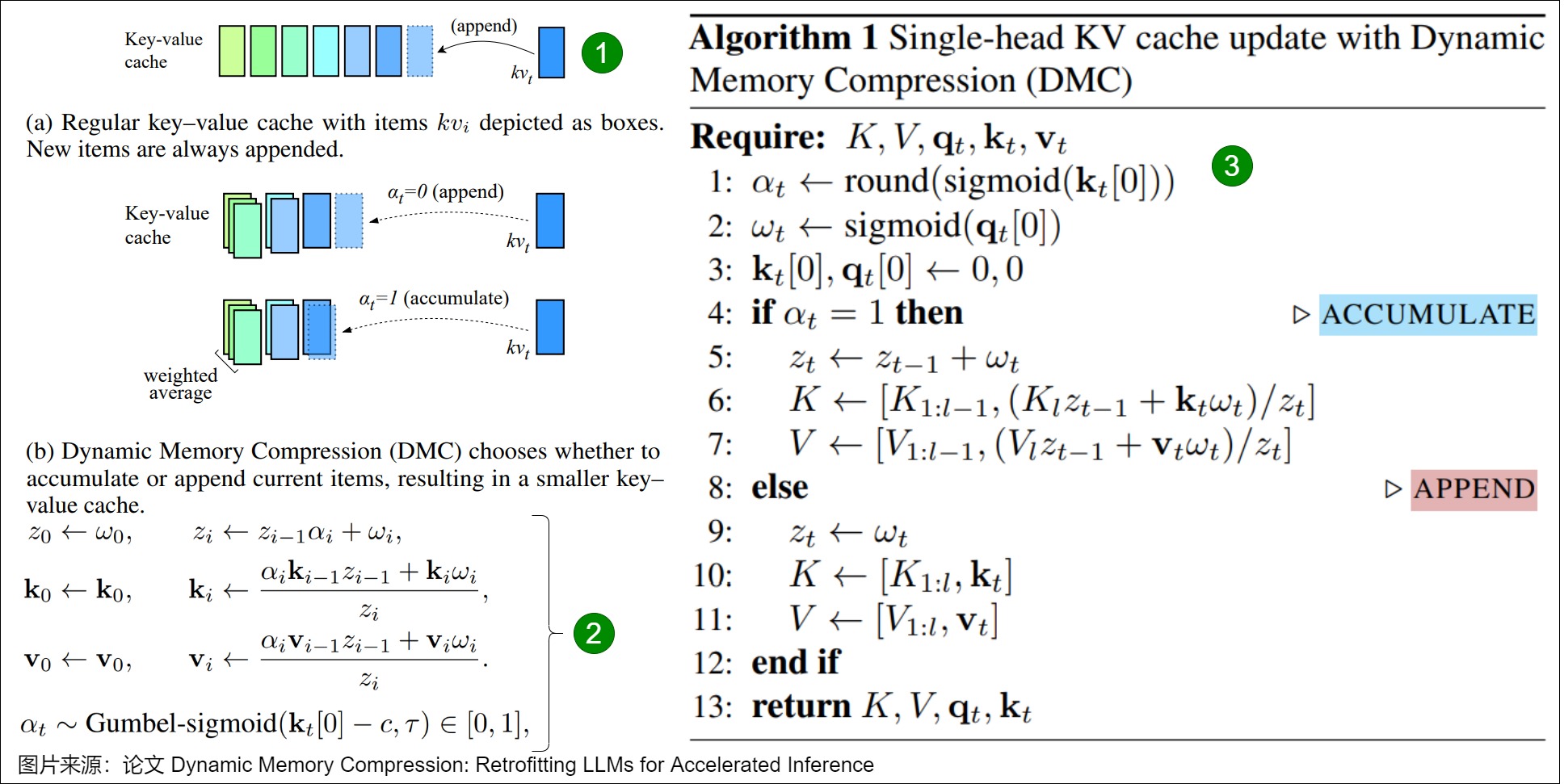
Source: A25 composite derived from Dynamic Memory Compression Figure 1, Equations 8-10, and Algorithm 1. It is used to expose the paper’s decision convention and running-mass update; it is not a local throughput result.
0x0CC DMC Tensor Trace: Five Rows Become Two Segments
For one layer and one K/V head, take
source positions:  [0, 1, 2, 3, 4]
alpha:             [0, 1, 0, 1, 1]
omega:             [1, 1, 2, 1, 1]

K rows: [[1,0], [3,2], [5,4], [7,6], [9,8]]
V rows: [[10,0], [30,20], [50,40], [70,60], [90,80]]
The two segments and their receipts are:
| compressed row | represented source positions | anchor position | mass z | merged K | merged V |
|---|---|---|---|---|---|
| 0 | [0,1] | 1 | 2 | [2,1] | [20,10] |
| 1 | [2,3,4] | 4 | 4 | [6.5,5.5] | [65,55] |
The anchor is the latest source position in the segment in this teaching receipt. That does not make the merged row equal to the latest token. It says which positional identity the compatible runtime assigns to the replacement. Mixing pre-RoPE rows, post-RoPE rows, or a different anchor convention without checkpoint and kernel agreement changes attention geometry.
def dmc_update(cache, q_t, k_t, v_t):
    alpha = round(sigmoid(control(k_t)))  # 1 means accumulate
    omega = sigmoid(importance(q_t))
    q_t, k_t = zero_control_channels(q_t, k_t)

    if alpha == 0 or cache.empty():
        cache.append(k=k_t, v=v_t, mass=omega,
                     source_span=[position_t, position_t])
    else:
        tail = cache.last()
        mass = tail.mass + omega
        tail.k = (tail.mass * tail.k + omega * k_t) / mass
        tail.v = (tail.mass * tail.v + omega * v_t) / mass
        tail.mass = mass
        tail.source_span[1] = position_t
    return cache
The production cache need not store every segment member, but audit and rollback state still needs enough identity to reject stale generations and to explain which source interval a replacement covers.
0x0CD DMC Training Is Not The Inference Loop Unrolled Naively
The binary decision cannot receive useful gradients through rounding. During continued pretraining, DMC relaxes it with a Gumbel-sigmoid sample,
and extends the recurrence to partial accumulation:
with the analogous value update. Training retains the intermediate states so tokens can be processed in parallel, then applies an additive attention mask that suppresses segment states which would no longer exist at inference. This is a different materialized graph from the ragged inference cache.
The one-sided compression objective penalizes too many appended rows:
and the paper optimizes ell_LM + ell_CR while ramping the target compression
ratio. The checkpoint can therefore learn unequal compression across heads and
layers. A fixed post-hoc alpha rule is an alternative method, not DMC’s
paper contract.
The paper uses the first Q/K neuron in its equations. The pinned official
Megatron-LM dmc branch at commit
d36bf8d5333b60c3d6b871128644c2b87d241d0b uses the last channel, zeros that
channel around RoPE, keeps per-head lengths, running weighted windows, and a
per-head paged block table. This is an implementation variant, not a reason to
rewrite the paper’s notation silently.
0x0CE DMC Runtime State Is Ragged Twice
DMC produces unequal sequence lengths across both layer and head:
The logical payload is therefore
plus running masses, per-head lengths, block tables, window state if the
approximation is enabled, and allocator rounding. Padding every owner to
max(T_lh) gives back part of the saved capacity. The pinned implementation
uses pages allocated per head; M5.3 still owns the physical allocator, and
M4.5 owns whether a backend can consume the resulting ragged state without
hidden densification.
0x0CF MiniCache: Merge Across Depth, Not Across Time
MiniCache starts from a different
observation: adjacent K/V states become similar in middle-to-deep layers. It
pairs layers from a starting layer S and replaces two same-position vectors
x^(l-1), x^l with one shared direction plus reconstruction metadata.
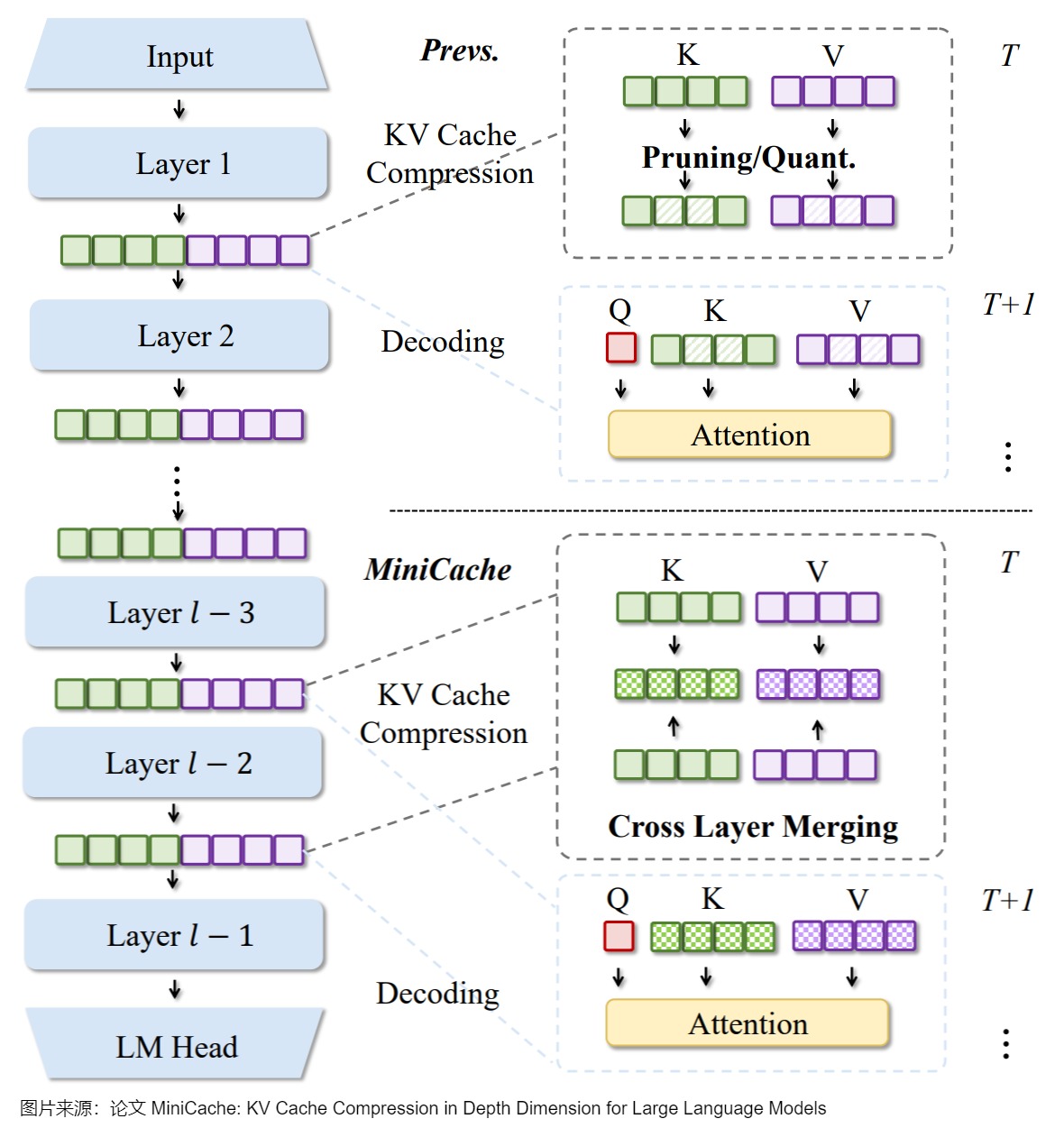
Source: A25-preserved MiniCache overview. The diagram distinguishes depth compression from token pruning; the illustrated behavior is paper-reported.
Write the unit directions and angle as
For interpolation coefficient rho, spherical interpolation derives the
shared direction
When Omega -> 0, an implementation needs a normalized-linear fallback;
when the pair is nearly antipodal, the shortest interpolation direction is
ill-conditioned and should be retained separately or handled by an explicit
policy. Restoration preserves each original norm but not its original
direction:
The directional error remains unless both original directions were equal. A shared row must therefore carry at least the pair identity, shared direction, two magnitudes, and the interpolation contract. Keys and values apply the construction separately.
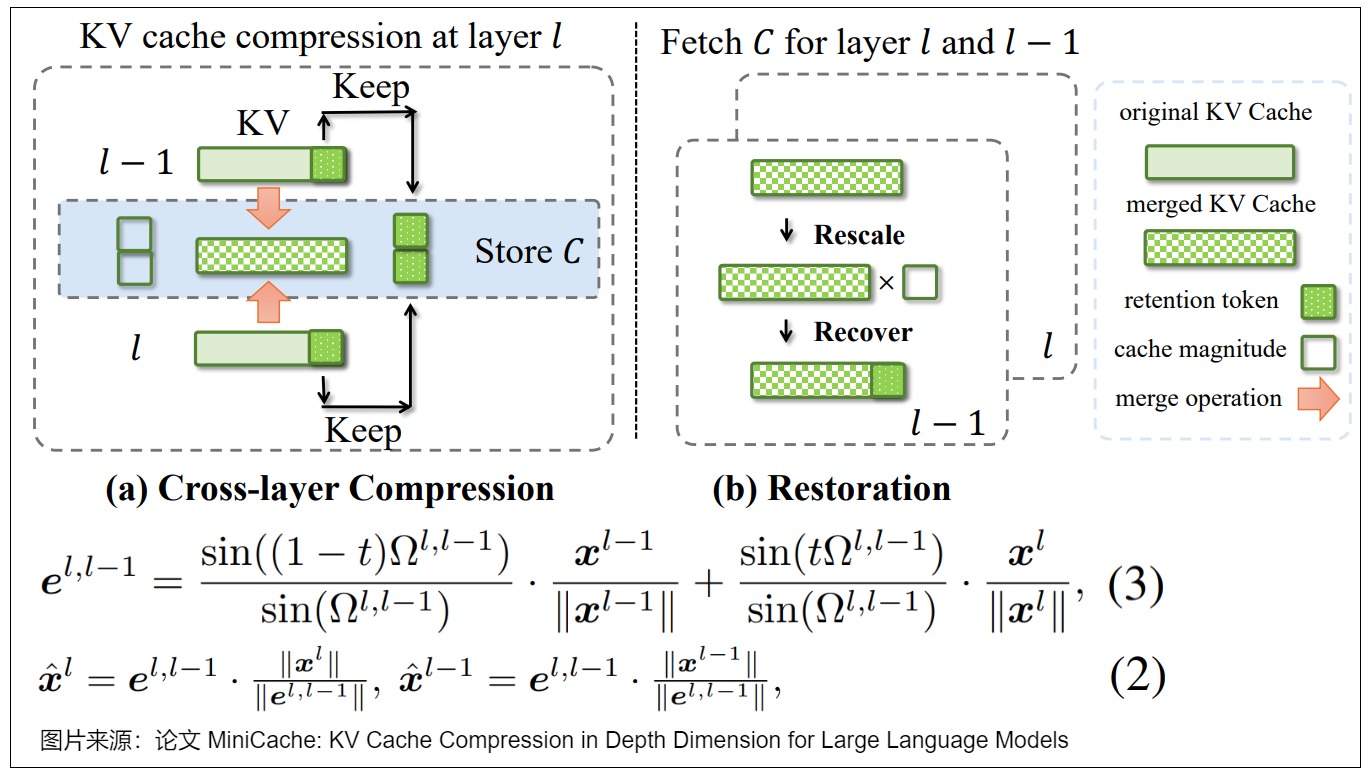
Source: A25 annotated composite based on MiniCache Figure 3 and Equations 2-3. It exposes the persistent and reconstructed objects rather than claiming exact recovery.
0x0CG Distinct-Pair Retention Is Part Of MiniCache, Not A Footnote
MiniCache measures normalized angular distance d_i=Omega_i/pi and retains
layer-specific rows for pairs deemed unsafe to merge. The compressed object is
therefore hybrid:
C^(l,l-1) =
    shared directions E
    + norms for layer l-1 and l
    + angle/interpolation metadata
    + original exception rows R^(l-1), R^l
    + exception indices I
On reconstruction, the runtime rescales the shared direction, then overwrites the exception positions with their exact retained layer-local rows.
There is a source-level issue worth preserving rather than normalizing away.
The MiniCache prose says highly distinct pairs are retained, but its printed Equation 4 uses a < threshold on angular distance for the set called retained.
Those statements point in opposite directions if d is interpreted literally
as distance. The official MiniCache repository snapshot
f1baccacba6bc83dc499f5db9257576397bb4ed8 contains a project page and figures,
not runnable method code that resolves the inequality. The local oracle follows
the prose-consistent rule “large angular distance becomes an exception” and
labels it rewrite interpretation, not a reproduction of Equation 4.
0x0CH MiniCache Prefill And Decode Materialize Different States
The paper’s runtime starts ordinary attention below S. For each adjacent
pair at or above S, prompt prefill materializes both layer caches, merges the
pair, stores side metadata and exception rows, and releases the redundant
layer-local cache. Decode then reconstructs the layer needed for attention,
appends the new token’s layer-local K/V, and re-merges the pair for the next
step.
def minicache_pair_prefill(x_lo, x_hi, rho, exception_indices):
    direction, norm_lo, norm_hi, angle = slerp_merge(x_lo, x_hi, rho)
    return SharedDepthCache(
        direction=direction,
        norms=(norm_lo, norm_hi),
        angles=angle,
        exception_indices=exception_indices,
        exception_lo=x_lo[exception_indices],
        exception_hi=x_hi[exception_indices],
    )

def restore_layer(shared, which):
    x_hat = normalize(shared.direction) * shared.norms[which]
    x_hat[shared.exception_indices] = shared.exceptions[which]
    return x_hat
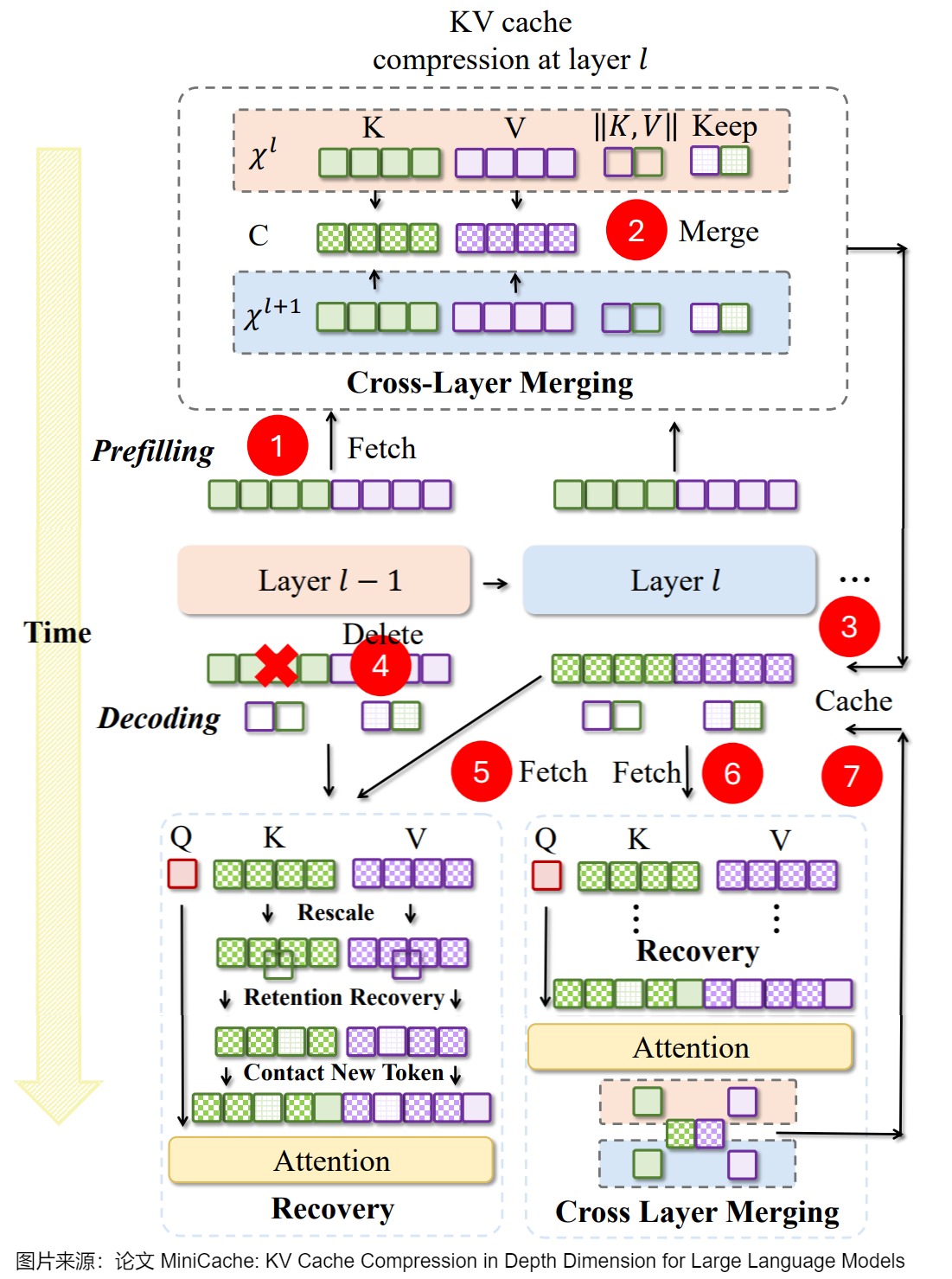
Source: A25-preserved MiniCache inference flow. Fetch, restore, attention, new-token update, and re-merge are separate operations; their latency is not measured locally here.
For one layer pair, sequence length T, head width d_h, exception count R,
and one scalar width b, a transparent K-plus-V logical ledger is:
The first term stores one shared K and V direction instead of two layers. The
remaining terms prove why “two layers become one” is not a 2x byte guarantee.
For tiny d_h, metadata can dominate; for real head widths, exception rate and
materialization workspace still decide the realized saving.
0x0CI MiniCache And DMC Are Not Interchangeable
| Question | DMC | MiniCache |
|---|---|---|
| Which redundancy is used? | adjacent time rows within one owner | same token across adjacent deeper layers |
| What is approximate? | a whole temporal segment becomes one weighted K/V | two layer directions become one interpolated direction |
| What stays exact? | no original row inside an accumulated segment | exception rows and per-layer magnitudes |
| Where is adaptation? | continued pretraining | training-free transform under the paper contract |
| Main runtime irregularity | per-layer/head ragged sequence lengths | restore/re-merge lifecycle and exception scatter |
| Main failure | learned segmentation destroys separable evidence | cross-layer directions are not sufficiently similar |
PyramidKV and Ada-KV choose which original positions remain. MiniCache can in principle run after a shared position set is established, but merging different position sets is undefined. DMC changes sequence segmentation online, so composing it with a post-hoc selector requires a declared order and a new training/evaluation contract.
0x0D Architecture-Level Condensation And Learned Summaries
0x0DA Layer-Condensed K/V Changes The Producer Graph
Layer-Condensed KV Cache is not a merge
operator. In its most condensed graph, queries from every layer consume K/V
produced by the top layer from prior tokens. Non-producer layers do not need
their own persistent K/V or their W_K,W_V parameters.
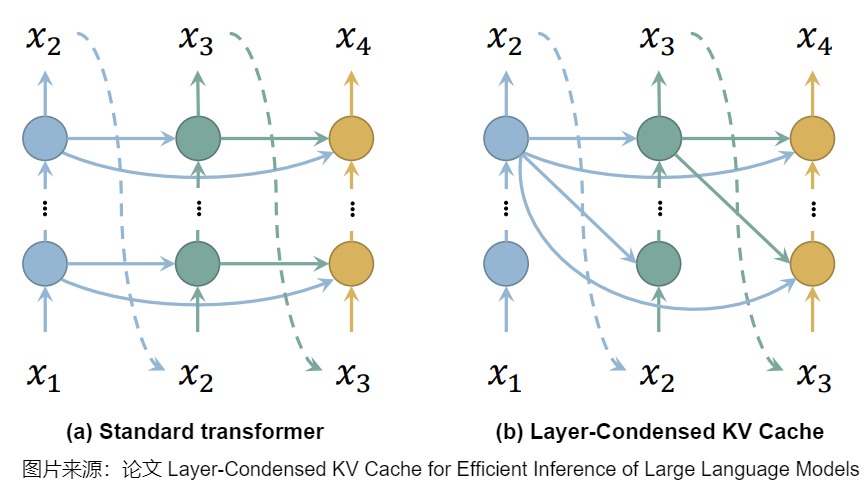
Source: A25-preserved Layer-Condensed KV Cache Figure 1. Horizontal edges denote query-to-K/V dependencies. This is a checkpoint graph, not a cache eviction schedule.
Let P be the set of K/V-producing layers. The persistent payload changes from
to
before allocator and metadata overhead. A six-layer teaching graph with
producer set P={0,5} and consumer map [0,5,5,5,5,5] stores two layer caches,
not six. That 3x payload ratio is a graph count, not a local throughput or
quality measurement.
0x0DB Why The Graph Creates A Cycle
For token t, a lower-layer query asks for the top-layer K/V of prior tokens.
That is legal. If a token also attends to itself, however, its lower-layer query
would need its own top-layer K/V before the token has reached the top layer.
The paper removes this cycle by masking the attention diagonal for the
top-attending path and using zero dummy K/V for the first token. Residual
connections still carry the current token upward.
The paper then restores a small set of ordinary warmup layers. With an even
count w, its sandwich configuration keeps w/2 bottom and w/2 top layers
on standard layer-local attention. The producer/consumer map, diagonal rule,
and warmup placement are therefore checkpoint coordinates, not serving flags.
0x0DC Parallel Training And Prompt Encoding Need Iterations
Exact left-to-right training would serialize tokens. The paper first rewrites
the graph as n parallel-token iterations: iteration r consumes top-layer
K/V from iteration r-1. Token i becomes correct by iteration i, so n
iterations recover the sequential graph, but that is still impractical.
The approximation has two truncations:
b backward iterations:
    gradients flow only through the last b iterations
    b=1 cannot train the K/V-producing path used by the last iteration

m forward-only iterations:
    approximate the earlier n-b iterations because K/V empirically converge
The paper uses m=7 and b=2 in its reported setup, and prompt encoding uses
m+b iterations before ordinary left-to-right decode. Those values are
source-reported choices, not universal convergence constants. The official
LCKV repository is pinned at
dd21716b9295fb4dbe4af51ec3352a936b2b7df8; its configuration exposes
layer_types, forward_passes, and backward_passes, while LayerCache
stores only declared producing layers and supports iterative update control.
0x0DD Checkpoint And Composition Gates
ordinary checkpoint + DMC cache updater:
    reject; control channels and compression behavior were not trained

ordinary checkpoint + LCKV consumer map:
    reject; graph, diagonal mask, projections, and training dependencies differ

ordinary checkpoint + MiniCache transform:
    potentially admissible under the paper/runtime contract
    but cache representation and restore kernels still change

representation merge + K/V quantization:
    compose only after declaring whether directions, magnitudes,
    exception rows, and running masses are quantized separately
M8.6 owns the scalar format and calibration of those components. M5.7 owns K/V-head sharing, and M5.8 owns latent-cache identity and absorbed execution. Multiplying theoretical ratios is not enough: each composed stage adds metadata, temporary materialization, kernel constraints, and a new quality surface.
0x0DE Representation-Change Failure Lab And Oracle
| Fault | First invalid state | Consequence |
|---|---|---|
DMC alpha convention reversed | append/accumulate branch | target compression and segment identity invert |
| running mass omitted | trailing weighted mean | old and new token importance no longer reconcile |
| control channel reaches attention | Q/K tensor | control logit becomes semantic attention content |
| DMC checkpoint identity ignored | admission | untrained controls silently mutate cache state |
| MiniCache pair has different positions | pair manifest | reconstructed rows mix unrelated tokens |
| near-antipodal pair forced through SLERP | direction merge | division by near-zero sin(Omega) |
| exception scatter uses packed row as source index | reconstruction | exact retained rows overwrite wrong positions |
| LCKV consumer names a non-producer | graph admission | required K/V object does not exist |
| ordinary checkpoint is relabeled LCKV | checkpoint admission | projections and dependency graph disagree |
| quantizer treats all side state identically | composition | norm, angle, mass, and vector error budgets collapse |
The executable evidence is intentionally synthetic:
docs/numinens-evidence/m5-4-long-context-kv-policies/
    representation_change_fixture.json
    invalid_representation_change_fixtures.json
    representation_change_oracle.py
    representation_change_report.json
    test_loop8_representation_change.py
It derives the five-row DMC trace, MiniCache SLERP and exception restoration, payload and reconstruction-error ledgers, the LCKV producer map, prompt iteration count, and incompatible graph/checkpoint failures. It does not train a checkpoint, execute the paper kernels, reproduce paper quality or throughput, measure GPU traffic, or certify a production cache implementation.
Forty-four one-contract mutations reject reversed DMC decisions, inconsistent segment masses, mismatched MiniCache layer pairs, missing exception state, invalid Layer-Condensed producer graphs, incompatible checkpoints, and byte or publication drift. Passing that oracle proves internal contract consistency, not paper-result reproduction.
Learned Segment Summaries Change The Serving Object
AutoCompressor-style memory changes the stored object again. The model receives special learned summary-token embeddings, runs an ordinary causal Transformer, and interprets the final hidden rows at those positions as a compressed state for later segments.
Let segment i contain m_i token embeddings, let kappa be the number of
summary tokens emitted per compressed segment, and let sigma_<i concatenate
the summaries from all earlier segments. The input order is:
where G is the learned block of kappa summary-token embeddings. After the
Transformer produces final hidden state H_i, the current summary is the last
kappa rows:
and summary accumulation updates the persistent state as:
This derivation exposes two easy mistakes:
summary-token embedding G:
    a learned input that asks the model to produce a summary

summary vector sigma_i:
    the resulting final-layer hidden state at that summary-token position

neither object is:
    an original token's per-layer K/V row
The distinction also separates AutoCompressor from the recurrent-memory baseline it extends:
| Design | State passed to segment i | Persistent length before segment i | Information path |
|---|---|---|---|
| RMT-style recurrence | previous summary sigma_(i-1) | kappa | earlier evidence must be repeatedly recompressed through one recurrent state |
| AutoCompressor summary accumulation | sigma_1, ..., sigma_(i-1) | (i - 1) * kappa | each segment keeps a direct summary-level path to every later segment |
Summary accumulation is therefore compressed growth, not globally
fixed-size memory. With b bytes per scalar, the externally stored summary
payload before segment i is:
It grows linearly in the number of compressed segments, but at kappa vectors
per segment rather than m_i source tokens. The paper explicitly notes that
attention over an ever-growing summary prefix still has a quadratic cost. A
memory ledger that writes only “50 summary vectors” is incomplete unless it
says whether those 50 vectors replace one segment or the whole document.

Training and position semantics are consumed from M3.5
M3.5 - Context Extension owns the AutoCompressor architecture and training derivation: summary-token inputs versus emitted summary vectors, the next-token objective, segment-length randomization, truncated cross-segment gradients, checkpoint-specific LoRA or full-parameter adaptation, and absolute/RoPE position conventions. M5.4 does not repeat that training recipe. It consumes one compatible trained checkpoint and asks what persistent object remains visible under its serving policy.
Runtime has persistent state and working state
Once sigma_i is extracted, an implementation can discard token-level working
state for segment S_i if it chooses summaries as the only persistent history.
That does not make later attention free. When sigma_<i is prepended to a later
call, the Transformer still projects those d_model vectors into per-layer
keys and values for that call. If generation caches the resulting prefix, those
derived K/V rows become part of the runtime cache.
persistent between calls:
    accumulated summary vectors         [B, (i - 1) * kappa, d_model]

temporary while compressing segment i:
    segment activations and attention state
    current summary-token rows

created when summaries are consumed:
    per-layer K/V derived from summary-prefix embeddings

discarded under summary-only retention:
    token-addressable history for completed source segments
The resulting failure contract is architectural and lossy:
summary bottleneck:
    evidence absent from sigma_i cannot be recovered from discarded source rows

segmentation shift:
    boundaries or lengths unlike training can change what is compressed together

state growth:
    accumulation is smaller than raw context but still grows by kappa per segment

checkpoint mismatch:
    summary vectors are meaningful only to a compatible trained model and position rule

false cache equivalence:
    treating sigma_i as ordinary K/V bypasses the model projections that consume it
M3.5 owns how this learned state is produced. M5.4 owns the serving classification above: summary accumulation is lossy compressed history with a checkpoint-specific consumer, a distinct byte trajectory, and newly projected K/V when the summaries are read. Using precomputed summaries as a retrieval corpus is a separate composition owned by M5.5.
0x0E Runtime Integration: One Generation-Fenced Policy Transaction
The preceding sections derived what each policy retains, merges, or replaces. That does not yet make a policy safe to install in a serving runtime. A service must answer a different question:
how does one logically valid successor become the only cache state that a
later decode step, allocator, retriever, or remote worker is allowed to read?
The answer is not an in-place topk() followed by a free(). Selection,
physical materialization, backend admission, publication, and reclamation have
different owners. They also fail independently. This section therefore defines
a normative Transformer System transaction contract. It is a rewrite-derived systems
contract grounded in the immutable state established in Sections 0x01-0x02 and
the neighboring M5 ownership boundaries; it is not a claim that StreamingLLM,
H2O, SnapKV, DMC, or another paper exposes this exact transaction API.
0x0EA State Machine And Owner Boundaries
One accepted mutation follows this order:
begin
  -> append_committed
  -> score
  -> protect
  -> select
  -> validate
  -> backend_admit
  -> allocator_reserve
  -> pack
  -> publish
  -> release_parent
  -> export_handoffs
The phase names do not claim that every policy recomputes a score after every token. A static sliding window can return a deterministic selection receipt; SnapKV can reuse the prompt-compression receipt during ordinary decode; an architecture-level representation can preserve the checkpoint-defined producer map. The transaction still requires an explicit receipt at every boundary so that a no-op is distinguishable from a skipped validation.
| Phase | Input fact | Produced fact | Authoritative owner |
|---|---|---|---|
| append | accepted token and legal frontier | committed logical cache successor | M5.1 |
| score/protect/select | policy manifest, evidence, budget | proposed original-position sets | M5.4 |
| backend admit | requested layout, positions, dtype, shape | capability and workspace receipt | M4.5 |
| reserve/pack | accepted logical sets | unpublished physical mapping and packed-view receipt | M5.3 |
| publish | parent identity plus complete successor receipts | one visible KVPolicyState(g+1) | M5.4 |
| release parent | observed publication | physical release receipt | M5.3 |
| scheduling handoff | bytes, work, readiness, fallback | admission and service decision | M5.2 |
| recoverability handoff | omitted-state class and identity | retrieval/promotion contract | M5.5 |
| transfer handoff | published packed object identity | placement and transfer contract | M5.6 |

The central invariant is:
There is no legal interval in which layer 0 reads the successor while layer 1 still reads the parent, or in which the new position map names rows whose physical reservation failed.
0x0EB Append Is A Committed M5.1 Input
Loop 5’s dynamic-policy order starts with the current accepted row. Runtime integration sharpens what “current” means. Let the parent logical cache have exclusive frontier and cache generation . M5.1 accepts the row at original position and publishes:
M5.4 may score position only after that append receipt is committed. An unaccepted speculative candidate, cancelled sampling attempt, or stale worker completion cannot enter the source universe merely because its K/V was temporarily materialized.
The Loop 9 fixture starts with:
request                  req-m54-loop9-001, generation 11
policy                   generation 7
parent policy state      generation 30
parent cache             generation 500, frontier [0, 63)

M5.1 accepted append     original position 63
logical successor        cache generation 501, frontier [0, 64)
This creates a two-generation relationship, not one overloaded counter:
cache generation 501:
    the accepted logical source rows changed

policy-state generation 31:
    the legal visible or represented subset of that source changed
Either can advance without the other in a different policy. Keeping both is what makes a stale selector detectable.
0x0EC Score, Protect, Select, Then Validate
The fixture uses two layers and two physical K/V heads. Each owner receives a
four-row budget and must preserve original positions 0 and 63:
Owner (layer, kv_head) | Proposed original positions | Protected check | Budget check |
|---|---|---|---|
(0,0) | [0, 7, 51, 63] | {0,63} present | 4 <= 4 |
(0,1) | [0, 11, 54, 63] | {0,63} present | 4 <= 4 |
(1,0) | [0, 9, 59, 63] | {0,63} present | 4 <= 4 |
(1,1) | [0, 13, 60, 63] | {0,63} present | 4 <= 4 |
For every owner , publication requires:
These are structural checks, not evidence that the selected set preserves task quality. The selector’s score receipt, decision epoch, policy generation, and source frontier must also match the transaction. A perfectly sorted set from the wrong attention epoch is still stale.
Alternative update strategies have different costs:
| Strategy | Publication behavior | Benefit | Cost or risk |
|---|---|---|---|
| compact every accepted token | new packed view every step | smallest immediate view | repeated gather, allocation, and metadata churn |
| compact at a watermark | append until threshold, then replace view | amortizes compaction | larger transient cache and burstier work |
| maintain a ring or stable slots | overwrite admitted slots under a fixed map | avoids full repack | more complex position/slot invariants; M5.3 owns safety |
| tombstone then compact | mark hidden rows before physical gather | separates policy decision from movement | backend may still scan or pad dead rows |
| recallable omission | publish a small resident view plus history identity | supports M5.5 fallback | omitted state remains a separate capacity and latency problem |
The policy manifest must name which strategy is active. They are not equivalent implementations of the same byte ledger.
0x0ED Backend Capability Admission Comes Before Packing
M5.4 can request a view; it cannot declare that a loaded backend consumes it. The Loop 9 request is:
representation: original_kv_rows_ragged_position_map_v1
owner lengths:  [4, 4, 4, 4]
positions:      explicit original-position map
hidden dense materialization: forbidden for this accounting claim
M4.5 returns a capability receipt stating whether the backend supports ragged owner lengths, explicit original positions, and the required mask/position semantics, plus declared workspace. This is admission evidence, not execution evidence. A capability flag does not prove that a kernel launched; that still needs M4.5’s dispatch diagnostic or profiler contract.
The ordering prevents a common accounting fiction:
M5.4 reports 16 retained rows
backend silently pads four owners to source length 64
service actually reads or materializes 256 owner-rows
If the backend cannot consume the requested representation, the legal choices are explicit: reject the policy configuration, fall back to a supported full or padded view and charge it, or select another admitted backend. “Continue and hope” is not a fourth mode.
0x0EE M5.3 Reserves And Packs An Unpublished Successor
After logical and backend validation, M5.3 receives an allocation request bound to:
transaction id
request generation
parent policy-state generation
successor cache generation
owner row lengths
representation schema
M5.3 owns physical blocks, offsets, reference counts, copy-on-write, mapping
generation, and release. M5.4 owns the selected original positions. The
PackedKVViewReceipt binds the two without merging their authority.
For the worked fixture, one K/V pair row is 256 bytes:
The parent has 24 live owner-rows and the successor has 16:
The packed-view digest covers request generation, successor policy and cache generations, manifest hash, and ordered original-position sets. Changing one selected row therefore changes the receipt identity. The digest does not replace the position map or authenticate a tenant; it detects contract drift in this deterministic evidence bundle.
0x0EF Publish Once, Release Later
Allocation success is not visibility. The new mapping remains unpublished until M5.4 can atomically bind all of the following:
parent state generation 30
successor state generation 31
parent cache generation 500
successor cache generation 501
source frontier 64
policy manifest generation 7
packed-view digest
backend capability receipt
score/protection/selection receipt
Conceptually:
Publish is conditional on every parent field still matching. It is not a
blind pointer swap after asynchronous work. Only after readers can acquire
S_31 may M5.3 release the physical rows owned solely by S_30.
wrong:
    free parent rows -> publish successor

correct:
    reserve successor -> pack -> publish successor -> release parent rows
Delayed release can temporarily retain both generations. That is not a leak by definition; it is the cost of making publication safe. A reclamation protocol may use epochs, leases, references, or another mechanism, but M5.3 must prove that no reader can still address the parent before reuse.
0x0EG Rollback Before Publication, Compensation After Publication
“Rollback” means different things on the two sides of the visibility point.
Before publication:
discard score/selection candidate
release any unpublished successor reservation
keep parent mapping, parent state generation, and reader visibility unchanged
record the rejection or fallback reason
After publication:
the successor may already have readers
do not resurrect the parent by mutating the published object
publish a compensating successor or follow an explicit terminal-failure path
This is why the transaction is not “do operations and undo them in reverse.” A published immutable generation cannot be made unpublished for readers that already observed it.
| Failure injection | Last legal visible state | Required action |
|---|---|---|
| stale request/cache/policy generation | parent | reject before scoring or packing |
| score or protected-set validation failure | parent | discard proposal |
| unsupported backend | parent | explicit supported fallback or reject |
| M5.3 reservation failure | parent | release partial successor reservation; keep parent |
| pack/digest mismatch | parent | reject receipt; never publish mapping |
| publication compare-and-swap loses race | winner’s published state | discard this stale successor |
| release fails after publication | successor | retry/reconcile reclamation; do not hide successor |
| export fails after publication | successor | retry handoff or publish later failure state |
The hard stop condition for Loop 9 is therefore executable:
failure before publication cannot expose a partially compacted cache
0x0EH M5.2 Receives Work, Peak, Readiness, And Fallback Facts
The scheduler needs a forecast before admission and a readiness fact after publication. It does not need M5.4 to reimplement continuous batching or fairness.
The transaction peak is not the successor payload alone. For this fixture:
The compaction traffic is a different ledger:
Neither number is a measured GPU value. The fixture uses small synthetic rows to make accounting identities auditable. A real runtime must include block rounding, metadata structures, synchronization, allocator behavior, and the actual backend workspace.
M5.4 exports:
persistent successor payload and metadata
transaction peak
selection work and compaction traffic
fallback class
policy version
decode_ready = false before publication
decode_ready = true only after publication and required foreign readiness
M5.2 decides whether and when that work is admitted. A positive estimate is not an allocation receipt, and an admitted transaction is not decode-ready before publication.
0x0EI Recoverability And Transfer Use The Published Identity
The fixture labels omitted rows recallable_nonresident. That label is legal
only because a separately identified source history still exists. M5.4 exports:
policy state generation 31
source frontier 64
source-history contract id
retrieval-plan id
omitted-state class
M5.5 owns lookup, promotion, movement, visibility, miss, and fallback. If no source history exists, M5.4 must label the omission irreversible instead of minting a retrieval plan.
M5.6 similarly receives only the published transfer-object identity:
request id and generation
policy state generation 31
cache generation 501
packed-view digest
representation schema
payload bytes
M5.6 owns worker choice, topology, transport, destination publication, and failure recovery. Exporting an unpublished successor would let a remote worker race ahead of local publication. Exporting only request ID would let a stale transfer satisfy a newer request generation.
This preserves the distinction:
M5.4: which logical state is the successor?
M5.5: which preserved state can be recalled and made locally visible?
M5.6: which worker receives a versioned state object, and when is it visible?
0x0EJ Observability Requires Identity And Denominators
A single “compression succeeded” counter cannot diagnose this state machine. At minimum, record by policy version and transaction result:
| Counter or trace field | Diagnostic question |
|---|---|
| attempts, commits, rollbacks | where do transactions stop? |
| stale-generation rejection | is asynchronous policy work outrunning request state? |
| backend rejection by reason | is the representation unsupported or merely unmeasured? |
| allocation failure | did physical capacity reject a logically valid proposal? |
| fallback by class | did service continue with full, padded, recomputed, or recalled state? |
| selected rows and bytes | what successor was actually published? |
| transaction peak | what headroom was required before old state could be reclaimed? |
| compaction read/write bytes | how much movement did the policy create? |
| parent-release lag | how long did two generations coexist? |
| publication-to-ready delay | which foreign dependency delayed decode? |
| policy/state/cache/mapping generations | which immutable objects participated? |
Useful derived metrics retain their denominators:
High compaction amplification can erase the traffic saved by a smaller attention view. High churn can indicate unstable selection and repeated data movement. Neither metric alone proves quality or latency impact.
0x0EK Transaction Pseudocode, Failure Lab, And Executable Oracle
The complete teaching path is:
def mutate_visibility(parent, append_receipt, policy, scheduler_admission):
    txn = begin_transaction(
        expected_request_generation=parent.request_generation,
        expected_cache_generation=parent.cache_generation,
        expected_policy_generation=parent.policy_generation,
        expected_state_generation=parent.state_generation,
    )

    assert append_receipt.parent_cache_generation == parent.cache_generation
    assert append_receipt.committed

    evidence = policy.observe(append_receipt.successor_frontier)
    proposed = policy.select(evidence)
    validate_sorted_unique_in_range(proposed)
    validate_protected_sets_and_budgets(proposed, policy)

    capability = m45_admit_backend(
        representation=policy.representation,
        owner_lengths=lengths(proposed),
        position_contract=policy.position_contract,
    )
    if not capability.admitted:
        return explicit_fallback_or_reject(parent, capability.reason)

    work = estimate_peak_and_compaction(parent, proposed, capability)
    assert scheduler_admission.matches(txn.identity, work)

    reservation = m53_reserve_unpublished(txn.identity, proposed, work)
    try:
        packed = m53_pack_and_validate(reservation, proposed)
        successor = make_immutable_successor(
            parent,
            append_receipt,
            proposed,
            capability,
            packed,
        )
        published = compare_and_publish(parent.identity, successor)
        if not published:
            raise StaleGeneration
    except Exception:
        m53_release_unpublished(reservation)
        assert visible_state(txn.request_id) is parent
        raise

    # Parent release is legal only after publication is observable.
    m53_release_parent_after_publication(parent.physical_receipt, successor)
    export_m52_work_and_readiness(successor, work)
    export_m55_recoverability(successor)
    export_m56_transfer_identity(successor)
    return successor
| Tempting shortcut | Failure | Required guard |
|---|---|---|
| compact an uncommitted candidate row | cancelled token enters persistent history | consume only committed M5.1 append receipt |
| validate request ID but not generations | stale selector overwrites newer state | bind request, cache, policy, state, and mapping generations |
| allocate before backend admission | memory is reserved for an unusable layout | capability receipt before reserve |
| call reservation success “published” | scheduler runs against unpublished mapping | separate reserve, pack, and publish states |
| free parent before pointer publication | readers dereference reclaimed rows | publish before release |
| export transfer metadata before publication | remote worker observes losing candidate | export published successor identity only |
| label deleted rows recallable | fallback points to nonexistent history | require M5.5 source-history contract |
| report successor bytes as peak | admission underestimates overlap/workspace | charge both generations plus workspace |
| mutate published successor after export | local and remote identities diverge | immutable generations; compensate with a new successor |
The checked-in evidence contains one accepted transaction and 109 one-contract-invalid fixtures. The oracle rejects stale identity, malformed selection, unsupported backend, hidden densification, allocation failure, partial publication, parent release before publication, premature scheduler readiness, missing fallback, stale recovery and transfer handoffs, rollback leakage, and inconsistent counters. It validates ordering and accounting only:
docs/numinens-evidence/m5-4-long-context-kv-policies/runtime_transaction_fixture.json
docs/numinens-evidence/m5-4-long-context-kv-policies/invalid_runtime_transaction_fixtures.json
docs/numinens-evidence/m5-4-long-context-kv-policies/runtime_transaction_oracle.py
docs/numinens-evidence/m5-4-long-context-kv-policies/runtime_transaction_report.json
docs/numinens-evidence/m5-4-long-context-kv-policies/test_loop9_runtime_transaction.py
It does not implement a scheduler, allocator, retrieval service, transfer path, backend kernel, or production cache. It records no GPU trace, latency sample, paper benchmark reproduction, or model-quality measurement.
0x0F Unified Policy Reconciliation: One CLI, Typed Coordinates, No Hidden Ranking
Loops 2-9 now have eight independent executable evidence bundles. Independence is useful: a bug in the SnapKV selector should not require the runtime transaction oracle to know how pooling works, and a DMC replacement receipt should not be forced into an original-row visibility schema. Independence also creates a publication problem:
how can one command prove that every checked example is current, identify
which values are actually comparable, and refuse to turn unlike fixtures into
a policy leaderboard?
Loop 10 answers with a report reconciler, not a ninth policy oracle. It consumes the checked outputs of Loops 2-9. It does not import or call their selectors, allocation algorithms, attention calculations, representation transforms, or transaction state machines.
0x0FA The Reconciler Owns Receipts, Not Algorithms
The ownership split is strict:
| Layer | Input | Allowed work | Forbidden work |
|---|---|---|---|
| Loop 2-9 oracle | one policy fixture | derive its policy result and reject its negative fixtures | claim results for another policy contract |
| Loop 10 adapter | one checked report shape | extract identity, state snapshots, ledgers, and already-computed metrics | rerun a selector or replace the report’s algorithm |
| Loop 10 coordinate gate | two normalized receipts | prove a declared lineage or exact comparison coordinate | rank values whose workload or denominator differs |
| renderer output | normalized checked report | emit stable JSON and Markdown tables | invent a value absent from checked evidence |
For report , the normalized receipt is:
where is the versioned adapter, is the comparison coordinate, is a sequence of extracted state snapshots, is a ledger sequence, and is the evidence boundary. None of those fields is a new policy decision.
An alternative would be to have the CLI rerun all eight oracles. That sounds stronger but creates a second orchestration implementation, hides which checked report the article cites, and lets environment drift change results at render time. Loop 10 instead verifies immutable outputs. Regenerating an upstream report remains the responsibility of its owning oracle and tests.
0x0FB Raw-Byte Hashes Precede Schema Adaptation
Each fixture and report is pinned by SHA-256 over its checked raw bytes:
Parsing before hashing would let whitespace or serialization changes escape the identity used by this release bundle. Canonical JSON is used only inside the negative-test harness when it deliberately constructs an in-memory mutation and refreshes the expected hash. The checked artifacts use raw-file hashes.
The suite digest binds report order, both hashes, and the adapter version:
For the checked bundle:
suite digest:
0ba2024124155ae0cc5db738eb99aaaf34ec72eddd952d0701858fc9b4c8a24b
A matching hash is necessary, not sufficient. After hashing, the adapter also checks schema version, normalized fixture identity, prior valid-fixture acceptance, prior negative-suite closure, negative-fixture count, and evidence flags. A report that newly claims latency measurement cannot silently pass through a manifest that declares synthetic accounting only.
0x0FC Versioned Adapters Preserve Historical Report Shapes
The report family predates Loop 10, so its shapes are deliberately not rewritten into one large schema. Six reports have named string schemas. Loop 5 uses an integer schema version and Loop 6’s checked report has no top-level schema field. Those two are accepted only through explicit legacy adapters and exact hashes:
| Loop | Report ID | Adapter | Prior invalid cases | Normalized role |
|---|---|---|---|---|
| 2 | loop2_visibility | visibility_v1 | 28 | tensor identity and packed original rows |
| 3 | loop3_cost_accuracy | cost_accuracy_v1 | 23 | byte, traffic, trajectory, and local-error ledgers |
| 4 | loop4_static | static_v1 | 27 | full/window/sink-plus-recent state snapshots |
| 5 | loop5_dynamic | dynamic_legacy_v1 | 40 | Scissorhands, H2O, and Keyformer selection state |
| 6 | loop6_snapkv | snapkv_legacy_v1 | 31 | prompt compression and first-decode handoff |
| 7 | loop7_adaptive | adaptive_v1 | 58 | heterogeneous layer/head allocation |
| 8 | loop8_representation | representation_v1 | 44 | method-specific replacement state |
| 9 | loop9_runtime | runtime_v1 | 109 | generation-fenced publication transaction |
The reconciled total is:
prior one-contract-invalid cases. Loop 10 adds 58 reconciliation-level mutations. A legacy adapter is not permission to guess. Any schema change, even adding a schema string to the schema-less SnapKV report, requires a new adapter or a manifest revision.
0x0FD State Snapshots Are Observations Of Checked Results
The adapters emit one common descriptive shape:
report_id, loop, policy, step, owner
state_generation, cache_generation
selected_original_positions, selected_row_count, published
null is meaningful. Loop 3’s accounting receipt has no publication
generation; Loop 8 replaces representations and therefore has no set of
unchanged selected original rows. Filling either field with a convenient value
would erase the mechanism boundary.
The checked reports yield 61 state snapshots:
Loop 2: four layer/KV-head packed views
Loop 3: one accounting receipt
Loop 4: full, sliding-window, and sink-plus-recent views at every event
Loop 5: H2O and Keyformer decode states plus final Scissorhands state
Loop 6: prompt publication and first-decode append per owner
Loop 7: six allocated layer/KV-head owners
Loop 8: one representation-replacement publication
Loop 9: twelve transaction phases
Loop 10 does not infer a missing state transition. If a checked report omits one, the adapter must expose the absence or the owning loop must publish a new report.
0x0FE Comparison Requires Equality Of The Metric Coordinate
Every report declares:
for cohort, phase, representation class, owner axis, budget unit, metric scope, and denominator. A metric is comparable between reports only if its required coordinate keys match:
Matching units are not enough. Two values both measured in bytes can differ in prompt length, number of owners, scalar width, included metadata, allocator rounding, representation, or phase. Two local attention errors can differ in query, values, selected budget, and normalization. The manifest therefore forbids cross-report comparison of resident bytes, workspace, reads, compaction, churn, local error, compression ratio, latency, and task quality unless a future schema declares one exact common cohort.
Only two cross-report links are currently declared:
| Link | Reconciled identity | Meaning | Legal metric comparison |
|---|---|---|---|
| Loop 2 -> Loop 3 | policy-manifest hash 2fa57cc8...f3e6c | Loop 3 extends the Loop 2 accounting lineage | full-payload baseline only |
| Loop 2 -> Loop 9 | policy-manifest hash 2fa57cc8...f3e6c | Loop 9 reuses the manifest identity in a different request transaction | none |
The second link is intentionally lineage-only. The same policy manifest
does not make Loop 2’s 8-token tensor comparable with Loop 9’s 64-position,
four-owner transaction. Across the eight reports there are 28 unordered pairs:
2 have declared lineage and the other 26 are mechanically incompatible for
metric comparison.

0x0FF Eleven Legal Within-Report Comparisons
The reconciler extracts 75 ledger rows and groups compatible values only inside their checked fixture. These values reproduce the article’s numeric examples without pretending that one fixture ranks another:
| Loop | Compatible coordinate | Checked values | What the comparison proves |
|---|---|---|---|
| 2 | same source tensor | full 512 B; selected payload 256 B | payload is 2x smaller before metadata |
| 3 | same ragged/padded state | ragged 545 B; padded 657 B | padding adds 112 B in this fixture |
| 3 | same local attention case | oracle-top-3 relative error 0.0806115; recent-3 0.578897 | local error differs; neither is task quality |
| 4 | same final frontier | full 8 rows; window 3; sink+recent 5 | static policies expose different history |
| 5 | same candidate sequence | final row count 4 for all; H2O and Keyformer churn 0.4 | equal size does not mean equal evidence |
| 6 | same prompt owners | full 288 B; compressed 192 B | fixture-local payload ratio is 1.5x |
| 7 | same total budget | full 576 B; uniform 288 B; adaptive 288 B | allocation changes ownership, not total bytes |
| 8 | DMC teaching case | full 40 B; compressed 16 B; local error 33.6881 | method-local replacement tradeoff |
| 8 | MiniCache pair ledger | full 1,048,576 B; compressed 589,208 B | ratio 1.779636x, including side metadata |
| 8 | layer-condensed teaching case | full 480 B; condensed 160 B | ratio 3x under a different checkpoint graph |
| 9 | one transaction | parent 6144 B; successor 4096 B; peak 13,824 B; movement 8192 B | successor size is not peak or traffic |
The generated Markdown table is longer because it retains option labels and contract conclusions verbatim. The compact table above is a renderer-facing explanation of the same checked JSON, not an independent calculation.
within_report_comparison_group_count: 11
cross_report_metric_comparisons_executed: 0
policy_algorithms_rerun: false
0x0FG CLI Lifecycle And Deterministic Outputs
The default command reconciles and writes the three checked outputs:
python3 docs/numinens-evidence/m5-4-long-context-kv-policies/policy_reconciliation_cli.py
Publication uses check mode:
python3 docs/numinens-evidence/m5-4-long-context-kv-policies/policy_reconciliation_cli.py --check
The pair explainer states why a tempting comparison is illegal:
python3 docs/numinens-evidence/m5-4-long-context-kv-policies/policy_reconciliation_cli.py \
  --explain loop2_visibility loop9_runtime
Its answer is shared_contract_lineage with metric comparability none, not a
ratio. The reconciliation-level negative suite is also directly executable:
python3 docs/numinens-evidence/m5-4-long-context-kv-policies/policy_reconciliation_cli.py \
  --check-invalid docs/numinens-evidence/m5-4-long-context-kv-policies/invalid_policy_reconciliation_fixtures.json
The implementation order is:
load manifest
assert owner and fail-closed contract
for Loop 2..9:
    resolve evidence-root-local paths
    hash raw fixture and report bytes
    assert exact expected hashes
    assert fixture and report schemas
    normalize fixture identity
    assert prior valid and negative-suite closure
    reject undeclared measurement claims
    adapt already-computed snapshots, ledgers, and metrics
validate declared cross-report identity links
classify every report pair by coordinate
emit deterministic JSON, Markdown, and negative-suite report
--check compares exact bytes with the checked outputs. A deterministic
reconciler that emits a different ordering is still a release failure because
it changes the cited artifact and suite digest contract.
0x0FH Failure Lab And Evidence Boundary
| Mutation | Why a permissive tool is dangerous | Loop 10 result |
|---|---|---|
| report changes but manifest hash does not | article cites stale evidence | reject HASH_MISMATCH |
| attacker refreshes hash but changes schema | old adapter may misread fields | reject REPORT_SCHEMA |
| fixture and report request identities differ | metrics attach to the wrong workload | reject REPORT_FIXTURE_ID |
| prior invalid count changes | upstream failure closure is stale | reject INVALID_COUNT |
synthetic report flips latency_measurement=true | evidence class changed without review | reject EVIDENCE_SCOPE |
| manifest path escapes evidence root | CLI can consume unrelated local state | reject PATH_ESCAPE |
| shared-manifest link no longer matches | lineage claim is stale | reject LINK_IDENTITY |
| unlike byte ledgers are placed in one comparison | denominator disappears | classify incompatible; execute no ratio |
| legacy schema is silently upgraded | adapter semantics become implicit | reject until a new adapter is named |
The 58 Loop 10 invalid cases cover manifest ownership, path confinement, hashes, schema, normalized fixture identity, prior report health, evidence scope, adapter version, coordinate completeness, lineage links, and forbidden cross-report metrics. They do not mutate the policy algorithms; the 360 upstream invalid fixtures already own those mechanisms.
Checked artifacts:
docs/numinens-evidence/m5-4-long-context-kv-policies/policy_reconciliation_manifest.json
docs/numinens-evidence/m5-4-long-context-kv-policies/policy_reconciliation_cli.py
docs/numinens-evidence/m5-4-long-context-kv-policies/policy_reconciliation_report.json
docs/numinens-evidence/m5-4-long-context-kv-policies/policy_reconciliation_tables.md
docs/numinens-evidence/m5-4-long-context-kv-policies/invalid_policy_reconciliation_fixtures.json
docs/numinens-evidence/m5-4-long-context-kv-policies/policy_reconciliation_invalid_report.json
docs/numinens-evidence/m5-4-long-context-kv-policies/test_loop10_policy_reconciliation.py
This is deterministic synthetic reconciliation evidence. It does not execute a model, selector, allocator, scheduler, kernel, retrieval service, or transfer; it records no GPU trace, latency, task quality, paper benchmark, or production service behavior.
Loop 10 closes when:
[x] all Loop 2-9 fixtures and reports are raw-byte hash pinned
[x] every historical report shape has an explicit adapter
[x] all 360 prior invalid cases remain closed
[x] 61 state snapshots and 75 ledger rows have named source reports
[x] all 11 numeric comparison groups stay inside compatible fixtures
[x] lineage identity is distinguished from metric comparability
[x] all 28 report pairs receive a deterministic relation
[x] no cross-report metric comparison or policy ranking executes
[x] the 58 reconciliation mutations fail for their expected reasons
[x] JSON and renderer-safe Markdown outputs are deterministic
0x10 Paper Contracts, Workload Sensitivity, Evaluation Boundaries, And Failure Closure
The mechanism sections deliberately went paper by paper. That is necessary for understanding how each policy works, but it creates one final hazard: once the method names share a table, a cache ratio or speedup can look comparable even when the retained object, checkpoint, workload, baseline, and metric differ.
Loop 11 does not select a winner. It asks a stricter question:
Before two policies or reported results are compared,
are they operating on the same persistent object,
at the same phase and owner granularity,
under the same checkpoint, budget, workload, baseline,
runtime, metric, quality condition, and evidence class?
0x10A A Paper Name Is Not A Cache Contract
For method m, define the policy contract:
where:
O_m   persistent object: original rows, merged state, or producer graph
Phi_m decision phase: prompt handoff, decode update, calibration, or training
G_m   owner granularity: position, layer, head, layer/head, pair, or segment
S_m   selection or transform signal
B_m   budget value, unit, scope, and denominator
C_m   calibration, profiling, checkpoint, or training requirement
U_m   update rule after another generated-input row is committed
R_m   recoverability of omitted source state
W_m   supported workload and task family
E_m   evaluation contract and quality metric
F_m   runtime integration and foreign-owner dependencies
A_m   assumptions and guarantee scope
The tuple is long because each coordinate blocks a real false equivalence. StreamingLLM and H2O both retain original rows, but one protects fixed sinks and recency while the other updates heavy-hitter scores. SnapKV and PyramidKV both compress prompt state, but SnapKV votes from a prompt-end observation window per owner while PyramidKV first changes the budget by layer. DMC and MiniCache both replace original state, but DMC learns temporal segment updates through continued pre-training while MiniCache is a training-free cross-layer reconstruction with magnitudes, interpolation metadata, and exception rows.
The checked registry preserves seventeen complete contracts:
| Contract | Persistent object and phase | Calibration or training | Evaluation and non-claim boundary |
|---|---|---|---|
| StreamingLLM | initial sink K/V plus rolling recent rows during decode | naturally occurring sinks need no fine-tuning; a dedicated sink token changes pre-training | streaming stability and speed; not arbitrary middle-context recall |
| Scissorhands | original rows under decode-time persistence scoring | training-free | memory and quality under paper budgets; persistence is a hypothesis, not future-relevance proof |
| H2O | recent plus cumulative heavy-hitter rows | training-free; quotas remain controls | paper quality/system results and conditional theory; not a universal 20% budget |
| Keyformer | key-token plus recent rows | inference-time scoring | paper model/task/runtime results; attention concentration is not universal |
| SnapKV | per-owner prompt gather, then ordinary decode tail | prompt-end observation and pooling controls | long-context quality/runtime under paper settings; not exact prefix reuse |
| PyramidKV | original prompt rows under layer budgets | training-free schedule and budget endpoints | LongBench/Needle results; information funneling is not a checkpoint law |
| PyramidInfer | layer-wise crucial context with reduced prompt work | paper execution contract | system and quality results; not another fixed PyramidKV vector |
| FastGen | original rows under a policy family chosen per head | lightweight attention profiling | paper memory/quality results; head roles are not permanent semantics |
| ZigZagKV | original rows under sensitivity-derived layer budgets | calibration by attention or output-similarity proxy | paper memory/quality; proxy sensitivity is not task-quality proof |
| Ada-KV | original rows under head-adaptive allocation inside one layer pool | plug-in over a compatible base eviction method | local attention-output bound plus RULER/LongBench results; not a full-model bound |
| HeadKV | original rows under a global layer/head pool | retrieval/reasoning head calibration | contextual-QA results; importance depends on calibration and task distribution |
| DMC | learned temporal segments and running mass | continued pre-training required | adapted-checkpoint quality/throughput; not training-free row retention |
| MiniCache | shared cross-layer direction, local magnitudes, metadata, exceptions | training-free transform | compression/runtime/quality under paper models; not lossless token eviction |
| Layer-Condensed K/V | K/V exists only at producer layers in a trained graph | architecture/training and iterative prompt encoding | paper system/quality results; not post-hoc layer deletion |
Three related papers stay in the registry as explicit architecture/training boundaries, not additional post-hoc K/V policies:
| Boundary contract | Persistent object | Why it is not ranked with M5.4 policies |
|---|---|---|
| Transformer-XL | stop-gradient recurrent hidden state | relative-position and segment-recurrence semantics belong to M3.5 |
| Compressive Transformer | fine and learned compressed activation memories | compression function and memory objectives require architecture training |
| AutoCompressor | learned summary vectors used as soft prompts | summaries are trained prompt state, not cached K/V rows |
This distinction also closes a common composition error. A MiniCache result reported with 4-bit state is a depth-transform plus quantization result. A Scissorhands result combined with 4-bit quantization is likewise a composed coordinate. The combined number cannot be attributed to the retention policy alone.

0x10B Evaluation Coordinates Come Before Reported Values
A paper result needs another tuple:
with source version V, source location C_s, model/checkpoint Theta,
hardware/runtime H, workload W, compression coordinate K, baseline B,
metric and denominator M, quality condition Q, reported value Y, and
evidence class E.
Renderer-safe fallback:
R=(source, location, model, hardware/runtime, workload,
   cache/budget coordinate, baseline, metric/denominator,
   quality condition, reported value, evidence class)
Measured comparison is permitted only if every required coordinate agrees:
The source-reported registry deliberately retains incompatible headlines:
| Source-reported result | Coordinate that must remain attached |
|---|---|
StreamingLLM: up to 22.2x versus sliding-window recomputation | streaming language modeling, recomputation baseline, sink/window state |
Scissorhands: up to 5x, or 20x when composed with 4-bit quantization | policy-only versus composed representation and paper quality suite |
H2O: up to 29x, 29x, and 3x against three systems; up to 1.9x same-batch latency reduction | OPT size, baseline system, heavy-hitter budget, batch, and metric differ |
Keyformer: 2.1x latency and 2.4x throughput | GPT-J/Cerebras-GPT/MPT, long summarization/conversation, paper runtime |
SnapKV: 3.6x generation speed and 8.2x memory efficiency at 16K input | prompt length, observation/gather contract, baseline runtime, 16-dataset quality condition |
PyramidKV: full-cache-matching paper performance at 12% retained | LongBench, checkpoint, budget schedule, and task metric |
PyramidInfer: 2.2x throughput with over 54% K/V-memory reduction | reduced pre-computation plus retention versus Accelerate |
| FastGen: source-reported substantial memory reduction with negligible quality loss | profiled head-policy distribution; no single abstract-level scalar |
ZigZagKV: approximately 20% of full K/V memory with nearly lossless paper performance | sensitivity profile, model, workload, and quality metric |
| Ada-KV: source-reported improvements over uniform allocation | 13 RULER and 16 LongBench datasets, question-aware/agnostic mode, base selector |
HeadKV: 1.5% cache retains 97% of full-cache contextual-QA performance | contextual QA, retrieval/reasoning calibration, checkpoint and budget |
DMC: up to 7x throughput on H100 and preserved downstream quality up to 4x compression | continued-pretrained Llama 2 checkpoint, H100, compression target |
MiniCache: up to 5.02x compression and approximately 5x throughput in the ShareGPT headline | Llama-2-7B, 4-bit MiniCache, FP16 full-cache baseline |
Layer-Condensed K/V: up to 26x throughput | trained LCKV graph and paper execution, not an arbitrary checkpoint |
Every value above is source-reported and unreproduced here. The executable coordinate check finds zero cross-paper result pairs whose complete vectors match. Therefore it produces no speedup ordering. That is the correct audit outcome, not missing analysis.
0x10C Deriving A Shared Byte And Visibility Ledger
The sensitivity suite does not emulate the fourteen methods. It defines a
small common ledger that can expose contradictions without claiming paper
performance. For L layers and H_kv persistent K/V heads, the number of
owners is:
One original K/V row stores one key and one value:
For prompt length S and committed generated-input rows G, full-cache
payload is:
The teaching policy keeps K prompt rows per owner and every generated-input
row, so:
This derivation explains why a prompt-compression ratio is workload-dependent.
At fixed K, increasing S raises rho; increasing the decode tail G
pushes the ratio back toward one because both full and compressed states append
the same generated rows.
For a sink-plus-recent-plus-scored policy, the selectable score slots are:
Increasing sinks or recency at fixed K cannot be free: it removes score-based
historical slots. For an observation window of O prompt-end queries, a simple
teaching score is:
Changing O can change selected identities while bytes remain constant. The
result is not a derivative of task quality; it is a visibility counterexample.
The base fixture uses:
L=4, H_kv=2, d_h=128, b=2 bytes
S=32 prompt rows, G=8 generated-input rows
K=10 prompt rows/owner
2 sinks + 4 recent + 4 score-selected rows
uniform layer budgets [20,20,20,20]
uniform head budgets [[10,10], ...]
It derives 8 owners, 512 B per K/V row, 163,840 B full payload,
73,728 B teaching-policy payload, and a 2.222222x full-to-policy ratio.
The selected prompt positions are [0,1,5,9,14,20,28,29,30,31]; delayed
reference 14 remains visible.
0x10D Eleven One-Control Workload Sensitivities
Each case mutates exactly one declared input. Define the discrete local change:
while every other control remains immutable. This is a mechanism probe, not a claim about a production response surface.
| One changed control | Derived consequence | What remains unproved |
|---|---|---|
prompt 32 -> 64, fixed K | full payload 163,840 -> 294,912 B; ratio 2.222222 -> 4x | quality or measured memory traffic |
decode tail 8 -> 16 | policy payload 73,728 -> 106,496 B; ratio falls to 1.846154x | latency or best compaction cadence |
prompt budget 10 -> 8 | policy payload 65,536 B; reference 14 disappears | task accuracy despite a better byte ratio |
recent window 4 -> 6 | score slots 4 -> 2; reference 14 disappears at unchanged bytes | that more recency is better |
sinks 2 -> 4 | score slots 4 -> 2; reference 14 disappears at unchanged bytes | that more sinks carry semantics |
delayed target 14 -> 24 | visibility flips to false at unchanged state | one budget’s transfer to another task |
observation 4 -> 8 | selected history changes from 14/20 to 24/25 | monotone quality from a larger observation window |
layer profile [20,20,20,20] -> [28,24,16,12] | total stays 80; max/min skew becomes 2.333333 | transfer of a pyramidal schedule |
head profile uniform -> [[16,4],[14,6],[12,8],[10,10]] | total stays 80; max/min skew becomes 4 | transfer of head importance |
| checkpoint compatible -> false | learned/architecture-changing methods become inadmissible | that bytes can override checkpoint identity |
| backend compatible -> false | runtime candidate becomes false | that a legal policy implies an executable kernel |
The budget, recent-window, and sink rows are the central counterexample. All three can advertise the same or lower bytes while exposing different history. The layer/head rows provide a second counterexample: equal global row counts do not imply equal owner visibility.

0x10E The Minimum Evaluation Protocol
A publishable K/V-policy evaluation must declare all of these axes:
checkpoint and positional contract
prompt-length and decode-length distributions
retained object, representation metadata, and recoverability
budget value, unit, owner scope, and denominator
task family and delayed-reference distance
prompt/decode decision phase and update cadence
quality metric and full-cache baseline
hardware, runtime, kernel, batch, and parallelism
prefill, decode, selection, compaction, and transfer timing
failure, fallback, and incompatible-request outcomes
evidence class and local-reproduction status
Quality should be reported as a surface, not one average:
where checkpoint Theta, workload/task W, prompt/decode lengths S,G,
budget K, decision phase Phi, owner granularity, and calibration contract
remain visible. Runtime likewise needs its own measured coordinate:
The two functions cannot be collapsed into one cache ratio. A ratio omits which rows or representations survived; a quality score omits whether the runtime realized any memory-bandwidth benefit; a kernel speedup omits selection and compaction work.
Outcome accounting must also retain incompatible and unmeasured cases:
quality-valid
quality-degraded
runtime-inadmissible
checkpoint-incompatible
backend-incompatible
unmeasured
Dropping incompatible cases makes an architecture-specific method look universally deployable. Dropping degraded cases makes a lossy selector look exact. Reporting only successful runtime cases hides fallback frequency.
0x10F Alternative Methods Follow Different Bottlenecks
The registry supports bounded design branches rather than a winner:
stable streaming with no arbitrary middle recall
    -> sink plus recent retention is relevant

online importance appears persistent
    -> Scissorhands/H2O/Keyformer-style dynamic retention is relevant

one long prompt should be compressed once before generation
    -> SnapKV-style prompt-handoff selection is relevant

layer/head demand is heterogeneous
    -> Pyramid/ZigZag/Ada-KV/HeadKV/FastGen allocation is relevant

checkpoint adaptation is allowed
    -> DMC or layer-condensed architecture choices become admissible

adjacent-layer state is similar and reconstruction kernels exist
    -> MiniCache-style depth representation is relevant

omitted state must remain recallable
    -> this is no longer pure M5.4; M5.5 owns lookup and movement
Composition creates a new contract. Combining Ada-KV with H2O requires both the allocator and base score/update semantics. Combining MiniCache with quantization requires representation metadata, scales, reconstruction order, and compatible kernels. Combining a selector with M5.5 recall changes destructive omission into a timeout/fallback state machine. Paper guarantees do not transfer automatically to any of those compositions.
0x10G Twenty Failure Classes Close Over 418 Prior Rejections
Loop 10 already hash-reconciled 360 invalid fixtures from Loops 2-9 and
closed 58 reconciliation mutations. Loop 11 consumes those checked reports by
raw hash, giving 418 prior failures without copying their policy logic.
Twenty cumulative classes then state where the final errors close:
| Boundary | Invalid shortcut | Legal closure |
|---|---|---|
| contract identity | compare paper names or shared slogans | preserve the full K_m tuple and source version |
| result coordinates | sort source-reported speedups | require equality of every comparison coordinate |
| evidence | call a paper headline a local measurement | retain local_reproduction=false |
| object and denominator | quote “10% cache” without saying rows, bytes, metadata, phase, or baseline | publish the retained object and full denominator |
| phase | mix prompt-only compression with decode-tail growth | report prompt and decode trajectories separately |
| quality | promote local attention error, retained mass, or one task score to universal quality | preserve proxy, task, checkpoint, and workload scope |
| task distance | omit delayed-reference position | report reference distance and visibility failures |
| selection evidence | tune observation/calibration on evaluation answers | split calibration and evaluation cohorts |
| recoverability | call destructive eviction recallable | add an M5.5 receipt or mark the row unavailable |
| architecture | present DMC/LCKV/summary memory as a post-hoc plugin | fail checkpoint admission |
| backend | publish a ragged/merged state unsupported by the consumer | fail capability admission before packing |
| runtime | infer speed from bytes | measure kernel, batch, selection, compaction, and fallback costs |
| composition | attribute a 4-bit combined result to one policy | retain every transform in the coordinate |
| sensitivity | move multiple controls and call the delta attributable | require exactly one changed path |
| ownership | let M5.4 claim allocation, retrieval, placement, or quantization readiness | consume foreign-owner receipts |
The remaining classes cover incomplete coordinates, budget-unit mismatch,
checkpoint/backend bypass, stale hashes/counts, and architecture-boundary
collapse. The executable negative suite adds 48 Loop 11 mutations, so the
checked cumulative rejection surface is 418 + 48 = 466 cases.
0x10H Executable Paper, Sensitivity, And Failure Contract
Loop 11 adds:
paper_contract_registry.json
source_reported_evaluation_registry.json
paper_sensitivity_failure_fixture.json
paper_sensitivity_failure_oracle.py
paper_sensitivity_failure_report.json
invalid_paper_sensitivity_failure_fixtures.json
paper_sensitivity_failure_invalid_report.json
test_loop11_paper_sensitivity_failure.py
Run or verify it with:
python3 docs/numinens-evidence/m5-4-long-context-kv-policies/paper_sensitivity_failure_oracle.py --write-report

python3 docs/numinens-evidence/m5-4-long-context-kv-policies/paper_sensitivity_failure_oracle.py --check --check-invalid
The report contains 17 paper/architecture contracts, 14 source-reported
result records, 11 one-control cases over 11 axes, 20 failure classes,
8 validator rules, 418 prior invalid cases, zero local reproductions, and
zero measured cross-paper comparable pairs.
It proves that the source, comparison, sensitivity, and failure contracts are internally closed. It does not execute the papers, measure task quality, run a GPU, calibrate a selector, reproduce latency/throughput, or establish an optimal K/V policy.
[x] fourteen M5.4 policy contracts retain their distinct objects and phases
[x] three architecture/training papers remain explicit M3.5 boundaries
[x] fourteen source-reported values retain complete named coordinates
[x] zero cross-paper result pairs are ranked
[x] eleven sensitivity cases change exactly one control
[x] equal bytes are shown not to imply equal visibility
[x] checkpoint and backend admission fail closed
[x] all 418 prior invalid cases remain hash-bound
[x] all 48 Loop 11 mutations fail for their expected reasons
0x11 Expanded Mechanism Contracts
| Mechanism | Contract | What remains visible | Formula term changed | Main risk |
|---|---|---|---|---|
| full KV cache | exact full-cache baseline | all prior K/V | none; full T remains | capacity and read pressure |
| sliding window | lossy if retrofitted | recent W positions | T -> W | old evidence disappears |
| StreamingLLM | lossy retention | sink plus recent positions | T -> K_sink + K_recent | middle context disappears |
| H2O | dynamic lossy retention | recent plus heavy hitters | T -> K_recent + K_heavy | future relevance is mispredicted |
| Scissorhands | dynamic lossy retention | recent plus persistent-importance rows | T -> K_budget | historical importance changes |
| Keyformer | regularized key-token selection | recent plus scored key tokens | T -> K_key + W_recent | selection distribution still misses future need |
| SnapKV | prompt compression | selected prompt K/V per head | prompt T -> selected positions | observation window misses future need |
| PyramidKV | layer-wise lossy retention | different K_l per layer | T -> sum_l K_l | layer funneling assumption fails |
| PyramidInfer | layer-wise crucial-context retention | pivotal context per layer | T -> K_l(t) | crucial context changes later |
| FastGen | head/module-adaptive retention | policy-specific K/V per head | T -> K_lh | profiling assumption fails |
| ZigZagKV | sensitivity-aware layer/head budgets | selected prompt rows under heterogeneous K_lh | uniform budget -> constrained allocation | calibration does not transfer |
| intra-layer merge | approximate compressed state | merged representations | cache growth becomes sublinear/policy-driven | merged row loses separable evidence |
| inter-layer merge | approximate shared layer state | reconstructed K/V for selected layers | L * cache -> shared + residual | cross-layer similarity fails |
| layer-condensed KV | architecture-level layer sharing | selected-layer K/V | reduces effective L_layers | requires training/architecture support |
| accumulated segment summaries | architecture-trained lossy state | final-layer summary vectors from every compressed segment | source tokens -> kappa d_model vectors per segment | compressed-away evidence and growing summary attention |
| InfiniGen | retrieval/offload | fetched K/V plus resident state | GPU resident T -> K_fetched | fetch latency or miss |
| PagedAttention | exact layout | all logical K/V | allocation waste, not T | deferred to M5.3 |
| prefix/radix reuse | exact reuse | exact prefix K/V | prefill work, not semantic history | deferred to M5.3 |
| MQA/GQA | architecture change | fewer full K/V heads by design | H_kv | deferred to M5.7 |
| MLA | architecture change | latent content plus positional cache by design | latent and RoPE dimensions | deferred to M5.8 |
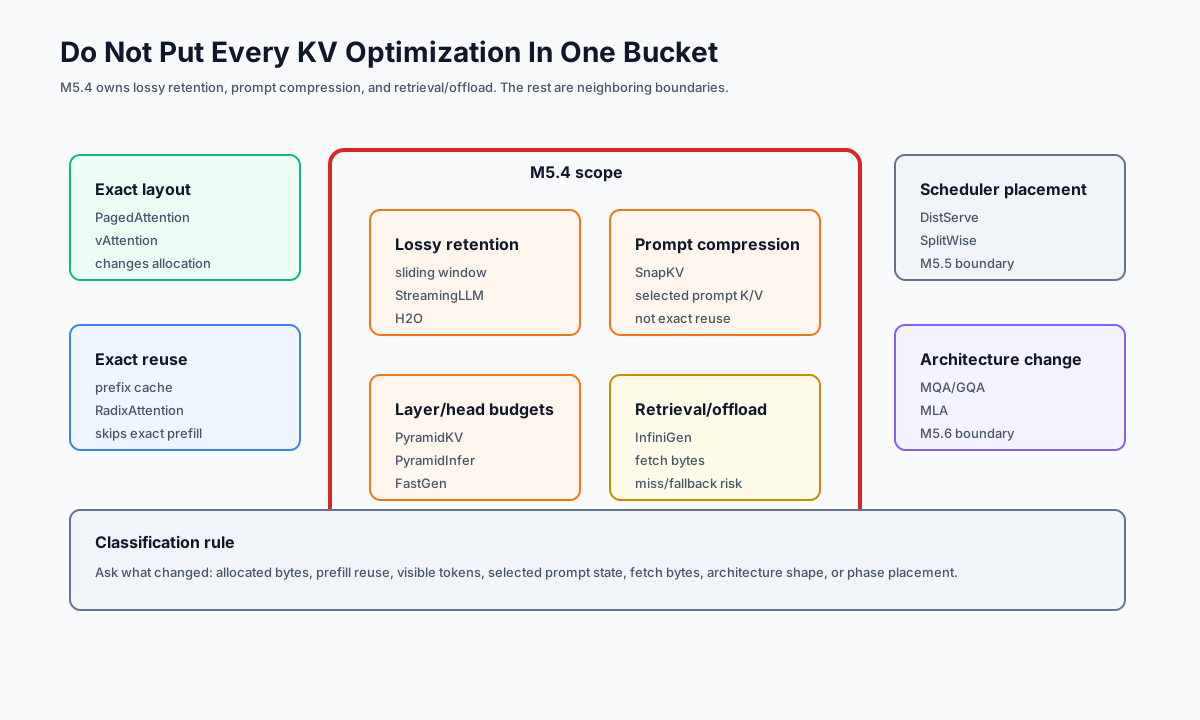
The sentence to keep repeating is:
which term changed?
| Change | Example |
|---|---|
T reduced by position | sliding window |
T reduced by sink plus recent retention | StreamingLLM |
T reduced by dynamic score | H2O, Scissorhands |
prompt-side T compressed by observation | SnapKV |
layer/head budgets replace uniform T | PyramidKV, PyramidInfer, FastGen |
GPU-resident T replaced by fetch set | InfiniGen |
| allocated bytes reduced without dropping K/V | PagedAttention |
H_kv reduced by architecture | MQA/GQA |
| cached object replaced by latent state | MLA |
| source segments replaced by accumulated hidden summaries | AutoCompressor |
0x12 Accuracy Contracts
Every lossy policy needs a failure-mode box. Without that, a memory article becomes misleading.
Full cache:
Safe with respect to cache visibility.
Not a guarantee of long-context reasoning quality.
Sliding window:
Unsafe for arbitrary old-context recall.
Any evidence older than W is unavailable.
StreamingLLM:
Useful for stable streaming.
Unsafe for arbitrary middle-context recall.
Sink tokens are anchors, not summaries.
H2O and heavy hitters:
Useful when importance persists.
Unsafe when future relevance differs from past attention scores.
Pure eviction cannot recover removed K/V.
SnapKV:
Useful when an observation window predicts future prompt relevance.
Unsafe for later questions about unselected prompt details.
Not exact prefix reuse.
PyramidKV, PyramidInfer, FastGen:
Useful when observed layer/head patterns hold.
Unsafe when the task needs broader context in layers/heads given small budgets.
InfiniGen:
Safer than pure deletion if full state remains offloaded and fallback exists.
Still unsafe for latency if useful entries are not fetched in time.
Approximate if non-fetched entries cannot participate.
The hard warning:
A token's current attention score is an observation under the current query,
layer, head, and decode state. It is not proof that the token will never be
needed again.
Accuracy Evidence Ladder
Section 0x02 derives the dense and selected attention outputs and publishes the article-local executable oracle. The policy-specific sections above must use that evidence ladder consistently:
selection identity and budget
    -> retained and omitted dense probability mass
    -> local attention-output error
    -> layer/token accumulation under the real checkpoint
    -> task metric and service-quality distribution
An early stage can diagnose a later failure, but it cannot replace the later
measurement. In particular, the cancellation fixture proves that more retained
mass need not mean lower local output error. Neither quantity proves downstream
quality. A release claim therefore needs full-model evaluation under the same
checkpoint, prompt distribution, generation policy, cache budget, and fallback
contract; Loop 3’s task_quality remains explicitly null.
0x13 Pseudocode Shapes
The static policies in Sections 0x03-0x05 derive views from an exclusive committed frontier. They do not mutate a list and then infer what happened:
def derive_static_views(F, W, K_sink, K_recent):
    assert F >= 0 and W > 0 and K_sink >= 0 and K_recent > 0

    source = range(0, F)
    full = source
    window = range(max(0, F - W), F)
    sink = range(0, min(K_sink, F))
    recent = range(max(0, F - K_recent), F)

    return {
        "full": full,
        "window": window,
        "sink_plus_recent": sorted(set(sink) | set(recent)),
        "sink_recent_overlap": sorted(set(sink) & set(recent)),
    }

def publish_static_successor(parent, committed_cache_receipt, widths):
    assert committed_cache_receipt.parent_cache_generation == parent.cache_generation
    assert committed_cache_receipt.frontier > parent.frontier

    views = derive_static_views(committed_cache_receipt.frontier, **widths)
    successor = bind_new_state_generation(parent, committed_cache_receipt, views)
    return atomic_publish(successor)

def cancel_static_candidate(parent, unpublished_candidate):
    discard(unpublished_candidate)
    return parent  # frontier, cache generation, state generation, and views are unchanged
The physical release, compaction, ring-slot reuse, and page reclamation implied by a new view remain M5.3 operations. A StreamingLLM-compatible position-shift path is an additional execution contract, not something this set derivation can silently install.
Dynamic-retention implementations must use the paper-specific contracts from 0x06:
Scissorhands -> scissorhands_compress(...)
H2O         -> h2o_append_score_select_publish(...)
Keyformer   -> keyformer_score_select_publish(...)
A shared cumulative_attention.topk() helper may be an experiment baseline,
but it must not be labeled as all three methods.
SnapKV-style prompt compression:
def snapkv_owner_preserving(
    source_k,
    source_v,
    observation_prefix_attention,
    query_to_kv_head,
    observation_window,
    maximum_prompt_capacity,
    pooling,
):
    # source K/V: [L, H_kv, T_prompt, d_h]
    # observation attention: [L, H_q, W_obs, L_prefix]
    L, H_kv, T_prompt, d_h = source_k.shape
    W_obs = observation_window
    L_prefix = T_prompt - W_obs
    K_select = maximum_prompt_capacity - W_obs

    assert source_v.shape == source_k.shape
    assert W_obs > 0 and maximum_prompt_capacity > W_obs

    if T_prompt < maximum_prompt_capacity:
        return full_prompt_receipt(source_k, source_v)

    # Holds here: K_select - L_prefix = maximum_prompt_capacity - T_prompt <= 0.
    assert 0 <= K_select <= L_prefix

    packed_k = {}
    packed_v = {}
    original_positions = {}

    for layer in range(L):
        # Sum normalized prefix attention over observation queries.
        query_head_votes = observation_prefix_attention[layer].sum(axis=-2)

        for kv_head in range(H_kv):
            mapped = [
                q for q, owner in enumerate(query_to_kv_head)
                if owner == kv_head
            ]
            # Teaching contract: preserve one physical K/V-head owner.
            owner_vote = mean(query_head_votes[mapped], axis=0)
            owner_score = pooling(owner_vote)
            selected = stable_topk(
                owner_score,
                K_select,
                tie_break="original_position_ascending",
            )

            positions = selected + list(range(L_prefix, T_prompt))
            assert len(set(positions)) == len(positions)

            packed_k[layer, kv_head] = gather(source_k[layer, kv_head], positions)
            packed_v[layer, kv_head] = gather(source_v[layer, kv_head], positions)
            original_positions[layer, kv_head] = positions

    return publish_compressed_prompt_receipt(
        packed_k,
        packed_v,
        original_positions,
        source_prompt_materialized_in_full=True,
        exact_prefix_reuse=False,
    )

def append_generated_row(compressed_prompt, accepted_row, original_position):
    assert original_position == compressed_prompt.frontier
    # Prompt positions are not reselected during ordinary decode.
    return publish_append_successor(compressed_prompt, accepted_row)
The order of the checks matters. Subtracting the two definitions gives
K_select - L_prefix = maximum_prompt_capacity - T_prompt, so a prompt shorter
than the capacity has more selection slots than prefix rows. With the fixture’s
capacity 4 and observation window 2, a three-token prompt has K_select = 2 but
L_prefix = 1; a one-token prompt even has L_prefix = -1. Such prompts must
leave through the full-prompt return, as in the pinned implementation, which
returns them before it forms any top-k budget. Below that return the budget
check restates an invariant and cannot fail; placed above it, the check would
raise on every short prompt and the full-prompt branch could never run.
The function above is the owner-preserving GQA alternative used by the local
oracle. The pinned official Llama path expands K/V with repeat_kv before
selection; changing between those contracts changes the persistent shape and
must not be hidden behind the same receipt.
Layer budget:
def apply_layer_budget(cache, K_by_layer, score_by_layer):
    for layer in cache.layers:
        selected = top_positions(score_by_layer[layer], K_by_layer[layer])
        cache[layer].retain(selected)
Retrieval/offload handoff:
def long_context_visibility_contract(cache_policy, retrieval_plan):
    logical_history = cache_policy.retained_positions()
    # M5.5 owns residency, transfer, selection, and fallback for this set.
    return retrieval_plan.make_visible(logical_history)
These are contract sketches, not library APIs. M5.5 owns the packed transfer layouts, asynchronous promotion, retrieval state, and scheduler integration behind make_visible.
0x14 What M5.4 Hands To M5.5-M5.8
M5.4 ends with a changed memory object:
full cache:
    all K/V remains visible

retained cache:
    only selected K/V remains visible

compressed prompt cache:
    prompt K/V was reduced before decode

offloaded cache:
    K/V may exist outside GPU and must be fetched
M5.5 owns retrieval, offload, hierarchical residency, consistency, and miss/fallback behavior. M5.6 asks where prefill and decode run and how exact phase-transition K/V moves between workers. M5.4 matters there because every retention or offload policy changes the transfer problem:
transfer full K/V
transfer retained K/V
transfer compressed prompt state
fetch K/V from host or remote storage
M5.7 and M5.8 ask what the model architecture stores per token. That is a different lever:
M5.4:
    reduce or move visible token positions

M5.7:
    reduce full K/V heads per token position

M5.8:
    replace full K/V rows with latent content plus positional state
Both levers can combine. A GQA model can still use a sliding window. An MLA model can still offload latent KV. But the contracts must stay separate.
0x15 Final Formula, Source, Rendering, And Cross-Article Boundary Audit
Loop 12 adds audit closure without reopening M5.4 mechanisms. It asks whether the finished article can be reconstructed from its equations, source pins, visual provenance, generated page, and neighboring owner contracts without silently changing what any earlier loop claimed.
0x15A Final Formula Closure
The final registry contains 119 ordered display formulas from the historical
object taxonomy through the Loop 11 evaluation protocol. Each row records its
article heading, normalized LaTeX, SHA-256 digest, formula family, and M5.4
ownership class. Formula order is part of the publication surface: inserting,
deleting, or moving an equation changes the generated registry and fails the
audit.
The audit does not pretend every symbolic expression is defined on every input. These guards are part of the formula contract:
| Formula IDs | Required domain or branch |
|---|---|
F024-F025 | the selected set has positive softmax mass before renormalization |
F031-F040 | window and sink budgets are nonnegative; modulo storage requires W > 0 |
F044 | the later pivotal set is nonempty before persistence recall is divided by its cardinality |
F045 | the history window and token index produce a legal nonempty score interval |
F053-F054 | the schedule horizon and every temperature are strictly positive |
F057-F061 | beta > 0, m > 0, and the interpolation formula branches when m = 1 |
F062-F065 | total layer sensitivity is positive before normalization |
F069 | beta >= 1 and the calibrated head scores reconcile to the declared shared pool |
F072-F077 | merge masses, relaxation temperature, and training dimensions are positive; the first token opens a segment and the achieved compression denominator is nonzero |
F080-F082 | both vectors have nonzero norm and zero/antipodal-angle cases use explicit numerical limits rather than dividing naively by sin(Omega) |
F100 | newly admitted K/V bytes are positive before traffic amplification is reported |
F101 | the union is nonempty before churn is normalized |
F107 | the metric-specific coordinate set is complete before comparability is admitted |
F114-F116 | the policy payload denominator is positive, protected rows fit the prompt budget, and 1 <= O <= S |
These are renderer-safe guard descriptions, not substitute equations. The
canonical expressions remain the display formulas beside their derivations.
formula_registry.json is mechanically regenerated from the Markdown and
must match the committed registry exactly.
0x15B Final Source And Figure Closure
The final source surface contains:
17 externally verified primary papers
15 implementation records bound to 12 exact GitHub commits
17 attributed source-figure excerpts
24 local article/evidence sources
15 custom visual units:
    13 responsive desktop/mobile pairs
     2 desktop-only legacy diagrams
45 article-owned content image files in total
All primary-paper endpoints and all twelve unique commit pins were rechecked on
2026-07-31. The audit preserves four different statements:
paper says                         -> source-reported claim
pinned repository contains        -> source-observed implementation detail
local deterministic fixture shows -> synthetic contract evidence
production runtime measured       -> not claimed here
Every source figure records its source URL, figure identity, transformation, rights note, semantic role, and scope limit. Every custom SVG records that it is an original reconstruction, has a title and description, uses no gradient, and is referenced by the article. Four legacy visuals that predated the loop manifests are now registered explicitly; an image may no longer remain in the article merely because its file happens to exist.
0x15C Final Rendering Closure
The source/render audit keeps Markdown correctness separate from browser
layout. At source level it checks balanced fences and display delimiters,
nonempty expressions, exact formula-registry hashes, local post routes, image
targets, alt text, and visual provenance. After npm run build, it requires:
119 display math nodes + 124 inline math nodes = 243 generated math nodes
0 empty generated math nodes
45 article-owned content image targets present in generated HTML
32 nonempty article image fallbacks
all local article routes generated
all four Loop 12 headings present
The responsive browser check remains a separate presentation test. It verifies desktop/mobile source selection, natural dimensions, image loading, MathJax materialization, duplicate IDs, and horizontal overflow. Neither generated HTML inspection nor browser geometry is a GPU, latency, quality, or paper benchmark.
0x15D Final Cross-Article Boundary Closure
M5.4 owns legal historical visibility and the policy state that changes it. It does not absorb the mechanisms needed to create, place, schedule, execute, or encode that state:
| Owner | Contract consumed or deferred by M5.4 |
|---|---|
| M3.5 | trained recurrent/compressed-memory architecture, checkpoint, and position contract |
| M4.5 | sparse/ragged mask execution, kernel dispatch, and backend admission |
| M5.1 | logical request/cache ABI, committed frontier, identity, and generation |
| M5.2 | admission, service order, fairness, SLO, overload, and preemption |
| M5.3 | physical mapping, allocator lifecycle, exact prefix identity, sharing, and reclamation |
| M5.5 | recallable source pool, index, tier movement, fetch, timeout, and fallback |
| M5.6 | prefill/decode placement, topology, transfer, directory, and worker readiness |
| M5.7 | MHA/MQA/GQA K/V-head representation and grouped execution |
| M5.8 | latent K/V representation and absorbed-kernel derivation |
| M8.6 | K/V scalar format, scales, calibration, quantized kernels, quality, and rollback |
The closure is executable:
docs/numinens-evidence/m5-4-long-context-kv-policies/
    formula_registry.json
    final_publication_audit_fixture.json
    final_publication_audit.py
    final_publication_audit_report.json
    render_audit.py
    render_audit_report.json
    test_loop12_final_publication.py
M5.4 is complete after Loop 12. A later edit that changes equation order or semantics, paper attribution, commit pins, visual provenance, generated math, or any ownership edge must rerun the final audit and the cumulative M5.4 test suite.
0x16 Publish Gate
| Gate | Status |
|---|---|
| Stored-cache bytes, read-pressure bytes, and fetch bytes are separated | pass |
| Full cache is the exact baseline | pass |
| Sliding window is labeled lossy when retrofitted | pass |
| StreamingLLM is framed as stability, not arbitrary memory | pass |
| H2O is framed as dynamic lossy retention | pass |
| Scissorhands, Keyformer, and H2O use distinct selection contracts | pass |
| Dynamic selection updates current attention before score, protection, selection, aligned gather, and publication | pass |
| Scissorhands pivotal analysis, low-score counter, batch drop, and printed recent-slice conflict are explicit | pass |
| H2O’s one-entry successor, heavy/recent implementation, and conditional dynamic-submodular result are separated | pass |
| Keyformer’s Gumbel score, temperature schedule, prompt phase, decode phase, and ordinary attention output are separated | pass |
| K/V, score state, and original-position metadata use one retained-row permutation | pass |
| Fixed-noise evidence does not claim production RNG reproduction | pass |
| Delayed-reference and topic-shift probes report visibility without inventing task quality | pass |
| SnapKV is separated from exact prefix reuse | pass |
| PyramidKV and PyramidInfer use layer budgets | pass |
| ZigZagKV exposes layer/head budget allocation and calibration | pass |
| Head-level budgets expose ragged-layout and calibration costs | pass |
| Semantic clustering is separated from permanent eviction and fixed-page recall | pass |
| Sparse attention traffic reduction is not conflated with cache-capacity reduction | pass |
| eviction, merging, offload, and architecture change are not conflated | pass |
| fixed-size memory identifies the stored object, shape, update rule, and consumer | pass |
| raw K/V, merged K/V, recurrent hidden memory, compressed activation memory, and learned segment summaries are distinct | pass |
| summary-token embeddings and emitted summary hidden states are distinguished | pass |
| accumulated summaries are labeled compressed growth rather than fixed-size memory | pass |
| summary training, gradient truncation, and position handling are handed to M3.5; the serving object and runtime K/V projection remain explicit here | pass |
| retrieval/offload is separated and handed to M5.5 | pass |
| Benchmark numbers are source-reported | pass |
| ”Low attention now may not mean irrelevant forever” is explicit | pass |
| M5.3 and M5.5-M5.8 boundaries are explicit | pass |
| Policy meaning and mutable selected state use separate immutable records | pass |
| Request, cache, policy, and state generations fence every packed view | pass |
| Packed K/V rows retain original layer, K/V-head, token-position, and K/V identity | pass |
| GQA query-head mapping does not duplicate persistent K/V ownership | pass |
| Exact, lossy-subset, lossy-replacement, and recallable classes reject contradictory combinations | pass |
| Valid manifest and 28 one-contract-invalid fixtures are executable | pass |
| Persistent payload, policy metadata, transaction peak, and logical traffic are separate | pass |
| Ragged, padded, and tombstone representations expose different byte ledgers | pass |
| Score-state growth names the candidate universe it tracks | pass |
| GQA persistent ownership is separated from query-expanded demand | pass |
| Per-step bytes and cumulative decode trajectories are separated | pass |
| Retained softmax mass, local output error, and full-model task quality are not conflated | pass |
| Loop 3 valid fixture and 23 one-contract-invalid fixtures are executable | pass |
| Full, window, and sink-plus-recent policies use one exclusive committed frontier | pass |
| Sliding-window warmup, prompt handoff, saturation, and rollover are explicit | pass |
Sink-plus-recent cardinality deducts early overlap instead of assuming K_sink + K_recent | pass |
| Original position, packed row, physical slot, and attention position are not conflated | pass |
| Post-RoPE absolute keys cannot be relabeled as packed positions | pass |
| The pinned StreamingLLM path declares pre-RoPE key storage and cache-local rotary application | pass |
| Retained-cache append is separated from sliding-window recomputation | pass |
| Candidate cancellation and replacement resume are fenced by cache and policy-state generations | pass |
| Sink anchors are not presented as semantic summaries of omitted middle context | pass |
| Loop 4 valid fixture and 27 one-contract-invalid fixtures are executable | pass |
| Loop 5 valid Scissorhands/H2O/Keyformer fixture and 40 one-contract-invalid fixtures are executable | pass |
| SnapKV selection runs after the full prompt prefill and before first decode | pass |
| Observation attention is normalized over visible prompt keys before prefix votes are summed | pass |
| Pooling scores is separated from merging or averaging K/V rows | pass |
| The observation suffix is protected outside the selected-prefix top-k budget | pass |
| GQA query-head expansion and owner-preserving K/V-head reduction are distinct contracts | pass |
| Every gathered prompt row retains original-position identity and aligned K/V indices | pass |
| Prompt compression publishes a generation-stamped lossy receipt rather than exact-prefix identity | pass |
| Generated rows append without silently reselecting the compressed prompt | pass |
| Prompt contribution is bounded while the generated-token tail can still grow | pass |
| Full prompt prefill and peak state are not erased from the resource contract | pass |
| SnapKV paper results are source-reported and local task quality remains null | pass |
| Loop 6 valid fixture and 31 one-contract-invalid fixtures are executable | pass |
| Allocation and row selection are separate phase contracts | pass |
| PyramidKV real-valued layer targets are derived and reconciled to exact integer totals | pass |
| PyramidInfer pivotal-context computation is not collapsed into a fixed layer schedule | pass |
| ZigZagKV MBA, LMBA, LMBO, floor, and conservation contracts are explicit | pass |
| Ada-KV global top-B is derived from its local L1 error upper bound without claiming task-quality optimality | pass |
| Paper formulas, pinned research-code rounding, and deployment apportionment are separate | pass |
| Layer totals, K/V-head budgets, protected observation rows, and ragged lengths reconcile | pass |
| GQA query-head votes do not duplicate persistent K/V-head ownership | pass |
| HeadKV cross-layer calibration and Ada-KV within-layer redistribution are not conflated | pass |
| FastGen policy-family profiling has a fallback and repository-scope caveat | pass |
| Ragged logical savings are not presented as measured kernel or latency savings | pass |
| Loop 7 valid fixture and 58 one-contract-invalid fixtures are executable | pass |
| DMC append/accumulate semantics, weighted segment mass, training relaxation, and per-owner ragged state are explicit | pass |
| DMC requires a compatible adapted checkpoint and is not presented as post-hoc eviction | pass |
| MiniCache shared directions, per-layer magnitudes, exception rows, reconstruction, and prefill/decode lifecycle are charged separately | pass |
| The MiniCache prose/equation threshold tension remains visible and the local exception rule is labeled interpretation | pass |
| Layer-Condensed producer graphs, cycle-breaking mask, warmup layers, training iterations, and prompt iterations are checkpoint coordinates | pass |
| DMC, MiniCache, and Layer-Condensed K/V are not collapsed into one merge method | pass |
| Representation change and K/V quantization require a component-wise composition contract | pass |
| Loop 8 valid fixture and 44 one-contract-invalid fixtures are executable | pass |
| Append, score, protect, select, validate, backend-admit, reserve, pack, publish, release, and export have one explicit transaction order | pass |
| Request, cache, policy, policy-state, mapping, packed-view, retrieval, and transfer identities remain distinct | pass |
| M4.5 capability admission precedes M5.3 reservation and does not claim kernel execution | pass |
| M5.3 allocation success remains unpublished until M5.4 atomically binds every successor receipt | pass |
| Parent physical state is released only after successor publication is observable | pass |
| Pre-publication failure exposes the parent only and releases unpublished successor reservations | pass |
| Post-publication failure requires compensation rather than mutation or silent parent resurrection | pass |
| M5.2 receives persistent bytes, transaction peak, work, fallback, policy version, and readiness without surrendering scheduler ownership | pass |
| M5.5 receives a source-history and retrieval identity only for recallable omitted state | pass |
| M5.6 receives only the published successor identity; placement and transport remain M5.6-owned | pass |
| Transaction peak and compaction traffic are derived separately from successor payload | pass |
| Loop 9 valid transaction and 109 one-contract-invalid fixtures are executable | pass |
| Loop 10 consumes checked reports without rerunning Loop 2-9 policy algorithms | pass |
| Fixture and report raw hashes, schemas, normalized identities, prior closure, and evidence flags are checked before adaptation | pass |
| Historical Loop 5 and Loop 6 report shapes require explicit versioned legacy adapters | pass |
State snapshots preserve absent generations or original-position sets as null rather than inventing state | pass |
| Comparison coordinates name cohort, phase, representation, owner axis, budget unit, metric scope, and denominator | pass |
| Shared policy-manifest identity is separated from workload and metric comparability | pass |
| All 11 numeric comparison groups remain inside one checked fixture | pass |
| All 28 report pairs are classified without executing a cross-report metric ranking | pass |
| Renderer-safe JSON and Markdown outputs are deterministic and exact-byte checked | pass |
| Loop 10’s 58 stale-hash, schema, identity, path, evidence, link, and coordinate mutations are executable | pass |
| Fourteen M5.4 methods and three architecture/training boundaries have complete paper contracts rather than name-only labels | pass |
| All fourteen source-reported results retain model, runtime, workload, cache coordinate, baseline, metric, quality condition, and evidence class | pass |
| No source-reported result is presented as a local reproduction or used to rank incompatible paper coordinates | pass |
| Eleven one-control sensitivity cases expose geometry, visibility, allocation, checkpoint, and backend dependence | pass |
| Equal retained bytes are not presented as equal token visibility or equal task quality | pass |
| Checkpoint and backend admission fail closed without converting architecture or training boundaries into policy plugins | pass |
| All 418 prior invalid cases remain bound by raw report hashes | pass |
| Loop 11’s 48 contract, coordinate, sensitivity, admission, and closure mutations are executable | pass |
The cumulative executable rejection surface is 418 + 48 = 466 cases | pass |
| Loop 11 claims no paper execution, model quality, GPU latency, throughput, or universal policy ranking | pass |
| All 119 display formulas are ordered, hashed, family-classified, and domain-guarded where required | pass |
| All 17 primary papers and 12 unique implementation commits are source-pinned and rechecked | pass |
| All 17 source figures and 28 custom visual files have explicit provenance | pass |
| Source and generated HTML contain the same 243 nonempty math expressions | pass |
| All 45 article-owned content image targets resolve and all 32 image fallbacks have nonempty alt text | pass |
| M3.5, M4.5, M5.1-M5.3, M5.5-M5.8, and M8.6 ownership boundaries are mechanically checked | pass |
| Loop 12 adds no policy mechanism, paper reproduction, GPU measurement, quality result, or universal winner | pass |
References
Local source articles:
- M3.5 - Context Extension
- M5.1 - Autoregressive Serving State: KV Cache Lifecycle and Scheduler Pressure
- M5.2 - Continuous Batching and Scheduler Pressure
- M5.3 - KV Memory Layout and Exact Reuse
- M4.5 - Decode Kernels and Backend Boundaries
- M5.5 - KV Retrieval, Offload, and Hierarchical Memory
- M5.6 - Prefill/Decode Disaggregation and KV Placement
- M5.7 - MQA and GQA
- M5.8 - MLA Latent Cache and Absorbed Kernels
- Exploring the Transformer Series (20) - KV Cache
- Exploring the Transformer Series (24) - KV Cache Optimization
- Exploring the Transformer Series (25) - KV Cache Optimization for Handling Long Text Sequences
- Exploring the Transformer Series (26) - KV Cache Optimization: P/D Separation or Merging
Primary and high-quality sources:
- Efficient Streaming Language Models with Attention Sinks
- StreamingLLM official implementation, pinned in Loop 4
- H2O: Heavy-Hitter Oracle for Efficient Generative Inference of Large Language Models
- H2O official implementation, pinned in Loop 5
- Scissorhands: Exploiting the Persistence of Importance Hypothesis for LLM KV Cache Compression at Test Time
- Keyformer: KV Cache Reduction through Key Tokens Selection for Efficient Generative Inference
- Keyformer official implementation, pinned in Loop 5
- SnapKV: LLM Knows What You are Looking for Before Generation
- SnapKV official implementation, pinned in Loop 6
- PyramidKV: Dynamic KV Cache Compression based on Pyramidal Information Funneling
- PyramidKV official implementation, pinned in Loop 7
- PyramidInfer: Pyramid KV Cache Compression for High-throughput LLM Inference
- PyramidInfer official implementation, pinned in Loop 7
- ZigZagKV: Dynamic KV Cache Compression for Long-context Modeling based on Layer Uncertainty
- Ada-KV: Optimizing KV Cache Eviction by Adaptive Budget Allocation for Efficient LLM Inference
- Ada-KV official implementation, pinned in Loop 7
- Not All Heads Matter: A Head-Level KV Cache Compression Method with Integrated Retrieval and Reasoning
- HeadKV official implementation, pinned in Loop 7
- Model Tells You What to Discard: Adaptive KV Cache Compression for LLMs
- FastGen repository snapshot pinned in Loop 7
- Dynamic Memory Compression: Retrofitting LLMs for Accelerated Inference
- DMC official Megatron-LM branch, pinned in Loop 8
- MiniCache: KV Cache Compression in Depth Dimension for Large Language Models
- MiniCache official repository snapshot, pinned in Loop 8
- Layer-Condensed KV Cache for Efficient Inference of Large Language Models
- Layer-Condensed KV Cache official implementation, pinned in Loop 8
- Transformer-XL: Attentive Language Models Beyond a Fixed-Length Context
- Compressive Transformers for Long-Range Sequence Modelling
- Adapting Language Models to Compress Contexts
- AutoCompressors official implementation
- ClusterKV: Manipulating LLM KV Cache in Semantic Space for Recallable Compression
- InfiniGen: Efficient Generative Inference of Large Language Models with Dynamic KV Cache Management
- Efficient Memory Management for Large Language Model Serving with PagedAttention
- DistServe: Disaggregating Prefill and Decoding for Goodput-optimized Large Language Model Serving