M5.3 - KV Memory Layout and Exact Reuse: PagedAttention, vAttention, and Prefix Caches
M5.3 - KV Memory Layout and Exact Reuse: PagedAttention, vAttention, and Prefix Caches
0x00 Historical Introduction And Owner Contract
M5.1 established that a K/V cache is persistent request state rather than an anonymous optimization tensor. M5.2 then made request membership an iteration-level decision:
observe immutable request frontiers
choose legal prefill intervals and decode rows
ask foreign subsystems whether the work is feasible
run one model iteration
publish completed service and cache progress
repeat
That loop still lacks a physical answer. A scheduler may estimate future K/V pressure and decide that a request should run, but those decisions do not create an address, reserve a real block, establish ownership, or prove that an old prefix is reusable.
The owner question is:
How does a serving runtime turn one logically continuous K/V sequence into versioned physical storage that can be allocated, shared, reused, mutated, and reclaimed exactly under concurrent requests?
M5.3’s thesis is that K/V memory efficiency is not only a tensor-size problem. It is an address, ownership, identity, index, and execution-reuse problem. PagedAttention, vAttention, prefix caching, RadixAttention, Prompt Cache, Hydragen, and ChunkAttention do not all solve the same one of those problems. The article will compare them only after naming the object and invariant each one owns.
0x00A From Rectangular Reservation To Dynamic Physical State
The simplest K/V implementation begins with an attractive invariant:
one request owns one contiguous tensor
the tensor has room for the request's maximum sequence length
token position t maps to a fixed stride from one base address
This layout makes addressing easy. If T_max,r token positions are reserved
for request r, every layer knows where any possible future K/V row would
live. The unresolved problem is that autoregressive serving does not know how
many of those future rows will become useful.
request A may stop after 12 output tokens
request B may continue for 700
request C may arrive while both are running
request D may share 2,000 prompt tokens with A
The maximum length is an admission bound, not a realized allocation need. A rectangular reservation converts output uncertainty into held physical capacity. Requests finish at different iterations, contiguous holes appear in different sizes, and another request can be rejected even when the sum of free bytes looks sufficient. Related requests can also duplicate the same prefix state because their private rectangular ranges have no shared ownership object.
This is the historical transition recovered from A24: the K/V tensor formula alone does not explain serving capacity. The runtime also needs a memory manager whose allocation unit follows current committed state more closely than an uncertain maximum output.
PagedAttention, introduced by Kwon et al. with vLLM, borrows the operating system distinction between logical and physical memory. A request retains one logical token order, while a block table maps consecutive logical K/V blocks to physical blocks that need not be adjacent. New physical capacity can be acquired as the sequence grows, and physical blocks can be returned or shared without moving the entire logical sequence.
The analogy is useful but incomplete:
operating-system page table:
    virtual address -> physical frame

PagedAttention request block table:
    logical token block -> physical K/V block

additional serving obligations:
    valid-token tail
    per-layer or cache-group layout
    reference ownership
    copy-on-write before divergence
    compatibility identity before cross-request reuse
    kernel-visible translation metadata
vAttention later preserves a contiguous virtual K/V range and maps physical GPU pages on demand. It attacks the same reservation/fragmentation pressure with a different kernel boundary: PagedAttention exposes block indirection to a paged attention kernel, whereas vAttention tries to preserve ordinary contiguous virtual indexing. The detailed comparison belongs to Loop 8; the historical point is that dynamic physical commitment does not require one universal virtual layout.
Neither design, by itself, proves that two requests may share K/V. Paging answers where bytes live. Exact prefix reuse asks whether the bytes mean the same computation under the new request’s model, positions, transforms, adapter, representation, and isolation domain. Prefix indexes then ask how to find the longest matching reusable object. Hydragen and ChunkAttention add yet another question: can shared-prefix attention work be organized differently even when the mathematical output remains exact?
0x00B Five Contracts That Must Not Collapse
The phrase “K/V cache reuse” is too broad for implementation. This article uses five separate contracts:
| Contract | Owner question | Example mechanism | What it does not prove |
|---|---|---|---|
| address | How does logical token position resolve to storage? | PagedAttention block table; vAttention virtual mapping | that another request may read the bytes |
| ownership | Who may read, append, fork, copy, release, or evict storage? | refcounts, copy-on-write, allocator generation | semantic compatibility |
| identity | Are old K/V rows exactly valid for this request? | cache ABI/compatibility manifest and prefix key | how a match is discovered or scheduled |
| index | How is the longest reusable object found and protected? | block-hash chain; RadixAttention tree | that the scheduler should run the request now |
| execution reuse | Which compatible attention work is reused or shared? | prefix hit, Prompt Cache, Hydragen, ChunkAttention | a universal speedup under every workload |
These distinctions create four negative rules that remain active throughout the article:
allocation is not identity:
    owning a block does not make foreign K/V compatible

identity is not an index:
    a compatibility rule does not locate the longest match

an index hit is not a scheduling decision:
    M5.3 reports the hit; M5.2 decides when the request runs

storage reuse is not execution reuse:
    sharing bytes, skipping prefill, and batching shared-prefix attention
    are different savings with different baselines
All mechanisms in M5.3 are exact under their declared compatibility and algorithm contracts: they preserve the legal K/V history and attention result. Changing which old positions remain visible is a different operation owned by M5.4.
0x00C The Missing Object: KVPhysicalState
The article owns one conceptual object:
KVPhysicalState
    identity:
        allocator epoch
        request and publication generation
        logical cache ABI and compatibility namespace

    address state:
        cache groups
        logical-block or virtual-page mappings
        physical block/page handles
        valid-token tail

    ownership state:
        request references
        shared-prefix references
        mutable private tail
        cached, locked, and evictable state

    exact-reuse state:
        concrete prefix keys
        hash-chain or radix-index entries
        runtime-admissible reusable length

    transaction boundary:
        immutable prefix-match receipt
        immutable allocation/release receipt
        committed mutation or explicit failure
This is a teaching object, not a claim that vLLM, SGLang, or vAttention exposes one class with these fields. Later loops will map each field to paper contracts and pinned source observations, while keeping rewrite-derived safety fields explicitly labeled.
The direction of authority is:
M5.1 logical cache intent
    + M5.2 selected work and allocation intent
    + M5.7/M5.8/M8.6 declared cache representation
        -> M5.3 validates identity and mutates physical state
            -> PrefixMatchReceipt / AllocationReceipt / ReleaseResult
                -> M5.2 may make its next policy decision
The scheduler never turns intent into ownership by declaration. M5.3 publishes physical feasibility only after the allocator transaction commits.
0x00D Owner Contract: Consumes, Owns, And Defers

M5.3 may consume a fact without inheriting the mechanism that produced it. It may mention a downstream constraint without becoming that article’s owner.
| Surface | M5.3 relationship | Authoritative owner |
|---|---|---|
| logical cache identity, request generation, committed frontier, append/fork/truncate/release intent | consumes factual state and mutation intent | M5.1 |
| selected token intervals, admission/preemption decision, future reservation intent, fairness, and SLO policy | consumes requests and returns feasibility; defers policy | M5.2 |
| logical-to-physical mapping, physical allocation, valid tails, references, COW, exact prefix identity, lookup index, and reclamation | owns and derives | M5.3 |
| online-softmax partial-state algebra and generic decode-kernel reduction | consumes exact merge/address interfaces; defers derivation | M4.3 and M4.5 |
| lossy retention, token visibility, merging, and approximation-quality policy | records a foreign visibility contract but defers policy | M5.4 |
| offload, promotion, prefetch, retrieval, fallback, and tier transfer | may publish an exact transferable object but defers movement | M5.5 |
| prefill/decode worker assignment, topology, remote directory, and inter-worker transfer | may expose mapping/identity facts but defers placement | M5.6 |
| MHA/MQA/GQA and MLA cache representation | parameterizes cache groups and ABI but defers architecture derivation | M5.7 and M5.8 |
| adapter routing, residency, and adapter-aware batching/kernel policy | consumes adapter identity only; defers serving mechanism | M6.5 |
| speculative candidates, acceptance, correction, and temporary branch algorithm | may allocate/fork temporary state but defers algorithm | M7 |
| K/V quantization, scales, calibration, kernels, and quality gates | consumes a declared representation and byte profile; defers quantization | M8.6 |
This boundary permits M5.3 to derive a Hydragen or ChunkAttention merge schedule without re-owning online softmax. It permits a radix index to return a longest prefix hit without choosing service order. It permits an inactive session to have exact identity without explaining CPU, SSD, or remote transfer.
0x00E Source Continuity And Corrections
A24 and A25 provide the handwritten source spine. The reconstruction preserves their mechanism depth while tightening five shorthand statements:
| Source-level shorthand | M5.3 contract |
|---|---|
”K/V cache memory is tokens * bytes_per_token” | that is useful logical payload; physical capacity, tail waste, metadata, and unique shared blocks are separate ledgers |
| ”PagedAttention is virtual memory for K/V” | it is an analogy with a request block table, valid-tail, cache-group, ownership, and kernel-address contract that must be derived explicitly |
| ”same prefix means cache hit” | token equality is necessary but not sufficient; semantic compatibility, isolation namespace, concrete key, and runtime full/partial-block policy are separate |
| ”RadixAttention schedules shared prefixes” | the radix index publishes match and ownership facts; M5.2 owns service order and must preserve any theorem’s workload/capacity assumptions |
| ”all prefix reuse avoids the same work” | storage sharing, cached-prefill reuse, schema reuse, and shared-prefix execution are different contracts |
The article will use primary papers for PagedAttention, vAttention, SGLang,
Prompt Cache, Hydragen, ChunkAttention, and CachedAttention. Runtime claims are
scoped to immutable source revisions: vLLM v0.23.0 at
0fc695fc6d1d82e9a5ac6835ac8e4e1c83703665, and the dereferenced SGLang
v0.5.11 commit 612785ffdcaf35552f1ed433a981d596ca9fe900.
Those revisions are evidence anchors, not deployment recommendations. Paper speedups remain source-reported unless this repository later adds a declared hardware, workload, runtime, raw-sample, numerical-validation, and profiler manifest.
0x01 Claim Status And Scope
| Claim | Status | Evidence | Rewrite-safe wording |
|---|---|---|---|
| PagedAttention is an exact memory-layout mechanism. | Source-local and externally verified | A24 and PagedAttention/vLLM | ”It stores logical K/V blocks in non-contiguous physical memory; it does not drop K/V tokens.” |
| Block tables are the core address-translation object. | Source-local and externally verified | A24 and PagedAttention/vLLM | ”The kernel maps a request’s logical block index to a physical KV block before reading K/V.” |
| Refcount and copy-on-write enable exact sharing. | Source-local and externally verified | PagedAttention/vLLM | ”Shared prefix blocks can be read by multiple sequences; diverging writes require private blocks.” |
| vAttention solves a different layout problem from PagedAttention. | Source-local and externally verified | A24 and vAttention | ”It preserves contiguous virtual KV layout while allocating physical memory on demand.” |
| Automatic prefix caching is exact only under a strict contract. | Source-local, externally verified, and rewrite interpretation | vLLM APC docs, SGLang/RadixAttention | ”Same tokens are not enough; model, position, preprocessing, adapters, and cache semantics must match.” |
| RadixAttention indexes reusable prefixes. | Source-local and externally verified | A25 and SGLang | ”A radix tree maps token-prefix segments to cached K/V and supports lookup, insertion, and eviction.” |
| Address, ownership, identity, index, and execution reuse are separate contracts. | Rewrite interpretation grounded in primary systems | M5.3 owner audit and the compared paper contracts | ”A valid physical mapping does not establish compatibility, and a compatible index hit does not choose service order.” |
KVPhysicalState is the article’s conceptual owner object. | Rewrite interpretation | M5.1/M5.2 handoff and M5.3 evidence contract | ”It groups the versioned mapping, ownership, exact-reuse identity, index state, and allocator receipts without claiming one runtime class has that shape.” |
| A scheduler reservation intent is not a physical allocation. | Rewrite interpretation with pinned runtime support | M5.2 owner contract and vLLM scheduler/KV-manager boundary | ”Only a committed allocator result establishes physical capacity and ownership.” |
| Exact prefix reuse includes multiple distinct savings. | Source-local, externally verified, and rewrite interpretation | A25, Prompt Cache, Hydragen, and ChunkAttention | ”Storage reuse, skipped prefill, and shared-prefix execution require separate baselines and mechanisms.” |
The article’s main distinction:
layout:
    preserve all K/V, change where it lives

exact reuse:
    preserve all semantics, skip recomputing a prefix already known to match

lossy retention:
    change which old K/V remains visible
M5.3 covers the first two. M5.4 covers the third.
0x01A Immutable Cache ABI, Layout, Identity, And Isolation
Loop 1 separated address, ownership, identity, index, and execution reuse. The next question is mechanical:
Which immutable facts must match before a runtime may interpret old K/V bytes, place them in a physical map, or return them as an exact prefix hit?
“The tokens match” is not an adequate answer. The same token IDs can produce different K/V when weights, adapters, upstream transforms, side inputs, or positions differ. Equal byte counts can describe incompatible layouts. A correct block hash can still cross an administrative boundary if isolation is not enforced outside the hash table.
This article therefore uses five records with different writers:
| Record | Question | Update authority |
|---|---|---|
M5.1 LogicalCacheABI | What mathematical K/V row does this cache mean? | model/artifact and logical serving configuration |
M5.3 CacheLayoutManifest | How are those rows represented and addressable here? | physical cache planner at engine initialization |
M5.3 CacheCompatibilityManifest | Which semantic and physical facts must match for exact reuse? | cache publication/admission boundary |
runtime ConcretePrefixKey | Which indexed candidate corresponds to this full token block? | pinned prefix-cache implementation |
deployment CacheIsolationNamespace | Which administrative domain may discover and reuse the candidate? | tenant/deployment control plane |
These records are immutable for one published cache generation. Changing an owned field produces a successor identity; it does not mutate the meaning of already-published blocks in place.

The concrete key narrows the search. It does not replace semantic, physical, or isolation compatibility.
Consume M5.1’s Logical Cache ABI; Do Not Re-Derive It
M5.1 already derives the logical cache ABI from:
artifact identity:
    base weights
    active adapter set
    weight transforms

logical cache schema:
    K/V axes
    local head ownership
    storage representation

position contract:
    cache positions
    RoPE/position semantics
    legal visibility interpretation
It also separates exact token/side-input prefix identity from tokenizer and
chat-template provenance. M5.3 consumes cache_abi_sha256 and the exact input
identity. Repeating the full model-to-row derivation here would create two
authorities for the same semantic object.
M5.3 adds a physical projection because one logical ABI can have more than one legal realization:
same logical K/V row
    -> contiguous rectangular allocation
    -> PagedAttention blocks
    -> vAttention virtual range plus mapped physical pages
    -> a tiered or quantized representation declared by another owner
Logical compatibility is necessary. Physical interpretability is an additional requirement.
CacheLayoutManifest: How The Bytes Can Be Addressed
The article-local layout record is:
CacheLayoutManifest
    schema_version
    manifest_id
    logical_cache_abi_sha256
    model_generation

    cache_groups[]:
        cache_group_id
        layer interval or explicit layer IDs
        K/V heads local to this shard
        head dimension
        storage dtype
        tensor axis order
        stride/layout identity

    physical_mode:
        rectangular | paged_blocks | virtual_pages

    token_block_size or physical_page_bytes
    scheduler_block_size
    hash_block_size
    tensor-parallel world size and rank
    quantization schema or none
    position-contract identity
    allocator revision
The manifest is not a block table. It freezes how to interpret every later block-table or page-map entry. For example:
same block_id + different cache_group_id:
    different physical K/V object

same byte count + different TP rank:
    different locally owned K/V heads

same scalar bytes + different dtype or quantization schema:
    different numerical interpretation

same token block size + different axis/stride identity:
    different address calculation
Later allocator loops will attach mutable physical handles to this immutable layout generation. They may recycle block IDs, but they may not reinterpret a live block under a different manifest.
CacheCompatibilityManifest: The Semantic Reuse Gate
The compatibility record combines the M5.1 facts with M5.3’s physical and administrative facts:
CacheCompatibilityManifest
    cache_abi_sha256
    cache_layout_sha256
    model_generation
    adapter_identity
    weight_transform_identity
    position_contract_sha256
    exact token IDs for the covered interval
    input-side-data identity
    cache-isolation namespace and generation
    cache salt
    publication generation

    provenance, recorded but not necessarily equality-bearing:
        tokenizer revision
        chat-template revision
        request ID
        sampling and stopping policy
The last group matters for audit and replay, but not every provenance field changes already-computed K/V. If two text-only requests have the same exact token IDs under the same cache ABI, a tokenizer-version label alone does not change those model inputs. Likewise, request ID, temperature, and stop strings govern ownership or future token choice; putting them in semantic compatibility would prohibit safe cross-request reuse.
The exclusion rule must not be inverted. A multimodal feature, prompt embedding, adapter, transform, or position change can alter hidden states or projected K/V without changing placeholder token IDs. Those identities are equality-bearing.
Conceptually:
def semantic_cache_compatible(producer, consumer):
    require_equal(producer.cache_abi_sha256, consumer.cache_abi_sha256)
    require_equal(producer.cache_layout_sha256, consumer.cache_layout_sha256)
    require_equal(producer.model_generation, consumer.model_generation)
    require_equal(producer.adapter_identity, consumer.adapter_identity)
    require_equal(producer.weight_transform_identity,
                  consumer.weight_transform_identity)
    require_equal(producer.position_contract_sha256,
                  consumer.position_contract_sha256)
    require_equal(producer.covered_token_ids, consumer.covered_token_ids)
    require_equal(producer.input_side_data_identity,
                  consumer.input_side_data_identity)
    require_equal(producer.cache_isolation_namespace,
                  consumer.cache_isolation_namespace)
    require_equal(producer.cache_salt, consumer.cache_salt)
    require_equal(producer.publication_generation,
                  consumer.publication_generation)
    return compatible
This is the article’s normative compatibility contract. It is not a verbatim vLLM or SGLang function.
ConcretePrefixKey: A Runtime Projection, Not The Whole Truth
An index needs a compact key. At pinned vLLM v0.23.0, the source-observed
full-block projection is approximately:
block_hash = Hash(
    parent_block_hash,
    full_block_token_ids,
    extra_keys_or_none,
)

lookup_key = block_hash || cache_group_id
The observed extra-key generators include:
LoRA name
multimodal feature identifier and its offset relative to the block
cache salt on the first block
SHA-256 of prompt embeddings covered by the block
The implementation computes hashes only for full blocks in this path. It can use a hash granularity distinct from a cache group’s physical block size, and adds the cache-group ID to the lookup key. These are source observations at the named revision, not a universal prefix-cache schema.
Important semantic fields are not all literal inputs to every per-block hash:
| Compatibility fact | In the pinned block projection? | How correctness can be enforced |
|---|---|---|
| parent prefix and exact full-block token IDs | yes | hash-chain ancestry |
| LoRA identity | yes, by LoRA name in extra keys | concrete key plus admission policy |
| multimodal identity/position | yes, by identifier and relative offset | concrete key plus side-input validation |
| prompt embeddings | yes, by per-block content hash | concrete key |
| cache isolation salt | first block; inherited through parent hash | namespace/key ancestry |
| cache-group identity | appended to lookup key | physical group lookup |
| model generation and weight transforms | not necessarily repeated per block | process/cache generation and reset boundary |
| position contract | not necessarily a literal key field | semantic compatibility gate and namespace |
| dtype, shard, axis layout, quantization schema | not necessarily a literal key field | CacheLayoutManifest and separate pools/namespaces |
This creates a critical counterexample:
same parent hash + same block tokens + same concrete extras
    -> same concrete candidate key

different position contract or physical layout
    -> semantic compatibility rejects reuse
The hash table proposes a candidate. The compatibility and isolation records decide whether the candidate is legal to expose.
CacheIsolationNamespace: Reuse Is Also An Authorization Decision
Exact numerical compatibility does not grant cross-tenant authority. The namespace contract includes:
deployment or cluster cache namespace
tenant/isolation-domain identity
namespace generation
unguessable cache salt where supported
model/cache generation
publication policy
At the pinned vLLM revision, cache_salt is included in the first block’s
extra keys; every descendant hash inherits that distinction through its parent
hash. This is useful defense, but the deployment still owns authentication,
salt issuance, namespace separation, and cache event exposure. A hash field is
not a complete authorization system.
The legal order is:
1. enter the authorized cache namespace
2. validate logical ABI and physical layout generation
3. derive the concrete key and find a candidate
4. validate equality-bearing compatibility facts
5. lock/reference the physical object
6. return an immutable PrefixMatchReceipt
Lookup before authorization can leak whether another tenant used a prefix, even if bytes are never returned. Isolation therefore gates discovery, not only the final K/V read.
Source-To-Tensor Rejection Trace
Suppose producer and consumer have the same 16 token IDs. Four independent changes still make reuse illegal:
adapter mismatch:
    adapter changes hidden states or effective W_K/W_V
    -> K/V values differ

position-contract mismatch:
    the same hidden key row receives a different positional transform
    -> key semantics differ

TP-rank or cache-group mismatch:
    identical shape can name a different subset of K/V heads
    -> bytes have different ownership

storage-dtype or quantization-schema mismatch:
    identical raw bytes decode under a different numerical representation
    -> physical interpretation differs
Multimodal and prompt-embedding mismatches fail earlier in the input-to-hidden trace. Equal placeholder tokens do not imply equal side-input vectors.
Executable Compatibility And Negative Fixtures
The article-local Loop 2 oracle evaluates all candidates against one immutable producer manifest. Its expected distinctions are:
| Candidate change | Semantic result | Concrete teaching-key relation | Reason |
|---|---|---|---|
| no change | accept | equal | exact compatible block |
| request ID / sampling policy only | accept | equal | ownership and future policy are excluded |
| tokenizer provenance only, exact IDs unchanged | accept | equal | provenance explains input production but does not change the given IDs |
| adapter name | reject | different | K/V-producing state and LoRA-name extra key differ |
| adapter revision under the same name | reject | may remain equal | revision is semantic state even when the runtime projects only the name |
| multimodal side input | reject | different | hidden input and concrete extra differ |
| cache salt | reject | different at the root chain | first-block isolation extra differs |
| namespace identity or generation, salt unchanged | reject | may remain equal | authorization state is not necessarily a block-key field |
| publication generation | reject | may remain equal | an old immutable publication cannot be relabeled as current |
| token ID | reject | different | block content differs |
| position contract | reject | may remain equal | semantic field is not guaranteed in the concrete key |
| dtype, quantization schema, TP rank, or cache group schema | reject | may remain equal | physical ABI differs outside the token hash |
| partial block in a full-block-only path | reject before lookup | no key | runtime policy cannot publish that candidate |
The checked artifact is generated by
docs/numinens-evidence/m5-3-kv-layout-exact-reuse/cache_identity_oracle.py.
It is a synthetic compatibility contract, not a replay of vLLM’s full cache
manager and not a cache-hit-rate measurement. Its canonical-JSON SHA-256 is a
teaching projection, not an exact runtime reproduction of vLLM’s serializer or
in-memory key type.
Invalidation Produces A Successor Namespace
When model weights, adapters, transforms, position semantics, representation, or shard ownership change, the runtime must not relabel old blocks as new:
freeze old namespace for its still-live owners
stop publishing old entries to new lookups
advance model/cache/namespace generation
create a new layout and compatibility manifest
admit new requests only against the successor generation
reclaim old physical state after its legal references reach zero
Pinned vLLM exposes a prefix-cache reset path, including an RLHF-oriented weight-update use case. The article’s successor-namespace rule is broader and normative: reset, process replacement, separate pools, or generation-scoped directories are implementation choices as long as stale K/V cannot become a new-generation hit.
Loop 2 freezes identity and interpretation only. Loop 3 derives physical byte accounting; Loop 4 traces addresses; Loop 5 owns allocator mutation; Loop 6 deepens full/partial-block keys and the full-prompt-hit edge.
0x02 The Rectangular KV Mistake
M5.1 owns the logical K/V payload. M5.3 must turn that payload into a
physical accounting convention before it can compare rectangular and paged
allocators. Otherwise allocated_KV can silently mean useful rows, request
capacity, unique blocks, or the entire provisioned pool.
0x02A Derive One Physical Row Before Counting Blocks
Let cache group contain cache-producing layers on this worker, locally owned K/V heads, head width , and stored scalar widths and bytes. One token contributes
key scalars and the same number of value scalars. Therefore the local bytes for one token in group are
and the worker-local row is
The familiar factor appears only when K and V use the same scalar width:
Renderer-safe contract:
B_row,g [bytes / token / local rank]
    = L_g * H_kv,g_local * d_h,g * (b_K,g + b_V,g)

B_row,rank [bytes / token / local rank]
    = sum_g B_row,g
This article’s Loop 2 layout has 32 layers, 4 local K/V heads, width 128, and two bytes per FP16 K or V scalar:
B_row,rank
    = 32 * 4 * 128 * (2 + 2)
    = 65,536 bytes
    = 64 KiB per token on one TP rank
With two disjoint K/V-head shards, the corresponding model-wide conceptual
row is 128 KiB. That multiplication is valid for this declared even head
partition. It is not a license to multiply arbitrary pipeline replicas,
offloaded copies, or heterogeneous cache groups by world size.
0x02B Rectangular Reservation Is A Reference Ledger
For live requests , let be committed rows and be the contiguous capacity reserved for that request. Then
and
The subscript ref matters: if three requests reference the same exact prefix,
their logical payload counts that prefix three times. It describes the three
request views, not necessarily three physical copies.
Rectangular reservation couples admission to unknown future output length. Choosing a large makes the request expensive before those rows exist; choosing a small value risks growth, relocation, or rejection. This reservation slack is an additive byte quantity. External fragmentation is not: it depends on where free extents lie and on the size of the next contiguous request.
0x02C Paged Request Capacity Is Not Pool Capacity
For a token block size , request needs
block-table references. Counting every request independently gives
The request-view tail is
This is useful for block-table and no-sharing baselines. It is not unique physical memory when block IDs are shared.
A preallocated block pool has another ledger. If equal-sized blocks are physically provisioned, unique blocks are reachable, and remain reusable, then
Idle pool bytes are not fragmentation by themselves. They are provisioned capacity available to future allocations. A deployment may reserve most free device memory for the K/V pool at startup even while only a subset of its blocks is owned by current requests.
0x02D Sharing Requires A Unique-Physical Ledger
Let be the physical block IDs referenced by request and
Request references and unique physical objects are therefore
If unique physical block contains initialized token rows, then
and
Two different savings ledgers now become visible:
logical payload deduplicated
    = M_logical,ref - M_materialized,unique

request-reference capacity avoided by sharing
    = M_paged,ref - M_capacity,unique
They need not be equal. A shorter request can reference only nine visible rows of a block that a longer request has fully materialized. Its request view has seven unused slots, but those seven slots are not unique physical tail waste: they contain valid rows owned by the longer exact-prefix view.
0x02E Metadata Is Parameterized, Located, And Separate
K/V payload dominates many configurations, but a complete allocator ledger also names its indexing and ownership records. With record sizes in bytes per record:
M_meta [bytes]
    = I_map  [bytes / map entry]  * N_request_block_refs [entries]
    + I_desc [bytes / descriptor] * N_pool_blocks [descriptors]
    + I_hash [bytes / hash entry] * N_cached_hashes [entries]
    + I_tail [bytes / request]    * N_live_requests [requests]
    + I_free [bytes / queue item] * N_free_blocks [items]
    + M_fixed [bytes]
The formula is dimensional; the constants are not universal. A Python object,
a packed C++ descriptor, a GPU integer block table, and a hash-map entry have
different sizes and may live in different address spaces. The Loop 3 fixture’s
482 bytes is deliberately synthetic and placement-unspecified. It validates
counting, not vLLM object size or measured GPU use.
0x02F Fragmentation Is A Taxonomy, Not One Subtraction
| Quantity | Derivable from lengths and mappings? | Additive byte ledger? | Meaning |
|---|---|---|---|
| rectangular reservation slack | yes | yes | reserved request rows not yet useful |
| paged request-view tail | yes | yes, only in the reference baseline | unused logical view slots |
| unique physical tail | yes, with unique block state | yes | uninitialized capacity in reachable physical blocks |
| idle pool capacity | yes, with pool state | yes | reusable provisioned blocks, not necessarily waste |
| metadata | only with record counts and sizes | yes within a declared address space | tables, descriptors, hashes, queues, fixed state |
| external fragmentation | no, needs allocator extents and a candidate size | no universal additive value | enough total free bytes may exist without one usable extent |
| duplicate prefix storage | only with sharing identity | yes relative to a declared no-sharing baseline | repeated physical materialization of equal rows |
A synthetic contiguous arena makes the external case concrete:
arena             = 12 MiB
allocated extents =  9 MiB
free extents      = [1 MiB, 2 MiB]
candidate         =  2.5 MiB contiguous

total free        = 3 MiB
largest free      = 2 MiB
contiguous result = reject
The descriptive ratio
is 1/3 for that snapshot. It is not another 1 MiB to add to reservation
slack. Under the synthetic 1 MiB block pool, the same candidate needs three
blocks; five interchangeable free blocks can satisfy it without contiguity.
The ratio is defined only when M_total_free > 0. A full arena has no free
extent distribution to summarize, so the implementation reports the ratio as
not_applicable rather than dividing by zero or silently assigning a perfect
fragmentation score.
0x02G Expected Tail Waste Needs A Distribution
Let terminal occupancy be uniform on . Unused slots are , so
Thus
For P=16 and B_row=64 KiB, that is 7.5 slots = 480 KiB per
independent terminal block. The fixture observes 15 unique tail slots because
its longest request ends one row into a block. An expectation under a uniform
offset model is not a prediction for that trace. Real prompt/output length
histograms, alignment rules, prefix sharing, and partial-block publication all
change the distribution.

Reference views, unique physical objects, and the provisioned pool answer different capacity questions. None may silently replace another.
That distinction explains four failures of coarse contiguous allocation:
- internal reservation slack: a request reserves more rows than it uses;
- external fragmentation: free memory exists but not in a useful contiguous shape;
- over-reservation: uncertain future lengths consume admission capacity early;
- duplication: related sequences materialize identical prefix K/V separately.
The PagedAttention paper frames this as the serving bottleneck: KV cache is huge, dynamic, and waste-prone; inefficient management limits batch size. The paper reports that existing systems in its experiments used only a fraction of KV-cache memory for actual token states, with the rest lost to reserved, internal, or external waste.
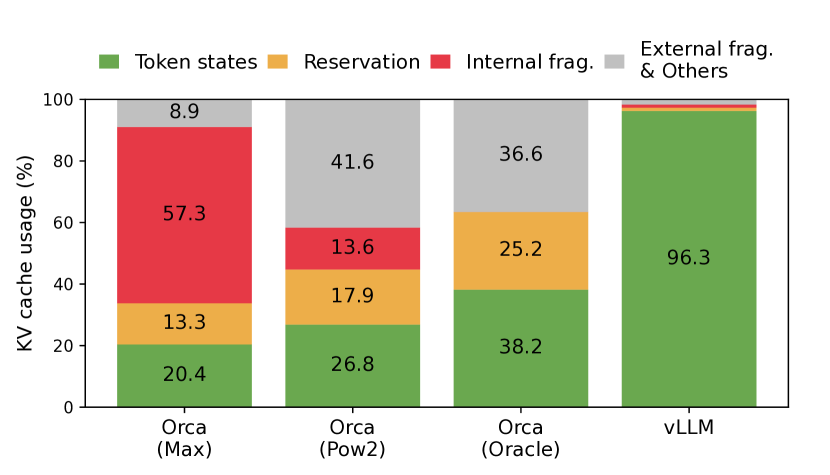
Source: Efficient Memory Management for Large Language Model Serving with PagedAttention, Figure 2. In the paper’s experiment, the three Orca allocation variants devote only 20.4%-38.2% of KV memory to token states, while vLLM reports 96.3%. Those percentages are workload- and implementation-specific; the durable result is that allocation policy can dominate the gap between live payload and reserved memory.
The green region is the payload the model actually needs. Orange, red, and gray are different allocator losses. This is why the next mechanism figure is not merely an operating-system analogy: it addresses measured serving capacity that the tensor payload formula alone misses.

Source: Efficient Memory Management for Large Language Model Serving with PagedAttention, Figure 3. The slot counts are the paper’s illustrative requests; the reusable distinction is among reserved future capacity, unusable space inside allocations, and holes between allocations.
The figure’s categories form the paper’s measured or illustrated allocator
breakdown. In a local analytical ledger, reservation slack and unique block
tail have direct byte identities; external holes require an allocator snapshot
and candidate extent. Treating all three as reserved - useful would double
count different mechanisms.
0x03 PagedAttention: Logical Blocks, Physical Blocks
PagedAttention borrows the virtual-memory idea, but “physical block 7” is not yet an address. A complete read names a request snapshot, cache group, model layer, K or V tensor, local K/V head, token position, and head-dimension lane. The block table resolves only one step in that chain.
logical K/V coordinate:
    (request snapshot, token position, model layer, K/V, local head, lane)

physical read coordinate:
    (cache group, pool identity, pool generation, physical block,
     physical slot, layer-local index, token offset, K/V base, head, lane)
This distinction is not ornamental. Treating a block number as a byte address can select the wrong cache group, wrong pool generation, wrong layer stride, or wrong K/V base while remaining numerically in bounds.
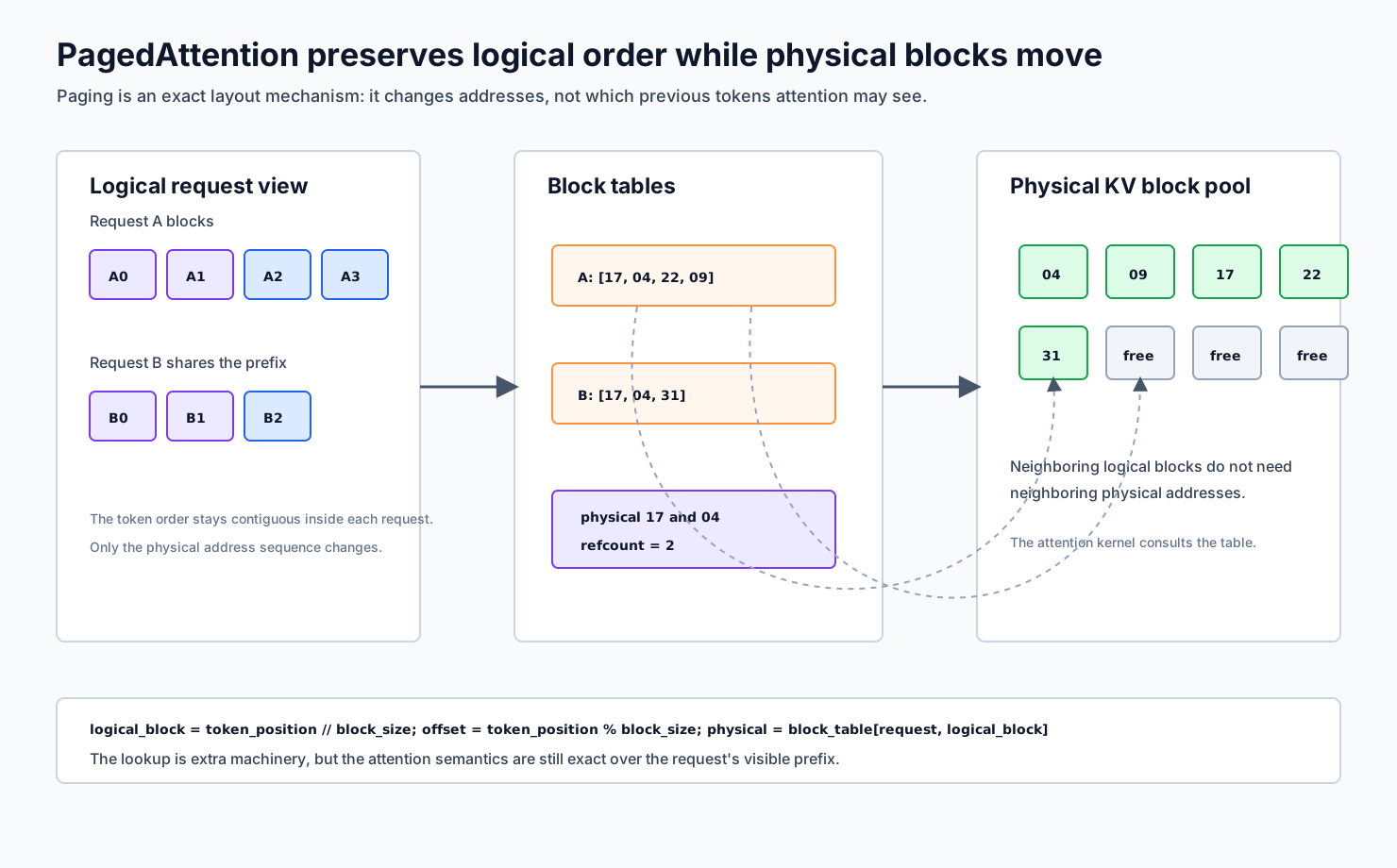
0x03A Logical Order And Physical Identity
The first abstraction is still simple:
logical token order:
    block 0, block 1, block 2, ...

physical storage:
    block 17, block 04, block 22, ...
The request still has a normal ordered sequence. The allocator no longer has to find one large contiguous range. However, a reusable physical identity must be scoped more strongly than an integer:
PhysicalRef_g =
    (cache_group_id, pool_id, pool_generation, physical_block_id)
The group says which layers and representation the block belongs to. The pool and generation prevent a stale block ID from silently naming a recycled object. The physical block ID names ownership inside that namespace. A later descriptor resolves it to a current pool slot.
The paper’s worked translation shows the actual metadata boundary more
precisely. Logical blocks preserve token order, each block-table entry names a
physical block, and the # filled field records the valid tail length. The
example also shows why a kernel cannot derive an address from token_pos
alone: logical block 0 maps to physical block 7 while logical block 1 maps to
physical block 1.
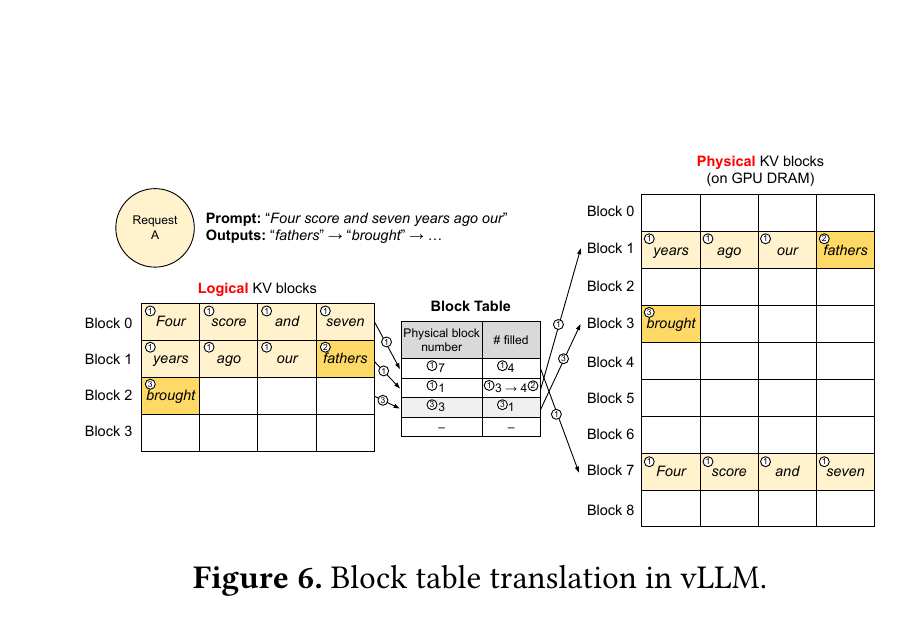
Source: Kwon et al., PagedAttention, Figure 6. The prompt, generated tokens, block size, and physical block IDs are illustrative. The durable contract is the logical-block, physical-block, and valid-tail translation that the attention kernel must follow.
The paper establishes logical-to-physical block translation. The following two-group byte-address trace is a synthetic Transformer System contract, not a claim about the paper’s tensor strides or one production backend.
0x03B Block Maps Are Cache-Group State
The Loop 4 fixture refines each all-layer block in Loop 3 into one physical block per cache group. It deliberately uses two non-identical groups:
| Group | Model layers | Local K/V heads | Axis order after K/V base | Row bytes | 16-token block bytes |
|---|---|---|---|---|---|
g0 | [0,24) | 4 | [physical_slot, layer_local, head, token_offset, dim] | 48 KiB | 768 KiB |
g1 | [24,32) | 4 | [layer_local, physical_slot, token_offset, head, dim] | 16 KiB | 256 KiB |
Their storage still reconciles exactly to Loop 3:
row bytes on rank 0       = 48 KiB + 16 KiB = 64 KiB/token
16-token block bundle     = 768 KiB + 256 KiB = 1 MiB
The Loop 3 1 MiB physical block was therefore an accounting bundle across
cache groups, not a promise that every layer occupies one contiguous extent.
With g1’s layer-major layout, one allocator block slot is strided across
layers.
For base request A, the group tables are:
| Logical block | Tokens | Loop 3 bundle | g0 physical ID -> slot | g1 physical ID -> slot |
|---|---|---|---|---|
| 0 | 0..15 | 100 | 1000 -> 7 | 2000 -> 1 |
| 1 | 16..31 | 101 | 1001 -> 2 | 2001 -> 6 |
| 2 | 32 | 102 | 1002 -> 5 | 2002 -> 3 |
Each request snapshot carries one table per cache group. In this fixture all
groups use P=16, so the tables have the same number of logical rows. That is
a fixture choice, not a universal K/V-cache law. A runtime supporting
group-specific block sizes needs group-specific quotient/remainder arithmetic.
At pinned vLLM v0.23.0, the source keeps a list of block tables and computes
slot mappings per K/V cache group. Its CPU and GPU implementations also carry
group-specific block sizes, table pointers, and table strides. Those are
pinned source observations. The exact tensor axis orders and base addresses in
this section remain synthetic.
0x03C Token Position To Group Table Entry
Let model layer resolve to exactly one cache group . Define its group-local layer index:
For group block size , logical token position becomes:
The request’s versioned group table resolves logical block :
g       = unique cache group containing model_layer
layer_g = model_layer - group.layer_start
j_g     = token_position // group.block_size
o_g     = token_position % group.block_size
p_g     = request.block_tables[g][j_g] at table version v
The lookup is legal only after checking:
0 <= token_position < request.context_length
0 <= j_g < len(request.block_tables[g])
PhysicalRef_g exists in the named pool generation
o_g < descriptor.valid_rows
The first bound is request visibility. The final bound is physical materialization. They are separate contracts, especially under sharing.
0x03D A Slot ID Is Not A Byte Address
Many runtimes flatten a block slot and in-block offset into a token-slot ID:
slot_id = physical_slot * block_size + token_offset
Pinned vLLM v0.23.0 contains this shape in its block-table slot-mapping
helpers, with additional context-parallel handling in the pinned source. The
slot ID answers which token row in a group pool. It does not yet answer
which layer, K or V tensor, local head, dimension lane, dtype, or byte base to
read. Calling slot_id a GPU address erases the backend ABI.
0x03E Axis Order Produces Strides, Then Bytes
For one K or V tensor in group , let the declared axis order have dimensions . Under a row-major teaching layout, element strides are derived from the dimensions to the right:
For coordinate vector , the element and byte offsets are:
Finally, with separate K and V bases:
stride[a]       = product(shape[b] for b > a)
element_offset  = sum(coordinate[a] * stride[a])
byte_offset     = scalar_bytes * element_offset
byte_address    = base_address[K_or_V] + byte_offset
An interleaved K/V layout would add a kv_kind axis instead. A packed or
vectorized backend could use different strides. The formula stays valid only
after the layout manifest supplies the actual dimensions and axis order.
0x03F One Complete Checked Address
Trace request A at token t=16, model layer 24, K head 1, dimension 5:
1. layer 24 selects g1, whose layer range is [24,32)
2. layer_local = 24 - 24 = 0
3. logical_block = 16 // 16 = 1
4. token_offset  = 16 % 16 = 0
5. A.g1.table[v=5][1] -> physical block 2001
6. descriptor(2001) -> pool generation 7, physical slot 6, valid_rows 16
7. slot_id = 6 * 16 + 0 = 96
8. g1 K shape = [8 layers, 8 slots, 16 tokens, 4 heads, 128 dims]
9. g1 strides = [65536, 8192, 512, 128, 1] elements
10. coordinate = [0, 6, 0, 1, 5]
Therefore:
element_offset = 49,285
byte_offset    = 98,570
K base         = 4,311,744,512
byte address   = 4,311,843,082
The checked output also proves slot_id=96 and
byte_address=4,311,843,082 are different quantities.

0x03G Request Visibility Dominates Shared Physical Capacity
Request B contains 25 visible tokens and shares bundle 101 with longer request
A. In g1, token 24 resolves to logical block 1, offset 8, physical block
2001. That physical block has 16 committed rows because A materialized tokens
16 through 31. B may still read only offsets 0 through 8:
B context length                  = 25
B last-block visible rows         = 9
shared physical block valid rows  = 16

token 24 -> offset 8  -> legal for B
token 25 -> offset 9  -> reject: outside B's logical context
Checking only offset < physical.valid_rows would leak later rows from A into
B’s attention history. The safe order is:
request visibility -> table bounds -> physical identity -> physical validity
The reverse failure also matters: if the request says a row is visible but the physical descriptor has not committed it, the read must fail rather than consume stale or uninitialized bytes.
0x03H Crossing A Block Boundary Consumes A Published Successor
Request C initially has 16 tokens and one block per group at table version 2.
Appending token 16 crosses the P=16 boundary. Loop 4 does not allocate or
publish blocks; Loop 5 owns that transaction. Instead, this trace consumes an
already-published successor snapshot:
| State | Context | Table version | g0 table | g1 table |
|---|---|---|---|---|
| predecessor C | 16 | 2 | [1000] | [2000] |
| published successor | 17 | 3 | [1000,1003] | [2000,2003] |
For the new token:
logical block = 16 // 16 = 1
token offset  = 16 % 16 = 0

g0: physical block 1003 -> slot 0 -> slot_id 0
g1: physical block 2003 -> slot 4 -> slot_id 64
The table version must change atomically with the published mapping and valid row state. How reservation, copy-on-write, commit, and rollback produce that successor belongs to Loop 5.
0x03I Reference Translator And Rejection Order
def resolve_kv_address(snapshot, request_id, token, layer, kind, head, lane):
    request = snapshot.requests[request_id]
    assert 0 <= token < request.context_length

    group = unique_group_containing(layer)
    layer_local = layer - group.layer_start
    logical_block = token // group.block_size
    token_offset = token % group.block_size

    table = request.block_tables_by_group[group.id]
    assert logical_block < len(table)
    physical_id = table[logical_block]

    desc = group.descriptor(
        pool_id=group.pool_id,
        pool_generation=group.pool_generation,
        physical_block_id=physical_id,
    )
    assert token_offset < desc.valid_rows
    assert 0 <= head < group.kv_heads_local
    assert 0 <= lane < group.head_dim

    slot_id = desc.physical_slot * group.block_size + token_offset
    coordinate = {
        "physical_slot": desc.physical_slot,
        "layer_local": layer_local,
        "kv_head_local": head,
        "token_offset": token_offset,
        "head_dim": lane,
    }
    element_offset = dot(
        reorder(coordinate, group.axis_order),
        row_major_strides(group.shape),
    )
    byte_address = group.base[kind] + group.scalar_bytes * element_offset
    assert group.base[kind] <= byte_address < group.end[kind]
    return slot_id, byte_address
This oracle rejects layer gaps, duplicate axes, table-length drift, unknown or stale physical identities, slot reuse, cross-group bundle mismatch, invalid tails, out-of-range coordinates, overlapping tensor ranges, stale successor versions, and frozen-address drift.
0x03J Layout Choices Change The Translator
| Choice | Address consequence | What this article requires |
|---|---|---|
| one dense table per group | fixed row stride and sentinel/capacity entries | group ID, request row, table version, legal logical length |
| CSR/ragged block lists | table row becomes indices[indptr[r]+j] | immutable request ordering and segment bounds |
| block-major tensor | one physical slot may own contiguous layer extents | exact block/layer/head/token/dim strides |
| layer-major tensor | one allocator block is strided across layer tensors | do not equate block capacity with one contiguous extent |
| separate K and V | two base addresses, no K/V axis | kind-specific base and range |
| interleaved K/V | one base plus K/V axis | kind stride in the manifest |
| contiguous virtual K/V | ordinary virtual offset; OS/GPU page tables map backing storage | virtual reservation and page-commit contract, deepened in the vAttention loop |
| gathered compact view | read translator feeds a temporary contiguous tensor | gather ownership, traffic, and synchronization must be measured |
M4.3 owns the generic online-softmax state and exact merge proof. M4.5 owns decode-kernel layouts, split planning, vectorization, and backend selection. M5.3 owns the storage map and the immutable metadata that lets a selected backend find exact K/V rows. Loop 4 therefore proves the address, not that any one axis order is fastest.
The durable invariants are:
Logical token order is contiguous.
Physical KV blocks need not be contiguous.
Block tables are cache-group and request-snapshot state.
Physical identities are scoped by pool and generation.
Request visibility is stricter than shared physical validity.
A slot ID is not a byte address.
Byte arithmetic is legal only under the declared axis/stride ABI.
The address trace consumes Loop 3’s accounting rather than redefining it:
one physical block [bytes / local rank]
    = P [tokens / block] * B_row [bytes / token / local rank]

live unique capacity
    = N_unique * P * B_row

provisioned pool capacity
    = N_pool * P * B_row
The maximum unique tail in one reachable partial block is
(P - 1) * B_row. Summing that bound once per request is valid only for an
unshared request-view baseline; shared mappings require the union of physical
block IDs.
0x04 Allocator Lifecycle: Ownership Is A Transaction
Loop 4 consumed an immutable predecessor map and an immutable successor map. The allocator’s job is to create that successor without exposing any half-mutated state. That is a stronger requirement than “pop a block from a free list.”
For one logical mutation, the allocator may have to coordinate:
request generation and table version
cache-group-specific physical handles
physical generations and valid-row frontiers
strong references and temporary leases
weak cache-index identity
free / eviction queue membership
copy completion
successor publication
rollback or compensating repair
The scheduler in M5.2 supplies intent and budgets. M5.3 decides whether the physical transition commits and returns an immutable receipt. A scheduler decision is not ownership until this transaction succeeds.
0x04A Committed State And Transaction State Are Different Axes
The article uses these derived teaching states:
| Derived state | Strong refs | Cache key | Free queue | Meaning |
|---|---|---|---|---|
FREE | 0 | no | yes | reusable storage with no reusable identity |
EVICTABLE | 0 | yes | yes | cached bytes that may be reclaimed for allocation |
LIVE_PRIVATE | 1 | no | no | one request owns the block |
LIVE_SHARED | >1 | no | no | several request maps reach the block |
CACHED_PRIVATE | 1 | yes | no | live owner plus reusable full-block identity |
CACHED_SHARED | >1 | yes | no | shared live block plus reusable identity |
RESERVED, COPYING, and READY_TO_PUBLISH are transaction phases, not
committed ownership states. An unpublished block must never be reachable from a
request map.
This taxonomy is Rewrite interpretation. Pinned vLLM v0.23.0 exposes a
narrower KVCacheBlock: block_id, ref_cnt, an optional full-block hash,
free-queue links, and a null-block flag. Its free queue contains both unused
blocks and zero-ref cached eviction candidates. It does not expose the
generation and lease fields used by the stronger teaching protocol below.
0x04B Derive Refcounts From Reachability
Let be committed request maps and active leases. For a generation-fenced handle :
Renderer-safe form:
refcount(handle)
    = committed request-map references
    + active read/write leases
The Loop 5 model treats a cache-index entry as a weak identity reference.
It does not increase refcount. Therefore:
refcount == 0 and cache_key is None  -> FREE
refcount == 0 and cache_key exists   -> EVICTABLE
This matches the important shape of pinned vLLM’s behavior: free_blocks
returns zero-ref blocks to the free queue without necessarily deleting their
hash, while allocating such a block evicts the old cached identity before
reuse.
The invariant is not “every cached block has a positive refcount.” It is:
and every committed request-reachable handle has .
0x04C The Operation Set
The state machine needs more than allocate and free:
| Operation | Physical effect | Publication effect |
|---|---|---|
allocate | reserve one block bundle across cache groups | create a new request map |
append | write a private tail, allocate a boundary bundle, or COW a shared tail | advance logical length and table version |
fork | increment refs on an immutable mapping snapshot | publish a new request map |
touch | retain cached full blocks; remove zero-ref hits from the free queue | publish a request map over the hit |
cache | attach identity only to complete eligible blocks | publish cache-index entries |
copy_on_write | reserve destinations, copy valid rows, append new row | replace one request’s tail bundle |
truncate | release only suffix mappings | publish a shorter successor map |
cancel | release all request references after cancellation | remove request map with a cancellation receipt |
release | decrement request ownership; zero-ref blocks enter free/eviction order | remove a finished request map |
evict | remove weak cached identity | does not revoke live request ownership |
rollback | return unpublished reservations and leases | preserve the exact committed predecessor |
The PagedAttention paper’s implementation discussion reduces decoding
algorithms to fork, append, and free, then uses a fused block-copy kernel
for COW copies. The table above is a systems expansion around that paper
contract: it names cache publication, rollback, stale generations, and
multi-group atomicity explicitly.
0x04D Transaction And Receipt
@dataclass(frozen=True)
class AllocationTxn:
    transaction_id: str
    expected_allocator_epoch: int
    request_id: str
    expected_request_generation: int
    expected_table_version: int
    operation: str
    touched_handles: tuple[PhysicalBlockHandle, ...]
    reserved_handles: tuple[PhysicalBlockHandle, ...]
    publication_state: str

@dataclass(frozen=True)
class AllocationReceipt:
    transaction_id: str
    predecessor_digest: str
    successor_digest: str
    useful_new_rows: int
    new_physical_blocks: int
    copied_rows: int
    copy_payload_bytes: int
    refcount_deltas: tuple
    allocator_epoch_after: int
    outcome: str
The receipt records physical fact, not policy intent. M5.2 may consume
outcome, available capacity, and retry information; it still owns admission,
preemption, fairness, and service order.
0x04E Append Has Three Physical Paths
For token position , block size , logical block , and offset :
o == 0
    -> reserve a new bundle, write row 0, publish one new table entry per group

o > 0 and every tail handle has one strong owner
    -> acquire a unique writer, write row o, publish valid_rows=o+1

o > 0 and the tail bundle is shared
    -> copy-on-write the bundle, append row o, then publish replacement handles
For cache groups , the new physical capacity at a boundary is:
The Loop 5 fixture keeps and reuses Loop 3’s row split:
group 0 row = 48 KiB
group 1 row = 16 KiB
bundle row   = 64 KiB
bundle block = 16 * 64 KiB = 1 MiB
The groups have separate pools and handles. Publishing only group 0 is not a smaller success; it is an invalid half-bundle successor.
0x04F Rollback Has A Boundary
Let be the committed predecessor and the successor. Before publication, a failed transaction must satisfy:
Renderer-safe form:
before publication:
    rollback must restore the exact predecessor digest

after publication:
    do not erase history with rollback
    publish a compensating successor transaction instead
The checked trace injects failure after reserving the group-0 destination but
before reserving group 1. It returns the reservation, publishes no request,
does not increment allocator epoch 43, and reproduces the predecessor state
hash exactly.
0x04G Source-Observed Runtime Versus Normative Protocol
| Concern | PagedAttention paper | Pinned vLLM v0.23.0 | Loop 5 teaching contract |
|---|---|---|---|
| Sharing | block refs and COW for sampling/beam search | request block lists and ref_cnt | request-map reachability equation |
| Allocation | dynamic physical blocks | get_new_blocks pops free/evictable blocks | reserve every group before publication |
| Cache hit | shared/cached physical blocks | touch removes zero-ref hit from free queue and increments ref_cnt | weak cache identity becomes a strong request ref |
| Free | free blocks whose refs reach zero | decrement refs, append zero-ref blocks to free queue | immutable release receipt and reachability reconciliation |
| Recycle | paper-level physical block reuse | old hash is evicted before allocation | generation increments and stale handles reject |
| Concurrency fence | not specified as this schema | no source-observed generation/lease fields | generation, source lease, predecessor version, atomic successor |
Do not attribute the rightmost column to vLLM. It is the article’s explicit linearizability model.
0x04H Allocation Is Not Kernel Execution
The layout win is not free. Paged kernels consume the group tables and physical handles produced here; M4.5 owns generic read-side kernel tiling and reduction. PagedAttention trades address-translation and allocator complexity for dynamic allocation and sharing. vAttention makes a different choice: contiguous virtual tensors with physical pages committed on demand. Loop 8 owns that lifecycle comparison.
0x05 Refcounts, Copy-On-Write, And Linearizable Publication
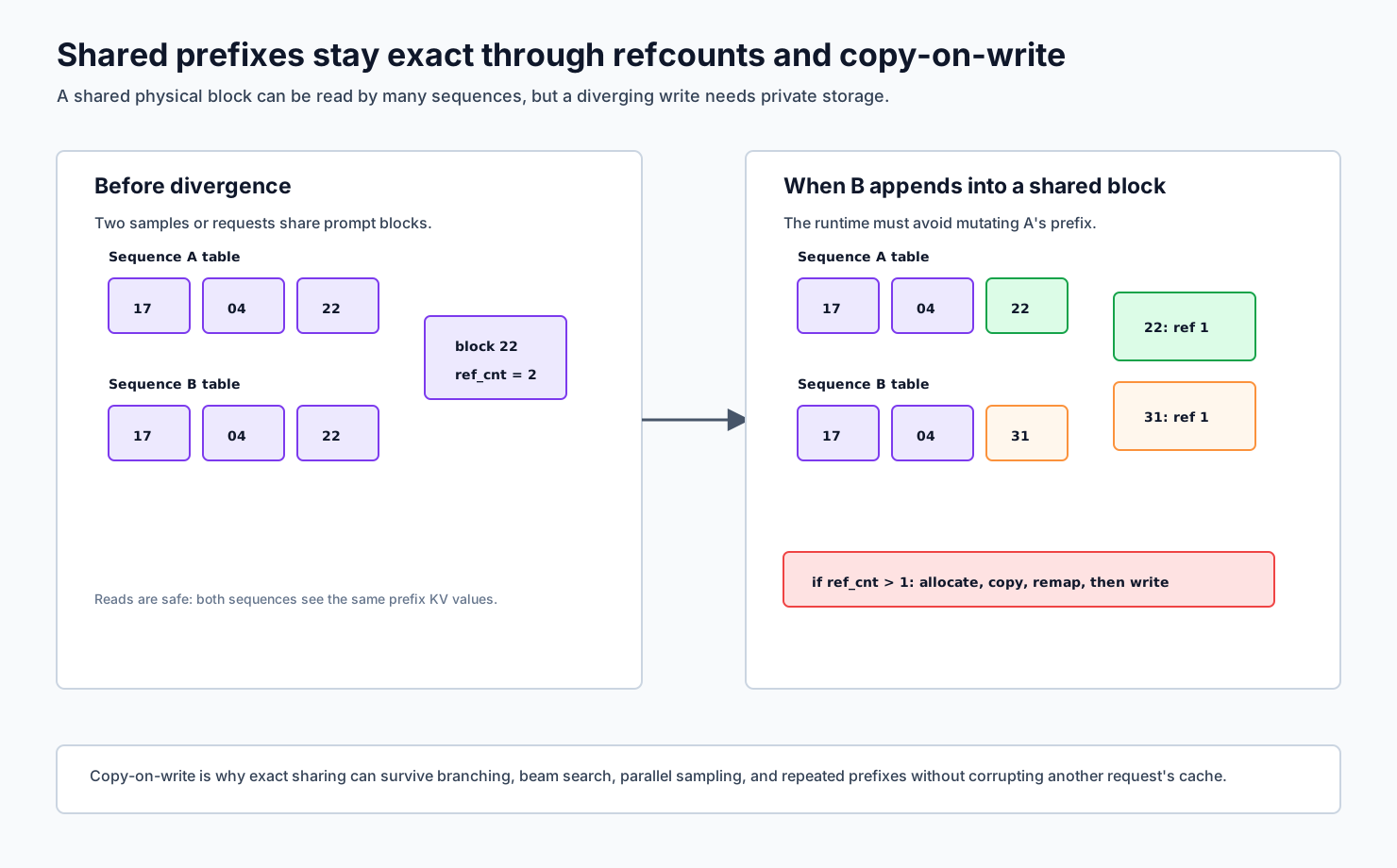
Block tables make exact sharing possible. If two sequences share a prefix, their logical blocks may resolve to the same physical handles:
A: [17@4, 04@9, 22@3]
D: [17@4, 04@9, 22@3]

refcount[17@4] = 2
refcount[04@9] = 2
refcount[22@3] = 2
Reading shared immutable rows is safe. Appending into the shared final block is not. The PagedAttention paper’s parallel-sampling example copies only the affected tail block when one sample diverges; after that refcount drops, the remaining unique owner can keep the original block.
0x05A Derive Copy Cost And Amplification
Suppose the shared tail contains valid rows and one new row is appended. For group-local row bytes :
Copying reads and writes those rows, then append writes one new row:
Relative to an ordinary one-row append:
Renderer-safe form:
copy_payload       = valid_tail_rows * bundle_row_bytes
COW traffic        = copy read + copy write + append write
COW amplification  = 2 * valid_tail_rows + 1
In the checked trace, r=2 and one bundle row is 64 KiB:
copy payload       = 2 * 64 KiB = 128 KiB
read + copy write  = 256 KiB
append write       = 64 KiB
total COW traffic  = 320 KiB
amplification      = 320 / 64 = 5x
new capacity       = 1 MiB across both cache groups
1 MiB is capacity reserved, not bytes copied. Conflating those quantities
would overstate COW traffic.
0x05B One Complete Two-Group COW Trace
Request A first appends privately at token 33:
A predecessor: context=33, table_version=5
tail handles:  g0=1002@9, g1=2002@12
tail rows:     1
refs:          1 per group

write offset 1
publish: context=34, table_version=6, tail rows=2
A is then forked to D. Every mapped handle gains one strong request reference, so the tail bundle becomes shared. D’s append at token 34 cannot mutate it in place:
predecessor D tail:  g0=1002@9,  g1=2002@12, rows=2, refs=2
reserved successor: g0=1003@12, g1=2003@6
copy rows:           [0, 2)
append row:          offset 2
published D tail:    g0=1003@12, g1=2003@6, rows=3, refs=1
old tail refs:       2 -> 1
D successor:         context=35, table_version=2
allocator epoch:     43 -> 44

0x05C Publication Order Is The Correctness Proof
1. validate allocator epoch, request generation, and table version
2. load expected source handles including physical generations
3. reserve every cache-group destination as unpublished
4. retain source handles while copy is in flight
5. copy exactly the predecessor's valid rows
6. write the appended row into every group destination
7. validate destination data frontiers
8. atomically publish successor tables, logical length, and refcount deltas
9. release temporary source leases
Step 8 is the linearization point. A reader sees either the complete
predecessor or the complete successor. It cannot see D mapped to group-0’s new
block and group-1’s old block, and it cannot see valid_rows=3 before row 2 is
valid.
0x05D Reference Transaction
def cow_append(req, expected_generation, expected_table_version, new_rows):
    predecessor = req.snapshot()
    require(predecessor.request_generation == expected_generation)
    require(predecessor.table_version == expected_table_version)

    source = predecessor.tail_bundle
    source_leases = allocator.retain_read_bundle(source)
    if source_leases is None:
        return STALE_BLOCK_GENERATION

    destinations = allocator.reserve_unpublished_bundle()
    if destinations is None:
        source_leases.release()
        return OUT_OF_MEMORY

    try:
        for group in req.cache_groups:
            copy_rows(
                src=source_leases[group],
                dst=destinations[group],
                rows=predecessor.valid_tail_rows,
            )
            write_row(destinations[group], predecessor.valid_tail_rows, new_rows[group])

        require(all_groups_data_valid(destinations))

        with req.mapping_transaction(expected=predecessor):
            successor = predecessor.replace_tail(
                destinations,
                valid_tail_rows=predecessor.valid_tail_rows + 1,
            )
            allocator.publish_bundle_and_ref_deltas(
                successor=successor,
                add_refs=destinations,
                drop_refs=source,
            )
    except BeforePublication:
        allocator.rollback_unpublished_bundle(destinations)
        return ROLLED_BACK
    finally:
        source_leases.release()

    return AllocationReceipt.from_successor(successor)
The with block is a specification boundary, not a claim about a particular
language lock or database transaction in vLLM.
0x05E Truncate, Cancel, Release, Cache, And Evict Are Not Synonyms
truncate(D, 32)
    removes only D's suffix bundle
    decrements destination refs to zero
    returns 1003@12 and 2003@6 to their free queues

allocate(F, 16)
    reuses those block IDs
    increments generations to 1003@13 and 2003@7
    rejects the stale D writer holding @12 and @6

release(A)
    removes A's strong request references
    full cached blocks become EVICTABLE, not identity-free

touch(G, cached block 0)
    removes the zero-ref cached blocks from free queues
    increments refs and publishes G's map

evict(cached block 1)
    removes weak cached identity
    does not revoke a live request mapping
cancel and normal release share physical reference mechanics in the fixture,
but their receipts differ because the service-level reason differs. truncate
may remove only a suffix. Removing an interior logical block would break
position continuity and is rejected.
0x05F Stale IDs Are An ABA Problem
The physical integer 1003 appears twice:
1003@12 -> D's COW destination -> truncated and freed
1003@13 -> F's new allocation
Comparing only block_id would let a delayed D operation mutate F’s lifetime.
The normative handle therefore includes generation:
@dataclass(frozen=True)
class PhysicalBlockHandle:
    pool_id: str
    cache_group_id: int
    block_id: int
    generation: int
Pinned vLLM’s KVCacheBlock does not contain this generation field. The field
is a recommended stale-handle defense in the teaching model, not a source-local
description of vLLM v0.23.0.
0x05G Failure Lab
The oracle rejects 22 malformed transitions. The highest-risk failures are:
| Failure | Why it is invalid | Required result |
|---|---|---|
| shared-tail in-place append | another request still reads that block | force COW |
| publish before copy-valid | reader can observe partial destination rows | reject before publication |
| half-bundle publication | cache groups describe different logical state | reject atomically |
| source release during copy | source can be recycled before copy completes | retain source lease |
| stale request/table generation | mutation was derived from an old snapshot | reject and retry |
| stale block generation | recycled ID belongs to another lifetime | reject without mutation |
| refcount underflow or duplicate release | ownership ledger no longer reconciles | reject explicitly |
| rollback reservation leak | failed transaction consumes invisible capacity | restore predecessor digest |
| rollback after publication | erases a committed history edge | require compensating transaction |
| cached partial block | key claims more reusable rows than are valid | cache only eligible full blocks |
| live block on free queue | allocator may hand out reachable storage | fail invariant check |
| cache index to recycled generation | identity points at unrelated bytes | invalidate stale index entry |
After every committed transition, the executable evidence recomputes refs from request-map reachability, checks every free queue, verifies cross-group valid rows, and hashes the complete committed state. Failed and rejected operations must preserve the predecessor hash.
0x06 vAttention: Virtual Reservation, Physical Commit, And Use
PagedAttention and vAttention begin from the same uncertainty: a request’s final context length is unknown, yet every decode step needs all committed K/V rows. They do not solve it at the same address boundary.
PagedAttention exposes non-contiguous logical blocks and a user-space block table to a paged attention kernel. vAttention reserves a large contiguous virtual K/V range, creates a pool of physical page handles separately, and maps those handles into only the request ranges needed at runtime. The GPU page table performs the final translation. That distinction is the thesis of the vAttention paper, not a claim that memory management disappears.
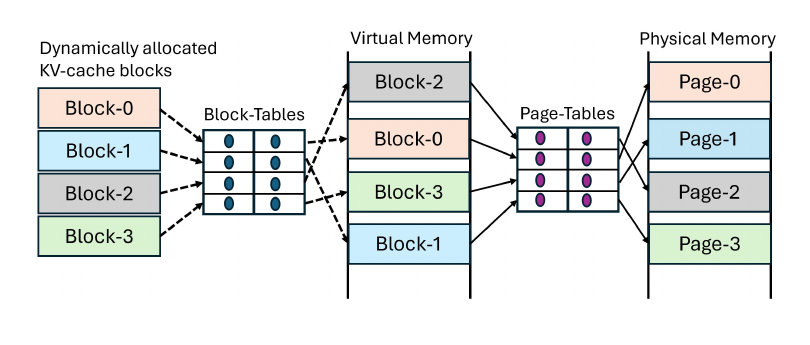
Source: vAttention Figure 1. The figure argues that PagedAttention adds a user-space translation layer before ordinary virtual-to-physical translation. The performance comparisons in that paper remain source-reported; this article uses the figure only to establish the address boundary.
The owner question for this section is stricter:
When is a virtual K/V address reserved, physically backed, safe for a kernel to use, semantically owned by one request generation, eligible for retained capacity reuse, unmapped, and finally released?
0x06A Reservation Is Not Commit, And Commit Is Not Valid K/V
Let one worker host:
L       transformer layers
B       maximum simultaneous request slots
T_max   maximum context rows per request
H_kv    local K/V heads after tensor-parallel sharding
d_h     elements per K/V head
b       bytes per element
G       physical page-group bytes
One token row in one K or V tensor at one layer occupies:
Renderer-safe form:
B_tensor,row = H_kv * d_h * b
If the implementation uses one K tensor and one V tensor per layer, one request
page frontier advances across 2L tensors. Assuming G is divisible by the
one-tensor row size, each mapped page holds:
The virtual extent reserved for one request in one tensor must cover T_max
rows and respect page granularity:
Therefore the worker’s virtual reservation is:
This number may be very large. Reserved address space is not resident HBM. It is address-space occupancy, not physical K/V residency. The paper’s Yi-34B example deliberately reserves terabytes of virtual address space while allocating physical K/V pages on demand.
The pinned vAttention prototype also creates physical handles ahead of time.
If N_handle handles of G bytes exist, the physical pool is:
Creating a physical handle is still not the same operation as mapping it into a request’s virtual range. For the per-layer K/V layout, one request-page bundle consumes:
For request slot r with target length T_r, the minimum complete mapped
frontier is:
Four ledgers are now visible:
M_VA           = reserved virtual address ranges
M_phys,pool    = created physical page handles
M_mapped       = handles currently mapped into request ranges
M_active,valid = K/V rows actually produced for active requests
Mapped backing must reconcile as:
The physical pool separately reconciles as:
No term in either equation is M_VA. Counting the reservation as resident HBM
would recreate the exact accounting error that decoupled VMM is meant to avoid.
0x06B The Runtime Lifecycle Has Two State Machines
The paper’s API sequence is:
init
    reserve virtual tensors
    create physical pages, initially unmapped

alloc_reqid
    bind an inactive request slot to a new request

step(sequence_lengths)
    ensure every active request frontier is physically backed

model.forward
    read and append K/V through the virtual tensors

free_reqid
    mark the request slot inactive
    unmap now, or retain mappings for later reuse

shutdown
    unmap, release physical handles, free virtual ranges
That sequence contains two related but non-identical state machines:
virtual range:
    UNRESERVED -> VA_RESERVED -> VA_RELEASED

physical handle:
    CREATED_FREE -> MAPPED(slot, tensor, page) -> CREATED_FREE -> RELEASED
A request generation adds a third semantic axis:
slot 0 / generation 1 / owner A / valid rows 0..4
slot 0 / generation 2 / owner C / valid rows initially empty
The virtual address and even its physical backing may survive the handoff. The old request’s K/V validity does not.
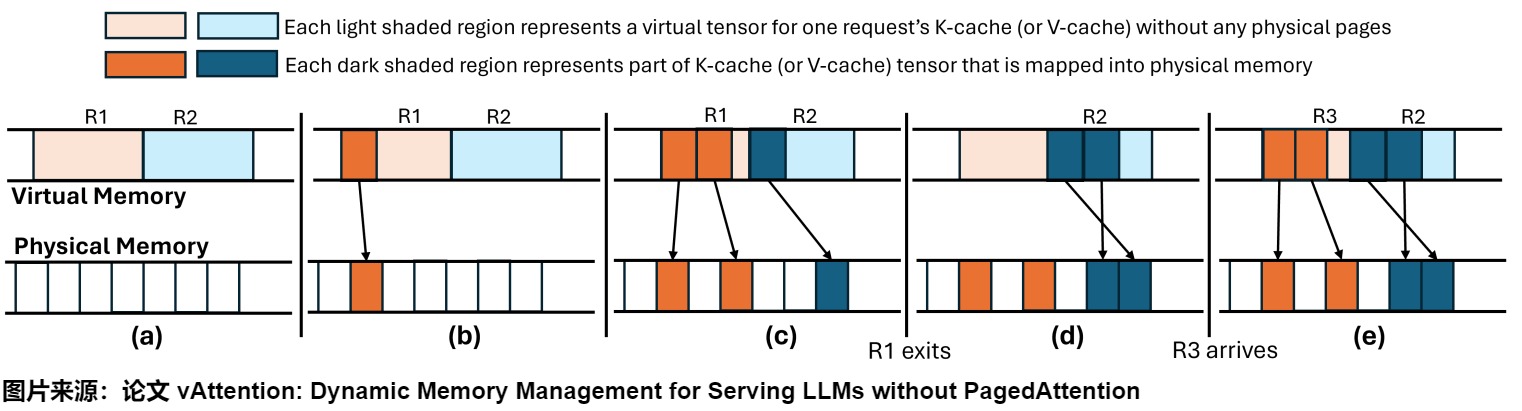
Source: vAttention Figure 5, retained from A24. R3 receives a request slot with existing physical backing. The figure demonstrates mapping-capacity reuse; it does not establish that R1 and R3 have equal tokens, model state, positions, or K/V values.
The pinned prototype makes that distinction concrete. free_batch_idx marks a
slot inactive by setting its tracked sequence length to zero; mapped pages may
remain. alloc_new_batch_idx(seqlen) prefers a fitting inactive slot whose
retained mapping already covers the new request. The new request must still
write its own K/V rows.
0x06C Contiguous Address First, Hardware Translation Second
For a separate tensor X_ell, where X is K or V and ell is the local
layer, let base(X,ell) be that tensor’s virtual base. A row-major scalar at
request slot r, token t, head h, and lane d has virtual address:
Define the byte offset within the request subrange:
Then:
The runtime must have mapped virtual page q for every required K/V-layer
tensor before use. Hardware translation then resolves:
(virtual tensor, request slot, page q)
    -> physical handle
    -> handle base + delta
Unlike Loop 4’s PagedAttention path, the attention kernel does not first query
a request K/V block table. It still needs a request-slot mapping such as
FlashAttention’s cache_batch_idx when continuous batching leaves holes in the
larger virtual tensor.

The checked synthetic scalar is D@3 / V1 / (t=8,h=1,d=3):
B_tensor,row = 2 * 4 * 2 = 16 B
u = 8*16 + 1*4*2 + 3*2 = 142 B
q = floor(142 / 64) = 2
delta = 142 mod 64 = 14 B

base(V1) = 3 * (3 slots * 192 B) = 1728 B
A_VA = 1728 + 0*192 + 142 = 1870 B

page-table mapping:
    (slot 0, V1, q=2) -> H11
physical location:
    H11 + 14 B
The synthetic address proves the contract shape, not a production pointer.
The 64 B page is intentionally synthetic. The paper describes standard CUDA
VMM at 2 MiB granularity and a modified open-source NVIDIA UVM driver for
64 KiB, 128 KiB, and 256 KiB page groups. The tiny fixture is an
executable algebra oracle, not a supported production configuration.
0x06D Map Before Use: Synchronous And Asynchronous Paths
The simplest safe path is synchronous:
def step_sync(active_requests):
    for req in active_requests:
        needed = ceil_div(req.target_tokens, tokens_per_page)
        while req.mapped_pages < needed:
            handles = reserve_complete_KV_layer_bundle()
            map_bundle_at_contiguous_frontier(req.slot, handles)

    receipt = publish_mapped_frontiers()
    assert receipt.ready_before_use
    return receipt
The paper observes that decode growth is predictable one iteration ahead: each decode request adds at most one token in an iteration. Its optimization maps a future page group in a background thread while the preceding iteration runs. That overlap changes timing, not the dependency:
receipt = step_async(next_sequence_lengths)

# Other work may overlap, but a kernel cannot cross the new frontier yet.
await receipt.mapping_complete
assert receipt.covers(request_generation, target_tokens)
model.forward(cache_batch_idx=receipt.request_slots)
The checked oracle uses a stronger normative publication rule: all K and V
pages across the worker’s local layers for one request frontier become visible
as one MappedFrontierReceipt. The pinned prototype performs concrete VMM map
operations; it does not define this named atomic receipt class. The stronger
contract is useful because a kernel observing K0:q without V1:q would see a
shape-consistent pointer range whose physical backing is incomplete.
Prefill and decode also stress the mapper differently:
| Phase | Demand shape | Safe integration |
|---|---|---|
| prefill | one request may need many page groups immediately | map current prompt requirement before forward; retained/eager pages may reduce critical-path work |
| decode | each active request grows predictably by one token | prepare a future boundary asynchronously, then await before crossing it |
| request finish | logical owner disappears immediately | unmap now or retain backing under an inactive slot |
| pressure | free-handle pool cannot satisfy growth | reclaim inactive retained pages, retry map, or return failure to the scheduler |
Mapping failure is a physical-feasibility result. M5.2 still owns which request to preempt, delay, or reject.
0x06E Delayed Reclamation Reuses Capacity, Not Prefix Identity
Deferred reclamation avoids immediate unmap/remap latency. Mapped backing is reusable capacity, not an exact-prefix hit:
A@1 maps slot 0 pages [0,1]
A completes
slot 0 becomes inactive, pages [0,1] remain mapped
C@2 receives slot 0 and needs only page [0]
no new mapping is required
Three facts must remain separate:
virtual address reused:       yes
physical mapping reused:      yes
old K/V values reusable:      no
On C@2 allocation, the oracle sets valid_tokens = 0, increments the slot
generation, and records old_KV_semantically_valid = false. C’s prefill writes
its own rows before any attention step may read them. Exact prefix reuse would
require Loop 2’s compatibility manifest and Loop 6/7’s indexed identity and
ownership receipts; vAttention slot reuse supplies none of those proofs.
Deferred pages also create a deliberate tradeoff. They can remove map calls from a later prefill, but consume mapped backing that another request may need. Under pressure, the runtime can unmap an inactive slot’s highest page, return its complete K/V-layer handle bundle to the pool, and map that bundle at an active request’s contiguous frontier.
0x06F One Checked VMM Lifecycle And Byte Reconciliation
The fixture uses:
L=2, B=3, T_max=12, H_kv=2, d_h=4, b=2 B, G=64 B

B_tensor,row = 2*4*2 = 16 B
P_tokens = 64/16 = 4 tokens/page
R = ceil(12*16/64)*64 = 192 B/request/tensor
M_VA = 2*2*3*192 = 2304 B

N_handle=12
M_phys,pool = 12*64 = 768 B
B_page-bundle = 2*2*64 = 256 B

Selected states reconcile exactly:
| State | active valid | active mapped slack | inactive retained | mapped backing | free handles | physical pool |
|---|---|---|---|---|---|---|
| A valid 5, B valid 4 | 576 B | 192 B | 0 B | 768 B | 0 B | 768 B |
| free A, retain two bundles | 256 B | 0 B | 512 B | 768 B | 0 B | 768 B |
| C valid 4 on A’s old slot | 512 B | 256 B | 0 B | 768 B | 0 B | 768 B |
| reclaim C’s unused tail | 256 B | 0 B | 256 B | 512 B | 256 B | 768 B |
| D valid 9 after reclaiming B | 576 B | 192 B | 0 B | 768 B | 0 B | 768 B |
| all requests free, eager reclaim | 0 B | 0 B | 0 B | 0 B | 768 B | 768 B |
| worker released | 0 B | 0 B | 0 B | 0 B | 0 B | 0 B |
The 24-operation trace performs five page-bundle maps and five unmaps. Two new
requests benefit from retained mappings. D’s asynchronous growth from eight to
nine tokens finds no free handles, reclaims B’s inactive page bundle, maps it
as D’s page q=2, awaits readiness, and only then commits token row 8.
The complete report and 20 negative cases live in
docs/numinens-evidence/m5-3-kv-layout-exact-reuse/.
0x06G Design Choices: The Mechanism Is Not One Fixed Policy
| Choice | Option A | Option B | What changes |
|---|---|---|---|
| kernel address path | PagedAttention block table | contiguous virtual tensor | kernel ABI and runtime metadata |
| mapping schedule | synchronous current demand | asynchronous predicted decode growth | critical-path latency and readiness synchronization |
| completed request | eager unmap | deferred reclamation | free-handle capacity versus future map avoidance |
| new request | allocate from empty slot | best-fit retained mapping | prefill map work, not semantic identity |
| page granularity | standard CUDA VMM 2 MiB | paper’s custom smaller page groups | internal tail waste, map-call count, driver requirement |
| tensor organization | separate K/V per layer | prototype megacache variant | handle bundle shape, token/page derivation, and kernel ABI |
Smaller pages reduce internal waste but increase mapping granularity and may require non-standard driver support. Larger pages reduce the number of page operations but can retain or strand more unused physical bytes. The paper’s timings and throughput results are useful source-reported evidence for its tested A100/H100 software stack; they are not a universal ranking against every modern PagedAttention runtime.
vAttention is also not “no memory manager.” The pinned implementation still tracks request slots, sequence lengths, mapped-page frontiers, physical handle pools, background work, reclamation, and cleanup. What changes is which translation is explicit in the attention-kernel interface.
0x06H Source-Observed Prototype Versus Normative Protocol
| Property | Pinned vAttention observation | This article’s stronger teaching contract |
|---|---|---|
| revision | Microsoft vattention commit ef3fff25... | fixture hash binds that revision record |
| virtual allocation | cuMemAddressReserve, page-aligned tensor/request extents | immutable worker manifest and checked M_VA |
| physical pool | cuMemCreate handles reserved separately | explicit handle partition: mapped or free |
| page frontier | mapped pages and current sequence lengths tracked separately | complete per-request K/V-layer bundle receipt |
| request reuse | best-fit inactive batch index; mapped pages may survive free_batch_idx | generation increment, valid_tokens=0, semantic-reset assertion |
| map timing | sync and background manager paths | readiness receipt required before use |
| reclaim | inactive overcommit can be unmapped and handles returned | deterministic highest-page reclaim and byte reconciliation |
| production status | research Sarathi-Serve integration with stated environment limits | no feature-parity or deployment-readiness claim |
The prototype source also contains a megacache path and research-facing integration code. Those are valuable design alternatives, not permission to generalize the exact fixture tensor organization or publication semantics to every vAttention deployment.
0x06I Failure Lab
| Failure | Broken invariant | Required result |
|---|---|---|
| count virtual reservation as HBM | address space and physical residency collapse | reject ledger |
| map only some K/V-layer pages | request frontier is physically incomplete | reject publication |
| expose a non-contiguous page frontier | ordinary contiguous dereference can enter a hole | reject mapping |
| use before async receipt | kernel may fault or read unmapped backing | block execution |
| unmap an active required page | committed visible history loses backing | reject unmap |
| reuse retained bytes as a prefix hit | old request identity leaks into new generation | reset validity; require recomputation |
| alias one handle into two ordinary mutable mappings | writes can corrupt another virtual range | reject ownership |
| free unknown or duplicate request | slot lifecycle no longer reconciles | reject transition |
| release worker with active requests | reachable K/V loses backing | reject shutdown |
| configure unsupported granularity | VMM allocation contract cannot be satisfied | fail initialization |
The executable oracle rejects all 20 malformed fixtures by named reason. It does not benchmark CUDA VMM, reproduce the prototype exactly, decide scheduler preemption, or claim that retained mappings imply exact prefix reuse.
0x07 Prefix Caching: Reuse Is A Contract
Prefix caching begins with a simple question and immediately splits into four:
have we already computed an exact semantic prefix?
which part of that prefix is present in this index snapshot?
which indexed rows may this runtime policy return?
which prompt rows still need execution and physical capacity?
The answers are not generally equal. vLLM’s automatic-prefix-caching design describes the operational objective as reusing K/V for a shared prompt prefix and skipping its repeated prefill. That can reduce repeated prefill work and TTFT. It does not remove decode work for later generated tokens, and a miss still follows the ordinary prefill path.
Loop 2 already froze authorization, semantic compatibility, physical layout, and the narrower concrete-key projection. Loop 6 consumes those records. It does not re-decide whether another model generation, adapter, position contract, cache representation, or isolation namespace is compatible.
0x07A Four Prefix Lengths, Not One Hit Count
Let:
S_prompt   = request prompt length
S_sem      = longest semantically exact token prefix
S_indexed  = longest contiguous compatible prefix present in the index
S_cap      = maximum prefix the execution path is allowed to reuse
S_runtime  = prefix rows actually returned by the runtime
S_recompute = S_prompt - S_runtime
The invariant chain is:
Renderer-safe form:
0 <= S_runtime <= min(S_sem, S_indexed, S_cap) <= S_prompt
S_recompute = S_prompt - S_runtime
For a logits-producing generative request, the pinned vLLM path sets:
The reason is dataflow, not cache identity. K/V rows alone do not contain the
final hidden state needed by the LM head. If every prompt row came only from
cache, the path still needs a valid execution that produces next-token logits.
This cap assumes S_prompt >= 1. Empty-input handling belongs to the request
and model interface; it must not enter this subtraction as an unsigned or
negative prefix length.
The pinned full-attention lookup also returns block-aligned hits. For block size :
Renderer-safe form:
S_runtime_full =
    P * floor(min(S_sem, S_indexed, S_prompt - 1) / P)
This equation follows in three steps:
- semantic compatibility limits the maximum exact prefix;
- the index can return only the contiguous entries it actually contains;
- the logits cap removes at least the final prompt row, then the full-block policy rounds the remaining length down to a multiple of .
Do not replace the last step with S_prompt - 1. That would silently claim
partial-block reuse in a path whose source contract returns complete blocks.
0x07B Derive The Parent Hash Chain
Split the token sequence into cache-key blocks . Let contain only the runtime’s declared extra-key projection for block . The incremental chain is:
The pinned vLLM v0.23.0 source computes this shape from the parent block hash,
the current full-block token tuple, and optional extra keys. Observed extras
include LoRA name, multimodal identifiers with block-relative offsets,
first-block cache_salt, and prompt-embedding hashes. Cache-group ID is then
combined with the block hash for lookup.
That is a concrete runtime projection, not the whole
CacheCompatibilityManifest. Model generation, complete cache ABI, tensor
layout, and namespace generation may be enforced by process lifetime,
namespace selection, reset, or validation outside the block digest. Do not
attribute the article’s larger manifest tuple to the pinned hash serializer.
Why recurse through ? Suppose block contains the same local tokens in two requests but block differs. The K/V for depends on the earlier hidden-state path, so a local-block-only key is insufficient. Under the collision-resistance assumption:
X_j changes
    -> h_j changes
    -> h_(j+1) consumes a different parent
    -> every later descendant hash changes
The Loop 6 fixture changes token position 37, inside logical block 2. The semantic match ends at row 37, but the full-block runtime can return only the two complete ancestor blocks: 32 rows. Blocks after the first miss are not independent cache candidates.
def hash_full_blocks(request, P, hash_fn):
    parent = None
    hashes = []

    for start in range(0, len(request.tokens), P):
        stop = start + P
        if stop > len(request.tokens):
            break  # pinned path hashes full blocks only

        extras = runtime_extra_keys(request, start, stop)
        parent = hash_fn(parent, tuple(request.tokens[start:stop]), extras)
        hashes.append(parent)

    return hashes
0x07C Lookup Is A Contiguous, All-Group Trace
A valid lookup is not “find every digest that happens to exist.” It walks the ancestry in order and stops at the first missing or incompatible block. With multiple cache groups, the same logical prefix frontier must be physically available for every group required by the model.
def longest_full_block_hit(request, manifest, namespace, index, policy):
    authorize(namespace)                    # before cache-existence timing
    require_compatible(manifest)

    max_hit = len(request.tokens) - 1 if request.requires_logits else len(request.tokens)
    max_blocks = max_hit // policy.alignment_tokens
    matched = []

    for block_hash in hash_full_blocks(request, policy.block_size, policy.hash_fn):
        if len(matched) == max_blocks:
            break

        group_entries = index.lookup_all_groups(block_hash)
        if group_entries is None:
            break
        if not generations_are_current(group_entries):
            break

        matched.append(group_entries)

    return len(matched) * policy.block_size, matched
lookup_all_groups is important. A digest present for the upper-layer cache
group but absent for the lower-layer group is not a partial success for an
ordinary full-model forward pass. Hybrid cache managers can impose additional
alignment and convergence rules; at the pinned revision, the coordinator
monotonically reduces candidate length until the participating cache-group
types agree on one common hit.
The output is an immutable match receipt, not a scheduling command. M5.2 may consume its work and capacity deltas; it still owns admission, service order, fairness, and SLO policy.
0x07D Full Blocks Versus Immutable Partial Tails
The article compares two valid design families. Only the first is attributed to the pinned vLLM path.
| Contract | Full-block-only policy | Immutable-partial-tail alternative |
|---|---|---|
| publishable key unit | exactly rows | full blocks plus one declared tail frontier |
| tail identity | absent from index | parent, tail tokens, valid_rows, policy ID, extras |
| runtime alignment | rows | potentially one row |
| complete-hit recompute | can expand to one entire block | can remain one row if execution supports it |
| append into indexed tail | tail was not shared from index | forbidden under old key; emit successor/COW intent |
| metadata/index pressure | lower | higher; more frontiers and mutation states |
| source status here | pinned vLLM source-observed | rewrite interpretation and alternative design |
For an immutable partial tail with valid rows:
Renderer-safe form:
h_tail = hash(parent_hash, tail_tokens[0:valid_rows], valid_rows,
              partial_policy_id, extra_keys)
Including valid_rows prevents a two-row frontier and a three-row frontier
from sharing identity accidentally. Appending under the same key would make
the key lie about the object. A partial-tail hit followed by a divergent write
therefore emits copy_valid_partial_rows to Loop 5, which owns reservation,
COW, publication, and rollback.
The fixture makes this difference concrete for a 50-token prompt and :
| Quantity | Full-block-only | Immutable partial tail |
|---|---|---|
| semantic exact prefix | 50 rows | 50 rows |
| logits cap | 49 rows | 49 rows |
| runtime hit | 48 rows | 49 rows |
| prompt rows recomputed | 2 rows | 1 row |
| new block bundles requested | 1 | 1 |
| valid tail rows copied before a write | 0 | 1 |
The partial design reuses one more row, but it does not make mutation free. It trades an extra identity/frontier and COW handoff for the saved execution row.
0x07E The Complete-Prompt-Hit Edge
The most dangerous shorthand is:
all prompt tokens cached -> zero prompt work
For the pinned generative path, that is false. Consider exactly three cached blocks:
P                  = 16 tokens
S_prompt           = 48 tokens
S_sem              = 48 tokens
S_indexed          = 48 tokens
S_cap              = 47 tokens
S_runtime          = 16 * floor(47 / 16) = 32 tokens
S_recompute        = 48 - 32 = 16 tokens
new block bundles  = ceil(16 / 16) = 1
The source comment explicitly notes that obtaining logits can trigger
recomputation of an entire block because num_computed_tokens must remain
block aligned. “Recompute the last token” describes the semantic need; it does
not imply that the current implementation always executes only one row.
For a 50-token prompt with three cached full blocks, the same policy yields:
S_cap              = 49
S_runtime          = 16 * floor(49 / 16) = 48
S_recompute        = 2
new block bundles  = ceil(2 / 16) = 1
The physical allocation is block granular even though only two rows are useful at this moment. With local row bytes KiB and block bundle bytes MiB, the useful recompute payload is 128 KiB while the requested new capacity is one 1 MiB bundle. Those are separate ledgers.

The fixture also covers a one-block prompt. With , the cap is 15 and full-block alignment reduces the reusable prefix to zero. The entire 16-row block is recomputed. This is an edge contract, not a claim that prefix caching is generally ineffective.
0x07F Collision Resistance Is Not Isolation
Three different controls are easy to collapse:
| Control | Question | Failure if omitted |
|---|---|---|
| semantic compatibility | would these rows be the same forward computation? | numerically wrong K/V reuse |
| collision resistance or witness check | did two different key inputs map to one digest? | false candidate identity |
| namespace authorization and salt | may this requester discover or reuse the object? | cross-domain reuse or timing disclosure |
The vLLM v0.23.0 design documents SHA-256 as the default hashing family and offers a deterministic CBOR serialization option for cross-environment keys. That makes accidental digest collision extremely unlikely; it is still a cryptographic assumption, not a mathematical proof that two inputs cannot collide. The Loop 6 negative fixture forces an artificial equal digest over different token witnesses to exercise an optional secondary-witness policy. Do not claim that the pinned runtime performs that synthetic witness audit.
cache_salt is injected into the first block and inherited by descendants
through the parent chain. It separates agreed trust groups and mitigates
cache-timing disclosure across them. It is not encryption, and a salt by itself
does not replace authorization. The safe order is:
authorize namespace
    -> validate namespace generation and semantic manifest
    -> derive/lookup concrete key
    -> validate entry generation and all-group handles
    -> publish PrefixMatchReceipt
Lookup before authorization can reveal cache existence through latency. A model update, adapter replacement, or isolation reset must produce a successor namespace/generation or reset the index; retaining old entries under a new semantic world is not exact reuse.
0x07G PrefixMatchReceipt And Failure Closure
The receipt freezes what was proved and what remains to execute:
@dataclass(frozen=True)
class PrefixMatchReceipt:
    request_id: str
    request_generation: int
    index_snapshot_id: str
    index_publication_generation: int
    compatibility_manifest_sha256: str
    namespace_id: str
    namespace_generation: int
    policy_id: str
    semantic_match_tokens: int
    runtime_hit_tokens: int
    prompt_rows_recomputed: int
    matched_group_handles: tuple
    new_block_bundles: int
    copy_valid_partial_rows: int
    logits_path: str
    receipt_sha256: str
The allocation derivation, assuming no already-owned writable tail slots, is:
Renderer-safe form:
N_new = ceil(S_recompute / P)
M_new_capacity = N_new * P * B_row
If a request already owns writable tail capacity, the allocator may need fewer new blocks. If the hit ends inside an immutable shared tail, the receipt emits a copy-row intent instead. Loop 5 resolves both cases transactionally; Loop 6 does not mutate a block table while looking up identity.
The executable failure lab rejects:
| Invalid state | Why it is invalid |
|---|---|
| adapter, ABI, layout, position, or model-generation mismatch | token equality does not prove equal K/V computation |
| namespace or salt mismatch | candidate is outside the authorized reuse domain |
| non-root key omits parent hash | local block identity is detached from causal ancestry |
| block 2 returned without block 1 | prefix matches must be contiguous |
partial key omits valid_rows | indexed frontier is ambiguous |
| partial entry returned by full-only policy | runtime policy and receipt disagree |
| one cache-group handle missing | full-model physical state is incomplete |
| entry points to recycled generation | digest identifies stale physical lifetime |
| forced equal digest with different witness | collision-hardening check rejects candidate |
| runtime hit exceeds semantic match | cache returned rows not proved exact |
| 47-row hit under 16-row full alignment | receipt violates runtime granularity |
| full prompt hit with no recompute/logits path | next-token logits have no producer |
| two recompute rows request zero blocks | floor was used where block capacity needs ceiling |
| partial tail appended under unchanged key | immutable identity no longer describes bytes |
The checked artifact evaluates eight positive traces and 22 malformed cases. It is a deterministic contract oracle, not a hit-rate, latency, or allocator- contention benchmark.
0x08 RadixAttention: Prefix Tree As A Cache Index
A hash table answers a fixed-block identity question. A radix tree answers a different question:
Across all exact token sequences retained by this runtime, what is the longest reusable prefix of this request, which physical K/V slots realize it, and how can that mapping survive concurrent insertions and reclamation?
A25 introduced RadixAttention as the point where prefix reuse stops being a
lookup trick and becomes persistent runtime state. SGLang retains both prompt
and generated K/V, maps variable-length token segments to K/V slot tensors,
splits segments when a new common boundary appears, protects paths used by
running requests, and reclaims cached leaves under memory pressure. The paper
uses one-token pages. The Loop 7 teaching trace also uses page_size = 1 so the
split algebra is visible; larger page policies must align every exposed
boundary to their declared granularity.
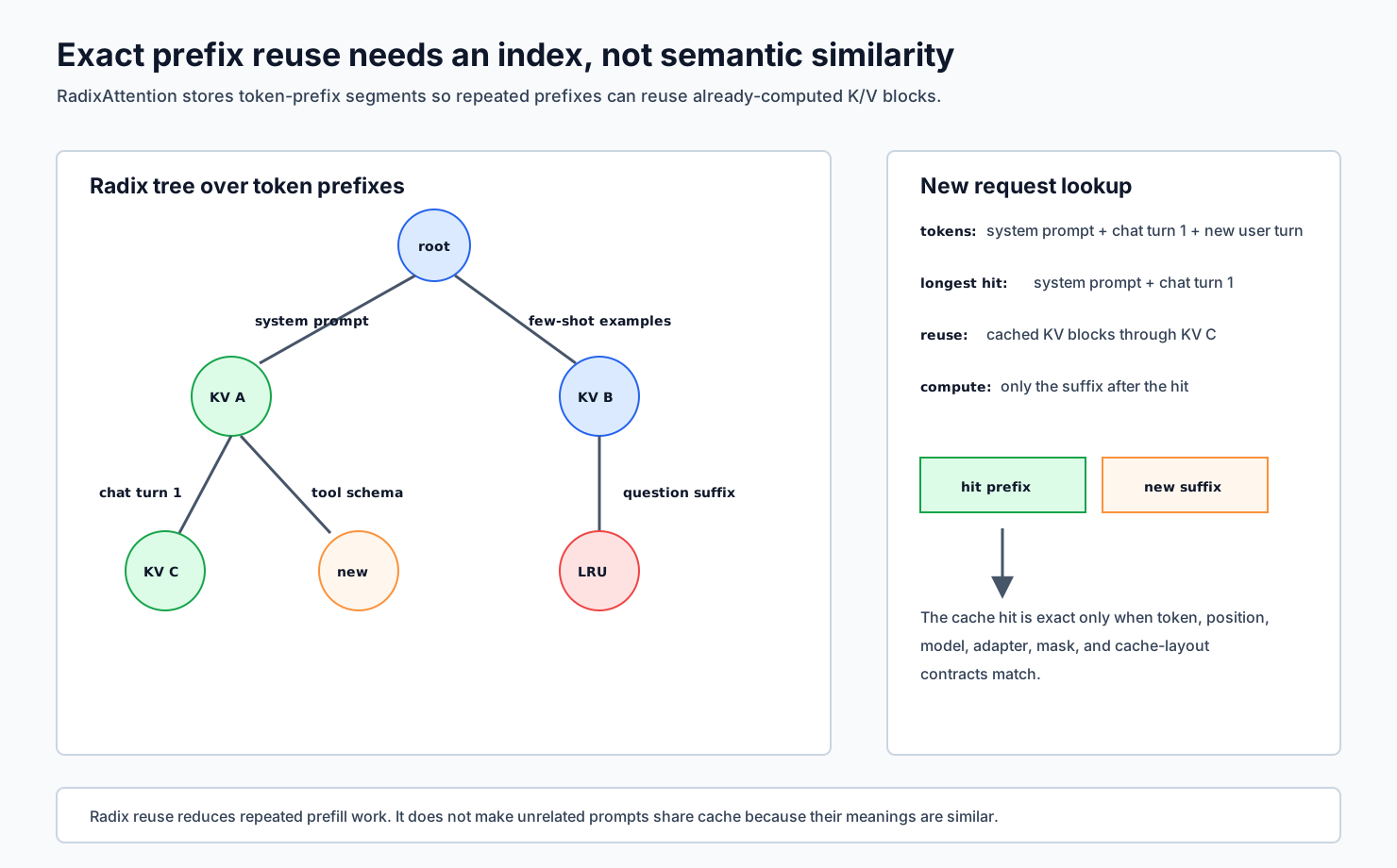
The SGLang paper follows that data structure through nine mutations rather than showing only one steady-state tree. New requests split edges at newly exposed common prefixes, accessed nodes remain cache hits, new suffixes are inserted, and least-recently-used leaves are evicted when capacity is needed. This is the missing operational point: the prefix index is persistent scheduler state, not a static diagram built once from a batch.
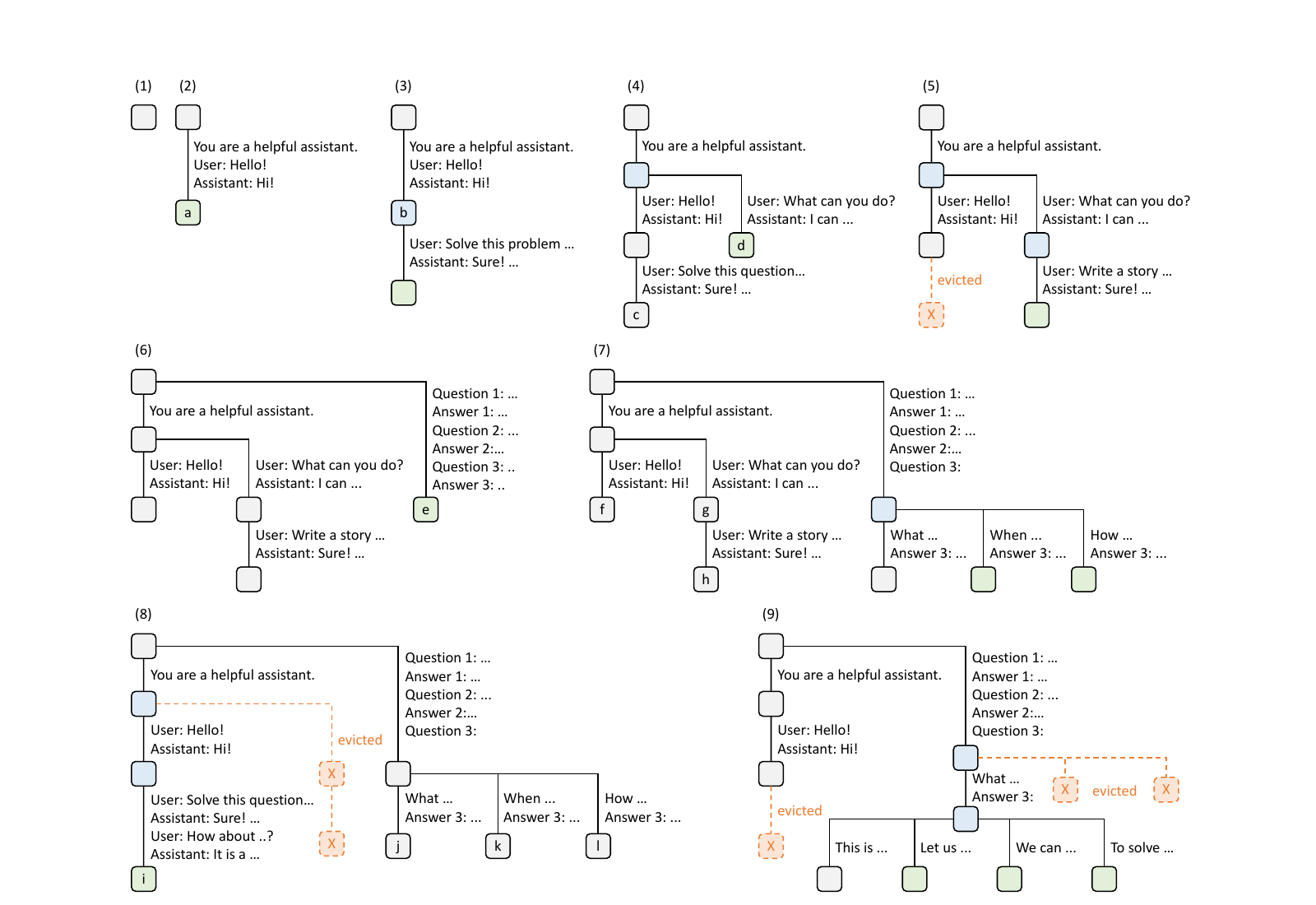
Source: Zheng et al., SGLang, Figure 3. Green nodes are newly added, blue nodes are cached nodes accessed at that time point, and orange dashed nodes are evicted. The scenarios cover two chats, few-shot queries, and self-consistency sampling; they illustrate the runtime operations, not a universal eviction policy for every prefix-cache workload.
0x08A A Compressed Edge Owns Equal Token And Slot Segments
For a non-root node , define the incoming compressed edge as:
Exact ownership requires:
where X_v[i] is the token at this path position and S_v[i] is the physical
token-slot index containing that token’s K/V rows. In the pinned SGLang
TreeNode, these objects are key and value. They are not interchangeable:
the token segment establishes prefix identity, while the value tensor locates
K/V storage.
Renderer-safe form:
edge(v) = (token_ids[v], kv_slot_ids[v])
len(token_ids[v]) == len(kv_slot_ids[v])
The complete key and slot path to terminal node are concatenations over its non-root ancestors:
The tree is therefore also a physical ownership ledger. For pool slot set , tree-owned slots , request-private unpublished slots , and free slots :
Loop 7’s committed snapshots contain no request-private suffix after each transaction, so the checked identity simplifies to:
tree_owned_tokens + free_slots = pool_slots
A request’s prefix_indices are references to tree-owned slots. They are not a
second owner and must not be added again. Lock references protect the path;
they do not clone its K/V tensors.
0x08B Compressed-Edge Match May Be A Mutation
At node , let the unconsumed request suffix be . The edge comparison is:
There are three cases:
| Result | Meaning | Tree action |
|---|---|---|
lcp = 0 | no child selected by the next token | stop at parent |
lcp = len(X_v) | whole compressed edge matches | append S_v, descend |
0 < lcp < len(X_v) | match ends or diverges inside the edge | split at lcp, return the exposed shared prefix |
This last case is why prefix lookup is not necessarily read-only. The pinned
SGLang match_prefix documentation and _match_prefix_helper explicitly allow
one split when the match ends inside a stored segment.
def match_compressed(root, query):
    node = root
    matched_slots = []
    offset = 0

    while offset < len(query):
        child = node.children.get(query[offset])
        if child is None:
            break

        m = lcp(child.token_ids, query[offset:])
        assert m > 0                         # child selector invariant

        if m < len(child.token_ids):
            shared = split_edge(child, m)    # structural mutation
            matched_slots.extend(shared.kv_slot_ids)
            node = shared
            offset += m
            break

        matched_slots.extend(child.kv_slot_ids)
        node = child
        offset += m

    return node, tuple(matched_slots), offset
In operation r02, the tree initially owns one edge:
tokens = [10, 11, 12, 13, 20, 21]
slots  = [ 1,  2,  3,  4,  5,  6]
The query [10, 11, 12, 99] has lcp = 3. The split is not a copy of K/V
payload; it is a partition of the same ordered ownership:
For m = 3:
shared edge: tokens [10, 11, 12] -> slots [1, 2, 3]
old suffix:  tokens [13, 20, 21] -> slots [4, 5, 6]

concatenate before = concatenate after
no slot allocated, copied, freed, or duplicated
The split must also reparent the old child, replace the parent’s selector, and preserve any active lock count on both the newly exposed prefix and the old suffix. Splitting only the token key would make the tree look correct while returning the wrong physical rows.
0x08C Insert, Duplicate Release, And Request Publication
Insertion traverses exactly like lookup. If the request diverges after cached tokens, only its suffix becomes a new edge. When a completed producer arrives with freshly allocated input slots , the first values are duplicates of slots already owned by the tree:
The tree retains S_new; the allocator releases S_duplicate. Operation
r05 inserts the second chat branch:
incoming tokens = [10, 11, 12, 13, 30, 31]
incoming slots  = [ 7,  8,  9, 10, 11, 12]
cached prefix   = 4 tokens

release duplicate input slots = [7, 8, 9, 10]
publish new branch             = [30, 31] -> [11, 12]
The existing [13, 20, 21] -> [4, 5, 6] edge is split again at one token:
[13]     -> [4]       shared by both chats
[20,21]  -> [5,6]     old chat branch
[30,31]  -> [11,12]   new chat branch
This is not reference-count-free deduplication. The prefix index takes responsibility for the retained slots, duplicate request-local slots return to the pool, and every transition must leave exactly one owner.
Finished and unfinished requests have different publication paths in the pinned source:
| Path | Source-observed sequence | Ownership consequence |
|---|---|---|
| finished | insert committed aligned token/slot pairs; free duplicate prefix and unaligned tail; release old terminal lock | request disappears while retained edges become cache state |
| unfinished/chunked | insert current aligned frontier; free duplicates; rematch; rewrite request prefix indices; move lock to new terminal | running request continues on the newly published path |
Operation r07 exercises the second path. req-chat-a already references six
tree slots, computes tokens [22, 23] into slots [13, 14], inserts one new
edge, then moves its lock from node 1 to node 5. The update is represented as
one stronger teaching transaction:
def publish_unfinished(req, append_tokens, append_slots):
    predecessor = validate_tree_and_request(req)
    reserve(append_slots)

    full_tokens = path_tokens(req.last_node) + append_tokens
    full_slots = path_slots(req.last_node) + append_slots
    prefix_len = insert(full_tokens, full_slots)
    free(full_slots[req.cache_protected_len:prefix_len])

    new_last, new_prefix_slots, matched = match_compressed(root, full_tokens)
    assert matched == len(full_tokens)

    dec_lock_ref(req.last_node)
    inc_lock_ref(new_last)
    publish_request_prefix(req, new_last, new_prefix_slots)
    return RadixMutationReceipt(predecessor, committed_tree_version())
The ordering above is a normative Transformer System contract. The pinned source exposes the individual insert, free, rematch, request-table write, and lock-move steps; it must not be cited as publishing the article’s one atomic versioned receipt.
0x08D Lock References Protect Paths, Not Just Leaves
Continuous batching cannot evict a prefix used by a running request. If active lease terminates at node , the derived reference count for node is:
The pinned inc_lock_ref and dec_lock_ref walk from the terminal node to the
root. If two running requests share a system-prompt edge, that ancestor has two
references even when their leaves differ. A split under an active request must
copy the old child’s lock count onto the newly exposed parent because the
shared prefix has become part of every formerly protected path.
Define source-shaped token ledgers:
Only a subset of the second quantity is reclaimable immediately:
An unlocked internal node still owns evictable cache state, but it cannot be
deleted before its descendants without disconnecting their keys. This is why
evictable_size and the current leaf-victim set answer different questions.
0x08E Leaf-Safe Eviction Is Recursive And Whole-Edge
The SGLang paper uses least-recently-used leaf eviction. The pinned v0.5.11 runtime also exposes LFU, FIFO, MRU, FILO, priority, and segmented-LRU strategies. The radix invariant is unlocked leaf first; victim ranking is a policy choice.
def evict_tokens(target):
    heap = rank(unlocked_leaf_nodes())
    released = 0

    while released < target and heap:
        leaf = heap.pop()
        assert leaf.lock_ref == 0
        assert not leaf.children

        free_kv_slots(leaf.kv_slot_ids)
        parent = delete_leaf_edge(leaf)
        released += len(leaf.kv_slot_ids)

        if parent is not root and not parent.children and parent.lock_ref == 0:
            heap.push(parent)       # newly exposed leaf

    return released
Eviction is whole-edge. A target of one token can release more than one if the
selected compressed edge contains several tokens. Operation r14 asks for
three rows and releases exactly three in two steps:
evict leaf [60]    -> free slot [20]
parent [50, 51] is now an unlocked leaf
evict that parent  -> free slots [15, 16]
Locked chat paths survive both eviction calls. After their leases are released,
r17 removes [22, 23] first, exposes [20, 21] as a leaf, then removes that
parent. This is the allocator consequence of the paper’s visual sequence: an
ancestor becomes reclaimable only after its last child disappears.
The paper’s scheduling theorem must remain scoped. For an offline fixed batch, a radix tree built from that request set, and cache capacity at least the maximum request length, DFS visits each edge once and reaches the lower bound:
Longest-shared-prefix-first is equivalent to a DFS order under those assumptions. The paper explicitly separates online arrivals, unpredictable output lengths, and starvation. The theorem is not an optimality result for online SLOs, fairness, arbitrary capacity, or unknown decode growth; those decisions remain in M5.2.
0x08F One Checked Mutation And Ownership Trace
The executable fixture uses 24 physical token slots and 18 committed operations. The high-value transitions are:
| Operations | Tree/lock mutation | Slot result |
|---|---|---|
r01-r03 | insert chat A; short query splits six-token edge at three; lock then finish | tree owns slots 1-6; no split copy |
r04-r08 | lock chat A; second chat splits at token 13; publish unfinished A; move locks; finish B | duplicate slots 7-10 freed; branches own 5,6, 11,12, 13,14 |
r09-r12 | insert two few-shot branches; split [50,51,52]; lock chat B branch; touch [60] | duplicate slots 18,19 freed; few-shot tree owns 15,16,17,20 |
r13-r14 | LRU leaf then newly exposed parent eviction | free 17, then 20,15,16; locked chats untouched |
r15-r17 | finish both chats; recursively evict old chat-A suffix | free 13,14, then 5,6 |
r18 | match and lock surviving chat-B path; emit handoff | path slots [1,2,3,4,11,12]; suffix interval [6,7) |
The final reconciliation is:
pool slots            = 24
tree-owned slots      = 6
free slots            = 18
active private slots  = 0

6 + 18 = 24

protected tree tokens = 6
evictable tree tokens = 0
Across the full trace:
edge splits                    = 3
duplicate input slots released = 6
eviction calls                 = 3
evicted compressed edges       = 5
evicted token slots            = 8
Every operation hashes its predecessor and successor states. Every committed successor re-derives child selectors, token/slot equality, path locks, slot disjointness, and the complete pool partition.

0x08G Immutable Scheduler Handoff, Not A Schedule
The final match returns an immutable physical fact:
@dataclass(frozen=True)
class RadixSchedulerHandoffReceipt:
    request_id: str
    request_generation: int
    tree_version: int
    tree_state_sha256: str
    matched_tokens: int
    prefix_slot_ids: tuple[int, ...]
    path_node_ids: tuple[int, ...]
    terminal_node_id: int
    suffix_interval: tuple[int, int]
    lock_lease_id: str
    lock_required_until_scheduler_disposition: bool
    scheduler_owner: Literal["M5.2"]
    policy_decision: None
    receipt_sha256: str
For req-handoff:
request generation = 4
tree version       = 18
matched tokens     = 6
path nodes         = [2, 3, 4]
prefix slots       = [1, 2, 3, 4, 11, 12]
suffix interval    = [6, 7)
terminal node      = 4
lock lease         = lease-req-handoff-v18
policy_decision    = none
M5.2 may use this receipt with request deadlines, fairness state, prefill/decode budgets, output uncertainty, and overload policy. It may choose FCFS, LPM, DFS-weight, or another declared policy. M5.3 does not sort the waiting queue. If M5.2 admits the request, it retains or exchanges the lock under an explicit transaction. If it rejects or defers the request, it must release the lease. Using an unlocked receipt after tree mutation is a stale-read bug.
The current prefill and capacity estimates still remain separate:
prompt_tokens_to_compute = S_prompt - matched_tokens
new_useful_KV_bytes = prompt_tokens_to_compute * B_row

new_physical_blocks =
    ceil(max(prompt_tokens_to_compute - free_private_tail_slots, 0) / P)

new_physical_capacity_bytes = new_physical_blocks * P * B_row
The receipt freezes physical evidence; Loop 5 performs allocation/COW, and M5.2 decides whether and when to request it.
0x08H Source-Observed Runtime Versus Normative Protocol
| Contract | Pinned SGLang v0.5.11 | Loop 7 teaching protocol |
|---|---|---|
| edge value | compressed RadixKey plus slot-index tensor | typed token/slot arrays with whole-pool reconciliation |
| match | page-align, update access metadata, split if needed, return indices and terminal node | same core algorithm plus versioned predecessor/successor receipt |
| publication | finished/unfinished methods insert, free duplicates, update request fields, move locks | one auditable transaction boundary |
| locks | terminal-to-root lock_ref increments/decrements | re-derived from active immutable leases after every operation |
| eviction | configured strategy ranks unlocked leaves; allocator frees node.value | deterministic LRU fixture with generation-independent slot IDs |
| scheduling | LPM/DFS-weight and cache-agnostic alternatives exist in scheduler code | receipt contains no policy decision and hands to M5.2 |
Do not attribute RadixMutationReceipt, tree-version hashing, complete pool
partition checks, or the synthetic 24-slot trace to SGLang. Conversely, do not
reduce the pinned source to the teaching model: v0.5.11 includes page
alignment, host/hierarchical state, EAGLE bigram keys, priorities, multiple
eviction strategies, K/V events, and scheduler paths outside this loop.
0x08I Failure Lab
| Invalid state or transition | Failure | Required response |
|---|---|---|
| token and slot segment lengths differ | path token resolves to no unique K/V slot | reject state |
| two sibling edges share a first-token selector | traversal is ambiguous | reject mutation |
| one slot appears on two edges | physical K/V has two tree owners | reject publication |
| tree-owned slot remains on free list | allocator may overwrite reachable K/V | stop allocation |
| split offset is zero or the full edge length | creates empty/duplicate structural edge | reject split |
| split partitions key but not value | returned slots no longer match tokens | reject successor |
| lock count differs from active terminal paths | protected/evictable ledger is false | rebuild or fail closed |
| locked node selected for eviction | running request loses required K/V | reject victim |
| internal node selected before descendants | child paths become disconnected | evict leaves only |
| duplicate producer slots are not released | pool leaks capacity after cache insertion | reconcile insertion receipt |
| request finishes without decrementing path locks | dead cache becomes permanently protected | reject finish receipt |
| handoff tree version is stale | slots may have been evicted or reassigned | rematch under current snapshot |
| handoff slots do not equal terminal path | scheduler receives unrelated physical rows | reject receipt |
| handoff hash changes without recomputation | supposedly immutable evidence was altered | reject receipt |
The negative fixture checks 18 malformed states, operations, and receipts. It includes locked-leaf eviction, internal-node eviction, lock underflow, owned slot reuse, stale version, path-slot mismatch, suffix mismatch, and receipt tampering. This is an exactness oracle, not a latency or cache-hit benchmark.
0x09 Block Size Is A Cost Vector
Paged allocation replaces uncertain whole-request reservation with a discrete granularity choice, but “block size” is overloaded. Loop 10 separates four objects before evaluating any sensitivity:
| Symbol | Object | Owned by | What the unit bounds |
|---|---|---|---|
| allocator block | cache manager | allocation, tail waste, publication, COW | |
| kernel block | attention backend | table traversal, thread geometry, vector packing | |
| physical page group | GPU VMM/runtime | map/unmap granularity and physical tail | |
| shared-prefix chunk | prefix tree/execution kernel | coverage interval, partial-state count, shared work shape |
They may be equal in one implementation. Equality is not part of the semantic contract. A runtime may allocate 32-token blocks while exposing 16-token kernel blocks, or retain a contiguous virtual tensor whose physical page group contains hundreds of token rows without exposing that page group to the attention kernel at all.
0x09A The Cost Vector Cannot Be Collapsed Before Measurement
No one scalar objective is portable across runtimes:
C(P_a, P_k, G, P_c; workload, backend) = (
    unique tail bytes,
    request-map and block-descriptor metadata,
    full-block prefix-hit granularity,
    allocator transitions,
    copy-on-write capacity,
    kernel block-table traversal and packing,
    VMM page-group tail and mapping operations,
    shared-prefix chunk visits and partial states
)
The first two components are executable in Loop 3. Hash publication is deepened in Loop 6, copy-on-write in Loop 5, and kernel addressing in Loop 4. Keeping the vector open prevents this section from choosing a block size with a fabricated weighted score.
0x09B Derive Storage, Metadata, And Hit Granularity Separately
The checked fixture holds these facts constant:
request lengths        = [33, 25, 16]
relationship           = every shorter sequence is an exact prefix of A
local row bytes        = 64 KiB
provisioned pool       = 128 token slots
metadata record sizes = synthetic constants declared in the fixture
For request length , allocator block size , and row payload :
Request-view tail counts every map independently. Under the nested-prefix fixture, unique physical capacity instead follows only the longest materialized path:
Renderer-safe fallback:
request_blocks(r) = ceil(T_r / P_a)
request_tail(r)   = request_blocks(r) * P_a - T_r
unique_blocks     = ceil(max_r T_r / P_a)
unique_tail       = unique_blocks * P_a - max_r T_r
The synthetic metadata ledger is not “metadata proportional to blocks” in the abstract. It names each declared record family:
Changing only gives:
| tokens | Block bytes | Request refs | Unique blocks | Request-view tail | Unique tail | Pool descriptors | Synthetic metadata |
|---|---|---|---|---|---|---|---|
| 4 | 256 KiB | 20 | 9 | 6 slots | 3 slots | 32 | 1,522 B |
| 8 | 512 KiB | 11 | 5 | 14 slots | 7 slots | 16 | 830 B |
| 16 | 1 MiB | 6 | 3 | 22 slots | 15 slots | 8 | 482 B |
| 32 | 2 MiB | 4 | 2 | 54 slots | 31 slots | 4 | 310 B |
| 64 | 4 MiB | 3 | 1 | 118 slots | 31 slots | 2 | 214 B |
At P=4, unique tail is only 3 * 64 KiB = 192 KiB, but the fixed
128-slot pool needs 32 descriptors and the three request maps contain 20
entries. At P=32, metadata falls, while one unique partial block leaves
31 * 64 KiB = 1.9375 MiB uninitialized. Request-view tail is larger still
because it counts the shorter prefix views independently.
The table’s sharing assumption describes storage identity, not a claim that a specific runtime will publish or match every partial prefix at every candidate block size. Full-block prefix-cache policy can reduce runtime-admissible hits even when an abstract exact-prefix storage layout is possible.
Smaller blocks generally improve tail granularity and copy-on-write bounds but increase maps, descriptors, hash entries, transitions, and kernel traversal. Larger blocks reverse those pressures. Dtype packing, cache-group alignment, hardware page behavior, and measured kernel performance still have to join the decision before a deployment chooses .
Full-block-only prefix publication adds a different staircase. If A’s 33-token path exists before exact-prefix requests B and C of lengths 25 and 16, and neither needs next-token logits (so the 0x07A logits cap does not apply), the reusable lengths are
| Full-block hit across B+C | Recomputed prompt tail | Immutable-partial-tail alternative | |
|---|---|---|---|
| 4 | 40 tokens | 1 token | 41 tokens reusable |
| 8 | 40 tokens | 1 token | 41 tokens reusable |
| 16 | 32 tokens | 9 tokens | 41 tokens reusable |
| 32 | 0 tokens | 41 tokens | 41 tokens reusable |
| 64 | 0 tokens | 41 tokens | 41 tokens reusable |
The table and the cost-vector figure at the end of 0x09C count these uncapped hits, which isolate block granularity. A logits-producing generative request takes the 0x07A cap first:
For the full-block hit across B+C then becomes 36, 32, 16, 0 and 0 tokens, and the recomputed prompt tail 5, 9, 25, 41 and 41 tokens. The immutable-partial-tail alternative is capped too, as in 0x07D, and reuses 39 tokens (24 for B, 15 for C). At , C is the one-block edge of 0x07E: its cap of 15 rows aligns down to zero, and its whole block is recomputed.
This does not prove partial-tail publication is preferable. It exchanges recomputation for a stronger immutable-frontier identity and, after a branch, copy-on-write work.
0x09C Copy-On-Write Has Useful-Byte And Capacity Amplification
Let two requests share 20 tokens and diverge at the next append. The valid shared-tail rows are
When , the prefix ends at a block boundary and the divergent request can allocate a fresh block without copying a tail. Otherwise one exact COW path copies useful rows but reserves one private block of rows:
| Valid shared tail | Copy traffic | Destination capacity | Capacity/useful row | |
|---|---|---|---|---|
| 4 | 0 | 0 | 0 | boundary |
| 8 | 4 rows | 512 KiB | 512 KiB | 2.0x |
| 16 | 4 rows | 512 KiB | 1 MiB | 4.0x |
| 32 | 20 rows | 2.5 MiB | 2 MiB | 1.6x |
| 64 | 20 rows | 2.5 MiB | 4 MiB | 3.2x |
Copy traffic counts source read plus destination write; destination capacity
counts the newly owned block. They answer different questions. The exact
values depend on where a branch falls, so an average COW cost requires the
workload’s branch-offset distribution, not just its mean prompt length.

0x0A What A Paged Decode Kernel Actually Loops Over
The exact translator in 0x03 resolves one scalar. A decode kernel hoists the
same metadata and traverses bounded block segments rather than repeating every
check for every lane:
For context length and kernel block size :
If a long row is split into reduction partitions of tokens and divides :
The first quantity counts kernel-visible block-table traversal. The second controls independent partial states and a later reduction. Allocator blocks, kernel blocks, and reduction partitions are therefore three separate levels.
def paged_decode_one_row(q, snapshot, request_id, layer, kv_head):
    request = snapshot.requests[request_id]
    group = unique_group_containing(layer)
    block_size = group.block_size
    table = request.block_tables_by_group[group.id]
    state = empty_online_softmax_state()
    num_blocks = ceil_div(request.context_length, block_size)

    for logical_block in range(num_blocks):
        physical_id = table[logical_block]
        desc = group.descriptor(group.pool_generation, physical_id)

        valid_rows = block_size
        if logical_block == num_blocks - 1:
            valid_rows = request.context_length % block_size or block_size
        assert valid_rows <= desc.valid_rows

        K = load_group_tile(group, "K", layer, kv_head, desc, valid_rows)
        V = load_group_tile(group, "V", layer, kv_head, desc, valid_rows)
        scores = q @ K.T * scale
        state = online_attention_update(state, scores, V)

    return finalize(state)
0x0AA Pinned vLLM Source Trace: BLOCK_SIZE Changes The Kernel
At pinned revision 0fc695fc..., the libtorch-stable paged-attention source
does not treat BLOCK_SIZE as an inert runtime label. It is a compile-time
template parameter that participates in:
num_seq_blocks          = ceil(seq_len / BLOCK_SIZE)
num_blocks_per_partition = PARTITION_SIZE / BLOCK_SIZE
thread_group_size       = max(warp_size / BLOCK_SIZE, 1)
tokens_per_thread_group = ceil(BLOCK_SIZE / warp_size)
value vector width      = min(16 / sizeof(scalar), BLOCK_SIZE)
The kernel first chooses the request row of block_tables, reads
physical_block_number = block_table[block_idx], and then combines that
number with kv_block_stride, kv_head_stride, and the in-block offset. That
is the code-level form of the 0x03 address derivation.
For the checked , , warp size 32, FP16 scalar fixture:
| Sequence blocks / table reads | Full-partition blocks | Thread group | Value-vector tokens | Pinned V1 launcher | |
|---|---|---|---|---|---|
| 4 | 513 | 128 | 8 | 4 | unsupported |
| 8 | 257 | 64 | 4 | 8 | supported |
| 16 | 129 | 32 | 2 | 8 | supported |
| 32 | 65 | 16 | 1 | 8 | supported |
| 64 | 33 | 8 | 1 | 8 | unsupported |
All five rows have five long-context partitions. They do not have the same
block-table traffic or thread geometry. The pinned V1 launcher instantiates
only 8, 16, and 32; its source says other listed sizes were omitted to
reduce compilation time. That is a source-revision observation, not a claim
that every vLLM backend supports exactly those sizes.
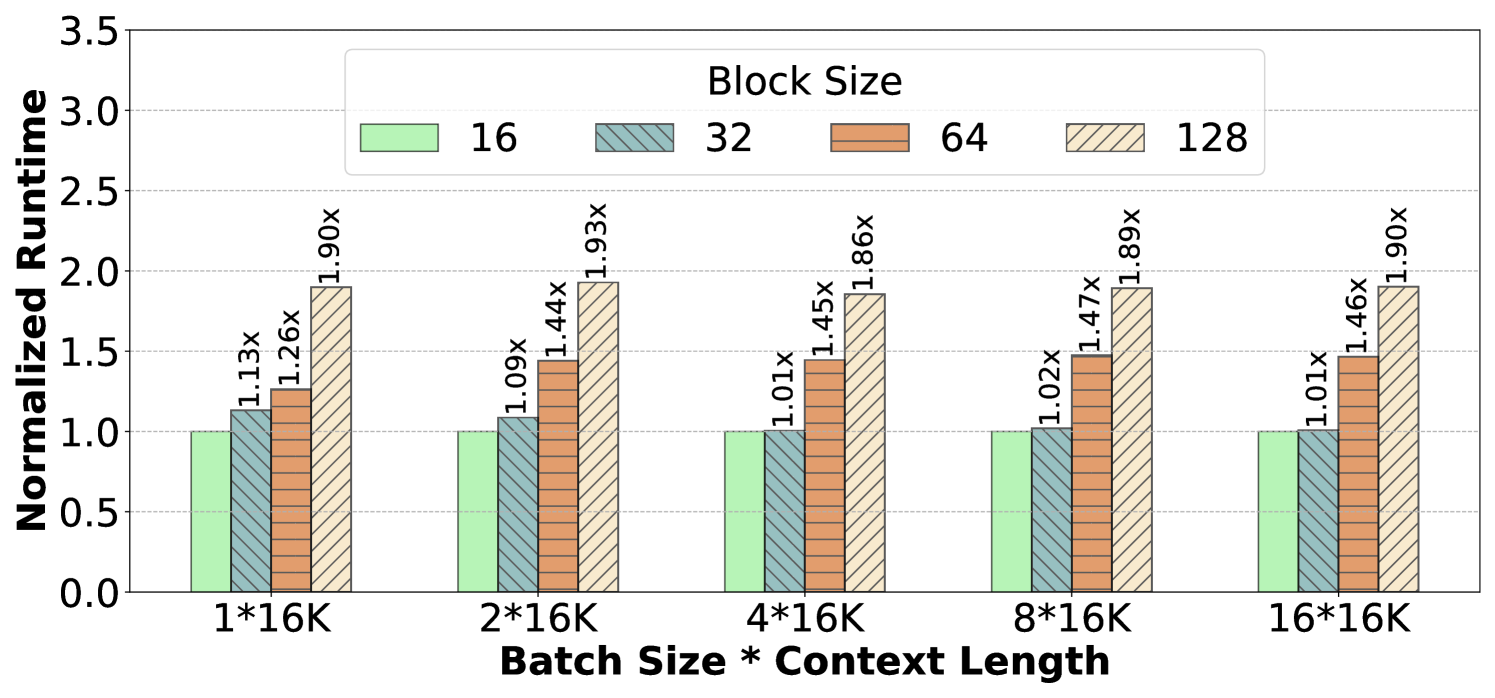
Source: Prabhu et al., vAttention, Figure 3. The figure establishes that block-size performance can be non-monotonic and backend-specific; it does not establish a universal best block size.
0x0AB Ragged Requests Create A Second Traversal Ledger
For request block counts , a dense rectangular staging table with rows and columns contains
Using lengths [64,63,17,1]:
| Per-request blocks | Dense cells | Used | Padding | Dense table bytes | |
|---|---|---|---|---|---|
| 4 | [16,16,5,1] | 64 | 38 | 26 | 256 B |
| 8 | [8,8,3,1] | 32 | 20 | 12 | 128 B |
| 16 | [4,4,2,1] | 16 | 11 | 5 | 64 B |
| 32 | [2,2,1,1] | 8 | 6 | 2 | 32 B |
| 64 | [1,1,1,1] | 4 | 4 | 0 | 16 B |
The byte totals are tiny because the fixture has four requests. The scaling
law is the point: a few long rows can set n_max for every short row. Compact
or ragged table encodings can reduce padding but introduce offsets, lengths,
packing work, or more irregular lookup. This article records the address and
byte contract; M5.2 owns which requests become co-resident.
0x0AC Allocator Blocks May Be Split For A Kernel
The pinned vllm/v1/worker/block_table.py receives allocator block_size and
kernel_block_size separately. Its supported hybrid direction is
Allocator block ID expands to
For P_a=32, P_k=16, allocator IDs [3,7] become kernel IDs
[6,7,14,15]. The physical payload did not duplicate, but the kernel-visible
table gained twice as many entries. For P_a=64, P_k=16, one allocator ID
expands to four kernel IDs.
The reverse direction is not a free mapping. A kernel block larger than an allocator block would require a guarantee that several separately allocated objects form the exact contiguous layout expected by that kernel, or a gather path with a different ABI. The pinned helper therefore rejects a kernel size that does not divide the allocator size.

Production kernels vectorize across requests, heads, blocks, and dimensions. They may split one long context across workers and reduce partial states as M4.5 derives. The implementation path remains:
request snapshot
    -> cache-group table and pool generation
    -> physical descriptor and bounded tile
    -> online softmax state
At minimum, a batched paged kernel needs:
request generation and block-table version
context length and number of logical blocks per group
group table, pool identity/generation, and physical descriptors
request-visible tail and physical valid length
K/V head mapping
layer-local index, K/V bases, axis order, shapes, and strides
position or mask limits
Variable-length batching therefore has two kinds of raggedness:
ragged token lengths
ragged physical block lists
The kernel must not read padding slots in a partially filled block as valid history. Those slots may contain stale data from a recycled physical block.
Append And Copy-On-Write Edge Case
Suppose requests A and B share a 20-token prefix with block size 16:
shared full block:
    positions 0..15

shared partial block:
    positions 16..19
    free slots 20..31
If A and B generate different token 20 values, both cannot append into the same partial block. Copy-on-write must occur before the first divergent append, even though the block is not full.
def append_token(req, k_row, v_row):
    tail = req.block_table[-1]

    if tail.has_free_slot() and refcount[tail] == 1:
        return write_next_slot(tail, k_row, v_row)

    if tail.has_free_slot() and refcount[tail] > 1:
        private_tail = copy_valid_prefix_of_block(tail)
        replace_tail_mapping(req, private_tail)
        return write_next_slot(private_tail, k_row, v_row)

    new_block = allocate_block()
    req.block_table.append(new_block)
    return write_next_slot(new_block, k_row, v_row)
Copying one valid tail block preserves exactness. Copying the entire request cache would preserve exactness too, but would erase much of the sharing benefit.
0x0B Exact Prefix Reuse Has Multiple Execution Designs
Prefix caching is often taught as one mechanism:
find token-prefix hit -> reuse K/V -> prefill suffix
A25 distinguishes several systems because they optimize different repeated work. The distinction matters most after prefill. Two requests can reference the same exact K/V rows and still make an ordinary decode kernel read those rows once per request:
storage reuse:
    one physical shared-prefix K/V object

ordinary decode execution:
    request 0 reads the object
    request 1 reads the object again
    request 2 reads the object again
Loop 6 proved whether the rows are semantically reusable. Loop 7 proved how a prefix tree indexes and protects them. Loop 9 begins only after those receipts exist. Its owner question is narrower:
Given an immutable batch snapshot whose sequence paths reference exact shared K/V chunks, how can a kernel partition shared-prefix and unique-suffix attention, execute each partition in a useful shape, and merge the partial states into exactly the same attention row?
This is execution reuse. It is neither a new cache-identity rule nor a scheduling policy.
0x0BA One Score Row, Disjoint Key Partitions, One Denominator
For one query row , let sequence ‘s legal keys be partitioned into disjoint sets:
may be a global system-prompt prefix. A second partition may be shared only by one subtree, and the final partition may be private to the request. The score for key row is
The full row is not the average of the local outputs. Each independently computed partition must preserve its softmax mass alongside its output information. The general common-denominator proof and stable LSE merge are owned by M4.3, section 0x09E. M5.3 consumes that merge; its additional contract is that each sequence’s chunk path covers the legal keys exactly once, using the same query row, score convention, mask, and immutable execution snapshot.
The partition API carries the canonical state, including its valid-key count:
For a valid partition, the adapter to Hydragen’s LSE/output coordinates is:
The consumer keeps the coordinate conversion explicit without rederiving the upstream merge:
LSE_p = m_p + log(l_p)
O_p   = u_p / l_p

# Merge valid partial states with the M4.3 LSE/output operator.
# Never average independently normalized prefix and suffix outputs.
The empty partition is a two-sided identity, not a valid row with
. Branch on valid before any expression resembling
.

0x0BB The Execution Snapshot Is A Tensor Contract
The partition identity is valid only for one immutable execution snapshot:
tree version and tree-state digest
sequence order
query row for each sequence
ordered chunk path for each sequence
chunk identity digest and coverage interval
K/V shape, head mapping, dtype, scale, and position contract
shared/private execution threshold
The Loop 9 fixture uses one decode query per sequence:
Q: [B=4, H_q=1, T_q=1, d_qk=2]
each K_chunk: [T_chunk, H_kv=1, d_qk=2]
each V_chunk: [T_chunk, H_kv=1, d_v=3]
scale denominator: sqrt(2)
numeric oracle: binary64
Production kernels may use GQA head expansion, FP16/BF16 inputs, FP32 state, quantized K/V, or different axis orders. Those are cache-ABI fields, not details to infer from a tensor’s rank. The checked fixture deliberately keeps one head and tiny widths so every path and state is inspectable.
Its tree is:
C0_global, 2 K/V rows, covers sequence indices [0,4)
├── C1_left_shared, 1 row, covers [0,2)
│   ├── C3_private_S0, 2 rows, covers [0,1)
│   └── C4_private_S1, 1 row, covers [1,2)
└── C2_right_shared, 2 rows, covers [2,4)
    ├── C5_private_S2, 1 row, covers [2,3)
    └── C6_private_S3, 1 row, covers [3,4)
The half-open intervals are not decorative. They let a chunk-first kernel map one chunk to a contiguous query-row range. Reordering active sequences without rebuilding those intervals would make the metadata stale even if the K/V bytes were unchanged.
Cache Lookup Reuse
Paged prefix caching and RadixAttention primarily answer:
Which exact prefix K/V blocks already exist?
Which requests or tree edges reference them?
When should they be retained or evicted?
They reduce repeated K/V projection and prompt prefill for a matching prefix. They do not automatically optimize repeated reads of a shared prefix during every decode step.
0x0BC Hydragen: Batch Queries Over Identical Shared K/V
Hydragen starts from a batch whose requests share prefix K/V but have unique suffixes. For request r:
K_r = [K_shared ; K_suffix_r]
V_r = [V_shared ; V_suffix_r]
An ordinary per-request decode schedule sees a matrix-vector product against the shared prefix for every request. Hydragen concatenates or reshapes the queries that share that K/V object and turns the shared part into a larger matrix operation:
shared:
    Q_shared [B_group, T_q, H_q, d_h]
    K_shared [T_shared, H_kv, d_h]
    V_shared [T_shared, H_kv, d_v]
    -> O_shared [B_group, T_q, H_q, d_v]
    -> LSE_shared [B_group, T_q, H_q]

unique:
    Q_unique [B_group, T_q, H_q, d_h]
    K_unique [B_group, T_unique, H_kv, d_h]
    V_unique [B_group, T_unique, H_kv, d_v]
    -> O_unique, LSE_unique

merge:
    (O_shared, LSE_shared) + (O_unique, LSE_unique)
    -> O_exact
The systems gain is not that one query avoids attending to its prefix. Every query still has the same logical query-key pairs. The gain is that shared K/V can be loaded and reused while several query rows are processed, changing matrix-vector-shaped work into matrix-matrix-shaped work.
def hydragen_level(Q_group, K_shared, V_shared, K_unique, V_unique):
    O_shared, LSE_shared = attention_with_lse(
        Q_group,
        broadcast_shared(K_shared, group=Q_group.shape[0]),
        broadcast_shared(V_shared, group=Q_group.shape[0]),
    )
    O_unique, LSE_unique = attention_with_lse(
        Q_group, K_unique, V_unique
    )
    return merge_lse(
        [O_shared, O_unique],
        [LSE_shared, LSE_unique],
    )
The Hydragen repository’s pinned hydragen/attention.py makes the state
contract concrete: its Torch path stacks partition outputs and LSE tensors,
subtracts the maximum LSE, exponentiates the differences, and uses the
resulting masses to combine outputs. Its Triton path specializes the
two-partition merge. The implementation also supports multiple shared levels;
a group size at one level may divide a larger group at another level.
def hierarchical_hydragen(snapshot):
    per_sequence = [[] for _ in snapshot.sequences]

    for chunk in snapshot.chunks_in_tree_order:
        begin, end = chunk.coverage
        Q_group = snapshot.Q[begin:end]
        O, LSE = attention_with_lse(Q_group, chunk.K, chunk.V)

        for local_row, sequence in enumerate(range(begin, end)):
            per_sequence[sequence].append((O[local_row], LSE[local_row]))

    return [
        merge_lse(outputs, lses)
        for outputs, lses in map(unzip, per_sequence)
    ]
The teaching pseudocode exposes one logical call per chunk. A production Hydragen implementation can fuse, reshape, or use variable-length kernels; the invariant is the same disjoint score partition and LSE-aware merge.
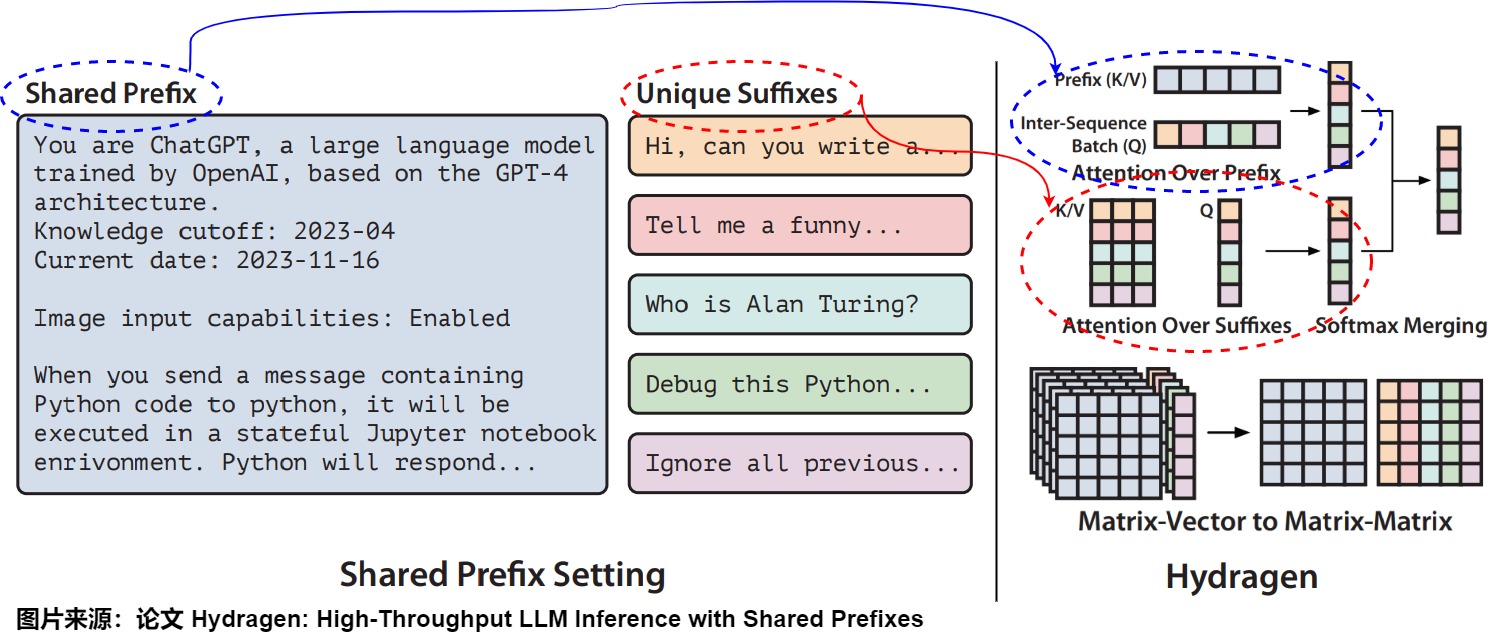
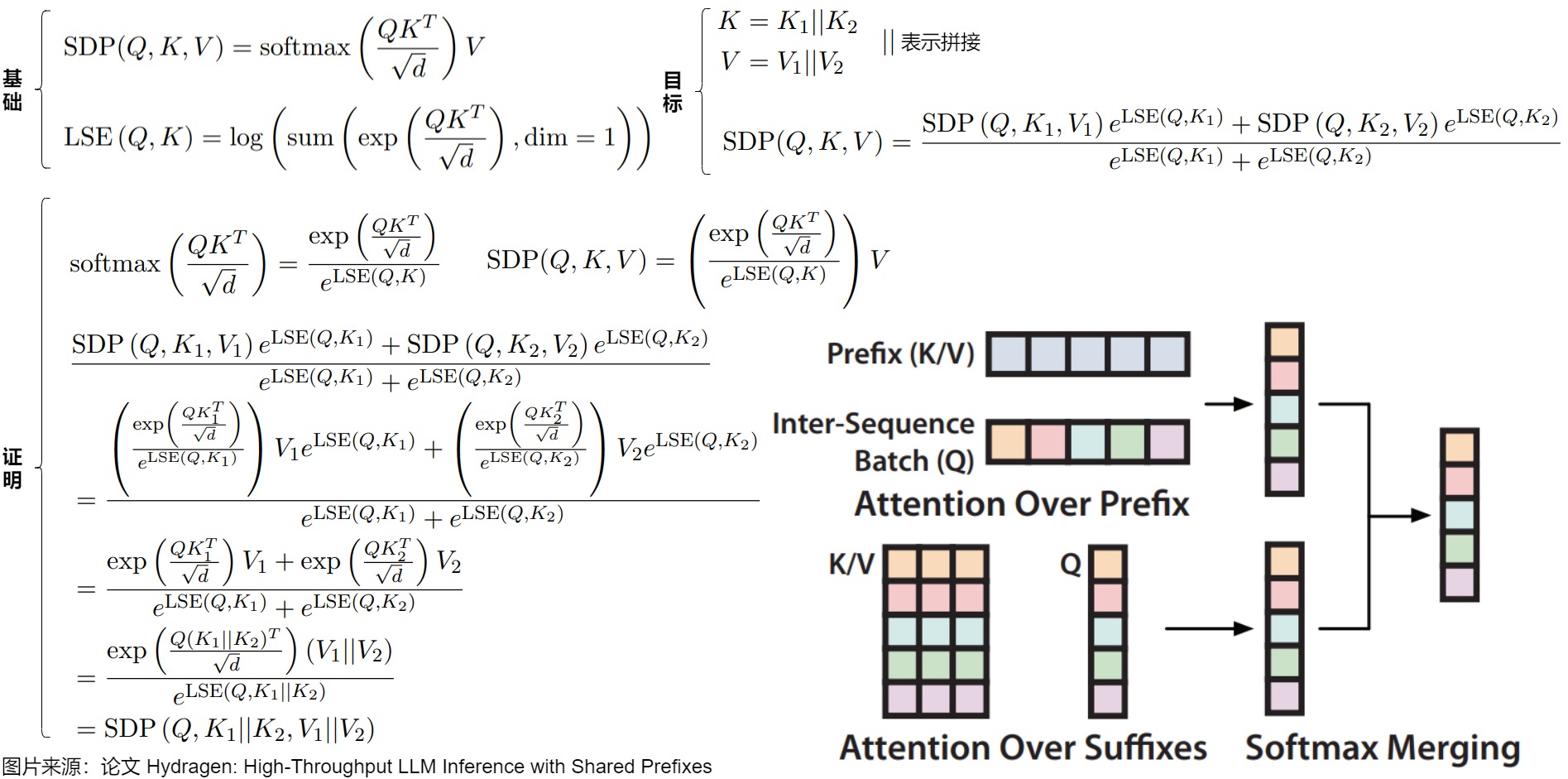
0x0BD ChunkAttention: Prefix Tree Plus Two-Phase Kernel
ChunkAttention couples a prefix-aware K/V tree to a different execution
schedule. Each ChunkInfo in the pinned repository binds one chunk to a
half-open sequence-index interval:
(chunk pointer, seq_idx_begin, seq_idx_end)
The runtime classifies chunks by coverage. A shared chunk enters the chunk-first phase; a private or below-threshold chunk stays in the sequence-first phase. The threshold is a tunable implementation decision, not a semantic distinction.
chunk-first phase:
    traverse chunks shared by several sequences
    batch those sequences' queries against one shared K/V chunk
    save partial online-softmax states

sequence-first phase:
    load each sequence's shared partial states
    traverse its private suffix chunks
    merge every partial state into the final row
def build_chunk_first_metadata(chunks, threshold):
    begins, ends, offsets = [], [], []
    partial_rows = 0

    for chunk in chunks:
        begin, end = chunk.coverage
        if end - begin <= threshold:
            continue
        begins.append(begin)
        ends.append(end)
        offsets.append(partial_rows)
        partial_rows += end - begin

    return begins, ends, offsets, partial_rows


for chunk_id, begin, end, offset in shared_chunk_metadata:
    Q_group = Q[begin:end]
    partial[offset:offset + end - begin] = partial_attention_state(
        Q_group, chunks[chunk_id].K, chunks[chunk_id].V
    )

for request in active_requests:
    state = empty_state()
    for chunk in request.path:
        if chunk.was_materialized_chunk_first:
            part = partial[chunk.offset + request.index - chunk.begin]
        else:
            part = partial_attention_state(
                request.q, chunk.K, chunk.V
            )
        state = merge_online_states(state, part)
    output[request] = finalize(state)
The pinned CUDA source constructs begins, ends, and
offsets on the host, transfers the metadata, allocates
attns:    [partial_rows, H_q, d_v]
maxsums:  [2, partial_rows, H_q]
and then lets sequence-first execution load the saved partial output, maximum,
and denominator state. In that source revision, partial outputs use the output
scalar type while maximum and sum use float. This is a source
observation, not a recommendation that every implementation use the same dtype
split.
Why materialize partial states rather than directly accumulate into the final sequence output? Materialization gives chunk-first work independent output rows and avoids parent/child update ordering or atomic reduction inside the shared phase. It costs temporary memory and a later read. A direct-reduction alternative could reduce that buffer, but then synchronization, deterministic merge order, and write ownership become first-class kernel contracts.
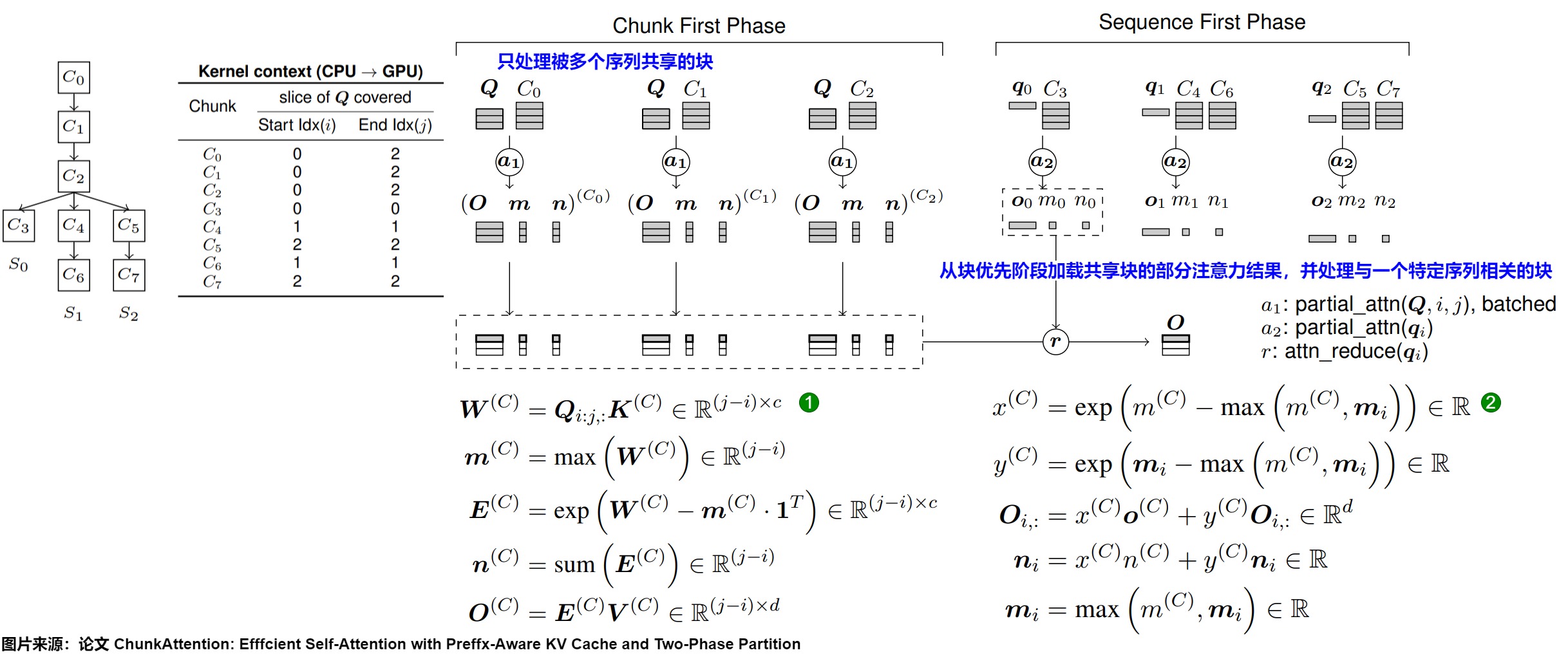
0x0BE One Checked Four-Sequence Trace
The executable fixture runs three attention schedules over the same immutable tree:
reference:
    concatenate each sequence path
    evaluate one monolithic attention row

Hydragen coordinate:
    batch all queries covered by each chunk
    emit (normalized output, LSE)
    merge the three path partitions

ChunkAttention coordinate:
    materialize shared (u, m, l) partial rows
    compute private leaf state during sequence-first
    merge the three path partitions
For every sequence, both partitioned schedules match the monolithic output within absolute error in the binary64 oracle. That is rounding-level agreement in the fixture, not a claim of bitwise equality across GPU kernels, dtypes, or reduction orders.
The work and payload ledgers are:
| Ledger | Per-request baseline | Shared execution | Difference |
|---|---|---|---|
| Logical query-key pairs | 19 | 19 | 0 |
| K/V rows read from the conceptual physical tree | 19 | 10 | 9 fewer duplicate reads |
| K/V payload at 10 bytes per toy row | 190 B | 100 B | 90 B avoided |
| Shared partial rows | 0 | 8 | 8 materialized |
| Shared partial buffer | 0 | 112 B | 112 B temporary |
| Valid binary state merges | 0 | 8 | 2 per sequence |
The row and temporary-state formulas are:
Renderer-safe checked substitution:
logical pairs        = 19
unique physical rows = 10
saved duplicate reads = 19 - 10 = 9

one toy K/V row = (d_qk + d_v) * 2 B
                = (2 + 3) * 2 = 10 B

baseline K/V payload = 19 * 10 B = 190 B
shared K/V payload   = 10 * 10 B = 100 B

partial rows = coverage(C0) + coverage(C1) + coverage(C2)
             = 4 + 2 + 2 = 8
partial row  = d_v * 2 B + max * 4 B + sum * 4 B
             = 3 * 2 + 8 = 14 B
partial buffer = 8 * 14 B = 112 B
The K/V-read ledger is a conceptual payload model: it excludes query reads, output writes, metadata, cache-line effects, kernel launches, partial-state traffic, and hierarchy behavior. It proves what the fixture counts; it does not predict latency.

0x0BF Design Choices Are Workload And Kernel Contracts
| Choice | Benefit | Cost or constraint |
|---|---|---|
| Ordinary per-sequence decode | simple integration; no partial buffer | shared K/V read once per sequence |
| One shared prefix plus private suffix | simple Hydragen decomposition | misses deeper hierarchical sharing |
| Hierarchical Hydragen levels | shares work at several tree vertices | group geometry, varlen metadata, and more merges |
| Chunk-first materialization | independent shared work; simple sequence completion | temporary output/max/sum buffer and reread |
| Direct shared-state reduction | may reduce temporary traffic | serialization, atomics, ownership, and merge-order constraints |
| Coverage threshold | avoids batching tiny groups | workload- and hardware-specific tuning |
| FP32 state with lower-precision output | stronger normalizer stability | more state bytes and conversion behavior |
No method dominates by name. The useful regime depends on shared-prefix length, suffix length, group size, hierarchy shape, K/V dtype, query/head geometry, kernel support, memory bandwidth, temporary-state traffic, and scheduler stability. Hydragen and ChunkAttention paper speedups remain source-reported results under their reported workloads and hardware.
Storage and execution mechanisms are composable only if their contracts align:
Loop 6/7:
    exact identity + protected tree path + immutable snapshot

Loop 9:
    coverage metadata + tensor ABI + exact state merge

M5.2:
    whether compatible requests are co-resident and ordered together

M4.5 / backend:
    whether a supported kernel exists for the chosen geometry
0x0BG Source-Observed Runtime Versus Normative Protocol
| Statement | Status |
|---|---|
| Hydragen partitions shared and unique attention and merges using LSE metadata. | Externally verified from the paper and pinned repository. |
| The pinned Hydragen source has Torch and Triton LSE-combine paths. | Source-observed at commit 1ea2255d.... |
| ChunkAttention binds chunks to contiguous sequence-index intervals and runs two phases. | Externally verified from the paper and pinned repository. |
| The pinned ChunkAttention source builds begins/ends/offsets and FP output plus float max/sum buffers. | Source-observed at commit dde08ce9.... |
| The Loop 9 tree produces 190 B versus 100 B of conceptual K/V payload and 112 B of temporary partial state. | Fixture-verified rewrite interpretation. |
| The oracle replays either CUDA or Triton implementation. | False. |
| The fixture reproduces paper throughput or establishes a universal method ranking. | False. |
The executable oracle imports M4.3’s pinned online-state implementation rather than silently copying its merge. It also binds the Loop 6 prefix-reuse report and Loop 7 radix-runtime report by SHA-256. Identity, index mutation, allocator state, and scheduling are therefore consumed as immutable inputs.
0x0BH Failure Lab
| Failure | What went wrong | Required rejection or repair |
|---|---|---|
| Average locally normalized outputs | partition masses differ | retain denominator or LSE and mass-weight the outputs |
| Drop LSE from Hydragen state | absolute softmax mass is gone | reject missing_partition_mass |
| Treat normalized output as | state coordinate mismatch | convert coordinates explicitly |
| Child coverage escapes parent | tree path and query group disagree | reject coverage_not_nested |
| Non-contiguous coverage metadata | one interval cannot name the covered rows | reorder/rebuild snapshot or use a different index representation |
| Path omits or reorders an ancestor | partitions no longer describe the sequence | reject path_parent_mismatch |
| Chunk identity digest differs from path receipt | K/V partition is stale or foreign | reject chunk_identity_mismatch |
| Same token appears in two path chunks | score sets are not disjoint | reject duplicate_token_partition |
| Tree version changes after metadata build | begin/end/offset rows may address another tree | reject stale_execution_snapshot |
| Empty partition marked valid | invalid exponent arithmetic can follow | use explicit empty identity state |
| Partial buffer is one row short | a shared query has no saved state | reject before sequence-first launch |
| Kernel reads a shared chunk for an uncovered sequence | cross-request state leak and wrong output | coverage and path checks must dominate launch |
0x0BI Loop 10: Shared Work Is Invariant, Traversal Is Not
Loop 9 proved exact state equivalence for one fixed tree. Loop 10 varies the shared-prefix chunk size while holding the logical attention problem constant:
batch B                  = 8
shared prefix S          = 64 tokens
private suffixes U_r     = [8,8,8,8,16,16,16,16]
K/V row payload          = 512 B
partial output width     = 128 FP16 values
partial normalizer state = two FP32 scalars
Ordinary per-sequence execution processes
An idealized exact shared-prefix schedule reads the shared K/V rows once:
For the fixture:
logical K/V rows = 8*64 + 96 = 608
unique K/V rows  = 64 + 96   = 160
saved row reads  = 448

baseline payload = 608 * 512 B = 304 KiB
shared payload   = 160 * 512 B = 80 KiB
saved payload    = 224 KiB
Those row counts do not depend on chunk size. Traversal and temporary state do. For chunk size :
If every shared chunk covers all queries and is materialized separately:
| Shared-prefix chunks | Ordinary chunk visits | Shared schedule visits | Avoided visits | Partial rows | Partial buffer | |
|---|---|---|---|---|---|---|
| 4 | 16 | 152 | 40 | 112 | 128 | 33,792 B |
| 8 | 8 | 76 | 20 | 56 | 64 | 16,896 B |
| 16 | 4 | 40 | 12 | 28 | 32 | 8,448 B |
| 32 | 2 | 24 | 10 | 14 | 16 | 4,224 B |
| 64 | 1 | 16 | 9 | 7 | 8 | 2,112 B |
Larger chunks reduce metadata and partial-state rows in this regular workload. They do not create more shared K/V savings: the same 448 duplicate row reads are avoidable at every size. If the actual prefix boundaries are irregular, larger chunks may instead reduce exact matches or force a private remainder. The chunk-size decision therefore needs the prefix-length and branch-position distribution, not only one average shared-prefix length.
0x0BJ Physical Page Groups Are Not Paged-Kernel Blocks
vAttention keeps a per-layer K or V tensor virtually contiguous. For one tensor row of bytes and physical page-group size :
is the number of token rows backed by one page group, provided divisibility holds. A request of rows needs
The source-reported vAttention Table 8 gives Llama-3-8B, TP-1 one-layer K or
V rows of 2,048 bytes. The checked arithmetic is:
| Tokens/page group | Tail at 33 tokens | Tail at 1,024 | Tail at 1,025 | |
|---|---|---|---|---|
| 64 KiB | 32 | 62 KiB | 0 | 62 KiB |
| 128 KiB | 64 | 62 KiB | 0 | 126 KiB |
| 256 KiB | 128 | 190 KiB | 0 | 254 KiB |
| 2 MiB | 1,024 | 1,982 KiB | 0 | 2,046 KiB |
The 1,024-token row deliberately lands on every page-group boundary. The 1,025th token exposes the staircase again. TP changes the local row width and therefore changes tokens per page; a page-group size cannot be translated into tokens without the tensor manifest.
The kernel-visible address path remains different:
PagedAttention:
    token -> user block table -> physical K/V block -> tensor strides

vAttention:
    token -> contiguous virtual offset -> GPU page-table translation
The Loop 10 oracle assigns zero user-space K/V block-table lookups to the vAttention path. It does not claim zero hardware translation, zero TLB misses, or zero runtime mapping work.
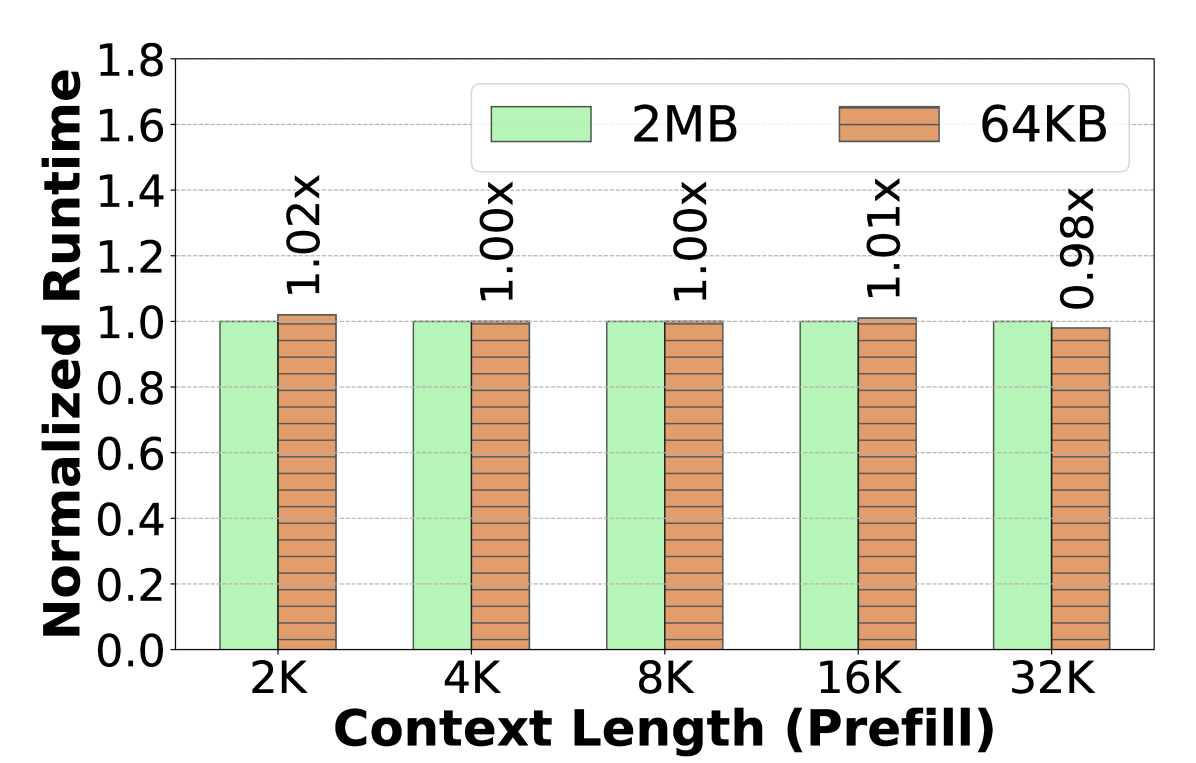
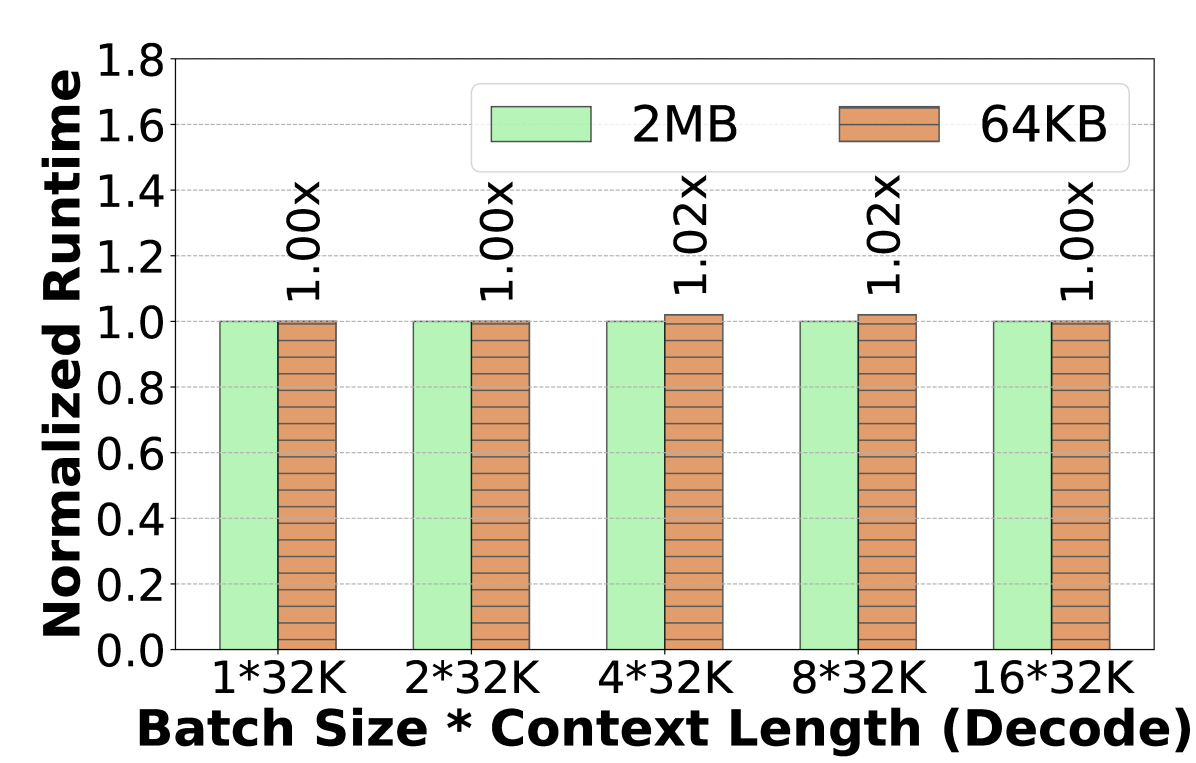
Source: Prabhu et al., vAttention, Figure 14. The authors report that 64 KiB pages did not materially degrade these tested kernels relative to 2 MiB pages. That observation is tied to their models, kernels, hardware, driver path, and access pattern; it is not a universal theorem that page size cannot affect TLB behavior.
0x0BK Workload Regimes Change Which Ledger Matters
| Workload regime | Pressure exposed by smaller granularity | Pressure exposed by larger granularity | Measurement needed |
|---|---|---|---|
| many short independent requests | table entries, descriptors, allocation transitions | physical tail capacity | admitted batch and tail distribution |
| one long request per batch | many block-table traversals | backend tile/cache behavior | kernel latency by context/head/dtype |
| ragged batch with one long request | dense table padding and staging | fewer cells but coarser tails | table build/copy time and decode latency |
| repeated full-block prefixes | more hash/index objects | fewer admissible hit boundaries | hit, recompute, and retained-byte curves |
| branches inside partial tails | small COW destination bounds | large private destination capacity | branch-offset and COW traffic distribution |
| large shared-prefix groups | more chunk metadata and partial rows | coarse prefix boundaries | group size, prefix length, partial traffic |
| contiguous VMM allocation | more map objects with small | larger physical tail with large | map latency, overlap, tail, TLB counters |
| allocator/backend size mismatch | wider kernel-visible tables after splitting | unsupported gather/coalescing direction | dispatch support and fallback rate |
This table deliberately does not assign a winner. M5.3 can reject an invalid combination and expose its ledgers. M5.2 owns which requests run together; M4.5 owns generic backend kernel selection and measured reduction strategy.
0x0BL A Measurement Protocol, Not A Magic Default
A defensible tuning pass holds semantic work constant and changes one contract at a time:
1. Freeze model/cache ABI:
   layers, local KV heads, head width, dtype/scales, positions, TP, backend.

2. Freeze workload trace:
   prompt/decode lengths, arrival order, prefix groups, branch offsets.

3. Enumerate legal tuples:
   (P_a, P_k, G, P_c) that pass allocator, kernel, VMM, and identity checks.

4. Reconcile structural ledgers:
   tail, metadata, hit/recompute, COW, table cells, visits, partial state.

5. Benchmark isolated kernels:
   prefill/decode separately; report context, batch, heads, dtype, hardware.

6. Replay end to end:
   measure TTFT, inter-token latency, goodput, memory headroom, fallbacks.

7. Hand candidates to M5.2:
   scheduling/admission policy chooses under its SLO and fairness contract.
Required observability includes:
allocator_block_size and kernel_block_size by cache group
kernel dispatch selected/rejected/fallback reason
request refs, unique blocks, valid tails, metadata bytes
full-block hit tokens and recomputed prompt-tail tokens
COW copied rows, traffic bytes, and destination capacity
dense/used/padded block-table cells and transfer bytes
shared group size, chunk visits, partial rows and state bytes
VMM page-group size, mapped groups, ready frontier, map latency
Without those counters, a throughput change cannot be attributed to memory capacity, a different admitted batch, kernel geometry, table preparation, shared-prefix locality, or mapping overhead.
0x0BM Source-Observed Contract Versus Checked Interpretation
| Statement | Status |
|---|---|
| PagedAttention uses fixed-token K/V blocks and a block table for non-contiguous placement. | Externally verified. |
The pinned vLLM BlockTable can split one allocator block into smaller kernel blocks when divisibility holds. | Source-observed at 0fc695fc.... |
The pinned libtorch-stable paged kernel templates traversal/vector geometry on BLOCK_SIZE. | Source-observed at 0fc695fc.... |
| The pinned V1 launcher instantiates block sizes 8, 16, and 32. | Source-observed for that launcher and revision only. |
| vAttention separates contiguous virtual addressing from physical page-group allocation. | Externally verified and source-observed. |
| The vAttention paper reports page-group and paged-kernel block-size sensitivity. | Source-reported benchmark evidence. |
| Loop 10’s five-size rows predict GPU latency. | False. They are structural accounting. |
| The vAttention figures were reproduced locally. | False. They are retained source figures. |
| One tuple is universally optimal. | False. |
0x0BN Granularity And Traversal Failure Lab
| Failure | Consequence | Required response |
|---|---|---|
Use P without naming allocator/kernel/page/chunk | incomparable formulas share one symbol | declare all four granularities |
| Kernel block does not divide allocator block | hybrid IDs cannot preserve source layout | reject backend tuple |
| Kernel block exceeds allocator block | separate allocations are assumed contiguous | reject or provide a different gather ABI |
| Launch unsupported pinned block size | no compiled specialization exists on that path | dispatch another backend or fail explicitly |
| Partition size is not divisible by kernel block | full-partition block count is fractional | select legal partitioning or tail-aware implementation |
| Full-block hit is not aligned | runtime claims rows it did not publish | cap to complete compatible blocks |
| Dense table has fewer cells than used entries | table write/address overflow | reject before staging |
| Tail rows equal or exceed block size | invalid frontier | reject manifest/state |
| Copy boundary tail as if partial | unnecessary COW and false traffic ledger | allocate a fresh block |
| Copy fewer rows than the valid shared tail | destination loses prefix state | reject COW receipt |
| Count COW capacity as copy traffic | memory and bandwidth ledgers are conflated | report both separately |
| Count shared K/V savings once per chunk visit | token-row savings change falsely with | keep logical rows invariant |
| Drop chunk partial-state bytes | shared execution appears free | charge output/max/mass writes and rereads |
| Convert page bytes to tokens without row width | model/TP-dependent granularity is wrong | bind tensor manifest first |
| Attribute user block-table lookup to vAttention kernel | address contracts are conflated | use virtual offset + hardware translation path |
| Generalize paper TLB observation | hardware/workload claim exceeds evidence | keep source-reported scope |
| Choose a winner from synthetic visits | no latency model was measured | run isolated and end-to-end benchmarks |
| Tune with a different workload per candidate | block-size effect is confounded | freeze immutable trace and ABI |
CachedAttention / AttentionStore: Reuse Across Inactive Sessions
Inactive-session reuse begins with an M5.3 question: does the resumed turn match an exact token prefix and cache ABI? CachedAttention/AttentionStore is included here because its reusable session state consumes that identity contract.
The hierarchy itself is not an M5.3 mechanism. GPU/host/storage residency, layer-wise prefetch, asynchronous saving, promotion visibility, and the recompute-versus-resume ledger now live in M5.5. M5.3 hands M5.5 a compatible cache key and covered token interval; M5.5 decides where the bytes live and when they are legal to read.
0x0C Paper-By-Contract And Operational Closure
It is tempting to put every K/V optimization into one table headed by latency or hit rate. That comparison is malformed before it starts. PagedAttention owns physical block placement. vAttention owns virtual-to-physical mapping. Prompt Cache declares reusable modules before requests arrive. RadixAttention discovers exact prefixes at runtime. Hydragen and ChunkAttention reuse attention work inside an active execution geometry. CachedAttention preserves compatible session history across inactive periods.
Those systems can coexist because they do not all own the same object. The first comparison question is therefore:
What object is reusable or mutable, who names it, and for how long is that name valid?
Only after that contract is explicit can a runtime compare traffic, TTFT, throughput, or hit rate.
0x0CA Seven Papers, Five Contract Lanes
The paper registry separates five lanes:
physical layout:
    PagedAttention, vAttention

declared modular reuse:
    Prompt Cache

runtime-discovered prefix reuse:
    RadixAttention

active execution reuse:
    Hydragen, ChunkAttention

inactive-session reuse:
    CachedAttention / earlier AttentionStore wording

Storage And Discovery Contracts
| Design | Owned or reused object | How the object is found | Mutation and lifetime |
|---|---|---|---|
| PagedAttention | fixed-token physical K/V blocks and block-table references | runtime allocation; an exact sequence may share block references | allocate, append, fork/share, COW, release, evict during the serving-cache lifetime |
| vAttention | contiguous virtual K/V range plus on-demand physical page groups | request-slot virtual range and mapping frontier | reserve, map, write, retain capacity, reclaim, unmap, release |
| Prompt Cache | precomputed attention states for named prompt modules | schema and PML declaration before ordinary request lookup | populate on schema load; validate and compose when a derived prompt arrives |
| RadixAttention | compressed token-prefix edges aligned with K/V slot segments | longest exact root-to-edge match at runtime | match/split, insert, path lock, release ownership, evict unlocked leaves |
| CachedAttention | compatible historical K/V for one inactive session | session reactivation plus exact identity and covered-history validation | save, fetch, partially prefill the new turn, publish the extended session |
Execution Contracts
| Design | Kernel-visible contract | Avoided work | Contract it does not prove |
|---|---|---|---|
| PagedAttention | block table resolves non-contiguous physical blocks | reservation waste and duplicate physical storage; exact sharing can skip repeated prefix prefill | semantic authorization or a universal block size |
| vAttention | contiguous virtual offset; GPU page tables resolve backing | custom user-space paged address traversal | semantic reuse of retained mappings |
| Prompt Cache | declared module states appear at schema-assigned positions | repeated attention-state computation for common modules | arbitrary-position concatenation or automatic prefix discovery |
| RadixAttention | immutable receipt names token path and K/V slots | repeated exact-prefix prefill and lookup duplication | online SLO-optimal scheduling |
| Hydragen | one shared K/V partition plus private suffix partitions | duplicate shared-prefix K/V reads and small matrix-vector work across a batch | persistent cache indexing or admission policy |
| ChunkAttention | chunk ranges, sequence membership, partial-state ABI | duplicate shared-prefix storage/reads under a compatible active request tree | free temporary state or a universal chunk size |
| CachedAttention | compatible historical interval must be resident before use | repeated multi-turn historical prefill | free hierarchy movement or M5.3 ownership of tier placement |
The table is not a leaderboard. In particular:
- Prompt Cache and RadixAttention differ in who declares reuse.
- PagedAttention and vAttention differ in what address the kernel sees.
- Hydragen and ChunkAttention differ in how an active shared-prefix execution is partitioned.
- CachedAttention changes lifetime and placement, not the exactness requirement for the reused history.
The alternatives can compose only through receipts. A declared Prompt Cache module can still be stored in paged blocks. A radix-tree hit can feed a Hydragen batch. An inactive session can be restored into a paged or virtual layout. Composition does not erase any intermediate identity, ownership, mapping, or execution gate.
0x0CB Prompt Cache: Declared Reuse Is Not Prefix Discovery
A25 introduced Prompt Cache because not every reusable segment is most naturally discovered as a longest prefix. System messages, templates, and documents may be known before requests arrive. Prompt Cache makes those segments explicit as prompt modules inside a schema.
The retained paper figure first separates three mechanisms. Autoregressive generation recomputes prior state, ordinary K/V caching retains the current request history, and Prompt Cache imports precomputed states for declared segments that may recur across prompts.
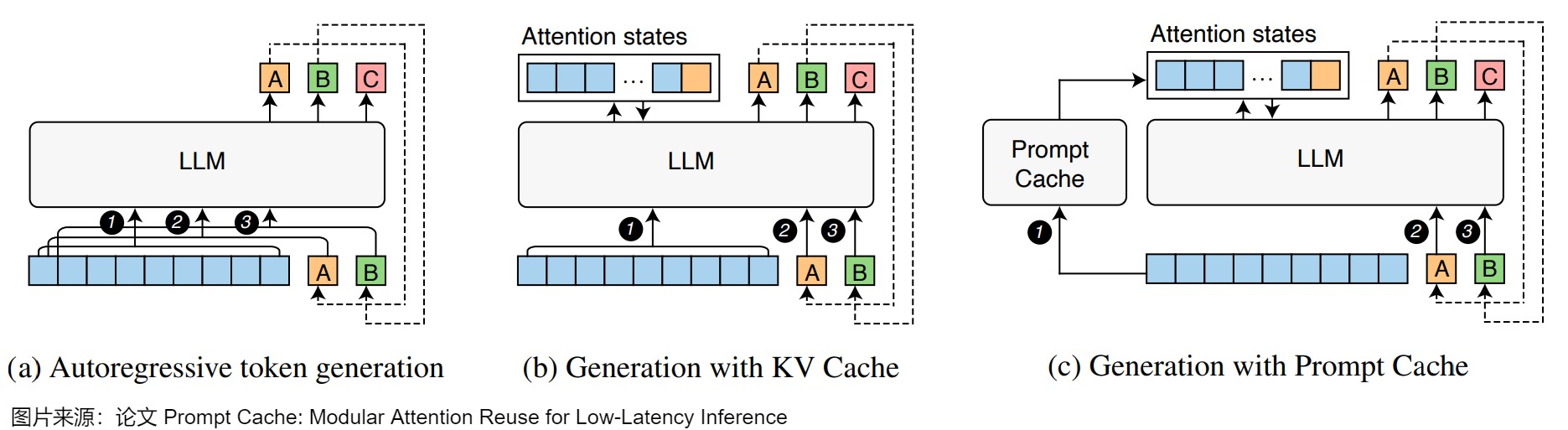
The hard part is positional identity. A module cannot be moved to arbitrary positions merely because its text is unchanged. The schema assigns relative locations and may leave gaps so parameters or uncached text can occupy their declared slots. This can produce discontinuous position IDs in the assembled prompt. Reuse is exact only under the position contract on which the cached states were computed.
The paper’s schema/module example makes that assembly visible:
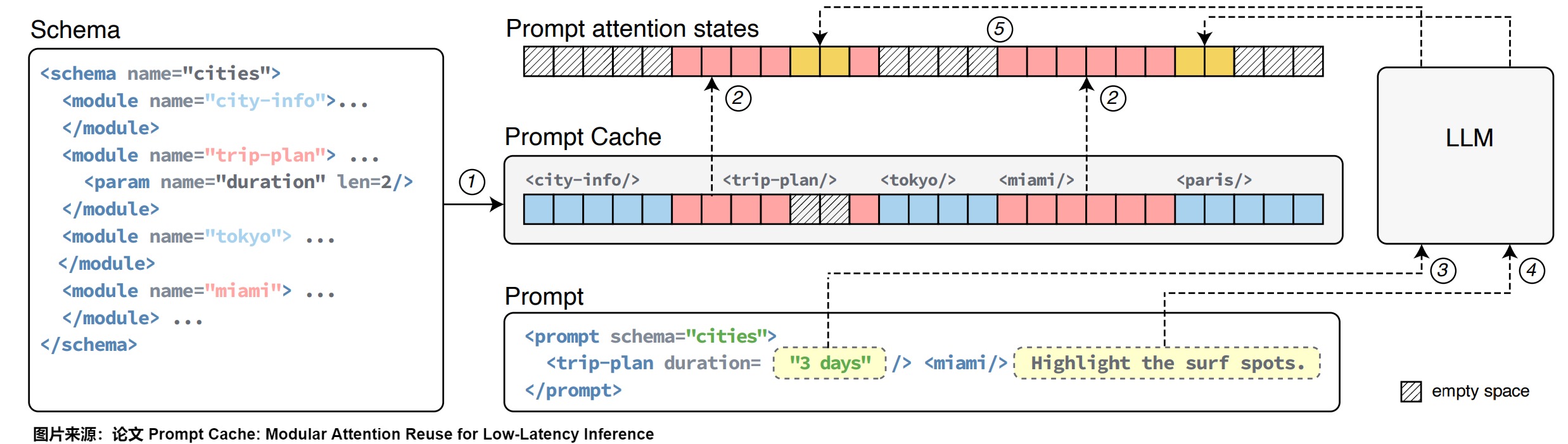
One typed teaching contract is:
@dataclass(frozen=True)
class PromptModuleReceipt:
    schema_id: str
    schema_generation: int
    module_id: str
    module_parameters_digest: str
    token_ids: tuple[int, ...]
    position_ids: tuple[int, ...]
    semantic_manifest_digest: str
    layout_manifest_digest: str
    namespace_id: str
    namespace_generation: int
    physical_refs: tuple[PhysicalRef, ...]
The receipt has two independent equal-length sequences:
Matching module text while changing the position sequence is not a hit:
where is the token sequence, is the position sequence, is the schema/generation contract, and is the semantic cache ABI. The product is Boolean conjunction, not a probability model.
def assemble_declared_prompt(prompt, schema, module_cache, namespace):
    authorize(namespace)                         # before cache lookup
    parsed = parse_pml(prompt)
    require(parsed.schema_id == schema.schema_id)
    require(parsed.schema_generation == schema.generation)

    segments = []
    for item in parsed.items_in_prompt_order:
        declared = schema.resolve(item.module_id)
        positions = declared.positions_for(item.parameters)

        if item.is_cached_module:
            receipt = module_cache.lookup(
                schema=schema.identity,
                module=item.module_id,
                parameters=item.parameters,
            )
            require(receipt.token_ids == tokenize(item.rendered_text))
            require(receipt.position_ids == positions)
            require_compatible(receipt, namespace, current_cache_abi())
            acquire_leases(receipt.physical_refs)
            segments.append(receipt)
        else:
            segments.append(compute_at_positions(item, positions))

    return concatenate_in_declared_position_order(segments)
This is a paper-by-contract alternative, not a recommendation that every prompt adopt PML. It transfers complexity from online prefix discovery to schema authoring, module population, position reservation, invalidation, and application integration.
| Choice | Benefit | Transferred cost or failure |
|---|---|---|
| schema-declared modules | reuse can include known non-prefix segments | schema/version lifecycle and position planning |
| runtime-discovered exact prefixes | no application schema required | lookup/index mutation and dependence on observed prefix overlap |
| fixed module positions | cached states have stable positional meaning | gaps and discontinuous positions must be supported correctly |
| recompute moved module | simple correctness fallback | loses the intended reuse for that segment |
0x0CC CachedAttention: Inactive Lifetime Is A Cross-Article Handoff
The paper now titled CachedAttention appeared with AttentionStore terminology in an earlier version and in A25’s retained figure. Its central observation is that a multi-turn session often discards historical K/V when it becomes inactive, then recomputes the same history when the next user turn arrives.
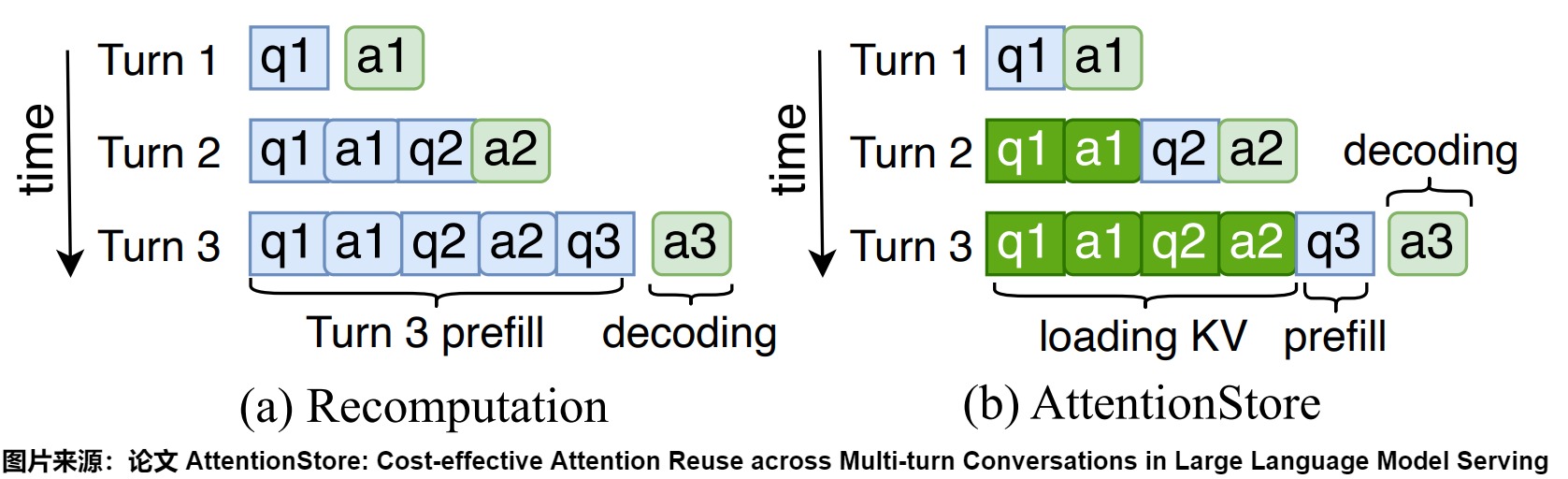
For a session with historical interval and new user tokens , the logical work boundary is:
The article does not infer latency from these token counts. Loading rows from another tier can be slower than recomputation for some hardware, models, or queue states. M5.3 emits:
SessionReuseReceipt:
    authorized session and tenant identity
    model/cache semantic digest
    physical representation/layout digest
    exact covered token interval [0, H)
    position/truncation contract
    publication generation
    source-tier object identity
M5.5 then owns:
tier location and directory
fetch/prefetch timing
promotion and demotion
layer-wise loading
asynchronous saving
fallback to recomputation
scheduler-aware tier placement
The ownership handoff is M5.3 identity receipt -> M5.5 placement, loading, and fallback; neither side may silently reinterpret the other’s receipt.
A matching session ID is therefore only one field. Reusing a prior turn after an adapter change, model replacement, position-contract change, cache quantizer change, namespace rotation, or incomplete save is a compatibility failure even if the conversation label is unchanged.
0x0CD One Reuse Attempt Is A Versioned Concurrency Protocol
Loops 2-10 introduced versions at their local ownership boundaries. Loop 11 closes them into one use receipt. For the checked synthetic path, the evidence tuple is:
with namespace generation , semantic and layout digests, index and tree versions, physical-pool generation, ready mapping frontier, and execution snapshot version. These coordinates do not necessarily live in one runtime struct. They are the evidence that must remain mutually consistent.
The use gate is:
An index match with is not an executable hit.

The checked transaction order is:
1. authorize namespace before any cache-existence lookup
2. build semantic/layout key and validate namespace generation
3. lookup candidate; retain collision witness if policy requires it
4. acquire path and physical-object leases
5. validate index version, tree version, pool generation, valid frontiers
6. validate declared-module positions or session interval when applicable
7. wait until physical mapping covers every dereferenced row
8. freeze immutable execution snapshot and kernel ABI
9. execute
10. release leases, or publish one complete COW successor atomically
def acquire_executable_reuse(request, expected, runtime):
    runtime.auth.authorize(request.principal, expected.namespace_id)

    candidate = runtime.index.lookup(expected.concrete_key)
    require(candidate.namespace_generation == expected.namespace_generation)
    require(candidate.semantic_digest == expected.semantic_digest)
    require(candidate.layout_digest == expected.layout_digest)
    verify_collision_witness(candidate, expected)

    leases = runtime.ownership.acquire(candidate.path_and_physical_refs)
    require(leases.cover(candidate.path_and_physical_refs))
    require(runtime.index.version == expected.index_version)
    require(runtime.tree.version == expected.tree_version)
    require_all_pool_generations(candidate, expected.pool_generations)
    require_all_valid_frontiers(candidate, expected.covered_interval)

    runtime.mapper.wait_ready(candidate.required_mapping_frontier)
    snapshot = runtime.execution.freeze(candidate, leases)
    require(snapshot.version == expected.execution_snapshot_version)

    return ExecutableReuseReceipt(candidate, leases, snapshot)
Race Closure
| Race | Unsafe interleaving | Required fence or recovery |
|---|---|---|
| lookup versus eviction | candidate is found, then its last physical object is recycled | acquire lease before use; generation mismatch rejects stale receipt |
| reader versus COW append | reader observes one cache group before successor publication and another after | immutable predecessor plus atomic multi-group successor publication |
| radix split versus delayed match | compressed edge mutates after match but before slot consumption | tree version and path lease; retry from root on mismatch |
| virtual slot reuse versus delayed kernel | old request generation dereferences retained mapping under a new owner | request-slot generation and execution snapshot validation |
| namespace rotation versus cache lookup | old object is exposed under a successor tenant/model namespace | authorize first; generation-scoped index; reject stale generation |
| Prompt Cache module invalidation versus assembly | schema positions or module text change after module lookup | schema generation and module receipt; recompute or repopulate |
| session save versus resume | resumed request observes partially persisted history | publish covered interval only after complete save; otherwise recompute |
| execution sharing versus tree mutation | Hydragen/ChunkAttention coverage changes during kernel execution | freeze immutable execution snapshot; mutate only in a successor version |
The paper sources motivate the individual mechanisms. The unified transaction is a checked rewrite interpretation. The Loop 11 oracle validates ordering and rejection reasons; it does not prove a production implementation linearizable under real threads.
0x0CE Security Isolation Is Part Of Exactness
K/V bytes are derived from private prompt content. A numerically exact hit in the wrong tenant is a security failure. Security is therefore not an optional layer applied after cache correctness.
Authorization Before Lookup
The safe order is:
authenticate principal
    -> authorize cache namespace
    -> validate namespace generation
    -> construct or expose candidate lookup
    -> validate semantic/layout compatibility
    -> acquire reusable object
Looking up first and rejecting later can still disclose cache existence through hit/miss timing or counters.
Salt, Hash, Authorization, And Witness Are Different Controls
The vLLM prefix-caching documentation describes cache_salt entering the
first block hash so requests sharing a trust group can reuse one another’s
blocks. That is a useful isolation key. It is not authentication, authorization,
namespace revocation, or a guarantee that every timing channel is closed.
| Control | Question answered | What it does not answer |
|---|---|---|
| authentication | who is making the request? | which cache namespace is allowed |
| authorization | may this principal discover and reuse this namespace? | whether candidate bytes are compatible |
| namespace generation | is this authorization/cache epoch current? | whether two key inputs collided |
| cache salt | should otherwise equal prefixes enter the same hash ancestry? | principal identity and access policy |
| cryptographic digest | is accidental or adversarial key collision sufficiently hard under the selected policy? | semantic/layout compatibility omitted from the key |
| collision witness | did this candidate preserve the exact key material expected by the policy? | ownership or physical liveness |
Revocation And Purge
A purge cannot mean only “delete the hash-table entry.” A strict namespace revocation protocol is:
1. stop admitting requests to namespace generation g
2. advance the authorized namespace generation to g+1
3. invalidate index candidates from g
4. wait for or cancel live leases from g
5. release or overwrite physical objects according to the threat model
6. remove external-tier copies through the M5.5 directory
7. emit completion only when no executable receipt from g remains
Whether released memory must be zeroed immediately depends on allocator and hardware isolation. The invariant is narrower and mandatory: stale bytes must never become visible to a new owner merely because a physical ID or virtual slot was recycled.
Telemetry Hygiene
Metrics need stable low-cardinality identifiers, not raw prompts, token lists,
or unsalted concrete cache keys. The checked fixture rejects both
raw_prompt_in_metrics and unsalted_cache_key_in_metrics. Debug traces that
must preserve a witness need access controls, retention limits, and an
explicit incident workflow; they should not silently become normal metrics.
0x0CF Observability Must Reconcile State
A single prefix hit rate cannot identify the failing contract. Loop 11 uses a monotone funnel:
The checked synthetic counts are:
requests                 12
authorized lookups       11   (1 authorization rejection)
candidate matches         9   (2 index misses)
compatible matches        7   (2 semantic/layout rejections)
current generations       6   (1 stale generation)
leased objects            6
mapping-ready receipts    5   (1 mapping frontier lag)
current snapshots         4   (1 stale execution snapshot)
executed hits              4
Every difference has one rejection bucket. Reporting only 4/12 as a hit
rate hides whether the workload stopped sharing prefixes, an adapter changed,
the allocator recycled objects, mappings lagged, or a concurrent mutation
invalidated the snapshot.

Reconciliation Gauges
For a snapshot whose allocator states are declared mutually exclusive:
The fixture checks:
12 = 3 free + 2 evictable + 5 live + 2 reserved/copying
Refcounts need a reachability oracle:
where derived references include request maps and active leases under the Loop 5 convention. The checked snapshot has . A nonzero value is not a performance metric; it is an ownership-integrity alert.
Mapping readiness is similarly directional:
The checked path has . A positive lag blocks execution even if virtual addresses are reserved and candidate identity is exact.
Counter Families And Alert Meaning
| Family | Minimum dimensions | Diagnostic meaning |
|---|---|---|
| identity | authorized lookups, candidate/compatible/current hits, rejection reason | workload miss versus compatibility or stale-state rejection |
| security | cross-namespace rejects, stale namespace generation, salt-policy rejects, purge leases | isolation policy operation without exposing prompt material |
| allocator | free, evictable, live, reserved/copying blocks; allocation failures; COW rows/bytes | capacity exhaustion, lock pressure, transaction backlog |
| ownership | recorded and derived refs, leases, stale-handle rejects | leak, undercount, delayed user, or ABA attempt |
| index/tree | lookup depth, splits, inserts, version retries, locked-eviction rejects | metadata pressure and concurrent mutation |
| mapping | required/ready frontier, map latency/failures, retained inactive bytes | VMM readiness versus identity or allocator pressure |
| execution | logical and unique K/V rows, partial-state bytes, merge rejects, kernel fallback | storage hit versus actual shared execution |
| inactive session | compatible history bytes, covered interval, promotion wait, recompute fallback | M5.3 identity outcome handed to M5.5 placement |
Useful alerts are joint predicates, not isolated thresholds:
allocator exhaustion:
    free == 0 and evictable == 0 and allocation_failures rising

locked-cache pressure:
    free == 0 and evictable > 0 and locked_eviction_rejects rising

reference leak:
    recorded_refcount - derived_refcount != 0 after grace interval

mapping stall:
    required_frontier > ready_frontier and map_wait_age > SLO budget

compatibility churn:
    candidate_matches stable and compatible_matches falling

stale receipt race:
    candidate_matches stable and generation/version rejects rising

security boundary pressure:
    cross_namespace_rejects or stale_namespace_rejects rising
M5.2 owns the SLO budget and service response. M5.3 owns the factual counters that tell M5.2 why an otherwise attractive request is not physically executable.
0x0CG Cumulative Failure Closure
Loops 2-10 already carried negative fixtures for identity, accounting, addressing, allocator lifecycle, exact-prefix reuse, radix mutation, vAttention mapping, shared-prefix execution, and granularity sensitivity. Loop 11 binds all nine prior reports and fixture hashes before adding its own failures:
Loop 2-10 negative cases = 184
Loop 11 negative cases   = 27
cumulative checked cases = 211
This number is not coverage of every production failure. It proves that the named teaching contracts have deterministic rejection paths and that Loop 11 did not silently replace earlier evidence.
| Failure class | Detectable invariant | Recovery or containment |
|---|---|---|
| unauthorized lookup | authorization gate must precede candidate lookup | reject without exposing cache existence |
| namespace/schema/session mismatch | current identity and generation equal receipt | reject; select current namespace/schema/session state |
| semantic or layout mismatch | compatibility digests equal | recompute into a compatible cache object |
| collision witness mismatch | witness equals expected key material | reject candidate; invalidate and investigate index entry |
| stale index/tree/pool generation | every version equals frozen receipt | release leases and retry lookup from current root |
| expired or incomplete lease | lease covers every path/object consumed | reject execution; reacquire from current state |
| mapping failure or lag | ready frontier covers required interval | wait, retry mapping, or hand recomputation/tier fallback to policy owner |
| locked eviction | eviction target has no active path/object lease | choose another victim or reject allocation |
| incomplete COW | copy and appended writes finish before atomic publication | rollback unpublished destination |
| non-atomic group publication | all cache groups switch in one successor | rollback before publication; compensate after publication |
| Prompt Cache position mismatch | token and declared position sequences match | recompute module at current positions or repopulate schema |
| incomplete inactive-session history | covered interval and save generation match | fetch complete object or recompute missing history |
| raw prompt/key telemetry | metrics contain no prompt material or unsalted key | drop field, rotate affected identifiers, audit access |
| pool partition mismatch | exclusive state counts sum to provisioned pool | stop allocation, reconcile descriptors and queues |
| refcount discrepancy | stored refs equal request reachability plus leases | quarantine blocks; repair ownership before recycling |
The final failure rule is:
Fallback may lose reuse, but it may not weaken identity, ownership, mapping, or execution exactness.
Recomputation is often the safest fallback. Reusing a stale or unauthorized object to preserve hit rate is not graceful degradation.
0x0CH Source-Observed Contract Versus Unified Protocol
| Statement | Status |
|---|---|
| Prompt Cache declares reusable prompt modules in a schema and preserves a position contract. | Externally verified; retained source figures from A25. |
| CachedAttention, earlier AttentionStore wording, preserves inactive-session history and partially prefills a resumed turn. | Externally verified; hierarchy and transfer remain M5.5. |
vLLM documents per-request cache_salt as an optional prefix-cache isolation mechanism. | Official-documentation observation; not a complete authorization claim. |
| PagedAttention, vAttention, RadixAttention, Hydragen, and ChunkAttention own the mechanisms described in their rows. | Externally verified and, where stated earlier, pinned-source observed. |
| All seven papers implement the Loop 11 version tuple. | False. The tuple is a checked rewrite interpretation. |
| The synthetic funnel is a production hit-rate measurement. | False. It is an observability reconciliation fixture. |
| The oracle stress-tested concurrency or security. | False. It checked structural ordering and 27 deterministic rejections. |
| One design is universally best. | False. The owned object, lifetime, workload, kernel, hierarchy, and policy coordinate differ. |
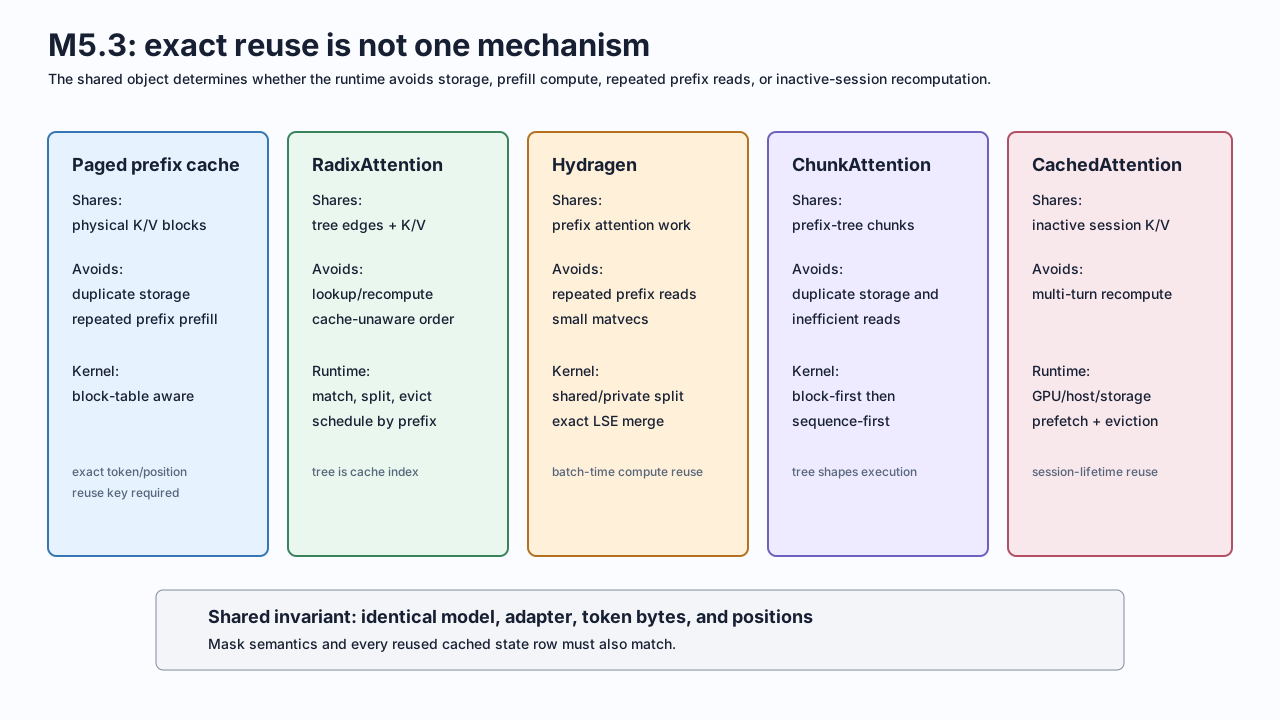
0x0D Worked Ledger
TP-Local Checked Reconciliation
The executable fixture binds to the Loop 2 layout rather than copying geometry into an unrelated calculator:
32 cache layers
4 local K/V heads on TP rank 0 of 2
head width 128
FP16 K and FP16 V

B_row,rank = 64 KiB / token
P = 16 tokens / block
B_block,rank = 1 MiB / physical block
Three requests form a nested exact-prefix family:
| Request | Live rows | Rectangular reservation | Physical block map | Request-view tail |
|---|---|---|---|---|
| A | 33 | 64 | [100, 101, 102] | 15 slots |
| B | 25 | 48 | [100, 101] | 7 slots |
| C | 16 | 32 | [100] | 0 slots |
The rectangular reference ledger is:
logical request rows = 33 + 25 + 16 = 74
logical payload      = 74 * 64 KiB = 4.625 MiB

reserved rows        = 64 + 48 + 32 = 144
reserved bytes       = 144 * 64 KiB = 9 MiB
reservation slack    = 70 * 64 KiB = 4.375 MiB
Paging without deduplicating request references gives six block-table entries:
request-view slots    = 6 * 16 = 96
request-view capacity = 6 MiB
request-view tail     = (96 - 74) * 64 KiB = 1.375 MiB
But the union of block IDs is only {100, 101, 102}. Blocks 100 and 101 are
full; block 102 contains one valid row:
unique materialized rows = 16 + 16 + 1 = 33
unique useful payload    = 33 * 64 KiB = 2.0625 MiB

unique physical slots    = 3 * 16 = 48
unique capacity          = 3 MiB
unique physical tail     = 15 * 64 KiB = 0.9375 MiB
This is why the 22 request-view tail slots cannot be labeled physical waste.
Seven of B’s non-visible block positions contain valid rows materialized for A;
the same is true for C’s shorter view. The checked identities are:
9 MiB = 4.625 MiB logical references + 4.375 MiB rectangular slack
6 MiB = 4.625 MiB logical references + 1.375 MiB request-view tail
3 MiB = 2.0625 MiB unique materialized + 0.9375 MiB unique tail
6 MiB = 3 MiB unique capacity + 3 MiB reference capacity avoided by sharing
4.625 MiB = 2.0625 MiB unique materialized + 2.5625 MiB deduplicated payload
The physical pool contains eight provisioned blocks:
pool provisioned = 8 * 1 MiB = 8 MiB
live unique       = 3 * 1 MiB = 3 MiB
idle reusable     = 5 * 1 MiB = 5 MiB
The fixture separately charges six 4-byte request-map entries, eight 32-byte block descriptors, two 24-byte cached-hash entries, three 2-byte valid-tail records, five 4-byte free-queue entries, and 128 fixed bytes:
M_meta = 24 + 256 + 48 + 6 + 20 + 128 = 482 synthetic bytes
Those record sizes are test inputs, not measurements and not a claim about their CPU/GPU placement. The oracle rejects 14 one-field failures, including a fixture that counts all six request references as six unique blocks.
Model-Wide Capacity-Pressure Illustration
The older running example uses a model-wide rather than TP-local convention:
L     = 32
H_kv  = 8
d_h   = 128
bytes = 2
One token’s K/V across all layers:
L * 2 * H_kv * d_h * bytes
= 32 * 2 * 8 * 128 * 2
= 131,072 bytes
= 128 KiB
If a block holds 16 tokens, the all-layer conceptual block payload is:
16 * 128 KiB = 2 MiB
Real systems may block per layer, head group, or backend-specific layout. This ledger is a capacity-pressure example, not a literal vLLM memory struct.
A 4096-token prompt has:
4096 / 16 = 256 blocks
Its all-layer K/V payload is:
4096 * 128 KiB = 512 MiB
If another request has an exact 3072-token prefix hit:
hit blocks = 3072 / 16 = 192 blocks

prefill tokens skipped = 3072
new prompt tokens to compute = S_prompt - 3072
The benefit is not just memory. The prefill compute for those 3072 tokens is skipped, which can improve TTFT. But if the response generates 1024 new tokens, decoding then grows the cache by up to 1024 more rows. Under M5.1’s ordinary stop the final emitted token is never processed as an input row, so 1023 rows are appended; only M5.1’s optional repair append adds the 1024th:
future decode growth <=
    1024 * 128 KiB
  = 128 MiB

ordinary stop:
    1023 * 128 KiB
  = 127.875 MiB
That growth still has to be admitted, allocated, and scheduled.
0x0E What M5.3 Does Not Claim
| Misconception | Correction |
|---|---|
| ”PagedAttention compresses K/V.” | No. It reduces allocation waste and enables sharing; the logical K/V values still exist. |
| ”vAttention is the same as PagedAttention.” | No. vAttention keeps a contiguous virtual layout and relies on physical allocation on demand. |
| ”A 12 TB virtual reservation consumes 12 TB of HBM.” | No. Virtual address reservation, created physical handles, mapped backing, and valid K/V are separate ledgers. |
| ”A free physical handle is already mapped.” | No. Handle creation and request-range mapping are different VMM operations. |
”free_reqid must immediately unmap every page.” | No. vAttention may retain inactive mappings and reuse that capacity for a later request slot. |
| ”Retained vAttention pages are a prefix-cache hit.” | No. Slot generation changes and valid rows reset; exact semantic reuse still requires the Loop 2 and Loop 6/7 contracts. |
| ”Asynchronous mapping removes synchronization.” | No. Mapping work may overlap, but the required frontier must be ready before a kernel dereferences it. |
| ”Prefix reuse is fuzzy matching.” | No. It is exact reuse of token-prefix K/V under a strict forward-pass contract. |
| ”APC speeds up all generation.” | It skips repeated prefill work; long decode-heavy responses may see little benefit. |
| ”RadixAttention is long-context eviction.” | No. It is an exact prefix-indexing/reuse mechanism. Eviction policy only decides what cached exact state remains retained. |
| ”A cache hit means no memory pressure.” | No. The hit may keep blocks resident and future decode still grows. |
| ”Block size is only an implementation detail.” | No. It changes internal waste, metadata pressure, kernel indexing, and copy-on-write granularity. |
| ”Allocator block size and kernel block size must match.” | Not always. The pinned vLLM block table can split one allocator block into smaller kernel blocks when divisibility holds, increasing kernel-visible entries. |
| ”A CUDA page group is a PagedAttention block.” | No. A page group is physical VMM granularity; a paged-kernel block is a user-visible attention layout unit. |
| ”Fewer block-table reads proves a faster kernel.” | No. Thread geometry, vectorization, cache behavior, context, dtype, and hardware still require measurement. |
| ”Smaller chunks save more shared-prefix K/V rows.” | Not in the fixed Loop 10 workload. Logical row savings stay constant while traversal, match boundaries, and partial-state bytes change. |
| ”The vAttention page-size result proves small pages never hurt.” | No. It is a source-reported result for the paper’s tested kernels, models, hardware, and driver path. |
| ”A physical block ID is a byte address.” | No. It is meaningful only inside a cache-group pool generation; a descriptor, K/V base, and tensor strides still resolve the byte. |
| ”A flattened slot ID identifies one scalar.” | No. It identifies a token row in one group pool; layer, K/V kind, head, lane, dtype, and layout remain unresolved. |
| ”Shared physical validity defines every request’s visible history.” | No. Each request’s context frontier is checked before the shared block’s committed-row bound. |
| ”Every cache group uses the same block map and strides.” | No. The immutable manifest must declare each group’s table, pool, layer range, representation, and physical ABI. |
| ”Refcount zero means the bytes have no cache value.” | Not necessarily. A zero-ref full block may remain indexed and evictable until allocation reclaims it. |
| ”A cache key owns a block.” | Not in the Loop 5 model. The cache index is a weak identity reference; request maps and active leases are strong references. |
| ”An equal block digest proves an authorized exact hit.” | No. The digest proposes an indexed candidate; namespace authorization, semantic/layout compatibility, physical generation, all-group availability, and collision policy remain separate gates. |
| ”A complete prompt hit means zero prompt execution.” | Not necessarily. The execution path still needs logits; under the pinned full-block alignment contract, one semantic final-token recomputation can expand to an entire block. |
| ”Partial-tail reuse is a free extension of full-block caching.” | No. The valid frontier must be part of immutable identity, and a divergent write returns to the allocator’s COW transaction. The partial-tail policy in this article is not attributed to vLLM. |
| ”COW copies the whole request cache.” | No. Block-granular COW copies only the shared mutable tail bundle, although that bundle may span several cache groups. |
| ”The block ID protects against delayed writers.” | No. Recycling creates an ABA hazard; the normative handle also carries pool, group, and generation. |
| ”Rollback can undo any failure.” | Only before successor publication. After the linearization point, repair requires another committed transaction. |
| ”A radix-tree match is always read-only.” | No. A match that ends inside a compressed edge may split that edge while preserving aligned token/slot ownership and active locks. |
| ”Locking the terminal leaf protects a running request.” | No. Every node on the terminal-to-root path contributes required K/V and must remain protected. |
| ”Longest-prefix lookup decides which request runs next.” | No. M5.3 emits immutable match and ownership evidence; M5.2 owns service order, fairness, deadlines, and overload policy. |
| ”Sharing K/V storage automatically shares decode-time attention work.” | No. An ordinary kernel may reread one shared object for every request; execution reuse needs compatible batch geometry and a partition-aware kernel. |
| ”Partial attention outputs can be averaged.” | No. A normalized local output has lost absolute softmax mass; exact merging must retain a denominator, LSE, or equivalent online state. |
| ”ChunkAttention’s temporary partial buffer is free.” | No. It trades duplicate shared-prefix K/V reads for partial-output and normalizer writes, rereads, metadata, and a second execution phase. |
| ”Prompt Cache is automatic prefix caching with another name.” | No. Prompt Cache declares reusable modules and their position contract in a schema; runtime prefix indexes discover observed exact prefixes. |
| ”The same Prompt Cache module text can be inserted at any position.” | No. Tokens, schema generation, parameters, and assigned position IDs are part of the reusable-state contract. |
| ”A matching conversation ID is enough to restore CachedAttention state.” | No. The tenant, model/cache ABI, representation, covered interval, position contract, and publication generation must still be compatible. |
”cache_salt authenticates and authorizes a requester.” | No. It partitions hash ancestry under the documented mechanism; authentication, authorization, namespace lifecycle, and telemetry hygiene remain separate controls. |
| ”Prefix hit rate identifies why reuse failed.” | No. Authorization, candidate, compatibility, generation, lease, mapping, snapshot, and execution counters need separate denominators and rejection buckets. |
| ”The Loop 11 oracle proves the runtime is linearizable and secure.” | No. It checks structural ordering and deterministic fixture rejection; real concurrency stress and security testing remain deployment work. |
0x0F Boundary To Later M5
M5.3 gives M5.4-M5.8 the memory object they will modify:
| Article | What changes | M5.3 boundary |
|---|---|---|
| M5.4 long-context policies | which old K/V remains logically visible after retention, merging, or compression | layout/reuse is exact; retention may be lossy |
| M5.5 retrieval and offload | which preserved rows are resident, promoted, or retrieved for one step | exact cache identity and covered intervals feed tier and retrieval transactions |
| M5.6 P/D disaggregation | which worker owns or receives K/V | block tables and prefix hits become placement metadata |
| M5.7 MQA/GQA | how many full K/V heads exist per token | architecture changes H_kv before layout handles it |
| M5.8 MLA | which latent representation is retained | layout handles latent plus RoPE rows and their kernel ABI |
The systems arc is:
M5.1:
    define K/V state

M5.2:
    schedule next work under KV pressure

M5.3:
    allocate, address, share, and exactly reuse K/V

M5.4:
    decide whether all old K/V remains visible
0x10 Publish Gate
0x10A Final Formula Closure
The final registry contains 78 formulas from Loops 3-11. Loop 12 adds no new
mechanism equation. It checks that every registered formula has a unique ID,
units, an accounting or validity convention, and an article location. The
audit also makes the edge conditions explicit:
| Formula family | Required domain or identity rule | Failure if omitted |
|---|---|---|
| external-fragmentation snapshot | M_total_free > 0; otherwise report not_applicable | division by zero or a misleading score for a full arena |
| generative prefix cap | S_prompt >= 1 before S_cap = S_prompt - 1 | negative or wrapped prefix length |
| online-softmax partition | each numerator and denominator sum uses the same legal key set; empty states branch before normalization | duplicated, missing, or undefined probability mass |
| COW capacity amplification | r > 0; block-boundary append is a separate path | division by zero and conflation of append modes |
| allocator/kernel expansion | P_k divides P_a in the checked split direction | fabricated contiguous kernel blocks |
| VMM page conversion | page bytes are divisible by the declared tensor-row bytes in the checked fixture | fractional token rows per mapped page |
| pool-state reconciliation | free, evictable, live, and reserved-or-copying buckets are mutually exclusive | double-counted physical capacity |
The code blocks remain accessibility fallbacks, not second formulas with a different convention. The final audit rejects an empty rendered math node, unbalanced display delimiters, duplicate formula IDs, or a registered formula without units and a convention.
0x10B Final Source And Figure Closure
The source ledger now distinguishes four evidence classes:
| Evidence class | Count | What it can support |
|---|---|---|
| primary papers | 7 | paper mechanisms and source-reported evaluations |
| pinned runtime repositories | 5 | revision-scoped implementation observations only |
| official versioned documentation | 1 | vLLM prefix-cache salting behavior at the named documentation version |
| source figures | 15 | mechanism or source-reported sensitivity, never a local reproduction |
All 15 source figures have explicit provenance entries. The 16 custom
desktop/mobile visual pairs are original reconstructions tied to local
fixtures; they do not inherit a paper’s benchmark claim. The final audit also
checks that every external primary URL appears in the article, every pinned
revision is named, and every local source or figure exists.
0x10C Final Rendering Closure
The publication check operates on both Markdown and the generated page. It
requires balanced math delimiters outside code fences, non-empty generated
math/tex nodes, resolved desktop and mobile images, accessible SVG
role/title/desc metadata, and generated targets for every local article
link. A successful Astro build is necessary but not sufficient: the generated
M5.3 page must pass the artifact audit after the build.
0x10D Final Cross-Article Boundary Closure
| Owner | Contract consumed or deferred by M5.3 | Boundary result |
|---|---|---|
| M4.3 | generic online-softmax state and exact merge proof | consumed; not re-owned |
| M4.5 | one/few-query split geometry, reduction workspace, backend admission | consumed; storage mapping remains M5.3 |
| M5.1 | logical request/cache ABI and committed frontier | immutable input |
| M5.2 | admission, service order, fairness, SLOs, and preemption | explicitly deferred |
| M5.3 | physical mapping, ownership, exact identity/index, and exact reuse receipts | owned here |
| M5.4 | lossy retention, merge, and legal visible history | explicitly deferred |
| M5.5 | tier placement, promotion, retrieval, and fallback | explicitly deferred |
| M5.6 | prefill/decode placement and inter-worker K/V transfer | explicitly deferred |
| M5.7 and M5.8 | K/V representation geometry | parameterizes the layout; derivation deferred |
| M6.5 | adapter identity, loading, routing, and batching | identity consumed; runtime policy deferred |
| M7.1 and later M7 variants | temporary branches, acceptance, correction, and rollback intent | physical fork receipt owned here; algorithm deferred |
| M8.6 | quantized K/V representation, scales, kernels, and quality policy | representation consumed; quantizer deferred |
This table follows the current roadmap numbering: the decode-kernel owner is M4.5. It also prevents exact physical reuse from silently absorbing scheduling, lossy retention, hierarchy movement, architecture, speculation, or quantization policy.
| Gate | Status |
|---|---|
| PagedAttention is framed as exact layout, not compression | pass |
| Token-to-group, quotient/remainder, block-table, slot, stride, and byte-address derivations are explicit | pass |
| Two non-identical cache groups reconcile exactly to Loop 3 row and block bytes | pass |
| Physical identity includes cache group, pool, generation, and block ID | pass |
| Slot ID and byte address are kept distinct | pass |
| Request visibility is checked before shared physical validity | pass |
| Block-boundary append consumes a versioned successor produced by the Loop 5 transaction model | pass |
| Pinned vLLM source observations are separated from the synthetic tensor layout | pass |
| Refcounts are recomputed from request reachability plus active leases | pass |
| FREE, EVICTABLE, live, cached, reserved, and copying states are not collapsed | pass |
| Private-tail, boundary, and shared-tail COW append paths are distinguished | pass |
| COW payload, traffic, capacity, and amplification are dimensioned separately | pass |
| COW uses generation-fenced handles, source leases, and atomic multi-group publication | pass |
| Failed pre-publication transactions reproduce the predecessor digest exactly | pass |
| Post-publication repair requires a compensating successor transaction | pass |
| Truncate, cancel, release, cache, touch, free, and evict have separate effects | pass |
| Recycled block IDs increment generation and reject stale writers | pass |
| Pinned vLLM allocator observations are separated from the stronger teaching protocol | pass |
| vAttention virtual reservation, physical handles, mapped backing, and valid K/V are separate ledgers | pass |
| Virtual and physical byte formulas reconcile on a checked fixture | pass |
| Request-slot generation and retained mapping capacity are separated from semantic prefix identity | pass |
| Synchronous and asynchronous map-before-use paths expose a readiness boundary | pass |
| PagedAttention and vAttention are compared by kernel-visible address contract | pass |
| Pinned vAttention prototype observations are separated from the stronger teaching receipt protocol | pass |
| Synthetic 64-byte pages are not presented as a production CUDA granularity | pass |
| Unmap, physical-handle release, and virtual-range release are distinct cleanup steps | pass |
| Prefix reuse exactness contract is explicit | pass |
| Incremental block hashes include parent-prefix identity and partial-tail policy | pass |
| Semantic, indexed, capped, runtime-hit, and recomputed lengths remain separate | pass |
| Full-block-only behavior is source-observed while immutable partial tails are labeled as an alternative | pass |
| Complete-prompt-hit logits recomputation and block alignment are derived numerically | pass |
| Collision resistance, semantic compatibility, and namespace isolation are separate controls | pass |
| Prefix lookup emits an immutable receipt and hands mutation back to Loop 5 | pass |
| Every compressed edge has equal-length token and physical-slot segments | pass |
| Mid-edge matching splits token and slot segments at the same offset without copying K/V | pass |
| Radix lock references are re-derived from all active terminal-to-root paths | pass |
| Eviction selects unlocked leaves and recursively exposes parents without disconnecting descendants | pass |
| The offline DFS lower-bound theorem is not generalized to online SLO or fairness policy | pass |
Scheduler handoff freezes tree version, path slots, suffix interval, and lock lease while leaving policy_decision = none | pass |
| RadixAttention is separated from lossy retention | pass |
| Numeric block ledger is included | pass |
| Block-size fragmentation and metadata tradeoff are derived | pass |
| Paged-kernel traversal and partial-tail safety are explicit | pass |
| Allocator block, kernel block, VMM page group, and shared-prefix chunk are separate contracts | pass |
| Full-block prefix-hit loss and immutable-partial-tail alternative are reconciled across five sizes | pass |
| COW useful rows, read/write traffic, and destination capacity are separate ledgers | pass |
| Pinned vLLM hybrid allocator-to-kernel block mapping is traced and checked | pass |
| Pinned paged-kernel traversal, partition, thread-group, and value-vector geometry are traced | pass |
| Ragged block-table used, padded, and transferred cells are derived | pass |
| Shared K/V row savings stay invariant while chunk visits and partial-state bytes vary | pass |
| vAttention page bytes are converted to tokens only through a model/TP-local tensor row | pass |
| Paper latency and page-size figures are labeled source-reported, not locally reproduced | pass |
| Workload sensitivity and measurement protocol do not select an M5.2 scheduling policy | pass |
| Hydragen coordinate adapter consumes the M4.3 canonical merge proof | pass |
| ChunkAttention begins, ends, offsets, partial rows, and sequence completion are traced | pass |
| Monolithic, Hydragen-coordinate, and ChunkAttention-coordinate outputs agree in the checked fixture | pass |
| Logical pairs, unique physical K/V rows, avoided duplicate reads, and temporary state have separate ledgers | pass |
| Empty partition, stale tree, invalid coverage, duplicate token, and missing mass failures reject explicitly | pass |
| Hydragen, ChunkAttention, and inactive-session identity are compared | pass |
| Inactive-session tiering and promotion are handed to M5.5 | pass |
| Seven papers are compared by owned object, discovery, mutation, execution, and lifetime rather than by a mixed leaderboard | pass |
| Prompt Cache schema/module identity and position sequences are explicit | pass |
| CachedAttention historical identity is separated from M5.5 hierarchy placement and transfer | pass |
| Authorization precedes cache-existence lookup | pass |
| Salt, hash, collision witness, namespace generation, and authorization are separate controls | pass |
| Index, tree, pool, mapping, and execution-snapshot versions close one checked use transaction | pass |
| Locked eviction, stale receipt, mapping lag, incomplete COW, and telemetry exposure have deterministic rejection paths | pass |
| Hit-funnel differences reconcile to named rejection buckets | pass |
| Allocator partition, refcount discrepancy, and mapping-frontier lag reconcile in the checked telemetry snapshot | pass |
| Raw prompts and unsalted concrete cache keys are excluded from normal metrics | pass |
| Three A25 source figures are retained with source-mechanism rather than local-measurement captions | pass |
| 184 prior negative fixtures plus 27 Loop 11 fixtures close to 211 deterministic rejection cases | pass |
| The unified protocol is labeled rewrite interpretation rather than attributed to one paper | pass |
| M5.4/M5.5/M5.6/M5.7/M5.8 boundaries are explicit | pass |
| All 78 registered formulas have unique IDs, units, conventions, and audited edge guards | pass |
| Seven primary papers, five pinned runtimes, one official documentation source, and 15 source figures reconcile | pass |
| Sixteen responsive custom visual pairs and all local article links pass the generated-artifact audit | pass |
| M4.3 online-state ownership and M4.5 decode-kernel ownership are not conflated | pass |
| Loop 12 adds audit closure without reopening M5.3 mechanisms | pass |
References
Local source articles:
- M4.3 - IO-Aware Attention and FlashAttention-1
- M4.5 - Decode Kernels and Backend Boundaries
- M5.1 - Autoregressive Serving State: KV Cache Lifecycle and Scheduler Pressure
- M5.2 - Continuous Batching and Scheduler Pressure
- M5.4 - Long-Context K/V Policies
- M5.5 - KV Retrieval, Offload, and Hierarchical Memory
- M5.6 - Prefill/Decode Disaggregation and K/V Placement
- M5.7 - MQA/GQA K/V Head Sharing
- M5.8 - MLA Latent Cache and Absorbed Kernels
- M6.5 - Multi-Adapter Serving Runtime
- M7.1 - Speculative Decoding: Draft, Verify, Accept, Reject
- M8.6 - Live-Data Quantization: Activations and K/V Cache
- Exploring the Transformer Series (20) - KV Cache
- Exploring the Transformer Series (24) - KV Cache Optimization
- Exploring the Transformer Series (25) - KV Cache Optimization for Handling Long Text Sequences
External sources:
- Efficient Memory Management for Large Language Model Serving with PagedAttention
- vAttention: Dynamic Memory Management for Serving LLMs without PagedAttention
- Microsoft vAttention research prototype at pinned commit
ef3fff25 - SGLang: Efficient Execution of Structured Language Model Programs
- Prompt Cache: Modular Attention Reuse for Low-Latency Inference
- Hydragen: High-Throughput LLM Inference with Shared Prefixes
- Hydragen pinned implementation
- ChunkAttention: Efficient Self-Attention with Prefix-Aware KV Cache and Two-Phase Partition
- ChunkAttention pinned implementation
- Cost-Efficient Large Language Model Serving for Multi-turn Conversations with CachedAttention
- Fast and Expressive LLM Inference with RadixAttention and SGLang
- SGLang v0.5.11 compressed radix cache and lock/eviction implementation
- SGLang v0.5.11 request cache-publication paths
- SGLang v0.5.11 cache-aware scheduling policies
- SGLang v0.5.11 scheduler integration
- SGLang v0.5.11 token-to-K/V slot pool
- vLLM v0.23.0 K/V cache manager
- vLLM v0.23.0
KVCacheBlockand free-block queue - vLLM v0.23.0 block pool
- vLLM v0.23.0 allocation and request-release path
- vLLM v0.23.0 K/V cache coordinator and common-hit convergence
- vLLM v0.23.0 full-attention prefix lookup
- vLLM v0.23.0 CPU-staged block tables
- vLLM pinned paged-attention kernel template
- vLLM pinned V1 paged-attention launcher
- vLLM pinned paged-attention benchmark harness
- vLLM v0.23.0 GPU-resident group block tables
- vLLM v0.23.0 K/V cache group interface
- vLLM v0.23.0 automatic prefix caching design
- vLLM v0.23.0 prefix-cache isolation and
cache_saltdocumentation - vLLM pinned source revision
- SGLang pinned source revision