M4.4 - FlashAttention-2 Work Partitioning and the Decode Boundary
M4.4 - FlashAttention-2 Work Partitioning and the Decode Boundary
0x00 From IO-Aware Exactness To The Work-Partition Problem
M4.3 established a result that is
easy to state and difficult to implement: exact dense attention does not need
to materialize its complete score and probability matrices in HBM. Tiled
execution can stream Q, K, and V, carry compact row state, and recompute
local score tiles in backward.
That result removes a major memory-schedule bottleneck. It does not prove that the remaining kernel uses the GPU efficiently.
Owner question: after FlashAttention-1 removes global
S/Ptraffic, how does FlashAttention-2 change state coordinates and assign work across thread blocks and warps so that exact attention spends more time on useful matrix operations?
This question marks a historical shift. FlashAttention-1 asks how exact attention can avoid unnecessary HBM movement. FlashAttention-2 starts from that IO-aware algorithm and asks why its realized throughput still trails highly optimized matrix multiplication. The answer is not one new attention equation. It is a set of connected scheduling decisions:
FA1 result:
    compact exact row state
    tiled HBM/on-chip schedule
    no global score or probability matrix

remaining FA1-era pressure:
    repeated non-matmul normalization work
    too few independent thread blocks for some prefill shapes
    shared-memory traffic caused by warp ownership

FA2 response:
    retain an unnormalized output numerator
    expose query-row blocks as independent forward work
    split Q across warps so one warp owns an output slice
    assign backward K/V columns to CTAs and reduce shared dQ updates

The durable thesis is:
exactness determines the state that must exist
IO awareness determines where that state may live
work partitioning determines who owns it and whether the GPU stays busy
M4.4 therefore continues the M4 accounting chain rather than restarting the attention derivation:
M4.1: count tensors, FLOPs, bytes, and persistent state
M4.2: map those ledgers to GPU execution and resource limits
M4.3: derive the exact online state and reconstruct the FA1 IO schedule
M4.4: derive the FA2 state and work-ownership changes
One-token decode appears here only as the point where FA2’s query-row axis collapses. The exact K/V-split reduction and runtime backend contract belong to M4.5, while M4.6 owns the Hopper and Blackwell pipeline branch.
0x00A Claim Status, Owner Contract, And Scope
Claim and evidence classes
- Source-local. A claim, explanatory order, or visual idea preserved from local article A19. It is not automatically treated as technically correct.
- Externally verified. A mathematical, algorithmic, or historical claim checked against the FlashAttention-2 paper or another named primary source.
- Version-scoped implementation. Behavior verified in FlashAttention tag
v2.0.0at the historical commit pinned below. It is not a claim about the current repository or every backend. - Synthetic contract test. A repository-authored oracle or estimator used to test a stated invariant. It is not a GPU measurement.
- Source-reported measurement. A number reproduced from a paper under that source’s hardware, shape, metric, and software conditions.
- Rewrite interpretation. A teaching or boundary decision that connects formulas, schedules, and neighboring modules.
- Unmeasured. A runtime, dispatch, or profiler claim for which this article has no local execution artifact.
What M4.4 owns, consumes, and defers
- Consumes from M4.1: tensor axes, FLOP/byte ledgers, persistent-state accounting, and declared units.
- Consumes from M4.2: thread-block/warp hierarchy, occupancy and wave vocabulary, shared-memory/register pressure, and the distinction between logical traffic and measured transactions.
- Consumes from M4.3: exact online-softmax algebra, the attention numerator, FA1 forward/backward schedules, compact LSE state, and the semantic/runtime evidence boundary.
- Owns in M4.4: FA2’s normalized-to-unnormalized state-coordinate change;
non-matmul work ledger; query-block launch geometry; split-K versus split-Q
warp ownership; FA2 backward ownership; causal prefill and MQA/GQA mapping;
historical
v2.0.0source-to-kernel and training integration; and the paper measurement contract. - Defers to M4.5: one/few-query K/V splitting, exact partial-state merge, paged-cache addressing, mask programs, SDPA/backend admission, and profiler proof.
- Defers to M4.6: Hopper TMA/WGMMA scheduling, FA3 ping-pong and FP8 paths, Blackwell TMEM/2-CTA MMA, and FA4 pipelines.
- Defers to M5: request scheduling, KV allocation and paging, batching, eviction, and serving-level latency/throughput policy.
Historical evidence contract
The mechanism authority is the FlashAttention-2 paper and the implementation
surface released with FlashAttention v2.0.0:
paper:
    arXiv:2307.08691

historical implementation:
    tag:    v2.0.0
    commit: 4f285b354796fb17df8636485b9a04df3ebbb7dc

current repository main:
    useful for later drift and runtime questions
    not evidence for what the historical FA2 release did
The article traces the pinned Python API, C++ admission path, launch specializations, forward/backward kernels, and Triton reference. It does not substitute a current high-level API call for that historical source trace.
Scope constraints
This is a source-linked kernel reconstruction, not a CUDA code dump.
This is not a locally reproduced benchmark unless an artifact says so.
This does not re-prove M4.3's online-state algebra.
This does not derive M4.5's Flash-Decoding merge or backend dispatch.
This does not derive M4.6's FA3/FA4 hardware pipelines.
Background knowledge: a fast algorithm still needs a balanced GPU work decomposition
A GPU kernel exposes work at several levels: thread blocks are scheduled across streaming multiprocessors, warps cooperate inside a block, and specialized units execute matrix operations efficiently when shapes and data movement align. Removing HBM intermediates does not guarantee that this hierarchy stays occupied.
algorithm question:
    how much arithmetic and data movement are required?

partition question:
    which independent tiles can run on different workers?

warp question:
    which operands are shared and which partial results need reduction?

shape question:
    do prefill and decode expose the same parallel axes?
FlashAttention-2 improves the partition of exact tiled attention, especially for long query sequences. One-token decode then exposes a different shape. M4.4 ends at that ownership change instead of treating one implementation as universal.
0x01 What FlashAttention-2 Improves
The FlashAttention-2 paper starts from a very specific observation.
FlashAttention already reduces HBM traffic and memory. But the v1 kernel still did not run as close to optimized GEMM efficiency as the authors wanted. The paper reports that FlashAttention reached only 25-40% of theoretical maximum FLOPs/s in its framing, while optimized matrix multiplication was much closer to the hardware ceiling.
The paper identifies three main improvements:
1. reduce non-matmul FLOPs
2. parallelize attention even within one head across thread blocks
3. partition work between warps to reduce shared-memory communication
The paper reports roughly 2x speedup over FlashAttention and 50-73% of theoretical maximum FLOPs/s on A100 for its tested settings. Treat those numbers correctly:
source-reported
hardware-specific
shape-specific
implementation-specific
The stable lesson is not a fixed multiplier. The stable lesson is:
avoiding HBM traffic is necessary,
but work placement still determines GPU utilization.
The work-axis ledger is:
FA1-style simple prefill grid:
    work blocks ~= B * H_q

FA2-style prefill grid:
    work blocks ~= B * H_q * num_q_blocks

one-token decode without KV splitting:
    work blocks ~= B * H_q

Flash-Decoding-style decode:
    work blocks ~= B * H_q * num_kv_chunks
    plus a final reduction over chunks
The exact grid layout depends on implementation, but the pressure is stable:
When B and H_q are small, adding a sequence axis can decide whether the GPU is busy.
0x02 Non-Matmul FLOPs Are Not Like GEMM FLOPs
Attention contains two large matrix products:
score product: Q @ K.T
value product: P @ V
It also contains row maxima, masks, subtraction, exponentials, row sums, reciprocals or division, frame conversion, and accumulator addition. Those operations do not all use the matrix-multiply path. A total FLOP count can therefore hide the instruction mix that limits a real kernel.
The FlashAttention-2 paper makes this argument with one A100 coordinate. It
quotes theoretical peaks of 312 TFLOPs/s for FP16/BF16 matrix multiplication
and 19.5 TFLOPs/s for FP32 non-matmul work, then uses their 16x ratio as a
motivation to remove scalar work from the inner loop. These are
source-reported, hardware-specific peak rates, not a claim that every
maximum, exponential, reciprocal, or addition takes exactly sixteen times the
latency of one matrix-multiply FLOP.
The useful question is consequently narrower:
Which normalizations follow from the mathematical result, and which follow only from the coordinate system chosen for the loop-carried state?
0x02A One Dense Row Defines Two Equivalent State Coordinates
M4.3 proved the general mergeable
state. M4.4 consumes that result and reconstructs the particular coordinate
change used by FA2. Let A be one non-empty set of visible key positions for a
single query row. With scores s_j and value vectors v_j, define:
The exact normalized attention output over A is:
Renderer-safe state definitions:
m_A = max_{j in A} s_j
l_A = sum_{j in A} exp(s_j - m_A)
u_A = sum_{j in A} exp(s_j - m_A) * v_j
O_A = u_A / l_A
The two valid coordinate systems are therefore:
| Coordinate | Stored row state | Meaning |
|---|---|---|
| normalized output | (m_A,l_A,O_A) | output has already been divided by the current denominator |
| unnormalized numerator | (m_A,l_A,u_A) | numerator and denominator remain in the same maximum frame |
They represent the same row because u_A=l_A O_A. FA2 does not change the
softmax distribution. It carries u instead of repeatedly carrying a newly
normalized O.
0x02B Two Blocks Must First Share One Maximum Frame
Let A and B be disjoint K/V blocks summarized independently. Their local
maxima define different exponential coordinates. Choose the union maximum:
Every contribution from A must be multiplied by alpha, and every
contribution from B by beta, before they can be added. For the denominator:
The numerator has the same change of coordinates:
The normalized result is then:
Substitute u_A=l_A O_A and u_B=l_B O_B:
Renderer-safe two-block merge:
m     = max(m_A, m_B)
alpha = exp(m_A - m)
beta  = exp(m_B - m)

l = alpha * l_A + beta * l_B
u = alpha * u_A + beta * u_B
O = u / l

# The same row in normalized coordinates:
O = (alpha * l_A / l) * O_A
  + (beta  * l_B / l) * O_B
This derivation identifies the non-negotiable operation: maximum-frame
rescaling remains necessary in either coordinate. Delaying the denominator
division is valid. Dropping alpha or beta is not.
0x02C The Sequential FA1-Style And FA2 Updates Are The Same Row
In a sequential kernel, A is all previously visited blocks and B is the
current score tile S_blk. Instead of first building a local summary for B,
write the current block directly in the new maximum frame:
A normalized working state must update both already-visited mass and the new
value contribution under l_new:
The second division can legally be placed on either side of the value product:
That is a real design alternative. Scaling the probability tile performs work
over its B_c columns; scaling the matrix-product result performs work over
its d_v output columns. Fusion, register layout, and tile shape determine
which physical schedule is preferable.
FA2 instead stores u_old=l_old O_old and updates:
Renderer-safe sequential coordinate updates:
normalized:
    O_new = (alpha * l_old / l_new) * O_old
          + (P_tilde @ V_blk) / l_new

unnormalized:
    u_new = alpha * u_old + P_tilde @ V_blk
Substituting u_old=l_old O_old into u_new/l_new recovers the normalized
update exactly:
The removed work is repeated denominator normalization. The retained work is the maximum, exponentiation, row reduction, and rescaling of the old numerator into the new maximum frame.

0x02D Induction, Final Normalization, And Backward LSE
After visiting blocks 1..j, the unnormalized recurrence maintains the
invariant:
The first valid block establishes the base case. For the induction step,
choose m^(j)=max(m^(j-1),m_blk), move the old state and current block into
that common frame, and add them. The two-block derivation then proves the
invariant for block j. No intermediate division is part of that invariant.
After T_c blocks, one reciprocal normalizes the final vector:
The same denominator gives the row log-sum-exp saved for backward:
For any reconstructed score s_j, its exact normalized probability before
dropout is:
Renderer-safe finalization:
O   = u_final / l_final
LSE = m_final + log(l_final)
p_j = exp(s_j - LSE)       # backward reconstruction before dropout
Saving LSE rather than both m and l is the paper’s second state change.
It replaces two row scalars with one row scalar; it does not save a dense
probability matrix.
0x02E Worked Two-Block Trace From The Executable Oracle
The repository fixture uses:
block A:
    scores = [1.0, -1.0]
    values = [[1.0, 2.0], [3.0, -1.0]]

block B:
    scores = [2.0, 0.5, -2.0]
    values = [[-1.0, 4.0], [2.0, 0.0], [5.0, -3.0]]
Its generated states are easier to audit as vertical ledgers than as one wide table:
Block A
m = 1.000000
l = 1.135335
u = [1.406006, 1.864665]
O = [1.238406, 1.642391]
Block B
m = 2.000000
l = 1.241446
u = [-0.462161, 3.945053]
O = [-0.372277, 3.177789]
Union A+B
m = 2.000000
l = 1.659112
u = [0.055079, 4.631025]
O = [0.033198, 2.791267]
The dense row, normalized online merge, and unnormalized online merge agree to
within 8.89e-16 in the generated binary64 report. The state-coordinate
residual max_abs(u-l*O) is also 8.89e-16. This is a synthetic contract
test, not a kernel accuracy or performance measurement.
The reproducible artifacts are:
docs/numinens-evidence/m4-4-flashattention2-work-partition/
    state_coordinate_fixture.json
    state_coordinate_oracle.py
    state_coordinate_report.json
    test_state_coordinate_oracle.py
0x02F Empty Rows And Finite Precision Are Separate Contracts
An empty block is the merge identity. An all-masked row is not a normal state
with m=-inf, because evaluating exp(-inf - -inf) is indeterminate. A safe
state machine carries a validity flag:
empty state:
    valid = false
    m = -inf
    l = 0
    u = 0

merge(empty, state) = state
merge(state, empty) = state

all-masked final row:
    use an explicit API/backend output policy
    do not infer it by evaluating the normal recurrence
The synthetic oracle reports zero payload and LSE=null for an all-masked row
so the test remains serializable. That is a fixture policy, not a universal
framework contract.
The exact-real-arithmetic coordinate proof is not a promise of bitwise equality.
The oracle includes a deliberately
ill-conditioned binary32 row with values [16777216, 1, -16777216, 1] and
equal scores. Two legal merge orders produce 0.25 and 0.5, while the
binary64 dense reference is 0.5. The large gap is intentionally constructed
to make non-associativity visible; it is not a claim about typical attention
error.
mathematical contract:
    normalized and unnormalized coordinates represent the same exact row

finite-precision contract:
    operation order, accumulation dtype, exp implementation, and fusion may
    change rounding; compare under declared tolerances, not bitwise identity
0x02G Declared Non-Matmul Operation Ledger
The following is a logical scalar ledger per valid query row, not an instruction trace. Let:
T_c = number of K/V blocks
B_c = visible score positions per full K/V block
d_v = value/output width

counting convention:
    one division = one reciprocal + elementwise multiplies

excluded here:
    QK.T and PV matrix products
    masks and tail predicates
    loads and stores
    vector instructions and compiler fusion
Work retained by both normalized and unnormalized coordinates is:
| Logical scalar work | Count per row | T_c=32, B_c=128, d_v=128 |
|---|---|---|
| score shifts | T_c B_c | 4,096 |
| score exponentials | T_c B_c | 4,096 |
| within-block max comparisons | T_c(B_c-1) | 4,064 |
| within-block row-sum additions | T_c(B_c-1) | 4,064 |
| running-max comparisons | T_c-1 | 31 |
old-frame exponentials alpha | T_c-1 | 31 |
| denominator frame multiply/add pairs | T_c-1 | 31 pairs |
| old output/numerator vector scaling | (T_c-1)d_v | 3,968 |
The state-specific alternatives are:
Normalized state, scale the probability tile
reciprocals:                            T_c
new-contribution normalization muls:   T_c * B_c
old-mass coefficient formation muls:   2 * (T_c - 1)
final output scaling muls:              0
Normalized state, scale the PV result
reciprocals:                            T_c
new-contribution normalization muls:   T_c * d_v
old-mass coefficient formation muls:   2 * (T_c - 1)
final output scaling muls:              0
FA2 unnormalized numerator
reciprocals:                            1
new-contribution normalization muls:   0
old-mass coefficient formation muls:   0
final output scaling muls:              d_v
For the declared 32 x 128 x 128 fixture, the unnormalized schedule removes:
31 repeated row reciprocals
4,096 inner-loop normalization multiplications
62 scalar multiplications used to form normalized old-mass coefficients

and adds:
128 final output-scaling multiplications

net state-specific multiplication delta under either displayed normalized
placement for this equal-width fixture: 4,030 fewer logical multiplies
B_c=d_v=128 makes the two normalized placements equal in this example. They
are not equal for every tile shape. More importantly, these logical counts are
not physical instruction counts, cycle estimates, or measured speedups.
Reciprocal approximations, vectorization, epilogue fusion, compiler scheduling,
and register layout can change how the work is realized. Later sections will
trace the historical kernel and paper schedule before making implementation
claims.
The cost-model translation is now precise:
FA2 removes repeated denominator normalization.
FA2 does not remove stable maxima, exponentials, row reductions, or old-frame
rescaling.
One final normalization and one final LSE evaluation remain.
0x03 Algorithm 1 Is A Tensor Storage Contract
The recurrence in 0x02 answers a mathematical question: what state is
necessary to merge the next K/V block exactly? Algorithm 1 answers a different
question: where does each tensor live while that recurrence executes, and how
long must it remain live?
That distinction is essential. The following source-local image, preserved
from A19, is a crop of the paper algorithm. It is useful as the primary
schedule reference, but its square N x d notation, abstract “on-chip SRAM,”
and real-valued tensors are not a production CUDA storage specification.
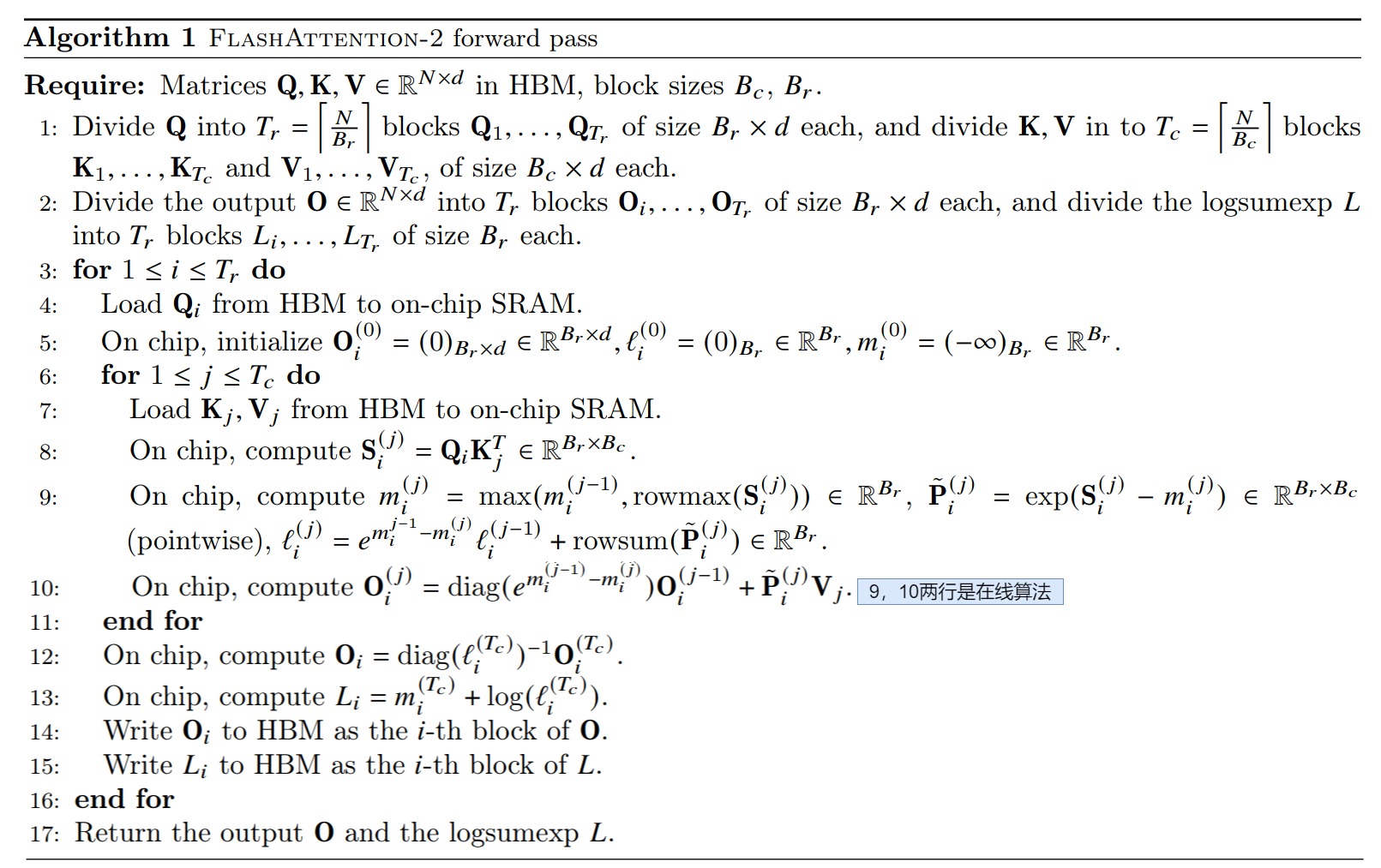
Source-local A19 crop of FlashAttention-2 Algorithm 1. The small annotation on lines 9-10 came with the original A19 asset. The primary paper, not the annotation, is authoritative; the crop is not a literal CUDA transcript or local runtime evidence.
0x03A Paper Algorithm, Generalized Trace, And Historical Kernel Are Three Contracts
This section keeps three layers separate:
paper Algorithm 1:
    Q,K,V in R^(N x d)
    abstract HBM and on-chip SRAM
    query-block outer, K/V-block inner

generalized teaching trace:
    separate S_q and S_k
    true tail extents b_r_i and b_c_j
    explicit d_h and d_v
    explicit causal, padding, and all-masked predicates

historical implementation trace:
    FlashAttention tag v2.0.0
    commit 4f285b354796fb17df8636485b9a04df3ebbb7dc
    concrete FP16/BF16 storage, FP32 accumulators, padding, and epilogue
The generalized trace is a rewrite interpretation of the paper schedule.
The pinned source trace is version-scoped implementation evidence. Neither
should be presented as a description of current FlashAttention main, a
framework’s present dispatcher, or a profiler capture.
For one batch item and one query head, define:
The true extents of block i and block j are:
Renderer-safe block contract:
T_r = ceil(S_q / B_r)
T_c = ceil(S_k / B_c)

b_r_i = min(B_r, S_q - i*B_r)
b_c_j = min(B_c, S_k - j*B_c)

Q_i:         [b_r_i, d_h]
K_j, V_j:    [b_c_j, d_h] in the paper's equal-width case
S_ij:        [b_r_i, b_c_j]
P_tilde_ij:  [b_r_i, b_c_j]
m_i, l_i:    [b_r_i]
u_i, O_i:    [b_r_i, d_v]
LSE_i:       [b_r_i]
The paper uses one d for Q, K, V, and O. Naming d_h and d_v in the
teaching ledger exposes which product owns each width; it does not claim that
the pinned v2.0.0 API accepted unequal K and V widths.
0x03B Lines 1-2: Partition Views, Not Yet Tensor Movement
Source
Q [S_q,d_h], K [S_k,d_h], V [S_k,d_v] in HBM
Destination and shape
logical views Q_i, K_j, V_j, O_i, and LSE_i
no score or probability tile exists yet
Dtype and lifetime
paper: real-valued tensors
v2.0.0 storage: Q/K/V share FP16 or BF16
metadata: launch/block coordinates
lifetime: launch scope
Partitioning is an address calculation. It does not require copying all blocks
into a new global tensor. A final block may have fewer than B_r query rows or
fewer than B_c key rows; calling the logical tail a full block would already
change the accounting model.
0x03C Lines 3-5: One Worker Becomes The Query-Row Owner
The outer loop selects query block i. Paper line 4 moves Q_i from HBM to
on-chip storage. Line 5 creates the identity state:
source:
    Q_i in HBM
    identity constants -inf and 0

destination:
    Q_i on chip                 [b_r_i,d_h]
    m_i = -inf                 [b_r_i]
    l_i = 0                    [b_r_i]
    u_i = 0                    [b_r_i,d_v]

lifetime:
    Q_i, m_i, l_i, u_i survive the complete inner K/V loop
The paper writes the working output accumulator with an O-like symbol. This
article calls it u_i because 0x02 proved that it is the unnormalized
numerator until line 12. Calling it the final normalized output inside the
loop would erase the state-coordinate change that FA2 introduced.
In the pinned kernel, Q_i may live in shared memory, register fragments, or a
shared-memory region later reused by K, depending on the launch specialization.
The stable ownership statement is narrower:
Q_i and row state remain local to the query-block owner;
they are not read from and written to HBM after every K/V block.
0x03D Lines 6-10: K/V Stream, Score And Probability Fragments Expire
Each inner iteration has three different lifetimes.
K/V block, line 7
source:       K_j,V_j in HBM
destination:  on-chip K/V tiles
shape:        [b_c_j,d_h] and [b_c_j,d_v]
lifetime:     one inner iteration, possibly overlapped by pipelining
Score and probability fragments, lines 8-9
S_ij = tau * Q_i @ K_j.T       [b_r_i,b_c_j]
P_tilde_ij                     [b_r_i,b_c_j]

lifetime:
    create for this block
    apply sequence/causal predicates before rowmax
    update m_i and l_i
    feed the value product
    discard
tau is the score scale, M4.3’s 1/sqrt(d_h). The paper omits it for clarity
(its footnote 2) and writes line 8 as S_ij=Q_iK_j^T; this trace keeps it
because backward must recompute the same scaled scores from LSE_i.
Loop-carried state, lines 9-10
m_i: [b_r_i]       running maximum
l_i: [b_r_i]       running denominator in the m_i frame
u_i: [b_r_i,d_v]   running value numerator in the same frame

lifetime:
    every visited K/V block for this query owner
Line 10 is the crucial ownership update:
u_i <- exp(m_old - m_new) * u_i + P_tilde_ij @ V_j
S_ij and P_tilde_ij do not become global S and P matrices. They are
temporary fragments whose only purpose is to update the compact row state.
0x03E Lines 11-17: Normalize And Commit Once
After all visible K/V blocks have been merged:
O_i   = u_i / l_i
LSE_i = m_i + log(l_i)
The epilogue then writes:
O_i:   [b_r_i,d_v] -> HBM once
LSE_i: [b_r_i]     -> HBM once
The lifetimes now diverge:
u_i, m_i, l_i:
    die after epilogue finalization

O_i:
    persists as the layer output

LSE_i:
    persists when backward must reconstruct probabilities
This is the storage consequence of the algebra from 0x02: carry (m,l,u)
on chip, normalize once, and save one row scalar LSE rather than repeatedly
materializing normalized output state between K/V blocks.

0x03F Executable Tail-Aware Schedule
The paper’s 17 lines can be expanded into a tail-aware teaching schedule. This is still not CUDA source:
def fa2_forward_owner(Q, K, V, B_r, B_c, causal_policy, tau):
    S_q, d_h = Q.shape
    S_k, d_k = K.shape
    assert d_h == d_k

    for i in parallel_range(ceil_div(S_q, B_r)):
        q0 = i * B_r
        q1 = min(q0 + B_r, S_q)
        Q_i = predicated_load(Q, rows=(q0, q1), width=d_h)

        m_i = full([q1 - q0], -inf, dtype=fp32)
        l_i = zeros([q1 - q0], dtype=fp32)
        u_i = zeros([q1 - q0, V.shape[-1]], dtype=fp32)
        valid_i = zeros([q1 - q0], dtype=bool)

        for j in visible_kv_tiles(i, S_q, S_k, B_r, B_c, causal_policy):
            k0 = j * B_c
            k1 = min(k0 + B_c, S_k)
            K_j = predicated_load(K, rows=(k0, k1), width=d_h)
            V_j = predicated_load(V, rows=(k0, k1), width=V.shape[-1])

            S_ij = tau * fp32_accumulate(Q_i @ K_j.T)
            allowed = sequence_and_causal_predicate(q0, q1, k0, k1)
            S_ij = where(allowed, S_ij, -inf)  # before rowmax

            block_valid = any(allowed, axis=-1)
            # Invalid rows merge the identity; they do not evaluate exp(-inf - -inf).
            m_new, l_new, u_new = merge_valid_rows(
                m_i, l_i, u_i, S_ij, V_j, block_valid
            )
            m_i, l_i, u_i = m_new, l_new, u_new
            valid_i |= block_valid

        O_i, LSE_i = finalize_under_declared_all_masked_policy(
            m_i, l_i, u_i, valid_i
        )
        predicated_store(O[q0:q1], cast_output_dtype(O_i))
        predicated_store(LSE[q0:q1], LSE_i)  # FP32 in v2.0.0
The valid_i branch is explicit because the algebraic identity and a backend’s
all-masked output policy are separate contracts. The historical kernel has its
own finite-state handling and early exits; this teaching code does not claim
line-for-line source equivalence.
0x03G Query, Key, Head-Width, And Causal Tails Are Different Predicates
A kernel can have four boundaries in one tile:
query tail:
    q_index < S_q

key/value tail:
    k_index < S_k

head-width tail:
    feature_index < materialized_d

causal boundary:
    allowed(q_index, k_index) under the declared alignment policy
The independent-tail fixture makes all three widths visible:
S_q = 257, S_k = 193, d_h = 78
B_r = 128, B_c = 64

query block rows:  [128, 128, 1]
K/V block rows:    [64, 64, 64, 1]

logical width:                 78
v2.0.0 wrapper storage width:  ceil(78/8)*8  = 80
kernel specialization width:   ceil(80/32)*32 = 96
The pinned wrapper physically pads Q/K/V from 78 to 80 values per row. It then
dispatches a 96-wide specialization. The kernel predicates feature lanes
against params.d=80, and the wrapper slices the returned output back to 78.
Those sixteen specialization lanes are not automatically sixteen extra HBM
values per row; predicates can suppress their global loads and stores.
The same caution applies to sequence rounding. v2.0.0 computes query and key workspace extents rounded to 128, including the optional returned softmax/dropout debug tensor. That does not mean the ordinary Q/K/V tensors are copied to full 128-row blocks before every kernel call.
For square causal attention, declare allowed(q,k) iff k <= q. A tile is:
full:
    k_end - 1 <= q_start

skipped:
    k_start > q_end - 1

partial:
    neither condition holds; mask cells before rowmax
With S_q=S_k=256, B_r=128, and B_c=64, the executable fixture finds:
2 full tiles
4 partial tiles
2 skipped tiles

6 visited tile rectangles contain 49,152 score slots
32,896 cells are causally allowed
The distinction matters: partial tile rectangles still contain masked cells.
The pinned forward kernel bounds n_block_max, iterates K/V blocks in reverse,
and separates masking iterations from mask-free iterations. Reverse order is
a source-level scheduling choice, not a different online-softmax result.
Sections 0x05.1 and 0x06 own the full causal and variable-length geometry;
this section establishes only the predicate and lifetime contract.
0x03H Dtype Is A Pipeline, Not One Label On The Operation
Algorithm 1 writes tensors over the reals. The pinned v2.0.0 source realizes that algorithm with several dtype roles:
| Object or stage | v2.0.0 dtype role | Source-inspected consequence |
|---|---|---|
| Q, K, V global/shared storage | FP16 or BF16, all equal | tensor-core input elements |
QK^T score fragment | FP32 accumulator | score maximum and exponential state start from FP32 accumulation |
m, l, and u/acc_o | FP32 | loop-carried numerical state stays in ElementAccum=float |
shifted P_tilde math | FP32 | exponentials and row sums update FP32 state |
P_tilde entering P @ V | converted to FP16/BF16 | second tensor-core product uses low-precision multiplicands with FP32 accumulation |
| final normalization | FP32 | reciprocal and output-accumulator scaling occur before output conversion |
| O write | same FP16/BF16 dtype as input | epilogue converts FP32 acc_o to Element |
| LSE write | FP32 | wrapper allocates softmax_lse with at::kFloat |
| row/feature predicates | boolean/control state | invalid rows and feature lanes are not committed |
These are not inferred from one paper equation. They are visible in the pinned
flash_api.cpp,
kernel_traits.h,
and flash_fwd_kernel.h.
The dtype contract also explains why a paper-level capacity count in scalar elements cannot be translated directly into shared-memory bytes. Q/K/V storage, score/output accumulators, row scalars, predicate state, and double-buffered tiles do not all have one width or one residency.
0x03I Dropout Adds Replay State Without Changing The Softmax Denominator
Training adds a second correctness contract. Attention dropout acts on the normalized probability path, but the stable maximum and denominator describe the undropped softmax distribution:
1. compute undropped m, l, and shifted probability numerator
2. generate the dropout decision for probability elements
3. apply the mask before P @ V
4. apply reciprocal keep-probability scaling
5. regenerate the same decisions during backward
The v2.0.0 Python autograd wrapper saves an opaque CUDA RNG state when
dropout_p > 0, restores it for backward, and then restores the caller’s later
RNG state. The kernel derives Philox seed/offset coordinates from batch, head,
lane, and attention-block location so forward and backward can traverse work
differently while regenerating the same mask.
Normal training does not require a dense probability matrix to persist. The
historical API can optionally return an S_dmask diagnostic tensor, but in
v2.0.0 return_softmax is accepted only when dropout is active. That optional
debug path must not be added to the ordinary Algorithm 1 traffic ledger.
0x03J FA1 And FA2 Move Different Objects
M4.3’s FA1 Algorithm 1 trace established the K/V-outer paper schedule. FA2 swaps loop ownership. For a non-causal square case, let:
b_in:   bytes per Q/K/V element
b_out:  bytes per O element
b_s:    bytes per m/l/LSE scalar
Under the declared logical schedule model, FA1 moves:
The final two terms are the paper’s initial writes of O, l, and m. FA2
moves:
Renderer-safe traffic formulas:
FA1 K/V-outer:
    K,V reads once             = 2*S_k*d*b_in
    Q reads per K/V block      = T_c*S_q*d*b_in
    O reads+writes per visit   = 2*T_c*S_q*d*b_out
    m,l reads+writes per visit = 4*T_c*S_q*b_s
    initialization writes      = S_q*d*b_out + 2*S_q*b_s

FA2 query-outer:
    Q reads once               = S_q*d*b_in
    K,V stream per Q block     = 2*T_r*S_k*d*b_in
    O writes once              = S_q*d*b_out
    LSE writes once            = S_q*b_s
For the fixture:
S_q=S_k=256, d=64
B_r=128 -> T_r=2
B_c=64  -> T_c=4
b_in=b_out=2 bytes, b_s=4 bytes

FA1 logical total including initialization: 509,952 bytes
FA2 logical total:                          197,632 bytes
declared difference:                       -312,320 bytes
FA2 does not reduce every term. It reloads K/V for each query-block owner,
while FA1’s idealized K/V-outer trace reuses each K/V block across query blocks.
FA2 wins this fixture’s ledger by eliminating repeated Q loads and repeated
HBM round trips for O,m,l, while also exposing independent query-block work.
Different tile sizes, cache behavior, GQA reuse, causal skipping, and launch
placement can change physical traffic.

The independent-tail case reports another pair of coordinates:
logical valid-payload FA2 bytes at d=78:     261,860
v2.0.0 materialized-width bytes at d=80:    268,548
extra bytes in that wrapper-width model:      6,688
The 96-wide specialization is reported as a tile-slot envelope, not as traffic. Predication, vector load policy, cache-line coalescing, compiler lowering, and cache residency decide which slots become physical transactions.
0x03K Executable Schedule Evidence And Failure Lab
The checked fixture and oracle are:
docs/numinens-evidence/m4-4-flashattention2-work-partition/
    algorithm1_schedule_fixture.json
    algorithm1_schedule_oracle.py
    algorithm1_schedule_report.json
    test_algorithm1_schedule_oracle.py
They verify:
every Algorithm 1 line group names source, destination, shape, dtype, lifetime,
and tail behavior

the 257 x 193 fixture retains every logical score rectangle exactly once

the causal fixture separates visited rectangles from actually allowed cells

the d=78 logical, d=80 materialized, and d=96 specialization widths stay distinct

FA1/FA2 traffic follows the declared loop order and byte widths

all generated evidence remains unmeasured
Common failures now become mechanically identifiable:
| Failure | Broken contract | Repair |
|---|---|---|
call the in-loop u_i a normalized output | erases the delayed denominator division | name unnormalized numerator and final epilogue separately |
| apply a tail or causal mask after rowmax | forbidden scores can change m and l | predicate scores before rowmax and rowsum |
count all B_r x B_c x d_kernel slots as HBM bytes | conflates logical shape, wrapper storage, specialization, and transactions | report each coordinate separately |
| say FA2 reads every K/V element once | ignores one stream per query-block owner | include T_r in the logical K/V term |
include optional returned S_dmask in ordinary inference traffic | turns a diagnostic dropout path into baseline state | count it only under its explicit API option |
| infer current backend behavior from v2.0.0 | historical source is not current dispatch evidence | keep implementation claims commit-scoped |
Run the schedule checks with:
python3 -m unittest -v \
  docs/numinens-evidence/m4-4-flashattention2-work-partition/test_algorithm1_schedule_oracle.py
This oracle is a synthetic contract test. It does not build the historical extension, run a GPU kernel, inspect SASS, collect Nsight counters, or measure latency.
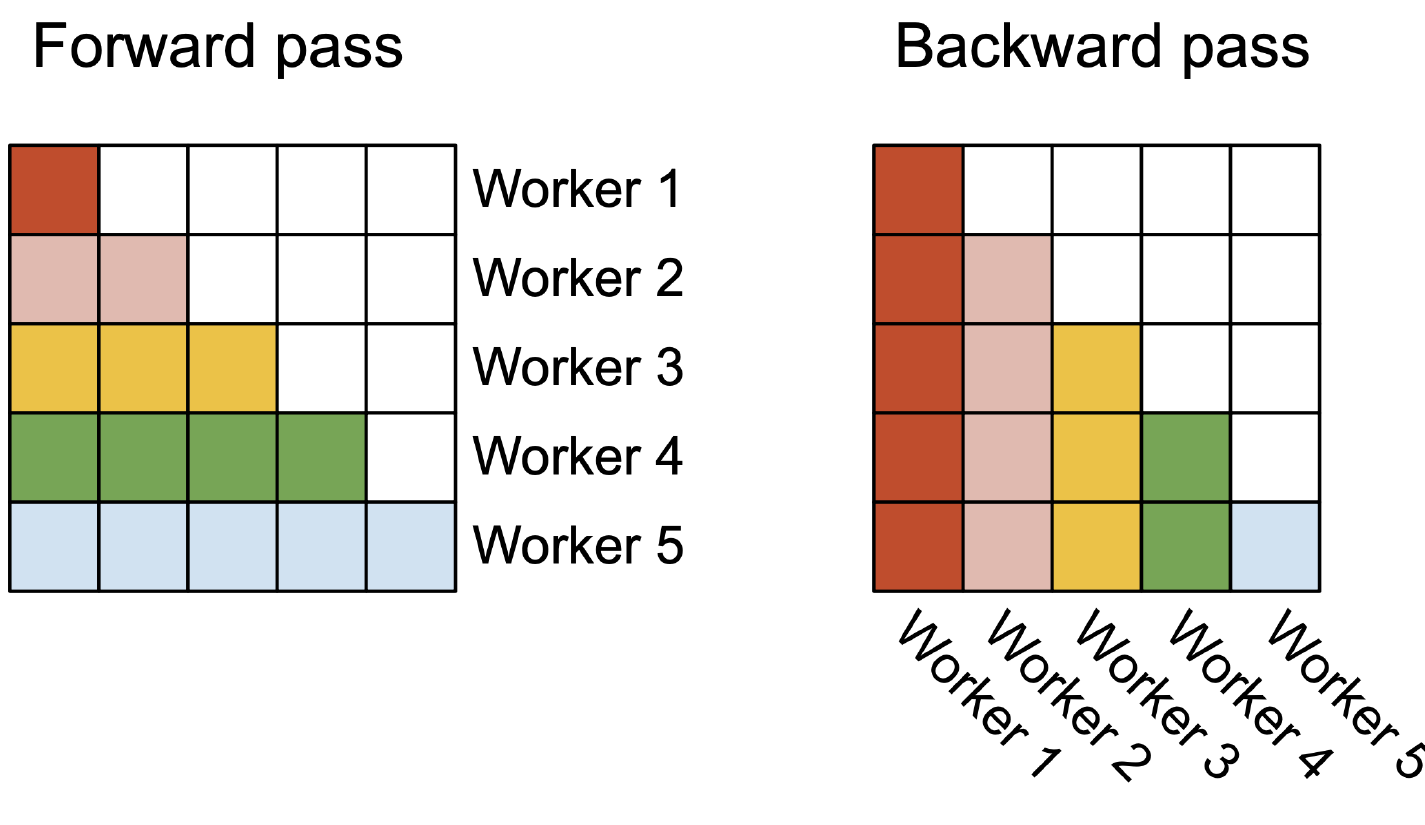
Source: FlashAttention-2, Figure 2. This is a source-reported partition schematic reproduced for technical commentary, not a literal CUDA grid or warp map and not a local measurement. Algorithm 1’s query-owner schedule explains the forward half; section 0x06.1 reconstructs the different backward write-conflict graph.
The formula and implementation are therefore not separate worlds. The formula determines the row state that must survive. The paper schedule chooses its owner. The historical kernel chooses dtypes, predicates, buffering, traversal order, and output conversion. Profiling is still required to determine what the device actually moved.
0x04 Launch Geometry Is A Resource Contract
Section 0x03 established one independent owner for each query-row block. That is an
algorithmic parallelism statement. A GPU launch needs a stricter chain:
logical tensor axes
    -> launched CTA coordinates
    -> active versus early-return CTAs
    -> threads and warps inside one CTA
    -> shared-memory and compiled-register demand
    -> resident CTAs per SM
    -> rounded waves across the device
M4.2 owns the generic CUDA residency model. M4.4 now applies that model to the historical FA2 forward kernel. It does not repeat the full CUDA programming model, and it does not substitute a paper tile for compiled resource metadata.
0x04A The Historical Grid Has Three Independent Axes
The paper writes T_r independent query blocks. The pinned v2.0.0 launch
template realizes them as the x dimension of a three-dimensional CUDA grid:
const int num_m_block =
    (params.seqlen_q + Kernel_traits::kBlockM - 1)
    / Kernel_traits::kBlockM;

dim3 grid(num_m_block, params.b, params.h);

kernel<<<grid,
         Kernel_traits::kNThreads,
         Kernel_traits::kSmemSize,
         stream>>>(params);
The mapping is exact for that historical source:
blockIdx.x -> query-row tile m_block
blockIdx.y -> batch item bidb
blockIdx.z -> query head bidh
Therefore:
Renderer-safe launch formulas:
T_r          = ceil_div(S_q, B_r)
grid         = (T_r, B, H_q)
launched CTA = T_r * B * H_q
For B=1, H_q=32, S_q=4096, and B_r=128:
grid = (32, 1, 32)
N_CTA,launch = 32 * 1 * 32 = 1,024
At S_q=1, the same specialization still launches one query tile per query
head:
grid = (1, 1, 32)
N_CTA,launch = 32
That is the exact arithmetic behind the later decode boundary. It is not yet an occupancy statement: a grid can expose 1,024 CTAs while resource limits allow only a small number to reside on each SM.
The head axis remains H_q, not H_kv. In the kernel, query head bidh maps
to K/V head bidh / h_h_k_ratio. GQA therefore changes K/V indexing and reuse,
but this v2.0.0 launch still creates one owner per query head and query tile.

The visual is a source-derived ownership reconstruction, not a literal lane map. The exact CUTE fragments depend on the selected trait; compiled register allocation still requires a build artifact.
0x04B Launched, Active, Full, And Useful Are Different Counts
For fixed-length input, every valid query block has work unless the key sequence
is empty. Packed variable-length batches are different. v2.0.0 launches from the
declared maximum seqlen_q, then the kernel checks the actual sequence lengths:
if (m_block * kBlockM >= binfo.actual_seqlen_q
    || binfo.actual_seqlen_k == 0) {
    return;
}
So four populations must not be conflated:
launched CTA: grid coordinate exists
active CTA:   survives the kernel-entry early return
full CTA:     owns B_r valid query rows
tail CTA:     owns fewer than B_r valid query rows
The executable packed fixture uses:
B=3, H_q=8, B_r=128
declared maximum S_q=512
actual S_q=[512,257,0]
actual S_k=[512,193,256]
The launch is:
grid = (4,3,8)
launched CTAs = 4 * 3 * 8 = 96
But only:
active CTAs after early return = 56
early-return CTAs              = 40
full query-tile CTAs           = 48
tail query-tile CTAs           = 8
The active CTAs expose 7,168 query-row slots, of which 6,152 are valid.
The remaining 1,016 rows are predicates inside the eight tail CTAs. A profiler
can still see launched blocks and instructions associated with checks; a tensor
ledger should count only valid rows. Both coordinates are useful, but they
answer different questions.
0x04C One CTA Is A Compile-Time Trait, Not Just A Query Tile
The v2.0.0 forward trait turns four template choices into a block:
Flash_fwd_kernel_traits<
    kHeadDim,
    kBlockM,
    kBlockN,
    kNWarps,
    Is_Q_in_regs,
    Share_Q_K_smem,
    Element>
The thread count is derived, not independently tuned:
4 warps -> 128 threads
8 warps -> 256 threads
The selected trait also fixes:
B_r: rows of Q and O owned by the CTA
B_c: K/V rows consumed per inner-loop iteration
d:   compile-time head-dimension specialization
Q/K/V shared-memory layouts and swizzles
CUTE tensor-core partition across warps
128-bit global-memory copy layout
The active v2.0.0 branches are not one universal tile:
| Historical branch | (d,B_r,B_c,warps) | Threads | Source-selection reason |
|---|---|---|---|
d=64, no dropout | (64,128,128,4) | 128 | selected active branch; comments reject slower alternatives for the tested case |
d=128, SM80 no dropout | (128,128,64,4) | 128 | A100-class branch |
d=128, SM86/SM89 non-causal | (128,128,32,4) | 128 | source comment targets two CTAs/SM with 48 KiB SMEM |
d=128, SM86/SM89 causal | (128,64,64,4) | 128 | square causal tile selected in source |
d=224, high-SMEM branch | (224,128,64,8) | 256 | selected only when the opt-in per-block limit admits 112 KiB |
d=224, fallback | (224,64,64,4) | 128 | lower per-block shared-memory demand |
d=256, A100 branch | (256,128,64,8) | 256 | source chooses 128 KiB on A100-class resources |
These are version-scoped implementation facts from commit
4f285b354796fb17df8636485b9a04df3ebbb7dc, not recommendations for a
current backend. The branch comments contain historical tuning observations;
they do not establish performance on another compiler, GPU, sequence shape, or
FlashAttention release.
0x04D Shared Memory Follows Tensor Lifetimes
For two-byte FP16/BF16 elements and the active default
Share_Q_K_smem=false, the forward trait computes:
Renderer-safe shared-memory derivation:
S_Q     = B_r * d * bytes_element
S_KV    = 2 * B_c * d * bytes_element
S_block = S_Q + S_KV                 # default active branches
S_KV contains one K tile and one V tile. It is not the full sequence. S_Q
contains the query-owner tile. The score fragment, probability fragment, row
maximum, denominator, and output numerator are predominantly accumulator or
register state in the source organization rather than additional persistent
shared-memory matrices.
At the epilogue, the kernel writes the output accumulator through an sO
shared-memory view. That view reuses the already allocated dynamic arena after
the K/V loop; it is not added to kSmemSize as another simultaneously live
B_r x d allocation. This is why a storage formula must follow lifetimes, not
sum every tensor name that appears anywhere in the kernel.
If Share_Q_K_smem=true, the trait instead uses:
but the source contract forces Q into registers before K/V reuse that storage. Shared-memory saving therefore exchanges one resource for register pressure; it does not make the Q tile disappear.
The checked active configurations produce:
| Configuration | S_Q | S_KV | S_block |
|---|---|---|---|
d=64, 128x128, 4 warps | 16 KiB | 32 KiB | 48 KiB |
d=128, 128x64, 4 warps | 32 KiB | 32 KiB | 64 KiB |
d=128, 128x32, 4 warps | 32 KiB | 16 KiB | 48 KiB |
d=224, 128x64, 8 warps | 56 KiB | 56 KiB | 112 KiB |
d=224, 64x64, 4 warps | 28 KiB | 56 KiB | 84 KiB |
d=256, 128x64, 8 warps | 64 KiB | 64 KiB | 128 KiB |
0x04E Feasibility Comes Before Occupancy
A candidate cannot be assigned an occupancy percentage until it is a legal launch. At minimum, check:
threads per CTA <= architectural per-block limit
dynamic SMEM per CTA <= opt-in per-block limit
head dimension satisfies tensor/copy-layout divisibility
thread count satisfies Q/K/V and P copy-layout divisibility
at least one CTA fits all SM resources after compilation
The historical launch path performs two notable CUDA calls:
if (smem_size >= 48 * 1024) {
    cudaFuncSetAttribute(
        kernel,
        cudaFuncAttributeMaxDynamicSharedMemorySize,
        smem_size);
}

cudaOccupancyMaxActiveBlocksPerMultiprocessor(
    &ctas_per_sm,
    kernel,
    Kernel_traits::kNThreads,
    smem_size);
The first opts the kernel into a larger dynamic shared-memory allocation. The second asks CUDA about the compiled kernel function on the selected device, using its thread count and dynamic SMEM. CUDA defines the result as the maximum active blocks per SM for that function and launch configuration. The current CUDA programming guidance also makes the missing dependency explicit: compiled register and shared-memory usage are required for occupancy calculation.
The v2.0.0 source stores ctas_per_sm only as a local diagnostic variable; the
checked source does not emit it into an article, log, or result tensor. This
repository did not build the extension or execute that API. Any numeric resident
CTA count below is therefore either a static ceiling or an explicitly declared
sensitivity scenario.
For the device limits used in the oracle:
A100 / compute capability 8.0:
    108 SMs
    64 resident warps/SM
    2,048 resident threads/SM
    32 resident CTAs/SM architectural limit
    65,536 32-bit registers/SM
    164 KiB shared memory/SM
    163 KiB maximum opt-in shared memory/CTA

generic compute capability 8.6 profile:
    48 resident warps/SM
    1,536 resident threads/SM
    16 resident CTAs/SM architectural limit
    65,536 32-bit registers/SM
    100 KiB shared memory/SM
    99 KiB maximum opt-in shared memory/CTA
The A100 SM count comes from NVIDIA’s A100 architecture whitepaper. The SM resource limits come from NVIDIA’s Ampere Tuning Guide. They describe hardware ceilings, not this kernel’s achieved occupancy.
0x04F A Static Ceiling Is Not The Compiled Residency
Specializing M4.2’s general resource model to a selected FA2 CTA gives:
This deliberately excludes registers. With a compiled
R_thread and a declared allocation model, a first-order register term is:
Actual allocation rounds registers at architecture-specific granularities, so
the CUDA occupancy API or occupancy calculator remains authoritative for the
compiled binary. The source’s C++ template tells us accumulator shapes and
ElementAccum=float; it does not tell us the final allocated registers per
thread after compilation.
The corresponding warp-occupancy ceiling is:
Using the declared A100 limits, while explicitly excluding compiled registers:
| Historical configuration | Static CTA ceiling | First limiter | Static warp-occupancy ceiling |
|---|---|---|---|
d=64, 128x128, 4 warps, 48 KiB | 3 | shared memory | 18.75% |
d=128, 128x64, 4 warps, 64 KiB | 2 | shared memory | 12.50% |
d=224, 128x64, 8 warps, 112 KiB | 1 | shared memory | 12.50% |
d=224, 64x64, 4 warps, 84 KiB | 1 | shared memory | 6.25% |
d=256, 128x64, 8 warps, 128 KiB | 1 | shared memory | 12.50% |
For the d=64 case, preserving three CTAs under the unrounded register model
would require no more than floor(65536/(3*128)) = 170 registers per thread.
The fixture does not assume that condition. For d=128, the analogous simple
threshold for two CTAs is 256, but the hardware maximum is 255; allocation
rounding and the compiled function still belong to the CUDA calculator rather
than prose inference.
The evidence ladder is:
source traits:
    tile, warps, threads, dynamic SMEM

compiled metadata:
    registers/thread, static SMEM, spills, target architecture

occupancy API/calculator:
    theoretical resident CTAs and warps for that binary and device

profiler:
    achieved active/eligible/issued warps, stall reasons, throughput
This section has the first layer and a static device-limit calculation. It has not collected the last three layers locally.
0x04G Resource Trade-Offs Explain The Configuration Matrix
Changing a tile changes several constraints at once:
increase B_r:
    fewer grid CTAs
    more Q/output accumulator state per CTA
    more Q shared memory

increase B_c:
    fewer K/V loop iterations
    more K/V shared memory
    larger score/probability fragments

increase warps:
    more threads and possible intra-CTA parallel work
    more resident warps per CTA
    different fragment ownership and possible register pressure

share Q/K shared memory:
    lower dynamic SMEM
    Q must survive in registers
The source itself records rejected alternatives. For d=64, a 256x64 tile
was reported 85% slower at sequence length 2K in the source comment because of
register spilling. For d=128, commented eight-warp alternatives were reported
28% slower for the same source-local test shape. These are historical tuning
notes, not portable benchmark claims, but they expose the mechanism:
more rows or more warps can increase parallel work
while simultaneously increasing live fragments, register demand, or spills
The d=224 branch queries maximum opt-in shared memory before choosing between
112 KiB / 8 warps and 84 KiB / 4 warps. The d=256 branch queries both
per-block and per-SM shared memory before choosing a 128 KiB A100-oriented
tile or a smaller-row alternative intended to permit two CTAs on hardware with
a larger SM budget. M4.6 owns the later Hopper pipeline consequences; M4.4 uses
this branch only to show that hardware resources participate in dispatch.
0x04H Device Waves Are Quantized
Suppose a compiled occupancy result admits N_res CTAs per SM on a device with
N_SM SMs. The simultaneous CTA-slot envelope is:
For N_launch query-owner CTAs, an equal-duration wave model gives:
The last wave contains:
and its slot fill is:
Renderer-safe wave formulas:
CTA slots      = N_SM * resident_CTA_per_SM
rounded waves  = ceil_div(launched_CTA, CTA_slots)
last-wave CTA  = launched_CTA - (waves - 1) * CTA_slots
last-wave fill = last-wave CTA / CTA_slots
Use the paper’s A100-class device count, the d=128,128x64,4-warp source
configuration, and a declared sensitivity scenario of two resident CTAs per
SM. This scenario matches the static SMEM ceiling, but no compiled occupancy
result was collected here:
N_SM = 108
resident CTA/SM scenario = 2
C_CTA = 216 slots
B=1, H_q=32, B_r=128
S_q | Query blocks | Launched CTAs | Rounded waves | Last-wave CTAs | Last-wave fill | Rounded slot fill |
|---|---|---|---|---|---|---|
| 1 | 1 | 32 | 1 | 32 | 14.81% | 14.81% |
| 768 | 6 | 192 | 1 | 192 | 88.89% | 88.89% |
| 769 | 7 | 224 | 2 | 8 | 3.70% | 51.85% |
| 2,048 | 16 | 512 | 3 | 80 | 37.04% | 79.01% |
| 4,096 | 32 | 1,024 | 5 | 160 | 74.07% | 94.81% |
The first full 216-slot wave requires:
so the smallest sequence length exposing at least that many query blocks is:
That same 769 case crosses a quantization boundary: 768 launches 192 CTAs
and fits in one wave; one additional valid query row creates a seventh tile per
head, 224 CTAs, and a second wave with only eight CTAs in this envelope.
If the compiled kernel admitted only one CTA per SM, the same 4,096-token case would have 108 slots and ten rounded waves rather than five. This sensitivity is why wave arithmetic must consume a compiled residency result, not infer it from tile names.

Wave count is not latency. It ignores overlap, scheduling order, unequal CTA duration, cache state, memory-system contention, and instruction dependencies. It is a launch-capacity diagnostic.
0x04I Causal CTAs Break The Equal-Duration Wave Model
For square causal attention, query block i visits only K/V blocks that can
contain visible keys. In the pinned kernel:
n_block_max = min(
    ceil_div(S_k, B_c),
    ceil_div((i+1)*B_r, B_c)
)
With S_q=S_k=4096, B_r=128, and B_c=64, the 32 query blocks perform:
K/V iterations per query block:
2, 4, 6, ..., 64

minimum / maximum: 2 / 64
longest-to-shortest ratio: 32x

causal total per head:    1,056 K/V-tile iterations
non-causal total per head: 2,048 K/V-tile iterations
ratio:                     51.5625%
The CTA resource footprint is chosen at launch; the early block does not return most of its registers or shared memory merely because its causal loop is short. Yet its duration can be much shorter than the final query block. CUDA does not promise grid scheduling order, so grouping CTAs into equal-duration waves is no longer a timeline prediction. A trace or profiler is required to observe actual tail behavior.
Packed inputs add another distortion. In the fixture’s two-CTA-per-SM scenario, the grid launches 96 CTAs into 216 slots, a nominal 44.44% one-wave fill. Only 56 CTAs survive entry checks, a 25.93% useful-CTA fill before query-row and K/V tails are considered. Reporting only the grid count would hide that gap.
0x04J Executable Resource Evidence And Failure Closure
The launch/resource evidence package adds:
launch_resource_fixture.json
launch_resource_oracle.py
launch_resource_report.json
test_launch_resource_oracle.py
The oracle checks:
the exact v2.0.0 grid and trait-derived thread count
Q plus K/V shared-memory formulas and lifetime aliasing
per-block feasibility under declared CC 8.0 and CC 8.6 limits
static CTA ceilings without inventing compiled registers
one-CTA and two-CTA residency sensitivity
the 768 -> 769 wave boundary
packed launched/active/full/tail CTA populations
causal 2 -> 64 inner-loop iteration imbalance
Run it with:
python3 -m unittest -v \
  docs/numinens-evidence/m4-4-flashattention2-work-partition/test_launch_resource_oracle.py
This is a synthetic contract test. It does not compile v2.0.0, inspect
ptxas register metadata, execute
cudaOccupancyMaxActiveBlocksPerMultiprocessor, collect Nsight counters, or
measure latency.
| Failure | Broken coordinate | Repair |
|---|---|---|
call B H_q ceil(S_q/B_r) occupancy | grid population is not resident warps | compute compiled per-SM residency first |
call kSmemSize the complete resource footprint | registers and allocation granularity are missing | add compiled metadata and occupancy API result |
| add Q, K, V, and epilogue O SMEM as simultaneously live | ignores arena reuse after the K/V loop | derive peak from lifetimes in kernel_traits.h and flash_fwd_kernel.h |
| infer register count from accumulator tensor shape | compiler allocation, temporary liveness, and spills are hidden | use ptxas --resource-usage or a compiled function attribute |
| call a two-CTA scenario measured occupancy | turns a declared sensitivity into a runtime fact | label the scenario and preserve the unmeasured status |
| report grid CTAs as useful work for packed input | ignores entry returns and tail rows | report launched, active, full, tail, and valid-row coordinates |
| treat rounded waves as elapsed time | assumes equal CTA duration and known scheduling | combine waves with trace/profiler evidence |
| assume causal halves every CTA equally | hides a 2-to-64 K/V-loop range in the fixture | retain per-query-block work |
This completes the inter-CTA launch and resource contract. The next section moves inside one CTA and asks how its warps divide Q, K, V, score, and output fragments.
0x05 Warp Partitioning Is An Output-Ownership Contract
Section 0x04 stopped at the CTA boundary. For one grid coordinate, the historical
forward kernel has already selected a query tile, batch item, and query head.
The remaining question is smaller in scale but not in consequence:
Which warp owns each query row, which operands are shared, and how many producers must be merged before one output row is valid?
The FlashAttention-2 paper compares two answers. Its older illustrated plan splits K/V across warps; its replacement splits Q. Calling those plans “split-K” and “split-Q” is only shorthand. Their actual difference is the output conflict graph:
split-K:
    W warps contribute to the same output row
    -> W producers, then an inter-warp reduction

split-Q:
    one warp owns each output row and scans all K/V tiles for it
    -> one producer, no inter-warp output-row reduction
That distinction recovers the mechanism explained in A19 while correcting one dangerous simplification. The paper says there is no need for communication between warps to add the illustrated partial outputs. It does not say that the complete CTA stops using shared memory, barriers, or lane-level reductions.
0x05A Figure 3 Is A Reduction Graph, Not A Literal Lane Map
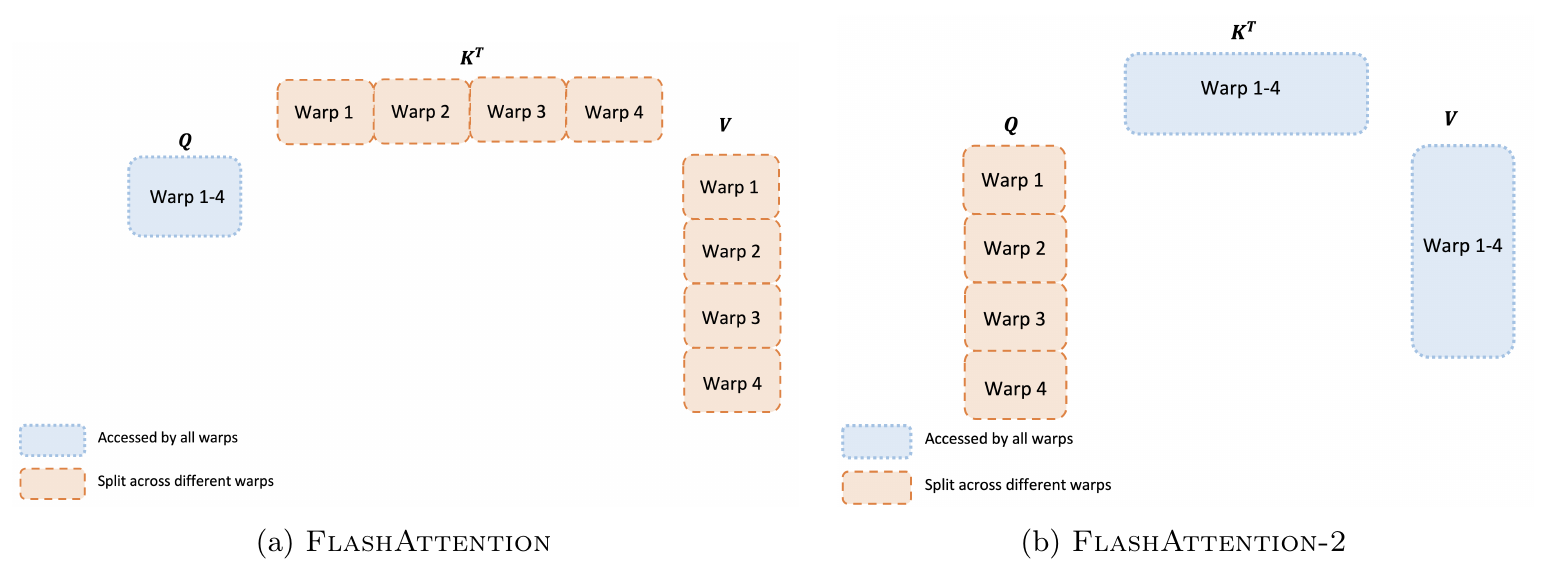
Source: FlashAttention-2, Figure 3. This source-reported conceptual comparison gives the left plan overlapping output ownership and the right plan disjoint query/output slices. It does not specify the CuTe lane layout of every specialization and is not local runtime evidence.
For one query tile Q_i, one K/V tile, and W warps, the two plans can be
written as an ownership table:
| Plan | Operand visible to every warp | Per-warp operand | Producers per output row | Required output-row action |
|---|---|---|---|---|
| illustrated split-K | Q_i | disjoint K_w,V_w slices | W | write partials, synchronize, reduce |
| illustrated split-Q | staged K_j,V_j | disjoint Q_w rows and their row state | 1 | write the owned row; no cross-warp row merge |
The paper’s performance argument is then precise: after FA1 removes the large
HBM materialization of S and P, FA2 removes an avoidable on-chip partial
output reduction from the forward warp plan.
0x05B Split-K Gives One Row Several Producers
Let the key indices be partitioned into disjoint sets
J_0,...,J_{W-1}. For query row i, warp w sees only its key/value slice
and can form a stable local state:
Every u_i^(w) targets the same final output row. The states are also in
different maximum frames, so averaging the locally normalized outputs is not
valid. They first need one common frame:
Renderer-safe merge contract:
m_i = max_w m_i^(w)
l_i = sum_w exp(m_i^(w) - m_i) * l_i^(w)
u_i = sum_w exp(m_i^(w) - m_i) * u_i^(w)
O_i = u_i / l_i
If globally normalized P already existed, the value product alone could be
written as O_i = sum_w P[i,J_w] @ V[J_w]. Fused attention does not begin
with that global P; its row maximum and denominator are part of the state
that must be reconciled. The exact merge above makes the hidden dependency
explicit. It is the same associative state algebra derived in M4.3, applied
here to simultaneous warp producers rather than sequential K/V tiles.
The executable fixture uses four query rows, eight keys, a value width of three, and four two-key partitions. Across all rows:
maximum error, exact split-K state merge vs dense: 2.22e-16
maximum error, average of four local outputs:       1.1794
output producers per row:                           4
binary merges required per row:                     3
For the first row, the result is:
dense output:       [0.947517, 0.664354, -0.216300]
exact merged output:[0.947517, 0.664354, -0.216300]
naive local average:[0.729781, 0.831874,  0.006329]
The toy is not a model of FA1’s physical shared-memory layout. It proves the semantic conflict: partitioning the reduction axis gives several partial row states that cannot independently become final output rows.
0x05C Split-Q Gives Every Output Row One Warp Owner
Now partition the query rows into disjoint sets I_w. Warp w owns:
Q[I_w, :]
row maxima m[I_w]
row denominators l[I_w]
unnormalized outputs u[I_w, :]
final O[I_w, :] and LSE[I_w]
The CTA cooperatively stages each K/V tile, and every warp consumes that tile for its own rows. The per-warp recurrence is:
for warp in warps:
    rows = I_w
    m, l, u = empty_row_state(rows)

    for K_blk, V_blk in shared_kv_stream:
        S = Q[rows] @ K_blk.T
        m, l, u = online_update(m, l, u, S, V_blk)

    O[rows] = u / l[:, None]
For I_0,...,I_3 = {0},{1},{2},{3} in the fixture, each output row has one
producer and matches the dense reference exactly. There is nothing to combine
with another warp because no other warp owns that row.

The reconstruction has a different job from paper Figure 3. Figure 3 records the historical design comparison. This visual exposes the exact state merge, the number of output producers, and the boundary of the communication claim.
0x05D Reduction Topology Changes Depth, Not The Ownership Conflict
With W partial states, an exact binary reduction needs W-1 merges per
output row regardless of topology:
The topology changes the critical path:
serial collector: depth = W - 1
balanced tree:    depth = ceil(log2(W)) for a power-of-two tree
For B_r=128, d_v=128, W=4, and FP32 (m,l,u) state:
state width                         = d_v + 2 = 130 FP32 values
partial row states                  = 128 * 4 = 512
binary state merges                 = 128 * 3 = 384
non-owner semantic payload floor    = 128 * 3 * 130 * 4 B
                                    = 199,680 B = 195 KiB
all partial states written once     = 128 * 4 * 130 * 4 B
                                    = 266,240 B = 260 KiB
serial depth / balanced-tree depth  = 3 / 2
This is a semantic payload envelope, not a profiler count and not a claim
that historical FA1 physically wrote this exact (m,l,u) representation.
Bank layout, vectorization, staging reuse, reduction topology, and whether a
component remains in registers determine real shared-memory transactions. The
ledger exists to show why “only on-chip” is not the same as “free.”
Split-Q removes those 384 cross-warp output-state merge edges for the
illustrated row tile. It does not remove its operand movement:
one staged K/V tile at B_c=64, d=128, FP16/BF16:
    2 * 64 * 128 * 2 B = 32 KiB

one Q tile at B_r=128, d=128, FP16/BF16:
    128 * 128 * 2 B = 32 KiB

one epilogue O staging tile at the same shape:
    128 * 128 * 2 B = 32 KiB
Those are logical tensor payloads for one selected trait, not measured bank transactions. K/V are staged cooperatively once per CTA iteration; saying “every warp sees K/V” must not be misread as four independent HBM loads.
0x05E The Pinned v2.0.0 Trait Places Warps Along Query Rows
The paper establishes the design. The historical source pin shows one concrete
realization. In
kernel_traits.h,
the forward tensor-core layout is:
using TiledMma = TiledMMA<
    typename Base::MMA_Atom_Arch,
    Layout<Shape<Int<kNWarps>, _1, _1>>,
    typename Base::ValLayoutMNK>;
The warp replication is on the first MMA dimension, M, which corresponds to
query/output rows. It is not on the N key-column dimension. That source fact
is the implementation-level split-Q contract.
The same forward kernel gives a source-visible causal-mask row seed:
row_seed = (tidx / 32) * 16 + (tidx % 32) / 4;
row_stride = kNWarps * 16;
For the active A100 d=128, B_r=128, B_c=64, four-warp specialization:
| Warp | Unique query/output rows derived from the source layout | Row count |
|---|---|---|
0 | 0-15, 64-79 | 32 |
1 | 16-31, 80-95 | 32 |
2 | 32-47, 96-111 | 32 |
3 | 48-63, 112-127 | 32 |
The non-contiguous row bands matter. Figure 3’s four clean horizontal slices
are an ownership illustration, not a promise that every specialization stores
one contiguous quarter per warp. For B_r=64 with four warps, the same source
formula gives contiguous 16-row ranges. For B_r=128 with eight warps, it
also gives 16 rows per warp. All three checked specializations cover the
complete row tile with zero cross-warp row overlap.
At lane granularity, four lanes cooperate over columns for each row seed. In
the B_r=128, four-warp case, lanes 0-3 of warp 0 touch row set
{0,8,64,72} across the repeated MMA-M positions. The pinned
softmax.h
reduces each row maximum and sum with Allreduce<4>. That is a four-lane
intra-warp reduction, not the cross-warp partial-output reduction that split-Q
removes.
0x05F One K/V Iteration Has A Fragment-Level Ownership Trace
The pinned forward source can be followed without pretending CUTE tensors are ordinary contiguous arrays:
// All CTA threads partition cooperative global -> shared copies.
auto copy_qkv = GmemTiledCopyQKV{}.get_thread_slice(tidx);
tQgQ = copy_qkv.partition_S(gQ);  tQsQ = copy_qkv.partition_D(sQ);
tKgK = copy_qkv.partition_S(gK);  tKsK = copy_qkv.partition_D(sK);
tVgV = copy_qkv.partition_S(gV);  tVsV = copy_qkv.partition_D(sV);

// The TiledMma gives each thread fragments in the warp's M-row ownership.
auto thr_mma = tiled_mma.get_thread_slice(tidx);
tSrQ = thr_mma.partition_fragment_A(sQ);
tSrK = thr_mma.partition_fragment_B(sK);
tOrV = thr_mma.partition_fragment_B(sV_transposed);
acc_o = partition_fragment_C(tiled_mma, Shape<B_r, d>{});

for each visible K/V tile:
    wait_for_shared_K();
    acc_s = Q_fragment @ K_fragment.T;       // FP32 score fragment
    mask_invalid_score_elements(acc_s);
    wait_before_reusing_KV_shared_storage();
    P, m, l = row_softmax_and_rescale(acc_s, m, l, acc_o);
    acc_o += P_fragment @ V_fragment;        // owned output rows only

normalize_owned_rows(acc_o, l);
The important tensor facts are:
| Object | Logical tile | Source-visible location during the step | Ownership |
|---|---|---|---|
sQ | [B_r,d] | dynamic shared memory; optionally copied into registers | CTA-staged, warp-row consumed |
sK,sV | [B_c,d] each | dynamic shared memory | CTA-staged, visible to all warp row owners |
acc_s | per-thread fragment of [B_r,B_c] | FP32 registers | query-row fragment plus key-column lanes |
scores_max,scores_sum | row-state fragments | FP32 registers | same warp as the output row |
tOrP | converted probability fragment | registers | transient input to P-V MMA |
acc_o | per-thread fragment of [B_r,d] | FP32 registers across K/V iterations | disjoint warp-row ownership |
There is no shared-memory write of four overlapping acc_o row states followed
by a cross-warp add. The output accumulator remains with its row owner while
K/V tiles stream.

0x05G No Output Reduction Does Not Mean No CTA Communication
The pinned source still contains several coordination mechanisms:
GmemTiledCopyQKVpartitions Q/K/V copies across all CTA threads.cp_async_wait<...>()and__syncthreads()protect K/V shared-memory production, consumption, and reuse in the inner loop.- Row softmax uses four-lane
Allreduce<4>operations for maxima and sums. - The epilogue converts FP32
acc_ofragments, writes them to sharedsO, synchronizes, then repartitionssOfor a coalesced global-memory write. - When Q and K share the same shared-memory arena, another synchronization
protects the lifetime transition before
sOreuses that arena.
So the precise claim is:
removed:
    cross-warp reduction of overlapping forward output-row partials

retained:
    cooperative operand staging
    shared-memory lifetime barriers
    lane-level row reductions
    epilogue shared-memory permutation and synchronization
This distinction is also why counting __syncthreads() occurrences cannot by
itself measure the optimization. The semantic purpose, dependency path, and
bytes protected by a barrier matter more than the source token count.
0x05H Alternative Choices Move Pressure Rather Than Erase It
| Choice | Advantage | New or retained pressure | Appropriate boundary |
|---|---|---|---|
| split-K inside one CTA | exposes parallel key-reduction work | overlapping row state and reduction | historical comparison in this section |
| split-Q inside one CTA | disjoint output rows; no output-state merge | all owners consume staged K/V; rows per warp shrink with more warps | FA2 forward path |
| four versus eight warps | more warp-level work can cover larger tiles | more threads, registers, and resource pressure per CTA | 0x04 trait matrix |
smaller B_r | more CTAs and simpler row ownership | less reuse and more launch/tail overhead | 0x04 wave sensitivity |
| split K/V across CTAs | recovers parallelism when query rows collapse | global partial-state merge and scheduler/backend contract | M4.5 |
| producer/consumer warp specialization | overlaps movement and compute on newer hardware | explicit pipeline stages and architecture-specific synchronization | M4.6 |
Split-Q is therefore not “the universally best axis.” It is the forward prefill answer when enough query rows exist inside the CTA. At one-token decode, that row-parallel surface collapses; M4.5 owns the exact K/V-split alternative and its partial-state merge rather than duplicating it here.
0x05I Executable Ownership Evidence And Failure Closure
The ownership evidence is reproducible with:
python3 -m unittest -v \
  docs/numinens-evidence/m4-4-flashattention2-work-partition/test_warp_partition_oracle.py
The checked artifacts are:
warp_partition_fixture.json
warp_partition_oracle.py
warp_partition_report.json
test_warp_partition_oracle.py
They verify exact split-K state merging, the failure of naive local normalization, split-Q single-producer ownership, the declared communication envelope, and source-derived row coverage for three v2.0.0 traits. This remains a synthetic contract test plus version-scoped source inspection. It does not emulate CUTE register fragments, provide a compiled register map, compile CUDA, count physical shared-memory transactions, or measure latency.
| Failure | Broken contract | Repair |
|---|---|---|
| average locally normalized split-K outputs | local partitions use different maxima and denominators | merge (m,l,u) in one maximum frame |
| call each split-K partial a final output row | W warps write the same semantic row | expose producer multiplicity and reduction |
| say every split-Q warp reloads K/V from HBM | confuses shared visibility with global duplication | trace cooperative CTA staging into sK/sV |
| say FA2 has no inter-warp communication | generalizes one removed reduction to the whole CTA | inventory remaining staging, barriers, lane reductions, and epilogue |
| draw Figure 3 as a literal lane map | hides specialization-dependent CUTE layouts | derive row sets from the pinned trait and source indices |
| call the 195/260 KiB envelope measured traffic | converts semantic state volume into hardware transactions | require compiled kernel and profiler counters |
| reuse forward split-Q ownership for backward | ignores dQ/dK/dV write conflicts | derive Algorithm 2 separately in 0x06.1 |
The key result is now stronger than “split Q is faster”:
FA2 changes the number of producers per forward output row from many to one.
That removes one exact reduction graph while preserving the CTA communication
needed to feed tensor cores and commit the owned rows.
Did The New Ownership Actually Move Throughput?
The work-partition argument is useful only if it survives measurement. The FlashAttention-2 paper benchmarks forward plus backward across causal and non-causal attention, two head dimensions, and several sequence lengths:
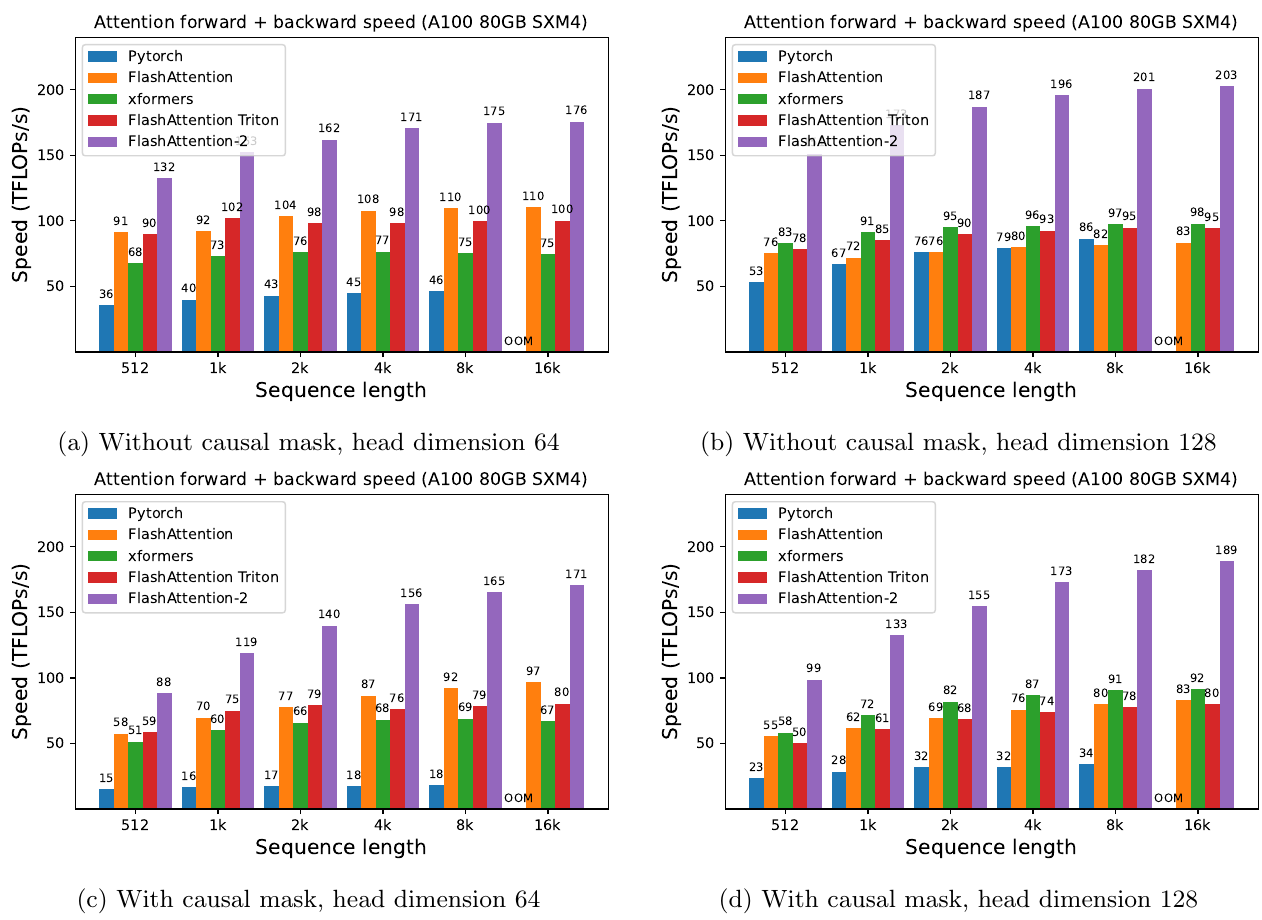
Source: FlashAttention-2: Faster Attention with Better Parallelism and Work Partitioning, Figure 4. These are paper-reported TFLOPs/s on one A100 80GB SXM4 benchmark configuration; they compare the implementations available to the authors at publication time and are not a current backend ranking.
Across the four panels, the purple FlashAttention-2 bars stay above the FlashAttention-1 and Triton baselines. The important connection to the previous sections is causal, not merely chronological:
FA1:
    fixes the dominant global-memory schedule

FA2:
    then exposes more thread-block work
    and reduces intra-block communication

measurement:
    checks whether those ownership changes raise achieved throughput
The chart still does not select a kernel for a new workload. Head dimension, mask mode, dtype, GPU generation, backward requirements, and framework dispatch remain part of that decision.
Backward Uses A Different Ownership Problem
Forward can assign one query block to one program because that program owns the
corresponding O_i rows. Backward has three different output axes:
dQ_i += dS_ij @ K_j
dK_j += dS_ij.T @ Q_i
dV_j += P_ij.T @ dO_i
No two-dimensional tile can be the unique owner of all three. A query-tile
owner can commit dQ_i directly but collides on dK_j/dV_j; a K/V-tile owner
can commit dK_j/dV_j directly but collides on dQ_i.
The paper chooses K/V-column workers and states that their dQ contributions
communicate through atomic adds. The historical source turns that sentence into
a preprocessing kernel, an FP32 atomic scratch tensor, a column-owner main
kernel, a conversion kernel, and a separate grouped-head reduction. Section
0x06.1 derives that full contract after causal and grouped coordinates have
been established.
The immediate lesson is narrower: “split Q in forward” is not a complete training schedule. Backward changes the write-conflict graph.
0x05.1 Causal Tile Geometry Is A Coordinate Contract
A19 correctly introduced causal masking as schedule work: whole-future tiles can be skipped, old-history tiles need no element mask, and only the boundary band needs element predicates. The missing step was to derive those classes from integer coordinates and to state which diagonal convention the kernel implements.
0x05.1A One Cell Predicate Determines Every Tile Class
Let a query tile i and key tile j use half-open logical ranges:
with:
Use an alignment offset delta and declare a score cell visible when:
Renderer-safe coordinate contract:
q tile: [q0, q1)
k tile: [k0, k1)
visible(q, k) iff k <= q + delta

top-left diagonal:    delta = 0
bottom-right diagonal: delta = S_k - S_q
For square self-attention, S_q = S_k, so both conventions reduce to
k <= q. Rectangular attention is where version and API semantics become
observable.
0x05.1B Full, Partial, And Skipped Follow From Range Extremes
A tile is fully visible only when its largest key index is visible to its smallest query index:
It is fully future only when its smallest key index is later than its largest query index:
Everything else intersects the causal boundary and needs an element mask:
def classify_causal_tile(q0, q1, k0, k1, delta):
    if k0 > (q1 - 1) + delta:
        return "skipped_future"
    if (k1 - 1) <= q0 + delta:
        return "full_visible"
    return "partial_mask"
This is more general than the shorthand j < i, j = i, j > i used for
aligned square tiles. If B_r != B_c, one query tile can intersect several key
tiles along the diagonal. If either sequence has a tail, tile ordinal alone no
longer states how many valid rows or columns exist.
0x05.1C Tail Shape And Causal Class Are Independent Predicates
Four questions must remain separate:
is the query tile short because q1 == S_q?
is the key tile short because k1 == S_k?
is the whole tile causally visible, partial, or future?
which head and batch item own this tile?
A tail tile can be fully visible. For S_q=S_k=257, B_r=128, and
B_c=64, the last coordinate is one cell:
query range: [256,257)
key range:   [256,257)
causal class: full_visible, because 256 <= 256
tail class: both query-tail and key-tail
Calling every tail a diagonal partial tile would conflate storage bounds with attention semantics.
0x05.1D The Pinned Kernel Culls Whole-Future Tiles Before QK^T
The historical v2.0.0 forward kernel computes:
n_block_max = ceil_div(actual_seqlen_k, kBlockN);
if (Is_causal) {
    n_block_max = min(
        n_block_max,
        ceil_div((m_block + 1) * kBlockM, kBlockN)
    );
}
For its top-left diagonal, query block m_block therefore visits only:
Future blocks beyond that limit never enter the QK^T loop. This is actual
work culling, not merely multiplying computed probabilities by zero later.
The source then traverses K/V blocks in reverse. It applies element masking to:
ceil(B_r / B_c) near-diagonal iterations in causal mode
the final K/V tail iteration in non-causal mode
and runs older, fully visible history tiles through an unmasked loop. In the
mask helper, every lane-derived score coordinate is set to -INFINITY when:
col_idx >= min(actual_seqlen_k, row_idx + 1)
The mask therefore executes before softmax_rescale_o computes the local
maximum and denominator. If future scores enter either reduction, masking the
output afterward cannot repair the denominator.
0x05.1E A Square 4096-Token Ledger Shows Tile Quantization
The executable fixture uses:
S_q = S_k = 4096
B_r = 128
B_c = 64
query tiles = 32
key tiles   = 64
The dense tile rectangle has 32 * 64 = 2,048 coordinates. Exact
classification gives:
| Tile class | Count | Kernel consequence |
|---|---|---|
| fully visible | 992 | run QK, softmax update, and PV without causal element predicates |
| partial causal | 64 | run the tile and set future score cells to -inf before row reductions |
| fully future | 992 | skip the complete QK/PV tile |
The source-visible K/V-loop counts are:
2, 4, 6, ..., 64
sum: 1,056 visited K/V tiles per query head
mask-loop iterations: 64
At cell granularity:
dense rectangle:                  16,777,216 cells
causally allowed:                  8,390,656 cells
visited rectangle after tile skip: 8,650,752 cells
visited but element-masked:          260,096 cells
The allowed count is exactly 4096 * 4097 / 2. The difference between
8,650,752 visited rectangle cells and 8,390,656 allowed cells is the
quantized diagonal-band tax. “Causal is half the FLOPs” is therefore an
asymptotic intuition, not a literal kernel ledger.
For the 257-token dual-tail fixture, the 3 x 5 grid contains:
7 full-visible tiles
4 semantic partial tiles
4 skipped-future tiles
11 source-visited tiles
6 source mask-loop iterations
There are six mask-loop iterations but only four semantically partial tiles because the source keeps a fixed two-tile causal mask band and the final tail coordinate is fully visible. Schedule masking work and semantic tile class are related, not identical.

The reconstruction is informed by the FlashAttention-2 causal-masking note,
A19’s causal introduction, pinned source, and
causal_gqa_report.json. It is not a measured instruction trace.
0x05.1F v2.0 And v2.1 Give Rectangular Causal Calls Different Meanings
The historical kernel pin uses delta=0: the triangle begins at the top-left.
The official FlashAttention changelog states that version 2.1 changed
rectangular causal masks to bottom-right alignment:
For S_q=2, S_k=5:
v2.0 top-left:       v2.1 bottom-right:
1 0 0 0 0            1 1 1 1 0
1 1 0 0 0            1 1 1 1 1
For S_q=5, S_k=2:
v2.0 top-left:       v2.1 bottom-right:
1 0                  0 0
1 1                  0 0
1 1                  0 0
1 1                  1 0
1 1                  1 1
This is a semantic API change, not a floating-point implementation detail. The square training case is unchanged; rectangular prefix/decode-style calls must name the alignment convention in tests and runtime records.
0x05.1G Source-Reported Causal Speedup Is Not A Geometry Theorem
The FlashAttention-2 paper reports roughly 1.7-1.8x causal speedup over its
non-causal attention path for the discussed settings. That result is
source-reported, not derivable from “half the matrix” alone. The measured
ratio also includes:
diagonal-band QK/PV work
element predicates and row reductions
CTA launch and wave quantization
non-matmul scalar work
memory and synchronization behavior
the paper's exact shapes, dtypes, kernels, and A100 hardware
The geometric oracle proves cell and tile counts. It does not predict the paper’s runtime.
0x06 Prefill MQA/GQA Is A Head-Ownership Contract
Prefill supplies many query rows, but MQA and GQA change which K/V head those rows read. Let:
Q: [B, S_q, H_q,  d_h]
K: [B, S_k, H_kv, d_h]
V: [B, S_k, H_kv, d_v]
O: [B, S_q, H_q,  d_v]
The output and LSE remain query-head objects. K/V storage uses H_kv heads.
0x06A Divisibility Produces The Direct Head Map
The admissibility condition is:
Define the contiguous group size:
Then query head h_q reads:
Renderer-safe form:
assert H_q % H_kv == 0
g = H_q // H_kv
kv_head = q_head // g
For H_q=16, H_kv=4, and g=4:
Q heads  0  1  2  3 -> KV head 0
Q heads  4  5  6  7 -> KV head 1
Q heads  8  9 10 11 -> KV head 2
Q heads 12 13 14 15 -> KV head 3
MQA is the endpoint H_kv=1; all query heads map to K/V head zero. MHA is the
other endpoint H_kv=H_q; g=1 and every query head maps to itself.
0x06B One Historical Docstring Reverses The Divisibility Sentence
At commit 4f285b3, the Python examples correctly map six query heads onto two
K/V heads, but their sentence says the number of K/V heads must be divisible by
the number of query heads. The pinned C++ admission check is the reverse:
TORCH_CHECK(
    num_heads % num_heads_k == 0,
    "Number of heads in key/value must divide number of heads in query"
);
The example, C++ check, and kernel address calculation agree on
H_q % H_kv == 0. This is why source reconstruction cannot treat comments,
wrapper text, and executable guards as interchangeable evidence.
0x06C Forward Does Not Materialize Repeated K/V Heads
The historical launch grid remains:
grid.x = ceil_div(S_q, B_r)  # query tile
grid.y = B                   # batch item
grid.z = H_q                 # query/output head
Inside one CTA, bidh = blockIdx.z is a query head. The wrapper stores:
h_h_k_ratio = H_q / H_kv
and the forward kernel forms K/V addresses with:
kv_head = bidh / params.h_h_k_ratio;
row_offset_k = ... + kv_head * params.k_head_stride;
row_offset_v = ... + kv_head * params.v_head_stride;
The tensor trace is therefore:
for batch in range(B):
    for q_head in range(H_q):
        kv_head = q_head // g
        for q_tile in range(ceil_div(S_q, B_r)):
            Q_i = Q[batch, q_tile, q_head]
            K_group = K[batch, :, kv_head]
            V_group = V[batch, :, kv_head]
            O[batch, q_tile, q_head] = exact_tiled_attention(Q_i, K_group, V_group)
No [B,S_k,H_q,d_h] K/V tensor is required in forward. The executable parity
fixture compares this direct map with explicit K/V repetition for
H_q=6, H_kv=2, g=3 and obtains zero binary64 error. Replacing contiguous
division with the shape-valid but wrong map q_head % H_kv produces maximum
output error 0.11 in the same fixture.
0x06D Reduced Storage Does Not Automatically Produce Grouped CTA Reuse
Consider:
B = 2
S_q = S_k = 257
B_r = 128
B_c = 64
H_q = 16
Every MHA, GQA, or MQA case launches:
programs, because the grid owns query/output heads, not stored K/V heads.
| Design | H_kv | g | Forward programs | Unique (batch,kv_head,q_tile) coordinates | Q-head CTAs sharing each coordinate |
|---|---|---|---|---|---|
| MHA | 16 | 1 | 96 | 96 | 1 |
| GQA | 4 | 4 | 96 | 24 | 4 |
| MQA | 1 | 16 | 96 | 6 | 16 |
Across five K/V tiles, the query-head CTA schedule performs 480 logical K/V tile visits in all three cases. The unique grouped coordinates are 480, 120, and 30 respectively. That ratio identifies a reuse opportunity. It is not a claim that GQA causes exactly four HBM reads or MQA sixteen: L2/cache residency, CTA order, and later fused kernels determine physical traffic.
The historical FA2 mapping is a simple, correct alternative:
one CTA owns one query head
several CTAs may address the same stored K/V head
no cross-CTA output reduction is needed
A head-group-fused alternative can place several query heads that share one K/V head in the same work unit, trading a more complex tile and more live query state for stronger explicit K/V reuse. M5.7 owns that grouped-kernel and persistent-cache analysis.
0x06E Backward Must Reduce The Implicitly Shared Heads
Forward uses one stored K/V head as input to g independent query-head
outputs. By the chain rule, every one of those output paths contributes to the
same learned K/V head:
The pinned C++ wrapper makes the ownership conflict explicit. When
H_kv != H_q, it allocates expanded gradient buffers shaped by H_q, lets the
backward path produce query-head-indexed contributions, reshapes them as:
dK_expanded: [B, S_k, H_q, d_h]
    -> [B, S_k, H_kv, g, d_h]

dV_expanded: [B, S_k, H_q, d_v]
    -> [B, S_k, H_kv, g, d_v]
and sums the group axis. For the oracle’s six-query-head fixture:
expanded dK rows by Q head:
    [1,2], [2,4], [3,6], [4,8], [5,10], [6,12]

reduced dK by KV head:
    KV0 <- Q0+Q1+Q2 = [6,12]
    KV1 <- Q3+Q4+Q5 = [15,30]
Forward index sharing and backward gradient summation are two sides of one
trained ownership contract. Section 0x06.1 derives Algorithm 2’s Q/K/V block
owners, atomics, and reduction alternatives; this section establishes the
final MQA/GQA head-group reduction that composes with that schedule.

This visual reconstructs the mechanism described by FlashAttention-2 and A19’s MQA/GQA section. MQA’s bandwidth motivation comes from Shazeer; GQA’s trained middle point comes from Ainslie et al. Checkpoint conversion, quality, cache bytes, decode reuse, and tensor-parallel placement remain in M5.7.
0x06F Causal, Grouped, And Packed Coordinates Compose Per Sequence
For variable-length batches, BlockInfo derives actual query and K/V extents
from cumulative sequence offsets before the kernel computes tile bounds. The
complete prefill owner key is therefore:
(batch/packed-sequence, query head, query tile)
    -> K/V head = query_head // g
    -> actual S_q and S_k for this sequence
    -> causal alignment and tile class
Using a global maximum sequence length for every packed item would launch
early-return CTAs and could apply the wrong causal geometry if actual lengths
are ignored. Using H_kv as the output-head grid would omit query-head outputs.
The sequence and head maps are independent axes that meet only in the final
address calculation.
0x06G Executable Geometry And Ownership Evidence
The causal/GQA contract is backed by:
causal_gqa_fixture.json
causal_gqa_oracle.py
causal_gqa_report.json
test_causal_gqa_oracle.py
The evidence class is synthetic contract test plus version-scoped source inspection. It proves:
tile classification from integer ranges
historical source visit and mask-band counts
v2.0/v2.1 rectangular mask matrices
direct grouped forward parity against explicit repetition
failure of a wrong but shape-valid head map
expanded-to-grouped dK/dV reduction
prefill-to-decode query-program collapse
It does not compile the extension, observe cache hits, count HBM transactions, or measure speedup.
| Failure | Broken contract | Repair |
|---|---|---|
| mask scores after rowmax | forbidden scores already changed maximum and denominator | predicate score fragments before online-softmax update |
classify tiles only by i and j | wrong for unequal tile sizes, tails, or rectangular alignment | derive from half-open integer ranges |
| assume every source mask-loop tile is semantically partial | fixed mask band and tails can include fully visible work | report semantic class and schedule path separately |
| run rectangular causal attention without naming alignment | v2.0 and v2.1 compute different masks | pin version and delta convention |
use q_head % H_kv | shape-valid wrong K/V ownership | enforce contiguous q_head // g map |
launch output programs over H_kv | missing query-head outputs | retain H_q as output-owner axis unless a fused kernel owns all grouped queries |
| call direct indexing guaranteed K/V reuse | storage reduction is mistaken for traffic measurement | inspect chosen schedule and profiler bytes |
| skip grouped gradient sum | K/V receives only one query path’s gradient | reduce expanded dK/dV across group axis |
0x06.1 Algorithm 2 Backward Is A Reduction-Topology Contract
The forward pass has one semantic output family, O, indexed by query row.
Backward must produce three families with two incompatible ownership axes:
dQ follows query rows
dK follows key rows
dV follows value rows, which share the key-row axis
This section owns the prefill/training backward schedule. It derives the
probability reconstruction, maps Algorithm 2 to tensors and lifetimes, traces
the active historical v2.0.0 launch, distinguishes atomicity from numerical
determinism, and compares alternative owner axes. It does not claim that this
historical source is the current backend, and it does not move one-token cache
backward into M4.4.
0x06.1A D_i = dO_i dot O_i Eliminates A Materialized Softmax Reduction
Start with one head, no dropout, and the forward pass’s score scale tau (not
the maximum-frame rescale factor alpha of 0x02):
The direct derivatives are:
The only non-obvious term is dS. For one query row, the softmax Jacobian is:
Contracting that Jacobian with the incoming row dP gives:
The row scalar appears to require reconstructed P and dP over the complete
key axis. Associativity exposes a cheaper saved-output identity:
Define:
Then every score tile can reconstruct its local derivative with the same row scalar:
Renderer-safe contract:
S      = tau * Q @ K.T
P_ij   = exp(S_ij - LSE_i)
dP_ij  = dot(dO_i, V_j)
D_i    = dot(dO_i, O_i) = sum_j P_ij * dP_ij
dS_ij  = P_ij * (dP_ij - D_i)

dQ = tau * dS @ K
dK = tau * dS.T @ Q
dV = P.T @ dO
O and rowwise LSE are therefore sufficient saved forward statistics for
this reconstruction. The quadratic S, P, dP, and dS objects remain
logical tensors; each tile is recomputed and expires on chip. Dropout adds
Philox replay and scaling to this path, but it does not change the owner-axis
conflict derived below.
0x06.1B Algorithm 2 Names A Column Owner Before It Names A CUDA Grid
Let:
T_r = ceil(S_q / B_r) query tiles
T_c = ceil(S_k / B_c) K/V tiles
Algorithm 2 places the K/V tile loop outside the query-tile loop. Its storage contract is:
| Algorithm stage | Tensor view | Typical source dtype | Lifetime and owner |
|---|---|---|---|
| partition inputs | Q_i,O_i,dO_i:[B_r,d], K_j,V_j:[B_c,d] | element dtype | logical views; no movement yet |
| saved statistics | LSE_i,D_i:[B_r] | FP32 | query-row state loaded for each visible pair |
| recomputed score state | S_ij,P_ij,dP_ij,dS_ij:[B_r,B_c] | FP32 accumulation with element fragments for tensor-core paths | one tile iteration |
| local K/V gradients | acc_dK_j,acc_dV_j:[B_c,d] | FP32 accumulators | live across all visible query tiles for column j |
| query contribution | Delta dQ_i^(j):[B_r,d] | FP32 | one (i,j) pair; must join other columns |
| final outputs | dQ:[S_q,d], dK,dV:[S_k,d] | requested element dtype | HBM outputs after reduction/conversion |
Paper lines 5-18 can be read as one transaction:
choose K/V column j
    load K_j and V_j once
    initialize dK_j and dV_j once
    stream every visible query tile i
        reconstruct P_ij and dS_ij
        accumulate dK_j and dV_j locally
        contribute to dQ_i
    commit dK_j and dV_j once
That outer-loop choice makes one worker the natural owner of dK_j/dV_j.
The paper’s sequential pseudocode reads, updates, and writes dQ_i for every
column. The parallel implementation cannot use an ordinary read-modify-write,
because multiple column workers can reach the same dQ_i concurrently.
0x06.1C The Gradient Equations Define The Producer Graph
At tile granularity define:
The complete gradients are reductions over opposite axes:
V(i) is the set of K/V tiles visible to query tile i; V(j) is the set of
query tiles that can see K/V tile j. The conflict cannot be removed by naming
one two-dimensional score tile as owner:
| Main CTA owner | Direct single-writer outputs | Cross-CTA reduction |
|---|---|---|
K/V column (j,b,h_q) | expanded dK_j, expanded dV_j | dQ_i across K/V columns |
query row (i,b,h_q) | dQ_i | dK_j, dV_j across query rows and grouped query heads |
one complete head (b,h_q) | expanded dQ,dK,dV | grouped-head sum only |
This is a conservation rule: changing the owner axis moves the reduction. It does not make all three outputs single-writer at once.
0x06.1D The Active Historical Source Is A Three-Kernel Column-Owner Pipeline
At commit 4f285b3, run_flash_bwd unconditionally calls
run_flash_bwd_seqk_parallel. For one specialization, the launch sequence is:
1. preprocess
   grid = (ceil(S_q/B_r), B, H_q)
   compute D = rowsum(dO * O)
   clear FP32 dQaccum

2. main column-owner kernel
   grid = (ceil(S_k/B_c), B, H_q)
   one CTA owns (K/V tile j, batch b, query head h_q)
   accumulate expanded dK_j/dV_j locally
   atomicAdd every dQ_i contribution into FP32 dQaccum

3. dQ conversion
   grid = (ceil(S_q/B_r), B, H_q)
   load FP32 dQaccum, apply final scale, cast, write dQ

4. wrapper-level GQA/MQA closure when H_q != H_kv
   reshape expanded dK/dV over [H_kv, g]
   sum the g query-head contributions
The three CUDA launches are ordered on the same stream. The preprocessing launch establishes zeroed atomic destinations before the main grid, and the conversion launch reads them only after the main grid has completed. No CTA in the main grid waits for another CTA or assumes which one runs first.

The diagram reconstructs source ownership and tensor state. It is not a CUDA timeline, a physical-traffic trace, or a current-backend claim.
0x06.1E One Active CTA Reconstructs Five Matmul-Shaped Paths
For main-program coordinate (n_block,b,h_q), the historical kernel computes:
j       = n_block
h_kv    = floor(h_q / g)
K_j,V_j = K/V[b, j, h_kv]
It retains FP32 acc_dk and acc_dv across visible query blocks. For each
query block, processed in reverse order, it performs the five backward
matmul-shaped operations counted by the paper:
1. recompute S_ij = tau * Q_i @ K_j.T
2. compute    dP_ij = dO_i @ V_j.T
3. accumulate dV_j += P_ij.T @ dO_i
4. accumulate dQ_i += tau * dS_ij @ K_j
5. accumulate dK_j += tau * dS_ij.T @ Q_i
The softmax tile is reconstructed from S_ij and LSE_i; causal and tail
predicates run before invalid entries can contribute. P and dS use shared
memory as layout bridges between MMA paths. sP and sdQ alias storage at
different lifetimes, so the barriers around their reuse are correctness
barriers, not decorative synchronization.
Conceptual source-faithful pseudocode:
def backward_column_owner(params, b, q_head, kv_tile):
    kv_head = q_head // params.group_size
    K_j = load_K(b, kv_head, kv_tile)
    V_j = load_V(b, kv_head, kv_tile)
    acc_dK = fp32_zeros([B_c, d])
    acc_dV = fp32_zeros([B_c, d])

    for q_tile in visible_query_tiles_reverse(kv_tile):
        Q_i, dO_i = load_main_query_state(b, q_head, q_tile)
        LSE_i = load_lse(b, q_head, q_tile)
        D_i = load_D(b, q_head, q_tile)

        S_ij = tau * Q_i @ K_j.T
        S_ij = apply_tail_and_causal_mask_before_exp(S_ij)
        P_ij = exp(S_ij - LSE_i[:, None])  # undropped
        # Z_ij: 0/1 mask, each entry kept with probability keep
        # (Z_ij = 1 and keep = 1 without dropout)
        Z_ij = replay_optional_dropout_mask(b, q_head, q_tile, kv_tile)

        dP_ij = (dO_i @ V_j.T) * Z_ij / keep
        dS_ij = P_ij * (dP_ij - D_i[:, None])

        acc_dV += (P_ij * Z_ij / keep).T @ dO_i
        acc_dK += tau * dS_ij.T @ Q_i
        # The scratch omits tau, which conversion applies; dS_ij already
        # carries 1/keep, so conversion must not apply it again.
        atomic_add_fp32(dQaccum[i], dS_ij @ K_j)

    store_element_dtype(dK_expanded[b, q_head, kv_tile], acc_dK)
    store_element_dtype(dV_expanded[b, q_head, kv_tile], acc_dV)
Under dropout the two paths need different probabilities. dV needs the
dropped P_ij*Z_ij/keep that formed O, while dS needs the undropped
P_ij with the masked and rescaled dP_ij. With this dP_ij,
D_i=dot(dO_i,O_i)=sum_j P_ij*dP_ij still holds, because O is the dropped
output. v2.0.0 places the 1/keep factor
differently: it marks dropped elements in the sign bit of the recomputed P,
masks dP without 1/keep, and scales D by keep in the preprocessing
kernel. Its loop therefore produces keep*dS_ij and keep*dV_j. It applies
1/keep once at the end: together with tau to dK and, during conversion,
to dQaccum, and alone to dV. Both placements give the same gradients.
The paper estimates backward FLOPs as 2.5x forward because backward has five
matmuls including score recomputation while forward has two. That is a
paper-reported FLOP convention, not a runtime theorem: exponentials, masks,
dropout replay, atomics, conversions, launch overhead, and grouped reduction
are outside the simple 5 / 2 ratio.
0x06.1F Atomic Add Solves Lost Updates, Not Reduction Ordering
An ordinary update is unsafe:
dQaccum[row, col] += contribution
Suppose two column CTAs both read zero and independently compute +0.75 and
-0.20. If their ordinary stores race and the second writer wins:
correct sum:  0.55
stored value: -0.20
absolute error from lost update: 0.75
The source instead selects GmemTiledCopydQaccumAtomicAdd and issues scalar
FP32 atomicAdd operations for dQaccum. CUDA
defines atomicAdd as one atomic read-modify-write at an address, so neither
contribution is lost. Atomicity does not impose a fixed order across CTAs. The
CUDA programming model permits thread blocks to run in any order, and FP32
addition is not associative. The oracle’s explicit order example gives:
float32((1e20 + -1e20) + 1) = 1
float32((1e20 + 1) + -1e20) = 0
Therefore:
atomicity contract:
    every producer contributes exactly once to one address

numerical-order contract:
    arrival order is not fixed by the grid

determinism contract:
    bitwise repeatability is not established by atomicAdd
A deterministic alternative can materialize one partial tensor per producer and reduce those partials in a fixed tree. That replaces atomic contention and unordered arrival with more scratch storage, more writes, a reduction launch, and a prescribed summation tree. It is a design alternative, not the active historical path.
0x06.1G Causality Makes Producer Multiplicity Triangular
Use a square four-by-four tile grid with B_r=B_c=128. Under top-left causal
semantics, the visible tile pairs are:
q0 <- k0
q1 <- k0,k1
q2 <- k0,k1,k2
q3 <- k0,k1,k2,k3
The active column-owner main grid still launches one CTA per K/V tile and query
head. Its logical dQ producer multiplicity is:
| Query tile | Column CTAs contributing to its dQ rows |
|---|---|
q0 | 1 |
q1 | 2 |
q2 | 3 |
q3 | 4 |
Each expanded dK_j/dV_j tile still has one main-kernel writer: that owner
loops over all query tiles that can see j. The inactive row-owner alternative
reverses the triangular pattern. Before grouped heads are considered, K/V tile
producer counts become [4,3,2,1].
The diagonal tile still needs element predicates. Tile-level producer counts say which CTAs may contribute to an output tile; they do not say every score cell within the tile is visible or that every atomic experiences equal contention.

0x06.1H GQA Adds A Head Reduction After The Tile Reduction
The active main grid uses H_q, not H_kv:
grid = (T_c, B, H_q)
For GQA group size g=H_q/H_kv, query heads in one group read the same stored
K/V head but follow different query paths. To keep main-kernel writes
single-owner, the wrapper supplies element-dtype expanded buffers:
dK_expanded: [B,S_k,H_q,d]
dV_expanded: [B,S_k,H_q,d]
The main CTA (j,b,h_q) writes its own expanded slice directly. After the
kernel, the wrapper performs:
[B,S_k,H_q,d]
    -> reshape [B,S_k,H_kv,g,d]
    -> sum axis g
    -> [B,S_k,H_kv,d]
Two independent reductions now exist:
tile-axis reduction:
    K/V-column CTAs atomicAdd into dQaccum across j

head-group reduction:
    expanded dK/dV query-head slices sum across g
Calling both simply “the backward reduction” hides their different axes, dtypes, synchronization mechanisms, and storage costs.
0x06.1I The Source Contains A Row-Owner Alternative, But Does Not Dispatch It
The pinned source also contains a sequence-Q-parallel helper and launcher. Its
dispatch and required dKaccum/dVaccum wrapper allocations are commented out
at this pin, so this is a dormant implementation branch rather than a ready
runtime choice. If completed and selected, it would:
clear FP32 dKaccum and dVaccum over (K/V tile, batch, H_kv)
launch one main CTA over (query tile, batch, H_q)
compute dQ directly for that query tile
atomicAdd dK/dV contributions into grouped K/V scratch
convert FP32 dKaccum/dVaccum to output dtype
For the oracle coordinate:
B=1, H_q=8, H_kv=2, g=4
S_q=S_k=512, B_r=B_c=128
the non-causal owner counts are:
| Schedule | Direct owner | Atomic producer multiplicity |
|---|---|---|
| active column owner | expanded dK/dV | each dQ tile receives 4 column CTAs |
| row-owner alternative | dQ | each final grouped dK/dV tile receives 4 query tiles * g=4, or 16 CTA paths |
For the causal coordinate, the row-owner K/V multiplicities become
[16,12,8,4]. That path can avoid an explicit expanded-head reduction by
accumulating directly into H_kv scratch, but it moves atomics onto two output
families and combines sequence and head-group contention.
The run_flash_bwd body calls the sequence-K path unconditionally at this
historical pin; the sequence-Q dispatch is commented out. Its presence is
evidence for a considered implementation alternative, not evidence that the
alternative ran in published benchmarks.
The broader design space is:
| Design | Parallel surface | Reduction cost | Main trade-off |
|---|---|---|---|
| one CTA per complete query head | B*H_q | no tile-axis global atomics | poor occupancy for small batch/head count and long sequences |
| K/V-column CTAs | B*H_q*T_c | FP32 atomic dQ, then optional GQA group sum | active historical FA2 choice |
| query-row CTAs | B*H_q*T_r | FP32 atomic dK/dV, naturally targets H_kv scratch | source-present inactive alternative |
| per-producer partial tensors plus fixed reduction | configurable | extra storage, writes, and reduction kernels | deterministic order is possible |
This comparison also prevents a terminology error. FA2 avoids a split-K
warp partition for an MMA output tile, but its active backward schedule
still splits the sequence-K axis across CTAs and reduces their dQ
contributions atomically. Warp-level split-K and a grid-level sequence-K split
are different hierarchy levels.
0x06.1J Scratch Memory Is Part Of The Algorithm Contract
For:
B=1, H_q=32, H_kv=8, g=4
S_q=S_k=4096, d=128
B_r=B_c=128
element dtype=2 bytes, accumulator dtype=4 bytes
the active historical source-level ledger is:
| Object | Shape | Width | Size |
|---|---|---|---|
dQaccum | [1,32,4096,128] | FP32 | 64 MiB |
D / softmax_d | [1,32,4096] | FP32 | 0.5 MiB |
dK_expanded | [1,4096,32,128] | element dtype | 32 MiB |
dV_expanded | [1,4096,32,128] | element dtype | 32 MiB |
one final grouped dK or dV | [1,4096,8,128] | element dtype | 8 MiB |
The declared backward scratch subset is therefore:
declared backward scratch subset = 128.5 MiB
It excludes Q/K/V/O/dO, saved LSE, final gradients, allocator effects, shared memory, registers, and any framework reduction workspace. “FlashAttention uses linear memory” does not mean “backward has no material scratch.” These objects are linear in sequence length, but their head and width multipliers matter.
The same coordinate launches:
1,024 preprocess programs
1,024 column-owner main programs
1,024 dQ-conversion programs
plus the grouped dK/dV reductions
For non-causal attention, each dQ element has 32 K/V-tile producers. The
oracle’s one-logical-add-per-element ledger contains 536,870,912 FP32 dQ
element updates. Top-left causal tiling reduces the corresponding full-tile
ledger to 276,824,064. These counts describe logical atomic update slots in
the reconstructed schedule. They do not measure coalescing, cache sectors,
atomic serialization, contention latency, or executed tail instructions.
0x06.1K Executable Backward Evidence And Failure Closure
The backward-ownership contract is reproducible with:
python3 -m unittest -v \
  docs/numinens-evidence/m4-4-flashattention2-work-partition/test_backward_ownership_oracle.py
The checked artifacts are:
backward_ownership_fixture.json
backward_ownership_oracle.py
backward_ownership_report.json
test_backward_ownership_oracle.py
They prove binary64 reference-gradient parity for column- and row-owner
schedules, causal and grouped producer multiplicities, the declared scratch
ledger, a lost-update failure, and an FP32 order-sensitivity example. Pinned
source inspection separately establishes the active launcher, grids, atomic
target, conversion path, direct expanded dK/dV commits, and grouped wrapper
sum.
They do not compile the extension, count executed atomics, measure contention, profile memory traffic, or establish bitwise determinism.
| Failure | Broken contract | Repair |
|---|---|---|
parallel column CTAs use ordinary dQ += partial | read-modify-write races lose contributions | clear FP32 scratch, then use device-wide atomic adds |
| convert each partial to FP16/BF16 before global accumulation | repeated low-precision rounding changes the reduction | accumulate shared dQ state in FP32, then convert once |
| call atomic addition deterministic | atomicity is confused with a fixed summation order | report numerical tolerance or use a fixed reduction tree |
let two column CTAs write final dK_j/dV_j | K/V ownership was not preserved | keep all visible query tiles inside one column owner |
launch column owners over H_kv in GQA | query-head gradient paths disappear | launch over H_q, then reduce expanded K/V gradients across g |
| skip the preprocessing clear | atomic scratch begins from undefined data | preserve launch ordering and explicit zero initialization |
| call source-present row ownership active | helper code is mistaken for selected dispatch | inspect run_flash_bwd, not only available templates |
treat 5/2 as measured slowdown | matmul FLOPs omit scalar, atomic, conversion, and launch work | keep the ratio as a paper FLOP convention and benchmark the full path |
| say FA2 eliminates split-K everywhere | warp-level work partition is conflated with grid-level sequence splitting | name hierarchy, owner, target, and reduction separately |
0x06.2 One Backward CTA Is A Storage-Lifetime Contract
Section 0x06.1 established the grid-level owner: one active main CTA owns one K/V
column tile for one (batch,query_head) coordinate. That is not yet an
implementation trace. Inside that CTA, five MMA paths need incompatible output
shapes, P and dS need shared-memory layout bridges, dK and dV remain
live across the complete query loop, asynchronous copies need publication
edges, and several logical tensors deliberately reuse the same byte interval.
This section owns those CTA internals for the pinned v2.0.0 source. It derives
declared dynamic shared memory, source-visible barrier hazards, CuTe atom
replication, and source-named accumulator-fragment pressure. It does not
claim a compiled register count, spill count, bank-conflict count, achieved
occupancy, or barrier latency. Those require a built kernel and profiler
evidence.
0x06.2A The Active Template Disables Two Source Branches
The active sequence-K launcher instantiates the main helper as:
compute_dq_dk_dv_1colblock<
    Kernel_traits,
    Is_dropout,
    Is_causal,
    false,  // Is_first
    false,  // Is_last
    true    // Seq_parallel
>(params, bidb, bidh, n_block);
Those booleans change the live storage graph:
| Template fact | Consequence in the active main CTA |
|---|---|
Is_first=false | D=rowsum(dO*O) is loaded from the preprocessing kernel; this CTA does not use the source branch that recomputes and stores it |
Is_last=false | the shared sdQ output path is inactive; each query-tile contribution is atomically added to FP32 dQaccum |
Seq_parallel=true | the CTA directly commits its expanded dK/dV column after the reverse query loop |
In other words, D is produced by the preprocessing kernel, while this active main CTA consumes it.
The source still declares storage for branches used by other template
combinations. Reading every declared pointer as simultaneously live would
overstate the active path. In particular, sdQ points at the same shared
address as sP, but the active Is_last=false main CTA never materializes a
shared dQ tile there.
0x06.2B Five MMA Paths Need Three Warp-Replication Layouts
For one visible query tile, let:
Q,dO : [B_r,d]
K,V  : [B_c,d]
S,P,dP,dS : [B_r,B_c]
The CTA executes five matmul-shaped paths:
| Path | Contraction | FP32 C-accumulator shape | Lifetime |
|---|---|---|---|
| score | Q @ K.T | [B_r,B_c] | one query-tile iteration; transformed into probability state |
| probability gradient | dO @ V.T | [B_r,B_c] | one iteration; transformed pointwise into dS |
| value gradient | P.T @ dO | [B_c,d] | acc_dV persists across all query tiles |
| query contribution | dS @ K | [B_r,d] | one iteration; then atomic-adds to global FP32 scratch |
| key gradient | dS.T @ Q | [B_c,d] | acc_dK persists across all query tiles |
One warp arrangement is not assumed to fit all three output geometries. The pinned trait declares:
TiledMmaSdP: (AtomLayoutMSdP, warps/AtomLayoutMSdP, 1)
TiledMmadKV: (AtomLayoutNdKV, warps/AtomLayoutNdKV, 1)
TiledMmadQ:  (AtomLayoutMdQ,  warps/AtomLayoutMdQ,  1)
For the high-shared-memory d=128 specialization
(B_r=64,B_c=128,W=8), the three CuTe replication shapes are:
score and dP: (2,4,1)
dK and dV:    (4,2,1)
dQ:           (2,4,1)
These tuples describe CTA-level replication of an MMA atom. They are not a literal lane-to-element map. Such a map also depends on the selected MMA atom, copy atoms, fragment layouts, dtype, and compiler lowering.

0x06.2C Shared Memory Is Derived From Simultaneous Lifetimes
Let one element occupy b_e bytes. The Q/dO prefix contains either one or two
Q stages plus one dO tile:
The remaining logical tile sizes, in elements, are:
When V remains in shared memory, all four intervals are retained in the main arena:
When Is_V_in_regs=true, every thread captures its V fragment before dS is
published. The former V interval can then become the start of sdS, so the
post-Q/dO arena is the larger of the original K/V pair and the K plus derived
state:
Renderer-safe formulas:
QdO elements = B_r*d*(2 if single-buffer Q else 3)
KV elements  = 2*B_c*d
dS elements  = B_r*B_c
P elements   = B_r*B_c

shared-V total = bytes * (QdO + KV + dS + P)
V-in-reg total = bytes * (QdO + max(KV, B_c*d + dS + P))
For element width 2 bytes:
| Specialization | Q/dO prefix | Post-prefix arena | Dynamic shared memory |
|---|---|---|---|
d=128, B_r=64, B_c=128, double Q, shared V | 48 KiB | K/V 64 + dS 16 + P 16 = 96 KiB | 144 KiB |
d=128, B_r=64, B_c=64, double Q, V in registers | 48 KiB | max(K/V 32, K 16 + dS 8 + P 8) = 32 KiB | 80 KiB |
d=256, B_r=B_c=64, double Q, shared V | 96 KiB | 80 KiB | 176 KiB |
same d=256 tile, single Q, shared V | 64 KiB | 80 KiB | 144 KiB |
The lower-memory branches do not perform the same schedule with free savings.
The d=128 fallback also shrinks B_c and keeps V in registers. The d=256
fallback removes one Q stage, reducing overlap and introducing a loop-carried
reuse barrier.
0x06.2D An Alias Is Valid Only After Its Last Reader
The source maps pointers into one dynamic shared-memory allocation. In the double-buffer, shared-V case, the conceptual address order is:
[ Q stage 0 ][ Q stage 1 ][ dO ][ K ][ V ][ dS ][ P / inactive sdQ ]
With V captured in registers, sdS starts where sV started:
[ Q stage 0 ][ Q stage 1 ][ dO ][ K ][ V then dS ][ P / inactive sdQ ]
After the reverse query loop, the epilogue reinterprets the K/V-and-derived arena:
old [ K ][ V / dS ][ P ]
new [ dK ][ dV ]
Three different alias contracts are present:
sV -> sdSis legal only after every warp has copied its V fragment into registers.sP <-> sdQis a compile-time alias, but the active main CTA does not use thesdQlifetime.sK/sV/derived state -> sdK/sdVis legal only after the last loop consumer has finished and before global epilogue copies begin.
An address equality is therefore not enough to explain correctness. The proof needs a last-reader edge, a barrier if readers span the CTA, and a new producer lifetime after that edge.

0x06.2E Fence, Wait, And CTA Barrier Have Different Jobs
The pinned kernel uses asynchronous global-to-shared copies. Its relevant sequence is conceptually:
copy_async(Q_or_next_Q, sQ_stage);
copy_async(K, sK);
copy_async(dO, sdO);
copy_async(optional_V, sV);
cp_async_fence();

cp_async_wait<0>();
__syncthreads();
consume_shared_operands();
cp_async_fence() commits or orders the current asynchronous-copy group; it
is not by itself a CTA-wide publication barrier. The consumer path waits for
the required asynchronous groups and then uses __syncthreads() so all threads
cross the shared-memory producer/consumer edge. NVIDIA’s CUDA documentation
likewise separates asynchronous copy completion from thread-block
synchronization.
The active source hazards are:
| Producer -> consumer | Reused storage | Required source edge | Failure without the edge |
|---|---|---|---|
| async Q/K/dO/V copies -> MMA operand readers | sQ,sK,sdO,sV | cp_async_wait then __syncthreads() | consumers can observe incomplete tiles |
| shared V -> per-thread V fragment | sV, then sdS when V is in registers | wait plus CTA barrier | dS can overwrite V before all warps capture it |
fragment dS stores -> dQ/dK operand readers | sdS | CTA barrier | MMA reads a partially published derivative tile |
| dV readers of current dO -> next dO async copy | sdO | CTA barrier | next dO overwrites rows still consumed by dV |
| dK readers of Q -> next Q copy in single-buffer mode | sole sQ stage | CTA barrier, then next copy group | next Q overwrites the only stage too early |
| loop consumers -> dK/dV epilogue producers | aliased K/V arena | CTA barrier when required by branch | epilogue overwrites still-live operands |
| fragment dK/dV stores -> global epilogue readers | sdK,sdV | CTA barrier | global copy observes incomplete CTA-produced tiles |
This is also why “FA2 removed a reduction” must not become “FA2 removed CTA synchronization.” Split-Q removes one output-state reduction topology in the forward kernel; operand publication and storage reuse still require barriers.
0x06.2F Barrier Count Follows Hazards, Not The Number Of Matmuls
Let T be the number of full visible query tiles processed by one active
column CTA, with no early exit. The source-path block-barrier executions are:
async operand publication: T
dS publication:            T
dO reuse protection:       T
dK/dV epilogue publish:    1
V-register capture:        +1 when V is in registers
V-reg epilogue alias:      +1 when V is in registers
single-Q-stage reuse:      +(T-1) when Q is not double buffered
Therefore:
| Q staging | V location | Source-path barrier formula | T=32 |
|---|---|---|---|
| double buffer | shared memory | 3T+1 | 97 |
| double buffer | registers | 3T+3 | 99 |
| single buffer | shared memory | 4T | 128 |
| single buffer | registers | 4T+2 | 130 |
These are dynamic executions along the reconstructed full path, not emitted
SASS instruction counts or measured stalls. Causal culling, sequence tails,
template branches, and an empty column can change T or bypass work. A larger
count also does not directly imply proportionally larger latency: the cost
depends on arrival skew, outstanding dependencies, occupancy, and hardware.
0x06.2G Accumulator Pressure Can Be Bounded Before Compiling, Not Measured
With W warps, the CTA has N_t=32W threads. For the source’s MMA output
fragments, the average logical FP32 C-accumulator elements per thread are:
acc_dK and acc_dV persist across every query tile. A source-named live-slot
ledger is therefore:
Define the named-fragment peak:
For three eight-warp specializations:
| Traits | nS,nP,nQ,nK,nV FP32 values/thread | Persistent dK+dV | R_named |
|---|---|---|---|
d=128, 64x128, shared V | 32,32,32,64,64 | 128 | 192 |
d=128, 64x64, V in registers | 16,16,32,32,32 | 64 | 112 |
d=256, 64x64, shared V | 16,16,64,64,64 | 128 | 208 |
The first row names 49,152 FP32 fragment slots across the CTA
(192*256). That is a tensor-fragment liveness ledger, not a claim that
ptxas allocates exactly 192 registers per thread. It excludes A/B operand
fragments, fragment copies, LSE/D scalars, predicates, RNG state, addresses,
compiler reuse, allocation granularity, and spills.
For the low-memory d=128 branch, V-in-registers adds 32 element-dtype V
values per thread. At FP16/BF16 width that is only a packing lower bound of 16
32-bit slots; actual compiled allocation can be larger. The branch reduces
the named FP32 peak by shrinking B_c, but then adds the V operand lifetime.
Only ptxas --resource-usage, local memory diagnostics, and a GPU profile can
close that trade.
0x06.2H The Specialization Matrix Moves Pressure Between Resources
The historical launcher contains a resource policy, not one universal tile:
| Head width and branch | Tile | V state | Q staging | Declared shared memory |
|---|---|---|---|---|
d=64, high-shared-memory path | 128x128 | shared | double | 144 KiB |
d=64, fallback | 64x128 | registers | double | 72 KiB |
d=96, no dropout | 64x128 | registers | double | 92 KiB |
d=96, dropout path | 64x128 | shared | double | 116 KiB |
d=128, high-shared-memory path | 64x128 | shared | double | 144 KiB |
d=128, fallback | 64x64 | registers | double | 80 KiB |
d=160, high/fallback | 64x64 | shared | double/single | 116/96 KiB |
d=192, high/fallback | 64x64 | shared/registers | double/single | 136/96 KiB |
d=256, high/fallback | 64x64 | shared | double/single | 176/144 KiB |
Moving V into registers can shrink the shared arena but lengthens a register
operand lifetime and adds alias barriers. Removing double buffering saves one
B_r*d stage but loses the safe next-Q prefetch window. Shrinking B_c
reduces score, probability, K/V, and persistent-gradient fragments, but creates
more K/V-column CTAs and therefore more grid-level dQ producers for the same
sequence. Section 0x06.1 owns that last reduction effect; this section owns
why the local tile changed.
Dropout can also select a different storage branch at the same head width. That is a reminder that algorithmic features alter RNG and probability-state lifetimes, not merely a scalar after the matmul.
0x06.2I The Epilogue Is A Final Alias Transition
After the last query tile, the CTA no longer needs K/V operands, P, or dS.
The source converts FP32 acc_dK/acc_dV fragments to the output element dtype
and stages them in the old operand arena:
finish all query-tile consumers
    -> protect the aliased arena where required
store converted dK fragments into sdK over old sK
store converted dV fragments into sdV over old sV/derived-state storage
    -> __syncthreads()
cooperatively copy sdK and sdV to expanded global output slices
The final barrier is a producer/consumer barrier inside one CTA: fragment
owners publish shared rows, and global-copy threads consume them. It is not the
grid-level GQA reduction and not the FP32 dQ atomic reduction. Those happen
at different hierarchy levels and in different storage.
0x06.2J Executable CTA Evidence And Failure Closure
The CTA storage-lifetime contract is reproducible with:
python3 -m unittest -v \
  docs/numinens-evidence/m4-4-flashattention2-work-partition/test_backward_cta_oracle.py
The checked artifacts are:
backward_cta_fixture.json
backward_cta_oracle.py
backward_cta_report.json
test_backward_cta_oracle.py
They derive all 15 declared historical specialization rows, exact shared-memory formulas and alias offsets, three CTA-level MMA replication shapes, barrier formulas for a full 32-query-tile path, and source-named accumulator-fragment pressure. Pinned source inspection establishes the active template flags and synchronization sites. The oracle does not compile the extension or emulate CuTe instructions.
| Failure | Broken contract | Repair |
|---|---|---|
| treat every declared shared pointer as active | inactive template branches inflate or confuse the live set | begin with Is_first, Is_last, and Seq_parallel |
overwrite V with dS before all warps capture it | shared alias begins before the old lifetime ends | wait for V, synchronize, then start the sdS lifetime |
call cp_async_fence a publication barrier | copy-group commit is confused with completion and CTA visibility | preserve cp_async_wait and the block barrier before consumers |
| remove the dS barrier because one warp produced its rows | dQ/dK operand readers can belong to other warps | synchronize the CTA after shared dS publication |
| single-buffer Q without a reuse edge | next async copy races the current dK consumer | add the loop-carried barrier or retain two Q stages |
report R_named as registers/thread | tensor-fragment arithmetic is confused with compiler allocation | label it a source-level pressure ledger and inspect ptxas |
| declare V-in-registers always cheaper | shared-memory savings hide register lifetime and extra barriers | compare compiled spills, occupancy, and timing for the selected branch |
| overwrite the K/V arena before the loop ends | epilogue aliases live operands | start sdK/sdV only after the last reader and required barrier |
infer barrier latency from 3T+1 | execution count is confused with stall cost | profile barrier stalls and arrival skew on the target GPU |
0x06.3 Backward Arithmetic Intensity Needs Two Byte Ledgers
Section 0x06.1 established who repeats data across CTAs. Section 0x06.2
established what one CTA retains on chip. Neither result is a physical HBM
measurement. This section connects them with an explicit source-logical I/O model, derives the five-path
matmul work, and then specifies the profiler experiment needed to replace that
model with hardware counters.
The distinction matters because three quantities are often called simply “traffic” or “arithmetic intensity”:
source-logical bytes:
    valid tensor elements requested or committed by the reconstructed schedule

physical hierarchy bytes:
    sectors transferred through L1, L2, DRAM, and local memory on one GPU run

semantic tensor size:
    unique elements in Q, K, V, gradients, and saved state
The first is derived here. The second remains unmeasured. The third is not a schedule: a tensor can be logically read many times by different owners even though it has one stored copy.
0x06.3A Five Matmuls Give 10 B_r B_c d FLOPs Per Scheduled Tile Pair
Use the conventional accounting rule that one fused multiply-add is two FLOPs.
Each of the five contractions derived in 0x06.2 performs a matrix product with
B_r B_c d multiply-adds:
Therefore one scheduled score-tile pair carries:
This is the derivation behind the paper’s 2.5x backward-to-forward matmul
ratio: backward has five matmul-shaped paths where forward has two. It does
not count maxima, exponentials, probability reconstruction, dropout replay,
atomics, casts, predicates, address arithmetic, or launch overhead.
For causal and tail-sensitive accounting, define the visited tile set
T and two score areas:
Then, for batch B and H_q query heads:
The scheduled numerator includes masked cells inside a visited diagonal tile and padded slots in a tail tile. The useful numerator does not. Neither is an instruction counter: tensor-core lowering, predication, and compiler behavior still require a compiled kernel.
0x06.3B Column Ownership Repeats Query State, Not K/V State
Let r_i be the number of valid query rows in tile i, and define the
source-logical row-visit count:
Use b_e bytes for Q/K/V/O/dO and final gradients, and b_a bytes for FP32
LSE, D, and dQaccum. The active column-owner main grid has the following
ledger:
The sum is the main-kernel logical byte ledger:
The terms follow directly from ownership:
- One column CTA loads its K and V tile once, so the complete K/V axis is loaded once per query head.
- That CTA loops over visible query tiles, so Q, dO, LSE, and D are repeated
according to
R. - Every visited pair contributes one FP32
dQtile update. - The owner writes its expanded
dK/dVcolumn once.
H_q, rather than H_kv, appears in the K/V term because the historical grid
launches one column owner per query head. GQA storage sharing creates a cache
reuse opportunity; it does not prove that physical K/V bytes collapse by the
group size.
B_Delta dQ counts four payload bytes per logical FP32 update. A hardware
atomic is a read-modify-write operation whose requests, sectors, cache path,
replay, and serialization are not represented by those four bytes. Calling
this term measured atomic traffic would be wrong.
Also note what is absent: the active main CTA does not read O. The
preprocessing kernel consumes O and dO to produce D; the main kernel consumes
Q, dO, LSE, and D.
0x06.3C The Pipeline Boundary Adds Fixed And Grouped Traffic
The historical backward operation is not one kernel. Its complete logical
ledger includes the surrounding stages from 0x06.1.
Preprocessing reads O and dO, writes D, and clears FP32 dQaccum:
The dQ conversion kernel reads FP32 scratch and writes the requested output dtype:
For GQA group size g=H_q/H_{kv}>1, the wrapper reads two expanded gradient
tensors and writes two grouped tensors:
For MHA, where g=1, that separate wrapper reduction is absent. The complete
source-logical pipeline ledger is:
The preprocess dot products, dQ scaling, and grouped additions can be reported separately, but adding only those operations still does not produce a complete scalar FLOP count. The exponential and pointwise derivative path remains outside this matmul convention.
0x06.3D A 4,096-Token Ledger Is Dominated By Repeated Rows And dQ Updates
Use the same training coordinate as 0x06.1:
B=1, H_q=32, H_kv=8, g=4
S_q=S_k=4096, d=128
B_r=64, B_c=128
b_e=2 bytes, b_a=4 bytes
For non-causal attention, each of 64 query tiles visits all 32 K/V tiles:
visited pairs per query head = 64 * 32 = 2,048
row visits per query head     = 4,096 * 32 = 131,072
scheduled score slots         = useful cells = 16,777,216
scheduled five-path work      = 687.195 GFLOPs
The byte ledger is:
| Stage or main term | Logical bytes |
|---|---|
| preprocess: O/dO reads, D write, dQaccum clear | 128.5 MiB |
| main: K/V loads | 64 MiB |
| main: repeated Q/dO loads | 2,048 MiB |
| main: repeated LSE/D loads | 32 MiB |
| main: logical FP32 dQ update payload | 2,048 MiB |
| main: expanded dK/dV stores | 64 MiB |
| dQ conversion | 96 MiB |
| GQA expanded-read and grouped-write reduction | 80 MiB |
| complete pipeline | 4,560.5 MiB |
Under the declared convention:
Renderer-safe result: 143.704 FLOPs/byte.
This number is reproducible, but it is not a roofline point measured from DRAM. The denominator includes one four-byte logical atomic payload rather than physical atomic traffic and assumes no cache reuse between CTAs.
For top-left causal attention, the high-memory specialization visits 1,056 tile pairs per query head:
row visits                         = 67,584
useful causal score cells          = 8,390,656
scheduled score slots              = 8,650,752
masked diagonal slots              = 260,096
scheduled work                     = 354.335 GFLOPs
main logical bytes                 = 2,256.5 MiB
complete pipeline logical bytes    = 2,561 MiB
scheduled pipeline intensity       = 131.948 FLOPs/byte
useful pipeline intensity          = 127.981 FLOPs/byte
Causality reduces repeated main-loop work and bytes together, but preprocess, conversion, and grouped reduction remain fixed at this shape. That fixed floor is why the complete-pipeline intensity falls even though the main loop does less work.

0x06.3E Tile Changes Can Move Different Ledgers In Opposite Directions
The historical trait sweep prevents four common but invalid shortcuts.
Smaller B_c: less diagonal waste, more repeated destinations
For d=128, the fallback changes B_c from 128 to 64 and moves V into
registers. Under the causal coordinate:
| Trait | Row visits/head | Diagonal/tail excess | Pipeline bytes | Scheduled intensity |
|---|---|---|---|---|
64x128, shared V | 67,584 | 3.10% | 2,561 MiB | 131.948 FLOPs/byte |
64x64, V in registers | 133,120 | 1.54% | 4,625 MiB | 71.957 FLOPs/byte |
The smaller key tile wastes fewer masked slots, so scheduled matmul work falls
from 354.335 to 348.966 GFLOPs. But there are twice as many K/V-column owners,
nearly doubling repeated Q/dO/LSE/D reads and logical dQ update payloads.
The resulting logical intensity is much lower.
This does not prove the larger tile is faster. The fallback exists because the larger tile may be infeasible under the device shared-memory envelope, and V-in-registers changes compiled register pressure. Feasibility precedes the traffic comparison.
Smaller B_r: more loop iterations can preserve the same bytes
The d=64 high-memory and fallback traits use 128x128 and 64x128 tiles.
The fallback has twice as many causal tile-pair iterations per query head
(1,056 versus 528), but each iteration contains half as many rows. For the
divisible 4,096-token coordinate, scheduled work and every source-logical byte
term are identical. Section 0x06.2 still predicts more source-path barrier
executions.
Therefore iteration count is neither byte count nor runtime.
Q buffering and V placement are not HBM terms by themselves
The d=256 double- and single-Q-buffer traits use the same 64x64 geometry.
Both produce exactly 9,217 MiB and 72.214 scheduled FLOPs/byte in the causal
pipeline ledger. The d=192 double/shared-V and single/V-register traits are
also identical in logical work and bytes.
Their differences are on-chip lifetimes, overlap, barriers, compiled
registers, possible spills, residency, and timing. Any reported HBM difference
must come from measured cache/spill behavior, not from relabeling 0x06.2’s
shared-memory savings as DRAM savings.
0x06.3F Modeled And Measured Arithmetic Intensity Are Different Coordinates
The source model uses:
A physical DRAM coordinate would use a reconciled measured numerator and measured off-chip denominator:
Nsight Compute defines roofline arithmetic intensity as work divided by memory
traffic, in FLOPs per byte. Its achieved point, memory boundary, compute
boundary, and ridge point are useful only when the work and traffic conventions
match the selected roofline. A tensor-core mixed-precision numerator, a scalar
FP32 numerator, and a shape-derived 10d numerator are not interchangeable.
Likewise, L2 bytes answer a different question from DRAM bytes. A K/V tile can be requested independently by four grouped query heads while some requests hit in L2. The logical ledger remains four requests; the DRAM counter may show less off-chip traffic. That is evidence of hierarchy reuse, not a contradiction.
No bound label follows from I_logical alone. Barrier skew, atomics, scalar
pipelines, occupancy, register spills, bank conflicts, and launch tails can
limit a kernel before either a tensor-core or DRAM roof is reached.
0x06.3G The Profiler Contract Is Per Stage, Not Only The Main Kernel
backward_profile_manifest.json freezes the experiment before any counters are
collected. Every hardware observation is currently null. A valid run must
record:
| Contract | Required evidence |
|---|---|
| build identity | exact source commit, local patch hash, CUDA/compiler versions, flags |
| device identity | GPU name and UUID, compute capability, driver, clocks, power, persistence |
| workload identity | tensor shapes, values hash, dtype, scale, causal/dropout policy, seed |
| launch identity | resolved kernel names and launch ordinals for all four stages |
| timing | warmups and repeated CUDA-event or framework timing outside profiler replay |
| launch resources | registers/thread, dynamic shared memory, residency, achieved warps |
| hierarchy traffic | DRAM read/write, L2 traffic, local spill traffic, shared conflicts |
| pipeline behavior | tensor/scalar utilization, atomics, barrier stalls, source hot spots |
The collection sequence is intentionally staged:
1. Time the complete backward range without Nsight Compute.
2. Resolve exact metric names with ncu --query-metrics for this GPU/tool pair.
3. Capture LaunchStats and Occupancy per kernel stage.
4. Capture SpeedOfLight, roofline, compute, and memory sections.
5. Capture scheduler, warp-state, instruction, and source counters separately.
6. Reconcile every measured numerator and denominator before comparing intensity.
Nsight Compute may need multiple replay passes, serializes profiled launches,
and restores written memory for kernel replay. That makes profiler duration a
diagnostic coordinate, not a substitute for the separately timed application
range. The exact metric names are also tool- and architecture-dependent; the
manifest records semantic questions and requires --query-metrics instead of
hard-coding one architecture’s counter vocabulary.

0x06.3H Owner Alternatives Move The Byte Terms
The active column owner loads K/V once and repeats query state; a query-row
owner would load Q/dO/LSE/D once and repeat K/V state. It would also move
atomics from dQ to dK/dV. A fixed-tree design would replace atomic updates
with partial-gradient stores and a deterministic reduction pass.
Those are different algorithms at the global-memory boundary:
| Owner choice | Repeated operand | Global reduction state | Additional cost |
|---|---|---|---|
| active K/V column | Q, dO, LSE, D | FP32 dQ atomics | expanded-head dK/dV sum for GQA |
| dormant query row | K and V | FP32 dK/dV atomics | combines sequence and group producers |
| fixed partial tree | chosen operand depends on owner | materialized partial tensors | partial writes, fixed reduction kernels, workspace |
The source-logical model can derive all three once their launch and storage contracts are frozen. It cannot choose the fastest one without physical cache, atomic, residency, and timing evidence. The historical source chooses the column path; the row path remains source-present but inactive at the pin.
0x06.3I Executable I/O Evidence And Failure Closure
The backward I/O contract is reproducible with:
python3 -m unittest -v \
  docs/numinens-evidence/m4-4-flashattention2-work-partition/test_backward_io_oracle.py
The checked artifacts are:
backward_io_fixture.json
backward_io_oracle.py
backward_io_report.json
backward_profile_manifest.json
test_backward_io_oracle.py
The oracle sweeps non-causal and top-left-causal work over all 15 historical backward trait rows. It derives visited tile pairs, valid row visits, useful cells, scheduled slots, five-path work, four pipeline stages, three intensity coordinates, and four specialization comparisons. It does not compile or profile FlashAttention.
| Failure | Broken contract | Repair |
|---|---|---|
| count unique tensor size as kernel traffic | CTA ownership and repeated reads disappear | sum logical requests over the visited owner graph |
use H_kv for main K/V loads | active grid over H_q is ignored | count one K/V column owner per query head; measure cache reuse separately |
| count four payload bytes as physical atomic traffic | read-modify-write, sectors, replay, and cache path are hidden | profile atomics and hierarchy bytes |
| use useful causal cells as executed tensor work | diagonal tile computation and tails disappear | report useful cells and scheduled slots separately |
| say smaller tiles always reduce work | repeated owners and destinations can increase | derive R, scheduled slots, and stage bytes for each trait |
| turn shared-memory savings into HBM savings | on-chip capacity is confused with off-chip transfer | preserve equal logical bytes for identical tile geometry |
| classify the kernel from modeled FLOPs/byte | physical bytes, scalar pipelines, stalls, and occupancy are absent | collect a reconciled per-stage profile |
| time only the main kernel | preprocessing, conversion, and GQA reduction vanish | report each stage and the complete backward range |
| compare Nsight replay duration with normal execution | collection perturbation becomes benchmark data | time outside the profiler and record replay mode separately |
| import M4.5 split-state traffic | prefill backward is mixed with one/few-query decode | keep decode K/V splitting and exact state merge in M4.5 |
0x06.4 One Name Does Not Identify One FlashAttention Contract
“FlashAttention” can name a mathematical invariant, a paper pseudocode loop, a CUDA launch, a Triton program, a source-present alternative, or a later API. Those objects are related, but they do not prove the same claims. Treating them as one implementation creates exactly the contradictions that appeared in the original A19 account: FA1 can seem both sequence-serial and sequence-parallel; FA2 can seem to eliminate all warp communication while its source still uses barriers; and a helper present in a header can be mistaken for a dispatched kernel.
The comparison therefore starts with an evidence rule:
paper algorithm
    proves the stated invariant, abstract owner, and paper claim

pinned source tree
    proves which code and alternatives exist at that commit

pinned launch trace
    proves which source-present path is active for an admitted call

later README or release note
    proves later API drift, not historical behavior

synthetic oracle
    proves only its declared algebra or ownership model
This is not administrative bookkeeping. The evidence coordinate is part of the technical claim.
0x06.4A The Chronology Contains More Than FA1 Then FA2
The FA1 paper established exact, IO-aware tiled attention. The FA2 paper then changed three different coordinates: non-matmul state updates, thread-block parallelism, and warp work partitioning. But the paper itself gives an important historical qualification: the query-outer loop swap and sequence parallelism were first suggested and implemented by Phil Tillet in Triton. FA2 did not invent every idea that later appeared inside the FA2 package; it assembled and extended them into a more complete work-partition design.
The relevant artifacts are:
| Artifact | What it establishes | What it does not establish |
|---|---|---|
| FA1 paper Algorithm 1 | normalized online state and a K/V-outer abstract schedule | the v1.0.9 CUDA grid or warp map |
| paper-attributed Phil Tillet Triton lineage | first query-outer loop swap and sequence-parallel implementation, according to FA2 | the exact code later shipped as the FA2 Triton reference |
pinned FA1 v1.0.9 | optional query-sequence splits, rounded extents, scratch, and selectable backward paths | that the paper pseudocode was copied literally into CUDA |
| FA2 paper Algorithms 1 and 2 | unnormalized numerator, query-row forward owners, split-Q warps, and K/V-column backward owners | the active v2.0.0 specialization or launch helper |
pinned FA2 v2.0.0 CUDA | active grids, traits, tails, barriers, atomics, scratch, GQA mapping, and epilogues | current repository or framework behavior |
source-present v2.0.0 alternatives | a Triton reference and a dormant CUDA row-owner backward helper exist | that either replaces the active CUDA dispatch |
| later repository boundary | v2.1 rectangular causal drift and a v2.2 short-query path | what the paper or v2.0.0 did |

This chronology resolves one inherited sentence that needs narrowing. The FA2
paper describes its first-version baseline as exposing B * H thread blocks.
That is a valid description of the baseline used in the paper’s comparison.
It is not a safe universal statement about every pre-FA2 implementation: the
pinned FA1 v1.0.9 launch can already split the query sequence to expose more
work, at the cost of temporary output state and another reduction path.
Long sequence length also does not change a model’s architectural head count.
It often forces a smaller batch under a memory budget, so the available B * H
surface can become too small. The runtime problem is reduced concurrent work,
not heads disappearing from the architecture.
0x06.4B Paper Pseudocode Is A Proof-Bearing Schedule, Not A CUDA Transcript
All of the compared forward paths compute the same dense row:
They differ in which state coordinate survives, which loop is outer, and which worker owns the final row:
| Contract | Persistent row state | Global owner | Commit boundary |
|---|---|---|---|
| FA1 paper Algorithm 1 | normalized O_i, maximum m_i, denominator l_i | K/V block is outer in the abstract loops | updated row state crosses the abstract outer iterations |
| query-outer Triton lineage | online row state | one program owns a query-row block | row owner commits after streaming K/V |
FA1 v1.0.9 source | online state plus split-dependent scratch | batch/head/split work unit | optional partial output and reduction state |
| FA2 paper Algorithm 1 | unnormalized numerator u_i, m_i, l_i | one worker owns one query-row block | normalize once, then commit O and LSE |
FA2 v2.0.0 CUDA | fragmented FP32 online state | grid (query_tile,batch,query_head) | register fragments use an epilogue before global store |
The semantic identity
u_i = l_i * O_i
O_i = u_i / l_i
allows normalized and unnormalized coordinates to represent the same row. It does not imply the same instruction order, register layout, scratch allocation, or bit pattern. Likewise, “query outer” does not uniquely determine the CUDA kernel. Two query-row owners may use different tile sizes, numbers of warps, tail predicates, shared-memory aliases, dropout replay coordinates, and epilogues.
The safe statement is therefore:
paper Algorithm 1:
    proof-bearing abstract schedule

v2.0.0 CUDA forward:
    one version-scoped materialization of that invariant and ownership idea

v2.0.0 Triton reference:
    a separate implementation path with its own feature and correctness scope
The historical Triton file shipped in v2.0.0 explicitly says it starts from
Phil Tillet’s implementation, but that file is not a frozen copy of the first
credited implementation. It adds and changes features, carries experimental
warnings, and differs from the CUDA path. Historical lineage and executable
identity must remain separate.
0x06.4C Global Loop Order Trades Output Traffic For Operand Repetition
For a paper-style K/V-outer schedule, the same query-row state is updated across
column blocks. For a query-row owner, that row state can remain private while
the worker streams every required K/V block. Let T_r and T_c be query- and
key-tile counts. A deliberately simplified ownership ledger is:
K/V-outer paper schedule:
    K/V tile requests:        T_c
    row-state update visits:  T_r * T_c

query-row owner schedule:
    row-state final owners:   T_r
    logical K/V requests:     T_r * T_c
This is not a physical DRAM formula. Cache hierarchy and CTA scheduling may serve repeated logical K/V requests from L2. The ledger identifies the cost that moved:
loop swap reduces:
    repeated global row-state commits

loop swap transfers or retains:
    repeated K/V requests across query-row owners
    per-owner register and shared-memory state
    enough query tiles to occupy the machine
Sequence parallelism adds another choice. Exposing query tiles as independent
CTAs can rescue a small B * H launch surface, but each additional owner has
resource state and a position in a quantized device wave. The improvement is
not “more parallelism is always faster”; it is “the launch gains schedulable
work while its repeated operands, resources, and tails remain affordable.”
0x06.4D Warp Partition Changes The Producer Set
Define the warp producer set for output row r as
The Figure 3 split-K design has
so partial states from W warps require an exact maximum-frame merge. A
split-Q design partitions query rows, giving
That removes the overlapping output-row reduction. It does not prove that the CTA performs no inter-warp communication. The pinned CUDA path still has cooperative K/V staging, asynchronous-copy waits, CTA barriers, lane-group max/sum reductions, and an output epilogue. “No need for communication” in the paper’s split-Q discussion is precise only when scoped to communication for combining overlapping output slices.
This alternative also moves resource pressure. Split-Q duplicates or
partitions different fragments, changes the MMA replication layout, and may
increase register pressure even while reducing shared-memory reduction
traffic. Sections 0x04 and 0x05 derived why the final choice still depends
on head width, tile geometry, compiled registers, and device capacity.
0x06.4E Backward Ownership Chooses Which Gradient Needs A Reduction
The gradient equations do not name one launch:
dQ_i += dS_ij @ K_j
dK_j += dS_ij.T @ Q_i
dV_j += P_ij.T @ dO_i
The owner graph does. With K/V-column ownership, one CTA owns column j, so
dK_j and dV_j are direct outputs. Every visible column owner contributes to
dQ_i:
The active v2.0.0 pipeline therefore accumulates FP32 dQ atomically. A
query-row owner reverses the graph: dQ_i becomes direct, while dK_j and
dV_j receive contributions from many row owners. Atomics have not vanished;
they moved.
A third alternative materializes one partial tensor per producer and reduces those partials through a fixed tree:
That replaces concurrent atomic ordering with explicit workspace, partial writes, reduction kernels, and tree depth. It can make the reduction topology repeatable, but it is not free and still performs finite-precision additions.
| Backward owner | Direct output | Reduced output | Cost transferred |
|---|---|---|---|
| K/V column | dK_j, dV_j | dQ_i | repeated Q/dO/LSE/D and FP32 dQ atomics |
| query row | dQ_i | dK_j, dV_j | repeated K/V and K/V-gradient atomics |
| chosen owner + fixed tree | owner’s direct gradients | materialized partial gradients | workspace, extra traffic, and reduction launches |
The row-owner CUDA helper is present in the pinned source, but the active
run_flash_bwd launch calls the sequence-K column-owner path. Source presence
proves a design alternative was encoded; only the launch trace proves dispatch.

0x06.4F Causal Alignment And GQA Show Why Version Pins Matter
Some alternatives preserve the same semantic output and move cost. Others change the API contract itself.
For rectangular causal attention, v2.0.0 uses top-left alignment:
The repository documents bottom-right alignment from v2.1:
When S_q != S_k, these predicates expose different cells. This is semantic
version drift, not a faster materialization of one fixed mask. A current README
can establish that the later contract exists; it cannot be projected backward
onto the FA2 paper or v2.0.0.
GQA provides a different cost-transfer example. With
forward avoids storing repeated K/V heads. But the pinned forward grid remains
over H_q, not H_kv: each query head still owns an output and merely indexes
its grouped K/V head. Backward then sums the implicitly expanded dK/dV
contributions over each query-head group. Reduced storage does not imply a
reduced query-head program count or a free backward path.
0x06.4G The Design Matrix Records Costs Removed, Retained, And Moved
No alternative is evaluated by a single “better” column:
| Transition | Reduced | Retained or transferred | Correctness boundary |
|---|---|---|---|
normalized O to unnormalized u | repeated reciprocal and row normalization | max, exp, denominator sum, numerator frame rescale | same real-arithmetic row; finite order differs |
| K/V outer to query outer | repeated row-state commits | repeated logical K/V requests and row-owner resources | same online merge invariant |
B*H to sequence-parallel surface | low available CTA count | more owners, wave quantization, scratch depending on split | partial states need an exact merge |
| split-K to split-Q warps | overlapping output-state merge | operand staging, barriers, lane reductions, epilogue | one output-row producer in split-Q |
| column to row backward owner | one gradient’s atomics | atomics and repeated operands move to another gradient | same gradient equations |
| atomics to fixed tree | concurrent reduction order | workspace, partial traffic, reduction kernels | fixed topology, not exact real arithmetic |
| MHA to GQA storage | stored K/V heads | H_q output owners and grouped backward reduction | divisibility and head map |
| top-left to bottom-right causality | nothing: this is not only an optimization | visible cells change for rectangular calls | versioned API semantics |
The choice cannot be ranked until a workload and machine are frozen. A
column-owner backward can win when K/V reuse and direct dK/dV ownership
outweigh atomic dQ; a row owner can win under a different cache, shape, or
contention regime. A fixed tree can be justified by reproducibility or bounded
atomic contention despite extra traffic. The paper supplies design reasoning;
the pinned source supplies a candidate schedule; only measurement at a declared
coordinate supplies a runtime ranking.
0x06.4H Corrected Claims From A19
The original article contains valuable explanatory diagrams and the right high-level motivation, but four statements need stronger contracts here:
| Compressed statement | Contract-safe replacement |
|---|---|
GEMM means a generative matrix operation | GEMM means general matrix-matrix multiplication |
| long sequences mean fewer heads | long sequences often force smaller batches; architectural head count is unchanged |
| FA1 only parallelizes over batch and heads | the FA2 paper’s baseline does; Phil Tillet’s Triton lineage and pinned FA1 source already expose sequence-parallel forms |
| split-Q removes warp communication | split-Q removes the overlapping output-row reduction; other synchronization and exchange remain |
One more correction is methodological: “FlashAttention-2 implementation” is not a unique coordinate. The paper, active CUDA path, Triton reference, dormant helpers, and later release paths are a family. Any implementation claim must name which member it describes.
0x06.4I Executable Contract Resolution And Failure Closure
The paper/source comparison is reproducible with:
python3 -m unittest -v \
  docs/numinens-evidence/m4-4-flashattention2-work-partition/test_paper_contract_oracle.py
The checked artifacts are:
paper_contract_fixture.json
paper_contract_oracle.py
paper_contract_report.json
test_paper_contract_oracle.py
The fixture contains seven evidence coordinates, eight design transitions, and eight deliberately conflated claims. The oracle requires each transition to name an invariant, the cost reduced, the cost retained or transferred, and its exactness boundary. It does not compile either historical extension, prove that a dormant helper dispatches, or rank alternatives by runtime.
def resolve_implementation_claim(claim, evidence):
    require_version_pin(evidence)
    require_authority_coordinate(evidence)  # paper, source, launch, or later drift

    if claim.says_path_is_active:
        require_pinned_launch_trace(evidence)

    if claim.compares_designs:
        require_named_invariant(claim)
        require_removed_cost(claim)
        require_transferred_cost(claim)

    if claim.ranks_runtime:
        require_frozen_workload_hardware_and_measurement(evidence)
| Failure | Broken contract | Repair |
|---|---|---|
| paper pseudocode is read as the CUDA loop nest | proof schedule and materialization collapse | name paper and source coordinates separately |
| historical credit is assigned only to FA2 | prior Triton lineage disappears | preserve the paper’s Phil Tillet attribution |
| pinned FA1 split support is ignored | “FA1 only has B*H work” becomes universal | scope that sentence to the paper baseline |
| source helper is called active | source presence substitutes for launch evidence | trace the selected launcher and template flags |
| split-Q is called communication-free | retained barriers and reductions disappear | name the removed output-owner conflict only |
| logical K/V requests are called DRAM traffic | cache service is assumed | preserve logical and measured byte coordinates |
GQA program count is changed to H_kv | output ownership is confused with storage | keep the grid over H_q and group only K/V addresses |
| later causal semantics are backported | a different mask is attributed to v2.0.0 | pin the API version and visibility predicate |
| alternative is ranked without a profile | cost transfer becomes a speed claim | freeze shape, traits, GPU, build, and measured stages |
0x06.5 A Throughput Number Is A Numerator-Duration Contract
The source Figure 4 above answers a real empirical question: under the paper’s benchmark coordinate, did FA2’s work partition complete attention forward plus backward faster than the compared implementations? It does not directly measure tensor-core instructions, scalar instructions, DRAM traffic, or the fraction of wall time spent inside one kernel. Those claims require different observations.
Every reported throughput in this section is therefore treated as a pair:
F_declared is an accounting numerator chosen by the paper. t_observed is
elapsed time. A bar can move because elapsed time moved even though the
declared numerator is identical, and two bars with different numerators cannot
be compared as if they measured the same operation set.
The evidence classes remain separate:
paper bar or table cell:
    source-reported measurement

FLOP reconstruction, ratio, or implied duration:
    analytically derived from the paper convention and rounded source value

future local run:
    unmeasured until a complete build/workload/timing manifest is filled
0x06.5A Figure 4 Freezes Tokens, Not Batch Size
Section 4.1 of the FA2 paper declares:
GPU:                  one A100 80GB SXM4
sequence length S:    512, 1k, 2k, 4k, 8k, 16k
tokens per batch:     B * S = 16,384
hidden width:         H * d_h = 2,048
head shapes:          (H=32, d_h=64) or (H=16, d_h=128)
mask modes:           noncausal and causal
phase in Figure 4:    forward + backward
Thus batch size falls as sequence length rises:
S | 512 | 1,024 | 2,048 | 4,096 | 8,192 | 16,384 |
|---|---|---|---|---|---|---|
B=16,384/S | 32 | 16 | 8 | 4 | 2 | 1 |
This sweep is designed to expose the exact pressure discussed in 0x04: long
sequences produce more query tiles but fewer batch owners. It is not a
same-batch sequence-length sweep, and it is not one fixed tensor shape.
The two head configurations also have the same hidden width. Therefore the
paper numerator below is identical for d_h=64 and d_h=128 at the same
sequence and mask mode. Different TFLOPs/s between those two panels means
different elapsed time under one declared amount of model work; it does not
mean the wider-head panel was assigned more numerator FLOPs.
0x06.5B Two Forward Matmuls Produce The Paper Numerator
For square attention with
Q, K, V: [B, H, S, d_h]
scores:  [B, H, S, S]
the QK^T contraction contains B H S^2 d_h multiply-adds. Counting one
multiply and one add as two FLOPs gives
The PV contraction has the same shape count:
The paper prints 4 * S^2 * d_h * H, which is the per-sequence expression.
Figure 4 times a batch, so extending that printed formula over B sequences
gives the dense forward numerator
This derivation counts the two matmul-shaped paths. It does not add maxima, exponentials, denominator sums, masking, dropout, casts, memory operations, or launch overhead to the numerator. Those operations still consume the measured duration. The resulting TFLOPs/s is best read as equivalent useful matmul throughput under the paper’s convention, not a hardware instruction count.
For causal attention the paper divides that numerator by two:
This is a convenient half-dense convention. An exact valid-cell ledger that
includes the diagonal would instead use S(S+1)/2 visible pairs:
The valid-cell expression exceeds the paper numerator by 2 B H d_h S, and
neither expression is a scheduled tile/instruction count. 0x05.1 owns the
separate full/partial/skipped tile geometry.
The paper then uses the two-forward-matmul versus five-backward-matmul argument:
so Figure 4’s combined numerator is
The 2.5x is an operation-count convention derived from matmul paths. It is
not a claim that backward latency must be exactly 2.5x forward latency.

0x06.5C A Worked Figure 4 Row Recovers Implied Duration, Not Raw Timing
At S=4096, the fixed-token rule gives B=4. Both head configurations have
H d_h=2048, so noncausal forward plus backward contains
The causal numerator is exactly half under the paper convention:
noncausal combined numerator:  1.924145 TFLOPs
causal combined numerator:     0.962073 TFLOPs
Inverting t=F/R against the rounded FA2 labels in Figure 4 gives:
Panel at S=4096 | Source label | Paper numerator | Implied duration |
|---|---|---|---|
noncausal, d_h=64 | 171 TFLOPs/s | 1.924145 TFLOPs | 11.252 ms |
noncausal, d_h=128 | 196 TFLOPs/s | 1.924145 TFLOPs | 9.817 ms |
causal, d_h=64 | 156 TFLOPs/s | 0.962073 TFLOPs | 6.167 ms |
causal, d_h=128 | 173 TFLOPs/s | 0.962073 TFLOPs | 5.561 ms |
These durations are derived from rounded chart labels. They are useful for checking arithmetic, but they are not recovered timer samples and must not be given extra precision in a benchmark report.
0x06.5D The 73 Percent, 63 Percent, 65 Percent, And 72 Percent Claims Differ
The paper cites 312 TFLOPs/s as the A100 FP16/BF16 dense tensor-core peak.
Dividing several source-reported maxima by that one peak yields superficially
similar percentages, but the numerators and measured scopes differ:
| Source coordinate | Reported maximum | Peak fraction | What was timed |
|---|---|---|---|
| Figure 4 forward + backward | 203 TFLOPs/s | 65.1% | attention forward plus backward |
| Figure 5 forward | 227 TFLOPs/s | 72.8% | attention forward |
| Section 4 rounded forward statement | 230 TFLOPs/s | 73.7% | rounded prose summary, reported as 73% |
| Figure 6 backward | 196 TFLOPs/s | 62.8% | attention backward |
| Table 1 end-to-end model | 225 TFLOPs/s/GPU | 72.1% | distributed GPT training under a model-FLOP numerator |
The paper’s “up to 73%” attention claim belongs to the forward result, not
the Figure 4 combined maximum. The 72% MFU claim belongs to the end-to-end
model numerator. Neither percentage is an Nsight measurement of tensor-pipe
occupancy, and neither says that 72-73% of every cycle issued a tensor-core
instruction.
0x06.5E Figure Names Are Not Sufficient Baseline Pins
Figure 4 names PyTorch, FlashAttention, xFormers, a Triton FlashAttention path, and FlashAttention-2. It does not publish a complete environment record for every bar. The paper gives the GPU, shape sweep, and numerator, but the prose does not close all of these fields:
exact dtype assigned to each plotted bar
input distribution and seed
dropout probability
warmup and timed repeat count
reported timing statistic and synchronization protocol
CUDA, PyTorch, compiler, xFormers, and Triton versions
clock and power policy
The pinned v2.0.0 repository contains a generic
benchmark helper
and a
one-shape varlen example.
That example uses B=64, S=1024, hidden width 1024, 16 heads, FP16,
dropout 0.1, and 30 repeats. It is not the Figure 4 sweep, so its defaults
cannot be backfilled into the paper as missing metadata.
This creates a precise reproducibility status:
paper result:
    source-reported and accounting-reconstructable

exact raw benchmark reproduction:
    blocked by open environment and timing metadata

version-scoped local reconstruction:
    possible after a new manifest chooses and records every open field
0x06.5F Table 1 Uses A Different Model-FLOP Numerator
Section 4.2 reports eight-GPU GPT training. Its per-sequence model numerator is
where N is the paper’s parameter count, L is layer count, and d_model is
hidden width. The first term is the familiar parameterized-matmul training
proxy: approximately 2SN forward work plus 4SN backward work. The second
retains sequence-dependent attention work.
Although these are causal GPT models, the paper explicitly does not halve the attention term. It keeps the literature convention for consistency. This means the Table 1 numerator and Figure 4 causal numerator make different choices:
Figure 4 causal attention:
    halve the dense attention numerator

Table 1 causal model training:
    keep the full 12 * L * d_model * S^2 attention term
For global sequence batch G, W GPUs, and observed step duration t_step,
the per-GPU reported rate has the form
That rate covers the complete training step under the model numerator. It is not an attention-kernel TFLOPs/s result, and communication, optimizer work, non-matmul primitives, and idle time can consume duration without appearing in the numerator.
The paper’s Table 1 reports:
| Model and context | Without FlashAttention | FA1 | FA2 | FA2 / no-Flash | FA2 / FA1 |
|---|---|---|---|---|---|
| GPT3-1.3B, 2k | 142 | 189 | 196 | 1.380x | 1.037x |
| GPT3-1.3B, 8k | 72 | 170 | 220 | 3.056x | 1.294x |
| GPT3-2.7B, 2k | 149 | 189 | 205 | 1.376x | 1.085x |
| GPT3-2.7B, 8k | 80 | 175 | 225 | 2.813x | 1.286x |
All first three numeric columns are source-reported TFLOPs/s/GPU. The ratio columns are derived from the rounded table cells.
The table exposes an internal reporting wrinkle: 220/72 = 3.056x, while the
paper prose says “up to 2.8x” versus no FlashAttention. The 225/80 = 2.813x
2.7B/8k row matches that prose after rounding, but it is not the largest ratio
obtainable from the printed cells. We preserve both source coordinates. We do
not silently replace the prose with 3.1x, nor suppress the table-derived
ratio to make it match the headline.
The maximum model rate does reconcile cleanly with the paper’s rounded MFU:
0x06.5G Repository Documentation Also Has Measurement Generations
At the same v2.0.0 pin, the top-level
README
advertises 225 TFLOPs/s and 72% model FLOPs utilization, matching the paper.
The nested
training README
still says 189 TFLOPs/s and 60.6% for its older training account. A git tag
does not force every documentation page to describe one measurement campaign.
The pinned configs do provide useful implementation coordinates: the base run uses eight GPUs, BF16, and 2k sequences; separate 8k configs change local and global batch. They do not prove that every Table 1 value came from an untouched config at this exact commit. Configuration presence, source-reported result, and executable reproduction remain three different claims.
0x06.5H Local Measurement Needs A Comparison Gate
A new benchmark should begin with the checked-in
benchmark_measurement_manifest.json, not with a copied throughput formula:
def reconcile(local_run, paper_contract):
    require_source_commit(local_run)
    require_gpu_driver_cuda_compiler(local_run)
    require_dtype_shape_mask_dropout(local_run)
    require_warmup_repeats_statistic_sync(local_run)
    require_selected_implementation_per_case(local_run)

    paper_flops = paper_numerator(local_run.shape, local_run.phase)
    paper_equivalent_tflops = paper_flops / local_run.elapsed_seconds / 1e12

    return {
        "paper_equivalent_tflops": paper_equivalent_tflops,
        "latency_distribution": local_run.latency_distribution,
        "comparison_status": close_or_list_open_differences(local_run, paper_contract),
    }
Latency remains the primary direct observation. Paper-equivalent TFLOPs/s is a derived view over the same timing samples. Peak memory, OOM status, selected kernel, profiler counters, and numerical error are separate result columns.

The current local manifest deliberately contains zero timing samples and zero profiler reports. Therefore this article makes no local A100 performance claim and no current-backend ranking. Nsight replay duration must not be substituted for application timing, and a TFLOPs/s bar cannot be inverted into DRAM bytes, occupancy, or stall reasons.
0x06.5I Executable Accounting Evidence And Failure Closure
The benchmark-accounting contract is reproduced with:
cd docs/numinens-evidence/m4-4-flashattention2-work-partition
python3 -m unittest -v test_benchmark_accounting_oracle.py
The checked artifacts are:
benchmark_accounting_fixture.json
benchmark_accounting_oracle.py
benchmark_accounting_report.json
benchmark_measurement_manifest.json
test_benchmark_accounting_oracle.py
The oracle reconstructs all Figure 4 FA2 paper numerators and implied
durations, checks fixed tokens and hidden width, reconciles the phase-specific
peak percentages, derives every Table 1 ratio, preserves the 2.8x versus
3.056x discrepancy, and requires the local measurement coordinate to remain
empty. It does not recover raw timer samples, execute CUDA, validate the
transcribed source bars against hidden source data, or claim that a current
backend reproduces the historical result.
| Failure | Broken contract | Repair |
|---|---|---|
| compare TFLOPs/s without naming numerator | equal units hide different operation sets | publish phase, FLOP formula, causal rule, and duration |
call Figure 4’s 203 the 73% result | combined and forward charts are conflated | bind 73% to Figure 5 forward |
call Table 1’s 225 attention-kernel speed | model and attention numerators collapse | preserve the model-FLOP equation and end-to-end scope |
| use exact triangular cells for a paper ratio | numerator convention changes after measurement | reproduce the paper half-dense numerator, report alternatives separately |
| treat implied duration as raw timing | rounded bar labels acquire false precision | label it analytically inverted and rounded |
| infer dtype or timing defaults from a nearby script | source example is projected into the paper | list open metadata and call the run a reconstruction |
turn 220/72 into the prose’s 2.8x | internal source discrepancy is hidden | retain 3.056x table ratio and 2.8x headline |
| divide by 312 and call it hardware utilization | model-equivalent work is confused with issued operations | call it paper peak fraction or MFU under the named numerator |
| rank a current backend against historical labels | versions, hardware, and dispatch drift disappear | pin both coordinates and measure the same manifest |
| infer physical traffic from a throughput bar | no byte counter was observed | use the separate profiler contract in 0x06.3G |
| import short-query decode measurements | prefill/training and decode schedules mix | keep K/V splitting and cache backends in M4.5 |
0x07 Prefill And Decode Expose Different Parallel Surfaces
For prefill:
Q: [B, H_q, S_q, d_h], S_q >> 1
K: [B, H_kv, S_k, d_h]
V: [B, H_kv, S_k, d_v]
The dense score semantics are [B,H_q,S_q,S_k], although M4.3’s online
schedule never materializes that full object in HBM. FA2’s historical forward
grid exposes:
With B=1, H_q=32, S_q=4096, and B_r=128:
query tiles: 32
forward programs: 1 * 32 * 32 = 1,024
GQA with H_kv=8 does not change that number in this kernel. It changes which
K/V head each of the 32 query-head owners addresses.
At one-token decode:
Q:       [B, H_q,  1, d_h]
K_cache: [B, H_kv, T, d_h]
V_cache: [B, H_kv, T, d_v]
score semantics: [B, H_q, 1, T]
The same query-owner grid becomes:
For the same B=1, H_q=32, H_kv=8 coordinate:
prefill programs: 1,024
decode programs:      32
Using eight K/V heads as the launch count would make the situation worse and would also omit output heads unless each program explicitly fused four query heads. Program count is not achieved occupancy or latency, but the 32x loss of the query-tile axis is an exact ownership fact.
0x07A Rectangular Causality Is Also A Decode API Boundary
Set S_q=1, S_k=8. Under historical top-left alignment:
delta = 0
the only query row sees key 0
Under bottom-right alignment:
delta = 7
the query row sees keys 0 through 7
The oracle records one allowed key versus eight. A one-token query over a long
prefix therefore needs offset-aware causal semantics or a specialized cache
API; simply passing causal=True to code with the wrong historical alignment
changes the model operation before performance is considered.
The official changelog separates the evolution cleanly:
v2.0: top-left rectangular causal alignment
v2.1: bottom-right rectangular causal alignment
v2.2: specialized inference path for very short Q, including K/V splitting
M4.4 pins v2.0.0 to explain FA2’s historical work partition. It does not use
current repository behavior as evidence for that artifact.

The high-level call can remain visually stable:
model(input_ids, past_key_values=cache)
but query length, causal offset, K/V storage, and kernel ownership have changed.
0x08 Decode Boundary: Query Parallelism Collapses
M4.4 stops after proving three boundary facts:
1. S_q=1 removes the query-tile multiplier.
2. GQA keeps H_q output owners even though only H_kv K/V heads are stored.
3. A short-Q/long-K causal call needs the correct positional alignment.
The cached sequence is the remaining long axis. Splitting it can expose more work, but no split then owns the global softmax denominator. That creates the partial-state reduction derived in M4.5, together with:
K/V-axis split selection
exact partial-state merge
contiguous or paged cache addressing
decode-specific GQA indexing and reuse
mask programs and FlashMask interval representation
SDPA/backend eligibility and profiler evidence
decode bandwidth and split-count tradeoffs
M5.7 separately owns the model and serving consequences:
checkpoint conversion and uptraining
persistent K/V bytes
logical broadcast versus materialized repetition
head-group-fused decode kernels
tensor-parallel placement and replication
This boundary is deliberate. Repeating M4.5’s exact merge or M5.7’s cache ledger here would create competing owners for the same mechanism. M4.4’s job is to show exactly why those mechanisms become necessary.
0x09 What FA2 Does Not Solve
FA2 is a major kernel improvement, but it does not erase all attention costs.
It does not remove the dense query-key relation:
prefill still has dense allowed pairs
It does not remove the KV cache:
decode still reads cached K/V
It does not guarantee the best kernel for one-query decode:
query-block parallelism collapses when Q length is 1
It does not make framework dispatch irrelevant:
unsupported masks, dtypes, head dimensions, or GQA layouts can change backend
It does not replace serving-level memory management:
many requests still need KV allocation, paging, batching, and eviction policy
This is the reason M4 points to M5 instead of trying to solve serving inside one kernel article.
0x0A Handoff To M4.6: FA3 And FA4 Hardware Pipelines
FlashAttention-3 is not the subject of this FA2 article, but it confirms the same direction. M4.6 now reconstructs that hardware branch through both FA3 on Hopper and FA4 on Blackwell.
The FA3 work targets Hopper features:
WGMMA
TMA
asynchrony
FP8
incoherent processing to reduce quantization error
The important M4 lesson is not the details of Hopper programming. It is the continuity:
FA1: avoid S/P HBM materialization
FA2: improve work partitioning and utilization
FA3: exploit newer hardware scheduling and precision features
Attention optimization keeps moving down the stack:
math expression
memory schedule
work partition
hardware pipeline
framework dispatch
M4.6 turns that continuity into a quantitative pipeline study: Hopper TMA/WGMMA producer-consumer schedules, FA3 pingpong and register pressure, Blackwell TMEM and 2-CTA MMA, FA4 forward/backward resource cycles, numerical approximations, deterministic reduction, and profiler evidence.
0x0B Handoff To M4.5, M4.6, And M5
M4.4 has stayed inside one attention call and shown the transition from FA2 prefill work to the decode problem.
It answered:
How does FA2 reduce repeated non-matmul normalization work?
What state does the unnormalized accumulator retain?
How does FA2 expose query-block work during prefill?
How do warp ownership and backward ownership differ?
Why does the softmax derivative reduce to D_i = dot(dO_i,O_i)?
Why do K/V-column CTAs directly own dK/dV but atomically reduce dQ?
How do causal tiling and GQA add independent reduction axes?
Which row-owner and fixed-tree alternatives move the reduction elsewhere?
What FP32 and expanded-head scratch does the historical backward path allocate?
Which backward template branches are active in the historical sequence-K main CTA?
How do V, dS, P, dK, and dV legally reuse shared-memory intervals?
Why do V placement and Q buffering move pressure among shared memory, registers, and barriers?
Why does shrinking B_c reduce diagonal waste while increasing repeated query-state and dQ-update traffic?
Why can Q buffering or V placement change on-chip feasibility without changing source-logical HBM bytes?
How must scheduled FLOPs, logical bytes, hierarchy counters, and per-stage time be reconciled before claiming a roofline bound?
Why are FA1 paper pseudocode, pinned FA1 source, FA2 paper pseudocode, and pinned FA2 source different evidence coordinates?
Which query-outer and sequence-parallel ideas does the FA2 paper credit to Phil Tillet's Triton lineage?
Why does source presence not prove that a row-owner backward helper is dispatched?
Which costs move when state coordinates, global loop owners, warp producers, or backward owners change?
Why must rectangular causal alignment and grouped-head behavior be version-scoped?
How do integer tile ranges determine full, partial, skipped, and tail work?
How does a query-head owner address grouped K/V without materializing repeats?
Why does grouped forward indexing imply a backward head-group reduction?
Why does one-token decode collapse the query-tile launch axis?
Where does one-token decode require a new kernel contract?
M5 will move one level outward.
M4.5 now owns the deeper decode/backend branch:
exact K/V split-reduction derivation
FlashMask interval representation
paged/GQA-aware kernel indexing
backend eligibility and profiler evidence
FA2 / Flash-Decoding / FlashMask / FA3 comparison
That extra article prevents the decode and mask implementation details from being compressed into a short FA2 epilogue.
M4.6 owns the hardware-generation branch:
Hopper TMA/WGMMA pipeline ownership
FA3 GEMM-softmax overlap and FP8 layout
Blackwell TMEM and 2-CTA MMA
FA4 forward/backward feeds-and-speeds derivations
architecture-specific compilation, scheduling, and numerical evidence
Serving is not one isolated attention call. It is many requests:
arriving at different times
with different prompt lengths
generating for different lengths
sharing limited GPU memory
competing for KV cache space
batched and rebatched by a scheduler
PagedAttention/vLLM frames the serving pressure directly: KV cache memory is large, grows and shrinks dynamically, and inefficient management wastes memory through fragmentation and duplication.
That is the next module’s problem:
M4: cost and kernel boundary
M5: serving scheduler and KV pressure
0x0C Publish-Gate Checks
This article should pass these checks before it is treated as publication-quality:
| Gate | Status |
|---|---|
| FA2 is presented as work partitioning, not a new attention formula | Covered in 0x01 through 0x05 |
| Source-reported speedups are qualified | 0x01 |
| Non-matmul work is separated from GEMM-shaped work | 0x02 |
| Normalized and unnormalized coordinates are derived from one denominator | 0x02A-0x02D, executable oracle |
| The unnormalized FA2 accumulator and final normalization are explicit | 0x02C-0x02E |
| Removed reciprocals are separated from retained maxima, exponentials, sums, and frame scaling | 0x02G, generated operation ledger |
| Empty/all-masked rows and finite-precision ordering have explicit contracts | 0x02F, executable oracle |
| FA1/FA2 loop and state ownership are made explicit | 0x03, 0x04, work-ownership visual |
| FA2 launch geometry and loop-order alternatives are traced numerically | 0x04 |
| Split-K partial states and exact maximum-frame merge are derived | 0x05B, executable oracle |
| Split-Q gives each forward output row one warp producer | 0x05C, 0x05E, source-derived row map |
| Removed output reduction is separated from retained CTA communication | 0x05D-0x05G, paired visuals |
| Warp layouts are version-scoped rather than inferred literally from Figure 3 | 0x05E, v2.0.0 trait and mask trace |
Backward D_i, dQ, dK, and dV ownership is explicit | 0x05 |
| Causal classes are derived from half-open integer ranges rather than tile ordinals | 0x05.1A-0x05.1C, executable oracle |
| Semantic partial tiles are separated from the historical source mask-loop band | 0x05.1D-0x05.1E, causal-coordinate visual |
| Rectangular top-left and bottom-right causal alignment are version-scoped | 0x05.1F, 0x07A, executable masks |
| GQA divisibility, contiguous head mapping, and direct K/V indexing are explicit | 0x06A-0x06C, pinned C++ and kernel source |
| Stored K/V heads, query-head programs, and physical traffic are separate ledgers | 0x06D, ownership visual |
| MQA/GQA backward gradients reduce the query-head group axis | 0x06E, executable reduction fixture |
| Packed sequence, causal, and grouped-head coordinates compose without replacing one another | 0x06F |
D_i = dot(dO_i,O_i) is derived from the softmax Jacobian rather than asserted | 0x06.1A, executable backward oracle |
| Algorithm 2 tensor shape, dtype, lifetime, and owner are explicit | 0x06.1B-0x06.1E, source-pipeline visual |
| The active historical preprocessing, column-owner, conversion, and GQA-reduction stages are separated | 0x06.1D, pinned launch and C++ wrapper source |
| Atomic correctness is separated from floating-point reduction order and bitwise determinism | 0x06.1F, CUDA contract, executable failure trace |
| Causal and grouped producer multiplicities are quantified | 0x06.1G-0x06.1I, ownership-topology visual and oracle |
| Source-present row ownership is not mislabeled as active dispatch | 0x06.1I, pinned launch source |
| Backward scratch and logical atomic-update ledgers have declared scope | 0x06.1J-0x06.1K, executable oracle |
| Active backward template flags are separated from dormant source branches | 0x06.2A, pinned main-helper instantiation |
| Five MMA output geometries and their three CTA replication layouts are traced | 0x06.2B, responsive CTA-pipeline visual |
| Shared-memory capacity follows simultaneous lifetimes and aliases | 0x06.2C-0x06.2D, executable CTA oracle |
| Async-copy fence, wait, and block barrier have distinct contracts | 0x06.2E-0x06.2F, CUDA documentation and hazard ledger |
| Named fragment pressure is not mislabeled as compiled registers | 0x06.2G-0x06.2H, specialization matrix and unmeasured boundary |
| The dK/dV epilogue alias begins only after loop consumers finish | 0x06.2I-0x06.2J, source trace and failure closure |
| Backward scheduled and useful FLOPs are derived from the same visited tile set | 0x06.3A, executable I/O oracle |
| Unique tensor size is separated from source-logical requests and physical hierarchy traffic | 0x06.3B-0x06.3C, profiler contract |
| Preprocess, main, dQ conversion, and grouped-head reduction bytes are accounted separately | 0x06.3C-0x06.3D, generated stage ledger |
| The logical atomic term is labeled as payload rather than physical read-modify-write traffic | 0x06.3B, 0x06.3I |
| Tile-width, row-height, Q-buffering, and V-placement sensitivities do not cross accounting coordinates | 0x06.3E, responsive sensitivity visual |
| Logical and measured arithmetic intensity use explicit, non-interchangeable numerators and denominators | 0x06.3F, Nsight Compute measurement boundary |
| Profiling is staged per kernel and its replay duration is not used as benchmark timing | 0x06.3G, unmeasured profile manifest |
| Owner alternatives identify which operand and gradient state become repeated or reduced | 0x06.3H, design-alternative ledger |
| Paper, pinned source, active launch, and later repository drift are separate evidence coordinates | 0x06.4A-0x06.4B, responsive contract-stack visual |
| Phil Tillet’s credited Triton lineage is preserved without equating it with a later reference file | 0x06.4A-0x06.4B, FA2 paper and pinned source |
| Global loop and sequence-parallel alternatives identify both removed and transferred costs | 0x06.4C, contract oracle |
| Split-Q is scoped to removing the overlapping output-row merge, not all CTA communication | 0x06.4D, producer-set derivation |
| Column-owner, row-owner, atomic, and fixed-tree backward alternatives preserve explicit reduction graphs | 0x06.4E, responsive cost-transfer visual |
| Source-present alternatives are not labeled active without a launch trace | 0x06.4E, pinned v2.0.0 launcher |
| Rectangular causality is treated as semantic version drift and GQA storage is separated from program ownership | 0x06.4F, pinned version predicates |
| A19 terminology, head-count, FA1 parallelism, and warp-communication simplifications are corrected | 0x06.4H |
| Design alternatives are not ranked without a frozen workload, hardware, build, and measurement coordinate | 0x06.4G-0x06.4I, executable contract oracle |
| Figure 4 forward, backward, and combined numerators are derived from the two-versus-five matmul convention | 0x06.5B-0x06.5C, executable benchmark-accounting oracle |
| The paper half-dense causal numerator is separated from exact valid cells and scheduled tile work | 0x06.5B, numerator-stack visual |
| Figure 4/5/6 attention rates and Table 1 model MFU retain different phases and numerators | 0x06.5D-0x06.5F, phase reconciliation ledger |
Table 1 ratios preserve the printed 3.056x maximum and the prose’s separate 2.8x claim | 0x06.5F, checked report |
| Missing paper environment fields are not backfilled from a nearby benchmark example | 0x06.5E, source-completeness contract |
| Source-reported bars, analytical inversions, local timings, and profiler counters remain separate evidence classes | 0x06.5H-0x06.5I, unmeasured manifest and comparison-gate visual |
| Prefill and decode tensor shapes and program surfaces are not conflated | 0x07, prefill/decode boundary visual |
Decode collapse is derived over H_q, not incorrectly over H_kv | 0x07, executable program-count fixture |
| Decode details are handed off rather than duplicated | 0x08, 0x0B |
| M4 hands off to M5 without pretending kernels solve serving | 0x09, 0x0B |
| M4.5 receives the full decode, mask, and backend implementation boundary | 0x0B |
| M4.6 receives the Hopper/Blackwell hardware-pipeline boundary | 0x0A, 0x0B |
| Every required formula family is present under one declared accounting coordinate | formula_contract.json, article_audit_report.json |
| Every local post and fragment target resolves to an existing owner | final publication audit |
| Every responsive SVG pair has stable dimensions, title, description, semantic alt text, and a pinned digest | visual_provenance_report.json |
| All four directly reused source figures have source, figure number, digest, rights boundary, and anti-claims | visual provenance contract |
| No exact long prose paragraph is duplicated from adjacent M4/M5 owners or A19 | final publication audit, 240-character threshold |
| Synthetic, source-reported, version-scoped, and unmeasured claims remain separate | source manifest and final audit |
0x0CA Formula Contract
The final audit does not treat “the page contains math” as formula closure. It registers the formula families by the coordinate each one describes:
exact semantic identities:
online state, common-maximum merge, final normalization, gradients
paper algorithm and source-logical models:
launch population, storage lifetimes, tile visits, logical bytes
source-reported accounting conventions:
attention FLOP numerators, model FLOPs, peak fractions
runtime measurements:
elapsed time, hierarchy bytes, occupancy, stalls, compiled resources
formula_contract.json requires the state, schedule, launch, ownership,
causal/GQA, backward, I/O, benchmark, and decode-boundary families. The offline
audit checks balanced and non-empty display-math blocks and confirms that every
registered expression is present. This is a notation and coverage check, not a
second mathematical proof; the executable oracles remain the numerical
evidence for their declared fixtures. The publication snapshot contains 126
display-math blocks; that count is a regression floor, not a depth target or a
substitute for checking the registered formula families.
0x0CB Source And Evidence Contract
source_manifest.json separates local article owners, primary papers and
official documentation, historical implementation pins, the later repository
boundary, repository-authored reconstructions, deterministic artifacts, and
unmeasured runtime fields. A source URL in the bibliography is not enough: the
audit also requires its claim status and role, and requires full commit pins
for implementation claims.
Four source figures are directly reused: A19’s annotated crop of paper
Algorithm 1 and the paper’s Figures 2, 3, and 4. Their digests, figure numbers,
source URLs, commentary purposes, rights boundaries, and anti-claims are
recorded separately from the 21 repository-authored responsive visual pairs.
visual_coverage_contract.json enumerates that complete semantic surface.
They support the paper schedule, abstract block/warp partition contrasts, and
the source-reported benchmark coordinate. They do not prove literal CUDA
launch geometry, lane maps, current dispatch paths, or local performance
results. They are retained for attributed technical commentary; no general
reuse license is claimed. This evidence contract does not turn an abstract
paper schedule into a literal CUDA transcript.
0x0CC Render And Accessibility Contract
The static visual audit requires every desktop/mobile SVG to provide fixed
width, height, and viewBox, role="img", one non-empty <title>, one
non-empty <desc>, and aria-labelledby="title desc". The article must give
every image non-empty semantic alt text, select the mobile asset at
(max-width: 640px), and contain no orphaned reconstruction or missing target.
The complete reconstructed surface is 21 responsive SVG pairs; the four
source rasters retain their original files and scale through article CSS rather
than pretending to have repository-authored mobile reconstructions.
The browser acceptance matrix is separate:
desktop: 1440 x 1000, light and dark
mobile: 390 x 844, light and dark
required:
all formulas typeset without MathJax errors
correct responsive source selected
no broken image
no document or article horizontal overflow
wide tables and code blocks remain intentionally scrollable on mobile
Static provenance cannot prove browser layout, and one browser run cannot pin future CSS behavior. Both checks are therefore retained as different gates.
0x0CD Boundary And Duplication Contract
The final boundary audit verifies outbound ownership links to M4.1-M4.3, M4.5-M4.6, and M5.7, plus reciprocal handoffs from M4.3, M4.5, and M4.6. It also resolves local fragment links against the target headings and rejects exact long-paragraph duplication against the adjacent owner corpus and A19 at the declared threshold of 240 normalized characters.
That duplicate check is intentionally narrow. Zero exact overlap does not prove zero conceptual repetition. The article still needs the owner table and handoff sections to explain why a repeated term is context rather than a second competing derivation.
0x0CE Final Publication Closure
The reproducible closure commands are:
cd docs/numinens-evidence/m4-4-flashattention2-work-partition
python3 audit_visual_provenance.py --output visual_provenance_report.json
python3 audit_article.py --output article_audit_report.json --fail-on-mismatch
python3 -m unittest discover -v
The audit can establish formula presence, source and artifact identity, responsive visual metadata, local-link integrity, boundary closure, and exact paragraph non-duplication. It cannot turn the empty benchmark and profiler manifests into measurements. Historical extension build status, local GPU timings, physical hierarchy traffic, compiled registers, spills, stalls, occupancy, and current-backend ranking remain explicitly unmeasured.
0xFF References
- Local source: Exploring the Transformer Series (19) - FlashAttention v2 and its upgrade
- Local source: Exploring the Transformer Series (18) - FlashAttention
- Local source: M4.1 - Transformer Cost Model
- Local source: M4.2 - GPU Execution Model for Transformer Kernels
- Local source: M4.3 - IO-Aware Attention and FlashAttention-1
- M4.5 - Decode Attention Kernels, Mask Programs, and Backend Boundaries
- M4.6 - FlashAttention-3/4 Hardware Pipelines
- M5.7 - MQA/GQA and KV-Head Sharing
- Tri Dao, FlashAttention-2: Faster Attention with Better Parallelism and Work Partitioning
- Tri Dao et al., FlashAttention: Fast and Memory-Efficient Exact Attention with IO-Awareness
- Dao-AILab, FlashAttention
v1.0.9historical source at commit6d48e14a - Dao-AILab, FlashAttention
v2.0.0historical source at commit4f285b354796fb17df8636485b9a04df3ebbb7dc - Dao-AILab, FlashAttention
v2.0.0benchmark utility - Dao-AILab, FlashAttention
v2.0.0one-shape varlen benchmark example - Dao-AILab, FlashAttention
v2.0.0top-level performance README - Dao-AILab, FlashAttention
v2.0.0training README and older throughput account - Dao-AILab, FlashAttention
v2.0.0Triton reference path and its lineage/feature warnings - Dao-AILab, FlashAttention
v2.0.0Python interface and historical MQA/GQA docstring - Dao-AILab, FlashAttention
v2.0.0C++ admission, head ratio, and grouped backward reduction - Dao-AILab, FlashAttention
v2.0.0forward kernel traits - Dao-AILab, FlashAttention
v2.0.0forward kernel - Dao-AILab, FlashAttention
v2.0.0backward launch selection and conversion pipeline - Dao-AILab, FlashAttention
v2.0.0backward column-owner, row-owner, atomic, and epilogue source - Dao-AILab, FlashAttention
v2.0.0softmax and mask helpers - Dao-AILab, Current FlashAttention README at commit
00756dbfor later causal-alignment and short-query inference drift - Noam Shazeer, Fast Transformer Decoding: One Write-Head is All You Need
- Joshua Ainslie et al., GQA: Training Generalized Multi-Query Transformer Models from Multi-Head Checkpoints
- NVIDIA, CUDA Runtime Occupancy API
- NVIDIA, Ampere GPU Architecture Tuning Guide: Occupancy
- NVIDIA, CUDA C++ Programming Guide: Compute Capabilities
- NVIDIA, CUDA Programming Guide: Atomics
- NVIDIA, CUDA Programming Model: thread-block scheduling order
- NVIDIA, CUDA Programming Guide: Cooperative Groups and asynchronous data copies
- NVIDIA, CUDA Programming Guide: thread-block synchronization
- NVIDIA, CUTLASS CuTe MMA atom-layout documentation
- NVIDIA, Nsight Compute Profiling Guide
- NVIDIA, NVIDIA A100 Tensor Core GPU Architecture
- Tri Dao, FlashAttention-3: Fast and Accurate Attention with Asynchrony and Low-precision