X1.2 - Multimodal Encoders, Projectors, Resamplers, and Fusion
X1.2 - Multimodal Encoders, Projectors, Resamplers, and Fusion
0x00 An image does not enter a language model
The phrase “give the model an image” hides several learned interfaces. The processor first creates units and metadata. A modality encoder converts those units into feature states. A projector or resampler changes feature width, row count, representation space, or all three. A fusion topology finally decides where language states can read the result.
raw media
    -> X1.1 units and geometry
        -> modality encoder
            -> feature states
                -> projector / adapter / resampler
                    -> prefix rows, interleaved rows, or external memory
                        -> language computation
The owner question is:
How do non-text features become usable language-side state, and what changes when fusion uses shared sequence rows, learned bottlenecks, or cross-attention memory?
This question inherits the query/key/value geometry developed in Transformer Series A4, but changes one premise. Self-attention derives all three tensors from one sequence. A multimodal bridge may derive language queries from one model and media keys/values from another model trained under a different objective. Compatible matrix dimensions make the operation executable; they do not make the two representation spaces aligned.
At code level, the answer must identify concrete tensors. If image units enter as
the vision encoder may produce
The language model expects states of width :
The bridge must resolve at least two mismatches:
width mismatch:
    d_v versus d_l

row/topology mismatch:
    N_e media rows versus the number and location of rows exposed to language
Matching only the width is necessary and not sufficient. Two encoders can both
emit 1024-wide features while representing entirely different objectives,
normalizations, spatial granularity, and layer semantics.
Some libraries fuse X1.1 unitization into the first encoder operator. For
example, the public API may pass pixel_values [B,C,H,W] directly to a
Conv2d patch projection rather than materializing
U_v [B,N_u,P*P*C]. This is an implementation fusion, not the absence of a
unitization contract. Kernel, stride, resize/crop policy, flatten order,
normalization, geometry, and processor-manifest hash still determine the rows
that the encoder sees.
What X1.2 owns and defers
X1.2 owns modality encoders as interfaces, feature-layer selection, linear and MLP projectors, query bottlenecks, Perceiver-style resampling, prefix and cross-attention fusion, training-stage comparisons, and architecture/runtime cost ledgers. X1.1 owns unitization and origin geometry. M2.2 owns the general embedding math. X1.3 owns exact multimodal packing, attention masks, loss masks, cache/state lifecycle, and serving APIs.
0x01 The modality encoder is already a modeling choice
For an image, a Vision Transformer makes the feature sequence explicit:
patches:          [B, N_patch, P*P*C]
patch projection: [B, N_patch, d_v]
vision blocks:    [B, N_patch (+ class), d_v]
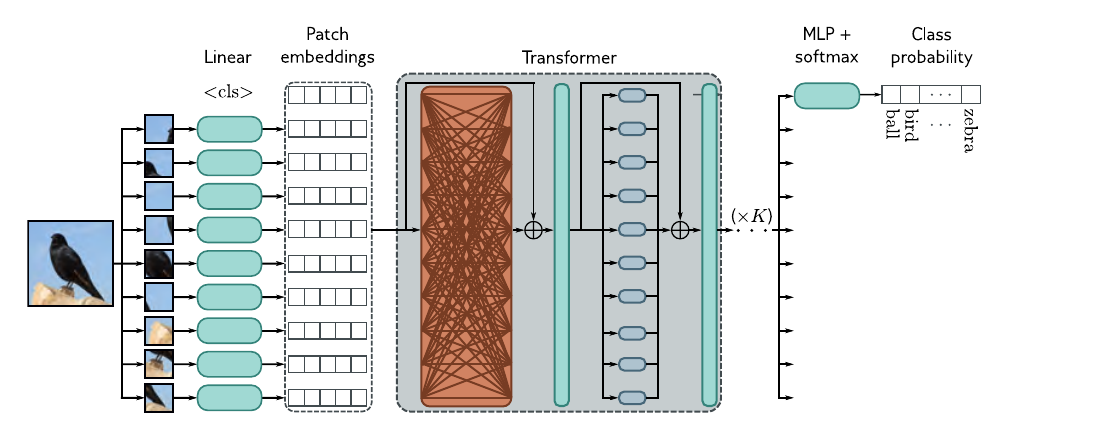
Source: Simon J. D. Prince, Understanding Deep Learning, Chapter 12, Figure 12.17. X1.1 owns patch identity; X1.2 begins with the encoded feature sequence.
The encoder output is not one universal object. Implementations must choose:
which encoder family and checkpoint
which layer or layers to read
whether to keep or drop class/register tokens
whether to keep the spatial grid
whether features are before or after final normalization
whether the encoder is frozen, partially tuned, or fully tuned
The pretraining objective survives inside the feature geometry
CLIP is a useful example because its image tower is not trained to emit language-token embeddings. Given normalized image and text embeddings and , a batch produces the pairwise logits
and a symmetric contrastive objective
The first term retrieves the paired text from an image; the second retrieves the paired image from a text. This objective explains why CLIP features are globally language-aligned, but it does not imply that every patch row already has the distribution expected by a decoder token embedding. LLaVA therefore reads CLIP grid features and learns an explicit projection into the language model width.
The readout is another design choice:
| Encoder use | Typical rows exposed | Information retained | Bridge consequence |
|---|---|---|---|
| retrieval/classification | class or pooled row | global semantics | one-vector interfaces can be sufficient |
| dense visual reasoning | patch/grid rows | spatially distributed evidence | row count and geometry must survive |
| multi-layer readout | selected layers or mixtures | different semantic/detail levels | projector checkpoint includes layer choice |
| video encoder | space-time rows or frame summaries | temporal order and motion | time metadata enters resampling and masks |
For the original LLaVA recipe, the selected representation is the CLIP ViT-L/14 visual grid before the final projection used by CLIP itself. The article-level invariant is broader: serialize the complete encoder interface, not only its output width.
encoder_contract = {
    "checkpoint": vision_checkpoint,
    "unitizer_hash": processor_manifest_hash,
    "feature_layer": feature_layer,
    "drop_prefix_tokens": drop_prefix_tokens,
    "post_norm": apply_post_norm,
    "grid_shape": (grid_h, grid_w),
    "feature_width": d_v,
}
Layer selection changes the bridge input
Let the encoder contain layers . The projector may consume the last layer, a penultimate layer, or a learned combination:
or
Later features can be more semantic and less locally precise; earlier features can preserve texture and geometry while being less aligned with language. A feature-layer choice is therefore part of checkpoint compatibility. It cannot be changed independently of a trained projector.
Encoded rows versus language-visible rows
Use separate symbols:
N_u:
    units emitted by preprocessing

N_e:
    rows emitted by the modality encoder

N_l:
    rows exposed to the language computation
A patch-merging encoder may have . A width-only projector preserves . A learned-query resampler chooses independently of the input resolution. Confusing these counts makes both cost and alignment audits unreliable.
0x02 Width-only projectors: what the matrix actually learns
The smallest bridge is a linear map:
so
The derivation is dictated by matrix compatibility. Each media row is a row
vector in , while concatenation with text requires a row in
. Right multiplication by a d_v x d_l matrix changes only
the last axis. It neither changes row count nor creates cross-row interaction.
Its parameter count is
including bias, and its leading multiply-add work is approximately
The projector is shared across media rows, so it learns a feature-space map, not an image-specific lookup.
The backward path makes the alignment role explicit. If and the batch and row axes are flattened,
When the vision tower is frozen, the second tensor is still the derivative needed to propagate through the projector boundary, but optimizer state and parameter gradients are not retained for the frozen tower. The projector update correlates encoder coordinates with language-side error directions. This is why random width matching is not semantic alignment.
class LinearProjector(nn.Module):
    def __init__(self, d_vision, d_language):
        super().__init__()
        self.proj = nn.Linear(d_vision, d_language)

    def forward(self, h, valid):
        # h: [B, N_e, d_vision]
        z = self.proj(h)                  # [B, N_e, d_language]
        z = z.masked_fill(~valid[..., None], 0)
        return z
A checkpoint loader should reject a dimensionally valid but semantically different encoder/projector pair:
def audit_projector_binding(projector_meta, encoder_contract):
    required = ("checkpoint", "feature_layer", "drop_prefix_tokens",
                "post_norm", "feature_width")
    for key in required:
        assert projector_meta["encoder"][key] == encoder_contract[key], key

    assert projector_meta["d_in"] == encoder_contract["feature_width"]
The masking line matters if padded media rows will be concatenated or cached. Zeroing does not replace an attention mask, but it prevents arbitrary padded features from leaking into later residual paths.
Nonlinear MLP projectors
A two-layer projector adds capacity:
For row-vector notation with hidden width :
An MLP can bend the feature space rather than apply one affine alignment. It still treats rows independently unless it contains token mixing. It cannot by itself reduce 4,096 patches to 64 rows or let one projected patch summarize another.
| Bridge | Changes width | Changes row count | Mixes media rows | Typical role |
|---|---|---|---|---|
| Linear | yes | no | no | cheap alignment baseline |
| Two-layer MLP | yes | no | no | nonlinear alignment |
| Token pooling/merge | optional | yes | locally or fixed | deterministic compression |
| Learned-query resampler | yes | yes | yes, through attention | bounded adaptive bottleneck |
| Cross-attention adapter | language width remains | media stays separate | language queries media | repeated fusion inside LM |
0x03 Prefix and interleaved fusion: media becomes language context
In a prefix-style design, projected media rows and text embeddings share one sequence:
The join is possible because both operands have width . The language model then updates them under one attention topology.
def prefix_fusion(pixel_values, input_ids, media_valid):
    h_v = vision_encoder(pixel_values)       # [B, N_e, d_v]
    z_v = projector(select_features(h_v))    # [B, N_l, d_l]
    x_t = token_embedding(input_ids)          # [B, L, d_l]

    x = torch.cat([z_v, x_t], dim=1)          # [B, N_l + L, d_l]
    valid = torch.cat([media_valid, input_ids != pad_id], dim=1)
    return x, valid
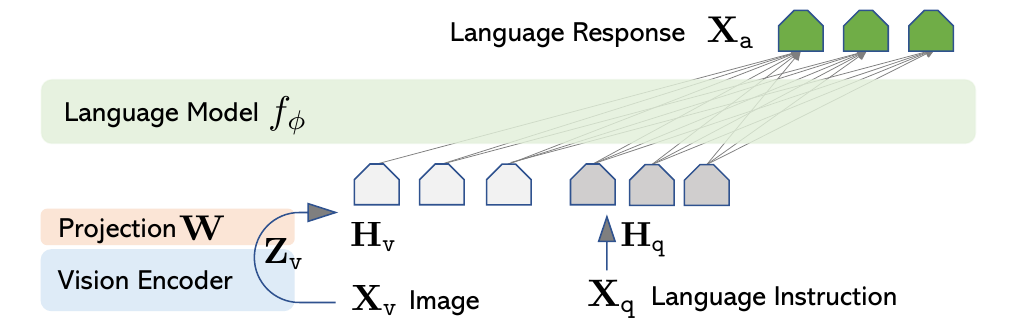
Source: Visual Instruction Tuning, Figure 1. LLaVA provides the canonical width-alignment and shared-language-context example.
Why prefix fusion is attractive
one language stack processes both origins
existing causal self-attention provides media-to-text access
projector can be small
media states participate in all later layers
implementation can reuse decoder-only kernels after input construction
Why prefix fusion is not free
If every row participates in dense self-attention, the logical score count per layer changes from to
The extra terms have distinct meanings. covers cross-origin interactions in both directions; is media-media interaction inside the language stack. During autoregressive decoding, the accepted media/prompt prefix also contributes persistent K/V state in ordinary decoder-only implementations.
Interleaving multiple images with text adds an origin problem:
<image_0 rows> text about image 0 <image_1 rows> text about image 1
Placeholder order, media order, row ranges, and position IDs must agree. X1.3 turns that requirement into a packing and cache-state contract.
0x04 Cross-attention fusion: media remains external memory
An alternative keeps language states and media memory separate. A cross-attention sublayer computes
Language positions supply queries; media rows supply keys and values. The score matrix is
This topology does not require media rows to occupy ordinary language-token positions. It does require inserted modules, media memory storage, and masks that bind each text position to the intended image or video.
Flamingo’s inserted block is more specific than a generic one-gate adapter. It has a gated cross-attention residual followed by a separately gated dense residual:
where both scalar gates are initialized to zero. At initialization , so the inserted block preserves the frozen language path. Yet the gate can learn immediately because
The parameters behind a closed gate initially receive a gradient scaled by . Optimization first opens the residual path; only then do the cross-attention and dense parameters receive an unattenuated signal.
def flamingo_gated_block(x, media, media_mask, alpha, beta):
    xattn_delta = cross_attn(
        query=layer_norm_xattn(x),
        key=media,
        value=media,
        key_padding_mask=~media_mask,
    )
    y = x + torch.tanh(alpha) * xattn_delta
    z = y + torch.tanh(beta) * dense(layer_norm_dense(y))
    return z
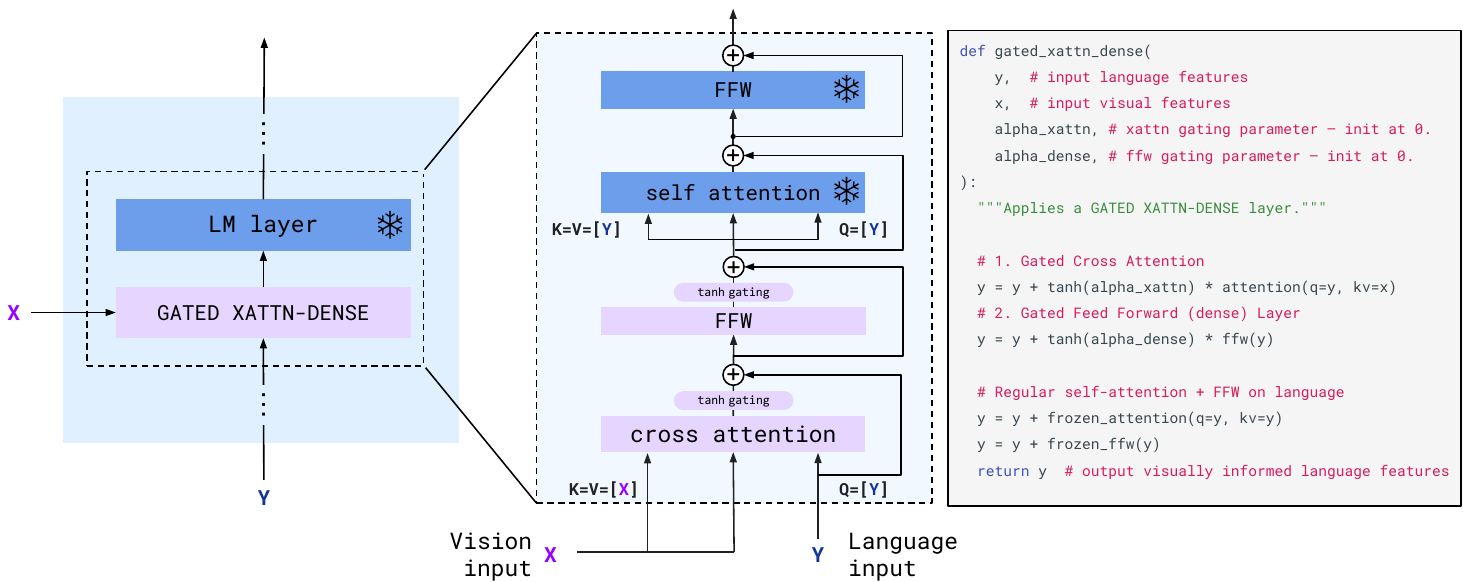
Source: Flamingo, Figure 4. Both gates are scalar tanh gates initialized to zero; reducing the block to one gate removes part of the published mechanism.
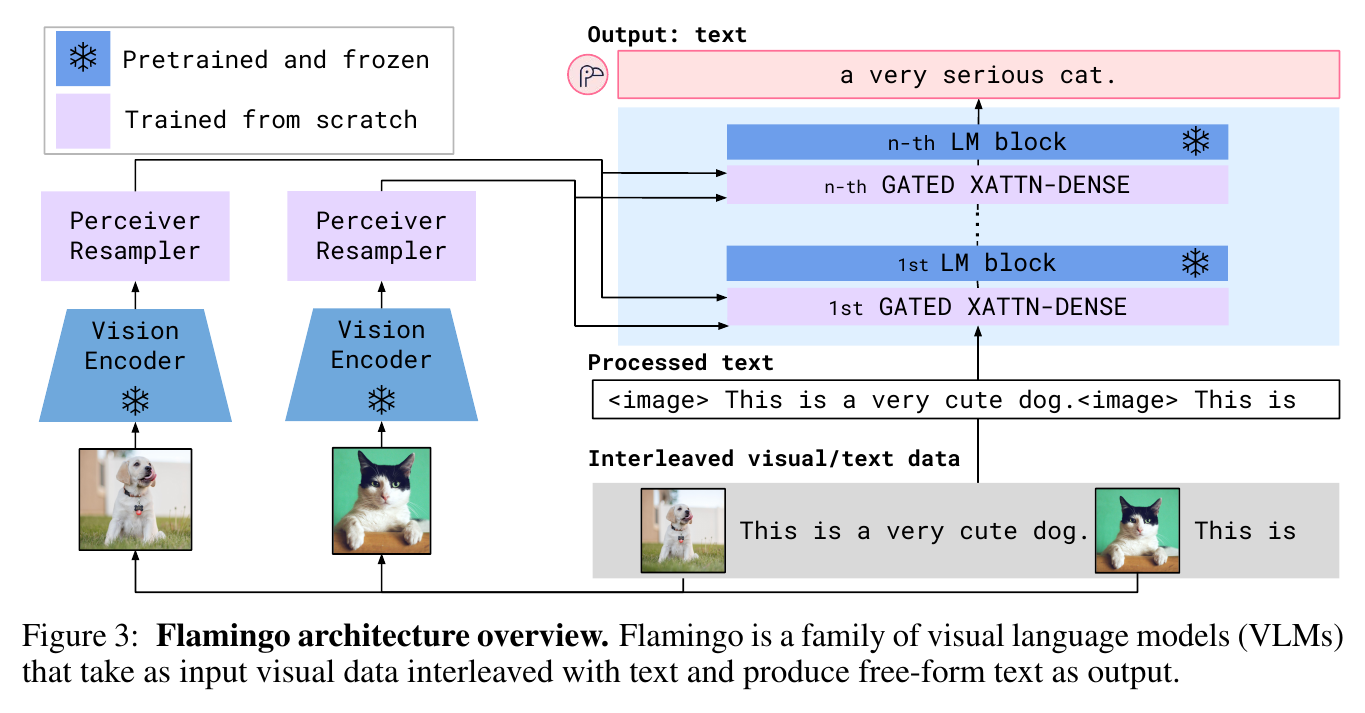
Source: Flamingo, Figure 3. The frozen vision encoder and language model remain distinct; trained resamplers and gated cross-attention modules bridge them.
Cost shape
Suppose cross-attention is inserted into language layers. Ignoring projections, its score work scales as
rather than adding media rows to every self-attention matrix. This can be preferable when is bounded and the base language stack should remain mostly unchanged. It also creates a separate media-memory lifecycle instead of ordinary prefix K/V rows.
The insertion count is itself a paper-variant choice. In the reported Flamingo family, the gated block appears before every frozen LM block in the 3B model, every fourth block in the 9B model, and every seventh block in the 80B model. Those source-reported configurations trade trainable parameters and media interaction frequency against memory and compute. “Flamingo-style” does not identify one universal insertion schedule.
0x05 Learned-query bottlenecks and resamplers
Width projection solves and leaves unchanged. A learned-query bottleneck solves a different problem: produce a bounded number of summary rows from a variable or large feature sequence.
Let learned queries be
A cross-attention update reads encoder features:
The score matrix is , and the output row count is always . That is why a resampler is not merely a projector: it performs content-adaptive cross-row compression.
class QueryResampler(nn.Module):
    def __init__(self, q, d_resampler):
        super().__init__()
        self.queries = nn.Parameter(torch.randn(q, d_resampler))

    def forward(self, media, media_valid):
        B = media.shape[0]
        q = self.queries[None].expand(B, -1, -1)  # [B, Q, d_r]
        q = q + cross_attn(q, media, media, media_valid)
        q = q + ff(norm(q))
        return q                                  # [B, Q, d_r]
BLIP-2 Q-Former
BLIP-2 uses learned queries in a Querying Transformer to bridge a frozen image encoder and a frozen language model. Its two-stage training contract matters:
stage 1 - vision-language representation learning:
    train Q-Former against frozen image features with
    image-text contrastive, image-text matching, and image-grounded generation

stage 2 - vision-to-language generative learning:
    connect Q-Former output to the frozen LLM and train the bridge for generation
The learned queries are not generic pooling slots trained only by final answer loss. Their pretraining objectives determine what information crosses the bottleneck.
The published Q-Former contains an image transformer and a text transformer that share self-attention parameters. Cross-attention layers are inserted into every other transformer block. The 32 learned queries and text tokens can therefore reuse one BERT-initialized self-attention stack while objective- specific masks decide which information is allowed to flow. The cross- attention layers are randomly initialized; BLIP-2 reports 188 million Q-Former parameters for its 32-by-768 query configuration. Those are source-reported architecture values, not requirements for every query bridge.
The first stage is three mechanisms, not one generic pretraining loss:
-
Image-text contrastive learning (ITC). Queries read the image, text encodes independently, and query/text self-attention leakage is blocked. The image-text score is the maximum similarity across query outputs:
Taking the maximum lets different learned queries specialize in different visual evidence while one query can support the pair-level match.
-
Image-grounded text generation (ITG). Query tokens see one another but not text tokens. Each text token sees every query plus only previous text tokens. The mask therefore turns the same shared self-attention parameters into a multimodal causal decoder.
-
Image-text matching (ITM). Queries and text interact bidirectionally. A binary classifier is applied to every query output and the logits are averaged; hard negatives are sampled from contrasting pairs.
These objectives cannot be reproduced by summing three scalar losses over one unchanged attention graph. Each objective changes the graph that produced its hidden states. X1.3 derives the masks explicitly.
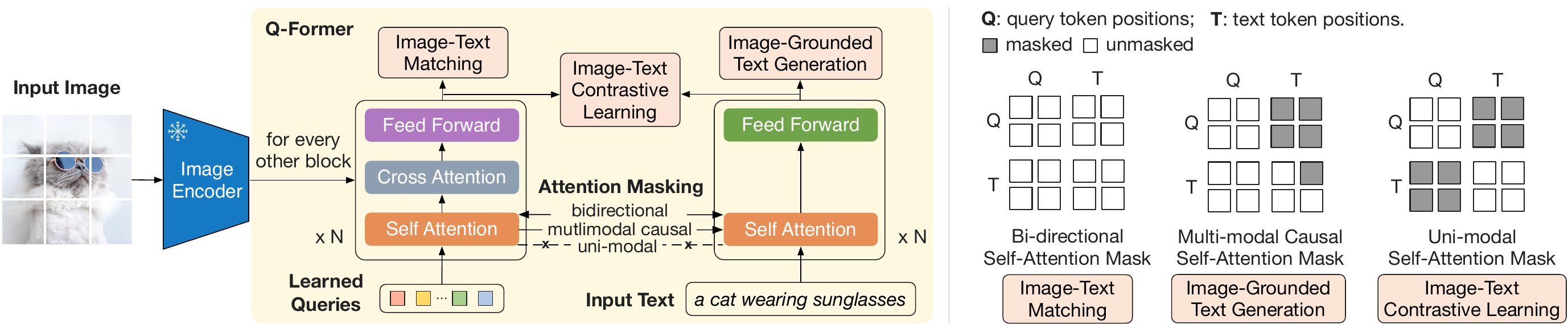
Source: BLIP-2, Figure 2. The same Q-Former parameters execute three objective-specific information-flow patterns.
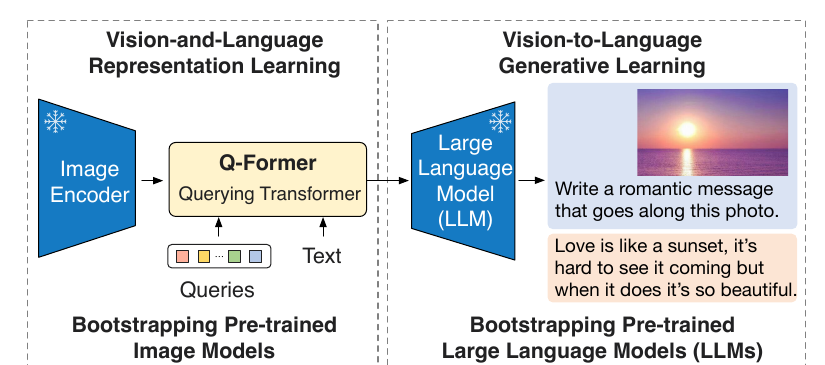
Source: BLIP-2, Figure 1. The left and right halves correspond to the two distinct pretraining stages.
The second BLIP-2 stage depends on the language-model family
A fully connected layer maps each query output from Q-Former width to the frozen language model’s input width :
For a decoder-only LLM, acts as a soft visual prefix and the text is trained with language modeling conditioned on that prefix. For an encoder-decoder LLM, the projected query sequence and prefix text feed the encoder while the suffix is generated by the decoder. Calling both paths “prefix tokens” hides different masks, position rules, and cache state.
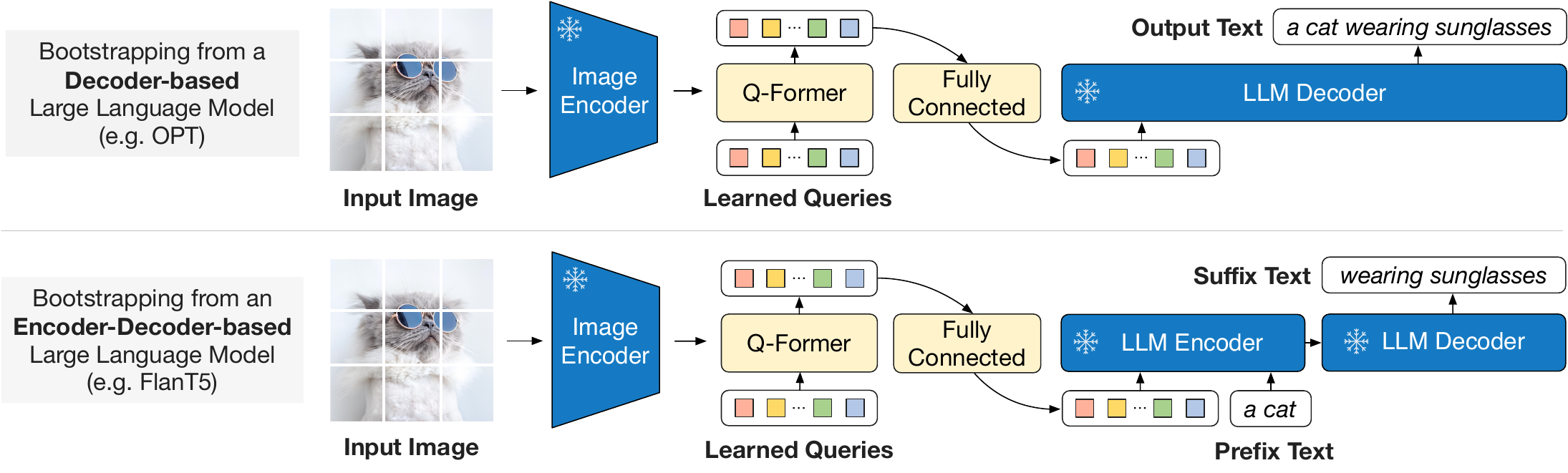
Source: BLIP-2, Figure 3. The bridge width is shared, but the downstream computation graph depends on the frozen LLM architecture.
InstructBLIP makes the bottleneck instruction-dependent
BLIP-2 can compute image query outputs without knowing the eventual user instruction. InstructBLIP instead supplies instruction tokens to Q-Former as well as to the frozen LLM. Through shared self-attention, the learned queries select image evidence conditioned on the task wording:
Consequently, a cache keyed only by the image is invalid for this bridge. The same image paired with “read the sign” and “count the vehicles” may produce different query states. Either cache the frozen encoder features and rerun the instruction-aware Q-Former, or include the normalized instruction and bridge checkpoint in the cache identity.
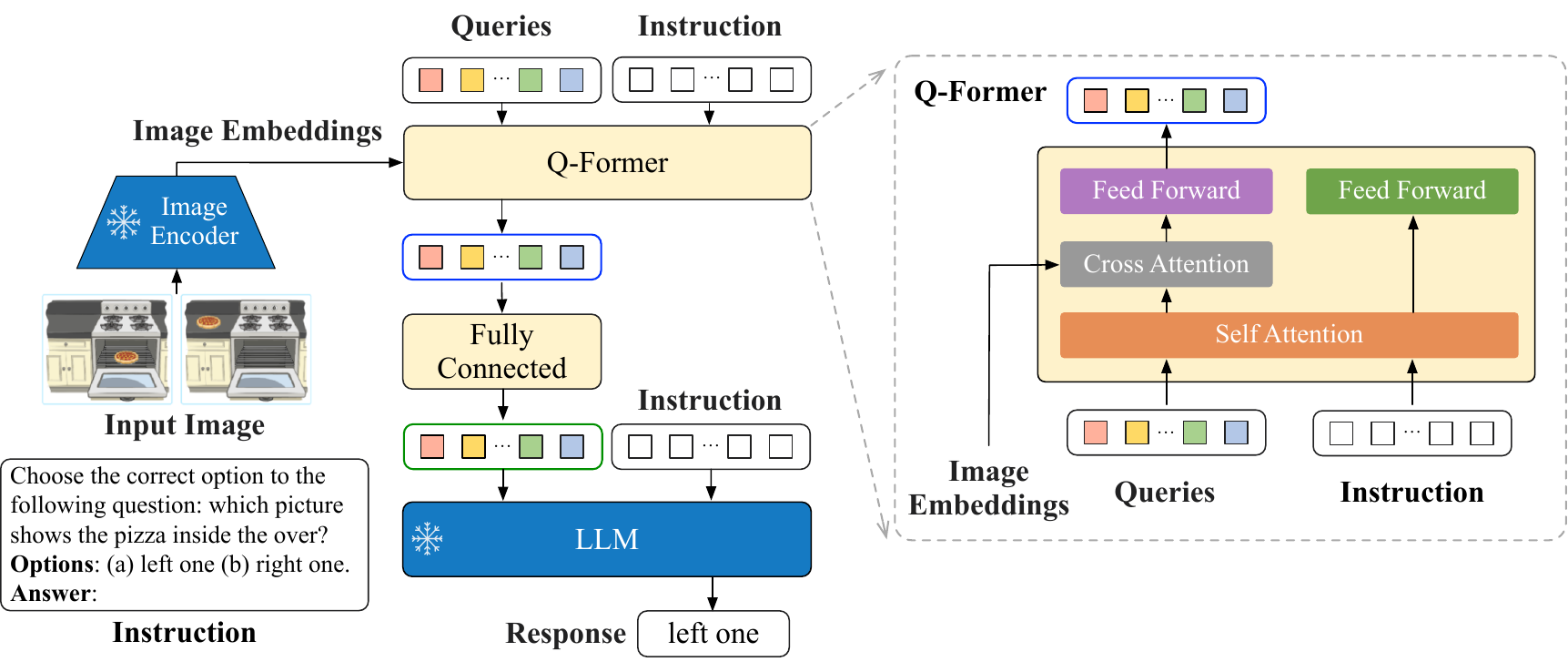
Source: InstructBLIP, Figure 3. During instruction tuning, the reported recipe keeps the image encoder and LLM frozen and updates Q-Former.
Flamingo Perceiver Resampler
Flamingo also converts variable visual features into a fixed number of visual latents, then exposes them through gated cross-attention layers. The resampler and Q-Former share learned-query attention as a motif, but they are not the same module or training program.
After adding temporal embeddings and flattening the space-time feature axes, the paper’s resampler update uses its current latent array as queries and concatenates visual features with the latent array for keys and values:
Including the latent array in lets each latent both read visual evidence and interact with the other latents in one attention operation. Flamingo uses 64 output latents per image or video in the reported architecture. This is a source-reported design point, not a universal optimum.
The reported NFNet-based Resampler adds learned temporal position embeddings but no explicit spatial-grid position embeddings; the authors report no gain from the latter and hypothesize that the CNN features already carry spatial information. A ViT-based reimplementation should treat that as a source- specific result, not a rule that spatial coordinates are never useful.
def perceiver_resampler(features, latents, time_embed, valid):
    # features: [B, T, S, d], latents: [B, Q, d]
    features = features + time_embed[:, :features.shape[1], None, :]
    features = features.flatten(1, 2)          # [B, T*S, d]

    x = latents
    feature_valid = valid.flatten(1, 2)        # [B, T*S]
    latent_valid = torch.ones(B, x.shape[1], dtype=torch.bool,
                              device=x.device)
    for block in blocks:
        kv = torch.cat([features, x], dim=1)   # K = V = [X_f; X]
        x = x + block.attn(
            q=block.norm_q(x),
            kv=block.norm_kv(kv),
            key_valid=torch.cat([feature_valid, latent_valid], dim=1),
        )
        x = x + block.ff(block.norm_ff(x))
    return x                                   # [B, Q, d]
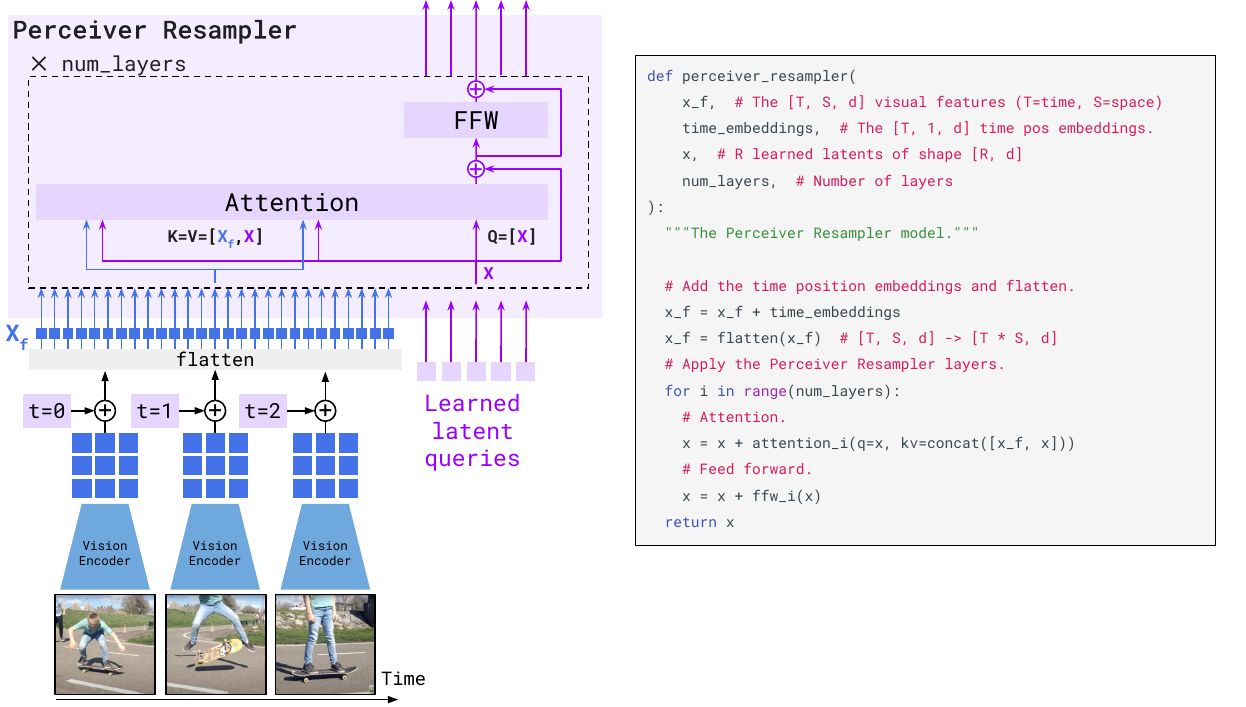
Source: Flamingo, Figure 5. The fixed latent count bounds the language-visible memory while attention makes the compression content-dependent.
| Variant | Bottleneck output | Downstream fusion | Frozen components | Training emphasis |
|---|---|---|---|---|
| Linear/MLP prefix | one row per encoder row | shared LM sequence | design-dependent | feature-to-LM alignment, instruction tuning |
| Flamingo resampler | fixed visual latents per image/video | gated cross-attention | pretrained vision encoder and LM in the paper | interleaved image-text next-token learning |
| BLIP-2 Q-Former | fixed learned-query outputs | connected to frozen LLM | image encoder and LLM | representation stage, then generative stage |
| Deterministic pooling | fixed or reduced grid | prefix or memory | design-dependent | no learned content selection in pooling itself |
The bottleneck tradeoff is measurable. Reducing to cuts the language-visible media rows by 64 times. It does not prove that the 64 rows retain the small OCR span, object count, or coordinate needed by a task.
0x06 Early, middle, and late fusion are different computation graphs
The word “fusion” is too broad unless it identifies where interaction occurs.
Early/shared-sequence fusion
Media and text become one sequence before most language layers.
project media -> concatenate with text -> shared self-attention stack
Advantages include direct repeated interaction and simple decoder-only reuse. Costs include longer context, media K/V residency, and strict placeholder/row bookkeeping.
Middle/cross-attention fusion
Media remains separate and selected language layers query it.
text self-attention -> media cross-attention -> FFN
This preserves a frozen or mostly frozen language path and separates memory state. It adds cross-attention modules and their per-layer projections.
Query-mediated fusion
Learned queries summarize media before either prefix or cross-attention fusion.
many media rows -> Q learned rows -> language interface
This stabilizes row budgets while moving information selection into a learned bottleneck.
Late/decision fusion
Separate models combine embeddings, scores, or decisions near the output. It can work for retrieval or classification and does not provide the same token-level generative conditioning as prefix or cross-attention fusion.
The design axis is therefore:
where do modalities first interact?
how often do they interact?
which state persists after interaction?
which parameters receive multimodal gradients?
0x07 Training contracts across paper variants
The same forward diagram can hide materially different optimization state.
LLaVA-style staged alignment
The original LLaVA architecture connects a CLIP vision encoder to a language model through a learned projection. A useful implementation decomposition is:
feature alignment stage:
    freeze vision encoder
    freeze language model
    train projector on image-text pairs

visual instruction tuning stage:
    keep vision encoder frozen in the original recipe
    train projector and language model on multimodal conversations
The first stage gives the projector a language-compatible starting point. The second teaches instruction following and answer behavior. A later implementation may unfreeze more components, but that is a different optimizer and memory contract.
The original paper reports a linear projector trained on 595K filtered CC3M image-caption pairs in stage 1, followed by visual instruction tuning where the vision encoder remains frozen and the projector and LLM are updated. In that second stage, only assistant-answer and stop-token positions receive the autoregressive loss. LLaVA-1.5 later reports a two-layer MLP projector and a CLIP ViT-L/14 encoder at 336-pixel resolution. The change is not cosmetic: resolution changes , while the MLP changes both trainable parameters and the family of alignment functions.
original LLaVA:
    CLIP ViT-L/14 grid -> linear projection -> Vicuna token space

LLaVA-1.5:
    CLIP ViT-L/14 at 336 px -> two-layer MLP -> language model
Flamingo-style frozen towers with inserted trainable paths
frozen:
    vision encoder
    pretrained language-model blocks

trained:
    Perceiver Resampler
    gated cross-attention dense blocks
Interleaved image-text data is central because language positions must learn which preceding media object they can use. The gate protects the initial text path but can also learn too slowly if optimization never opens it.
The reported training mixture combines M3W interleaved image-text data with ALIGN and LTIP image-text pairs and VTP video-text pairs. Flamingo accumulates their gradients with weighted losses rather than cycling one dataset at a time:
Those coefficients are source-reported recipe values. The deeper design point is that interleaved examples teach image-to-text binding, paired examples provide scale, and each data stream has an explicit optimization weight. Training telemetry should therefore report per-dataset loss, mixture rate, and both gate values, not only the aggregate language loss.
BLIP-2-style bridge pretraining
BLIP-2 separates representation learning from generative bootstrapping. This creates more training machinery than a linear projector and avoids end-to-end retraining of both large towers. The Q-Former objectives and attention masks change between sub-objectives; reducing the method to “32 query tokens” loses the mechanism that trained those queries.
In the second stage, the image encoder and LLM remain frozen while Q-Former and the fully connected projection are optimized with language-modeling loss. The architecture has therefore changed objectives and downstream graph without turning either large tower into an end-to-end trainable model.
InstructBLIP-style instruction tuning
InstructBLIP starts from pretrained BLIP-2 components, freezes the image encoder and LLM, and instruction-tunes Q-Former across a mixture of tasks. Its reported dataset sampler reduces domination by large datasets with
where is dataset size. This is a design alternative to sampling in direct proportion to dataset size. It increases the relative frequency of smaller tasks while retaining more data-dependent weighting than uniform-over-dataset sampling. The paper also reports manual adjustments for selected datasets, so the square-root equation is the baseline sampler rather than the whole recipe.
Parameter and optimizer ledger
For each stage, record:
trainable parameters by module
frozen parameters resident for forward
parameters requiring backward activations
optimizer-state bytes
precision and gradient-scaling policy
which datasets and losses update each module
Freezing a tower removes its optimizer state and parameter gradients. It does not remove its forward compute, weights, inputs, or necessarily all activations needed to train downstream modules.
Whether frozen-tower activations must remain depends on the cut in the backward graph:
frozen encoder output detached before bridge:
    encoder forward activations can be released after H_v is produced
    bridge parameters still receive gradients from H_v as a constant input

frozen encoder parameters but gradient flows to an earlier trainable input/path:
    backward graph through the encoder is still required

trainable encoder:
    encoder parameter gradients, retained activations, and optimizer state apply
| Recipe | Vision tower | Bridge/resampler | Language tower | Objective topology |
|---|---|---|---|---|
| LLaVA alignment | frozen | train projector | frozen | image-caption language alignment |
| LLaVA instruction | frozen in original recipe | train projector | train | assistant-only causal LM |
| Flamingo | frozen | train resampler and gated blocks | frozen base blocks | weighted interleaved/paired next-token LM |
| BLIP-2 stage 1 | frozen | train Q-Former | absent | ITC + ITG + ITM with different masks |
| BLIP-2 stage 2 | frozen | train Q-Former + projection | frozen | decoder-only or encoder-decoder LM |
| InstructBLIP | frozen | train Q-Former | frozen | instruction-conditioned LM across task mixture |
def set_training_stage(model, stage):
    freeze(model.vision_encoder)

    if stage == "projector_alignment":
        freeze(model.language_model)
        unfreeze(model.projector)
    elif stage == "instruction_tuning":
        unfreeze(model.projector)
        unfreeze(model.language_model)
    else:
        raise ValueError(stage)

    trainable = [p for p in model.parameters() if p.requires_grad]
    assert trainable
    return trainable
This sketch is LLaVA-like, not universal. BLIP-2 and Flamingo require different stage/module tables.
0x08 End-to-end tensor trace
Consider two images and a text prompt. The processor emits two padded image grids with origin metadata:
pixel_values: [B, M, C, H, W]
media_valid:  [B, M]
input_ids:    [B, L]
source_geometry: per-image transform and patch-grid policy
processor_manifest_hash: exact X1.1 unitizer identity
Here patch extraction is fused into vision_encoder; logically it still
creates patch units before producing encoded rows.
A prefix implementation may flatten image and patch axes only after preserving the media origin:
def encode_images(pixel_values, media_valid, processor_manifest_hash):
    B, M, C, H, W = pixel_values.shape
    assert processor_manifest_hash == encoder_contract["unitizer_hash"]
    flat = pixel_values.reshape(B * M, C, H, W)

    h = vision_encoder(flat)                 # [B*M, N_e, d_v]
    h = select_patch_features(h)
    z = projector(h)                         # [B*M, N_l, d_l]
    z = z.reshape(B, M, z.shape[1], z.shape[2])

    # A whole missing image invalidates every row for that image slot.
    row_valid = media_valid[:, :, None].expand(B, M, z.shape[2])
    # Padded slots still pass through the encoder and projector, so their rows are not zero; zero them explicitly.
    z = z.masked_fill(~row_valid[..., None], 0)
    return z, row_valid                      # [B, M, N_l, d_l]
At the bridge boundary, preserve enough metadata to prove that every output row still belongs to the intended media item:
@dataclass
class BridgeOutput:
    states: Tensor          # [B, M, N_l, d_bridge]
    row_valid: Tensor       # [B, M, N_l]
    media_id: Tensor        # [B, M]
    source_geometry: object
    unitizer_hash: str
    encoder_contract_hash: str
    bridge_checkpoint_hash: str

def audit_bridge_output(out, expected_media_ids):
    assert out.states.shape[:-1] == out.row_valid.shape
    assert torch.equal(out.media_id, expected_media_ids)
    assert torch.isfinite(out.states[out.row_valid]).all()
    assert (out.states[~out.row_valid] == 0).all()
The placeholder expansion path then maps each media item to an exact text location. A dangerous shortcut is to flatten all media rows and prepend them, even when the chat template interleaves image placeholders with text. That preserves total shape and changes which sentence refers to which image.
For cross-attention, the same encoded tensor can remain
[B,M,N_l,d_bridge]; an image-causal mask selects which media indices are visible to
each text position.
0x09 Architecture and runtime ledger
Let be the number of language layers containing cross-attention.
| Path | Language self-attention length | Extra interaction | Persistent state tendency |
|---|---|---|---|
| Prefix | included in shared self-attention | media rows often become prefix K/V | |
| Interleaved prefix | shared, origin-sensitive | interleaved prefix K/V | |
| Cross-attention memory | score terms | separate media K/V per inserted layer | |
| Query prefix | resampler plus shared self-attention | prefix rows | |
| Query memory | resampler plus | separate -row memory | |
| Instruction-aware query memory | query extraction depends on media and instruction | cache encoder features, or key query state by both inputs |
This table omits projection constants and kernel effects. It is a topology ledger, not a latency prediction. Runtime performance also depends on encoder placement, media preprocessing, batching by image shape, cache reuse, and whether the backend has optimized multimodal kernels.
0x0A Failure lab
| Failure | Why shape checks may pass | Consequence |
|---|---|---|
| Wrong vision layer | every layer has compatible width | detail/semantic balance differs from projector training |
| Class/register token mismatch | row count differs by a small constant | placeholders and geometry shift |
| Width match treated as alignment | d_v == d_l by coincidence | feature spaces remain incompatible |
| Linear projector expected to compress | output has correct width | media row count remains large |
| Resampler over-compresses | fixed Q is valid | small or rare evidence disappears |
| Media padding not masked | padded rows have vectors | language attends to synthetic evidence |
| Image order differs from placeholder order | total media count matches | prompt binds to wrong image |
| Frozen-module assumption wrong | forward still runs | optimizer state and gradients explode memory |
| Gate stays closed | stable text behavior | media path receives little useful signal |
| Gate opens abruptly | loss may decrease | pretrained language behavior destabilizes |
| Cross-attention mask leaks future image | tensor is broadcastable | interleaved examples use unavailable evidence |
| Prefix cost omitted | output quality looks correct | prefill and K/V budget fail under load |
| Checkpoint/projector mismatch | dimensions match | normalization and feature semantics differ |
| Image-only cache reused for InstructBLIP queries | tensor shape and image hash match | query state answers the wrong instruction |
| Flamingo block implemented with one gate | model still trains | published cross-attention and dense residual controls are conflated |
| Q-Former objectives share one mask | all losses are finite | ITC leaks text, ITG loses causality, or ITM cannot fuse bidirectionally |
| Frozen encoder interpreted as free | no encoder gradients exist | forward latency and weight residency remain unbudgeted |
0x0B Design selection questions
Do not choose a fusion method from its name. Ask:
evidence:
    Is fine localization/OCR required, or is scene-level summary sufficient?

row budget:
    Can media rows enter the language context directly?

training budget:
    Which towers can be frozen, adapted, or fully tuned?

data topology:
    Are examples single-image pairs or arbitrarily interleaved media and text?

runtime:
    Does the serving engine support the fusion graph, media cache, and batching?

state:
    Should media become ordinary prefix K/V or remain separately reusable memory?

compatibility:
    Which encoder layer, normalization, projector, and template were trained together?
The final invariant is:
A multimodal bridge is a trained tensor and state contract, not merely a dimension-matching layer.
X1.3 now follows that contract into packing, visibility, labels, cache state, and serving.
0xFF References
- An Image is Worth 16x16 Words
- Learning Transferable Visual Models From Natural Language Supervision
- Show, Attend and Tell
- Visual Instruction Tuning / LLaVA
- Improved Baselines with Visual Instruction Tuning / LLaVA-1.5
- Flamingo
- BLIP-2
- InstructBLIP
- Perceiver
- Transformer Series (2) - Overall Architecture
- Transformer Series (4) - Encoder and Decoder
- Transformer Series (7) - Embedding
- Transformer System M2.2 - Embeddings and Projectors
- X1.1 - Unitization and Geometry Metadata
- X1.3 - Multimodal Masks, Training, Runtime, and State