M6.6 - MoE Runtime Systems: Placement, Dispatch, Kernels, and Topology
M6.6 - MoE Runtime Systems: Placement, Dispatch, Kernels, and Topology
0x00 Overview: A Route Is Not Yet An Execution Plan
M6.1 followed a token through a router, capacity check, expert buffer, and weighted combine. M6.2 moved the same computation across expert-parallel ranks and introduced all-to-all traffic, device-limited routing, shared experts, and load balancing. Those mechanisms define the mathematical layer, but a production runtime must answer a more physical question:
How does a logical top-k route become executable distributed work under device placement, variable token counts, kernel-shape, precision, topology, and latency constraints?
The distinction matters because a router returns logical expert identifiers. It does not inherently name a GPU, a process, a physical replica, a memory address, a communication offset, or a grouped-GEMM segment. Those objects belong to the runtime.

An MoE forward pass therefore contains two related plans:
semantic plan:
    token -> logical expert -> gate weight -> weighted expert output

physical plan:
    token row
        -> physical expert replica
        -> destination rank
        -> send offset
        -> local expert segment
        -> kernel row
        -> return offset
        -> origin token and route slot
The semantic plan determines model behavior. The physical plan determines whether the behavior can be executed correctly and efficiently on the current cluster.
0x00A Five Runtime Eras, Not One Kernel
The runtime did not appear after the MoE algorithm was finished. Each stage of MoE scaling exposed a different physical problem, and later systems changed the execution contract rather than merely making one old kernel faster.
| Era | Newly visible constraint | Runtime consequence |
|---|---|---|
| sparse conditional computation | one example activates only a few remotely stored experts | route rows to expert owners, then return them without changing semantic identity |
| expert-parallel Transformers | every data-parallel rank contributes rows to partitioned experts | encode, all-to-all dispatch, local expert compute, all-to-all return, decode |
| static-capacity systems | collectives and dense kernels prefer bounded regular buffers | capacity slots, padding, overflow policy, and fixed split layouts enter the schedule |
| adaptive and dropless systems | expert row counts are data-dependent and often highly uneven | fast permutation, variable splits, grouped GEMM, or block-sparse execution replace one padded dense batch |
| low-latency serving | decode exposes tiny segments, repeated synchronization, changing request sets, and graph constraints | phase-specific dispatch, persistent buffers, masked execution, topology-aware placement, replicas, and explicit completion handles |
The first sparsely gated systems already mixed data and model parallelism: ordinary layers were replicated over input batches while experts were shared across devices. Combining rows from several input shards enlarged each expert’s effective batch, but it also made permutation and cross-device movement part of the layer definition. GShard and Switch made that pattern routine at Transformer scale; DeepSpeed-MoE and Tutel then treated communication topology, parallel composition, and adaptive execution as system design variables rather than hidden framework behavior.
The A21 figure below preserves that expert-parallel baseline. Attention and gating remain local to each worker, routed rows cross an all-to-all boundary to partitioned experts, and expert outputs cross a second boundary before the next replicated block. It is a lineage diagram, not a claim that every modern runtime uses the same collective or buffer layout.
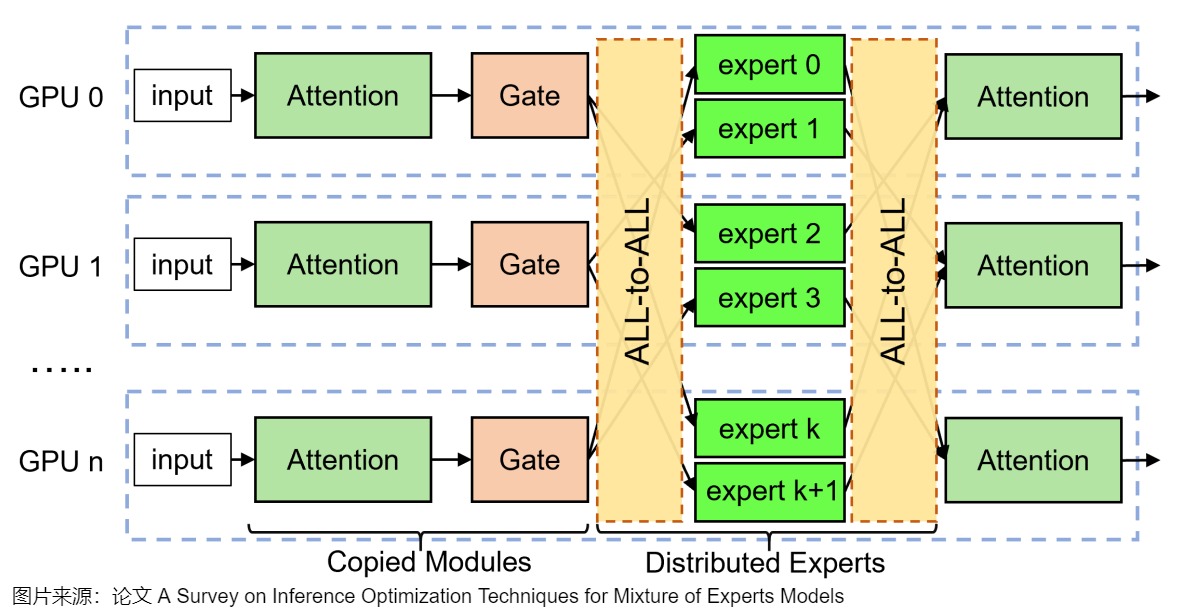
Source-local visual: A21 - MoE, Figure 28. The source article uses it to explain expert parallelism. M6.6 retains only the physical ownership lesson; M6.1 owns route semantics and M6.2 owns logical balance and locality constraints.
The next pressure was irregularity. A route tensor is token-major, but an expert kernel wants expert-major contiguous rows. FastMoE made the scatter/compute/gather transformation explicit and implemented the memory movement as a dedicated operator. Tutel generalized the systems problem toward adaptive parallelism and pipelining. MegaBlocks changed the local compute representation again: instead of dropping rows or padding every expert to a common capacity, it maps uneven expert segments into block-sparse operations.
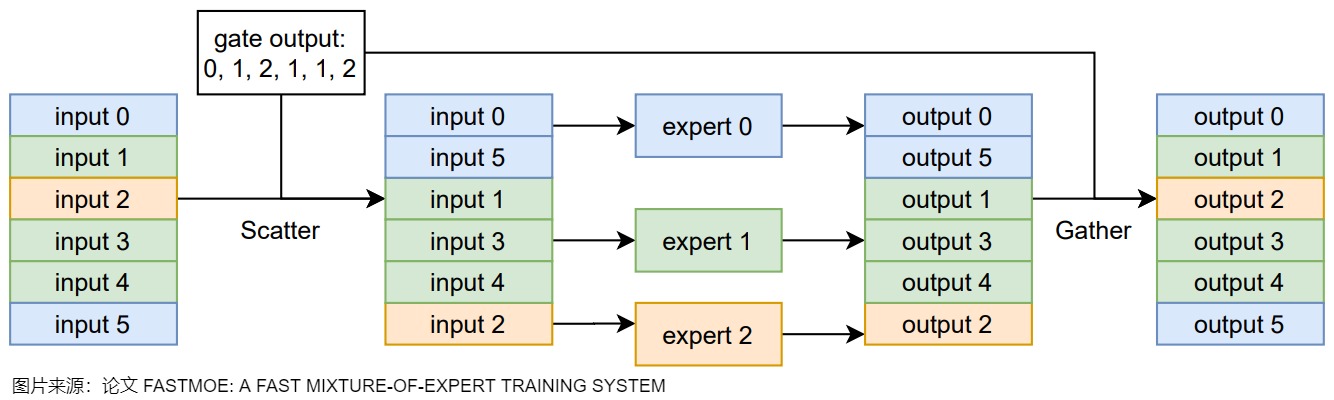
Source-local visual: A21 - MoE, Figure 42, which attributes the diagram to FastMoE. It proves the permutation problem’s historical visibility, not the exact metadata layout or CUDA implementation reconstructed later in this article.
Modern serving adds another discontinuity. DeepSeek-V3 reports restricting communication fanout and overlapping communication with computation. DeepEP exposes paired dispatch/combine communication objects; EPLB separates logical experts from physical replicas; Megatron Core carries several dispatcher families; and SGLang chooses communication and expert-runner backends according to phase and deployment constraints. These are related systems, but they are not interchangeable versions of one algorithm.
The result is a family of execution contracts. A correct article must first say which contract it is describing.
0x00A1 What The History Does And Does Not Prove
The historical sequence supports three conclusions:
- permutation and reverse permutation are semantic necessities once experts are physically partitioned;
- regular capacity-padded execution, variable-size grouped execution, and block-sparse dropless execution solve different shape contracts;
- prefill throughput and decode latency can legitimately select different communication and compute plans.
It does not prove that a paper benchmark transfers to another model, topology, batch distribution, or library version. It also does not prove that a released reference implementation is the private training or production runtime described by a paper.
0x00B Why Dynamic Routing Fights Static Kernels
Dense Transformer layers expose regular matrices. If a dense FFN receives rows, both projections see a known input. An MoE layer begins with the same hidden-state tensor but partitions its routed rows according to data-dependent expert choices.
For top- routing:
input rows:              T
routed rows:             R = T * k
rows assigned to expert e: n_e, data-dependent
sum_e n_e:               R
The total routed-row count is known once and are known. The vector is not. Yet high-throughput kernels prefer:
contiguous operands
known alignment
few launches
stable workspaces
predictable synchronization
reusable graph shapes
The runtime is largely the machinery that reconciles variable expert loads with those kernel requirements.
0x00C Prefill And Decode Are Different Operating Points
The same MoE layer can see thousands of prompt rows during prefill and only one row per active request during decode. A throughput path can amortize metadata and communication over large contiguous segments. A latency path may instead prioritize fixed buffers, graph capture, fewer synchronization points, and masked execution.
This article will not use “the MoE kernel” as if one path were optimal for both regimes.
0x00D Evidence Ladder And Runtime Pins
No one source proves the complete path from a router decision to production latency. M6.6 keeps five evidence levels separate:
| Evidence level | What it can establish | What it cannot establish alone |
|---|---|---|
| source-local A21/A29 | teaching lineage, terminology, original figure context, and links worth following | correctness of every translated explanation or current runtime behavior |
| primary paper/report | stated algorithm, experimental setup, and source-reported result | unreleased implementation details or performance on another system |
| released project documentation | supported public concepts and configuration at that documented version | exact behavior after later commits or undocumented production policy |
| immutable source artifact | one concrete interface, tensor path, and implementation state at one commit | universal API semantics or reproduced end-to-end performance |
| local oracle and measurement | behavior of the declared fixture or benchmark environment | paper reproduction or production generality unless the protocol matches |
The runtime artifacts used by the later implementation trace are frozen at Loop 1 rather than resolved from floating branches:
| Runtime surface | Immutable revision | Loop-owned use |
|---|---|---|
DeepEP V2 ElasticBuffer README and legacy wrapper | 01dc3aaac82068020353dce2c302e38153c0bfaa | paired dispatch/combine handle, phase-specific operation, event ownership |
| EPLB solver | d52c72d5b2f2fb4c41afbf8eb21366820239913d | logical-to-physical replication and placement maps |
| Megatron Core dispatchers | 0896be0f5735e910a906dc4a8b5ed0363e4a7be6 | all-to-all, flex, and graph-compatible dispatcher lifecycle |
| SGLang expert-parallel stack | e76d0acdc923d992bbda20d4b2bc51db9ac314a7 | serving-stage dispatch/runner/combine integration |
| MegaBlocks DMoE implementation | 952db33d6eac334d22c61e47a0d5d41446298784 | block-sparse dropless local execution |
| Tutel fast dispatcher | ac0e51b943bb7084d4a6a7243e44a4afe04b9911 | encode/decode permutation and adaptive runtime lineage |
The commit hash is part of every implementation claim. Later source-to-instruction work may compare newer revisions, but it must add a new artifact record rather than silently moving this baseline.
0x00E Ownership And Boundaries
This article owns:
logical-to-physical expert placement
expert replicas and placement versions
dispatch metadata and variable-size collectives
local expert execution layouts
prefill and decode runtime modes
topology-aware dispatch
expert-parallel load balancing
communication-compute overlap
payload precision and alignment
runtime observability, evaluation, and failure recovery
It defers:
router learning and capacity semantics         -> M6.1
DeepSeek routing and balancing algorithms      -> M6.2
general serving/KV lifecycle                   -> M5
quantization method selection and release      -> M8
The same boundary as a contract table is:
| Relation | Owner | Exact contract |
|---|---|---|
| consumes | M6.1 | accepted route rows, route-slot identity, logical expert identity, gate weights, admission state, and inverse-combine identity |
| consumes | M6.2 | route-exact expert-major segmentation, logical locality records, replay state, and a producer contract that explicitly excludes physical ranks and kernels |
| consumes | M4 | byte, traffic, launch, occupancy, and measured-kernel accounting conventions |
| consumes | M5 | request phase, batch composition, graph-capture, stream, and serving-lifecycle constraints |
| owns | M6.6 | logical-to-physical maps, replicas, ranks, variable exchanges, expert-runner layouts, completion handles, placement generations, and runtime evidence |
| hands forward | M8 | payload/weight representation requirements, alignment, scale ownership, kernel eligibility, and release compatibility |
| defers | M6.1/M6.2 | route selection, route admission, gate mathematics, balance objectives, and training control |
The firewall is operational: M6.6 may choose a replica for an already-selected logical expert, but it may not replace that logical expert, renormalize its gate, reinterpret a dropped route, or infer semantic admission from a physical buffer limit.
0x01 Vocabulary And Runtime Invariants
Let:
| Symbol | Meaning |
|---|---|
| input token rows initially owned by one rank | |
| token rows across the expert-parallel group | |
| hidden width of each routed row | |
| number of logical routed experts | |
| selected experts per token | |
| routed rows before any overflow or duplicate suppression | |
| number of expert-parallel ranks | |
| number of physical expert slots in placement version , including replicas | |
| logical expert stored in physical slot under placement version | |
| set of physical slots that replicate logical expert under version | |
| routed rows assigned to logical expert | |
| routed rows assigned to physical slot after replica selection | |
| bytes per dispatched activation element | |
| bytes per returned output element |
A correct runtime must preserve these invariants.
0x01A0 Six Identity Namespaces Before Any Collective
An integer such as 3 is not a sufficient expert identifier. It can mean logical expert 3, local slot 3, rank 3, replica 3, or the fourth element of a process-group array. A runtime manifest has to type those namespaces before it can derive counts or offsets.
| Namespace | Stable within | Can change without changing model semantics? | Example in the executable fixture |
|---|---|---|---|
| logical expert ID | model architecture and checkpoint | no; replacing it changes the selected function | E0 through E3 |
| physical slot ID | one placement generation | yes, if it remains a compatible replica | q0 through q5 |
| replica ID | one logical expert and checkpoint generation | yes; another replica may execute the same logical route | e0-r0, e0-r1 |
| destination rank | one process-group epoch | yes; placement may move or replicate an expert | rank 0 through rank 3 |
| process-group ID | one communicator membership epoch | only through an explicit runtime transition | ep-group-0 |
| placement/checkpoint version | dispatch-handle lifetime | no; dispatch and combine must agree | placement-v17, checkpoint-0042 |
The semantic identity of accepted route row is:
where is the execution scope, the route ID, the origin partition, the origin token row, the selected route slot, the logical expert, and the combine gate. M6.6 receives this tuple; it does not recompute it.
The runtime appends a physical tuple:
where is the placement version, the physical slot, the replica ID, the destination rank, the process group, the topology domain, and the expert checkpoint version. Keeping the tuples separate is what permits replica selection without semantic rerouting.
The Loop 2 fixture freezes all 17 fields in the M6.2 handoff with a canonical SHA-256 digest before adding any physical field. A mutation to logical_expert_id or combine_gate therefore fails before dispatch planning begins.
0x01A Semantic Invariant
For token , if the router selects logical expert set , the output remains:
Physical replication must not silently change . Every usable replica of logical expert must represent the same model state for that execution version.
0x01B Conservation Invariant
Without overflow, dropping, or route deduplication:
Every accepted routed row must be dispatched once, executed once, returned once, and combined once. A mismatch usually indicates a lost route, duplicate route, stale placement map, or incorrect collective count.
0x01C Identity Invariant
A routed row is not identified only by its token index. It needs at least:
origin expert-parallel rank
origin token row
route slot in [0, k)
logical expert id
physical expert slot
destination rank
gate weight
placement version
send and return positions
Two routes from the same token are distinct rows even when they carry identical hidden values. They may use different experts and different gate weights.
0x01D State-Version Invariant
The following objects must agree:
router output logical ids
logical-to-physical map
replica weights
dispatch counts and offsets
combine handle
expert checkpoint/version
Changing expert placement between dispatch and combine without a versioned transition can return a numerically valid tensor from the wrong expert.
0x01D1 Compatibility Is A Predicate, Not A Lookup
For accepted route targeting logical expert , physical slot is legal only when every coordinate agrees:
The four clauses reject four different failures:
- the slot stores another logical expert;
- a replica has stale or mixed checkpoint state;
- the destination rank is outside the pinned expert-parallel communicator;
- the topology label does not own that rank.
Replica selection must then satisfy a cardinality contract:
Zero assignments lose a route. Two assignments execute it twice. Assigning one row to a slot outside conserves the row count but changes the model function. Count conservation alone is therefore necessary and insufficient.
0x01D2 One Immutable Execution Scope
The runtime snapshot used by one layer execution binds:
semantic contract version
execution scope id
placement version
expert checkpoint version
process-group id and membership epoch
dispatch handle id
route count and inverse identity
The snapshot is acquired before physical assignment. Dispatch records copy its version coordinates, and combine consumes the same handle. A new placement may become active concurrently, but it cannot service an old handle.
def acquire_runtime_scope(logical_routes, placement_registry):
    semantic_digest = sha256(canonical(logical_routes))
    placement = placement_registry.acquire_active_generation()

    handle = DispatchHandle(
        execution_scope_id=logical_routes.execution_scope_id,
        semantic_digest=semantic_digest,
        placement_version=placement.version,
        checkpoint_version=placement.checkpoint_version,
        process_group_id=placement.process_group_id,
        generation_reference_acquired=True,
    )
    return placement, handle
Acquisition does not imply that placement is immutable forever. It means that the selected generation cannot be retired until every handle that references it has combined and released.
0x02 Logical Experts, Physical Slots, And Replicas
0x02A The One-Expert-One-Rank Baseline
Suppose and each rank owns one expert:
logical expert 0 -> rank 0, slot 0
logical expert 1 -> rank 1, slot 1
logical expert 2 -> rank 2, slot 2
logical expert 3 -> rank 3, slot 3
The map is easy, but a hot expert becomes a hot rank. If of routed rows while the other experts split the rest, rank 0 determines the layer barrier even when the cluster has unused compute elsewhere.
0x02B Replication Changes Placement, Not The Router Vocabulary
Replicate logical expert 0:
physical slot q0 on rank 0 -> logical expert 0
physical slot q1 on rank 1 -> logical expert 0
physical slot q2 on rank 1 -> logical expert 1
physical slot q3 on rank 2 -> logical expert 2
physical slot q4 on rank 3 -> logical expert 3
The router still emits expert id 0. A replica selector chooses either or for that route. This second decision can account for locality, predicted load, queue depth, or a deterministic balancing rule.
If logical expert has replicas and the runtime balances perfectly, its ideal per-replica load is:
The actual load may differ because routes are indivisible, topology constraints restrict candidates, and replica selection itself can be stale.
0x02B1 A Six-Slot Manifest With Two Replicated Experts
The executable Loop 2 fixture uses four logical experts, four ranks, two nodes, and six physical slots:
| Slot | Logical expert | Replica | Rank | Domain | Checkpoint |
|---|---|---|---|---|---|
q0 | 0 | e0-r0 | 0 | node-0 | checkpoint-0042 |
q1 | 0 | e0-r1 | 1 | node-0 | checkpoint-0042 |
q2 | 1 | e1-r0 | 1 | node-0 | checkpoint-0042 |
q3 | 1 | e1-r1 | 2 | node-1 | checkpoint-0042 |
q4 | 2 | e2-r0 | 2 | node-1 | checkpoint-0042 |
q5 | 3 | e3-r0 | 3 | node-1 | checkpoint-0042 |
The semantic expert counts are [4, 2, 1, 1]. Replica selection maps them to physical slot counts {q0: 2, q1: 2, q2: 1, q3: 1, q4: 1, q5: 1} and rank counts {0: 2, 1: 3, 2: 2, 3: 1}. These ledgers answer different questions:
logical expert counts:
    did execution preserve the selected model functions?

physical slot counts:
    how much expert-runner work did each replica receive?

destination-rank counts:
    how much row work and communication pressure reached each rank?
Balancing the last two ledgers is legal. Altering the first is not.
0x02B2 The Versioned Placement Manifest
The manifest stores physical slots under a placement generation rather than as one timeless table:
{
  "placement_version": "placement-v17",
  "generation": 17,
  "state": "DRAINING",
  "process_group_id": "ep-group-0",
  "checkpoint_version": "checkpoint-0042",
  "in_flight_refcount": 1,
  "slots": [
    {
      "physical_slot_id": "q1",
      "logical_expert_id": 0,
      "replica_id": "e0-r1",
      "destination_rank": 1,
      "topology_domain_id": "node-0",
      "parameter_digest": "expert-0-state-v42"
    }
  ]
}
physical_slot_id is unique only inside the placement version. The complete key is (placement_version, physical_slot_id). Likewise, a replica name is not proof of compatible weights; all replicas of one logical expert must agree on checkpoint version and parameter-state digest for that generation.
0x02B3 Dispatch/Combine Generation Fence
The fixture models a safe placement transition:
1. placement-v17 is active
2. dispatch-h17 acquires one v17 generation reference
3. placement-v18 becomes active for new dispatches
4. v17 enters DRAINING
5. retirement of v17 is denied: refcount = 1
6. combine uses dispatch-h17 and v17 metadata
7. the handle releases its generation reference
8. retirement of v17 is now allowed
The state machine is deliberately stricter than “the new map exists.” ACTIVE means eligible for new dispatches. DRAINING means ineligible for new dispatches but still valid for pinned handles. RETIRED means no future dispatch or combine may resolve through that generation.
def combine_and_release(local_outputs, handle, registry):
    placement = registry.require_live(handle.placement_version)
    assert placement.checkpoint_version == handle.checkpoint_version
    assert placement.process_group_id == handle.process_group_id

    output = inverse_dispatch_and_combine(local_outputs, handle)
    registry.release_generation(handle.placement_version, handle.handle_id)
    return output
If combine silently resolves placement_registry.active() after step 3, it can use v18 offsets or replica owners for v17-dispatched rows. Shapes may still match; identity does not.
0x02C Resident Parameter Cost
If one expert contains parameters stored at bytes per parameter, its resident weight memory is:
Physical expert residency is:
For equal-sized experts and additional replicas:
Replication buys compute and placement flexibility by spending parameter memory. It does not reduce the model’s logical parameter count, and it does not make the expert output an ensemble average. One physical replica is selected for each logical route.
0x02D Rank Load
Let be the physical slots on rank . A row-count approximation to rank work is:
A better estimate includes expert widths, kernel efficiency, dtype, and communication:
Equal token counts do not guarantee equal time. An expert segment below a kernel-efficiency threshold can cost more per row than a larger segment, and inter-node routes can cost more than local routes.
0x03 From Router Output To Dispatch Layout
The dispatch pipeline transforms token-major routing outputs into destination-major expert segments.

0x03A Router-Side Tensors
For one origin rank:
hidden_states:      [T_l, d]
topk_ids:           [T_l, k]
topk_weights:       [T_l, k]
placement_version: scalar or plan handle
Flattening route slots creates route records:
route_hidden:       [R_l, d]       # gathered or logically indexed from hidden_states
origin_token:       [R_l]
route_slot:         [R_l]
logical_expert:     [R_l]
physical_slot:      [R_l]
destination_rank:   [R_l]
gate_weight:        [R_l]
Materializing route_hidden duplicates each token row times. Some implementations delay or fuse that gather, but the logical routed-row count remains .
0x03A1 A Columnar Eight-Route Record
The executable trace does not invoke placement.select_replica again. Loop 2 already froze one compatible physical assignment for every accepted semantic route under placement-v17. Loop 3 joins that assignment to four hidden rows of width three:
hidden[p0,t0] = [1, 10, 100]    hidden[p0,t1] = [2, 20, 200]
hidden[p1,t0] = [3, 30, 300]    hidden[p1,t1] = [4, 40, 400]
The resulting relation is columnar even though the table prints it by row:
| Route | Source rank | Origin | Route slot | Logical expert | Gate | Physical slot | Destination rank |
|---|---|---|---|---|---|---|---|
r00 | 0 | p0.t0 | 0 | 0 | 0.65 | q0 | 0 |
r01 | 0 | p0.t0 | 1 | 1 | 0.35 | q2 | 1 |
r02 | 0 | p0.t1 | 0 | 0 | 0.70 | q1 | 1 |
r03 | 0 | p0.t1 | 1 | 2 | 0.30 | q4 | 2 |
r04 | 1 | p1.t0 | 0 | 3 | 0.58 | q5 | 3 |
r05 | 1 | p1.t0 | 1 | 0 | 0.42 | q0 | 0 |
r06 | 1 | p1.t1 | 0 | 1 | 0.55 | q3 | 2 |
r07 | 1 | p1.t1 | 1 | 0 | 0.45 | q1 | 1 |
Ranks 2 and 3 own no input partitions in this fixture. They nevertheless remain members of the four-rank process group. Removing those zero-count source axes would change every split-vector coordinate and can make peers disagree about collective shape.
Before counting, every row is checked against the immutable slot manifest:
slot = placement.slots[route.physical_slot_id]
assert slot.logical_expert_id == route.logical_expert_id
assert slot.replica_id == route.replica_id
assert slot.destination_rank == route.destination_rank
assert route.source_rank in process_group.member_ranks
assert route.destination_rank in process_group.member_ranks
This is stronger than checking that there are still eight rows. A route sent once to the wrong expert conserves counts and still changes the function.
0x03B Count, Prefix Sum, Permute
For source rank and destination rank , define one count-matrix entry:
The fixture produces:
             destination rank u
source p       0   1   2   3
       0       1   2   1   0
       1       1   1   1   1
       2       0   0   0   0
       3       0   0   0   0
Every row sum is the source’s routed-row count. Every column sum is the destination’s receive count. Both total eight:
The send offset for destination axis is the exclusive prefix sum:
Thus rank 0 obtains [0,1,3,4,4] and rank 1 obtains [0,1,2,3,4]; zero-source ranks obtain [0,0,0,0,0]. The final sentinel offset is part of the contract because segment occupies:
Rows are stably sorted by (destination_rank, physical_slot_id, semantic_route_position). The last key makes ties deterministic and retains a path back to semantic route identity:
rank 0 send order: r00 | r02 r01 | r03 | empty
rank 1 send order: r05 | r07     | r06 | r04
def pack_source(routes, hidden, group_ranks):
    counts = zeros([len(group_ranks)], dtype=int64)
    for route in routes:
        counts[group_axis(route.destination_rank)] += 1

    offsets = exclusive_prefix_sum(counts)  # length P + 1
    order = stable_argsort(
        routes,
        key=(destination_rank, physical_slot_id, semantic_route_position),
    )
    send_rows = gather(hidden, routes[order].origin_identity)
    send_meta = gather(route_columns, order)

    assert offsets[-1] == len(routes)
    return send_rows, send_meta, counts, offsets, order
This is mechanism pseudocode. A real implementation avoids Python objects and uses device-side histograms, prefix sums, fused permutation kernels, and compact metadata arrays.
0x03C Variable-Size Exchange
The distributed transpose is easier to audit when token rows stay visibly color-coded by origin and destination:
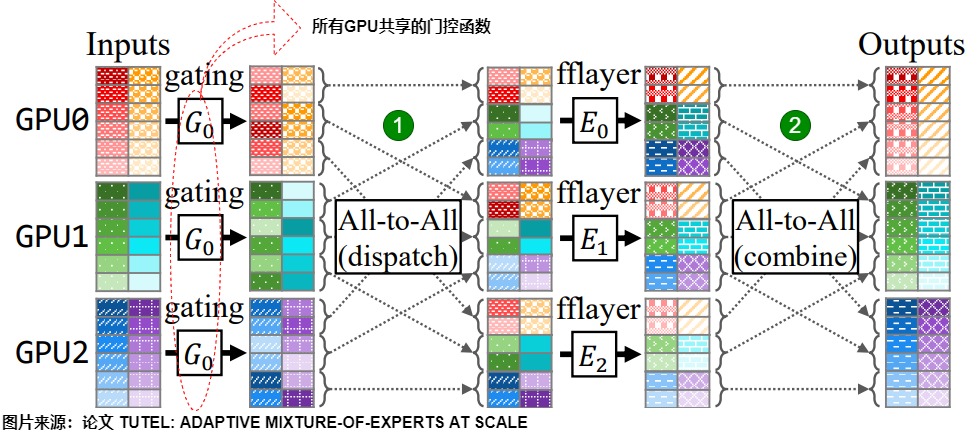
Source-local visual: A21 - MoE, citing Tutel. Stage 1 is the all-to-all dispatch from origin-GPU token order into expert-owner order; stage 2 returns expert outputs to the origin ranks for combine. The gate may be replicated, but expert FFNs are partitioned. The figure shows a regular dense layout; production exchanges can be variable-sized and topology-aware.
After each source rank computes destination counts, the expert-parallel group exchanges counts and then payloads. Conceptually:
origin rank p:
    send_counts[p, :]
    send_buffer grouped by destination

destination rank r:
    receive_counts[:, r]
    receive_buffer grouped by origin and physical expert
An all-to-all-v operation is a natural representation because each source-destination pair can carry a different row count. Implementations may realize this through native variable-size collectives, padded all-to-all, all-gather plus local filtering, or a specialized dispatch library.
0x03C1 Split Vectors Are A Matrix Transpose
The count matrix is not only a traffic summary. It is the shape agreement between senders and receivers. Destination rank receives source-indexed split vector:
For the exact fixture:
rank 0 receives [1,1,0,0] -> [r00,r05]
rank 1 receives [2,1,0,0] -> [r02,r01,r07]
rank 2 receives [1,1,0,0] -> [r03,r06]
rank 3 receives [0,1,0,0] -> [r04]
The payload arrives source-major because each sender contributed one contiguous destination slice. An implementation that assumes this is already expert-major can feed the right number of rows to the wrong expert.
The count-control alternatives carry different contracts:
| Design | Shape agreement | What stays regular | What may be wasted or delayed |
|---|---|---|---|
| native all-to-all-v | exchange or derive every peer split | useful payload rows | count/control path and dynamic offsets |
| uniform padded all-to-all | fixed peer capacity | allocation, collective shape, graph capture | padding to the hottest source-destination pair |
| all-gather and filter | common gathered shape | ownership and collective API | rows received by ranks that do not execute them |
| fused runtime transport | implementation-owned handle and buffers | pack/transport/decode pipeline | portability and version-specific assumptions |
For this fixture, all-to-all-v carries eight useful row slots. Uniformly padding all source-destination cells to the maximum split of two allocates:
so 24 of 32 row slots are padding. This is a row-slot comparison, not yet a byte or latency claim; Loop 4 owns payload dtype, metadata, liveness, events, and measured transfer cost.
0x03C2 Receive-Side Expert Repack
The destination performs a second stable permutation, now by (physical_slot_id, source_rank, source_send_position). Let be the rows for physical slot resident on destination . Its local expert offsets are:
where means the manifest’s explicit local slot order, not lexicographic coincidence. The fixture yields:
rank 0: q0 [r00,r05]                   counts [2],   offsets [0,2]
rank 1: q1 [r02,r07], q2 [r01]         counts [2,1], offsets [0,2,3]
rank 2: q3 [r06],     q4 [r03]         counts [1,1], offsets [0,1,2]
rank 3: q5 [r04]                       counts [1],   offsets [0,1]
Three coordinates must survive for each route: its position in the source send buffer, the destination receive buffer, and the local expert buffer. None can be reconstructed safely from token ID alone.
for route in semantic_route_order:
    metadata[route.id] = {
        "source_send_position": inverse_send[route.id],
        "destination_receive_position": inverse_exchange[route.id],
        "local_expert_position": inverse_expert_repack[route.id],
        "origin_partition": route.origin_partition,
        "origin_token": route.origin_token,
        "route_slot": route.route_slot,
        "gate": route.combine_gate,
    }
0x03C3 Round-Trip Identity And Weighted Combine
After expert execution, inverse local repack and inverse exchange restore the eight route rows to semantic order:
[r00,r01,r02,r03,r04,r05,r06,r07]
If is source packing, the variable exchange, and the receive-side expert repack, the return path must implement the inverse composition:
The combine is then a weighted scatter-add over the original semantic key, not over physical slot or destination rank:
The oracle uses scalar expert transforms [1,2,3,4] only to make wrong-expert execution observable. Packed execution and direct semantic execution both produce:
p0.t0 -> [1.35, 13.5, 135]
p0.t1 -> [3.20, 32.0, 320]
p1.t0 -> [8.22, 82.2, 822]
p1.t1 -> [6.20, 62.0, 620]
Changing only a count, offset, stable order, split vector, local slot offset, inverse route, or combined value causes the checked fixture to fail. The oracle executes no collective and no expert GPU kernel; it proves tensor identity and algebra for this declared layout.
0x03D Activation Byte Ledger
Loop 3 counted rows and positions. Bytes appear only after Loop 4 pins a representation. The baseline uses BF16 activation and expert-output elements, INT64 count/offset coordinates, INT32 transport metadata, and FP32 combine gates retained in the origin handle.

Five ledgers must remain distinct:
| Ledger | Question answered | Evidence required |
|---|---|---|
| row slots | how many useful or padded tensor rows exist? | route and layout manifest |
| logical bytes | what payload follows from declared shapes and dtypes? | representation manifest |
| live allocation bytes | which declared buffers coexist? | half-open lifetime schedule and alias rules |
| measured fabric/HBM bytes | what did hardware actually transfer? | profiler counters under a pinned runtime/topology |
| elapsed time | how long was the dependency path? | synchronized benchmark protocol and clocks |
The first three are executable in the local oracle. The last two are deliberately unclaimed.
0x03D1 Staging Payload Is Not Remote Network Payload
Let be all useful route rows in a collective staging layout, the subset whose destination rank differs from its source, and the dispatch and combine element widths. Then:
but the representation-level remote payload is:
For the exact fixture, , , , and bytes:
collective staging payload:
    dispatch = 8 * 3 * 2 = 48 B
    combine  = 8 * 3 * 2 = 48 B

remote row payload:
    dispatch = 6 * 3 * 2 = 36 B
    combine  = 6 * 3 * 2 = 36 B
The two local route rows remain in the packed staging layout but do not traverse a network link under the declared local-bypass policy. Calling 48 bytes “network traffic” would therefore overcount even before protocol effects.
0x03D2 Transport Metadata, Handle State, And Control Tables
Payload rows do not contain enough identity to return themselves. The baseline sends two INT32 fields per remote dispatch row, one INT32 handle index per remote combine row, and retains eight INT32-sized semantic/physical fields per useful route in the origin handle:
This is one selectable schema, not a universal ABI. A runtime can pack fields, derive them from offsets, transmit gates, or keep richer metadata. It must still preserve route identity and declare where each field lives.
The four-rank count and split tables use INT64 coordinates:
The local expert-offset arrays contain ten INT64 entries across the four destinations, adding 80 bytes. Summing table storage is not a network claim: these tensors can be produced locally, exchanged, derived, cached, or embedded in a specialized handle depending on the runtime.
Under this declared schema, remote row payload plus remote transport metadata is:
It excludes collective headers, scale tensors, alignment, retransmission, link-layer transactions, topology duplication, and physical HBM reads/writes. The name therefore remains logical remote bytes excluding protocol.
0x03D3 Half-Open Buffer Lifetimes And Peak
The fixture allocates fourteen named buffers. A buffer is live on half-open interval , so the declared live payload at epoch is:
| Buffer or allocation | Bytes | Live interval | Last completion required |
|---|---|---|---|
| input hidden | 24 | [0,9) | handle released |
| immutable route handle | 256 | [0,9) | handle released |
| count matrix | 128 | [1,7) | combine complete |
| send offsets | 160 | [1,7) | combine complete |
| receive splits | 128 | [1,7) | combine complete |
| packed send payload | 48 | [1,3) | dispatch complete |
| send metadata | 64 | [1,3) | dispatch complete |
| source-major receive | 48 | [2,4) | expert input ready |
| local expert offsets | 80 | [3,5) | expert complete |
| local expert input | 48 | [3,5) | expert complete |
| expert output / return payload | 48 | [4,7) | combine complete |
| return metadata | 32 | [4,7) | combine complete |
| returned source-order rows | 48 | [6,8) | output ready |
| output hidden | 24 | [7,10) | downstream consumer |
Adding every allocation gives 1,136 bytes, but the peak is 904 bytes at epoch 4. The sum and peak differ because lifetimes differ. The expert_output_return_payload is one declared alias: expert output is reused as the combine send payload without a second overlapping allocation. Two independently live buffers assigned that alias group are rejected.
0x03D4 Submission, Completion, And Stream Ownership
The correctness DAG is:
route_ready [route stream]
    -> dispatch_packed [pack stream]
    -> dispatch_complete [communication stream]
    -> expert_input_ready [expert stream]
    -> expert_complete [expert stream]
    -> combine_complete [communication stream]
    -> output_ready [output stream]
    -> handle_released [output stream]
An API returning from dispatch(...) can mean “submitted,” “payload available,” or “operation complete.” The handle must say which. Reusing send_payload immediately after submission is safe only if the transport has copied or finished reading it; the abstract baseline waits for dispatch_complete.
dispatch_ticket = dispatch_stream.submit(send_payload, send_metadata, splits)
dispatch_complete = dispatch_ticket.completion_event

expert_stream.wait(dispatch_complete)
expert_input = repack(receive_source_major, route_handle)
expert_output = run_local_experts(expert_input)
expert_complete = expert_stream.record_event()

combine_stream.wait(expert_complete)
combine_ticket = combine_stream.submit(expert_output, return_metadata)
combine_complete = combine_ticket.completion_event

output_stream.wait(combine_complete)
output = inverse_permute_and_scatter(returned_rows, route_handle)
output_ready = output_stream.record_event()

route_handle.release_after(output_ready)
This is a dependency contract, not a claim that a runtime uses these stream names or serializes all experts. Loop 10 owns legal communication-compute overlap and contention. Loop 7 will map the abstract tickets to pinned public interfaces.
0x03D5 Safe Release Is A Last-Reader Property
For buffer , let be operations that may still read it. Safe reuse requires:
That rule explains several otherwise same-shape failures:
| Premature action | Missing fence | Consequence |
|---|---|---|
| overwrite packed send rows after host submission | dispatch completion | in-flight transport reads new rows |
| release source-major receive before repack completes | expert-input-ready event | expert rows become nondeterministic |
| reuse expert output while combine is in flight | combine completion | returned values are corrupted |
| retire placement generation after dispatch but before scatter | output-ready/handle release | inverse metadata or replica state disappears |
The checked oracle rejects an early send release, early handle release, missing dependency, cyclic event graph, epoch-before-dependency, and overlapping live alias.
0x03D6 Regular Padding Changes Allocation Before It Changes Time
The Loop 3 count matrix has maximum peer split two. Uniformly padding all 16 source-destination cells therefore reserves 32 row slots. At BF16 and width three:
per direction: 32 * 3 * 2 = 192 B
round trip:    384 B

useful staging per direction: 48 B
useful staging round trip:     96 B
That proves a fourfold row-payload reservation for this fixture. It does not prove a fourfold slowdown: regular buffers can reduce control cost, enable graph capture, or select a faster transport. Conversely, all-to-all-v can send fewer useful bytes and still lose to launch, synchronization, or skew. Loop 6 owns the prefill/decode and graph-capture operating-point decision.
For a larger shape with , , , BF16 rows, and remote fraction :
all useful routed rows, one direction:
    T * k * d * 2 = 64 MiB of staging payload

dispatch plus combine staging payload:
    128 MiB

remote row payload only:
    0.75 * 128 MiB = 96 MiB
Metadata, control tensors, protocol overhead, quantization scales, padding, and physical transactions remain separate. The ledger describes representation-level bytes, not elapsed time.
0x03E A Two-Rank Trace
Suppose each rank starts with two tokens, , and two logical experts:
rank 0 owns physical expert 0
rank 1 owns physical expert 1

rank 0 routes:
    token 0 -> expert 0, expert 1
    token 1 -> expert 1, expert 0

rank 1 routes:
    token 0 -> expert 1, expert 0
    token 1 -> expert 1, expert 0
Each rank has four routed rows. Rank 0 sends two rows to rank 1 and keeps two locally. Rank 1 sends two rows to rank 0 and keeps two locally. After expert execution, each returned row must recover:
origin rank
origin token row
route slot
gate weight
Combining only by token id would collide rank 0 token 0 with rank 1 token 0. Combining only by (origin_rank, token_id) would still lose the two route slots. The full route identity is required until reduction.
0x04 Local Expert Execution: Padding, Grouped GEMM, Or Blocks
After dispatch, a destination rank owns variable row counts per physical expert slot. A local runner does not receive a router probability matrix. It receives the already selected, already placed, already permuted segments from Loop 3:
received_rows:      [R_recv, d]
expert_offsets:     [Q_local + 1]
rows for slot q:    received_rows[offsets[q]:offsets[q+1]]
route handle:       inverse coordinates + combine gates + generation
The runtime can encode those segments in several ways without changing which expert function each useful row must evaluate. This section therefore compares representations of one fixed route tensor, not different routing policies. Capacity selection and token dropping remain M6.1/M6.2 decisions.

0x04A The Frozen Six-Segment Input
Loop 3 fixes the local physical-slot order and route membership:
| Destination rank | Physical slots | Useful rows in slot order |
|---|---|---|
| 0 | q0 | q0=[r00,r05] |
| 1 | q1,q2 | q1=[r02,r07], q2=[r01] |
| 2 | q3,q4 | q3=[r06], q4=[r03] |
| 3 | q5 | q5=[r04] |
In global physical-slot order, the useful row counts and exclusive offsets are
Those eight rows are the semantic work. A representation may add zero-valued fringe rows, descriptor state, or sparse topology metadata, but it may neither discard a useful route nor return a padding row to combine.
Each production expert commonly contains a gated FFN such as SwiGLU:
Under the M4 convention that one multiply-add is two FLOPs, the three matrix multiplications contribute
The SiLU and Hadamard product are non-matmul work and must be accounted for separately if a kernel-level estimate needs them. The executable fixture uses the much smaller operator with . That substitution makes representation parity exactly inspectable; it does not claim to run a SwiGLU GPU kernel. The SwiGLU shapes and FLOPs are a separate analytical ledger.
0x04B Capacity-Padded Dense Execution
The fixed-capacity construction first reserves rows for every physical slot, then may round that capacity to a kernel row alignment :
For the frozen fixture, let , , and . Capacity alone reserves row slots. Kernel alignment raises the stride to , so the runner actually presents 24 rows:
useful rows                   8
capacity row slots           18   (10 capacity-unused)
aligned executed row slots   24   (6 more alignment-only)
total non-useful rows        16
row utilization              8 / 24 = 33.3%
input scalar values          24 * d     = 72
SwiGLU intermediate values   24 * d_ff  = 96
For and , the analytical matmul ledger is
while only FLOPs correspond to useful rows.
The padding mask belongs to the runner contract, not to the router:
for physical_slot, useful_segment in segments:
    dense = zeros([aligned_capacity, d], dtype=activation_dtype)
    dense[:len(useful_segment)] = useful_segment

    dense_out = expert[physical_slot](dense)

    # Only useful rows retain route identities. Padding never reaches combine.
    useful_out = dense_out[:len(useful_segment)]
    return_rows(useful_out, route_metadata[physical_slot])
Regular shapes can simplify a batched kernel, static allocation, and graph capture. The row ledger alone does not decide latency: a more regular kernel may outperform an irregular representation despite doing more arithmetic. That is a measurement question for Loop 11.
0x04C Variable Grouped GEMM
A grouped interface keeps the exact row dimension for every active physical slot while sharing one launch or scheduler:
problem q, gate/up:   [n_q, d]    @ [d_ff, d]^T
problem q, down:      [n_q, d_ff] @ [d, d_ff]^T
problem list m:       [2, 2, 1, 1, 1, 1]
segment offsets:      [0, 2, 4, 5, 6, 7, 8]
The grouped runner executes eight row slots and has row utilization one for this fixture. It still needs a descriptor or equivalent launch state for each active problem. The teaching ABI uses eight INT64 fields per problem:
m, n, k,
input_offset, gate_weight_offset, up_weight_offset,
down_weight_offset, output_offset
Six active problems therefore use descriptor bytes in the fixture. This is a selectable teaching schema, not a universal grouped GEMM ABI. Real libraries may use pointer arrays, device-side problem shapes, group tables, persistent schedulers, or additional workspace.
problems = []
for slot, begin, end in zip(slot_ids, offsets[:-1], offsets[1:]):
    if begin == end:
        continue
    problems.append(
        ExpertProblem(
            m=end - begin,
            n=d_ff,
            k=d,
            x=received_rows[begin:end],
            weights=weights[slot],
            output=expert_outputs[begin:end],
        )
    )

grouped_swiglu(problems, workspace)
The analytical matmul work is exactly the useful-row ledger, FLOPs for the toy dimensions. That does not mean the runtime cost is zero beyond those FLOPs. Descriptor construction, very small segment efficiency, load scheduling, workspace, and tail dimensions can dominate.
0x04D Block-Sparse Dropless Execution
MegaBlocks starts from a useful equivalence. Fixed-capacity batched expert GEMMs can be written as one block-diagonal multiplication. Uneven expert row counts then become diagonal blocks with unequal heights. Splitting those variable regions into smaller fixed blocks makes the operation representable by block-sparse matrix multiplication.
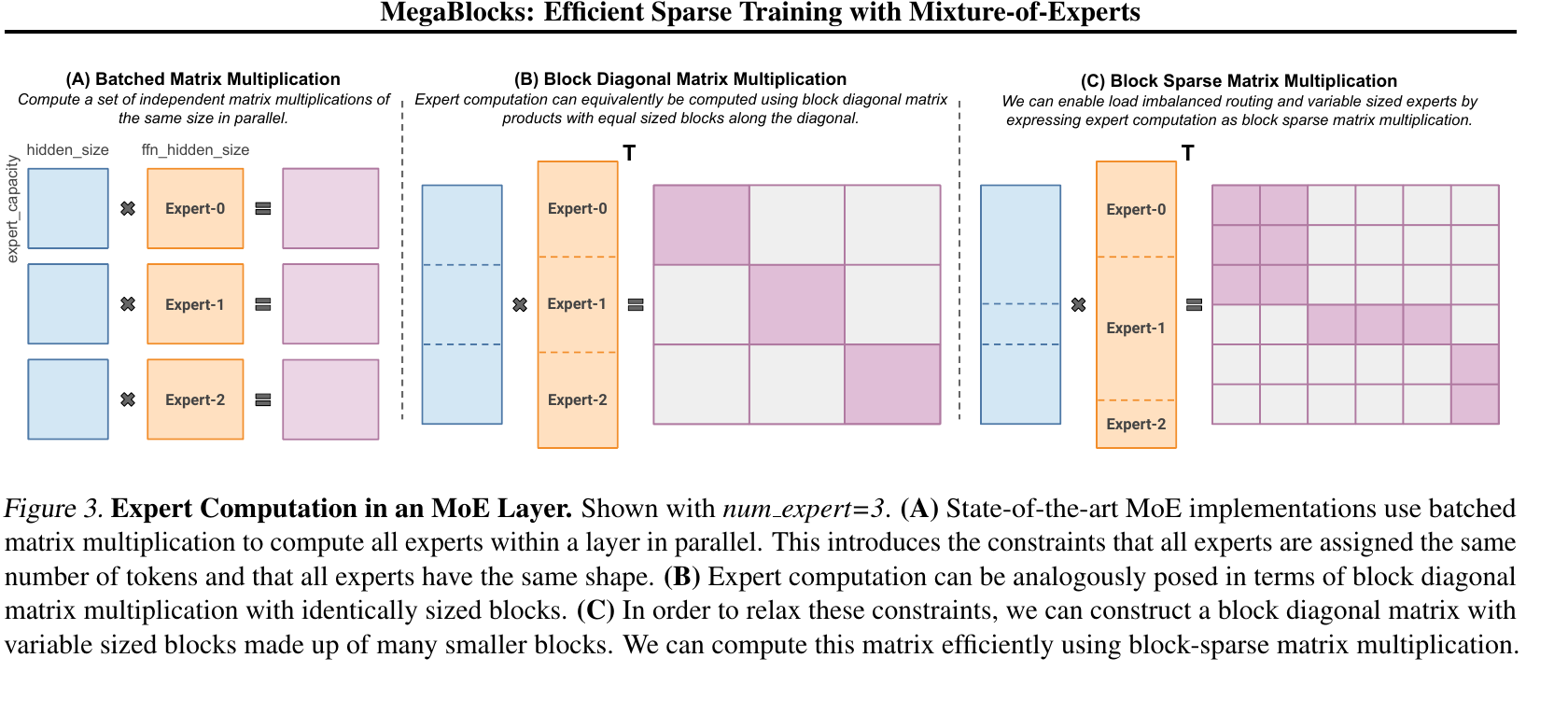
Source: MegaBlocks, Figure 3. Panel A is equal-size batched expert computation, panel B its equal-size block-diagonal form, and panel C the variable-row block-sparse construction. It is not a generic layout used by every grouped-GEMM or inference runtime.
For a token-row block size , each expert is rounded independently:
The teaching fixture uses , giving
It executes 12 row slots: eight useful rows plus four block-fringe rows, for row utilization. The analytical matmul ledger is FLOPs.
The output-column teaching block is and , so each expert row block has two nonzero column blocks. Six row blocks produce 12 nonzero matrix blocks. A minimal fixture topology stores:
row_offsets:        7 INT32 values
column_indices:    12 INT32 values
row_indices:       12 INT32 values
transpose_indices: 12 INT32 values
total:             43 INT32 values = 172 bytes
Those 172 bytes do not include gather indices, padded bins, allocator headers, or kernel workspace. They are a schema-specific topology ledger, not a claim about total MegaBlocks metadata.
counts = histogram(physical_slot_ids)
padded_counts = round_up_each(counts, block_rows)
padded_bins = inclusive_prefix(padded_counts)

x_blocked = padded_gather(received_rows, route_order, padded_bins)
topology = make_block_diagonal_topology(padded_bins, d_ff, block_shape)

# A gated MLP alternates sparse-output and sparse-input products.
hidden = sdd(x_blocked, W_gate_and_up, topology)
blocked_out = dsd(activation(hidden), W_down, topology)

useful_out = padded_scatter_useful_rows_only(blocked_out, route_order)
The pinned MegaBlocks implementation at revision
952db33d6eac334d22c61e47a0d5d41446298784 uses a block size of 128, rounds
each expert’s token count before padded_gather, constructs dynamic topology,
and supports a grouped path as a distinct implementation choice. The oracle’s
two-row block exists only so every index fits in a visible example. It must not
be presented as MegaBlocks’ production block size or as a performance
reproduction.
0x04E Capacity, Alignment, And Block Padding Are Different
The three sources of extra rows answer different questions:
| Extra-row contract | Question answered | Frozen-fixture result |
|---|---|---|
| capacity padding | How many rows may one expert admit under the model/runtime policy? | 18 slots before alignment |
| alignment padding | What row multiple does this dense kernel path require? | 24 executed slots |
| block-fringe padding | How many rows are needed to complete each sparse block? | 12 executed slots |
Token dropping is a fourth choice and is not padding. Dropping would reduce the set of eight useful routes and therefore change the semantic contract. None of the three exact runner alternatives in this loop drops a route.
0x04F One Function, Three Physical Representations
The CPU oracle executes the teaching expert through all three layouts. For example:
q0 -> expert 0: r00=[1,10,100], r05=[3,30,300]
q2 -> expert 1: r01=[2,20,200]
q4 -> expert 2: r03=[6,60,600]
q5 -> expert 3: r04=[12,120,1200]
After inverse routing and gate-weighted combine, every runner recovers the Loop 3 outputs:
p0.t0 = [1.35, 13.5, 135]
p0.t1 = [3.2, 32, 320]
p1.t0 = [8.22, 82.2, 822]
p1.t1 = [6.2, 62, 620]
The representations therefore have equal semantics in this declared fixture, but different work and state:
| Runner | Executed rows | Row utilization | Input values | Intermediate values | Analytical SwiGLU matmul FLOPs | Additional state shown |
|---|---|---|---|---|---|---|
| capacity-padded dense | 24 | 33.3% | 72 | 96 | 1,728 | valid-row mask |
| variable grouped GEMM | 8 | 100% | 24 | 32 | 576 | 384-byte teaching descriptor table |
| teaching block sparse | 12 | 66.7% | 36 | 48 | 864 | 172-byte minimal topology |
This table is an accounting result, not a winner declaration. It omits physical kernel throughput, launch cost, occupancy, cache behavior, topology-build cost, and hardware-specific alignment. Those measurements may reverse the ordering.
0x04G Runner Failure Lab
| Same-shape mistake | Violated contract | Consequence |
|---|---|---|
capacity chosen below max(n_q) | all useful rows execute | overflow is silently converted into a runner drop |
| padded row retains a route id | padding has no semantic identity | zero/fringe output is combined into a real token |
| grouped descriptor points to the wrong expert weight offset | physical slot owns its parameter state | numerically valid output from the wrong expert |
| grouped offsets omit a zero-row expert without preserving slot identity | descriptor index and physical slot are conflated | later descriptors bind to shifted weights |
| block bins use raw counts while gather uses rounded counts | topology and payload share offsets | one expert reads another expert’s fringe rows |
| block topology is reused after route counts change | topology is generation- and shape-dependent | sparse products read stale coordinates |
| MegaBlocks’ 128-row source pin is replaced by the toy block size | evidence scopes are conflated | teaching arithmetic is misreported as implementation fact |
| fewer analytical row FLOPs are called lower latency | logical work is confused with measurement | unsupported performance claim |
0x05 Prefill And Decode Runtime Modes
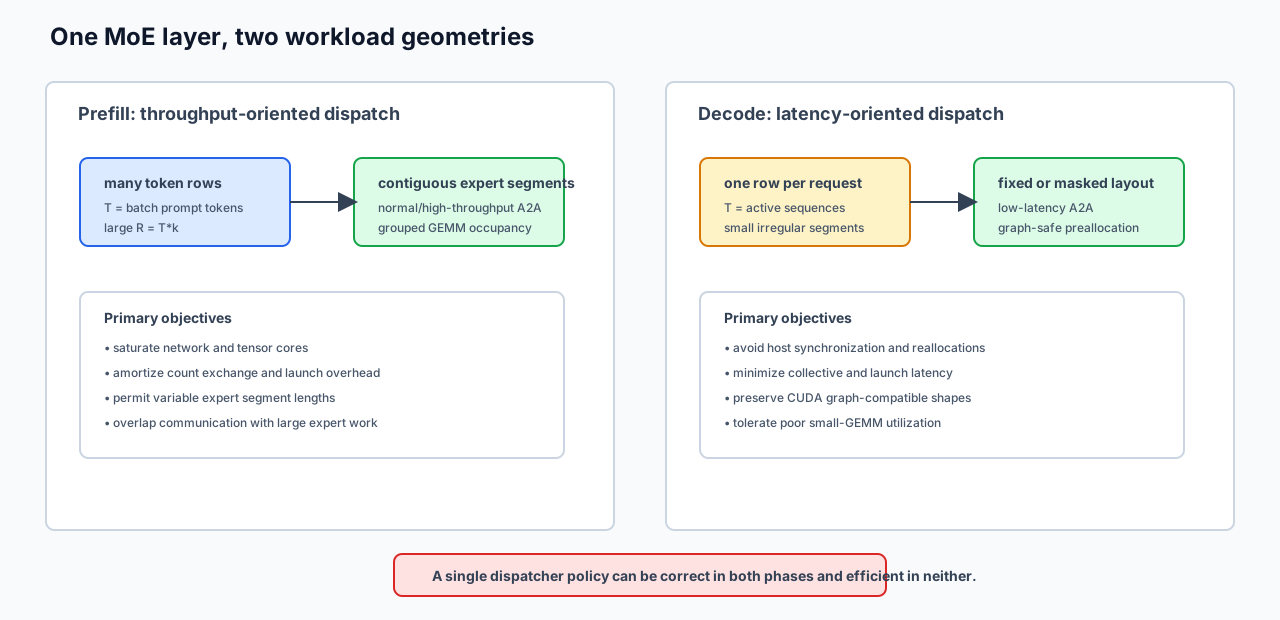
The words prefill and decode do not select a kernel by themselves. They change the number and provenance of current token rows, the frequency with which the path repeats, the useful expert-segment sizes, and which state can remain at stable addresses. The semantic route still obeys
where is the number of current input rows in this MoE invocation, not the total number of tokens represented by the KV cache. During one-token decode, is normally the active sequence count. During prefill, is the number of uncached prompt rows admitted to that invocation.

0x05A One Phase Manifest, Four Workloads
Loop 6 keeps the Loop 5 dimensions , , , six physical
slots, and the same placement-v17 generation. It changes only current-row
shape and phase policy:
| Profile | Rank-local current tokens | Physical-slot route counts | Useful routes |
|---|---|---|---|
| prefill | [32,24,0,0] | [28,22,18,16,14,14] | 112 |
| decode | [3,2,0,0] | [2,2,2,2,1,1] | 10 |
| mixed outer batch | [8,7,0,0] | [7,6,5,4,4,4] | 30 |
| oversize decode | [5,4,2,0] | [5,4,4,3,3,3] | 22 |
Every row satisfies . The profiles declare no latency. They count logical host submissions and control items only to expose how fixed orchestration becomes more prominent as route rows shrink.
0x05B Prefill: Variable Shapes And Amortized Planning
The prefill fixture has 56 current input rows and 112 routed rows. Its selected path keeps variable dispatch counts and invokes grouped expert problems with the exact segment sizes:
dispatch useful / executed token slots   56 / 56
runner useful / executed route rows      112 / 112
logical host submissions                 7
declared control items                    34
control items per useful route            34/112 = 0.304
The 34 items are a teaching control ledger: count cells, slot coordinates, and prefix/dispatch decisions under one declared schema. They are not FLOPs, bytes, or microseconds. The ratio
shows only that a fixed amount of planning is amortized over more useful rows. It does not show how much time each control item costs.
Large prefill segments often make contiguous permutation and grouped or block-sparse expert execution attractive. They do not guarantee balance: one long prompt or one hot expert can still dominate a rank. Loop 8 owns the topology consequences, and Loop 11 owns measurements.
0x05C Decode: A Fixed Bucket With Mutable Valid State
The decode fixture has five active requests: ranks contribute [3,2,0,0]
current rows. Its graph manifest reserves four token slots per rank and two
route rows per physical slot:
graph id                         decode.bucket4.v17
rank token capacities            [4,4,4,4]
physical-slot route capacities   [2,2,2,2,2,2]
valid input rows                 5
reserved input slots             16
valid route rows                 10
executed masked runner rows      12
The graph padding is physical state, not semantic input. Device-side real-count and valid-route tensors must mask all 11 unused input slots and both unused runner rows before they can acquire expert identities.
The teaching graph reserves five stable buffers:
graph.hidden
graph.route_ids
graph.gates
graph.expert_output
graph.step_metadata
For BF16 hidden/output, INT32 route ids, FP32 gates, , , , 16 token slots, and three INT32 metadata values per rank, the reserved payload ledger is
This is not total graph memory. It excludes allocator overhead, expert weights, collective workspace, kernel workspace, graph runtime objects, and every buffer not named by the fixture.
The captured addresses stay fixed, while these values change on device each step:
real_tokens_by_rank
valid_tokens
rank_token_offsets
valid_routes_by_slot
The fixture therefore executes more physical slots than it uses:
dispatch useful / executed token slots   5 / 16
runner useful / executed route rows      10 / 12
logical host submissions                 1
declared control items                    12
control items per useful route            12/10 = 1.2
One logical graph submission does not prove one GPU launch, nor does it prove a latency value. It records the host orchestration boundary only.
0x05D Graph Admission Is An Exact Predicate
The route counts may vary inside captured capacities, but the graph’s immutable key may not drift:
where is process-group identity, placement generation, checkpoint, dtypes, and rank-token and physical-slot capacities.
def admit_decode_graph(step, graph):
    if step.phase != "decode":
        return Fallback("phase_not_decode")
    if step.immutable_key != graph.immutable_key:
        return Fallback("graph_key_mismatch")
    if any(t > cap for t, cap in zip(step.rank_tokens, graph.rank_caps)):
        return Fallback("rank_token_capacity_exceeded")
    if any(n > cap for n, cap in zip(step.slot_routes, graph.slot_caps)):
        return Fallback("expert_route_capacity_exceeded")
    if not graph.stable_buffers_ready:
        return Fallback("stable_buffer_unavailable")

    update_device_validity_state(step)
    mask_graph_padding_routes()
    return Replay(graph.graph_id)
Placement is part of the key because captured expert pointers and physical-slot
coordinates belong to one generation. Replaying a placement-v17 graph against
placement-v18 is not dynamic load balancing; it is stale state. The valid
fallback is an uncaptured path with the current immutable plan, or a graph built
for the new generation.
0x05E Mixed Batches Preserve Phase Provenance
The outer mixed fixture contains 12 prefill rows and three decode rows. Merging all 15 rows into one homogeneous execution would erase whether a row is latency sensitive and whether it is eligible for the captured decode bucket. The declared policy partitions the batch before dispatch:
prefill unit:
    rank tokens [7,5,0,0]
    24 routes
    variable dispatch + grouped runner

decode unit:
    rank tokens [1,2,0,0]
    6 routes
    decode graph admitted
    16 dispatch slots + 12 runner rows
The aggregate accounting is then
useful input rows                 15
executed dispatch token slots     12 + 16 = 28
dispatch padding slots            13
useful route rows                 30
executed runner rows              24 + 12 = 36
runner padding rows               6
phase execution units             2
graph execution units             1
logical host submissions          7 + 1 = 8
Splitting is not universally optimal. It can reduce segment sizes and introduce another scheduling boundary. It is the declared fixture policy because it keeps phase objectives and graph eligibility explicit. M5 owns the ordinary scheduler decision that forms these units.
0x05F Oversize Decode Falls Back Without Semantic Drift
The oversize decode contributes [5,4,2,0] current rows. Rank 0 exceeds its
captured capacity of four, and several expert segments exceed the graph’s
two-route slot capacities. Admission fails first at
rank_token_capacity_exceeded.
The fallback executes 11 variable dispatch rows and 22 grouped expert rows. It does not truncate the fifth rank-0 token, drop routes to fit the graph, or reuse stale graph metadata:
graph replay:                 rejected
semantic input rows:         11 unchanged
semantic route rows:         22 unchanged
fallback dispatch slots:     11
fallback runner rows:        22
A fallback is correct only if it preserves the route and generation contracts. Graph admission is a performance-path decision, never permission to alter model semantics.
0x05G Source Contracts Behind The Phase Split
The phase distinction is visible in several versioned implementation surfaces:
- The pinned DeepEP V2 README exposes a normal training/prefill path and a decode path under one dispatch/combine interface, with handles and completion events. Its benchmark numbers remain source-reported.
- The pinned SGLang EP documentation distinguishes normal throughput-oriented prefill and low-latency graph-compatible decode modes and recommends automatic switching. That is one release’s integration contract, not a universal API.
- The pinned Megatron inference dispatcher separates equal-count graph and variable-count behavior, uses stable per-step metadata tensors, and includes a variable-count graph-oriented path under stated hardware constraints.
Loop 7 will bind exact classes, methods, arguments, and source lines. Loop 6 uses only the common state contract: stable addresses, mutable valid counts, masked padding, exact capacity admission, and semantic-preserving fallback.
0x05H Phase And Graph Failure Lab
| Same-shape mistake | Violated contract | Consequence |
|---|---|---|
| cached-context length used as decode | current rows define MoE work | route and capacity ledgers are inflated |
| graph padding receives valid router ids | padding has no semantic identity | inactive slots execute and combine |
| route counts change but valid-count tensors do not | mutable graph state describes this step | stale rows survive replay |
| placement changes without graph-key change | graph binds physical generation | captured pointers address wrong experts |
| oversize step is clipped to its bucket | fallback preserves semantic rows | accepted tokens/routes disappear |
| mixed rows are merged without phase provenance | graph admission and objective are per execution unit | decode latency and prefill throughput policies are conflated |
| stable buffer address is changed after capture | replay uses captured addresses | graph reads or writes unrelated storage |
| one graph submission is called one kernel | host and device execution coordinates are conflated | launch accounting is false |
| fewer control items per route is called lower latency | logical control count is not measured time | unsupported performance conclusion |
0x06 A Real Runtime Trace: Dispatcher, Runner, Combine
Fast-moving runtime code must be treated as a versioned implementation, not as the definition of MoE. This section traces six public surfaces pinned in Loop 1:
Megatron token dispatcher       0896be0f... / blob 256f38cc...
Megatron inference dispatcher   0896be0f... / blob 1a2ae10b...
DeepEP V2 README                01dc3aaa... / blob 078a1514...
DeepEP legacy compatibility     01dc3aaa... / blob e4f92abe...
SGLang EP documentation         e76d0acd... / blob 26e38cf0...
SGLang DeepEP dispatcher        e76d0acd... / blob f33c74f7...
The trace is source evidence. No GPU path was executed, and comments or type signatures do not prove latency, throughput, memory use, or a private production runtime.

0x06A Six Surfaces, Not Six Implementations Of One Interface
The public artifacts expose different ownership layers:
| Surface | What the pin exposes | What it does not establish |
|---|---|---|
| Megatron standard all-to-all | layer-level preprocess, transport, local expert ordering, reverse transport, and final unpermute | one explicit portable dispatch-handle object |
| Megatron flex + DeepEP manager | layer wrapper around fused dispatch/combine and manager-owned state | the same ABI as standard all-to-all |
| Megatron inference NCCL | equal-count graph and unequal-count padded/compact all-gather paths | universal decode eligibility |
| Megatron inference NVLS | on-device variable-count metadata and persistent symmetric buffers | support without Hopper+, NVLink, and symmetric-memory prerequisites |
| DeepEP README + compatibility wrapper | communication primitives, mode-specific handles, counts, and completion events | full router, expert runner, scheduler, or current ElasticBuffer source internals |
| SGLang DeepEP integration | typed normal/low-latency outputs, runner boundary, stage machine, and mode resolution | DeepEP’s internal kernel schedule or a universal serving architecture |
The common statement is deliberately narrower:
An already-selected route becomes transport state, destination-local expert rows, expert output, reverse transport state, and origin-local output. The state created for dispatch must remain valid through its matching combine.
0x06B The Eight-State Lifetime Contract
Loop 7 names the lifecycle independently of any method signature:
0 router_output
    produces topk_ids, topk_weights

1 dispatch_metadata_ready
    produces counts, layout, placement_generation

2 dispatch_in_flight
    produces dispatch_handle, dispatch_event

3 expert_rows_ready
    dispatch_event has completed

4 expert_output_ready
    local runner has produced expert_output

5 combine_in_flight
    consumes expert_output and dispatch_handle

6 origin_rows_ready
    combine_event has completed

7 dispatch_state_releasable
    origin output is visible; paired state may retire
The lifetime invariant is
for the generation bound to one in-flight invocation. The source libraries do not all call this value a generation. M6.6 requires it because Loop 2 proved that an old placement cannot retire while its route state is still live.
0x06C Megatron Standard All-To-All: State Lives In The Dispatcher
At 0896be0f..., MoETokenDispatcher splits the layer into six abstract
operations rather than one dispatch() call:
dispatch_preprocess
token_dispatch
dispatch_postprocess
expert runner                    # outside dispatcher
combine_preprocess
token_combine
combine_postprocess
The standard MoEAlltoAllTokenDispatcher consumes
hidden_states   [T_local, d]
routing_map     [T_local, E] bool
probs           [T_local, E]
and derives variable split state from expert counts. For the EP axis,
The pinned source then executes this exact physical order:
preprocess routing_map
    -> num_local_tokens_per_expert
    -> input_splits / output_splits

permute 1
    hidden [T_local,d]
    -> route-major local send rows [R_local,d]
    save reversed_local_input_permutation_mapping

token_dispatch
    all_to_all(hidden, output_splits, input_splits)
    all_to_all(probs,  output_splits, input_splits)

dispatch_postprocess
    optional TP gather
    optional sort_chunks_by_idxs into local-expert order
    -> [R_recv,d], tokens_per_expert, route probabilities

expert runner

combine_preprocess
    reverse local-expert sort
    optional TP reduce-scatter

token_combine
    all_to_all(hidden, input_splits, output_splits)

combine_postprocess
    unpermute with saved inverse map and routing_map
    reshape to original hidden shape
There is no single EPHandle in this path. The paired state is distributed
over instance fields such as input_splits, output_splits, routing_map,
probs, and reversed_local_input_permutation_mapping. Calling the API
“stateless” because it lacks a handle argument would therefore be wrong.
The source also shows a real design choice: token rows and probability rows are separate all-to-all operands. A fused transport may package those coordinates differently, but it must preserve their route association.
0x06D Megatron Flex And Inference Paths Change The State Contract
The same Megatron revision also contains a flex dispatcher whose DeepEP manager
uses fused communication. _DeepepManager.setup_metadata converts the dense
route/probability surface to top-k indices and probabilities. fused_dispatch
returns destination rows, destination indices, probabilities, expert counts,
and a manager-owned handle. fused_combine consumes that handle, after which
the source clears the handle and dispatched metadata.
standard A2A:
    explicit permute -> A2A -> local sort
    reverse state spread across dispatcher fields

flex DeepEP manager:
    setup_metadata -> fused_dispatch
    reverse state held by _DeepepManager.handle
    fused_combine -> clear handle and dispatched metadata
Neither representation changes the selected logical route. The flex manager’s reconstruction of top-k indices is a format conversion over upstream probabilities and dropped-route sentinels, not permission to choose a different expert policy.
Megatron’s inference source exposes two more contracts:
| Dispatcher | Per-step row contract | Persistent state | Qualification |
|---|---|---|---|
NCCLAllGatherDispatcher graph path | equal token counts per EP rank | stable _valid_tokens_tensor | source says decode-only graphs enforce equal counts at this pin |
NCCLAllGatherDispatcher non-graph path | unequal rank counts; pad to max, all-gather, compact | _local_tokens_per_rank plus valid-count state | host count synchronization occurs; source says this path does not run under graph capture |
NVLSAllGatherVDispatcher | variable counts with device-side metadata | _step_metadata, real-count tensor, hidden/route/probability/return symmetric buffers | requires Hopper+, NVLink, and symmetric-memory support |
The NVLS path allocates worst-case buffers once, updates
[valid_tokens, rank_token_offset, ep_max_tokens] in place, and pre-masks route
storage so graph-padding rows cannot reach the expert runner. That source
contract is the implementation analogue of Loop 6’s stable addresses plus
mutable valid state; it is not evidence that the Loop 6 teaching buffer schema
matches Megatron byte for byte.
0x06E DeepEP: Communication Handle And Event, Not A Full MoE Layer
The pinned DeepEP V2 README describes one ElasticBuffer surface for
high-throughput and low-latency operations. Its training/prefill example returns
recv_x
recv_topk_idx
recv_topk_weights
EPHandle
EventOverlap
and the matching combine consumes the handle. The event may be waited on before the runner reads receive rows. The decode example additionally shows a cached handle path, qualified by the condition that the routing layout remains valid.
The separately pinned deep_ep/buffers/legacy.py is explicitly a compatibility
surface. It must not be presented as the V2 ElasticBuffer implementation.
It is still useful source evidence for two physical layouts:
normal dispatch:
    variable received rows
    recv_topk_idx / recv_topk_weights
    num_recv_tokens_per_expert_list
    mode-specific tuple handle
    EventOverlap

low-latency dispatch:
    expert-major capacity tensor
    packed receive counts
    low-latency handle
    invalid slots represented separately from useful tokens
    EventOverlap or receive hook
The normal and low-latency handles are not interchangeable tuples. Their matching combine methods unpack different state. A generic tutorial should therefore type the handle by runtime revision and mode rather than serialize it as an undocumented list of tensors.
0x06F SGLang Makes Mode And Stage State Explicit
At e76d0acd..., SGLang’s public EP documentation separates TopK,
Dispatcher.dispatch, MoeRunner.forward, and Dispatcher.combine. The
pinned DeepEP dispatcher then defines different typed transport boundaries:
DeepEPNormalDispatchOutput:
    hidden_states, hidden_states_scale,
    topk_ids, topk_weights,
    num_recv_tokens_per_expert

DeepEPLLDispatchOutput:
    hidden_states, hidden_states_scale,
    topk_ids, topk_weights,
    masked_m, expected_m
Normal mode first obtains a dispatch layout, calls buffer.dispatch, stores
self.handle, waits on the event when configured for asynchronous finish, and
passes a normal-format object to the runner. Its combine consumes the stored
handle and clears it after completion.
Low-latency mode calls buffer.low_latency_dispatch, retains both
packed_recv_count and self.handle, and passes a masked expert-major contract
to the runner. low_latency_combine consumes the handle and gate state; the
source clears both retained fields after launching the return path.
The wrapper also enforces an explicit state machine:
INITIAL
    -> AFTER_DISPATCH_A
    -> AFTER_DISPATCH_B
    -> AFTER_COMBINE_A
    -> INITIAL
Calling combine before dispatch_b, dispatching twice without combine, or
mixing normal output with low-latency combine input violates a typed integration
contract even if the hidden tensors have compatible shapes.
In auto mode, _get_impl() resolves normal versus low-latency from batch
phase at this pin. That is SGLang behavior at one revision, not a universal
definition of prefill and decode.
0x06G Binding The Loop 6 Profiles To Public Source Surfaces
The source oracle makes only five phase bindings:
| Loop 6 profile | Pinned surface | Binding strength |
|---|---|---|
| 56-row prefill | SGLang normal DeepEP integration | documentation and source at e76d0acd... |
| five-request decode | SGLang low-latency integration | documentation and source at e76d0acd... |
| five-request decode | Megatron equal-count NCCL graph path | conditional pinned-source contract |
| five-request decode | Megatron variable-count NVLS graph path | conditional on stated hardware and symmetric-memory support |
| oversize decode | uncaptured or larger valid path | M6.6 correctness boundary, not one library API promise |
DeepEP’s README supports training/prefill and decode communication surfaces, but the Loop 6 numeric profiles are not DeepEP benchmark reproductions. Mixed-batch splitting remains an M5 scheduler decision consumed by M6.6.
0x06H A Portable Contract Without A Fictional Portable API
The safest integration pseudocode names state ownership while leaving each runtime’s method decomposition intact:
def execute_routed_layer(hidden, routes, phase, runtime):
    generation = runtime.acquire_placement_generation()

    dispatch_state = runtime.prepare_dispatch(
        hidden=hidden,
        immutable_routes=routes,
        phase=phase,
        generation=generation,
    )

    received = runtime.start_dispatch(dispatch_state)
    runtime.wait_dispatch_ready(received.completion)

    expert_output = runtime.run_local_experts(
        received.rows,
        received.runner_metadata,
    )

    returned = runtime.start_combine(
        expert_output,
        paired_dispatch_state=dispatch_state,
    )
    runtime.wait_combine_ready(returned.completion)

    assert returned.generation == generation
    assert returned.output.shape == hidden.shape
    runtime.release_dispatch_state(dispatch_state)
    runtime.release_placement_generation(generation)
    return returned.output
For Megatron standard all-to-all, dispatch_state is an explanatory wrapper
around instance fields. For DeepEP it corresponds more directly to a handle and
event. For SGLang it also includes mode-specific typed state and stage-machine
position. The pseudocode is a contract adapter, not copy-paste API code.
0x06I Source-To-Instruction Failure Lab
| Mistake | Why shapes can still look valid | Failure |
|---|---|---|
| standard Megatron path is described as handle-free | inverse state lives in dispatcher fields | second invocation overwrites state needed by the first combine |
| flex handle is reused after combine | source clears it after paired return | stale routing metadata or use-after-release |
| NVLS path is enabled without its hardware contract | tensor shapes do not encode fabric support | initialization failure or unsupported transport |
| graph padding is not pre-masked | buffers are capacity-shaped | invalid rows acquire expert work |
legacy.Buffer is called the V2 ElasticBuffer implementation | both expose dispatch/combine language | documentation and source claims are conflated |
| normal DeepEP handle is passed to low-latency combine | both are tuple-like state | fields are interpreted under the wrong layout |
| SGLang normal output enters the low-latency runner path | hidden width can match | counts/masks and combine format disagree |
combine() runs before dispatch completion | asynchronous return exists | expert runner reads incomplete receive rows |
| placement generation changes while state is live | source APIs may not name generation | return path addresses another placement |
| source comment is promoted to a latency result | no timing is required to compile code | unsupported performance claim |
The executable evidence records six artifacts, 17 line spans, 80 symbol references, six source surfaces, five phase bindings, and twenty rejected one-field mutations. It leaves private production code, compiled kernel order, unnamed allocator state, profile measurements, and post-pin API changes public unknowns.
0x07 Topology-Aware Routing, Hierarchical Exchange, And Process Groups
Topology is not a performance annotation attached after dispatch. It changes which coordinate indexes a split vector, which paths consume intra-node or inter-node transport, where relay buffers live, and which communicator may legally execute the collective. It must nevertheless leave the Loop 3 route identity unchanged.
The executable Loop 8 fixture reuses all eight routes from Loop 3 under
placement-v17. It adds two nodes, two NIC identities, four process groups,
and a deliberately nontrivial expert-parallel peer order. No collective or
network path was executed.

0x07A Freeze Physical Domains Before Estimating Cost
The fixture topology is:
| Global rank | Node | GPU-local rank | Intra-node domain | NIC | Node relay |
|---|---|---|---|---|---|
| 0 | node-0 | 0 | nvlink-domain-0 | nic-0, direct | yes |
| 1 | node-0 | 1 | nvlink-domain-0 | nic-0, via rank 0 | no |
| 2 | node-1 | 0 | nvlink-domain-1 | nic-1, direct | yes |
| 3 | node-1 | 1 | nvlink-domain-1 | nic-1, via rank 2 | no |
NVLink and RDMA are teaching transport classes here, not measured links.
The pinned DeepEP README distinguishes NVLink for intra-node communication and
RDMA for inter-node communication, but it does not prove this fixture’s path,
bandwidth, rail choice, or relay schedule.
A topology record needs at least:
global rank
node and GPU-local rank
intra-node fabric domain
NIC identity and locality
node relay, if the schedule uses one
process-group identity and collective epoch
peer-slot order inside every process group
placement and topology versions
The topology version is separate from placement-v17. Moving an unchanged
expert replica to another rank changes placement. Rewiring rank-to-NIC or
process-group membership changes topology or communicator state. A graph or
dispatch handle may need both identities.
0x07B Global Rank Is Not Communicator Peer Slot
The fixture’s expert-parallel group has the peer-slot order:
peer slot:   0  1  2  3
global rank: 2  0  3  1
Let the process-group map be
For a global-rank count matrix , source rank must construct the split vector in peer-slot order:
and destination rank expects receive splits:
Loop 3’s global-rank matrix is still:
             destination global rank
source          0  1  2  3
rank 0         [1, 2, 1, 0]
rank 1         [1, 1, 1, 1]
rank 2         [0, 0, 0, 0]
rank 3         [0, 0, 0, 0]
The resulting source-0 split vector is not [1,2,1,0]. It is:
global destination order: [0,1,2,3] -> [1,2,1,0]
peer-slot order:           [2,0,3,1] -> [1,1,0,2]
All four send vectors are:
rank 0: [1,1,0,2]
rank 1: [1,1,1,1]
rank 2: [0,0,0,0]
rank 3: [0,0,0,0]
and destination rank 1’s source splits are [0,2,0,1], not its global-source
column [2,1,0,0]. Confusing global rank with peer slot can preserve the total
row count while sending every nonuniform segment to the wrong peer.
Zero-count ranks remain in every vector. Removing them changes the coordinate system even though they contribute no rows to this step.
0x07C One Route Relation, Three Physical Classes
For route row with source rank and destination rank , define:
The eight immutable routes classify as:
same GPU:              r00, r07                  -> 2 rows
same node, remote GPU: r01, r02, r05             -> 3 rows
different node:        r03, r04, r06             -> 3 rows
Therefore:
With BF16 values, one teaching row contains six activation bytes. The flat dispatch carries 18 intra-node bytes and 18 inter-node bytes; combine returns the same logical payload:
| Flat path | Dispatch rows | Dispatch bytes | Round-trip bytes | Directed pairs per direction |
|---|---|---|---|---|
| same-node remote GPU | 3 | 18 | 36 | 2 |
| different node | 3 | 18 | 36 | 3 |
These are logical activation values only. They exclude route metadata, count exchange, alignment, protocol, retransmission, relay storage, and link-layer transactions. They are not fabric counters.
0x07D A Logical Expert Group Is Not A Physical Domain
M6.2 owns group-limited or device-limited route selection. Its released-model trace showed that a contiguous expert-ID group is a logical eligibility group until a physical manifest proves otherwise. Loop 8 consumes the already-selected logical expert and resolves its physical destination.
The forbidden shortcut is:
A model can use group-limited routing while experts in one logical group are spread across nodes. Conversely, a runtime can colocate several logical groups inside one node. The route policy and placement policy can coordinate, but neither namespace may be inferred from the other.
0x07E Hierarchical Exchange Preserves Payload And Adds Relay Work
The fixture’s teaching schedule uses rank 0 as node-0 relay and rank 2 as
node-1 relay. Inter-node dispatch becomes:
1. source rank -> source-node relay
2. source relay -> destination-node relay
3. destination relay -> final expert rank
For r03, rank 0 already is the source relay and rank 2 is the final expert
rank, so only stage 2 carries a row. For r04, rank 1 first stages to rank 0,
then rank 0 sends to rank 2, then rank 2 forwards to rank 3. For r06, only
the source staging and inter-node stages are needed.
The exact dispatch ledger is:
source -> source relay:        2 rows
source relay -> dest relay:    3 rows
dest relay -> final rank:      1 row
Combine reverses source and destination responsibilities:
expert rank -> expert relay:   1 row
expert relay -> origin relay:  3 rows
origin relay -> origin rank:   2 rows
Thus the inter-node payload is preserved:
while the teaching hierarchy adds six intra-node relay-row movements:
What changes is the inter-node message-pair coordinate: flat dispatch plus combine use six directed source/destination rank pairs, while the relay schedule uses two directed relay-node pairs. Fewer inter-node pairs can enable coalescing; it does not prove fewer network bytes or lower latency.
0x07F Why Hierarchical Can Win Or Lose
A teaching decomposition is:
Hierarchy can help when coalescing reduces small-message overhead, maps traffic to a better NIC rail, or avoids many cross-node peers. It can lose when relay copies, HBM traffic, barriers, queueing, or relay hot spots dominate. Peak link bandwidth cannot decide between the schedules by itself.
A valid comparison must hold constant:
route IDs and gates
final expert destinations
origin ranks for combine
payload and metadata schema
placement and checkpoint generation
process-group membership and collective epoch
warmup, batch phase, skew, and measurement window
Loop 11 owns measured flat-versus-hierarchical latency. Loop 8 proves only coordinates, conservation, and logical byte ledgers.
0x07G Process-Group Construction Is Part Of The Plan
The fixture binds four groups:
| Group | Kind | Peer-slot order | Purpose |
|---|---|---|---|
ep-group-0 | full expert parallel | [2,0,3,1] | flat route transpose |
ep-node-0 | node-local EP | [1,0] | gather/scatter inside node 0 |
ep-node-1 | node-local EP | [3,2] | gather/scatter inside node 1 |
ep-relays | inter-node relays | [2,0] | node-coalesced exchange |
Every group uses collective epoch 12. Equal member sets with different peer orders are different coordinate systems. A placement snapshot must not retain an old peer-slot map after group reconstruction.
def build_topology_plan(routes, topology, process_groups):
    ep = process_groups.require("ep-group-0", epoch=topology.collective_epoch)
    assert set(ep.global_ranks) == set(topology.global_ranks)

    count_global = count_by_global_source_destination(routes)
    send_splits = {
        source: [count_global[source, ep.global_rank(peer)]
                 for peer in range(ep.size)]
        for source in topology.global_ranks
    }

    for node in topology.nodes:
        local = process_groups.require(node.local_group_id, epoch=ep.epoch)
        assert set(local.global_ranks) == set(node.member_ranks)
        assert node.relay_rank in local.global_ranks

    relays = process_groups.require("ep-relays", epoch=ep.epoch)
    assert set(relays.global_ranks) == {node.relay_rank for node in topology.nodes}

    return preserve_route_identity(
        classify_and_stage(routes, topology, send_splits)
    )
The helper intentionally receives immutable routes. It may stage an inter-node row through relays, but the final physical expert slot and inverse-combine identity remain those frozen in Loops 2 and 3.
0x07H What The Pinned Runtimes Establish
| Pinned surface | Topology/process-group evidence | Scope limit |
|---|---|---|
DeepEP README 01dc3aaa..., lines 71-72 and 131-151 | distinguishes NVLink intra-node and RDMA inter-node communication; buffer binds a distributed process group | documentation and source-reported capabilities, not this relay schedule |
Megatron dispatcher 0896be0f..., lines 81-89 and collective call sites | separates EP, expert-TP, and TPxEP process groups and indexes collectives through explicit group objects | does not make global rank equal group-local rank |
| Megatron inference dispatcher at the same pin | NVLS path requires an eligible NVLink and symmetric-memory domain | not a generic multi-node path |
SGLang EP docs e76d0acd..., lines 73-75 | backend construction and supported EP/TP relations are configuration-specific | compatibility changes after the pin |
| DeepSeek-V3 report | source-reports restricted communication fanout and overlap design | does not expose every production topology or packet schedule |
The source contracts justify explicit topology and process-group identities. They do not justify claiming that every runtime uses one relay per node, that RDMA always means inter-node, or that a logical router group maps directly to a physical fabric domain.
0x07I Topology And Process-Group Failure Lab
| Same-shape mistake | Violated contract | Consequence |
|---|---|---|
| global rank indexes a peer-slot split vector | communicator order owns split coordinates | valid total rows reach wrong peers |
| zero-count peer axes are removed | every participant uses the same group shape | collective split disagreement |
| logical expert group is treated as node ID | routing and placement namespaces differ | fanout or locality is misreported |
| one rank belongs to two nodes | topology domains form a partition | bytes and relay ownership are double-counted |
| node relay is not a node member | relay stages are node-local | cross-node path appears in an intra-node stage |
| node-local group crosses a node boundary | group membership must match topology | local collective uses the wrong fabric |
| relay group includes a nonrelay rank | one named relay per node | coalesced stage addresses a rank without relay state |
| collective epoch changes under a live handle | split vectors bind group generation | old peer slots index a rebuilt communicator |
| hierarchical stage changes final expert rank | staging cannot reroute semantics | another replica or expert executes the row |
| inter-node payload reduction is assumed | coalescing changes pairs, not useful rows | byte ledger silently drops accepted routes |
| added relay traffic is omitted | hierarchy materializes extra local stages | HBM and intra-node costs are understated |
| fewer pairs is called lower latency | time includes copies, sync, queueing, and contention | unsupported performance conclusion |
NVLink/RDMA labels are treated as measurements | transport class is not a counter | source capability becomes fabricated bandwidth |
The executable oracle freezes four ranks, two nodes, two NICs, four process groups, eight routes, three transport classes, flat and hierarchical byte ledgers, and twenty rejected one-field mutations. Actual collective algorithms, packetization, switch paths, relay buffers, contention, and latency remain public unknowns.
0x08 EPLB Replication, Rebalancing, And State Migration
Router balancing changes the demand presented by logical experts. Expert-parallel load balancing changes physical supply: how many compatible copies exist, where they reside, and which placement generation new work may use. The distinction is strict. Replicating logical expert does not add another term to the MoE sum. One accepted route still executes exactly one compatible copy of .

The visual and executable fixture use the same one-layer load vector
, four ranks, two nodes, two expert groups, eight target physical
slots, and immutable checkpoint-0042. They transcribe the public EPLB solver
at commit d52c72d5...; migration and generation fencing are additional M6.6
runtime contracts, not behavior claimed from that solver.
0x08A Demand Is A Matrix With Provenance
For MoE layers and logical experts, a placement solver consumes:
The matrix needs a provenance record:
load unit: accepted rows, FLOPs, time, or weighted cost
observation window and phase: prefill, decode, or mixed
aggregation: count, mean, quantile, or moving estimate
router/checkpoint version
topology and placement version that produced the observation
timestamp or iteration interval
The Loop 9 teaching matrix is not predicted traffic. It is the exact accepted route count from the Loop 2 semantic handoff:
Row counts are a useful first coordinate because they reconcile to route identity. They are not automatically equal to expert time. Different expert widths, dtypes, segment sizes, padding, and kernel tactics can give equal row counts different costs.
0x08B Why Replication Divides Load
Let be the number of physical copies of logical expert . If a separate replica selector distributes evenly, the ideal copy load is:
Adding one redundant copy changes that ideal from to
. The pinned replicate_experts routine therefore allocates each
next physical slot to:
This is a greedy discrete heuristic. It is understandable because it attacks the largest current ideal copy load. It is not a proof of a globally optimal placement once node constraints, indivisible routes, kernel shape, memory, migration, and tie behavior are included.
Tie behavior is observable. The pinned PyTorch max selects the first maximum
index. For node-0 loads and two redundant copies:
| Allocation state | ideal copy loads | next choice | ||
|---|---|---|---|---|
| initial | 1 | 1 | expert 0 | |
| after first copy | 2 | 1 | expert 0 by first-index tie | |
| final | 3 | 1 | stop |
The final maximum is higher than . The example is not a bug in the transcription; it exposes why deterministic tie policy and greedy order belong to the placement artifact.
0x08C The Pinned Solver Has Three Hierarchical Stages
The public EPLB implementation applies three transformations when the number of expert groups is divisible by the number of nodes.
0x08C1 Pack Logical Groups To Nodes
For contiguous group with expert set :
balanced_packing sorts groups by descending and greedily assigns each
group to the currently lightest node while enforcing exactly the same number
of groups per node. In the teaching fixture:
group 0 = {E0,E1}, load 6 -> node 0
group 1 = {E2,E3}, load 2 -> node 1
Because there is one group per node, cardinality fixes that assignment. Group locality is preserved, but the node loads remain unequal.
0x08C2 Replicate Experts Inside Each Node
The solver applies the greedy ratio rule independently to each node’s logical experts. With four physical slots per node:
node 0: [E0,E1] loads [4,2] -> replica counts [3,1]
node 1: [E2,E3] loads [1,1] -> replica counts [2,2]
The physical-copy weight used by the next stage is:
0x08C3 Pack Physical Copies To GPUs
Within each node, balanced_packing assigns the physical copies to equal-size
GPU packs. With two copies per GPU, the exact target map is:
| Global rank | Target slots | phy2log | replica ranks | ideal rank load |
|---|---|---|---|---|
| 0 | p0,p1 | |||
| 1 | p2,p3 | |||
| 2 | p4,p5 | |||
| 3 | p6,p7 |
The source returns three related coordinates:
phy2log[physical_slot] -> logical expert
phyrank[physical_slot] -> rank among that logical expert's copies
logcnt[logical_expert] -> number of physical copies
It then constructs a padded inverse map:
log2phy[E0] = [p2, p3, p1]
log2phy[E1] = [p0, -1, -1]
log2phy[E2] = [p4, p5, -1]
log2phy[E3] = [p6, p7, -1]
-1 is padding, not a physical slot. A route-to-replica selector must use
logcnt[e] or a validity mask before indexing log2phy[e].
0x08D Hierarchical And Global Are Different Contracts
The pinned entry point selects hierarchical placement when:
Otherwise it invokes the same hierarchical routine with one group and one logical node, which yields global replication and GPU packing. For the exact same and eight physical copies, the global counterfactual is:
logcnt = [4,2,1,1]

rank 0: [E0,E0] -> ideal load 2
rank 1: [E1,E0] -> ideal load 2
rank 2: [E2,E1] -> ideal load 2
rank 3: [E3,E0] -> ideal load 2
Define the ideal rank-load ratio:
The teaching fixture gives:
| Policy | replica counts | rank loads | What the number omits | |
|---|---|---|---|---|
| hierarchical | route-to-replica policy, locality benefit, migration, kernel time | |||
| global counterfactual | group-locality loss and resulting communication |
Global is more balanced in this fixture’s ideal row-load coordinate. That does not prove lower communication or latency. Hierarchical preserves expert-group node locality. A complete decision requires both coordinates and measurement. The EPLB README’s prefill/decode guidance is source-specific guidance, not a universal phase law.
0x08E Source-Faithful Solver Trace
def source_faithful_rebalance(weight, Q, groups, nodes, gpus):
    # eplb.py lines 150-156: policy selection.
    if groups % nodes == 0:
        group_load = sum_contiguous_expert_groups(weight)
        group_to_node = balanced_packing(group_load, nodes)

        node_local_weight = reorder_by_group_pack(weight, group_to_node)
        phy2local, replica_rank, local_count = replicate_experts(
            node_local_weight,
            Q // nodes,
        )

        copy_weight = gather(node_local_weight / local_count, phy2local)
        copy_to_gpu = balanced_packing(copy_weight, gpus // nodes)
        phy2log = undo_group_and_copy_permutations(phy2local, copy_to_gpu)
    else:
        phy2log, replica_rank, local_count = hierarchical_rebalance(
            weight, Q, groups=1, nodes=1, gpus=gpus
        )

    log2phy = padded_inverse(phy2log, replica_rank, local_count)
    return phy2log, log2phy, local_count
The transcription preserves source ordering and fixed pack cardinality. It does not silently add a topology-aware route selector, migration planner, allocator, or measured cost model.
0x08F A Placement Map Is Not A Migration Plan
The solver output names what placement-v19 should contain. The runtime must
still compare it with active placement-v18, reserve memory, materialize
missing state, verify compatible parameters, publish the new generation, and
drain old handles.
The toy expert is a BF16 SwiGLU with and . Its three matrices contain:
so one teaching copy carries:
This is parameter payload only. It excludes allocator metadata, checkpoint framing, transport protocol, optimizer state, and temporary copy buffers.
The exact placement-v18 -> placement-v19 plan is:
| Target rank | Target slot | Expert | Action | Source | Payload |
|---|---|---|---|---|---|
| 0 | p0 | E1 | same-node network copy | rank 1 q2 | 36 B |
| 0 | p1 | E0 | retain compatible storage | rank 0 q0 | 36 B retained |
| 1 | p2 | E0 | same-node network copy | rank 0 q0 | 36 B |
| 1 | p3 | E0 | same-GPU duplicate after p2 | rank 1 target state | 36 B local |
| 2 | p4 | E2 | retain compatible storage | rank 2 q4 | 36 B retained |
| 2 | p5 | E2 | same-GPU duplicate after p4 | rank 2 retained state | 36 B local |
| 3 | p6 | E3 | retain compatible storage | rank 3 q5 | 36 B retained |
| 3 | p7 | E3 | same-GPU duplicate after p6 | rank 3 retained state | 36 B local |
Therefore:
retained copies:              3 -> 108 B state, no transfer
same-node network copies:     2 ->  72 B logical transfer payload
same-GPU duplicate copies:    3 -> 108 B local copy payload
old copies retired later:     3 -> 108 B state
The source and target resident ledgers are:
If retained copies are immutable and shared by both generation records, peak unique parameter storage during overlap is:
Adding old and new resident bytes without subtracting shared retained storage would double-count. Retiring old metadata before its handles drain would be a correctness failure, even when the underlying parameter storage is shared.
0x08G Publication Is A Generation State Machine
placement-v18 ACTIVE, one handle acquired
    -> collect load
    -> solve placement-v19 candidate
    -> reserve storage for five non-retained target copies
    -> materialize two network and three local copies
    -> verify logical expert, checkpoint, and parameter digest for all slots
    -> publish placement-v19 for new dispatches
    -> mark placement-v18 DRAINING
    -> reject retirement while refcount(v18) = 1
    -> combine and release dispatch-h18-0099
    -> retire placement-v18 metadata and unreferenced old copies
The transition can be written as:
candidate = solve_eplb(observed_load, topology, replica_budget)
reservation = reserve_nonretained_state(candidate, active_generation)
materialize_and_verify(candidate, reservation, checkpoint="checkpoint-0042")

registry.publish(candidate, generation="placement-v19")
registry.mark_draining("placement-v18")

assert not registry.can_retire("placement-v18")  # live h18-0099
combine_with_generation(handle="dispatch-h18-0099", generation="placement-v18")
registry.release("dispatch-h18-0099")
assert registry.can_retire("placement-v18")
registry.retire("placement-v18")
Publication before every target digest verifies can route new work into stale or partial expert state. In-place replacement is worse: an old dispatch handle can combine with new inverse maps while every tensor shape still matches.
0x08H Replica Selection Is A Separate Runtime Decision
EPLB returns replica sets. It does not assign each route row to one member of that set. For accepted route targeting logical expert , a runtime selector must choose exactly one compatible target:
def select_physical_replica(route, generation, predicted_rank_load):
    candidates = generation.log2phy[route.logical_expert_id]
    candidates = candidates[: generation.logcnt[route.logical_expert_id]]
    candidates = [q for q in candidates if generation.compatible(route, q)]
    q = min(candidates, key=lambda slot: (
        remote_class(route.origin_rank, generation.rank_of(slot)),
        predicted_rank_load[generation.rank_of(slot)],
        slot,
    ))
    return q  # logical expert and combine gate remain unchanged
Locality-first, least-load, round-robin, hash-based, and queue-aware selectors can produce different physical traffic from the same EPLB map. Their policy, state, and update cadence must be named before post-placement bytes are claimed.
0x08I Alternative Objectives And Load Estimators
The pinned solver is one design point. Alternatives change the owned object:
| Choice | Changed contract | Benefit | New failure surface |
|---|---|---|---|
| greedy redundant copies | discrete by | simple deterministic allocation | tie/order sensitivity; no joint migration objective |
| hierarchical group placement | group-to-node locality before GPU balance | can reduce cross-node group fanout | constrains node balancing |
| global placement | ignores expert groups | larger balancing search space | can increase inter-node routes |
| exact min-max integer solve | jointly minimizes a declared load objective | auditable optimum for small instances | solver cost and objective mismatch |
| topology-aware multi-objective | adds traffic and domain penalties | can price locality | requires route distribution and link model |
| migration-aware optimization | penalizes state movement and peak overlap | avoids churn | can retain a temporarily poor placement |
| phase-specific plans | separate prefill and decode estimates | matches different row distributions | transition and cache/graph complexity |
A general teaching objective is:
This is an M6.6 scheduler formulation, not an EPLB paper equation. Its terms cannot be compared until units and normalization are declared.
Load estimation alternatives include trailing counts, exponentially weighted counts, phase-specific histograms, kernel-time estimates, and predictive models. EPLB consumes the matrix but does not predict it. A moving estimate:
adds lag and update cadence. A burst can make an otherwise exact placement solve obsolete before migration finishes.
0x08J Pinned Source Contract
Source span at d52c72d... | Exact use here | Explicit non-claim |
|---|---|---|
balanced_packing, lines 5-41 | descending greedy packing with equal item count | globally optimal weighted partition |
replicate_experts, lines 44-71 | repeated weight / logcnt maximum and replica rank | route assignment or measured speedup |
rebalance_experts_hierarchical, lines 74-129 | group-to-node, node-local replication, copy-to-GPU pipeline | weight migration or process-group rollout |
rebalance_experts, lines 131-162 | policy condition and phy2log/log2phy/logcnt outputs | load prediction, generation fencing, or rollback |
| EPLB README at the same commit | redundant-expert motivation and source-specific hierarchical/global guidance | a theorem that one policy wins each phase |
The local oracle is dependency-free and transcribes only those integer and greedy operations. It compares the hierarchical output with an explicit global counterfactual, then adds a separately labeled teaching migration state machine. No GPU kernel, distributed collective, allocator, or benchmark is executed.
0x08K Replication And Migration Failure Lab
| Same-shape mistake | Violated contract | Consequence |
|---|---|---|
| load matrix loses router/checkpoint provenance | placement input is versioned evidence | stale workload drives a valid but irrelevant solve |
| row count is called kernel time | load unit is explicit | equal counts hide shape-dependent stragglers |
| EPLB map is treated as route assignment | placement and replica selection are separate | post-placement traffic is fabricated |
log2phy padding -1 is indexed | logcnt owns validity | invalid slot reaches dispatch metadata |
| replica rank is confused with global rank | namespaces differ | compatible copy maps to wrong device |
| tie policy changes silently | greedy order is artifact state | replica counts or pack order drift |
| global balance number ignores group locality | objective is incomplete | lower ideal load can raise communication |
| new generation publishes before digest verification | all slots must be compatible | requests execute stale or partial expert state |
| retained bytes are counted as network traffic | state and transfer ledgers differ | migration traffic is overstated |
| retained storage is counted twice at peak | aliases are explicit | memory admission falsely rejects candidate |
| source copy is retired before materialization completes | copy lifetime is incomplete | target digest is corrupt or unavailable |
| old map is overwritten in place | live handles bind old generation | shape-correct combine returns wrong expert rows |
| old generation retires at nonzero refcount | drain fence is absent | use-after-free of maps or weights |
| replica means ensemble member | physical copies preserve one function | expert output is multiplied or averaged incorrectly |
| computed payload bytes are labeled measured | analytical and observed evidence collapse | unsupported bandwidth or latency claim |
The executable fixture rejects twenty one-field mutations across upstream hashes, source spans, load provenance, divisibility, parameter state, migration identity, generation order, and claim scope.
0x09 Communication-Compute Overlap Is A Dependency Schedule
Overlap is not a boolean optimization flag. It is a schedule over tasks, streams, buffers, and completion events. A diagram that merely draws communication and compute on top of each other has not yet proved that the consumer sees complete data, that two tasks do not collide on one serialized resource, or that a buffer remains live until its final consumer.

0x09A Pinned Interfaces Own Events, Not This Teaching Timeline
The pinned DeepEP README at revision 01dc3aaa exposes dispatch and combine
operations that return handles and events; consumers wait before using the
corresponding results. It also documents BF16 input or an FP8 data-and-scale
tuple at that revision. The pinned Megatron dispatcher at revision 0896be0f
contains explicit waits around shared-expert FC1/FC2 and routed all-to-all work.
Those source spans prove that event ordering, handles, shared-path overlap, and precision metadata are concrete runtime concerns. They do not report the durations below. The Loop 10 oracle uses integer analytical time units so the dependency arithmetic can be replayed without presenting a GPU or network benchmark.
0x09B From The MoE Dataflow To An Event DAG
For a task with start , end , and declared duration ,
Tasks sharing the same teaching stream may not overlap. Tasks on different streams may overlap only after their own predecessors finish. The exact fixture has eleven tasks:
| Task | Units | Stream | Must wait for |
|---|---|---|---|
| route plan | 1 | control | nothing |
| pack 0, pack 1 | 1 each | pack | route plan |
| dispatch 0, dispatch 1 | 3 each | communication | corresponding pack |
| shared path | 5 | compute | route plan |
| expert 0, expert 1 | 4, 2 | compute | corresponding dispatch |
| combine 0, combine 1 | 2 each | communication | corresponding expert |
| reduce | 1 | compute | both combines and shared path |
The dependencies preserve the runtime meaning:
route metadata -> pack_j -> dispatch_j -> expert_j -> combine_j
route metadata -> shared path -----------------------------> reduce
combine_0 + combine_1 ------------------------------------> reduce
dispatch_0 does not authorize expert_1; expert_0 does not authorize
combine_1; and completion of one route slot does not authorize the token
reduction while another route slot is still outstanding.
0x09C Serialized And Overlapped Schedules, Derived
Placing every task one after another gives
The executable alternative is:
| Task | Serialized | Overlapped |
|---|---|---|
| route plan | [0,1) | [0,1) |
| pack 0 | [1,2) | [1,2) |
| pack 1 | [2,3) | [2,3) |
| dispatch 0 | [3,6) | [2,5) |
| dispatch 1 | [6,9) | [5,8) |
| shared path | [9,14) | [1,6) |
| expert 0 | [14,18) | [6,10) |
| expert 1 | [18,20) | [10,12) |
| combine 0 | [20,22) | [10,12) |
| combine 1 | [22,24) | [12,14) |
| reduce | [24,25) | [14,15) |
The overlapped makespan is the latest task end:
The union of compute intervals intersects the union of communication intervals for eight units. This is not the same as saying that all ten hidden critical path units are communication time. Pack/control movement and changed idle gaps also affect the schedule.
Most importantly, is not a measured speedup. It is the result of one exact dependency fixture under fixed integer durations. On real hardware, communication can consume SMs, HBM bandwidth, copy engines, network injection credits, and workspace that the expert kernels also need. Concurrent tasks can both become slower.
0x09D Buffers Have A Longer Contract Than Their Producers
An event does not merely release a successor. It also closes a buffer lifetime. The overlapped fixture keeps nine half-open lifetimes:
| Buffer | Allocated | Last consumer ends | Release |
|---|---|---|---|
| send 0, send 1 | 1, 2 | 5, 8 | 5, 8 |
| receive 0, receive 1 | 5, 8 | 10, 12 | 10, 12 |
| expert output 0, 1 | 10, 12 | 12, 14 | 12, 14 |
| shared output | 6 | 15 | 15 |
| combined segment 0, 1 | 12, 14 | 15, 15 | 15, 15 |
The producer’s launch is not a release fence. For example, send_1 remains
live until dispatch_1 ends at unit 8, and shared_out remains live from unit
6 through the final reduction at unit 15. Early reuse can produce a
shape-correct but nondeterministic wrong answer.
0x09E Alternative Overlap Designs
The same semantics permit several physical schedules:
| Design | Unit of readiness | Advantage | New burden |
|---|---|---|---|
| bulk all-to-all | whole rank payload | simplest completion contract | no expert starts early |
| peer/chunk pipeline | peer segment or chunk | earlier compute and return | more events, buffers, and small-message risk |
| shared-path overlap | routed dispatch vs always-on expert | independent useful work | shared and routed paths may contend for SM/HBM |
| microbatch pipeline | communication for batch vs compute for | coarse reusable schedule | extra activation state and pipeline bubbles |
No option dominates without the phase, topology, row histogram, resource profile, and tail-latency objective measured together.
0x09F Overlap Failure Lab
| Same-shape mistake | Violated contract | Consequence |
|---|---|---|
| expert starts when dispatch is launched | completion, not launch, owns readiness | expert reads partially written rows |
| two communication tasks overlap on one serialized stream | stream exclusion | fixture invents impossible concurrency |
| send buffer releases after pack | dispatch is still a consumer | payload is overwritten in flight |
| shared output releases when FC2 ends | final reduction still consumes it | routed/shared sum is corrupted |
| optimistic units are called milliseconds | analytical and measured evidence differ | fictitious latency result |
| timeline overlap is called speedup | resource contention is omitted | deployment regresses despite a prettier trace |
0x0A Precision Is Data Plus Metadata
Precision is not one dtype attached to the layer. Router decisions, dispatched activation data, scale metadata, expert arithmetic, gate weights, returned rows, and token accumulation can each use different representations. Every representation change adds an owner, shape, lifetime, and error boundary.
0x0AA One Frozen Payload Scenario
To avoid silently changing traffic after Loop 9 replication, the precision
fixture deliberately returns to the pre-rebalance placement-v17 scenario:
six remote route rows, eight useful local-plus-remote rows, and physical-slot
counts
This is a counterfactual payload ledger for those six rows. It is not the
post-placement-v19 route traffic, because the article has not defined a new
route-to-replica assignment for that generation.
0x0AB Deriving BF16 And FP8 Payloads
With activation width , BF16 element width bytes, FP8 data width byte, and FP32 scale width bytes, pure BF16 data is
One FP32 scale per route row gives
With one scale per elements per row,
The exact logical payload results are:
| Width | BF16 data | FP8 + one scale/row | FP8 + one scale/128 values/row |
|---|---|---|---|
| 3 | 36 B | 42 B | 42 B |
| 16 | 192 B | 120 B | 120 B |
| 7,168 | 86,016 B | 43,032 B | 44,352 B |
The row is intentional: low-precision data does not guarantee a smaller total logical payload. Six FP32 scales cost 24 bytes, so 18 FP8 data bytes plus scales exceed 36 BF16 data bytes. Real transports may add alignment, route metadata, protocol headers, packetization, allocator state, and physical link transactions; none is included above.
0x0AC Scale Tensor Ownership And Row Trace
For the per-row contract, quantization produces a pair rather than one tensor:
source activation rows      X_remote_fp8   [6, d]
source scale rows           S_remote_fp32  [6, 1]
stable route order          shared by X and S

dispatch(X_remote_fp8, S_remote_fp32, route_handle)
    -> destination X_fp8 segment [n_q, d]
    -> destination S_fp32 segment [n_q, 1]

dequantize with the scale at the same route row
    -> expert arithmetic
    -> BF16 return row in this teaching contract
If payload rows are permuted by destination but scales remain token-major, all shapes still match while every dequantized row can use the wrong scale. Scale shape, permutation, destination split, and dispatch handle therefore belong to one generation.
0x0AD Alignment Is Local Executed Work, Not Remote Traffic
Let the local expert runner require row alignment . Each physical slot executes
For , all six segments round to four rows:
Those sixteen fringe rows are local runner work in this fixture. They are not sixteen additional remote network rows. Padding before transport is a different design and would require a different payload oracle.
0x0AE Router, Gate, Combine, And Accumulation Dtypes
| Stage | Loop 10 teaching representation | Why it is separate |
|---|---|---|
| router logits and top-k comparison | FP32 | perturbations can change discrete expert identity |
| dispatch activation | BF16 or FP8 plus FP32 scales | transport payload and quantization error |
| expert arithmetic | backend-owned | weight/activation/accumulator policy is a kernel contract |
| returned expert row | BF16 | the pinned interface permits a higher-precision combine path |
| route gate | FP32 | preserves the declared mixture coefficient |
| token accumulation | FP32 | sums multiple returned route slots |
This table is one explicit policy, not a universal recommendation. It does prevent an invalid algebraic shortcut. The MoE output is
The gate may be fused with the expert output before return or with the origin reduction after return, subject to finite-precision ordering. It cannot generally be moved to the expert input: for a nonlinear expert, . The counterexample gives , not .
0x0AF Precision Failure Lab
| Same-shape mistake | Violated contract | Consequence |
|---|---|---|
| FP8 bytes omit scales | representation is data plus metadata | traffic is understated |
| scales use token-major order after expert-major permutation | scale and row share route identity | finite but corrupted expert input |
| still assumes FP8 is smaller | metadata can dominate tiny rows | false universal compression claim |
| alignment rows are added to remote-row count | local execution and transport differ | network payload is fabricated |
| gate is applied before nonlinear expert | mixture algebra changes | different model is executed |
| router precision change is judged only by logit error | top-k is discrete | small error can reroute the token |
| lower-precision mode is called quality-safe | interface support is not model validation | unsupported quality claim |
0x0B Parallel Axes Change Physical Ownership
Parallel folding is not merely a different set of group sizes. EP determines which rank group owns expert identities; ETP determines whether one physical expert copy is complete on one rank or sharded across several ranks. Changing ETP therefore changes the unit named by the placement table.
0x0BA Two Exact Four-Rank Layout Manifests
The fixture has global ranks [0,1,2,3]. Its active layout keeps complete
expert copies on rank slots:
active placement-v19
attention: TP=2, CP=1, DP=2, PP=1
MoE:       ETP=1, EP=4, EDP=1, PP=1

EP group:  [0,1,2,3]
ETP groups:[0] [1] [2] [3]
physical expert unit: one complete copy on one rank slot
The candidate shards each physical expert over two ranks:
candidate placement-v20-required
attention: TP=2, CP=1, DP=2, PP=1
MoE:       ETP=2, EP=2, EDP=1, PP=1

rank coordinates (EP, ETP):
    r0=(0,0)  r1=(0,1)  r2=(1,0)  r3=(1,1)
EP groups:   [0,2] [1,3]
ETP groups:  [0,1] [2,3]
physical expert unit: one copy spanning one ETP group
For these declared coordinate systems,
Equal products prove only that both manifests cover four ranks. They do not prove that their ownership, traffic, or checkpoint shards are compatible.
0x0BB Why placement-v19 Cannot Be Reused
In the active layout, physical_slot_id=p4 can name one complete expert copy
on one destination rank. In the candidate, the analogous copy has two weight
shards, two ETP coordinates, an intra-expert collective contract, and a group
rather than a single destination rank.
old identity:
    (logical expert, replica rank, destination rank, complete parameter digest)

new identity:
    (logical expert, replica rank, ETP group, shard coordinate,
     per-shard digest, collective generation)
Reusing placement-v19 would preserve an integer slot id while changing what
that slot physically means. The candidate must materialize, verify, publish,
drain, and retire as a new placement-v20 generation. Loop 9’s generation
state machine still applies; only the parameter-state schema becomes richer.
0x0BC Redistribution Is A Tensor Contract, Not A Product Formula
Attention and MoE can use different rank coordinates. The hidden rows crossing their boundary may need an all-gather, reduce-scatter, all-to-all, local view, or fused redistribution depending on which tensor dimensions each rank owns. The axis products above cannot determine the byte count.
To derive redistribution bytes, a runtime needs at least:
per-rank input tensor shape and strides
source shard dimension and coordinate
destination shard dimension and coordinate
replication vs reduction semantics
dtype and scale metadata
padding, sequence, and microbatch shape
process-group peer order and topology
The Loop 10 result is therefore explicit:
attention-to-MoE redistribution bytes:
    unknown_without_per_rank_shard_manifest
This is stronger than guessing zero from equal world factors or guessing one full hidden tensor from group sizes alone.
0x0BD Training, Prefill, And Decode Integration
| Phase | Axis pressure | Runtime consequence |
|---|---|---|
| training | optimizer/gradient ownership plus expert parameter shards | EDP and ETP affect reductions, checkpointing, and migration state |
| prefill | many routed rows, larger expert GEMMs | EP can aggregate useful work; redistribution and all-to-all volume grow |
| one-token decode | few rows per request, repeated latency path | large EP/ETP groups can expose tiny collectives and synchronization tails |
| mixed serving | prefill and decode share ranks | one fixed folding can be poor for one phase; phase split needs explicit state transfer |
Alternatives include complete experts with larger EP, sharded experts with ETP, node-local EP plus cross-node data replication, phase-specific pools, or a fixed global layout that sacrifices one operator to avoid redistribution. Each choice changes placement, process groups, checkpoint shards, and release evidence; none is a free configuration toggle.
0x0BE Parallel-Axis Failure Lab
| Same-shape mistake | Violated contract | Consequence |
|---|---|---|
| axis products equal four, so layouts are called equivalent | factorization does not define ownership | wrong process group or shard is selected |
| EP and ETP groups both use adjacent-rank assumption | each group has its own coordinate rule | tokens or shards cross the wrong peers |
placement-v19 reused after ETP 1 to 2 | physical expert unit changed | complete-copy digest is applied to a shard group |
| route handle omits collective generation | combine must invert the same groups | output returns through incompatible communicator |
| redistribution bytes inferred from group sizes | per-rank tensor manifest is absent | fabricated traffic ledger |
| one folding is declared optimal for all phases | row shape and cadence differ | decode tail or prefill throughput regresses |
The executable Loop 10 fixture rejects twenty one-field mutations spanning upstream identity, source revision, task duration and dependency, stream collision, buffer release, precision metadata, alignment, dtype, parallel factorization, placement generation, and forbidden performance claims.
0x0C A Runtime Is Released As One Compatibility Object
Loops 2-10 isolated identities, tensors, traffic, kernels, phase modes, source interfaces, topology, placement, and precision. A deployment cannot select those coordinates independently. A graph compiled for one placement and a handle produced by another can both have valid shapes while encoding different expert ownership.
The release object is therefore a tuple, not a binary:
where is checkpoint identity, placement generation, topology, process-group generation, route and handle ABIs, dtype roles, phase/backend selection, and graph manifests. A change to any coordinate requires either compatibility evidence or a new release identity.

0x0CA The Exact Release Fixture
The checked release is m66-placement-v19-canary-01. It binds
checkpoint-0042, placement-v19, topology-v3,
groups-v19-ep4-etp1, BF16 dispatch/combine, FP32 gate/accumulation, and
three phase paths:
| Phase path | Dispatcher | Expert runner | Graph state |
|---|---|---|---|
| variable prefill | throughput-variable | grouped GEMM | eager |
| fixed-bucket decode | low-latency | padded and masked | decode.bucket4.v19 |
| oversize decode | low-latency eager | grouped GEMM | explicit fallback |
Every digest in the teaching fixture is synthetic, but every field is a real compatibility question. Loop 11 also hashes all nine Loop 2-10 reports. A release built after one report changes is a different evidence object even if its human-readable configuration is unchanged.
@dataclass(frozen=True)
class MoEReleaseBundle:
    release_id: str
    checkpoint_version: str
    checkpoint_digest: str
    placement_generation: str
    placement_digest: str
    topology_version: str
    process_group_generation: str
    route_abi: str
    dispatch_handle_abi: str
    precision_roles: dict[str, str]
    phase_backends: dict[str, BackendManifest]
    graph_manifest_digest: str
    upstream_report_digests: tuple[str, ...]
placement-v20-required is deliberately not the candidate. Loop 10 changes
EP4/ETP1 into EP2/ETP2, so one physical expert becomes an ETP-sharded object.
Without a per-rank checkpoint-shard manifest, the redistribution bytes and
the target weight identity are both unknown. Equal world-size products do not
make that alternative releasable.
0x0CB Runtime Objects Carry The Release Coordinates
@dataclass(frozen=True)
class PlacementSnapshot:
    release_id: str
    placement_generation: str
    checkpoint_version: str
    process_group_generation: str
    phy2log: Tensor
    log2phy_offsets: Tensor
    log2phy_values: Tensor
    physical_rank: Tensor

@dataclass
class DispatchHandle:
    release_id: str
    placement_generation: str
    process_group_generation: str
    origin_token: Tensor
    route_slot: Tensor
    inverse_permutation: Tensor
    send_counts: Tensor
    recv_counts: Tensor
    expert_offsets: Tensor
    gate_weights: Tensor
    dispatch_ready: Event
    combine_ready: Event
Compression of these fields is allowed; loss of their identity is not. The minimum cross-stage condition is
0x0CC Forward Blueprint With Admission And Fallback
def moe_forward(hidden, runtime, phase):
    release = runtime.release_registry.acquire_active()
    placement = release.placement.acquire_snapshot()
    try:
        backend = release.select_backend(phase, hidden.shape[0])
        ids, gates = runtime.router(hidden)
        plan = runtime.plan_routes(hidden, ids, gates, placement)
        assert_route_conservation(plan)

        if not backend.graph_key_matches(release, plan):
            backend = release.eager_fallback_for(phase)

        recv_rows, handle = backend.dispatch(plan, release)
        assert handle.release_id == release.release_id
        assert handle.placement_generation == placement.placement_generation
        assert handle.process_group_generation == release.process_group_generation
        handle.dispatch_ready.wait()

        expert_out = backend.run_experts(recv_rows, handle.expert_offsets)
        output = backend.combine(expert_out, handle)
        handle.combine_ready.wait()
        assert output.shape == hidden.shape
        return output
    finally:
        release.placement.release_snapshot(placement)
        runtime.release_registry.release(release)
The eager path is not a silent approximation. It must preserve route identity, gate ownership, checkpoint state, and placement generation. Only the execution representation changes.
0x0CD Route And Combine Assertions
expected_routes = hidden.shape[0] * topk
assert plan.accepted_routes + plan.dropped_routes == expected_routes
assert sum(plan.send_counts) == plan.accepted_routes
assert sum(handle.recv_counts) == recv_rows.shape[0]
assert handle.inverse_permutation.numel() == plan.accepted_routes

def combine(returned_rows, handle, local_token_count, d):
    token_major = returned_rows[handle.inverse_permutation]
    weighted = token_major * handle.gate_weights[:, None]
    out = zeros([local_token_count, d], dtype=weighted.dtype)
    scatter_add_(out, handle.origin_token, weighted)
    return out
If a runner already applies the gate to each expert output, combine must not apply it again. The release ABI therefore owns weighting location as well as tensor shape.
0x0D Evaluation Requires Cells, Denominators, And Evidence Classes
A list of metric names is not an evaluation protocol. Each result needs a release ID, workload cell, numerator, denominator, observation window, quantile convention, and evidence class. Loop 11 uses four deterministic synthetic cells only to execute this accounting contract:
| Cell | Steps | Attempted / accepted / dropped routes | Remote / inter-node | Graph replay / fallback |
|---|---|---|---|---|
| prefill uniform | 40 | 320 / 320 / 0 | 240 / 120 | 0 / 0 |
| decode fixed bucket | 100 | 200 / 200 / 0 | 120 / 60 | 96 / 4 |
| decode hot expert | 80 | 160 / 158 / 2 | 120 / 70 | 70 / 10 |
| mixed burst | 20 | 120 / 120 / 0 | 90 / 50 | 10 / 10 |
These are fixture observations, not a benchmark. They let the oracle derive five non-interchangeable ratios:
For the exact aggregate, , , and . Therefore
while and . Dividing remote routes by attempted routes would answer a different question. Omitting the denominator would make the ratio unreproducible.
0x0DA Tail Statistics Need A Convention
The fixture includes twenty positive synthetic iteration units. For sorted observations , it uses nearest rank:
That gives p50=11, p95=23, and max=24 analytical units. These values are
not milliseconds, TTFT, TPOT, or GPU timing. A production evaluation must name
clock boundaries, warmup, synchronization, concurrency, sample count, and the
hardware/software manifest before publishing latency quantiles.
0x0DB Telemetry Schema And Cardinality
| Metric | Numerator | Denominator | Required bounded labels |
|---|---|---|---|
moe_route_drop_ratio | dropped routes | attempted routes | release, phase |
moe_remote_route_ratio | remote routes | accepted routes | release, phase |
moe_inter_node_route_ratio | inter-node routes | accepted routes | release, phase, topology |
moe_graph_replay_ratio | graph replays | replay + fallback | release, phase, graph |
moe_fallback_step_ratio | fallback steps | all steps | release, phase, reason |
| route-output mismatch counter | mismatches | counter | release, phase |
| stale-handle acceptance counter | accepted stale handles | counter | release, placement generation |
| count-conservation counter | failures | counter | release, process-group generation |
Request IDs, token IDs, and raw prompt strings do not belong in metric labels. Per-expert diagnostics need bounded expert IDs or sampled traces; otherwise the observability system becomes a second unbounded routing workload.
0x0DC Promotion Is A Conjunction, Not A Score
The exact teaching gate is
The fixture passes that logical gate. It does not prove production performance, availability, or quality. A real release must add named latency, throughput, memory, numerical-parity, quality, and SLO gates from measured artifacts.
The benchmark matrix must still cross phase, token count, uniform/hot/bursty routing, one-node/multi-node topology, EP/ETP layout, payload dtype, runner, placement, and graph mode. One balanced prefill batch cannot authorize decode or a hot-expert production distribution.
0x0E Fault Injection And Rollback Close The Runtime Contract
Happy-path parity does not exercise ownership failures. The Loop 11 oracle requires ten faults and one declared safe result for each:
| Injected fault | Required safe outcome |
|---|---|
| Loop 2-10 report hash drifts | reject build |
| process-group generation differs | reject load |
| peer route counts disagree | abort before payload exchange |
| inverse permutation is corrupt | reject output before publish |
| stale handle reaches new active generation | reject handle and replan |
| graph key differs | explicit eager fallback |
| FP8 scale count differs | reject payload before expert compute |
| runner parity differs | block canary |
| completion dependency is absent | reject schedule |
| active candidate faults | roll back to prior generation |
“Abort before payload exchange” requires a control agreement before ranks enter incompatible collectives. A local assertion after one rank has entered all-to-all cannot rescue the group.
0x0EA Rollback Is Ordered State Transfer
The candidate trace is
BUILT -> VERIFIED -> LOADED -> SHADOW -> CANARY -> ACTIVE
       -> DRAINING -> RETIRED
The exact fault path is:
stop new candidate dispatch
    -> activate loaded placement-v18 for new dispatch
    -> drain three placement-v19 handles to zero
    -> release placement-v19 graph resources
    -> retire placement-v19
    -> rollback complete
The lifetime rules are
Activating the prior generation before draining the candidate keeps new work flowing while old handles complete against the snapshot they acquired. The two generations may coexist only if their weights, maps, process groups, graph resources, and refcounts remain separately owned.
def rollback(candidate, prior, registry):
    registry.stop_new_dispatch(candidate.release_id)
    assert prior.loaded
    assert prior.checkpoint_version == candidate.checkpoint_version
    registry.activate_for_new_dispatch(prior.release_id)

    registry.wait_for_refcount(candidate.release_id, expected=0)
    candidate.graph_pool.release_all()
    registry.retire(candidate.release_id)
Retiring first is use-after-free. Draining first without activating fallback is
an availability outage. Reusing a placement-v19 graph under
placement-v18 is an ABI violation even when the graph bucket shape matches.
0x0EB Failure Closure Table
| Same-shape mistake | Violated release contract | Consequence |
|---|---|---|
| logical expert ID used as GPU ID | semantic and physical namespaces collapsed | wrong owner or out-of-range slot |
| dispatch and combine use different maps | handle generation not immutable | correct shape, wrong route output |
| expert-major output indexed by token ID | inverse metadata absent | route rows permute silently |
| alignment rows counted as drops | execution and semantic ledgers collapsed | false quality alarm |
| graph fallback clips oversize routes | fallback is not semantic parity | missing expert contributions |
| gate applied before and after expert output | weighting owner duplicated | systematic scale error |
| replica publishes before digest agreement | release manifest incomplete | request-dependent parameters |
| candidate accepts work after stop fence | acquisition fence violated | rollback never drains |
| graph pool releases at nonzero refcount | graph and handle lifetimes diverge | in-flight use-after-free |
| synthetic units labeled latency | evidence class changed | fabricated benchmark claim |
The executable fixture rejects twenty one-field mutations across upstream hashes, release identity, EP/ETP ownership, graph digest, blocked-v20 state, route conservation, telemetry denominators, sample gates, fault outcomes, rollout order, drain state, and claim scope. It executes no collective or GPU kernel and reports no production latency, throughput, quality, or availability.
0x0F Claim Status And Evidence
| Claim | Status | Evidence or qualification |
|---|---|---|
| expert parallelism requires token dispatch to expert-owning ranks and a return/combine path | source-local and externally verified | A21/A29, DeepSpeed-MoE, Megatron Core documentation |
| variable expert loads create irregular local matrix shapes | externally verified | MegaBlocks and grouped-GEMM runtime designs |
| block-sparse execution can support dropless MoE without global capacity padding | externally verified | MegaBlocks; performance results remain source-reported |
| all-to-all can be a major MoE cost | externally verified | DeepSpeed-MoE and Megatron documentation; exact fraction is workload-specific |
| current runtimes expose separate throughput and low-latency dispatch paths | externally verified, version-pinned | current DeepEP/SGLang documentation checked 2026-07-15 |
| redundant experts can balance hot logical experts | externally verified | official EPLB repository and DeepSeek runtime practice |
| hierarchical placement always wins for prefill and global placement always wins for decode | not universal | EPLB README gives scenario guidance, not a theorem |
| router precision can affect discrete expert identity | technically motivated and implementation-supported | Megatron Core guidance; sensitivity is model-specific |
| quantized dispatch always improves end-to-end latency | uncertain if generalized | depends on conversion, scale traffic, topology, and quality constraints |
| overlap always reduces latency | false if generalized | contention and dependency shape can reverse gains |
0x10 Handoffs
M6.6 closes the path from router output to distributed expert execution. It also exposes questions that belong elsewhere:
How should the router learn or constrain load?
    -> M6.1 and M6.2

How should low-rank updates be designed and served?
    -> M6.3, M6.4, and M6.5

How do expert and adapter states interact in routed adaptation?
    -> later M6 routed-adapter treatment

How should payload, expert weights, and deployment artifacts be quantized?
    -> M8

How do scheduler and KV lifetimes interact with decode?
    -> M5
0x11 Publish Gate
| Check | Status |
|---|---|
| Logical expert identity is separated from physical placement and replicas | pass |
| Semantic, conservation, identity, and placement-version invariants are explicit | pass |
| Routed-row tensors, counts, offsets, permutation, and inverse mapping are traced | pass |
| Communication bytes distinguish total routed rows from remote routed rows | pass |
| Padded, grouped-GEMM, and block-sparse execution are compared | pass |
| Capacity, alignment, and block padding are distinct | pass |
| Prefill and decode runtime modes are treated separately | pass |
| Dispatch and combine are represented as a paired stateful operation | pass |
| Current engine APIs are version-qualified rather than universalized | pass |
| Topology-aware, group-limited, and hierarchical exchange choices are explicit | pass |
| Expert replication includes memory, load, mapping, and transition costs | pass |
| Communication-compute overlap includes dependencies and contention | pass |
| Router, dispatch, combine, and accumulation precision are separated | pass |
| EP, ETP, TP, DP, CP, and PP composition is acknowledged | pass |
| Runtime data structures and route-accounting assertions are concrete | pass |
| Evaluation covers phase, skew, topology, precision, placement, and tail latency | pass |
| Failure injection includes stale maps, count mismatch, metadata corruption, and graph fallback | pass |
0xFF References
- Transformer Series A21 - MoE
- Transformer Series A29 - DeepSeek MoE
- M6.1 - Routed Capacity
- M6.2 - Expert Parallelism and DeepSeek MoE
- Outrageously Large Neural Networks: The Sparsely-Gated Mixture-of-Experts Layer
- GShard: Scaling Giant Models with Conditional Computation and Automatic Sharding
- Switch Transformers
- DeepSpeed-MoE
- Tutel: Adaptive Mixture-of-Experts at Scale
- MegaBlocks: Efficient Sparse Training with Mixture-of-Experts
- FastMoE: A Fast Mixture-of-Expert Training System
- DeepSeekMoE
- DeepSeek-V3 Technical Report
- Megatron Core MoE documentation, version 0.17.0
- Megatron Core inference token dispatcher, version 0.17.0
- DeepEP README at
01dc3aaa - EPLB README at
d52c72d5 - SGLang expert-parallelism documentation at
e76d0acd