M7.3 - Lookahead Decoding: Jacobi Iterations, N-Gram Pools, and Parallel Verification
M7.3 - Lookahead Decoding: Jacobi Iterations, N-Gram Pools, and Parallel Verification
0x00 Overview And Background
Autoregressive decoding is not serial because a Transformer is unable to process
many rows at once. It is serial because row t+1 needs a token selected from the
distribution at row t, and that token normally does not exist until the target
forward has finished. M7.1
introduced one way to manufacture those missing inputs: run a separate drafter.
M7.2 introduced another: attach
future-offset heads and compile their candidates into a tree.
Lookahead decoding starts from a different observation. A causal target model can be asked to update several guessed future positions in one forward. The complete guessed row is usually not ready to publish, but adjacent states along repeated updates contain short fragments that the same target model considered locally plausible. Preserve those fragments, retrieve them when their first token matches the live frontier, and verify them against the real prefix: the otherwise wasteful Jacobi trajectory becomes a target-generated proposal source.
The owner question is therefore:
How can one unchanged causal target model simultaneously
    update a rolling field of future guesses,
    harvest reusable n-grams from that trajectory,
    verify several disjoint continuations against one committed prefix,
and publish exactly the same greedy or sampled output distribution?
Its answer is not “Jacobi converges faster than autoregression.” Vanilla Jacobi usually does not. The answer is a four-stage state machine:
predict:    update W future positions from N-1 trajectory levels
collect:    turn adjacent trajectory states into keyed N-grams
verify:     test up to G matching suffixes under target conditionals
publish:    commit one validated path and repair every temporary state
That distinction matters. W, N, and G control a temporary computation
graph, not three kinds of model context. The n-gram pool is generated state, not
an external retrieval datastore. The lookahead rows are proposals, not committed
history. The verification rows share one prefix but are disjoint paths. And
“exact” names a decoding contract, not a promise that extra rows are free.
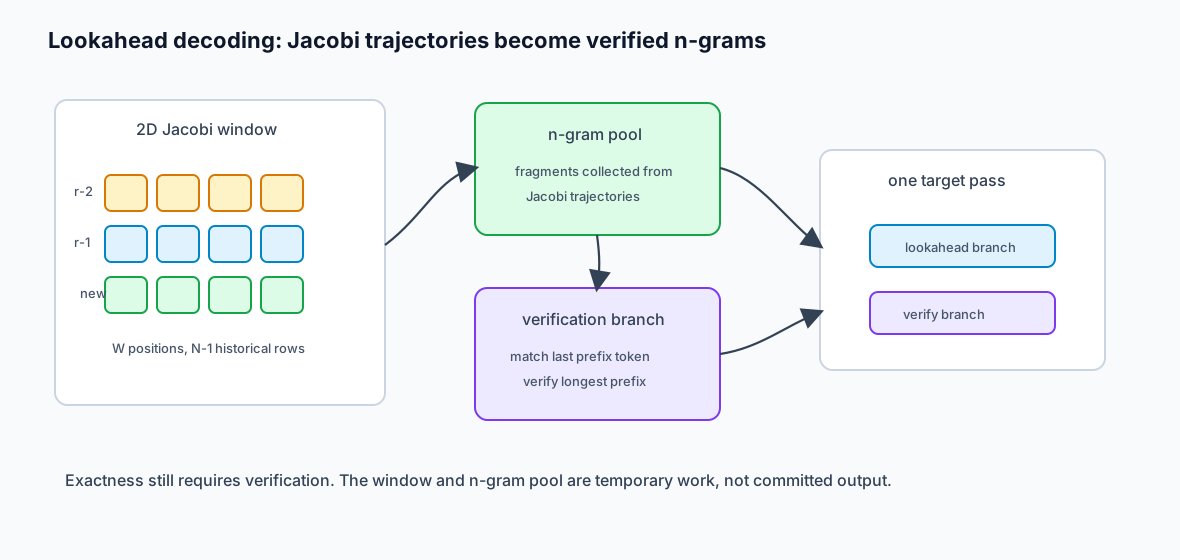
Historical path: from triangular decoding to trajectory reuse
The useful lineage is about which dependency is relaxed, not just publication dates:
| Stage | What executes in parallel | What remains serial | What Lookahead inherits |
|---|---|---|---|
| ordinary autoregression | tensor work inside one target step | token selection across positions | the exact target conditional |
| blockwise/guess-and-verify decoding | target scoring of known candidate positions | producing the candidate path | longest verified-prefix publication, owned in M7.1 |
| Jacobi parallel decoding | updates for many guessed positions | fixed-point iterations | target-only future-state trajectories |
| Lookahead decoding | rolling Jacobi updates and disjoint suffix verification | publication of the verified frontier | trajectory n-grams, keyed pool, joint branch mask |
Santilli et al.’s parallel decoding work formulated greedy Transformer decoding as a triangular nonlinear system and applied Jacobi and Gauss-Seidel-style iterations. The Lookahead paper then made a different engineering move: it stopped treating nonconverged trajectory values as pure waste and cached the N-grams that appear across adjacent iterations. This chronology supports the mechanism lineage; it does not by itself establish priority beyond the cited publications.
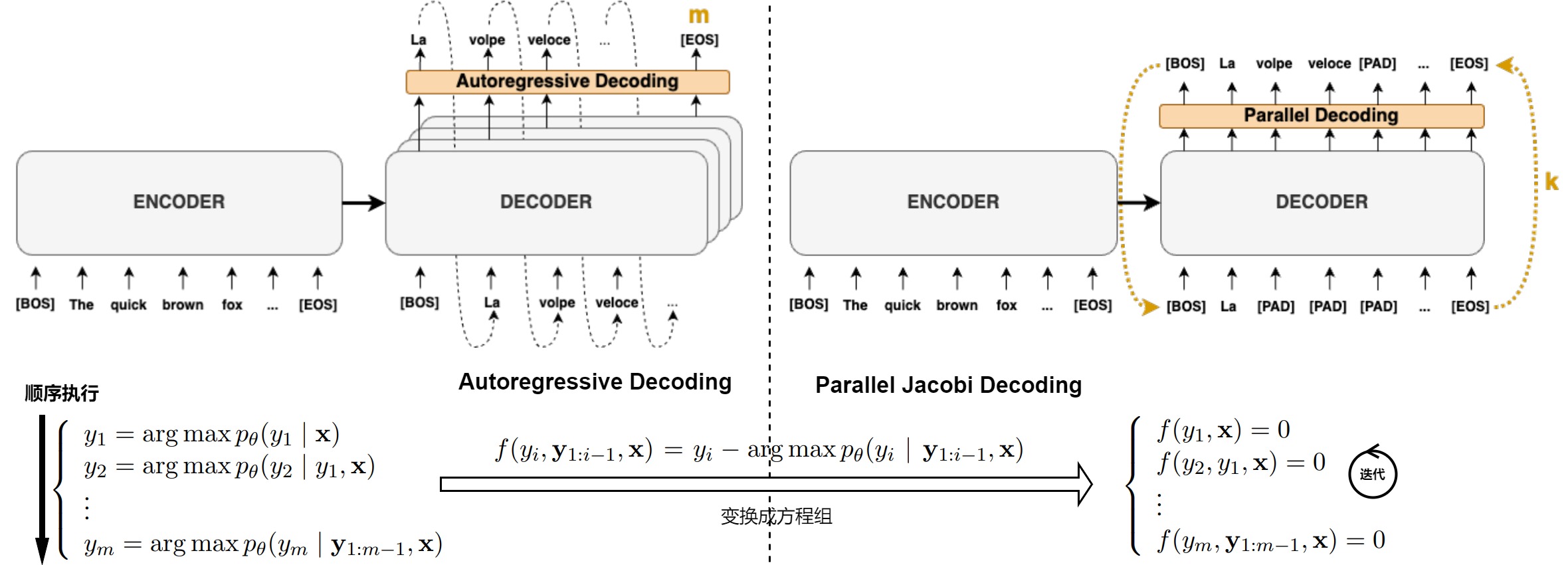
Source-local visual: A32 - Lookahead Decoding, adapting the parallel-decoding lineage. The encoder-decoder drawing is historical motivation; M7.3’s runtime contracts below are written for decoder-only causal LMs.
The paper’s key systems premise is also conditional. Low-batch autoregressive decode often leaves accelerator arithmetic underused while repeatedly streaming model state. Lookahead spends more token-row work per target call to reduce the number of calls. This can lower latency only while the enlarged call remains an efficient use of available compute and accepted progress grows faster than packing, attention, MLP, K/V, synchronization, and sampling costs. M4 owns the general hardware model; this article derives only Lookahead’s additional rows and state transitions.
Owner contract: what M7.3 owns and what it defers
M7.3 owns the full mechanism connecting five objects:
triangular target equations
    -> Jacobi trajectory window
    -> keyed N-gram pool
    -> packed lookahead/verification target call
    -> exact output and K/V publication transaction
It derives the coordinate system, reconstructs the released implementation at a pinned commit, and separates paper pseudocode from runtime-specific choices. It also compares greedy and exact sampling verification because Lookahead’s disjoint one-hot proposal proof is method-defining.
It deliberately defers:
| Deferred owner | M7.3 may use | M7.3 must not re-own |
|---|---|---|
| M7.1 | target verification and output-distribution language | general draft-model rejection sampling and correction K/V lifecycle |
| M7.2 | branch-isolation intuition | Medusa heads, tree buffers, and typical acceptance |
| M7.7 | bounded comparison of proposal sources | generalized prompt lookup, REST, dependent heads, and hardware-aware tree search |
| M7.8 | metrics needed to judge a Lookahead deployment | scheduler policy, rollout experiment design, SLO gates, and rollback ownership |
| M4/M5 | decode bottlenecks and K/V-cache vocabulary | generic kernel derivations, cache allocators, and serving schedulers |
The original A32 article remains the source-local implementation narrative. M7.3 does not replace it with a short summary: it turns its diagrams and code observations into derivations, immutable manifests, executable oracles, and failure checks.
Background knowledge: Jacobi iteration updates many dependent variables from an older state
Jacobi methods solve coupled systems by updating each variable in parallel from the previous iteration rather than immediately consuming newly updated neighbors. Applied to greedy decoding, future token positions can be initialized with guesses and repeatedly updated by the target model.
The intermediate rows are not automatically a valid final continuation, but they can contain reusable local fragments:
lookahead window:
    parallel future positions across recent Jacobi iterations

n-gram pool:
    fragments harvested from those trajectories

verification branch:
    checks promising fragments under exact autoregressive conditionals

window update:
    advances the iterative state after committed output
Lookahead decoding is consequently target-only candidate generation plus verification. Its speedup depends on useful fragment recurrence and verification efficiency, not on Jacobi convergence alone.
0x01 Claim Status And Scope
| Claim | Status | Evidence | Rewrite-safe wording |
|---|---|---|---|
| Lookahead is based on Jacobi decoding plus n-gram reuse. | Source-local and externally verified | A32, Lookahead paper | ”Lookahead uses parallel iterative guesses and caches n-grams from trajectories.” |
| Lookahead needs no auxiliary draft model or Medusa-style heads. | Source-local and externally verified | A32, Lookahead paper | ”It trades more target-model work per step for fewer total decode steps.” |
| Lookahead is exact under its algorithmic contract. | Externally verified | Lookahead paper | ”Exactness does not mean zero overhead.” |
| The mask and branch packing are implementation-critical. | Source-local | A32 | ”Lookahead and verification branches must not see invalid tokens.” |
Jacobi’s at-most-m greedy convergence follows from the triangular causal system. | Source-local and externally verified | A32, Santilli et al., Lookahead paper | ”Coordinate i becomes fixed after the preceding coordinates are fixed; this is not a generic nonlinear-convergence claim.” |
| The released Python path is the algorithm itself. | False | Paper and pinned implementation | ”Paper equations, Python row packing, specialized FlashAttention, and distributed LP are separate contracts.” |
| Lookahead eliminates serial dependence. | False if unqualified | Lookahead paper | ”It reduces target-call count when verified progress pays for extra per-call work; output publication remains ordered.” |
Exactness is scoped to the decoding policy and verification contract described by the Lookahead paper. Do not read it as “every stochastic sampling policy is distribution-preserved without an accept/reject correction rule.”
Evidence labels remain distinct throughout this article:
Source-local          reported by untouched A32
Primary paper         owned by the Jacobi or Lookahead paper
Pinned implementation observed at official commit eed010d...
Derived               algebra or tensor state checked by a local oracle
Synthetic             illustrative coordinate, never measured performance
Unmeasured            no local checkpoint/GPU quality or latency experiment
0x01A Immutable Round, Window, Pool, And Backend Manifest
Before deriving the algorithm, freeze one coordinate system. The paper presents
a rectangular semantic window; the pinned Python implementation stores a ragged
steady-state representation in which the live current-token row supplies one
cell that is not duplicated in past_tokens. Mixing those two views produces
off-by-one row, position, and K/V bugs.
Let:
| Symbol | Meaning | Constraint |
|---|---|---|
B | request batch in one Lookahead state machine | pinned Python path asserts B=1 |
V | vocabulary size | logits use final dimension V |
L | Transformer layer count | K/V contract repeats per layer |
d | hidden width | hidden rows are [B,Q,d] |
H_kv, d_h | K/V heads and head width | cache row is [B,H_kv,1,d_h] per K or V |
N | full n-gram length, including lookup key | general setting: N >= 2; illustrated pinned schedule: N >= 3 |
S=N-1 | stored/verified suffix length | every pool value has exactly S token IDs |
W | number of trajectory n-grams generated per steady round | controls lookahead work |
G | maximum suffixes retrieved for the current key | candidate count C_t <= G |
R=N-1 | semantic trajectory levels used by one n-gram | not a model layer count |
K_in | committed K/V rows entering the round | excludes temporary lookahead/verification rows |
I | live ordinary input rows not already in K/V | normally one in steady decode |
The general n-gram definition admits N=2, but the pinned multilevel schedule
illustrated here requires N >= 3, hence at least two trajectory levels.
Both its first warmup branch and its steady window update access
past_tokens[1]. Reject the unsupported one-level case before initializing or
compiling a round; satisfying the row-count equation alone is not enough.
This is a schedule-specific admission rule, not a restriction on every possible
Lookahead variant. The source is the pinned
warmup and update.
def pinned_suffix_length(N):
    if type(N) is not int or N < 3:
        raise ValueError("the illustrated pinned schedule requires integer N >= 3")
    return N - 1


S = R = pinned_suffix_length(N)  # validate before warmup or row compilation
Semantic paper window at round t:
Pinned Python steady-state storage:
The missing first-level cell is represented by the live current token. Therefore the appended lookahead-state rows are:
With C_t retrieved suffixes, verification contributes:
For the pinned steady call with I=1, the total uncached/current query rows are:
This equality is a reconciliation check, not a universal allocation law.
Warmup has ragged level sizes, prompt prefill has I>1, FlashAttention reorders
lookahead rows, and distributed LP shards W and candidates. Every runtime must
publish its actual level_sizes, row roles, logical positions, and K/V source map.
The pool is a typed map, not an unstructured list:
One round owns six state classes:
| State | Logical shape | Persistent after round? | Mutation owner |
|---|---|---|---|
| committed token prefix | [P] token IDs | yes | publication transaction |
| committed target K/V | L x 2 x [B,H_kv,K_in,d_h] | yes | publication transaction |
| trajectory window | ragged storage reconciling to R x W semantics | yes, but never target history | lookahead update |
| keyed suffix pool | token -> <=G tuples[S] | yes, proposal state only | pool LRU update |
| packed row metadata | Q roles, positions, mask, logit flags | no | row compiler |
| temporary target outputs | hidden/logits/K/V for packed rows | no, except gathered winning rows | target forward and publisher |
Dtype ownership is equally explicit:
token ids / logical positions: integer index dtype (pinned path: torch.long)
branch-role metadata:          integer/boolean host or device metadata
dense additive mask:           model-compatible floating dtype after expansion
hidden and K/V rows:           model execution dtype
LM-head logits:                promoted to float32 in the pinned LLaMA wrapper
sampling probabilities:        normalized floating state after logit warpers
pool/window storage:           host Python integer objects in the pinned path
Backend identity belongs in the manifest because it changes physical order:
| Backend | Physical row order | Visibility implementation | Evidence class |
|---|---|---|---|
| dense reference | level-major append order | materialized custom additive mask | pinned Python |
| specialized Lookahead FlashAttention | transposed/interleaved lookahead rows | hard-coded W/N/G pattern | pinned Python/CUDA integration |
| separate forwards | branch-local ordinary causal layouts | multiple target calls | design alternative, not released fast path |
| Lookahead Parallelism | rows/candidates distributed across replicated models | rank-local branch work plus result coordination | paper and pinned distributed path |

The manifest is immutable for one compiled round. After publication, prefix length, window origin, pool recency, candidate count, and K/V length advance together and a new manifest is compiled. Mutating any one of them early makes the already-compiled positions, mask, or K/V source rows stale.
0x02 Jacobi Decoding Intuition
Ordinary autoregression solves positions sequentially:
y_1 = F_1(x)
y_2 = F_2(x, y_1)
y_3 = F_3(x, y_1, y_2)
Jacobi decoding treats the future tokens as variables and iteratively updates guesses:
Renderer-safe fallback:
y_i^(r+1) = F_i(x, y_<i^(r))
The fixed point is the autoregressive result. The practical question is whether the iteration creates useful fragments before it fully converges.
The statement can be derived from an explicit residual system. With fixed prompt
x, fixed model parameters, a deterministic greedy selector D (including a
fixed tie-breaking rule), and desired output length m, define:
The token subtraction is only formal notation for the root condition. The
actual discrete equation is y_i = T_i(y_<i;x). Collecting the coordinates:
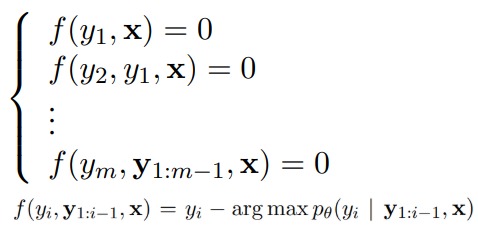
Source-local visual: A32. The important property is triangular dependence: equation i reads coordinates <i, never future coordinates.
One Jacobi sweep applies the whole operator to the old vector:
Gauss-Seidel is a different schedule:
It consumes newly updated earlier coordinates inside the same sweep. On a single device this can collapse back toward serial autoregression. Lookahead needs the Jacobi schedule because all future-position queries must be compilable before the target call starts. A kernel that accidentally lets a later lookahead row attend to a same-sweep updated predecessor silently changes the algorithm from Jacobi to a partially Gauss-Seidel graph.
0x02A Why Jacobi Reaches The Greedy Autoregressive Fixed Point
For a desired continuation of length m, define the triangular greedy system:
Jacobi uses the previous iteration’s guesses for every dependency:
Let y^AR be the ordinary greedy continuation under the same selector and
tie-break rule. The first coordinate has no guessed future dependency, so
y_1^(1)=y_1^AR. Assume after sweep r the first r coordinates are correct:
At sweep r+1, coordinate r+1 reads exactly that correct prefix from the old
vector:
Earlier correct coordinates remain correct because their dependencies are
already correct. Therefore, a length-m greedy continuation converges in at
most m iterations. This guarantee comes from causal triangular structure, not
from a generic convergence theorem for arbitrary nonlinear systems.
The guarantee has four non-negotiable assumptions:
- the prefix and target parameters do not change during the solve;
- every sweep uses the same deterministic greedy selector and tie-break;
- coordinate
isees only the previous sweep’s coordinates<i; - the requested finite horizon
mis fixed.
It does not prove convergence for independently sampled coordinates. The released Lookahead path generates window proposals greedily even when final publication uses stochastic sampling; exactness then comes from the verifier in 0x05B, not from this fixed-point induction.
Jacobi alone is still unattractive: it can spend almost the same number of steps as autoregression, and useful tokens can appear at the wrong positions before the stable prefix reaches them. Lookahead’s contribution is to preserve meaningful n-grams formed along those trajectories and verify them when the real prefix reaches a compatible key.
0x02B Stop Conditions And Stable-State Semantics
Three conditions are easy to conflate:
| Condition | Meaning | Safe action |
|---|---|---|
y^(r+1) == y^(r) | entire finite Jacobi vector is a fixed point | vanilla Jacobi may stop |
first a coordinates match y^AR | induction property in a proof/oracle | no runtime publication without verification |
| a cached n-gram matches target distributions under the live prefix | Lookahead verification success | publish that verified prefix transactionally |
Lookahead does not wait for the full window to become a fixed point. It harvests N-grams from intermediate trajectories and later verifies them under a different, live committed frontier. Conversely, equality between two arbitrary window rows is not permission to append them to output.
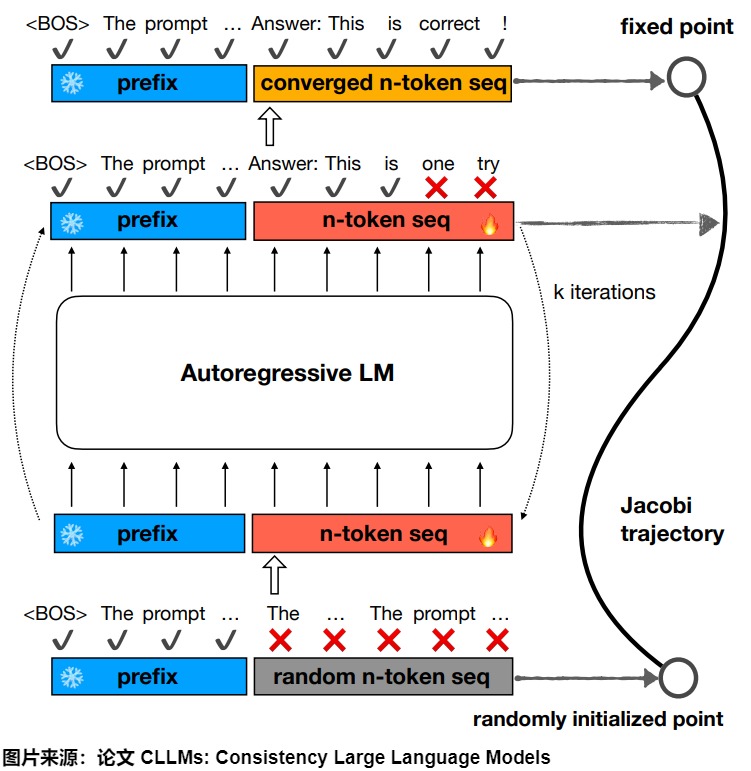
Source-local visual: A32, citing the Jacobi trajectory intuition. The frozen prefix in this figure is an analysis condition; M7.3’s publisher still requires the verification contract.
0x02C Jacobi Toy Table
Suppose the target greedy continuation is:
the cat sat
Jacobi decoding updates several future positions in parallel. A toy trajectory might look like:
| iteration | t+1 | t+2 | t+3 | stable prefix |
|---|---|---|---|---|
| r0 initial | dog | runs | fast | none |
| r1 update | the | dog | sat | the |
| r2 update | the | cat | sat | the cat sat |
The table is not meant to model all sampling behavior. It shows the useful property: while the whole row is not correct at first, fragments such as the and later cat sat can become reusable candidate n-grams. Exact stochastic sampling uses the separate verification algorithm in 0x05B; it does not follow from the greedy fixed-point argument alone.
The executable fixture in the evidence package makes the schedule visible. Its four-coordinate operator is deliberately small:
T1()         = 2
T2(y1)       = (y1 + 1) mod 10
T3(y1,y2)    = (y1 + y2) mod 10
T4(y1,y2,y3) = (y3 + 1) mod 10
Starting from [9,9,9,9], Jacobi needs four sweeps because each coordinate reads
the previous vector. Gauss-Seidel reaches [2,3,5,6] in one sweep because it
consumes updates immediately. Both can solve this triangular toy; only the
Jacobi trace models one parallel future-position target call.
0x03 N-Gram Pool And 2D Window
Lookahead records fragments from Jacobi trajectories.
2D window:
    sequence dimension W
    iteration/history dimension N-1

n-gram pool:
    candidate fragments collected from prior trajectories
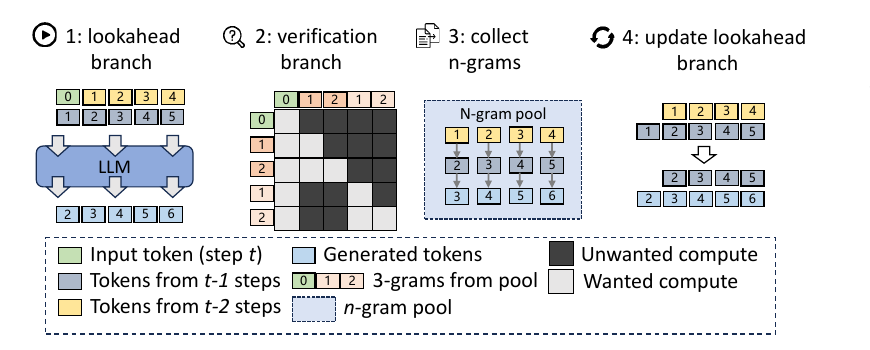
Source: Break the Sequential Dependency of LLM Inference Using Lookahead Decoding, Figure 1. The workflow separates Jacobi lookahead, verification, n-gram collection, and window update. (W), (N), and (G) are algorithmic work-shape parameters, not model context limits.
The released representation is keyed by the first token. For n-gram size N:
At decode time the current last token x_t is the lookup key, and the verification suffixes are:
The pool is not a separate model. It is a cache of guesses produced by the target model’s own parallel iterations. Storing only the N-1 suffix avoids repeating the shared key token in every verification branch.
0x03A Window And Pool Lifecycle
Lookahead has a warmup problem. Before there are enough historical rows, the system cannot form the intended n-grams.
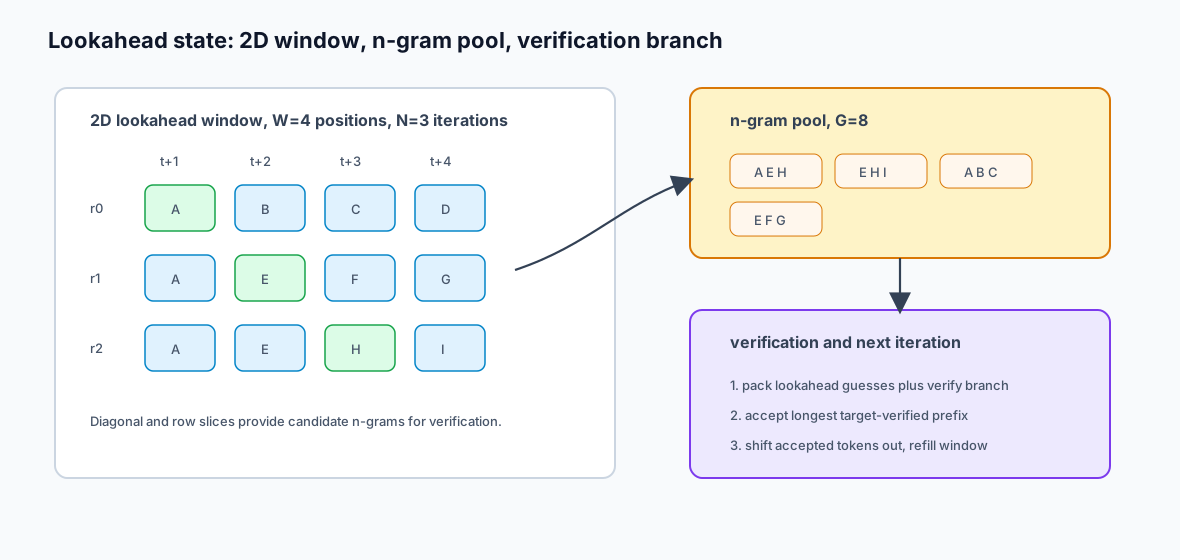
For W=4 and N=3:
W:
    four future positions tracked in the sequence dimension

N:
    three-token n-grams

trajectory rows involved:
    N - 1 prior/new update levels contribute to each suffix
Conceptually, the steady-state window retains N-1 trajectory levels across W future positions. The released code uses a longer first row during initialization so repeated shifts can fill later levels without shrinking the requested width. That storage detail should not be confused with the semantic knobs:
| Knob | Meaning | Cost/coverage effect |
|---|---|---|
W | lookahead positions updated in parallel | more trajectory n-grams and more lookahead rows |
N | n-gram length / trajectory lookback depth | longer possible accepted chunks and deeper warmup |
G | maximum suffixes retained/verified for one key | more candidate coverage and verification rows |
There are two useful initialization choices:
| Warmup mode | Mechanism | Tradeoff |
|---|---|---|
| trajectory warmup | seed window tokens, then run N-1 fill stages before full verification | no prompt dependency; spends startup target steps |
| prompt-seeded pool | insert prompt n-grams into \mathcal P immediately | fast coverage for repeated prompt patterns; no help for unseen continuations |
The official runtime exposes prompt-pool seeding as an option and otherwise seeds lookahead slots from prompt tokens. Random or copied seeds do not affect final correctness because they are only candidate-generation state, but they do affect early acceptance.
The pinned warmup layout explains the otherwise surprising W+N-3 initial
row. For N=4, W=5, and R=N-1=3:
before first target call:  level sizes [6, None, None]
after first fill:          level sizes [5, 6, None]
after second fill:         level sizes [4, 5, 5]
steady state:              level sizes [W-1, W, W]
At fill stage r, the current deepest materialized level determines the number
of inp_logits rows. Existing levels shift left by one; the newly created deeper
level drops its first output where needed. The overlong first row is therefore
temporary storage that lets the final ragged layout retain W extractable
N-grams without shrinking later levels.
Prompt-pool seeding and trajectory warmup affect different state:
POOL_FROM_PROMPT:
    inserts observed prompt N-grams into the keyed pool
    does not eliminate the need to materialize window levels

trajectory warmup:
    constructs proposal rows needed for ongoing n-gram generation
    initially runs without a verification branch
An implementation may initialize proposal tokens randomly, copy prompt tokens, cycle through the prompt, or copy the last token. That choice can change early proposal quality but cannot change output correctness if proposal rows remain isolated and every publication passes target verification.
Steady-state lifecycle:
1. look up at most G suffixes under key x_t
2. pack the lookahead update rows and verification suffixes
3. run one target forward with branch-specific mask and position IDs
4. verify one output token plus zero or more candidate suffix tokens
5. commit only the selected verified output/KV path
6. extract new keyed n-grams from the Jacobi trajectory
7. update per-key LRU suffix lists
8. shift both sequence and trajectory dimensions of the window
0x03B N-Gram Pool Invariants
The official Python implementation uses a compact token map:
token_map[first_token] = [
    suffix_0 of length N-1,
    suffix_1 of length N-1,
    ...
]  # at most G entries, least-recently-used first
On reinsertion, an existing suffix is moved to the most-recent position. Once the per-key list is full, the oldest suffix for that key is evicted. This is different from a global top-score pool: a frequent key cannot consume every other key’s candidate budget.
def upsert_suffix_lru(token_map, key, suffix, G):
    bucket = token_map.setdefault(key, [])
    suffix = tuple(suffix)

    if suffix in bucket:
        bucket.remove(suffix)
    elif len(bucket) == G:
        bucket.pop(0)

    bucket.append(suffix)


def update_pool_from_trajectory(token_map, history_rows, new_row, N, W, G):
    for key, suffix in extract_keyed_ngrams(history_rows, new_row, N, W):
        assert len(suffix) == N - 1
        upsert_suffix_lru(token_map, key, suffix, G)
The extraction walks the trajectory geometry, not merely every contiguous slice of one row: a key from an older level is paired with tokens produced by later Jacobi levels and the new model output. This is how adjacent trajectory values become a candidate n-gram.
For steady past_tokens = [u^(0),u^(1),...,u^(R-1)] and new greedy
lookahead outputs z[0:W], the pinned extractor emits exactly W keyed suffixes.
At column zero:
For columns j=1,...,W-1:
Every s_j has R=N-1 tokens, so (k_j,s_j) reconstructs one full
N-gram. The one-column offset between u^(0) and deeper levels is the physical
consequence of using the live frontier as the missing first key.
Example with N=4, W=5:
live key x_t: 10
level 0:      [11, 12, 13, 14]
level 1:      [21, 22, 23, 24, 25]
level 2:      [31, 32, 33, 34, 35]
new row z:    [41, 42, 43, 44, 45]

extracted:
10 -> (21,31,41)
11 -> (22,32,42)
12 -> (23,33,43)
13 -> (24,34,44)
14 -> (25,35,45)
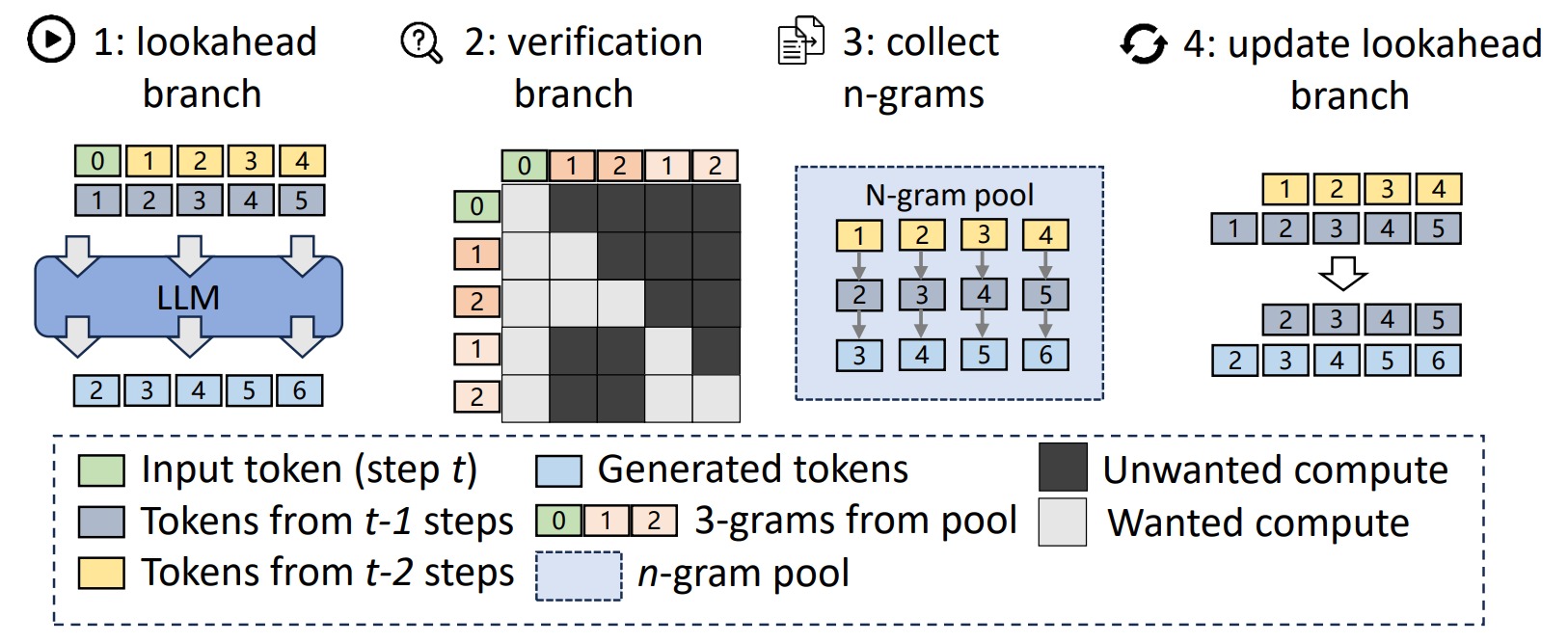
Source-local visual: A32, reproducing the paper’s lookahead, verification, collection, and update sequence. The executable trace above supplies the storage offsets omitted by the conceptual figure.
The bounded pool uses recency per key. For capacity G:
insert a new suffix into a non-full bucket: append as most recent
reinsert an existing suffix:               remove then append
insert into a full bucket:                 evict bucket[0], then append
retrieve:                                  use only bucket for current token key
This policy bounds each hot key independently but does not bound the number of distinct keys or total host-memory use. A production service needs a global pool budget, request lifetime policy, and telemetry; those serving policies belong to M7.8. M7.3 owns only the per-request algorithmic map used by the pinned implementation.
0x03C Window Advancement After Published Progress
With the pinned ALWAYS_FWD_ONE=True greedy path, proposal state advances one
window column regardless of how many output tokens were published. For a
fully warmed-up state, the shape-checked teaching helper is:
def advance_pinned_window(past_tokens, new_results, N, W):
    R = pinned_suffix_length(N)
    if type(W) is not int or W < 1:
        raise ValueError("window width must be a positive integer")
    if (len(past_tokens) != R or any(row is None for row in past_tokens)
            or [len(row) for row in past_tokens] != [W - 1] + [W] * (R - 1)):
        raise ValueError("expected fully warmed-up ragged levels")
    if len(new_results) != W:
        raise ValueError("expected W new lookahead outputs")
    return ([past_tokens[1][1:]]
            + [row[:] for row in past_tokens[2:]]
            + [new_results[:]])
The minimum admitted depth is N=3, with R=2: initialization at W=5
has sizes [5, None]; the first fill produces [4, 5]. A steady update maps
[old_level_0, old_level_1] to [old_level_1[1:], new_results[:]], again
with sizes [4, 5]. There is no intermediate-level copy in this boundary case.
The existing N=4 trace still uses [4, 5, 5]. N=2 is rejected rather than
passed into an update that would index a nonexistent second level.
This keeps the ragged shape [W-1,W,...,W]. The helper checks proposal storage,
not all backend or distributed-runtime constraints. The sampling path contains an
alternative ALWAYS_FWD_ONE=False schedule that slices by additional accepted
tokens and then refills proposal slots. These schedules can generate different
candidate pools while still preserving target output if verification and
publication remain correct. They are design choices, not algebraically
interchangeable state updates.
Window and pool mutations occur only after the current target output has been interpreted. Otherwise a newly inserted suffix could be selected by the same round that produced it, despite not being present when row metadata and target logits were compiled.
Compatibility screening is deliberately cheap:
verify_suffixes = token_map.get(current_last_token, [])[:G]
Matching the key does not prove that a suffix is correct under the current full prefix. It only makes the suffix promising enough to spend target verification work.
0x04 Two Branches In One Step
Each step carries two jobs:
| Branch | Job | State effect |
|---|---|---|
| lookahead branch | run Jacobi-style updates over the window | generate future n-grams for the pool |
| verification branch | test promising n-grams against the current prefix | commit accepted tokens |
The inference sequence is packed so the model can process both jobs together:
[current token / ordinary decode row]                    1 row
[flattened lookahead trajectory queries]                 Q_LA rows
[G candidate suffixes, each with N-1 token rows]         Q_V rows
The packed row number is not automatically the causal position. Each row needs branch-aware logical positions:
ordinary row:
    next committed sequence position

lookahead row:
    future position represented by its window column

verification suffix row:
    current prefix length + suffix offset
    repeated independently for each candidate
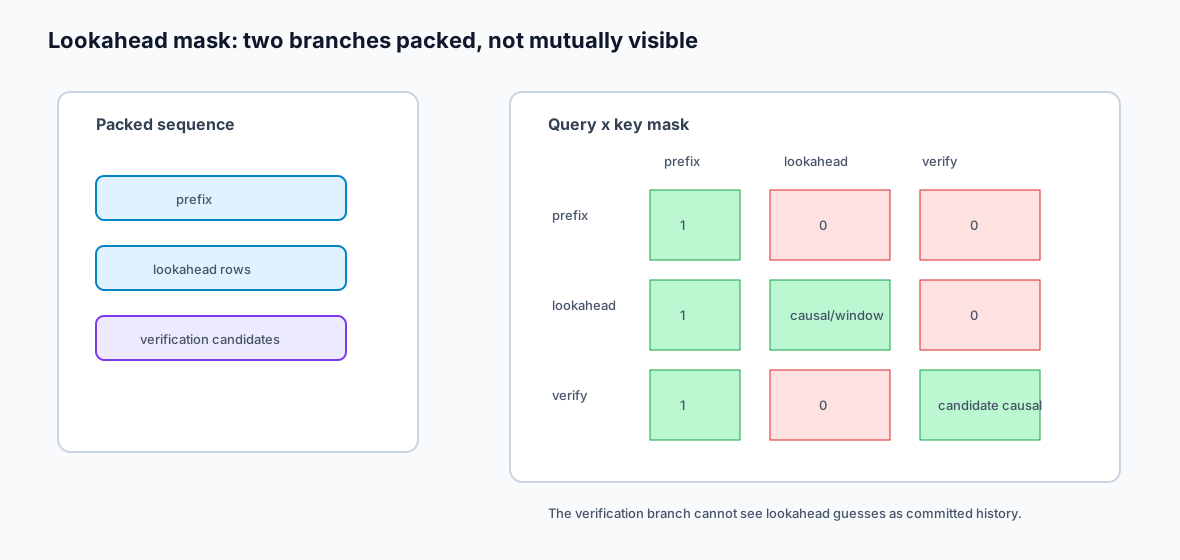
The mask must enforce two rules:
lookahead branch and verification branch do not see each other
each branch remains causally valid inside its own path
Packed mask sketch:
| query \ key | prefix | lookahead rows | verify candidates |
|---|---|---|---|
| prefix | 1 | 0 | 0 |
| lookahead rows | 1 | causal/window | 0 |
| verify candidates | 1 | 0 | causal/candidate |
The zeros are the point. The lookahead branch is allowed to generate future n-grams, but the verification branch must not see those temporary guesses as if they were committed history.
The model wrapper must split the packed output back into three semantic views:
| Output slice | Logical use | Commit status |
|---|---|---|
out_logits | target distribution for ordinary one-token progress | sampled/argmax token may be emitted |
inp_logits | next Jacobi row for W lookahead positions | pool/window state only |
guess_logits | target distributions along each candidate suffix | selected verified path only |
The released runtime uses these three roles explicitly. Flattening them into one generic outputs tensor hides the index contract needed for K/V compaction and n-gram extraction.
0x04A Pinned W=5,N=4,G=2 Row Compiler
For the steady dense reference path, level_sizes=[4,5,5], S=3, and two
candidates produce 21 uncached rows. The compiler treats the current ordinary
row plus level zero as one five-position base stripe:
| Packed rows | Role | Logical positions relative to current p | Logits consumed as |
|---|---|---|---|
0 | ordinary frontier | p | out_logits |
1:5 | trajectory level 0 remainder | p+1 ... p+4 | intermediate only |
5:10 | trajectory level 1 | p+1 ... p+5 | intermediate only |
10:15 | deepest/new trajectory level | p+2 ... p+6 | inp_logits for next row |
15:18 | candidate 0 suffix | p+1 ... p+3 | first verification path |
18:21 | candidate 1 suffix | p+1 ... p+3 | second verification path |
All rows may attend the incoming committed K/V prefix. Among current rows, let
b_j be base-stripe row j, u_(r,j) be trajectory level r>0 at column
j, and v_(c,s) be candidate c at suffix offset s. The intended allowed
edges are:
There are no edges from verification rows to lookahead rows b_1... or u,
no edges from lookahead rows to verification rows, and no edges between
different candidates. Logical position equality does not create visibility:
two rows can both represent p+2 while belonging to isolated branches.
The mask compiler and position compiler must therefore consume the same row records:
Row(
    packed_index,
    role,               # ordinary | lookahead | verify
    trajectory_level,   # lookahead only
    window_column,      # lookahead only
    candidate_id,       # verify only
    suffix_offset,      # verify only
    logical_position,
    request_logit,
)
Building token IDs, positions, masks, and logit slices in separate loops without a shared record risks a shape-correct semantic mismatch.
The output-slice identities for the dense level-major path are:
The indices are coordinate-specific. In the pinned wrapper they are derived
from prefill_size, deepest-level width, and flattened guess length; the
specialized FlashAttention path reorders lookahead rows and explicitly
rearranges logits before exposing inp_logits.
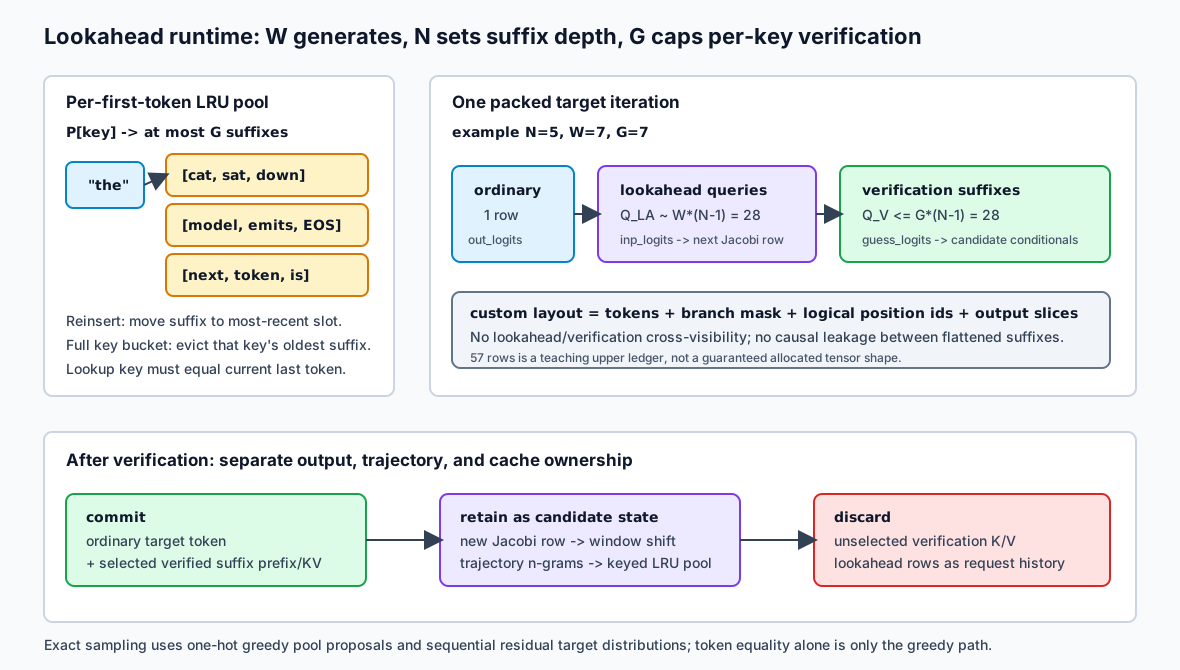
The diagram follows the pinned runtime’s greedy pool generation. Its sampling note is implementation-specific; the conditional frozen-candidate generalization is separated in §0x05B below.
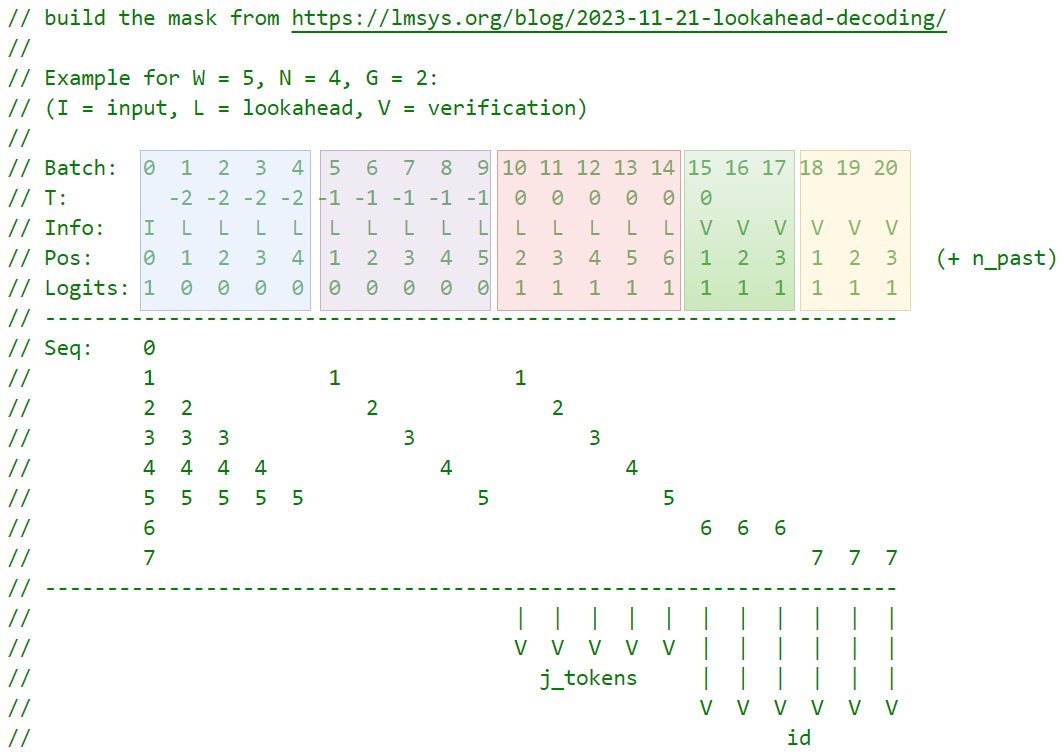
Source-local implementation visual: A32 - Lookahead Decoding, reproducing the llama.cpp layout comment. T separates prompt, lookahead, and verification row groups; Info names their semantic role; Pos carries logical positions; and Logits identifies rows whose distributions are needed. The lower dependency sketch is the mask contract encoded by those arrays.
The figure is valuable precisely because dimensions alone are insufficient. Two packed tensors can have the same row count while differing in role labels, position offsets, requested-logit rows, or visibility. Those metadata arrays must be versioned with the custom mask/kernel.
0x04B Ordinary Causal FlashAttention Is Not Enough
Lookahead’s mask is neither one lower-triangular matrix nor a standard padded batch. The paper’s implementation hardcodes the adjustable W/N/G pattern into a specialized FlashAttention path. Source-reported experiments found that this specialized path improved the straightforward PyTorch Lookahead implementation, but that result does not mean unmodified FlashAttention automatically supports the mask.
Runtime choices:
| Backend | Advantage | Requirement |
|---|---|---|
| explicit dense/custom mask | easiest correctness reference | materialized mask and weaker kernel efficiency |
| specialized Lookahead attention | avoids generic-mask overhead | kernel must implement branch geometry for configured W/N/G |
| separate branch forwards | simpler causal kernels | streams target weights more than once and loses fused-step benefit |
0x04C Pinned Python Source-To-Tensor Trace
The following trace is scoped to official Lookahead commit
eed010d.
It is evidence about that implementation, not a required API for every runtime.
Configuration first renames the paper knobs:
LEVEL         = N
WINDOW_SIZE   = W
GUESS_SET_SIZE= G
GUESS_SIZE    = LEVEL - 1 = S
The generation loop owns host proposal state and passes four groups into
jforward_multilevel:
input_ids:        [1,I] current ordinary rows (steady I=1)
past_key_values:  L pairs, each [1,H_kv,K_in,d_h]
past_tokens:      R host lists with steady lengths [W-1,W,...,W]
guess_tokens:     flat host list of C_t*S suffix token ids or None
Inside the wrapper:
all_pastflattens trajectory levels in level-major order for the dense backend. The Flash path transposes/interleaves later levels instead.ids_listassigns logical positions from the currentposition_ids[-1], compensating for ragged level zero.- Candidate suffixes are appended after lookahead rows; every candidate reuses
positions
p+1 ... p+S. - The attention mask length is extended for every appended row, then
j_make_causal_mask_multilevelconverts row metadata into the branch mask. - The target produces hidden rows and K/V for all uncached rows.
- The LM head scores every packed row and the wrapper promotes logits to
float32before slicing semantic outputs.
For the Loop 5 coordinate with K_in=128, I=1, Q=21, d=4096, and
V=32000:
| Tensor | Shape | State class |
|---|---|---|
packed input_ids | [1,21] | current ordinary + proposal token rows |
packed position_ids | [1,21] | branch-local logical positions |
| full key visibility axis | K_in+Q=149 | committed cache plus current rows |
| dense additive mask | [1,1,21,149] | temporary compiler output |
| final hidden rows | [1,21,4096] | temporary model dtype |
| full LM-head logits | [1,21,32000] | temporary float32 in pinned wrapper |
| returned K or V per layer | [1,H_kv,149,d_h] | committed prefix plus all temporary rows |
out_logits | [1,32000] | ordinary frontier distribution |
inp_logits | [1,5,32000] | new greedy trajectory row |
guess_logits | [1,6,32000] | two disjoint suffix traces |
Two lengths serve different purposes:
kvcache_len is the destination frontier before additional accepted candidate
rows. step_len reaches the physical end of the packed temporary K/V. Using
one where the other is expected can copy a lookahead row or the wrong candidate
into committed cache while every tensor shape still passes.

The pinned code also exposes implementation limits that prose must not generalize away: the wrapper asserts single-request batch, patches Hugging Face generation/model classes, scopes model adaptation to LLaMA, computes LM-head logits for all packed rows, and holds pool/window state as Python objects. These are current code properties, not theoretical requirements of Lookahead.
0x05 Verification And Speedup
The verification branch accepts the longest target-verified prefix:
Step cost sketch:
Lookahead helps when:
Renderer-safe fallback:
A = longest target-verified prefix
C_step = C_lookahead_branch + C_verify_branch + C_pack_mask
speedup condition: E[A] / (C_step / C_target_step) > 1
This is the same engineering shape as speculative decoding: accepted progress must exceed the extra work.
0x05A Greedy Verification
For greedy decoding, candidate checking is deterministic, but it is not a
single equality over an already chosen suffix. The target first predicts the
ordinary next token from out_logits. That token becomes the first member of
the reference path. Each verification row then predicts the token after its
candidate input under the same accepted prefix.
For candidate suffix
define the target continuation along that packed branch as
The candidate hit length is the longest prefix for which
The first element compares the first candidate token with the ordinary target prediction. The next comparison uses the target row whose input was the first candidate token, and so on. This one-position offset is easy to lose when flattened logits and candidate IDs have the same length.
An equivalent survivor view is:
target_token = argmax(out_logits)
survivors = all_candidates
emitted = [target_token]

for offset in range(candidate_suffix_length):
    survivors = [g for g in survivors if g[offset] == target_token]
    if not survivors:
        break

    # Every surviving path has the same accepted prefix. Its packed target
    # row must therefore expose the same next-token conditional.
    conditionals = target_rows_after_offset(survivors, offset)
    assert all_equal(conditionals)
    target_token = argmax(conditionals[0])
    emitted.append(target_token)
All candidates that disagree with an accepted token are removed. Candidates that share it remain because their later suffixes may differ. The target conditional at the next offset may be read from any survivor only because the branch mask gives every survivor the same visible prefix. If those rows differ, the mask, logical positions, or row-to-candidate map is already wrong.
There are two related output conventions in the literature and code. The paper
can describe a fully matched length- proposal followed by one additional
target token. The pinned Python path computes a hit count over its concrete
guess_results slices and publishes according to that implementation’s
max_hit convention. Loop 8 reconciles those output counts with physical K/V
rows instead of assuming that paper pseudocode and released code share an
off-by-one convention.
0x05B Exact Sampling With Disjoint One-Hot Proposals
The sampling path is more subtle than candidate == sampled_target_token.
Lookahead stores token IDs, not a vocabulary-sized proposal distribution for
every n-gram. The paper and pinned path generate lookahead proposals greedily
and verify those token IDs as one-hot proposals. That describes the implemented
generation policy; the conditional verifier proof and its scope are separated
below.
At one output position, let p^{(0)} be the target sampling distribution and
c_1,\ldots,c_m the candidate tokens offered by surviving n-grams. The
proposal list may contain duplicates; the probability partition is over
distinct token IDs, not candidate rows. For the next previously untested
token c_r:
On rejection, remove that token’s mass and renormalize:
If every distinct candidate is rejected, sample from the final residual distribution. This sequentially partitions the original target mass among candidate tokens and the residual vocabulary. For two distinct candidates:
P(output c1) = p(c1)

P(output c2)
  = P(reject c1) * p(c2)/(1-p(c1))
  = (1-p(c1)) * p(c2)/(1-p(c1))
  = p(c2)

all other tokens retain their original combined residual mass
The division is not merely suggestive. If the offered distinct set is , then every offered token recovers its target mass,
and a non-offered token recovers
Duplicate rows require a separate invariant. Once token A has been rejected,
its residual mass is zero. Offering A again must either be skipped by
deduplication or receive zero acceptance probability. Removing A twice and
renormalizing twice is incorrect.
For the frozen audit coordinate,
target p              A=.20  B=.30  C=.10  D=.40
candidate rows        A, A, B
distinct test order   A, B

P(output A)           .20
P(output B)           (1-.20) * (.30/.80) = .30
residual after A,B    C=.20, D=.80 conditionally
P(output C)           .50 * .20 = .10
P(output D)           .50 * .80 = .40

reconstructed output  A=.20  B=.30  C=.10  D=.40 = target p
After accepting a candidate token, keep only n-grams that share that token at
the current offset, move to the next suffix position, and use a target
distribution computed under that same surviving prefix. For suffixes
[A,C], [A,D], and [B,D], accepting A keeps the first two and accepting
B keeps only the third. This is the disjoint-n-gram analogue of tree pruning.
It is why the paper can preserve target sampling without storing q(x) vectors
for the entire pool.
def sample_verify_position(target_probs, candidates_at_offset):
    residual = target_probs.clone()
    tested = set()

    for token in candidates_at_offset:
        if token in tested:
            continue
        tested.add(token)

        if uniform() < residual[token]:
            return token, "accepted_candidate"

        residual[token] = 0.0
        residual /= residual.sum()

    return multinomial(residual), "residual_target_sample"

A32’s sampling algorithm exposes the same control-flow distinction in source form: proposal acceptance, residual renormalization, and suffix filtering are three different state transitions, not one comparison.
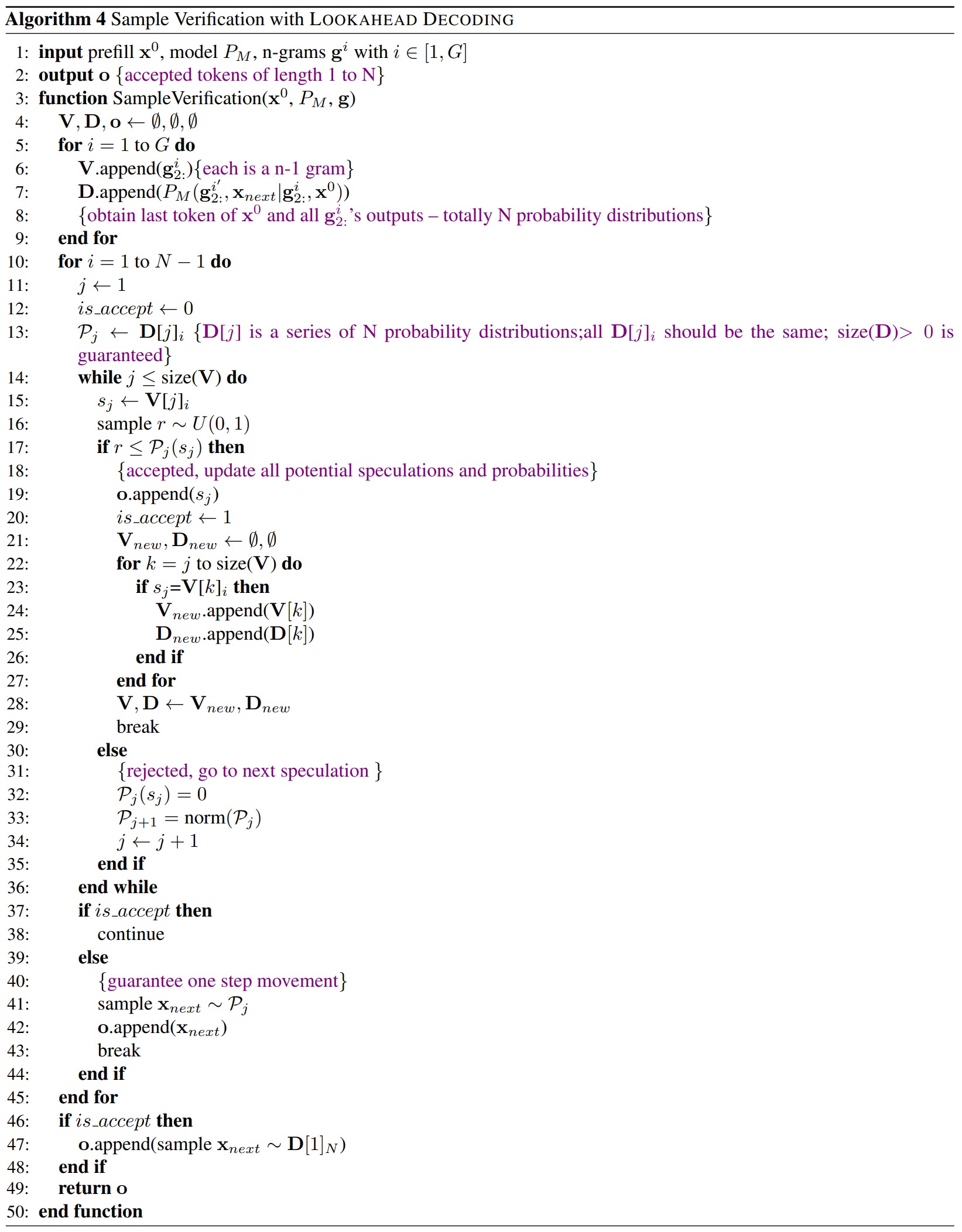
The exactness contract therefore has four independent obligations:
- one-hot proposal ownership: verification treats each tested token as a point mass; the pinned runtime generates its pool tokens greedily;
- mass ownership: each distinct token consumes target mass at most once;
- path ownership: acceptance filters suffixes before the next offset;
- conditional ownership: the next target row was computed under the accepted prefix and not under a rejected or cross-candidate path.
The pinned runtime’s proposal-generation scope remains greedy. The residual proof above is conditional on a frozen candidate list and prefix, with fresh verifier randomness independent of how that list was generated. A randomly generated but independently frozen list can therefore also be tested as point masses: random origin alone does not invalidate the proof. This is a mathematical generalization, not a claim that the pinned runtime implements another sampling mode.
Do not conflate that conditional membership test with sampling from a proposal
distribution q and applying a p/q acceptance rule. The latter needs M7.1’s
actual proposal probabilities and correction machinery. Reusing proposal
randomness for verification, changing the candidate list in response to that
randomness, or scoring a different prefix invalidates the stated conditional
argument.
0x05C Row And FLOP Ledger
Step compression and wall-clock speedup are different outputs. Start with the paper’s probability model, then add physical work.
Accepted-token expectation from survival probabilities
Suppose one proposal has length , and each successive proposed token passes with independent probability . Progress always includes the ordinary target token. Let be output tokens published in that round. The tail-sum identity gives
For independent candidate suffixes, let be the maximum progress. To advance beyond the ordinary token by at least positions, at least one candidate must survive its first tokens:
Therefore
This is a model, not a measured acceptance process. Real candidate paths share the same prompt, token frequencies are nonuniform, pool entries are correlated, and per-depth acceptance is neither independent nor constant.
From one good pool hit to average step compression
If one round in every rounds has candidates matching the assumed distribution and the other rounds make one-token progress, then
The paper identifies and, under its practical setting,
. It then studies how step compression changes as more parallel work is
allocated. These assumptions must stay attached to the conclusion. Increasing
W does not force the pool to contain more useful independent candidates;
increasing G does not make duplicates independent; increasing N does not
keep deep-prefix acceptance constant.
Exact packed-row ledger for the pinned layout
Let Q_{LA} be the lookahead query rows and Q_V the verification suffix rows:
for the steady, non-transposed pinned Python layout, with candidates actually found for the current key. Including its one ordinary row,
The identity happens to match the paper’s rough token-work expression when . Warmup, missing pool entries, distributed window shards, and specialized row transposes change physical layouts.
For the released teaching setting N=5, W=7, G=7 at full candidate occupancy:
lookahead rows                W*(N-1)-1 = 27
verification rows             G*(N-1)   = 28
ordinary row                  1
packed query rows             Q          = 56
The earlier 57-row upper-style intuition double-counted the ordinary row that is already embedded in the paper’s approximation. The exact pinned steady formula closes that ambiguity.
A target round is more than transformer FLOPs
For a dense packed implementation, one round includes at least:
token-wise target work     projections, normalization, MLP over Q rows
attention work             only allowed (query,key) pairs if kernel exploits mask
LM-head work               pinned code projects every packed row to vocabulary
temporary K/V              Q rows per layer before compaction
mask/layout work           compiler, position IDs, possibly dense mask storage
host state                 keyed LRU lookup/update and candidate flattening
publication               acceptance, selected K/V copy or re-feed, truncation
distributed sync           if using worker shards / LP
For homogeneous full K/V rows, temporary code payload excluding metadata is
Here is bytes per scalar. This dense uniform-width example is not
a generic quantized or MLA allocation estimate. Admission consumes the actual
cache schema and per-layer retained segments, including qparams, residuals,
sparse exceptions, page rounding and shared allocations counted once. Use the
incremental allocation-union delta, with masks/logits/workspace charged
separately. M8.6 owns quantized representation, M5.8 latent representation, and
M5 cache retention/publication/lifetime; a kv_dtype label alone is insufficient.
The pinned full-row LM-head multiplication scales roughly as
which may become material when Q is large even if decode attention was
originally bandwidth-bound. A backend that computes logits only for required
output slices has a different cost contract.
The deployment metric is therefore
Step compression exceeds one whenever average progress exceeds one. Wall-clock speedup additionally requires
A synthetic sensitivity coordinate makes the distinction concrete. The model
below uses normalized T_AR=1, T_round=0.90+0.02Q; these constants are
illustrative and are not measurements:
| Profile | N,W,G | expected output/round | synthetic speedup | ||
|---|---|---|---|---|---|
| sparse/weak pool | 4,2,2 | .20,4 | 12 | 1.114 | 0.977x |
| paper-like teaching point | 4,4,4 | .425,3.106 | 24 | 1.552 | 1.124x |
| strong repeated structure | 4,8,8 | .60,2 | 48 | 2.414 | 1.298x |
The first profile compresses target steps but still loses wall time because round overhead grows faster than useful progress. The third wins only under its strong synthetic acceptance and pool-hit assumptions.

0x06 Loop Pseudocode
S = R = pinned_suffix_length(N)  # reject unsupported depth before allocating state
token_map = initialize_keyed_pool(prompt, N=N, per_key_limit=G)
window = initialize_trajectory_window(prefix, W=W, N=N)

while not done:
    key = prefix[-1]
    verify_suffixes = token_map.get(key, [])[:G]  # each has N-1 tokens

    packed = pack_iteration(
        ordinary_token=key,
        lookahead_window=window,
        verification_suffixes=verify_suffixes,
    )
    mask, position_ids, slices = build_iteration_layout(packed, W, N, G)

    packed_output, temporary_kv = target_model(
        packed.tokens,
        past_key_values=prefix_kv,
        attention_mask=mask,
        position_ids=position_ids,
    )

    out_logits = packed_output[slices.ordinary]
    inp_logits = packed_output[slices.lookahead]
    guess_logits = packed_output[slices.verification]

    if sampling_policy == "greedy":
        emitted, chosen_rows = greedy_verify(
            out_logits, guess_logits, verify_suffixes
        )
    else:
        emitted, chosen_rows = exact_disjoint_sample_verify(
            out_logits, guess_logits, verify_suffixes
        )

    new_lookahead_row = argmax(inp_logits, dim=-1)
    plan = build_publication_plan(
        emitted=emitted,
        chosen_rows=chosen_rows,
        temporary_kv=temporary_kv,
        kvcache_len=packed_output.kvcache_len,
        step_len=packed_output.step_len,
    )
    validate_publication_plan(plan, packed, prefix_kv)
    publish_iteration(
        plan, prefix_kv, token_map, window, new_lookahead_row
    )
Helper sketches:
def build_lookahead_verification_mask(prefix_len, lookahead_layout, candidate_layout):
    total = prefix_len + lookahead_layout.rows + candidate_layout.rows
    mask = zeros([total, total], dtype=bool)

    prefix = range(0, prefix_len)
    lookahead = lookahead_layout.row_range_after(prefix)
    verify = candidate_layout.row_range_after(lookahead)

    allow_causal(mask, prefix, prefix)
    allow(mask, lookahead, prefix)
    allow_trajectory_dependencies(mask, lookahead_layout)
    allow(mask, verify, prefix)
    allow_each_suffix_causal_without_cross_candidate_leakage(
        mask, candidate_layout
    )

    return mask
No line in that helper allows lookahead queries to see verification candidates, or verification queries to see lookahead rows. The candidate block also needs separation between disjoint suffixes; a single triangular mask over all flattened candidates would let later candidates read earlier ones.
0x06A Prepare Next Iteration
Verification does not directly mutate serving state. It produces a publication plan with four coupled outputs:
output plan:
    target tokens released to input_ids / streamer

KV plan:
    ordinary input row already materialized by this call
    selected verification rows copied into the contiguous cache frontier
    all other packed rows discarded by truncation

trajectory plan:
    new argmax row and post-commit window shift

pool plan:
    n-grams extracted from the pre-shift trajectory
    optional generated-prefix insertion
These plans must agree on one accepted path before any becomes externally visible. The official Python implementation mutates these Python and tensor objects in a concrete order; the atomic transaction below is a stronger engineering contract, not a claim that the released loop provides exception rollback.
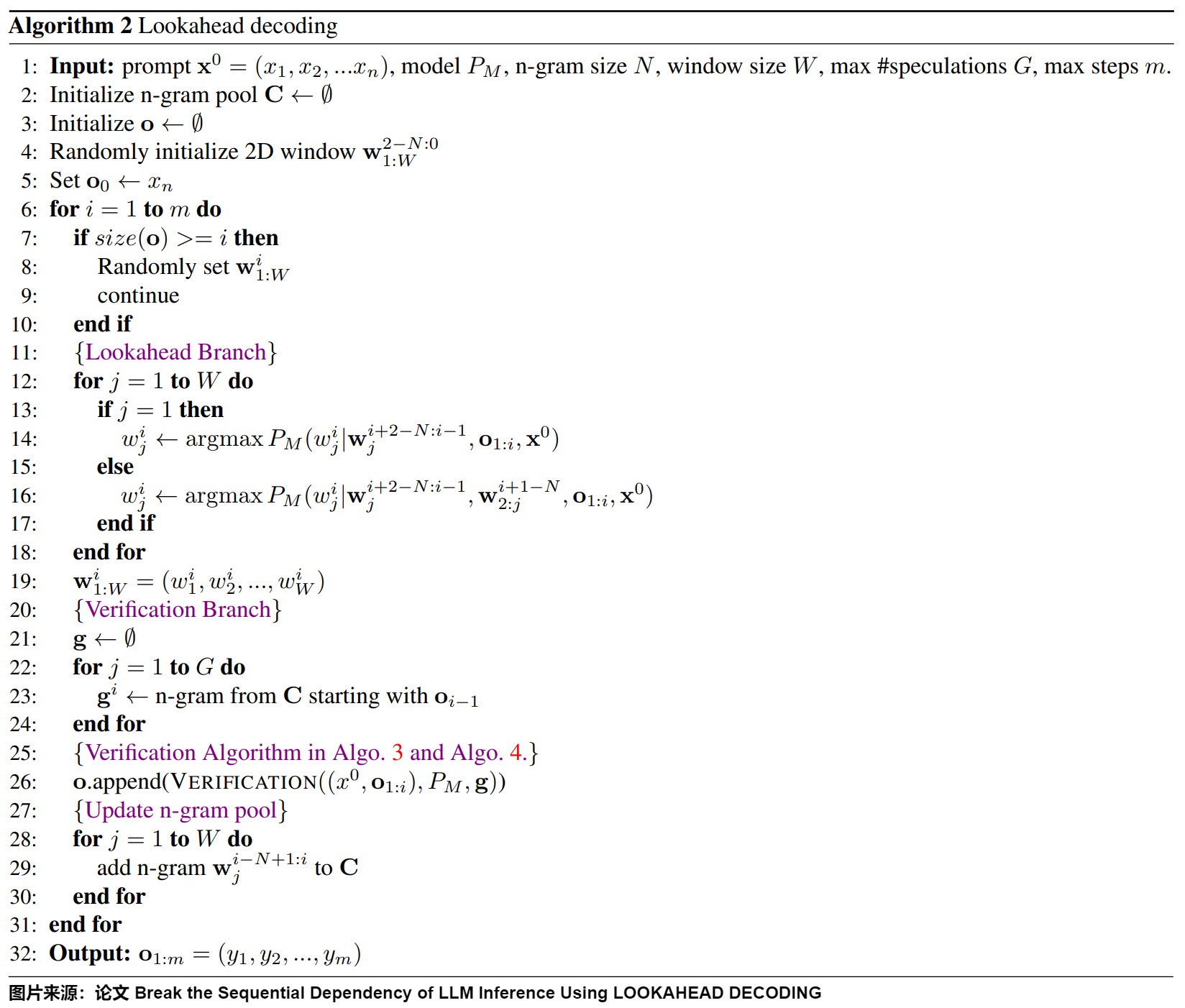
The paper-level order is visible in A32’s retained algorithm: run both branches, verify, append output, then update the n-gram pool. The runtime must additionally publish physical K/V rows.
0x06B The Output Frontier Is One Token Ahead Of K/V
An autoregressive cache stores rows for tokens already processed as inputs. The latest emitted token normally becomes the ordinary input of the next target call. Therefore output length and cache length are related, but their token labels are shifted.
Let:
K_in       incoming K/V rows
I          ordinary uncached input rows in this call (pinned path: 1)
h          pinned max_hit, the number of verification rows copied
Then the pinned single-worker path publishes
where is the number of newly emitted target tokens. With , , but the new K/V rows are not K/V for all emitted tokens:
new K/V labels      [ordinary input u, emitted h0, ..., emitted h(h-1)]
new output labels   [h0, ..., emitted h(h)]

the final emitted token h(h) remains the next ordinary uncached input
That distinction prevents the same correction-token error discussed in M7.1: an output token can be valid before its own K/V row exists.
0x06C Pinned max_hit=2 Compaction Trace
Reuse the frozen Loop 6 coordinate:
K_in                       128
kvcache_len                129 = K_in + ordinary row
step_len                   149 = physical packed K/V end
candidate suffix size S    3
flattened candidate rows   6
winning candidate index    1
max_hit                    2
The pinned source computes the winning candidate’s physical start as
It copies exactly max_hit rows:
| Meaning | Physical source | Contiguous destination |
|---|---|---|
K/V for first accepted emitted token h0 | 146 | 129 |
K/V for second accepted emitted token h1 | 147 | 130 |
The cache is then truncated to row 131 exclusive. Candidate row 148, other
candidate rows, and every lookahead row are discarded. Output publishes three
tokens [h0,h1,h2]; h2 is the valid target prediction after the second copied
row and becomes next round’s ordinary input.

def build_pinned_commit_plan(K_in, kvcache_len, step_len,
                             guess_token_count, suffix_size,
                             winner, max_hit, emitted):
    assert kvcache_len == K_in + 1
    assert len(emitted) == max_hit + 1

    src0 = step_len - guess_token_count + winner * suffix_size
    copies = [
        (src0 + j, kvcache_len + j)
        for j in range(max_hit)
    ]
    return {
        "copies": copies,
        "trim_exclusive": kvcache_len + max_hit,
        "next_uncached_token": emitted[-1],
    }
The source rows must belong to the winning candidate and correspond to accepted
candidate inputs. Row 147 processes h1 and predicts h2: copying that
row to destination 130 as K/V for h1 is required. Treating it as K/V
for h2 would be wrong. A row’s K/V belongs to its input token, whereas its
output logits predict the next token. Published h2 remains the uncached
frontier; do not copy candidate row 148 merely because its input token might
equal h2. The existing copy plan and trim boundary remain unchanged.
Window movement has two axes:
time/trajectory axis:
    drop the oldest Jacobi level
    promote newer levels
    append the new argmax row

sequence axis:
    drop positions consumed by committed output
    shift remaining future slots left
    refill vacated slots from the configured seed/reset source
The pinned ALWAYS_FWD_ONE path advances one trajectory column regardless of
max_hit; its alternative slices each level by max_hit and refills the tail.
That choice changes how much speculative trajectory state survives. It must not
change the output/KV publication plan already validated for this round.
0x07 KV State
Lookahead’s cache has three physical regions during the target call:
stable prefix [0:K_in):
    K/V inherited from earlier target calls

ordinary frontier [K_in:kvcache_len):
    current uncached input, normally one row

packed workspace [kvcache_len:step_len):
    lookahead rows and candidate rows
Publication selects zero or more verification rows from the workspace, copies
them immediately after kvcache_len, and truncates everything after the new
frontier. The temporary work can affect memory and scheduling even though most
of it never becomes user-visible state. In an M5-style serving engine, the
scheduler must budget those rows during the model iteration.
Temporary-work ledger:
temporary positions =
    lookahead query rows
  + every verification suffix row

new persistent rows =
    ordinary input rows processed in this call
  + selected verified candidate-input rows

new output tokens =
    target token predicted by ordinary row
  + target tokens predicted by copied candidate rows
As with Medusa, packed temporary K/V must be gathered from the chosen verification suffix and compacted into contiguous request history. Lookahead-window K/V is iteration workspace, not prefix K/V. A row can contain a target-generated argmax useful for a future n-gram while still being invalid to commit at its current logical output position.
The publication order should be fail-closed:
def publish_iteration(plan, state):
    validate_sources_are_winning_candidate_rows(plan)
    validate_output_cache_frontiers(plan, state)
    validate_window_and_pool_versions(plan, state)

    staged_kv = compact_and_trim_without_publishing(state.kv, plan)
    staged_window = advance_window_copy(state.window, plan)
    staged_pool = update_pool_copy(state.pool, plan)
    staged_output = state.output + plan.emitted

    # One logical publication point. A production engine may use versioned
    # handles rather than copying all four structures.
    state.swap(staged_output, staged_kv, staged_window, staged_pool)
If validation or compaction fails, no output token should be streamed and no pool/window mutation should survive. Streaming before K/V publication turns an internal cache error into an externally irreversible response.
0x07A Implementation And Parallelism Variants
The mathematical dependency graph does not prescribe one physical schedule. Five implementations can compute the same target conditionals while making very different launch, mask, cache, and communication choices:
| Design | Target weight residency | Target calls / round | Mask and K/V contract | Critical cost |
|---|---|---|---|---|
| separate forwards | one target | 1 + W + C_t conceptually | ordinary causal call per branch; explicit result assembly | repeated launches and weight reads |
| dense packed reference | one target | 1 | materialized arbitrary branch mask; temporary packed K/V | mask memory and general attention path |
| specialized Lookahead FlashAttention | one target | 1 | branch pattern encoded in a custom kernel; layout may be transposed | kernel specialization and parameter coverage |
| pinned single-worker Python | one target | 1 | packed LLaMA path plus selected-row K/V copy | Python state, full-row LM head, copy/trim |
| paper Lookahead Parallelism | one full model replica per worker | 1 per worker | disjoint token branches, local temporary K/V | replicated weights and post-forward token synchronization |
Separate forwards: the semantic oracle
The safest reference schedule runs the ordinary row, each lookahead trajectory, and each verification suffix as isolated causal forwards. It makes branch leakage structurally impossible and provides an excellent correctness oracle. It also repeatedly launches the target and rereads weights, forfeiting the memory-bandwidth amortization that motivates Lookahead. It is a testing design, not the expected production winner.
Dense packed mask: flexible but physically expensive
The dense path packs all rows once and applies the Loop 5 visibility matrix.
Its advantage is auditability: arbitrary W/N/G, warmup raggedness, and branch
roles can be compared directly with the separate-forward oracle. Its cost is
not just allowed attention pairs; an explicit additive mask can scale with
where is 1 for a broadcast mask or the materialized head count. A
logical sparse graph does not make a dense tensor physically sparse.
Specialized FlashAttention: pattern compiled into the kernel
Ordinary causal FlashAttention cannot express the Lookahead graph by passing a
single causal flag. The paper reports hardcoding an adjustable W/N/G pattern
into FlashAttention and a source-reported end-to-end improvement over its
native PyTorch implementation. The pinned LLaMA path exposes this choice as
use_flash and changes row layout with swap_axis_for_flash; it is therefore
a different physical compiler target, not a drop-in flag over the same row
order.
The source-reported gain is not a universal kernel constant. It depends on shape, model, hardware, branch occupancy, and whether packing, LM-head, Python, and K/V publication remain outside the optimized kernel.
Pinned distributed path: synchronize tokens, re-feed K/V
At commit eed010d, distributed workers shard candidate suffixes and pieces of
the lookahead window, run the full model locally, and synchronize results after
the forward:
verification decision    all_gather max_hit; broadcast winning hits
lookahead result          all_gather generated window slices
accepted K/V              not copied across workers
next model input          re-feed max_hit + 1 emitted tokens
When DIST_WORKERS > 1 and max_hit > 0, the code truncates local K/V to
kvcache_len, sets guess_skip_dist=max_hit, and sends the last
1+max_hit output IDs through the next target call. This exchanges redundant
target compute for avoiding remote candidate-K/V transfer. It is a concrete
runtime policy, not an algorithmic requirement.
Lookahead Parallelism: replicated-model token parallelism
Lookahead Parallelism is not tensor parallelism. The paper assigns disjoint lookahead branches and independent verification candidates to devices while keeping a full model copy on each device. Shared prefix tokens are redundantly placed/computed; generated token results synchronize after the forward. This avoids model-shard collectives in the forward critical path, but it multiplies weight residency:
for workers, before K/V and workspace. It is a latency-oriented strong-scaling design when every replica fits, not a way to serve a model that does not fit one worker.

The decision order is therefore:
- prove dependency and logits against separate forwards;
- prove packed dense mask and output slices against that oracle;
- prove specialized-kernel row permutation against the dense compiler;
- choose single-worker copy or distributed re-feed deliberately;
- benchmark time per committed token under the actual serving load.
The official repository also patches model-specific generation and attention paths. “No auxiliary model” does not mean “no runtime integration”: a serving engine needs custom packing, positions, masks/kernels, K/V compaction, and sampling-state support.
0x07B Paper-By-Contract Comparison
Method names hide the contracts that actually determine correctness and integration. The bounded comparison below asks the same questions of each neighbor without reopening its owning article:
| Method | Proposal state | Target work | Exactness contract | Temporary topology | Training / extra weights | Owner |
|---|---|---|---|---|---|---|
| autoregressive decode | none | one ordinary row per output | target policy directly | one causal path | none | M3/M5 baseline |
| Parallel Jacobi decoding | rolling full-position guesses | target updates many coordinates | greedy triangular fixed point | rectangular trajectory | none | lineage in this article |
| Lookahead | 2D Jacobi window + keyed n-gram pool | ordinary + lookahead + disjoint verification rows | greedy equality or disjoint one-hot residual proof | independent suffixes, not a token tree | none; custom runtime | M7.3 |
| draft-model speculation | autoregressive proposal model with q | target verifies one draft path | p/q acceptance plus correction | one path, or extension-specific tree | separate draft weights | M7.1 |
| Medusa | future-token heads on target hidden state | target verifies candidate tree | exact rule when used; typical acceptance is a separate quality contract | ancestry tree | trained heads, possibly backbone recipe | M7.2 |
| prompt/REST lookup | prompt or external token sequences | target verifies retrieved proposals | depends on target acceptance contract | sequence set or tree | no drafter weights; retrieval state | M7.7 |
| MTP / EAGLE family | future-token heads/modules or drafted features | target verification when used for acceleration | training objective alone proves no serving exactness | heads, chain, or dynamic tree | additional training/module state | general MTP: M7.4; EAGLE/HASS: M7.5; DeepSeek modules: M7.6 |
Three comparisons are especially easy to flatten incorrectly:
- Jacobi is not yet Lookahead. Jacobi supplies trajectory tokens; Lookahead adds reusable n-gram collection and a target verification branch.
- Disjoint suffixes are not a Medusa tree. They may share an accepted prefix semantically, but their packed candidate rows cannot attend across suffixes.
- No auxiliary model is not no auxiliary state. Window rows, keyed pool, masks, logical positions, temporary K/V, acceptance state, and publication metadata remain runtime-owned.
0x08 Failure Lab
| Failure | Why it happens | Symptom |
|---|---|---|
| exactness treated as no cost | per-step work ignored | benchmark disappointment |
| Jacobi and Lookahead conflated | n-gram pool omitted | poor explanation of acceptance gains |
global pool used instead of per-key G cap | hot keys evict unrelated candidates | unstable coverage and memory |
| candidate suffix includes the shared key twice | lookup representation confused with packed input | shifted verification positions |
| branch masks handwaved | invalid cross-branch visibility | verification is not faithful |
| flattened candidates share one causal triangle | one suffix sees a different suffix | invalid target conditionals |
| sampling verification reduced to equality test | residual target distribution omitted | output distribution changes |
| duplicate proposal token consumes mass twice | candidate rows confused with distinct token IDs | residual distribution is biased |
| survivors disagree on next target distribution | branch mask, positions, or row map leaked | exactness proof no longer applies |
| sampled-origin proposals used without a declared verifier contract | frozen point-mass testing is confused with p/q sampling, or verifier randomness is reused | the applicable exactness proof is missing |
max_hit treated as emitted-token count | pinned index/count convention ignored | output or copied rows are off by one |
| output and K/V token labels assumed identical | last emitted token has not yet been an input | wrong row committed for frontier token |
| source rows copied from losing candidate | winning candidate index lost after flattening | future decode conditions on another path |
| lookahead K/V committed as prefix state | trajectory guesses treated as emitted history | future decode is corrupted |
| output streamed before state publication | cache/window/pool update later fails | response cannot be rolled back cleanly |
| dense logical sparsity assumed to save mask memory | arbitrary mask is physically materialized | attention workspace OOM |
| LM-head cost omitted | every packed hidden row projected to vocabulary in pinned code | large Q loses expected latency |
pinned logits_processor assertion ignored | runtime uses unsupported generation transforms | implementation and policy diverge |
| distributed path assumed to copy remote K/V | pinned path actually truncates and re-feeds hits | wrong communication/compute model |
| LP described as tensor parallelism | full model replication is hidden | deployment exceeds device memory |
G treated as actual candidate occupancy | current key may have fewer useful suffixes | work/progress model is optimistic |
| EOS truncates output but not K/V/window plan | multi-token stopping is applied after planning | state extends beyond visible sequence |
| no draft model read as universal speedup | acceptance depends on task/pool/window | no improvement under some prompts |
| temporary tokens ignored | scheduler only counts committed output | token budget overrun |
| source speedups generalized | hardware and workload differ | deployment mismatch |
0x09 Boundary To M7.4–M7.6
Lookahead is runtime-only candidate generation.
The next owners separate training objectives from feature and module drafters:
M7.4 — general MTP:
    train future-token prediction objectives/modules

M7.5 — EAGLE/HASS:
    draft at feature level
    align training and decoding contexts for speculation

M7.6 — DeepSeek MTP:
    propagate state through sequential token-conditioned modules
M7.7 places Lookahead beside retrieval, prompt lookup, self-speculation, parametric drafters, and head/module proposers under one proposal-buffer contract. M7.8 owns temporary-row admission, dynamic speculative depth, and load-dependent serving evaluation.
0x0A Publish Gate
| Check | Status |
|---|---|
| Jacobi intuition is formalized | pass |
| Greedy fixed-point convergence is derived from causal triangular structure | pass |
| 2D window and n-gram pool are separated | pass |
| Per-key suffix representation and LRU eviction are explicit | pass |
W/N/G semantics, warmup, and prompt seeding are compared | pass |
| Lookahead and verification branches are both present | pass |
| Packed tensor slices and logical position ownership are explicit | pass |
| Mask constraints are explicit | pass |
| Mask-builder pseudocode separates lookahead and verification branches | pass |
| Greedy and exact stochastic verification are derived separately | pass |
| Conditional point-mass exactness and the pinned runtime’s greedy generation are distinguished | pass |
| Duplicate proposal mass and survivor-path ownership are explicit | pass |
| Warmup and next-iteration lifecycle are explicit | pass |
| Speedup condition includes extra per-step work | pass |
| Row-count and runtime-backend ledgers are explicit | pass |
| Pinned source-to-tensor shapes and output slices are executable | pass |
| Output-token and processed-K/V frontiers are distinguished | pass |
| Winning candidate source rows, destinations, and trim are executable | pass |
| Dense, Flash, single-worker, re-feed, and LP schedules are distinct | pass |
| Accepted-token expectation is derived from survival probabilities | pass |
| Paper scaling assumptions remain attached to source-reported claims | pass |
| Synthetic sensitivity is not presented as a local benchmark | pass |
| Every local route and visual asset is closure-tested | pass |
| A32 remains unchanged and hash-pinned | pass |
0xFF Reference
Local series and boundaries
- Transformer Series A32 - Lookahead Decoding - source-local mechanism, implementation walkthroughs, and retained visuals.
- M7.1 - Speculative Decoding - general
p/qacceptance and correction lifecycle. - M7.2 - Medusa - target-attached heads and tree verification.
- M7.4 - Multi-Token Prediction - general training-time supervision and independent heads.
- M7.5 - EAGLE Feature Drafting - feature drafters and EAGLE/HASS train-inference alignment.
- M7.6 - DeepSeek MTP - sequential token-conditioned MTP modules.
- M7.7 - Draft Sources and Hardware-Aware Trees - generalized proposal sources and topology.
- M7.8 - Speculative Serving - admission, scheduler, evaluation, release, and rollback.
- M4.3 - FlashAttention - generic online-softmax and I/O-aware kernel derivation.
- M5.1 - Autoregressive Serving State - generic K/V lifecycle and scheduler pressure.
Primary papers and implementation
- Parallel decoding via Jacobi iteration - triangular fixed-point lineage.
- Break the Sequential Dependency of LLM Inference Using Lookahead Decoding - Lookahead mechanism, exact sampling proof, scaling model, FlashAttention integration, LP, and source-reported evaluation.
- Official Lookahead Decoding implementation, pinned commit - Python row packing, masks, acceptance, K/V publication, and distributed path audited here.
- Lookahead Decoding project page - author/project explanation and diagrams; secondary to the paper and pinned source for contracts.